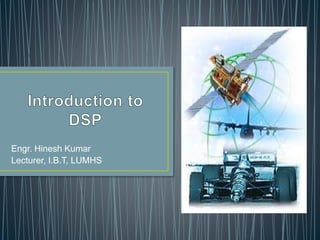
Engr. Hinesh Kumar
Lecturer, I.B.T, LUMHS
• Signal
• Signal Classification
• Signal Processing
• Concept of Systems
• DSP
• Elements of DSP
• Advantages of DSP
• Limitations
• Applications
• A word ‘Signal’ comes from latin ‘Signum’ which
means ‘Sign’.
• “ A signal is a quantity or effect such as current or
voltage that can be varied in such a way as to
convey information.” OR
• “ A signal is defined as a mathematical function that
conveys information about the state or behavior of a
physical system.”
• Examples: electrical current, voltage, force,
speed, speech, music, picture and video signals
etc
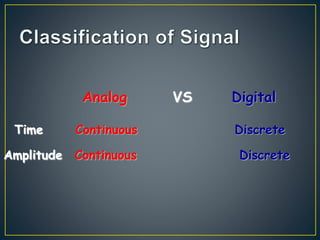
Analog Digital
VS
Time Continuous Discrete
Amplitude Continuous Discrete
• An analog or analogue signal is any continuous
signal for which the time varying feature.
• An analog signal is a signal that exists at every
instant of time
• A continuous signal is often referred to as
continuous time or analog.
• The independent variable is a continuous variable
• Continuous signal can assume any value over a
continuous range of numbers
• It is a special form of discrete time signal
which is discrete in time and amplitude.
• A digital signal is acquired by representing the
sampled analog value into a finite set of values
(quantization).
• These signals are called digital because the
samples are represented by digits.
Computer, Semiconduct and Information Science
1960’s-1970’s
Representation, transformation and manipulation
of signals and the information they contain.
Signal operation include:
(1) Transform, filter, inspection, spectrum analysis;
(2) Modulation and coding;
(3) Analog Signal Processing;
(4) Digital Signal Processing.
System
Device or technology of signal processing
Analog System
System with analog input and output.
 Digital System
System with digital input and output.
Acoustic
domain
Electric
domain
Acoustic
domain
Continuous-time system: the input and output signals
are continuous time
Acoustic
domain
Acoustic
domain
Electric
domain
Digital domain
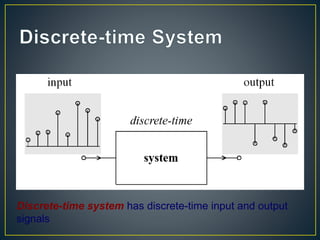
Discrete-time system has discrete-time input and output
signals
Acoustic
domain
Electrical
domain
Electrical
domain
Acoustic
domain
Digital
domain
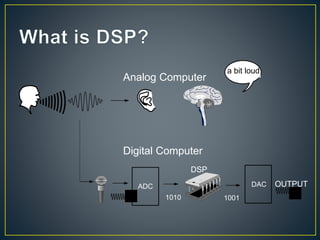
a bit loud
Analog Computer
Digital Computer
ADC
DSP
DAC OUTPUT
1010 1001
a bit loud
• Converting a continuously changing waveform (analog)
into a series of discrete levels (digital).
• The analog waveform is sliced into equal segments and
the waveform amplitude is measured in the middle of
each segment
• The collection of measurements make up the digital
representation of the waveform
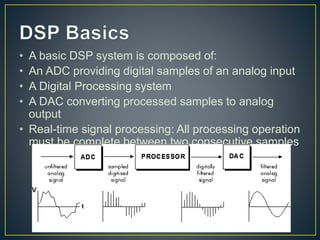
• A basic DSP system is composed of:
• An ADC providing digital samples of an analog input
• A Digital Processing system
• A DAC converting processed samples to analog
output
• Real-time signal processing: All processing operation
must be complete between two consecutive samples
Sensor
ADC
Analog Signal
Conditioning
Digital Signal
Conditioning
DSP DAC
Analog Signal Processing
Digital Signal Processing
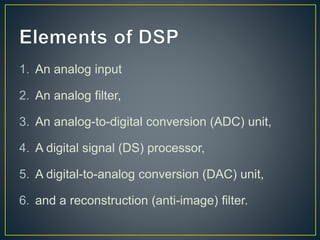
1. An analog input
2. An analog filter,
3. An analog-to-digital conversion (ADC) unit,
4. A digital signal (DS) processor,
5. A digital-to-analog conversion (DAC) unit,
6. and a reconstruction (anti-image) filter.
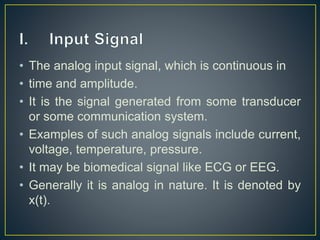
• The analog input signal, which is continuous in
• time and amplitude.
• It is the signal generated from some transducer
or some communication system.
• Examples of such analog signals include current,
voltage, temperature, pressure.
• It may be biomedical signal like ECG or EEG.
• Generally it is analog in nature. It is denoted by
x(t).
• This is basically a low pass filter.
• It is used for the following purposes.
It removes the high frequency noise contained
in input signal.
As the name indicates, it avoids aliasing effect.
That means it is used to band limit the signal.
• The band-limited signal at the output of the
analog filter is then sampled and converted
into the digital signal, which is discrete both
in time and in amplitude.
• This is required because digital signal
processor accepts the signal which is digital
in nature.
• It processes input signal digitally.
• In a simple language processing of input signal
means modifying the signal as per requirement.
• It consists of lowpass, highpass, and bandpass
digital filtering, or other algorithms for different
applications.
• DS processor is a special type of digital computer
consists of , a microprocessor, or an advanced
microcontroller; and can be implemented using
software in general.
• The DAC unit, converts the output of the digital
signal processor into an analog output signal.
• The signal is continuous in time and discrete in
amplitude.
• Output signal of DAC is an analog, that means it
is a continuous signal.
• It may contain high frequency components which
are unwanted.
• To remove these components, reconstruction
filter is used.
1. Versatility
Digital systems can be reprogrammed for
multiple applications ( where programmable DSP
chips are used). Moreover, digital systems can be
ported to different hardware
2. Repeatability
Digital systems can be easily duplicated.
These systems do not depend upon component
tolerances and temperature.
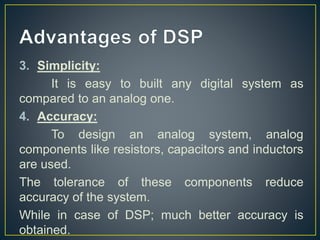
3. Simplicity:
It is easy to built any digital system as
compared to an analog one.
4. Accuracy:
To design an analog system, analog
components like resistors, capacitors and inductors
are used.
The tolerance of these components reduce
accuracy of the system.
While in case of DSP; much better accuracy is
obtained.
5. Remote Processing
Analog signals are difficult to store because
of problems like noise and distortion.
While digital signal can be easily stored on storage
media like magnetic tapes, disks etc.
Thus as compared to analog signals digital signals
can be easily transposed.
So remote processing of digital signal can be done
easily.
6. Implementation of algorithms:
The mathematical processing algorithms can
be easily implemented in case of digital signal
processing.
But such algorithms are difficult to implement in
case of analog signals.
7. Easy Up gradations:
Because of the use of software, digital signal
processing systems can be easily upgraded as
compared to analog systems.
8. Compatibility:
In case of digital systems, generally all
applications needs standard hardware.
Thus operation of DSP system is mainly
dependent on software.
Hence universal compatibility is possible as
compared to analog systems.
9. Cheaper:
In many applications, the digital systems are
comparatively cheaper than analog systems.
1. System Complexity:
DSP system needs use of converters like
ADC and DAC.
This increases the system complexity compared to
analog systems. Similarly in many applications, the
time required for this conversion is more.
• Bandwidth Limitation:
In case of DSP system, if input signal is
having wide bandwidth then it demands for high
speed ADC.
This is because to avoid aliasing effect, the
sampling rate should be at least twice the
bandwidth.
Thus such signals require fast digital signal
processors. But always there is practical limitation
in the speed of processors and ADC.
3. Power Consumption:
A typical digital signal processing chip
contains more than four lakh transistors.
Thus power dissipation is more in DSP systems as
compared to analog systems
4. For small applications digital signal processing
systems are expensive as compared to analog
systems
IMAGE PROCESSING
Pattern recognition
Robotic vision
Image enhancement
Satellite weather map
animation
INSTRUMENTATION & CONTROL
Spectrum analysis
Position and rate control
Noise reduction
Data compression
SPEECH & AUDIO
Speech recognition
Speech synthesis
Text to speech
digital audio
MILITARY
Secure communication
Radar processing
Sonar processing
Missile guidance
TELECOMMUNICATION
Echo cancellation
Adaptive equalization
Video conferencing
data communication
Biomedical
Patient monitoring
Scanners
ECG (Electrocardiograph)
X-ray storage/enhancement
Consumer applications
digital, cellar mobile phones
universal mobile telecommunication system
digital television
digital camera
internet music, phones and video
digital answer machines, fax and modems
voice mail system
interactive entertainment systems
DSP intro 1.pptx

DSP intro 1.pptx

  • 1.
  • 2.
    • Signal • SignalClassification • Signal Processing • Concept of Systems • DSP • Elements of DSP • Advantages of DSP • Limitations • Applications
  • 3.
    • A word‘Signal’ comes from latin ‘Signum’ which means ‘Sign’. • “ A signal is a quantity or effect such as current or voltage that can be varied in such a way as to convey information.” OR • “ A signal is defined as a mathematical function that conveys information about the state or behavior of a physical system.” • Examples: electrical current, voltage, force, speed, speech, music, picture and video signals etc
  • 4.
    Analog Digital VS Time ContinuousDiscrete Amplitude Continuous Discrete
  • 5.
    • An analogor analogue signal is any continuous signal for which the time varying feature. • An analog signal is a signal that exists at every instant of time • A continuous signal is often referred to as continuous time or analog. • The independent variable is a continuous variable • Continuous signal can assume any value over a continuous range of numbers
  • 6.
    • It isa special form of discrete time signal which is discrete in time and amplitude. • A digital signal is acquired by representing the sampled analog value into a finite set of values (quantization). • These signals are called digital because the samples are represented by digits.
  • 7.
    Computer, Semiconduct andInformation Science 1960’s-1970’s Representation, transformation and manipulation of signals and the information they contain. Signal operation include: (1) Transform, filter, inspection, spectrum analysis; (2) Modulation and coding; (3) Analog Signal Processing; (4) Digital Signal Processing.
  • 8.
    System Device or technologyof signal processing Analog System System with analog input and output.  Digital System System with digital input and output.
  • 9.
  • 10.
    Continuous-time system: theinput and output signals are continuous time
  • 11.
  • 12.
    Discrete-time system hasdiscrete-time input and output signals
  • 13.
  • 14.
    a bit loud AnalogComputer Digital Computer ADC DSP DAC OUTPUT 1010 1001 a bit loud
  • 15.
    • Converting acontinuously changing waveform (analog) into a series of discrete levels (digital). • The analog waveform is sliced into equal segments and the waveform amplitude is measured in the middle of each segment • The collection of measurements make up the digital representation of the waveform
  • 16.
    • A basicDSP system is composed of: • An ADC providing digital samples of an analog input • A Digital Processing system • A DAC converting processed samples to analog output • Real-time signal processing: All processing operation must be complete between two consecutive samples
  • 17.
    Sensor ADC Analog Signal Conditioning Digital Signal Conditioning DSPDAC Analog Signal Processing Digital Signal Processing
  • 19.
    1. An analoginput 2. An analog filter, 3. An analog-to-digital conversion (ADC) unit, 4. A digital signal (DS) processor, 5. A digital-to-analog conversion (DAC) unit, 6. and a reconstruction (anti-image) filter.
  • 20.
    • The analoginput signal, which is continuous in • time and amplitude. • It is the signal generated from some transducer or some communication system. • Examples of such analog signals include current, voltage, temperature, pressure. • It may be biomedical signal like ECG or EEG. • Generally it is analog in nature. It is denoted by x(t).
  • 21.
    • This isbasically a low pass filter. • It is used for the following purposes. It removes the high frequency noise contained in input signal. As the name indicates, it avoids aliasing effect. That means it is used to band limit the signal.
  • 22.
    • The band-limitedsignal at the output of the analog filter is then sampled and converted into the digital signal, which is discrete both in time and in amplitude. • This is required because digital signal processor accepts the signal which is digital in nature.
  • 23.
    • It processesinput signal digitally. • In a simple language processing of input signal means modifying the signal as per requirement. • It consists of lowpass, highpass, and bandpass digital filtering, or other algorithms for different applications. • DS processor is a special type of digital computer consists of , a microprocessor, or an advanced microcontroller; and can be implemented using software in general.
  • 24.
    • The DACunit, converts the output of the digital signal processor into an analog output signal. • The signal is continuous in time and discrete in amplitude.
  • 25.
    • Output signalof DAC is an analog, that means it is a continuous signal. • It may contain high frequency components which are unwanted. • To remove these components, reconstruction filter is used.
  • 26.
    1. Versatility Digital systemscan be reprogrammed for multiple applications ( where programmable DSP chips are used). Moreover, digital systems can be ported to different hardware 2. Repeatability Digital systems can be easily duplicated. These systems do not depend upon component tolerances and temperature.
  • 27.
    3. Simplicity: It iseasy to built any digital system as compared to an analog one. 4. Accuracy: To design an analog system, analog components like resistors, capacitors and inductors are used. The tolerance of these components reduce accuracy of the system. While in case of DSP; much better accuracy is obtained.
  • 28.
    5. Remote Processing Analogsignals are difficult to store because of problems like noise and distortion. While digital signal can be easily stored on storage media like magnetic tapes, disks etc. Thus as compared to analog signals digital signals can be easily transposed. So remote processing of digital signal can be done easily.
  • 29.
    6. Implementation ofalgorithms: The mathematical processing algorithms can be easily implemented in case of digital signal processing. But such algorithms are difficult to implement in case of analog signals. 7. Easy Up gradations: Because of the use of software, digital signal processing systems can be easily upgraded as compared to analog systems.
  • 30.
    8. Compatibility: In caseof digital systems, generally all applications needs standard hardware. Thus operation of DSP system is mainly dependent on software. Hence universal compatibility is possible as compared to analog systems. 9. Cheaper: In many applications, the digital systems are comparatively cheaper than analog systems.
  • 31.
    1. System Complexity: DSPsystem needs use of converters like ADC and DAC. This increases the system complexity compared to analog systems. Similarly in many applications, the time required for this conversion is more.
  • 32.
    • Bandwidth Limitation: Incase of DSP system, if input signal is having wide bandwidth then it demands for high speed ADC. This is because to avoid aliasing effect, the sampling rate should be at least twice the bandwidth. Thus such signals require fast digital signal processors. But always there is practical limitation in the speed of processors and ADC.
  • 33.
    3. Power Consumption: Atypical digital signal processing chip contains more than four lakh transistors. Thus power dissipation is more in DSP systems as compared to analog systems 4. For small applications digital signal processing systems are expensive as compared to analog systems
  • 34.
    IMAGE PROCESSING Pattern recognition Roboticvision Image enhancement Satellite weather map animation INSTRUMENTATION & CONTROL Spectrum analysis Position and rate control Noise reduction Data compression SPEECH & AUDIO Speech recognition Speech synthesis Text to speech digital audio MILITARY Secure communication Radar processing Sonar processing Missile guidance TELECOMMUNICATION Echo cancellation Adaptive equalization Video conferencing data communication Biomedical Patient monitoring Scanners ECG (Electrocardiograph) X-ray storage/enhancement Consumer applications digital, cellar mobile phones universal mobile telecommunication system digital television digital camera internet music, phones and video digital answer machines, fax and modems voice mail system interactive entertainment systems