The inverse z transform
The inverse z-transform can be found by
one of the following ways
 Inspection method
 Partial fraction expansion
 Power series expansion
Each will be explained briefly next
1
Inverse z transform by
inspection method
The inspection method is based on the z
transform pair table.
In order to find the inverse z transform we
compare 𝑋(𝑧) to one of the standard
transform pairs listed in the z transform
pairs table
2
Inverse z transform by partial
fraction
If 𝑋(𝑧) is not in a form listed in the table of
z transform pairs we can use the partial
fraction method to simplify the function into
one of the standard forms listed in the z
transform pair table
3
Inverse z- transform example 1
Consider a sequence 𝑥[𝑛] with z transform
of 𝑋 𝑧 =
1
1−
1
4
𝑧−1 1−
1
2
𝑧−1
𝑧 >
1
2
Where the ROC is as shown
4
Inverse z- transform example 1
S𝑜𝑢𝑙𝑡𝑖𝑜𝑛
Note that 𝑋(𝑧) can be rewritten as X 𝑧 =
1
1−
1
4
𝑧−1 1−
1
2
𝑧−1
=
𝐴1
1−
1
4
𝑧−1
+
𝐴2
1−
1
2
𝑧−1
To find the constants 𝐴1 and 𝐴2 we use
the following 𝐴1 = 1 − 1
4
𝑧−1
𝑋 𝑧 | 𝑧−1=4 =
− 1
Similarly 𝐴2 = 1 − 1
2
𝑧−1
𝑋 𝑧 | 𝑧−1=2 = 2
5
Inverse z- transform example 1
Note that 𝑋(𝑧) Now can be rewritten as
X 𝑧 =
−1
1−
1
4
𝑧−1
+
2
1−
1
2
𝑧−1
The inverse z transform results in the 𝑥[𝑛]
shown below 𝑥 𝑛 = − 1
4
𝑛
𝑢 𝑛 + 2 1
2
𝑛
𝑢 𝑛
6
Inverse z transform by the
partial fraction with - 𝑀 ≥ 𝑁
The partial fraction method can be used to find the
inverse z-transform for rational functions with
numerator of order 𝑀 and denominator of order 𝑁
The partial fraction can be used only if the
numerator order 𝑀 is less than denominator order 𝑁
If the numerator order is greater than or equal the
denominator order then we use long division to
make the denominator order 𝑁 greater than the
numerator order 𝑀 before we can use the partial
fraction method
7
Partial fraction with - 𝑀 ≥ 𝑁
The long division converts the 𝑋(𝑧) function in
the following form
𝑋 𝑧 =
𝑟=0
𝑀−𝑁
𝐵𝑟 𝑧−𝑟 +
𝑘=1
𝑁
𝐴 𝑘
1 − 𝑑 𝑘 𝑧−1
Where 𝑀 is the numerator order, 𝑁 is the
denominator order, 𝐴 𝑘 are constants of the
partial fraction and 𝑑 𝑘 are the roots
8
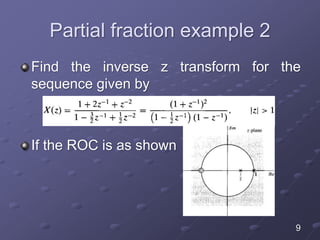
Partial fraction example 2
Find the inverse z transform for the
sequence given by
If the ROC is as shown
9
Partial fraction example 2
As it can be seen from 𝑋(𝑧) the order of
the numerator is equal to the order of the
denominator
Long division can be used to make the
order of the numerator less than the order
of the denominator as shown below
10
Partial fraction example 2
Now the function 𝑋(𝑧) can be rewritten as
shown below
Or
Where 𝐵0 = 2
11
Partial fraction example 2
The constants 𝐴1 and 𝐴2 can be found as
follows
𝑋(𝑧) can now be written as
12
Partial fraction example 2
Recall that from the z-transform pairs table
we have
Therefore 𝑥[𝑛] is given by
13
Partial fraction with multiple
poles and 𝑀 greater than 𝑁
If the 𝑋(𝑧) function contains multiple poles
and 𝑀 > 𝑁 as shown in this form
The coefficients 𝑐 𝑚 can be found by deriving
𝑋(𝑧) 𝑚 number of times as shown
14
Inverse z transform by using
power series expansion
From the definition of the z-transform we
can write the z-transform as
𝑋 𝑧 =
𝑛=−∞
∞
𝑥[𝑛]𝑧−𝑛
= ⋯ + 𝑥 −2 𝑧2 + 𝑥 −1 𝑧1 + 𝑥 0 + 𝑥 2 𝑧−1 + 𝑥 2 𝑧−2 + ⋯
This is known as Laurent series
From this series we can find the sequence
𝑥[𝑛] as illustrated by the next example
15
Inverse z transform by using power
series example 3
Find the inverse z-transform for the
sequence defined by
𝑋 𝑧 = 𝑧2
1 − 1
2
𝑧−1
1 + 𝑧−1
1 − 𝑧−1
Solution
Note the sequence 𝑋[𝑧] can be expanded
as 𝑋 𝑧 = 𝑧2
− 1
2
𝑧 − 1 + 1
2
𝑧−1
If we compare 𝑋 𝑧 with the Laurent series
we can extract 𝑥[𝑛] as follows
16
Inverse z transform by using
power series example 3
17
Inverse z transform by using
power series example 4
Consider the z transform defined by
𝑋 𝑧 =
1
1−𝑎𝑧−1 𝑓𝑜𝑟 𝑧 > 𝑎
Find 𝑥[𝑛] by using long division
18
Inverse z transform by using
power series example 4
Solution
This series reduces to 𝑥 𝑛 = 𝑎 𝑛
𝑢[𝑛]
19
Inverse z transform by using
power series example 5
Find the inverse z transform of the
sequence defined by
𝑋 𝑧 =
1
1 − 𝑎𝑧−1
𝑓𝑜𝑟 𝑧 < 𝑎
20
Inverse z transform by using
power series example 5
Solution
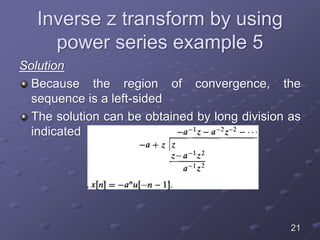
Because the region of convergence, the
sequence is a left-sided
The solution can be obtained by long division as
indicated
21
Z-transform properties
The z-transform has many useful properties
similar to Fourier transform properties
These properties can be used to find the
inverse z-transform for certain complex z
functions as it will be demonstrated in the
examples
These properties are
 Linearity
22
z transform properties
 Time shifting
 Multiplication by an exponential
 Differentiation of 𝑋(𝑧)
 Conjugation of a complex sequence
 Time reversal
 Convolution of a sequence
 Initial value theorem
These properties are summarized in the table
shown in the next two slides
23
Z-transform properties table
24
Z-transform properties table
25
Example 6
Determine the z-transform and the ROC for
the sequence 𝑥 𝑛 = 3(2) 𝑛
𝑢 𝑛 − 4(3) 𝑛
𝑢 𝑛
Solution
We can divide 𝑥[𝑛] into two different
functions 𝑥1 𝑛 = (2) 𝑛
𝑢 𝑛 𝑎𝑛𝑑 𝑥2 𝑛 =
(3) 𝑛
𝑢 𝑛
Now 𝑥[𝑛] can be rewritten as 𝑥 𝑛 = 3𝑥1 𝑛 −
4𝑥2 𝑛
26
Example 6
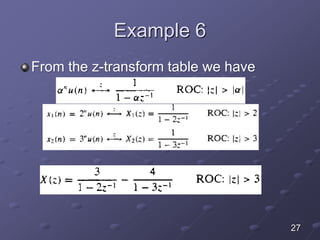
From the z-transform table we have
27
Example 7
Determine the z-transform of 𝑥[𝑛] = 𝑢[−𝑛]
Solution
By using the time reversal property we
have
28
Example 8
Compute the convolution of the following two
sequences using the z transform
𝑥1 𝑛 = 1, −2, 1
𝑥2 𝑛 =
1, 0 ≤ 𝑛 ≤ 5
0 𝑒𝑙𝑠𝑒𝑤ℎ𝑒𝑟𝑒
Solution
Note that the z transform of each of the previous
sequences is given by 𝑋1 𝑧 = 1 − 2𝑧−1 + 𝑧−2
and 𝑋2 𝑧 = 1 + 𝑧−1
+ 𝑧−2
+ 𝑧−3
+ 𝑧−4
+ 𝑧−5
29
Example 8
If we multiply 𝑋1(𝑧)𝑋2(𝑧) we get the
following answer
The inverse z-transform which is the
convolution of 𝑥 𝑛 = 𝑥1 𝑛 ∗ 𝑥2 𝑛 is given
by
30
Example 9
Find the inverse z transform for the
function defined by
𝑋 𝑧 = log 1 + 𝑎𝑧−1
𝑧 > 𝑎
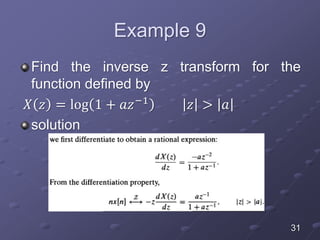
solution
31
Example 9
32

inverse z transform

  • 1.
    The inverse ztransform The inverse z-transform can be found by one of the following ways  Inspection method  Partial fraction expansion  Power series expansion Each will be explained briefly next 1
  • 2.
    Inverse z transformby inspection method The inspection method is based on the z transform pair table. In order to find the inverse z transform we compare 𝑋(𝑧) to one of the standard transform pairs listed in the z transform pairs table 2
  • 3.
    Inverse z transformby partial fraction If 𝑋(𝑧) is not in a form listed in the table of z transform pairs we can use the partial fraction method to simplify the function into one of the standard forms listed in the z transform pair table 3
  • 4.
    Inverse z- transformexample 1 Consider a sequence 𝑥[𝑛] with z transform of 𝑋 𝑧 = 1 1− 1 4 𝑧−1 1− 1 2 𝑧−1 𝑧 > 1 2 Where the ROC is as shown 4
  • 5.
    Inverse z- transformexample 1 S𝑜𝑢𝑙𝑡𝑖𝑜𝑛 Note that 𝑋(𝑧) can be rewritten as X 𝑧 = 1 1− 1 4 𝑧−1 1− 1 2 𝑧−1 = 𝐴1 1− 1 4 𝑧−1 + 𝐴2 1− 1 2 𝑧−1 To find the constants 𝐴1 and 𝐴2 we use the following 𝐴1 = 1 − 1 4 𝑧−1 𝑋 𝑧 | 𝑧−1=4 = − 1 Similarly 𝐴2 = 1 − 1 2 𝑧−1 𝑋 𝑧 | 𝑧−1=2 = 2 5
  • 6.
    Inverse z- transformexample 1 Note that 𝑋(𝑧) Now can be rewritten as X 𝑧 = −1 1− 1 4 𝑧−1 + 2 1− 1 2 𝑧−1 The inverse z transform results in the 𝑥[𝑛] shown below 𝑥 𝑛 = − 1 4 𝑛 𝑢 𝑛 + 2 1 2 𝑛 𝑢 𝑛 6
  • 7.
    Inverse z transformby the partial fraction with - 𝑀 ≥ 𝑁 The partial fraction method can be used to find the inverse z-transform for rational functions with numerator of order 𝑀 and denominator of order 𝑁 The partial fraction can be used only if the numerator order 𝑀 is less than denominator order 𝑁 If the numerator order is greater than or equal the denominator order then we use long division to make the denominator order 𝑁 greater than the numerator order 𝑀 before we can use the partial fraction method 7
  • 8.
    Partial fraction with- 𝑀 ≥ 𝑁 The long division converts the 𝑋(𝑧) function in the following form 𝑋 𝑧 = 𝑟=0 𝑀−𝑁 𝐵𝑟 𝑧−𝑟 + 𝑘=1 𝑁 𝐴 𝑘 1 − 𝑑 𝑘 𝑧−1 Where 𝑀 is the numerator order, 𝑁 is the denominator order, 𝐴 𝑘 are constants of the partial fraction and 𝑑 𝑘 are the roots 8
  • 9.
    Partial fraction example2 Find the inverse z transform for the sequence given by If the ROC is as shown 9
  • 10.
    Partial fraction example2 As it can be seen from 𝑋(𝑧) the order of the numerator is equal to the order of the denominator Long division can be used to make the order of the numerator less than the order of the denominator as shown below 10
  • 11.
    Partial fraction example2 Now the function 𝑋(𝑧) can be rewritten as shown below Or Where 𝐵0 = 2 11
  • 12.
    Partial fraction example2 The constants 𝐴1 and 𝐴2 can be found as follows 𝑋(𝑧) can now be written as 12
  • 13.
    Partial fraction example2 Recall that from the z-transform pairs table we have Therefore 𝑥[𝑛] is given by 13
  • 14.
    Partial fraction withmultiple poles and 𝑀 greater than 𝑁 If the 𝑋(𝑧) function contains multiple poles and 𝑀 > 𝑁 as shown in this form The coefficients 𝑐 𝑚 can be found by deriving 𝑋(𝑧) 𝑚 number of times as shown 14
  • 15.
    Inverse z transformby using power series expansion From the definition of the z-transform we can write the z-transform as 𝑋 𝑧 = 𝑛=−∞ ∞ 𝑥[𝑛]𝑧−𝑛 = ⋯ + 𝑥 −2 𝑧2 + 𝑥 −1 𝑧1 + 𝑥 0 + 𝑥 2 𝑧−1 + 𝑥 2 𝑧−2 + ⋯ This is known as Laurent series From this series we can find the sequence 𝑥[𝑛] as illustrated by the next example 15
  • 16.
    Inverse z transformby using power series example 3 Find the inverse z-transform for the sequence defined by 𝑋 𝑧 = 𝑧2 1 − 1 2 𝑧−1 1 + 𝑧−1 1 − 𝑧−1 Solution Note the sequence 𝑋[𝑧] can be expanded as 𝑋 𝑧 = 𝑧2 − 1 2 𝑧 − 1 + 1 2 𝑧−1 If we compare 𝑋 𝑧 with the Laurent series we can extract 𝑥[𝑛] as follows 16
  • 17.
    Inverse z transformby using power series example 3 17
  • 18.
    Inverse z transformby using power series example 4 Consider the z transform defined by 𝑋 𝑧 = 1 1−𝑎𝑧−1 𝑓𝑜𝑟 𝑧 > 𝑎 Find 𝑥[𝑛] by using long division 18
  • 19.
    Inverse z transformby using power series example 4 Solution This series reduces to 𝑥 𝑛 = 𝑎 𝑛 𝑢[𝑛] 19
  • 20.
    Inverse z transformby using power series example 5 Find the inverse z transform of the sequence defined by 𝑋 𝑧 = 1 1 − 𝑎𝑧−1 𝑓𝑜𝑟 𝑧 < 𝑎 20
  • 21.
    Inverse z transformby using power series example 5 Solution Because the region of convergence, the sequence is a left-sided The solution can be obtained by long division as indicated 21
  • 22.
    Z-transform properties The z-transformhas many useful properties similar to Fourier transform properties These properties can be used to find the inverse z-transform for certain complex z functions as it will be demonstrated in the examples These properties are  Linearity 22
  • 23.
    z transform properties Time shifting  Multiplication by an exponential  Differentiation of 𝑋(𝑧)  Conjugation of a complex sequence  Time reversal  Convolution of a sequence  Initial value theorem These properties are summarized in the table shown in the next two slides 23
  • 24.
  • 25.
  • 26.
    Example 6 Determine thez-transform and the ROC for the sequence 𝑥 𝑛 = 3(2) 𝑛 𝑢 𝑛 − 4(3) 𝑛 𝑢 𝑛 Solution We can divide 𝑥[𝑛] into two different functions 𝑥1 𝑛 = (2) 𝑛 𝑢 𝑛 𝑎𝑛𝑑 𝑥2 𝑛 = (3) 𝑛 𝑢 𝑛 Now 𝑥[𝑛] can be rewritten as 𝑥 𝑛 = 3𝑥1 𝑛 − 4𝑥2 𝑛 26
  • 27.
    Example 6 From thez-transform table we have 27
  • 28.
    Example 7 Determine thez-transform of 𝑥[𝑛] = 𝑢[−𝑛] Solution By using the time reversal property we have 28
  • 29.
    Example 8 Compute theconvolution of the following two sequences using the z transform 𝑥1 𝑛 = 1, −2, 1 𝑥2 𝑛 = 1, 0 ≤ 𝑛 ≤ 5 0 𝑒𝑙𝑠𝑒𝑤ℎ𝑒𝑟𝑒 Solution Note that the z transform of each of the previous sequences is given by 𝑋1 𝑧 = 1 − 2𝑧−1 + 𝑧−2 and 𝑋2 𝑧 = 1 + 𝑧−1 + 𝑧−2 + 𝑧−3 + 𝑧−4 + 𝑧−5 29
  • 30.
    Example 8 If wemultiply 𝑋1(𝑧)𝑋2(𝑧) we get the following answer The inverse z-transform which is the convolution of 𝑥 𝑛 = 𝑥1 𝑛 ∗ 𝑥2 𝑛 is given by 30
  • 31.
    Example 9 Find theinverse z transform for the function defined by 𝑋 𝑧 = log 1 + 𝑎𝑧−1 𝑧 > 𝑎 solution 31
  • 32.