Elementary Signals
By
Md. Fazle Rabbi
16CSE057
4.2
Elementary Signal
 There are several elementary signals which play vital role
in the study of signals and systems.
 These elementary signals serve as basic building blocks for
the construction of more complex signals.
 These elementary signals are also called standard signals
4.3
Types of Elementary Signals
1. Unit step sequence
2. Unit ramp sequence
3. Unit parabolic sequence
4. Unit impulse sequence
5. Sinusoidal sequence
6. Real exponential sequence
4.4
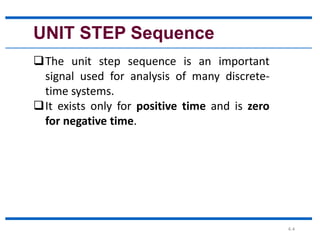
UNIT STEP Sequence
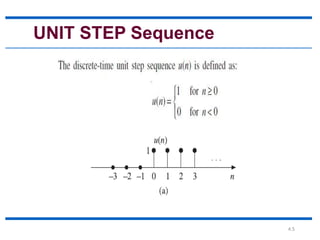
The unit step sequence is an important
signal used for analysis of many discrete-
time systems.
It exists only for positive time and is zero
for negative time.
4.5
UNIT STEP Sequence
4.6
UNIT RAMP Sequence
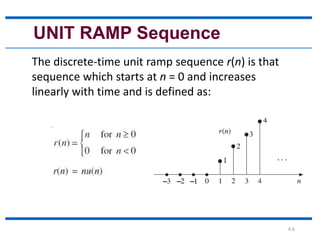
The discrete-time unit ramp sequence r(n) is that
sequence which starts at n = 0 and increases
linearly with time and is defined as:
4.7
UNIT PARABOLIC Sequence
The discrete-time unit parabolic sequence p(n) is
defined as:
4.8
UNIT IMPULSE Sequence
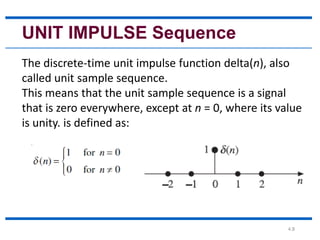
The discrete-time unit impulse function delta(n), also
called unit sample sequence.
This means that the unit sample sequence is a signal
that is zero everywhere, except at n = 0, where its value
is unity. is defined as:
4.9
SIMUSOIDAL Sequence
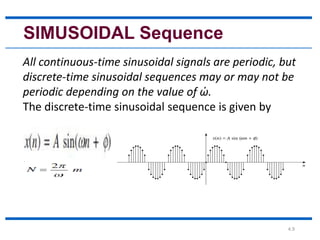
All continuous-time sinusoidal signals are periodic, but
discrete-time sinusoidal sequences may or may not be
periodic depending on the value of ὠ.
The discrete-time sinusoidal sequence is given by
4.10
Real Exponential Sequence
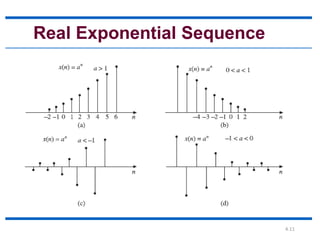
The discrete-time real exponential sequence 𝑎𝑛is
defined as:
• a > 1, the sequence grows exponentially as
shown in Figure (a).
• 0 < a < 1, the sequence decays exponentially
as shown in Figure (b).
• a < 0, the sequence takes alternating signs as
shown in Figure [(c) and (d)].
4.11
Real Exponential Sequence
4.12
Thank You

1. elementary signals

  • 1.
  • 2.
    4.2 Elementary Signal  Thereare several elementary signals which play vital role in the study of signals and systems.  These elementary signals serve as basic building blocks for the construction of more complex signals.  These elementary signals are also called standard signals
  • 3.
    4.3 Types of ElementarySignals 1. Unit step sequence 2. Unit ramp sequence 3. Unit parabolic sequence 4. Unit impulse sequence 5. Sinusoidal sequence 6. Real exponential sequence
  • 4.
    4.4 UNIT STEP Sequence Theunit step sequence is an important signal used for analysis of many discrete- time systems. It exists only for positive time and is zero for negative time.
  • 5.
  • 6.
    4.6 UNIT RAMP Sequence Thediscrete-time unit ramp sequence r(n) is that sequence which starts at n = 0 and increases linearly with time and is defined as:
  • 7.
    4.7 UNIT PARABOLIC Sequence Thediscrete-time unit parabolic sequence p(n) is defined as:
  • 8.
    4.8 UNIT IMPULSE Sequence Thediscrete-time unit impulse function delta(n), also called unit sample sequence. This means that the unit sample sequence is a signal that is zero everywhere, except at n = 0, where its value is unity. is defined as:
  • 9.
    4.9 SIMUSOIDAL Sequence All continuous-timesinusoidal signals are periodic, but discrete-time sinusoidal sequences may or may not be periodic depending on the value of ὠ. The discrete-time sinusoidal sequence is given by
  • 10.
    4.10 Real Exponential Sequence Thediscrete-time real exponential sequence 𝑎𝑛is defined as: • a > 1, the sequence grows exponentially as shown in Figure (a). • 0 < a < 1, the sequence decays exponentially as shown in Figure (b). • a < 0, the sequence takes alternating signs as shown in Figure [(c) and (d)].
  • 11.
  • 12.