Digital Libraries
RupeshKumarA
a.rupeshkumar@gmail.com
Digital Library
“a focused collection of digital objects, including text, video, and
audio, along with methods for access and retrieval, and for
selection, organization, and maintenance of the collection.” –
IanH.Witten
Digital Library
• DigitalObjects– text, audio, video, 3D objects, simulations,
dynamic visualizations, virtual-realityworlds
• Access and retrieval methods– for theuser
• selection, organization, and maintenance– for the librarian /
library staff
Digital Library
• “An organization, which might be virtual, that
comprehensively collects, manages and preserves for the long
term rich digital content, and offers to its user communities
specialized functionality on that content, of measurable
quality and according to codified policies” - DELOS Digital
Library ReferenceModel
Characteristics of DLs
Libraries without walls
• Digitallibraries are libraries withoutwalls.
• They do not have geographical barriers for access.
• However, they do have boundaries in respect of contentand
purpose.
Distinct fromWWW
• Digitallibraries are differentfrom theWorld Wide Web.
• The Web lacks theessentialfeaturesof selection and
organization.
Different fromWebsite
• DLs are differentfrom Websites.
• Websites may not have methods for search and retrieval of
information.
• Every fileon a website may not have metadataand an
identifier.
• In a website, more emphasis is on thepresentation.
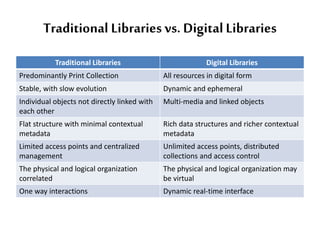
Traditional Libraries vs. Digital Libraries
Traditional Libraries Digital Libraries
Predominantly Print Collection All resources in digital form
Stable, with slow evolution Dynamic and ephemeral
Individual objects not directly linked with
each other
Multi-media and linked objects
Flat structure with minimal contextual
metadata
Rich data structures and richer contextual
metadata
Limited access points and centralized
management
Unlimited access points, distributed
collections and access control
The physical and logical organization
correlated
The physical and logical organization may
be virtual
One way interactions Dynamic real-time interface
Basic Concepts
Collection
• DLs hold any informationthatcan be encoded as sequence of
bits.
• Sometimesthese are digitized versions of conventional media
(such as text, images, music, sound recordings, specifications
and designs, and many more formats)
• As DLs expand, moreborndigital documentstakeplace of
legacydocuments
Data and Metadata
• Datais thegeneraltermused todenoteinformationthatis
encoded in digitalform.
• Metadatais dataabout otherdata.
• Metadatais theinformationwhich describes thepropertiesofa
document/object.
• Metadatacan beclassifiedinto:
– DescriptiveMetadata: bibliographicinformation
– StructuralMetadata: Formatsandstructures
– AdministrativeMetadata: rights,permissionsandotherinformation
usedtomanageaccessanduse
Digital Object
• An Itemstored in a digital library is referred to asdigitalobject
or documentor resource.
• A digital object typically consists of data, associated metadata,
and an identifier.
Need for Digital Libraries
DL brings the library to the User
• A user has to physically visit a traditional library to access
information.
• Generally, access is restricted by membership.
• A DL brings the informationto theuser’s desk
• DLs can be accessed at any place: home, office, Internetcafé,
etc.
• Hence, DL brings the library to theUser
Computing Poweris used for searching &
browsing
• In a traditional library, browsing and searching are time-
consuming.
• Searching & browsing requires some skill.
• In a DL, computer systems are used for searching & browsing.
• Computer systems are better thanmanualmethodsof finding
information.
Information can be shared
• Placinginformationin digital format on a network makes
information available to everyone.
• Physical duplication of documentsis laborious and time-
consuming.
• DLs provide seamless, concurrent access to multipleusers.
Easier to keep informationup-to-date
• It is difficultto update print documentsoften.
• The entire documenthas to be reprinted and all old versions
should be replaced.
• It is easier to update digital documents.
• Easier to trace old versions and replace themwith the
updated one.
Information is alwaysavailable
• ‘The doorsof digital libraries neverclose.
• The scope of digital collections expand wellbeyond the walls
of the library.
• Anytimeavailability of informationensures continuous,
seamless access.
• Informationis likely to be availablewhereverandwhenever
users want.
New forms of presentation
• DLs make it possible to present informationin newformats.
• Some types of informationcannot be presented effectively in
text.
E.g. 3D simulations, virtual reality objects, games
• They need newforms of presentation.
• DLs make this possible
Technologiesinfluencinggrowth ofdigital
libraries
• Electronic Storage: becoming cheaper thanprint
• Computer displays have become more pleasantto use.
• High-speednetworks are becoming common
• Computers have become portable

Basic Concepts of Digital Library

  • 1.
  • 2.
    Digital Library “a focusedcollection of digital objects, including text, video, and audio, along with methods for access and retrieval, and for selection, organization, and maintenance of the collection.” – IanH.Witten
  • 3.
    Digital Library • DigitalObjects–text, audio, video, 3D objects, simulations, dynamic visualizations, virtual-realityworlds • Access and retrieval methods– for theuser • selection, organization, and maintenance– for the librarian / library staff
  • 4.
    Digital Library • “Anorganization, which might be virtual, that comprehensively collects, manages and preserves for the long term rich digital content, and offers to its user communities specialized functionality on that content, of measurable quality and according to codified policies” - DELOS Digital Library ReferenceModel
  • 5.
  • 6.
    Libraries without walls •Digitallibraries are libraries withoutwalls. • They do not have geographical barriers for access. • However, they do have boundaries in respect of contentand purpose.
  • 7.
    Distinct fromWWW • Digitallibrariesare differentfrom theWorld Wide Web. • The Web lacks theessentialfeaturesof selection and organization.
  • 8.
    Different fromWebsite • DLsare differentfrom Websites. • Websites may not have methods for search and retrieval of information. • Every fileon a website may not have metadataand an identifier. • In a website, more emphasis is on thepresentation.
  • 9.
    Traditional Libraries vs.Digital Libraries Traditional Libraries Digital Libraries Predominantly Print Collection All resources in digital form Stable, with slow evolution Dynamic and ephemeral Individual objects not directly linked with each other Multi-media and linked objects Flat structure with minimal contextual metadata Rich data structures and richer contextual metadata Limited access points and centralized management Unlimited access points, distributed collections and access control The physical and logical organization correlated The physical and logical organization may be virtual One way interactions Dynamic real-time interface
  • 10.
  • 11.
    Collection • DLs holdany informationthatcan be encoded as sequence of bits. • Sometimesthese are digitized versions of conventional media (such as text, images, music, sound recordings, specifications and designs, and many more formats) • As DLs expand, moreborndigital documentstakeplace of legacydocuments
  • 12.
    Data and Metadata •Datais thegeneraltermused todenoteinformationthatis encoded in digitalform. • Metadatais dataabout otherdata. • Metadatais theinformationwhich describes thepropertiesofa document/object. • Metadatacan beclassifiedinto: – DescriptiveMetadata: bibliographicinformation – StructuralMetadata: Formatsandstructures – AdministrativeMetadata: rights,permissionsandotherinformation usedtomanageaccessanduse
  • 13.
    Digital Object • AnItemstored in a digital library is referred to asdigitalobject or documentor resource. • A digital object typically consists of data, associated metadata, and an identifier.
  • 14.
  • 15.
    DL brings thelibrary to the User • A user has to physically visit a traditional library to access information. • Generally, access is restricted by membership. • A DL brings the informationto theuser’s desk • DLs can be accessed at any place: home, office, Internetcafé, etc. • Hence, DL brings the library to theUser
  • 16.
    Computing Poweris usedfor searching & browsing • In a traditional library, browsing and searching are time- consuming. • Searching & browsing requires some skill. • In a DL, computer systems are used for searching & browsing. • Computer systems are better thanmanualmethodsof finding information.
  • 17.
    Information can beshared • Placinginformationin digital format on a network makes information available to everyone. • Physical duplication of documentsis laborious and time- consuming. • DLs provide seamless, concurrent access to multipleusers.
  • 18.
    Easier to keepinformationup-to-date • It is difficultto update print documentsoften. • The entire documenthas to be reprinted and all old versions should be replaced. • It is easier to update digital documents. • Easier to trace old versions and replace themwith the updated one.
  • 19.
    Information is alwaysavailable •‘The doorsof digital libraries neverclose. • The scope of digital collections expand wellbeyond the walls of the library. • Anytimeavailability of informationensures continuous, seamless access. • Informationis likely to be availablewhereverandwhenever users want.
  • 20.
    New forms ofpresentation • DLs make it possible to present informationin newformats. • Some types of informationcannot be presented effectively in text. E.g. 3D simulations, virtual reality objects, games • They need newforms of presentation. • DLs make this possible
  • 21.
    Technologiesinfluencinggrowth ofdigital libraries • ElectronicStorage: becoming cheaper thanprint • Computer displays have become more pleasantto use. • High-speednetworks are becoming common • Computers have become portable