Topic-Digital Library: Definition, Features,
and Components.
Submitted To
Dr. Akhandanad Shukla
Dep. Of Lib.& Inf.
Science
MZU.
Submitted By
Babita Yadav
Research Scholar.
Introduction
A digital library is an online collection of digital objects, of
assured quality, that are created or collected and managed
according to internationally accepted principles for
collection development and made accessible in a coherent
and sustainable manner, supported by services necessary to
allow users to retrieve and exploit the resources.
A digital library forms an integral part of the services of a
library, applying new technology to provide access to
digital collections.
What is Digital Library
1. It is new types of information resources.
2. It is new methods of acquiring and distributing
information resources.
3. New means of storing and preserving information
resources.
4. New modes of interaction with and for library users.
5. It is new ways of using computing and network
technologies.
Definition of Digital Library
According to Clifford Lynch (1995), a well-known
expert on digital libraries and new technologies,
defined digital library as “a system providing a
community of users with coherent access to a large,
organized repository of digital information and
knowledge. The digital library is not just one entity,
but multiple sources seamlessly integrated.”
Purpose of Digital Library System
 To contributing to the lifelong learning opportunities.
 To encourage cooperation among libraries.
 To develop the means to collect, store, and organize
information and knowledge in digital form.
 Provide easy and fast access to information
irrespective of time and location.
 Digital library has a lot of storage capacity.
Characteristics Of Digital Library
1. Digital libraries are the digital counterparts of traditional
libraries and include both electronic (digital) as well as
print and other (e.g. audio, video, graphics, animation,
etc.) material.
2. Digital libraries are not bound to physical spaces.
3. A digital library has a unified organizational structure
with consistent points for accessing the data.
4.Digital libraries support quick and efficient access to a
large number of distributed but interlinked information
sources that are seamlessly integrated.
5.Digital libraries offer access to its content to multiple
users simultaneously, these content can be listed in
multiple ways by different users simultaneously.
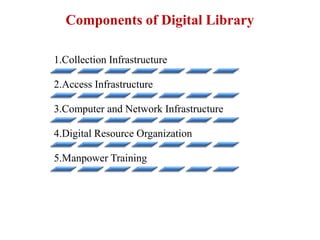
1.Collection Infrastructure
2.Access Infrastructure
3.Computer and Network Infrastructure
4.Digital Resource Organization
5.Manpower Training
Components of Digital Library
 Reduce the cost of government.
 Support interoperability between different
computer systems.
 24x7x365 Availability.
 Information retrieval.
 Multi-User Access.
Advantage of Digital Library
Limitation of Digital Library
 Lack of speed of Access.
 Lack of staff Motivation.
 Copyright issue.
 Security issue.
 Lack of Standardization
Project Gutenberg
https://www.gutenberg.org/
https://ndl.iitkgp.ac.in/
National Digital Library of India
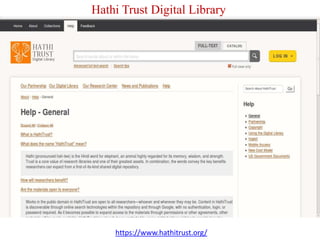
Hathi Trust Digital Library
https://www.hathitrust.org/
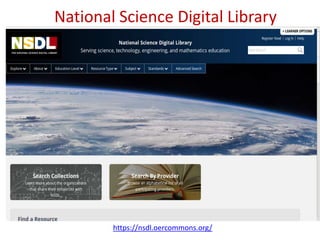
National Science Digital Library
https://nsdl.oercommons.org/
Internet Archive
https://archive.org/index.php
The Rosetta Project
http://rosettaproject.org/
Traditional Knowledge Digital Library
http://www.tkdl.res.in/tkdl/langdefault/common/Home.asp
Kalasampada- IGNCA Digital Library
http://www.ignca.nic.in/dgt_0001.htm
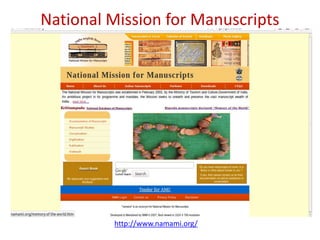
National Mission for Manuscripts
http://www.namami.org/
Conclusion
 Digital libraries are amongst the most complex and advanced form
of information systems.
 Deployment of digital library requires integration of several
information technologies because of many diverse requirements
involving creation of digital contents, its organization, ontology,
multiple accesses, digital document imaging, OCR, web
technology, hypertext, information storage and retrieval system,
IPR, management of multilingual collection, data mining,
electronic and real-time reference service, electronic document
delivery and personalization.
• Kataria, B. a. (2008). Digital Library. New Delhi: Mahamaya
Publishing House.
• Lakshmi, V., & Jindal, S. (2004). Digital Libraries. New Delhi:
Isha Books.
• Lyman, P. (2018, 10 22). What is a Digital Library? Technology,
Intellectual Property, and the Public Interest. American
Academy of Arts & Sciences, Vol. 125(No. 4, ), pp. 1-33.
Retrieved from https://www.jstor.org/stable/20027384
• Arora, J. (2018, October 28). EPG Pathsala. Retrieved from ze-
PG Pathshala: https://epgp.inflibnet.ac.in/ahl.php?csrno=21
References
• Nigam, B., & Katariya, S. (2008). Digital Libraries. New
Delhi: Mahamaya Publishing House.
• Seadle, M., & Greifeneder, E. (2007, March 22). Defining
a digital library. Library Hi Tech, Vol. 25 (No. 2, ), pp.
169-173. doi:DOI 10.1108/07378830710754938
• Mittal, R., & Mahesh, G. (2008, March). Digital
Libraries in India: A Review. doi:DOI:
10.1515/libr.2008.002
 Digital library

Digital library

  • 1.
    Topic-Digital Library: Definition,Features, and Components. Submitted To Dr. Akhandanad Shukla Dep. Of Lib.& Inf. Science MZU. Submitted By Babita Yadav Research Scholar.
  • 2.
    Introduction A digital libraryis an online collection of digital objects, of assured quality, that are created or collected and managed according to internationally accepted principles for collection development and made accessible in a coherent and sustainable manner, supported by services necessary to allow users to retrieve and exploit the resources. A digital library forms an integral part of the services of a library, applying new technology to provide access to digital collections.
  • 3.
    What is DigitalLibrary 1. It is new types of information resources. 2. It is new methods of acquiring and distributing information resources. 3. New means of storing and preserving information resources. 4. New modes of interaction with and for library users. 5. It is new ways of using computing and network technologies.
  • 4.
    Definition of DigitalLibrary According to Clifford Lynch (1995), a well-known expert on digital libraries and new technologies, defined digital library as “a system providing a community of users with coherent access to a large, organized repository of digital information and knowledge. The digital library is not just one entity, but multiple sources seamlessly integrated.”
  • 5.
    Purpose of DigitalLibrary System  To contributing to the lifelong learning opportunities.  To encourage cooperation among libraries.  To develop the means to collect, store, and organize information and knowledge in digital form.  Provide easy and fast access to information irrespective of time and location.  Digital library has a lot of storage capacity.
  • 6.
    Characteristics Of DigitalLibrary 1. Digital libraries are the digital counterparts of traditional libraries and include both electronic (digital) as well as print and other (e.g. audio, video, graphics, animation, etc.) material. 2. Digital libraries are not bound to physical spaces. 3. A digital library has a unified organizational structure with consistent points for accessing the data.
  • 7.
    4.Digital libraries supportquick and efficient access to a large number of distributed but interlinked information sources that are seamlessly integrated. 5.Digital libraries offer access to its content to multiple users simultaneously, these content can be listed in multiple ways by different users simultaneously.
  • 8.
    1.Collection Infrastructure 2.Access Infrastructure 3.Computerand Network Infrastructure 4.Digital Resource Organization 5.Manpower Training Components of Digital Library
  • 9.
     Reduce thecost of government.  Support interoperability between different computer systems.  24x7x365 Availability.  Information retrieval.  Multi-User Access. Advantage of Digital Library
  • 10.
    Limitation of DigitalLibrary  Lack of speed of Access.  Lack of staff Motivation.  Copyright issue.  Security issue.  Lack of Standardization
  • 11.
  • 12.
  • 13.
    Hathi Trust DigitalLibrary https://www.hathitrust.org/
  • 14.
    National Science DigitalLibrary https://nsdl.oercommons.org/
  • 15.
  • 16.
  • 17.
    Traditional Knowledge DigitalLibrary http://www.tkdl.res.in/tkdl/langdefault/common/Home.asp
  • 18.
    Kalasampada- IGNCA DigitalLibrary http://www.ignca.nic.in/dgt_0001.htm
  • 19.
    National Mission forManuscripts http://www.namami.org/
  • 20.
    Conclusion  Digital librariesare amongst the most complex and advanced form of information systems.  Deployment of digital library requires integration of several information technologies because of many diverse requirements involving creation of digital contents, its organization, ontology, multiple accesses, digital document imaging, OCR, web technology, hypertext, information storage and retrieval system, IPR, management of multilingual collection, data mining, electronic and real-time reference service, electronic document delivery and personalization.
  • 21.
    • Kataria, B.a. (2008). Digital Library. New Delhi: Mahamaya Publishing House. • Lakshmi, V., & Jindal, S. (2004). Digital Libraries. New Delhi: Isha Books. • Lyman, P. (2018, 10 22). What is a Digital Library? Technology, Intellectual Property, and the Public Interest. American Academy of Arts & Sciences, Vol. 125(No. 4, ), pp. 1-33. Retrieved from https://www.jstor.org/stable/20027384 • Arora, J. (2018, October 28). EPG Pathsala. Retrieved from ze- PG Pathshala: https://epgp.inflibnet.ac.in/ahl.php?csrno=21 References
  • 22.
    • Nigam, B.,& Katariya, S. (2008). Digital Libraries. New Delhi: Mahamaya Publishing House. • Seadle, M., & Greifeneder, E. (2007, March 22). Defining a digital library. Library Hi Tech, Vol. 25 (No. 2, ), pp. 169-173. doi:DOI 10.1108/07378830710754938 • Mittal, R., & Mahesh, G. (2008, March). Digital Libraries in India: A Review. doi:DOI: 10.1515/libr.2008.002