From
folksonomies to
ontologies :
a socio-technical
solution
1P H I L O W E B – O c t o b e r 1 6 t h 2 0 1 0
Freddy Limpens
Edelweiss, INRIA Sophia Antipolis
Supervisors:
Fabien Gandon, Edelweiss, INRIA Sophia Antipolis
Michel Buffa, I3S, Université Nice – Sophia Antipolis/CNRS
Edelweiss
• Online communities of interest
• "Enterprise 2.0" & organizations
cross-fertilizing Web 2.0 and
Semantic Web
Context of the thesis
2
3
From social tagging to folksonomies
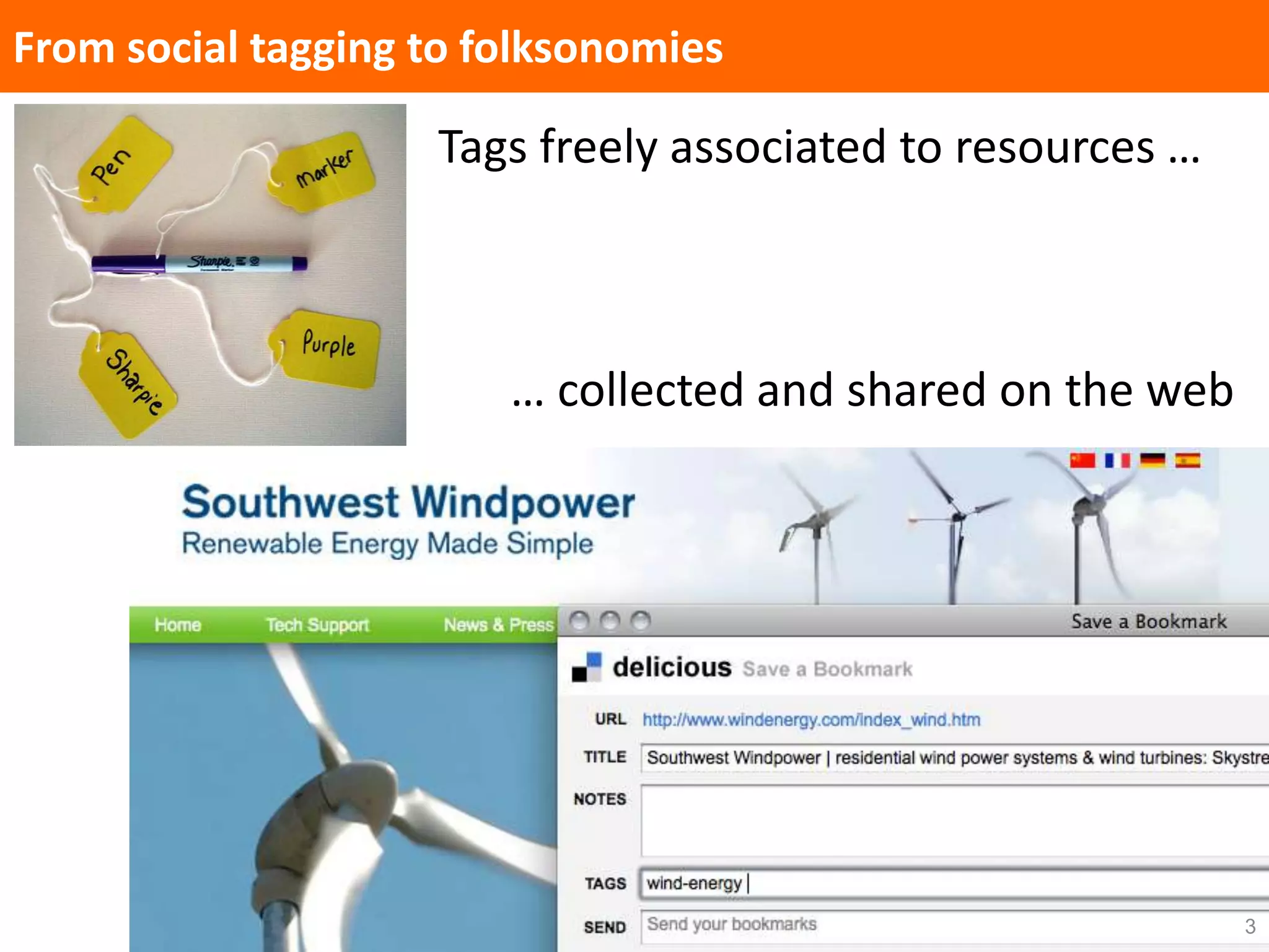
Tags freely associated to resources …
… collected and shared on the web
4
… resulting in
FOLKSONOMIES
A mass of users for a mass of resources
Limitations of folksonomies
5
Spelling variations of tags:
newyork = new_york = nyc
6
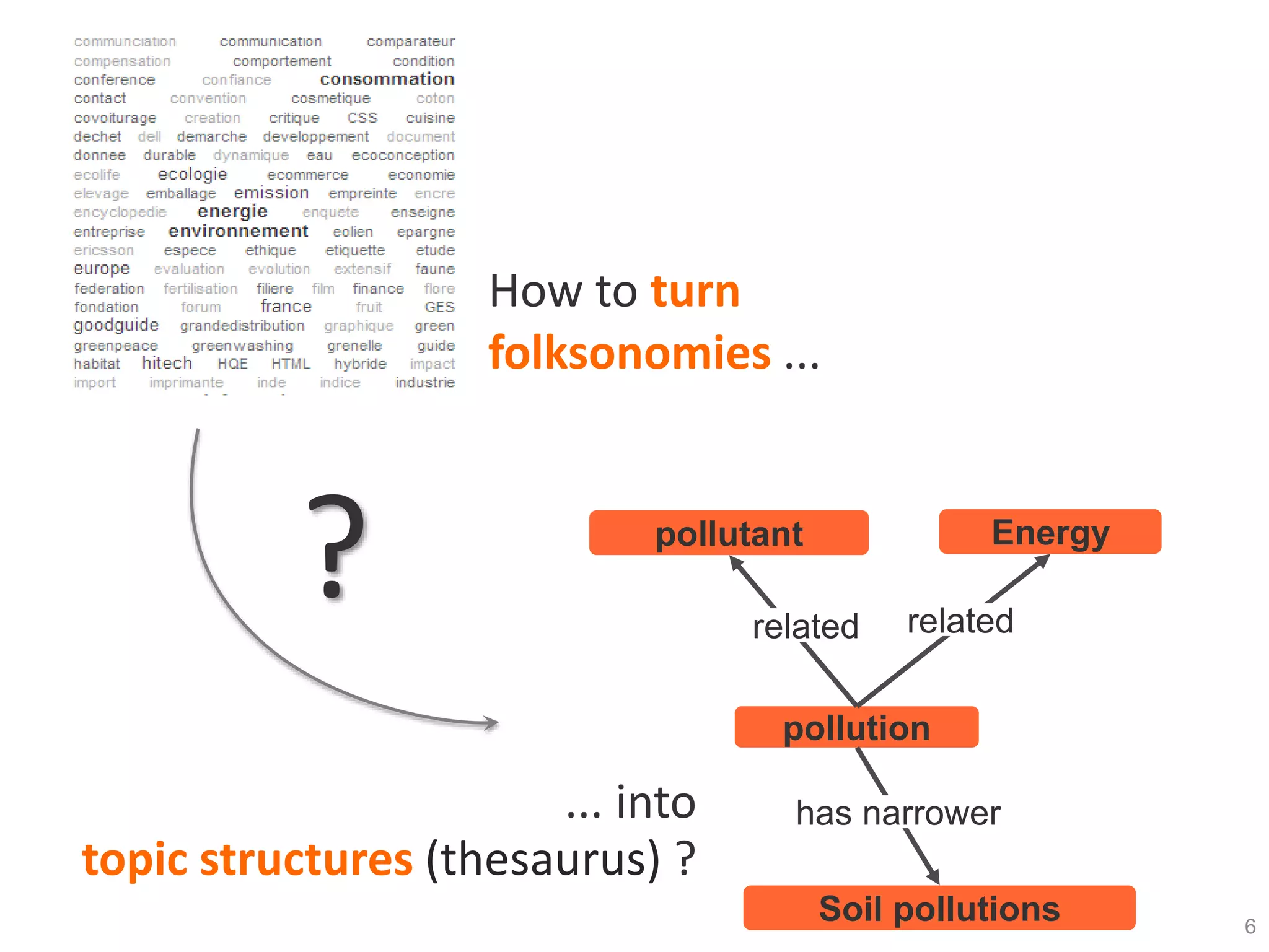
How to turn
folksonomies ...
?
... into
topic structures (thesaurus) ?
pollution
Soil pollutions
has narrower
pollutant Energy
related related
7
… without overloading users
… and by collecting
all user's expertise
into the process
8
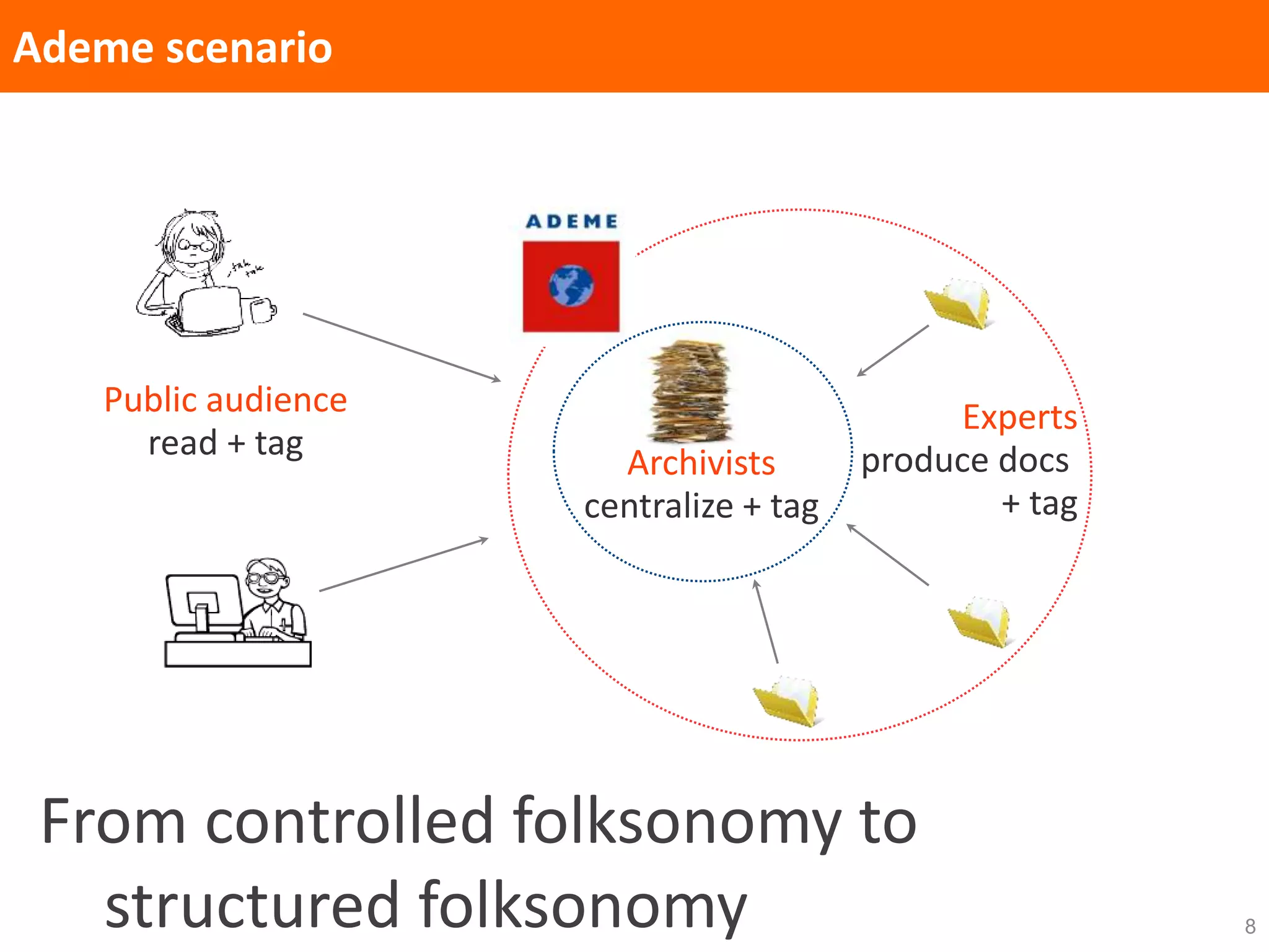
Ademe scenario
Experts
produce docs
+ tag
Archivists
centralize + tag
Public audience
read + tag
From controlled folksonomy to
structured folksonomy
2. State of the art
and positioning
9
10
State of the art
Automatic extraction of tag semantics:
• Similarity based on co-occurrence patterns (Specia & Motta 2007;
Catutto 2008)
• Association rule mining (Mika 2005; Hotho et al. 2006)
pollution
Soil pollutions
has narrower
pollutant Energy
related related
11
State of the art
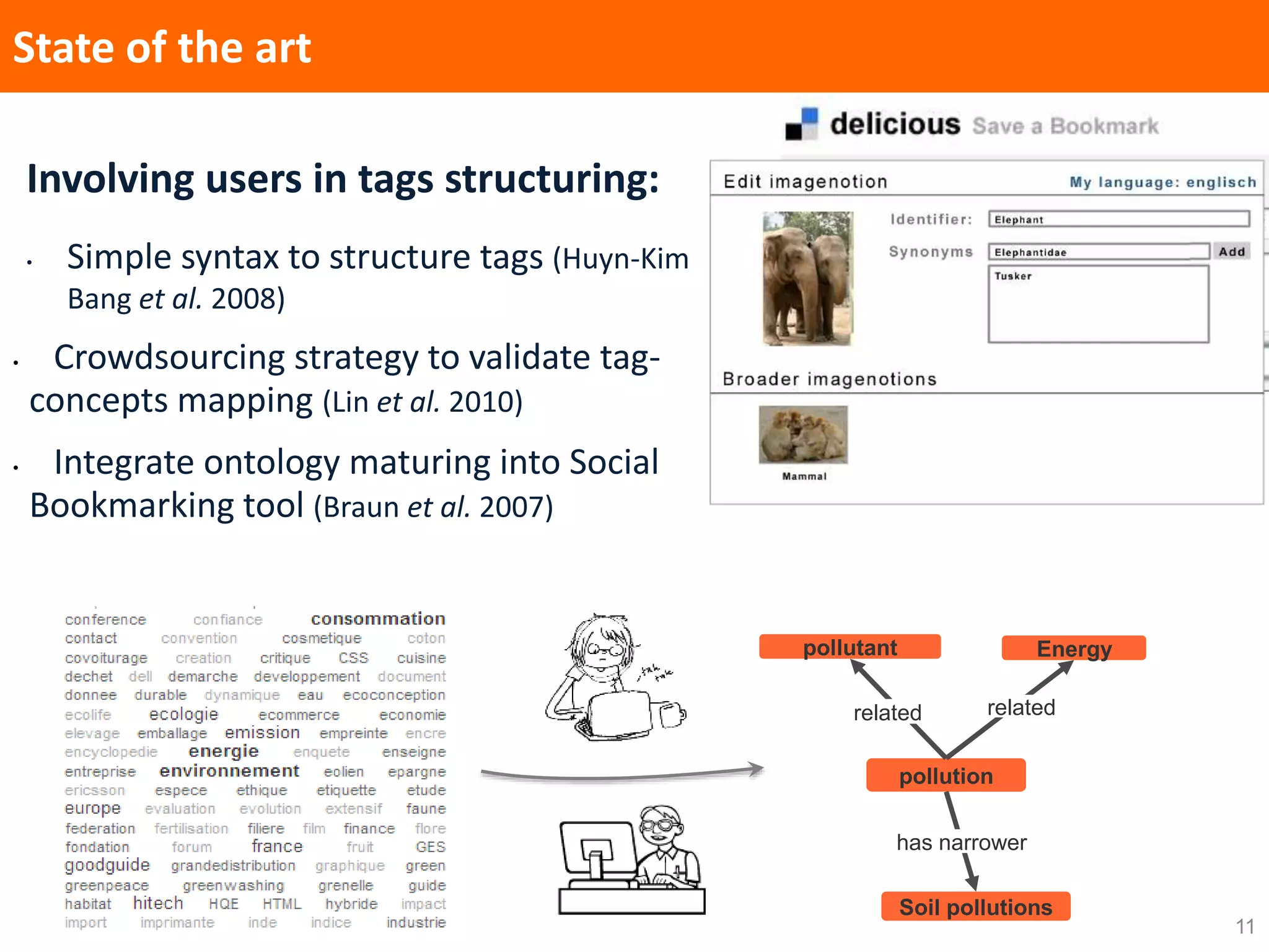
Involving users in tags structuring:
• Simple syntax to structure tags (Huyn-Kim
Bang et al. 2008)
• Crowdsourcing strategy to validate tag-
concepts mapping (Lin et al. 2010)
• Integrate ontology maturing into Social
Bookmarking tool (Braun et al. 2007)
pollution
Soil pollutions
has narrower
pollutant Energy
related related
RDF
 ? :
 Resource Description Framework
☐ Rwanda Defense Force
12
State of the art
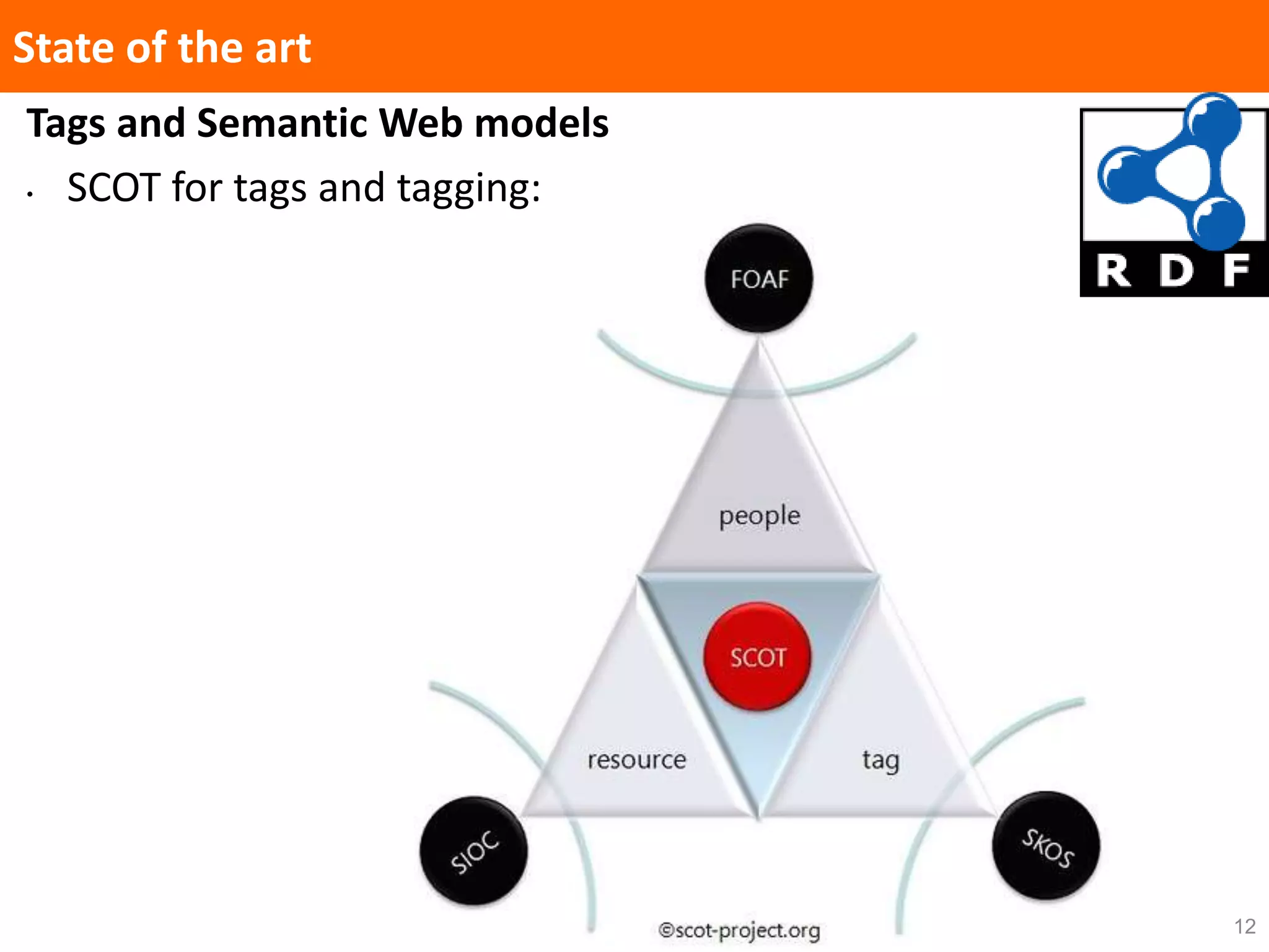
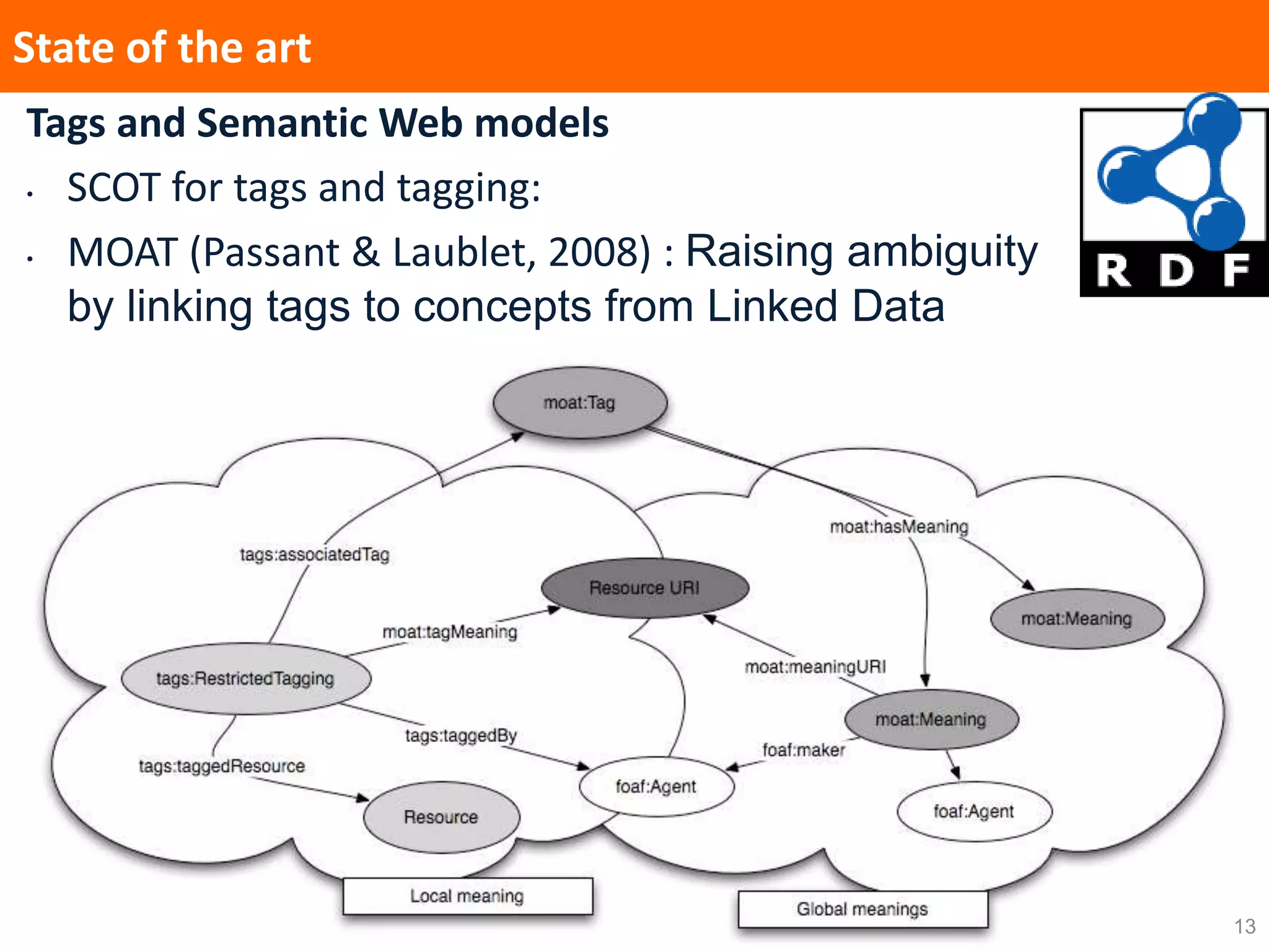
Tags and Semantic Web models
• SCOT for tags and tagging:
13
State of the art
Tags and Semantic Web models
• SCOT for tags and tagging:
• MOAT (Passant & Laublet, 2008) : Raising ambiguity
by linking tags to concepts from Linked Data
3. Tagging & folksonomy
enrichment models
14
15
Tagging model
Tagging = linking a resource with a sign
What is tagging ?
16
Tagging model
NiceTag : tagging as named graphs (Carrol 2005)
nt:TaggedResource rdfs:Resourcent:isRelatedTo
nt:TagAction(named
graph)
sioc:UserAccount
sioc:has_creator
sioc:Container
sioc:has_container
xsd:Date
dc:date
17
Folksonomy enrichment
2 complementary semantic enrichment:
wind-energy
renewable
energy
windenergy
wind turbine
has broader
close match
has narrower
environment
related
Structuring tags as in a thesaurus (SKOS)
http://www.windenergy.com
nt:ManualTagAction
nt:isAbout
freddy
sioc:has_creator
delicious.com
sioc:has_container
18
Tagging model
Supporting diverging points of view
car pollutionskos:related
john
agrees
paul
disagrees
Supporting diverging points of view
Reification of relations with named graphs
car pollutionskos:related
srtag:SingleUser
"john"
srtag:hasApproved
srtag:SingleUser
"paul"
srtag:hasRejected
srtag:TagSemanticStatement
srtag:TagStructureComputer
"r2d2"
srtag:hasProposed
19
4. Going through the
folksonomy enrichment
life-cycle
20
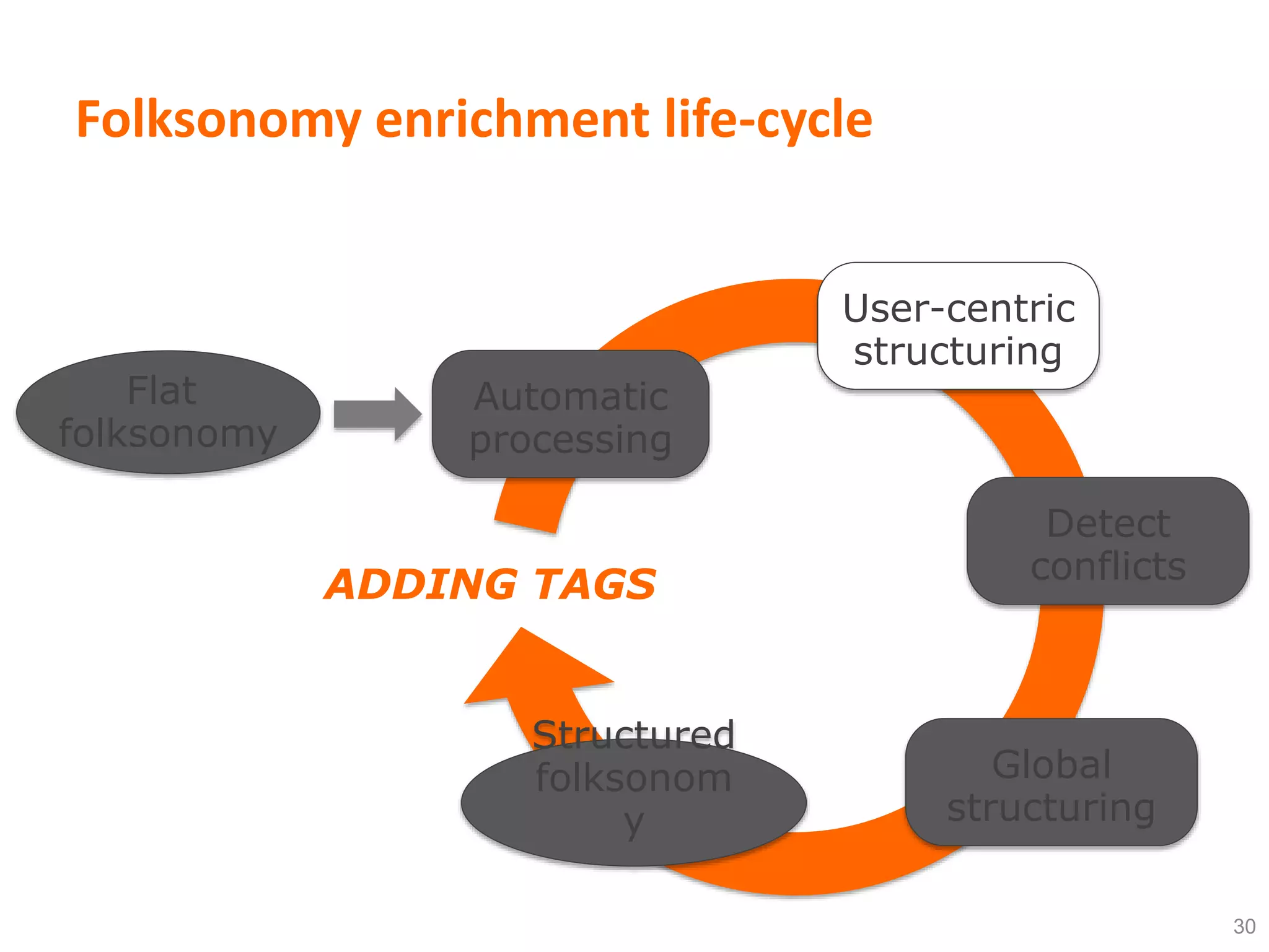
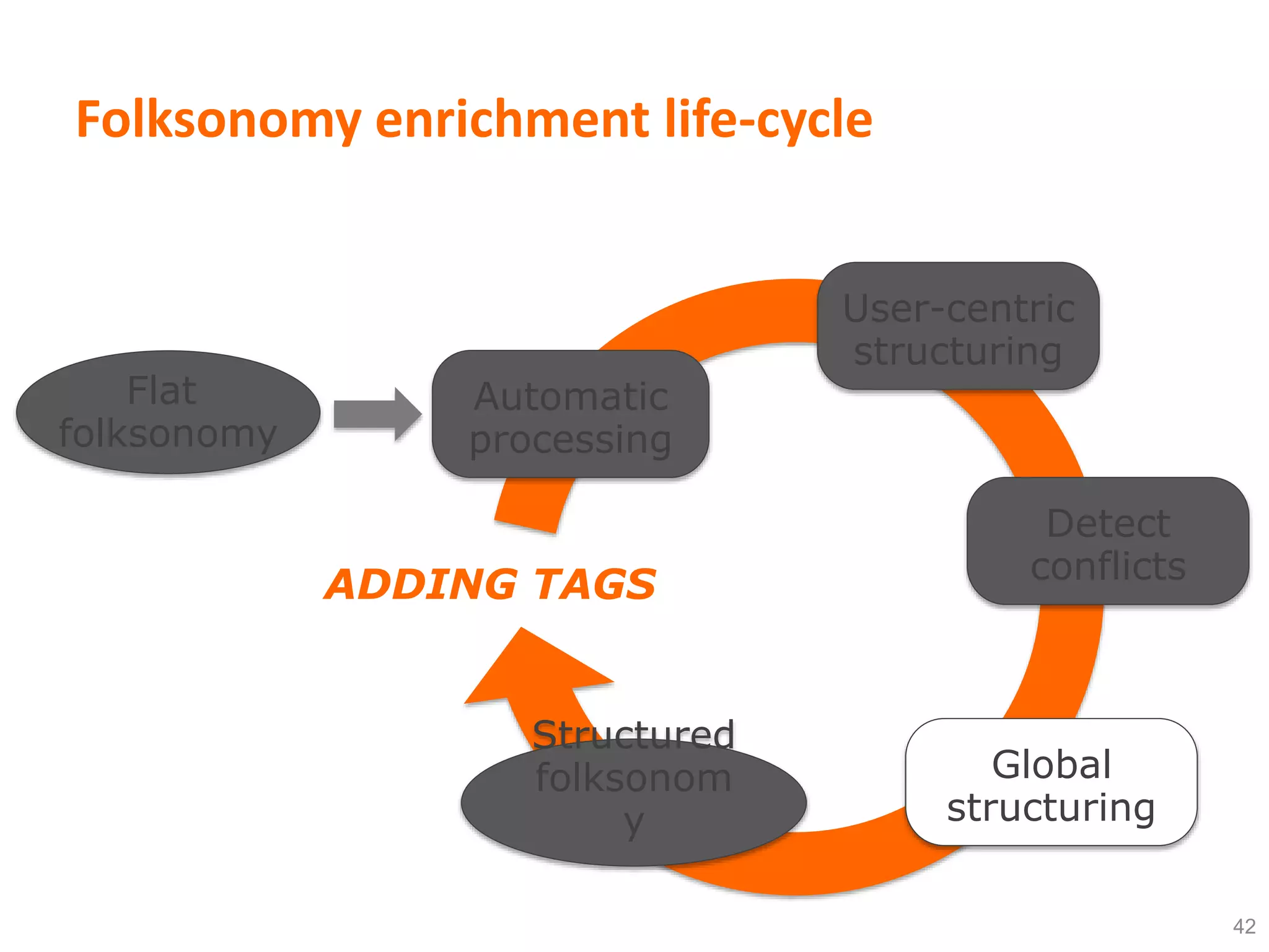
ADDING TAGS
Automatic
processing
User-centric
structuring
Detect
conflicts
Global
structuring
Flat
folksonomy
Structured
folksonom
y
Folksonomy enrichment life-cycle
21
ADDING TAGS
Automatic
processing
User-centric
structuring
Detect
conflicts
Global
structuring
Flat
folksonomy
Structured
folksonom
y
Folksonomy enrichment life-cycle
22
23
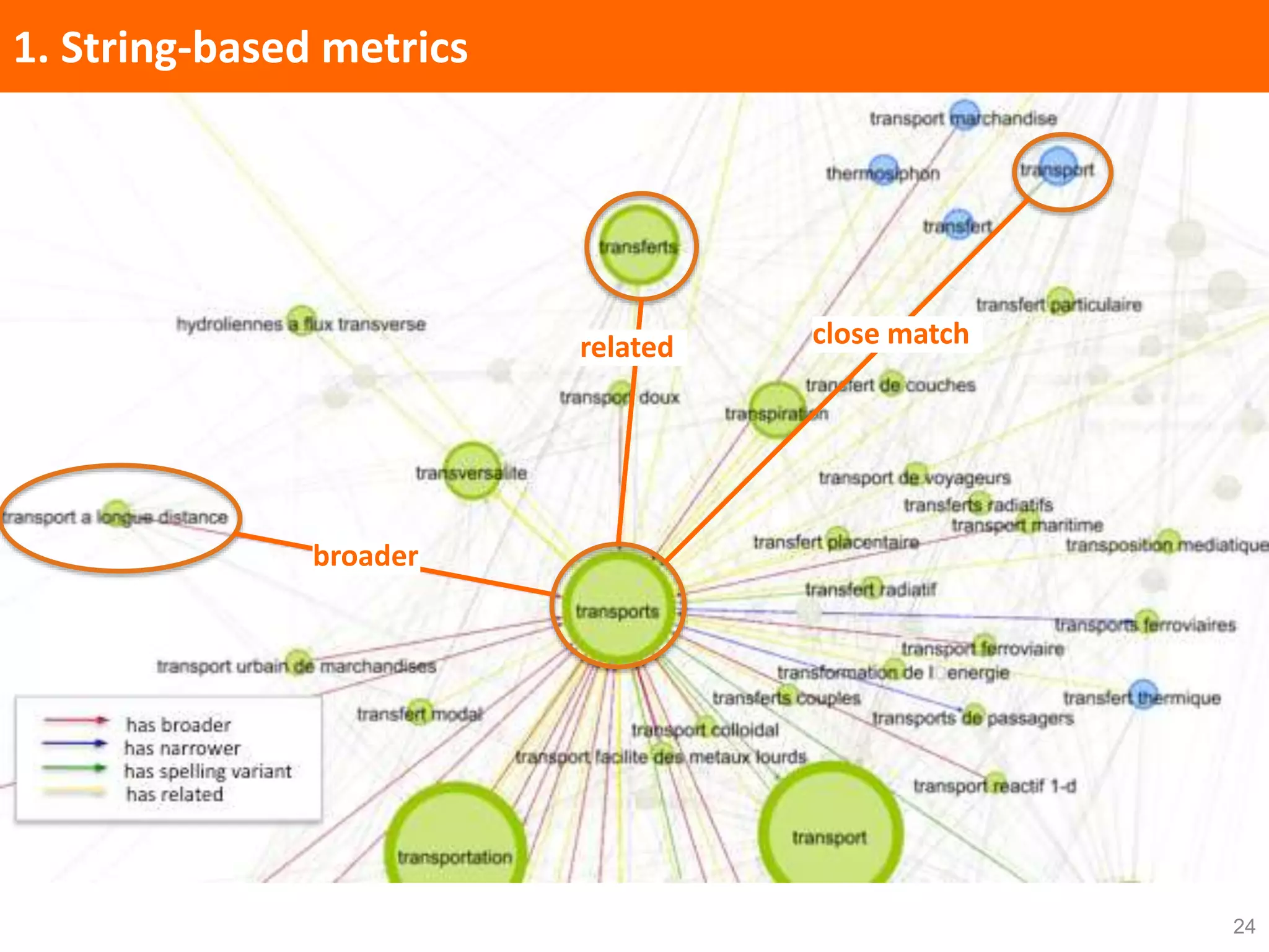
1. String-based metrics
pollution Soil pollutions
pollutantpollution
=> « pollution » related to « pollutant »
=> « pollution » broader than « soil pollutions »
1. String-based
metrics results1. String-based metrics
24
close matchrelated
broader
25
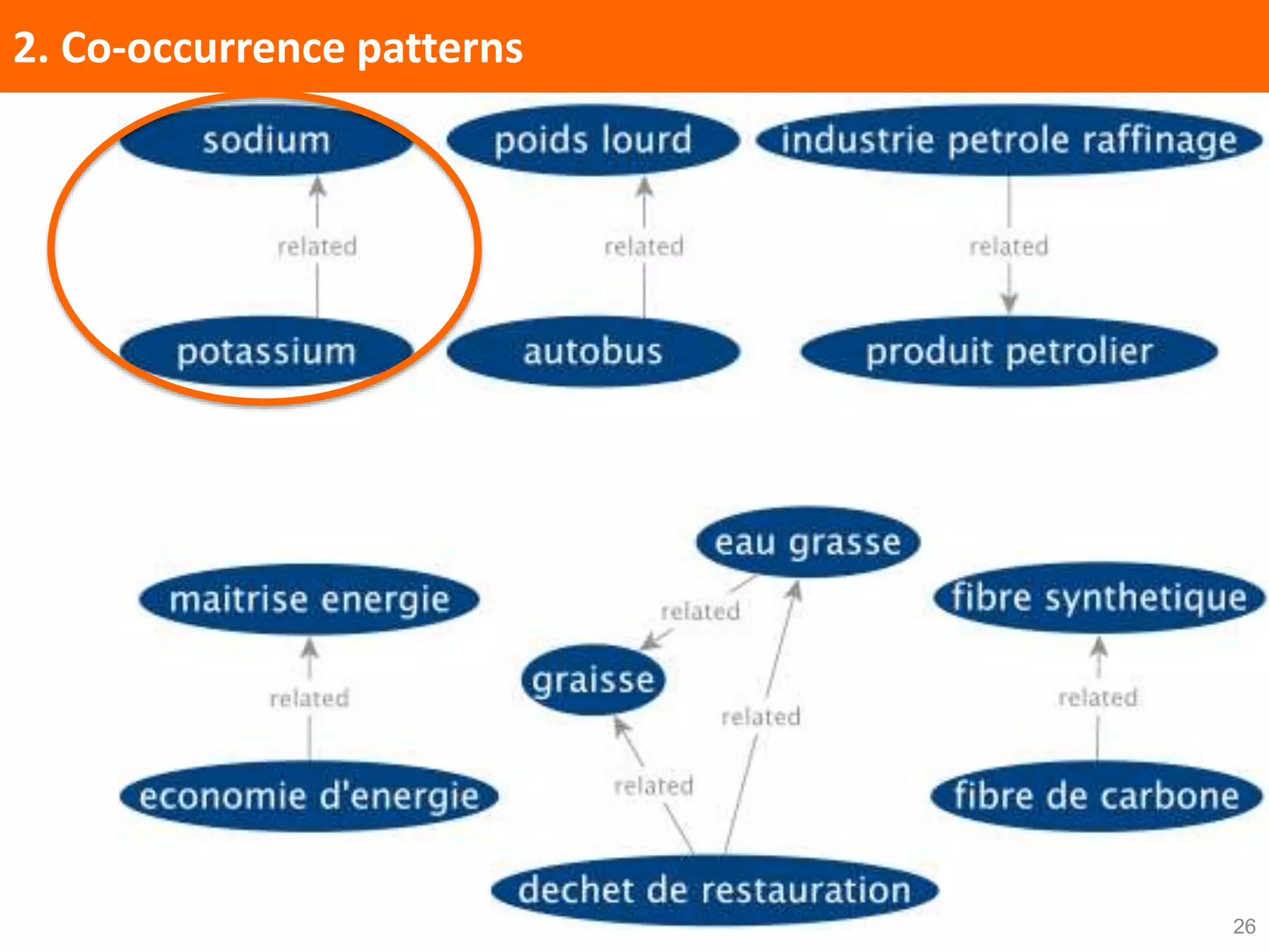
2. Co-occurrence patterns
Example of folksonomy
26
2. Co-occurrence patterns
renewable energy
wind-energy
A
l
e
x
D
e
l
p
h
i
n
e
C
l
a
i
r
e
M
o
n
i
q
u
e
A
n
n
e
 Hyponym relations (broader/narrower):
« renewable energy » broader than « wind-energy »
3. User-based association
27
3. User-based
association
28
Global results of automatic processings on Ademe data
Total with 3 automatic methods: 83027 relations for 9037 tags
29
ADDING TAGS
Automatic
processing
User-centric
structuring
Detect
conflicts
Global
structuring
Flat
folksonomy
Structured
folksonom
y
Folksonomy enrichment life-cycle
30
31
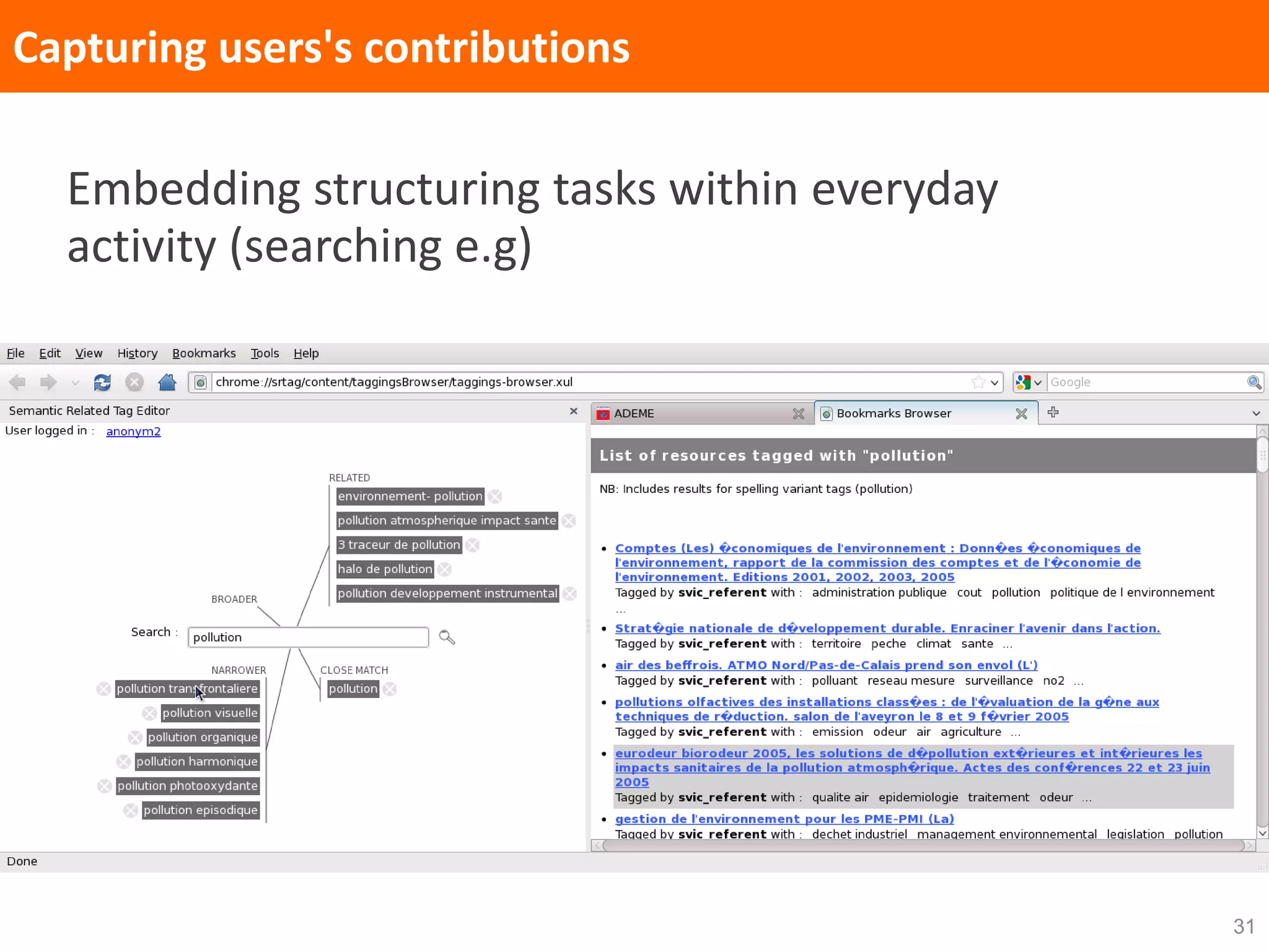
Capturing users's contributions
Embedding structuring tasks within everyday
activity (searching e.g)
32
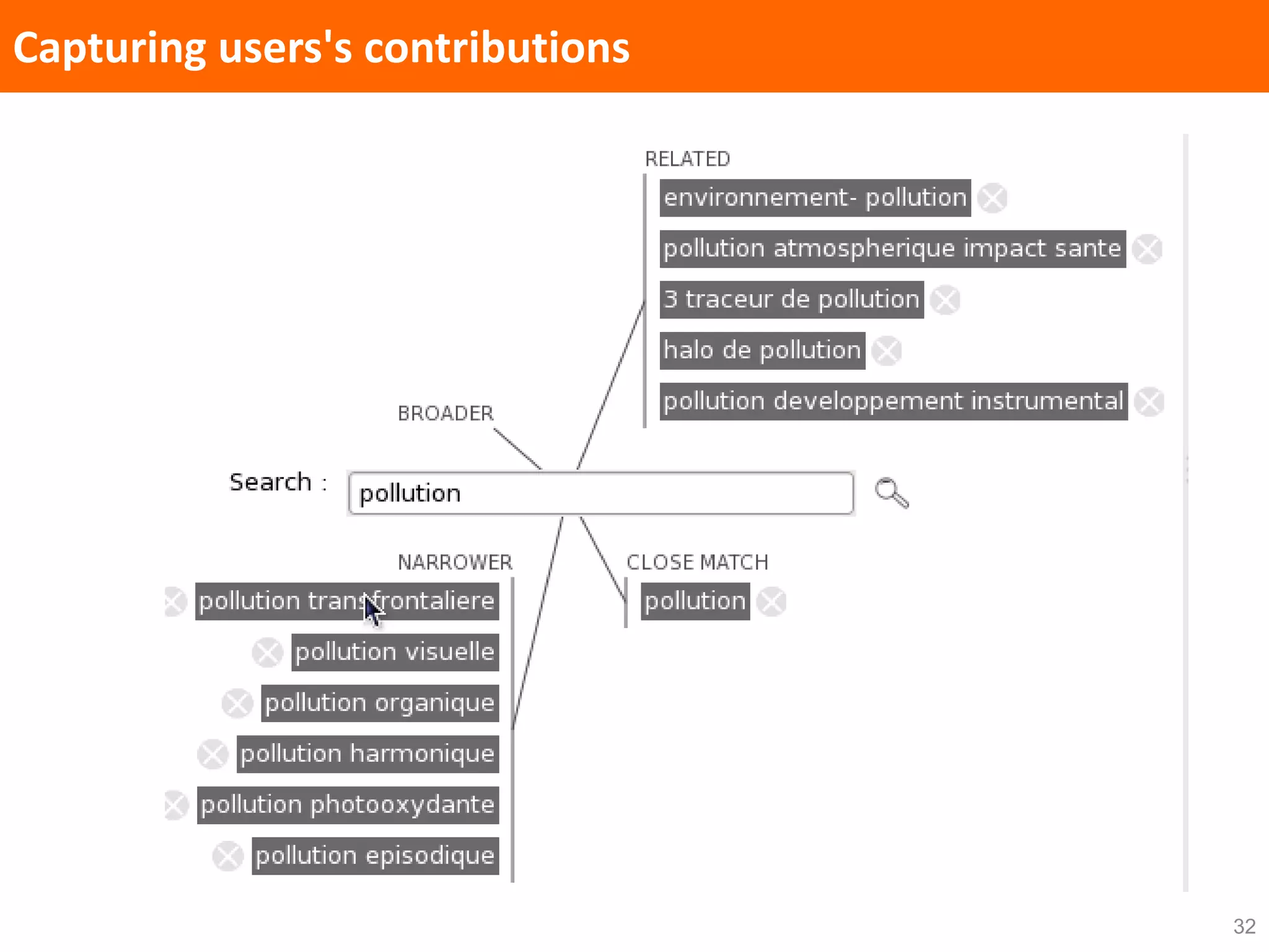
Capturing users's contributions
33
Capturing user's point of view
John
srtag:hasRejected
energie
france
skos:broader
srtag:TagSemanticStatement
Exemple:
Rejecting a relation
34
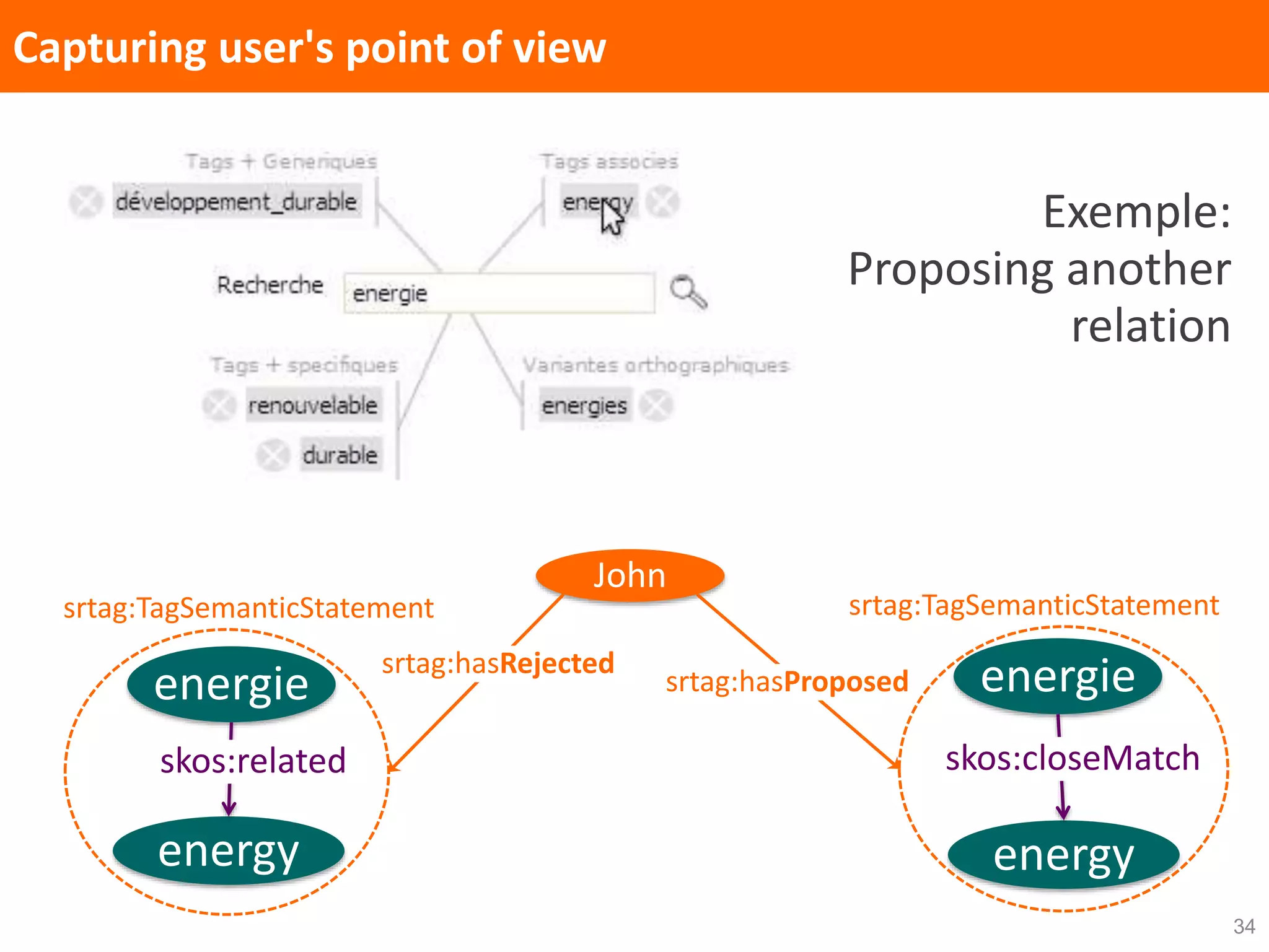
Capturing user's point of view
John
srtag:hasRejected
energie
energy
skos:related
srtag:TagSemanticStatement
Exemple:
Proposing another
relation
energie
energy
skos:closeMatch
srtag:TagSemanticStatement
srtag:hasProposed
ADDING TAGS
Automatic
processing
User-centric
structuring
Detect
conflicts
Global
structuring
Flat
folksonomy
Structured
folksonom
y
Folksonomy enrichment life-cycle
35
36
Conflict detection
environment pollution
Using rules:
IF num(narrower)/num(broader) ≥ c
THEN narrower wins
ELSE 'related' wins
narrower
John
srtag:hasApproved
Anne
srtag:hasApproved
broader
Monique
srtag:hasApproved
Delphine
srtag:hasApproved
37
Conflict detection
related
broader narrower
less constrained less constrained less constrained
close match
relatedenvironment pollution
narrower
broader
38
Experimentation at ADEME
Participation of 3 members at Ademe
+ 2 professionals in environment
Several cases of conflicting situations
Conflicting : >1 relation
per pair of tags
Approved : 1 relation,
only approved
Debatable : 1 relation,
BOTH approved and
rejected
Rejected : 1 relation, only
rejected
39
Several cases of conflicting situations
Distribution over
relation types :
• "closeMatch" tends
to draw a consensus
more easily than
others
•
"broader/narrower"
and "related" cause
more
debates/conflicts
40
Example conflict resolution
Conflicting
Conflict solver choice
debatable
rejected 41
ADDING TAGS
Automatic
processing
User-centric
structuring
Detect
conflicts
Global
structuring
Flat
folksonomy
Structured
folksonom
y
Folksonomy enrichment life-cycle
42
Helping Referent User (Ademe archivists) choose solutions to
conflicts
Reporting
43
44
Global map
Choices of the referent
user (archivists at Ademe e.g.)
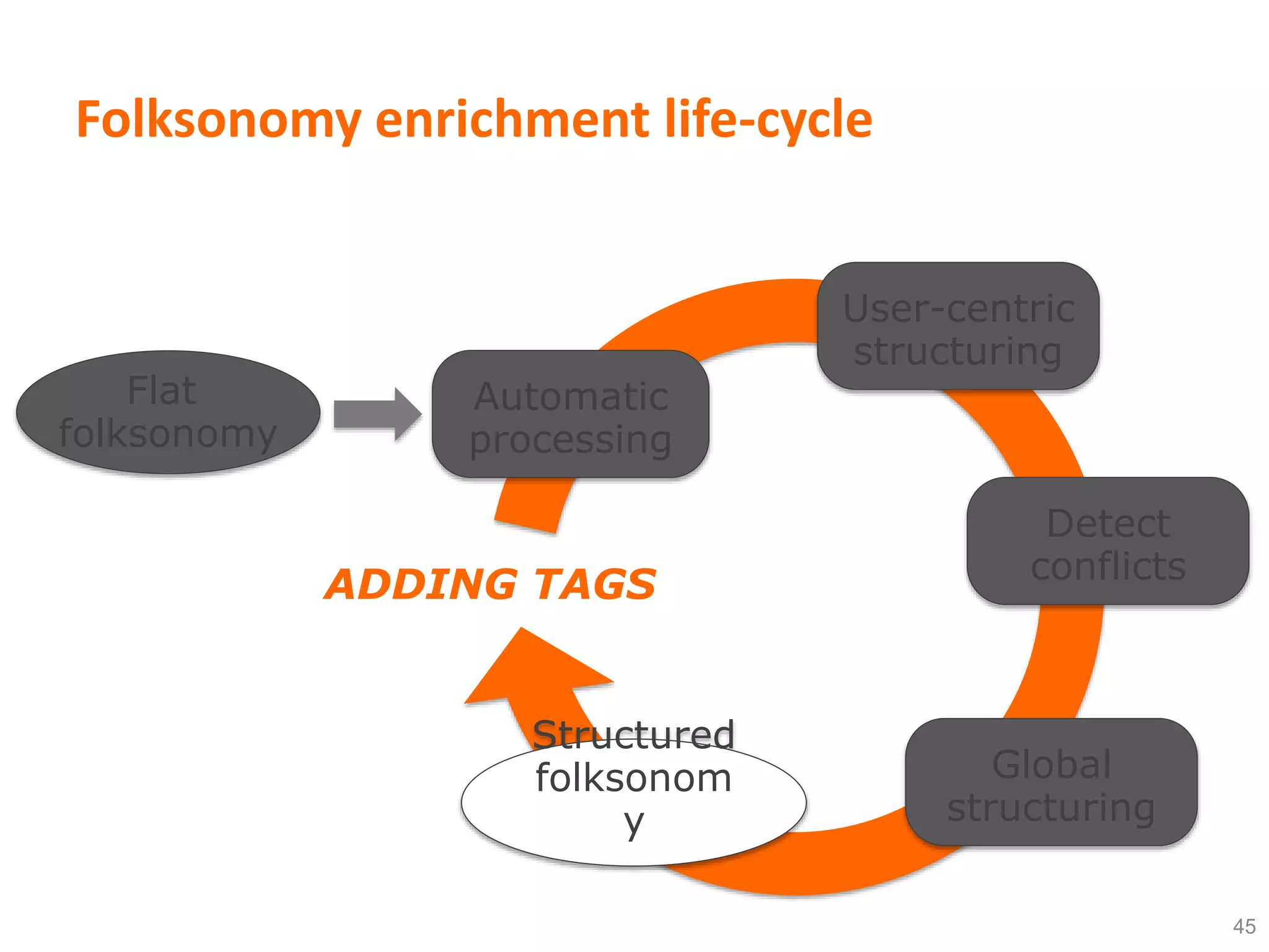
ADDING TAGS
Automatic
processing
User-centric
structuring
Detect
conflicts
Global
structuring
Flat
folksonomy
Structured
folksonom
y
Folksonomy enrichment life-cycle
45
Each point of view
corresponds to a layer
46
Enriching individual points of view
Integrating others' contributions:
1. Current user -> "Anne"
2. ReferentUser (e.g. archivists)
3. ConflictSolver (software agent)
4. Other single users
5. Automatons (metrics)
BROADER
NARROWER
RELATED
CLOSE MATCH
environnementSearch:
preoccupation environnementales
grenelle de l environnement
competences environnementales
environment
environmental
domaines environnementaux
Anne is looking for tag
"environnement"
47
5. Conclusion
48
49
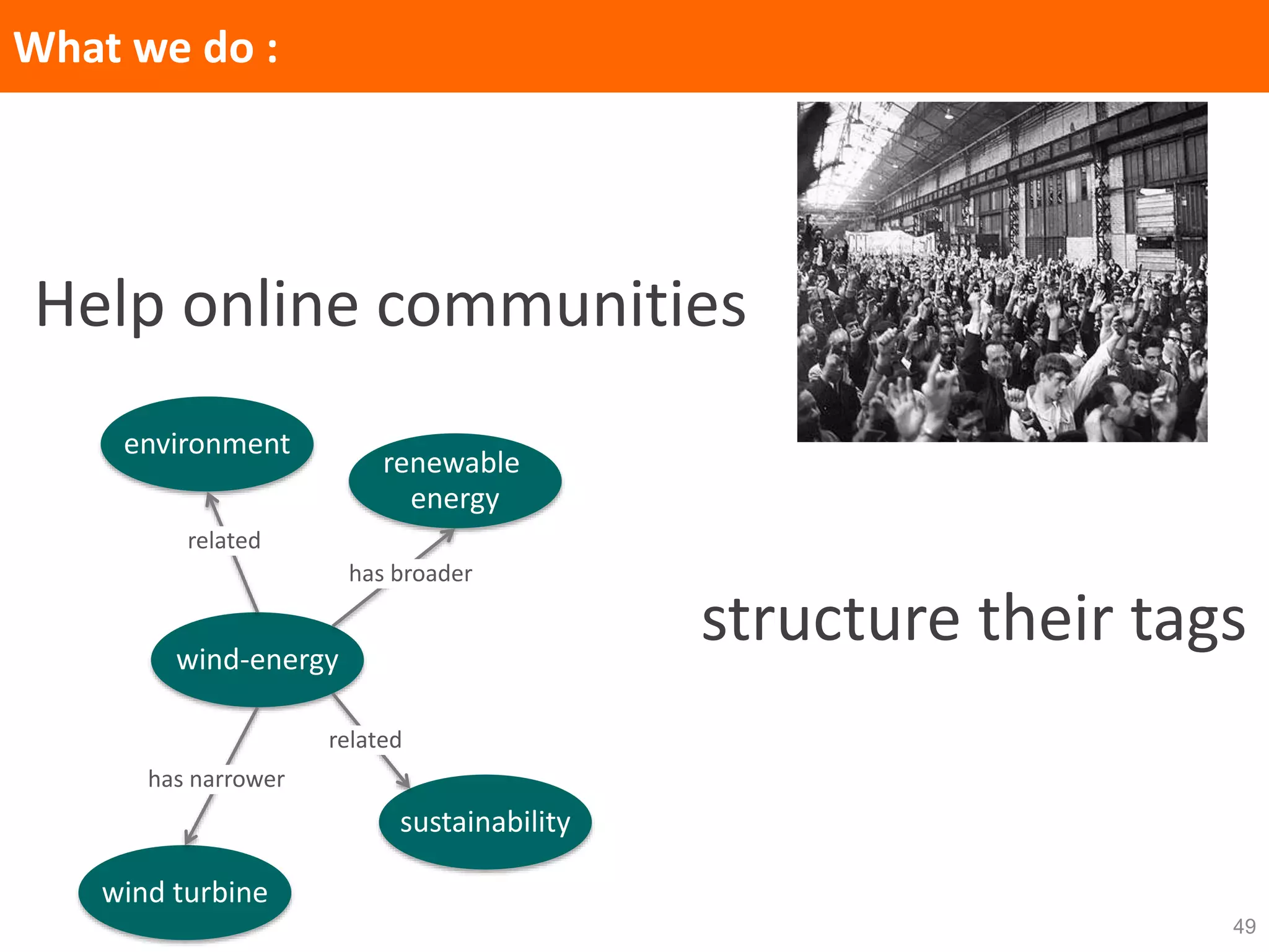
What we do :
Help online communities
structure their tagswind-energy
renewable
energy
sustainability
wind turbine
has broader
related
has narrower
environment
related
• Integrating collaborative ergonomics in design of socio-
technical systems
• User interfaces : how to visualize structuring process ?
• Towards Computer Supported Argumentation
• Application to the Web at large ?
• Semantics of tags : Topic vs Concept ?
50
Dicussion
51
Thank you !
freddy.limpens@inria.fr
http://www-sop.inria.fr/members/Freddy.Limpens/
2010
• Monnin, A.; Limpens, F.; Gandon, F. & Laniado, D. Speech acts meets tagging: NiceTag ontology AIS SigPrag International Pragmatic Web
Conference, 2010
• Monnin, A.; Limpens, F.; Gandon, F. & Laniado, D. ,L'ontologie NiceTag : les tags en tant que graphes nommés,A. Monnin, F. Limpens, D.
Laniado, F. Gandon, EGC 2010, Atelier Web Social
• Limpens, F.; Gandon, F. & Buffa, M. Helping online communities to semantically enrich folksonomies Proceedings of the WebSci10:
Extending the Frontiers of Society On-Line, http://webscience.org, 2010
2009
• Limpens, F.; Monnin, A.; Laniado, D. & Gandon, F. NiceTag Ontology: tags as named graphs International Workshop in Social Networks
Interoperability, ASWC09, 2009
• Limpens, F.; Gandon, F. & Buffa, M. Sémantique des folksonomies : structuration collaborative et assistée Ingénierie des Connaissances,
2009
• Limpens, F.; Gandon, F. & Buffa, M. Collaborative semantic structuring of folksonomies (short article) IEEE/WIC/ACM Int. Conf. on Web
Intelligence, 2009
• Erétéo, G.; Buffa, M.; Gandon, F.; Leitzelman, M. & Limpens, F. Leveraging Social data with Semantics W3C Workshop on the Future of
Social Networking, Barcelona., 2009
• Henri, F.; Charlier, B. & Limpens, F. Understanding and Supporting the Creation of More Effective PLE Int. Conf. on Information
Resources Management, Dubai, 2009
2008
• Henri, F.; Charlier, B. & Limpens, F. Understanding PLE as an Essential Component of the Learning Process World Conf. on Educational
Multimedia, Hypermedia & Telecommunications, ED-Media, Vienna, Austria, 2008
• Limpens, F.; Gandon, F. & Buffa, M. Rapprocher les ontologies et les folksonomies pour la gestion des connaissances partagées : un Etat
de l'art Proc. 19èmes journées francophones d'Ingénierie des Connaissances, Nancy, 2008
• Limpens, F.; Gandon, F. & Buffa, M. Bridging Ontologies and Folksonomies to Leverage Knowledge Sharing on the Social Web: a Brief
Survey Proc. 1st International Workshop on Social Software Engineering and Applications (SoSEA),
http://www-sop.inria.fr/members/Freddy.Limpens/?q=biblio
52
Personal publications
53
54
Positioning
Computed
Tag similarity
Tag-Concept
mapping
Users'
contrib.
Sem-Web
formalism
Multi-points
of view
Angeletou et al.
(2008)
✓ ✓ ✓
Huynh-Kim Bang
et al. (2008)
✓ ✓
Passant &
Laublet(2008)
✓ ✓ ✓
Lin & Davis
(2010)
✓ ✓ ✓ ✓
Braun et al.
(2007)
✓ ✓
Our approach ✓ partly ✓ ✓ ✓
55
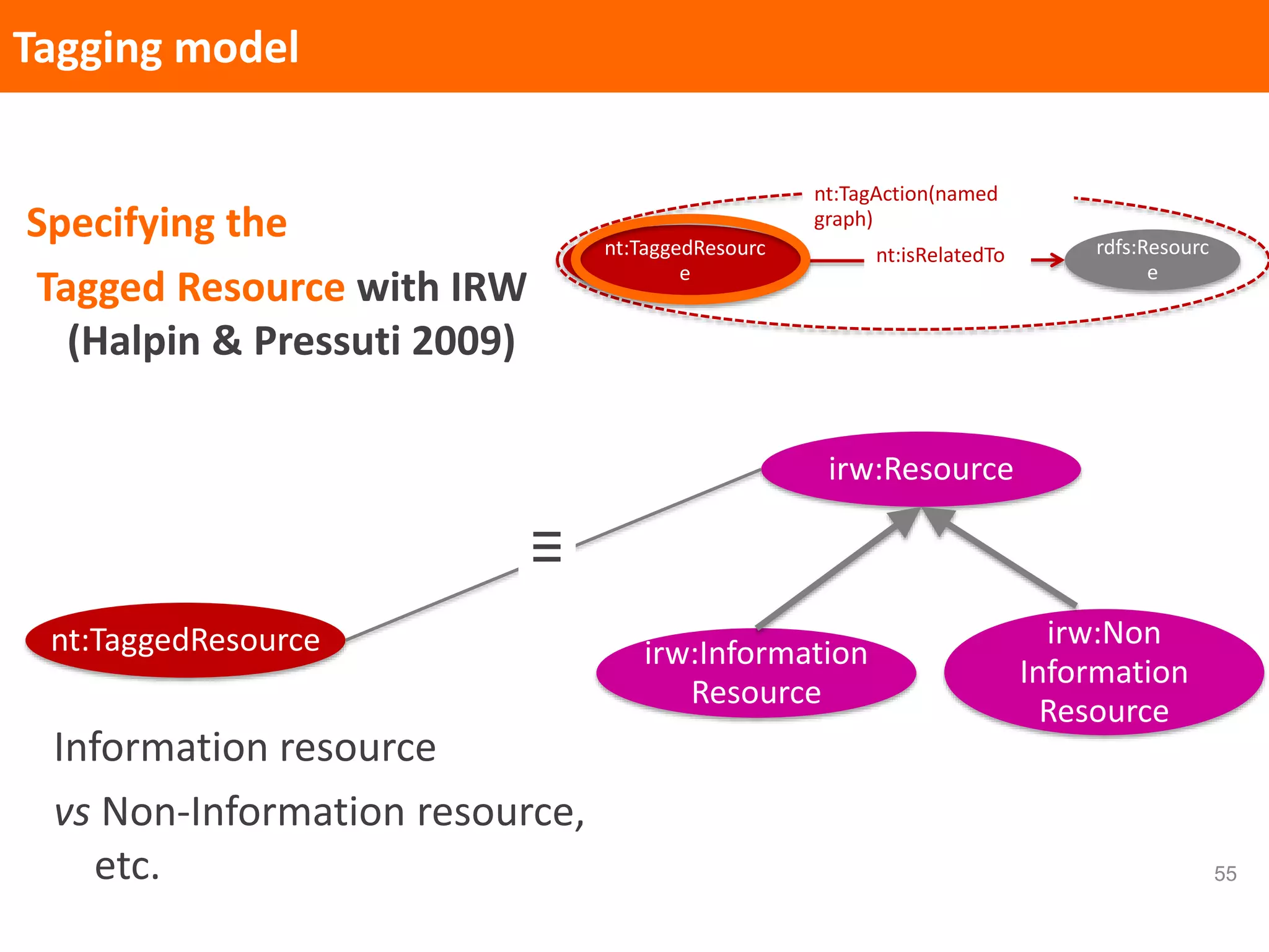
Tagging model
Specifying the
Tagged Resource with IRW
(Halpin & Pressuti 2009)
nt:TaggedResourc
e
rdfs:Resourc
e
nt:isRelatedTo
nt:TagAction(named
graph)
nt:TaggedResource
Information resource
vs Non-Information resource,
etc.
irw:Resource
irw:Information
Resource
irw:Non
Information
Resource
≡
56
Tagging model
No constraints on the model
of the sign used to tag
nt:TaggedResourc
e
rdfs:Resourc
e
nt:isRelatedTo
nt:TagAction(named
graph)
nt:TaggedResource
http:geonames.org/2990440
nt:isRelatedTo
scot:Tag
:)
skos:Concept
nt:isRelatedTo
nt:isRelatedTo
nt:isRelatedTo
nt:isRelatedTo
moat:Tag moat:hasMeaning
57
Tagging model
Typing the relation to reflect
on pragmatics of use of tags
nt:TaggedResourc
e
rdfs:Resourc
e
nt:isRelatedTo
nt:TagAction(named
graph)
58
Tagging model
Typing the named graphs
for additional dimensions
of tagging
nt:TaggedResourc
e
rdfs:Resourc
e
nt:isRelatedTo
nt:TagAction(named
graph)
59
Tagging model
Example of a tagging in delicious
http://www.windenergy.com
nt:ManualTagAction
nt:isAbout
scot:Tag
"wind-energy"
freddy
sioc:has_creator
delicious.com
sioc:has_container

Freddy Limpens: From folksonomies to ontologies: a socio-technical solution.

Editor's Notes

  • #15 Giving basic of the models aimed at giving us expressivity we need
  • #40 En couleur
  • #48 Ajouter slide traduisantcecidansl'interfaceRefaire le graphetrauduitdansl'interface + ajouter image user "Anne"