Digital Libraries:
the process, initiatives and developmental issues in
                         India
                          By

               Sudesh Kumar Sood
                  Chief Librarian,
       H.P. Central State Library, Solan (H.P)
             sood_sk14@yahoo.co.in
Features

• A digital library may allow
  either online or offline access
  to the elements it organizes
  and houses.
• May include multimedia as
  well as multilingual data.
Objectives and Workflow
• Enhance the digital collection in a substantial
  way.
• Embrace popular digital standards , formats and
  software platforms.
• Emphasis on maximize the efficiency and
  effectiveness of the information access
• Standard workflow patterns are to be identified
  for the system for:
     ‘content selection’, ‘content acquisition’, ‘
     content publishing’, ‘content indexing and storage’,
     and ‘content accessing and delivery’.
• The system should also concern about such
  related issues,
  – preservation, usage monitoring, access management,
    interoperability, administration and management etc.
Meta-data Standards and
              Protocols
• Metadata, or “data about data,” is a critical
  element for searching information through a
  database
• A major governing body of the Web has
  developed de facto standards including RDF
• At present, digital library initiatives in India make
  use of
   – Dublin Core for web-based publications,
   – Encoded Archival Description (EAD) for archiving and
     Visual Resources Association (VRA) for visual data.
   – Open Archives Initiative Protocol for Metadata Harvesting
     (OAI_PMH) to automatically extract metadata
     information from digital libraries and enhance
     interoperability between systems.
Selection of the Software
• It should be robust in technical architecture as
  well as the content architecture.
• The system should address all major digital
  library related issues such as ‘design criteria’,
  ‘collection                 building’, ‘content
  organization’, ‘access’, ‘evaluation’, ‘policy
  and legal issues’ including ‘intellectual
  property rights’.
• The system should also provide a powerful
  search engine and the interface should be easy
  to navigate and there should be provision for
  customization.
• There are many digital library soft wares
  available, proprietary as well as open
  source, and most of them conform to
  international standards.
• VTLS and ACADO are the commercial
  ones available and popular in the Indian
  market.
• Some of the popular Open Source
  Software for digital libraries, which are
  in use internationally, are ‘DSpace’,
  ‘Dienst’, ‘Eprints’, ‘Fedora’,
  ‘Greenstone’ etc.
Some Initiatives of India

• Institutional Repositories
• Open Courseware Initiatives
• Open Access Journals
• Metadata Harvesting
  Services
• and Others
Digital Repositories in India

• Institutional repository (IR) systems by libraries, using
      • Greenstone
      • Dspace
      • EPrints
• Some open access repositories are specially created to
  disseminate intellectual outputs of the country in the
  form of electronic theses and dissertations
      • Vidyanidhi
      • ETD@IISc.
• Other national level open access repositories provide
  all kinds of scholarly materials on particular discipline.
      • The OpenMED@NIC
      • Librarians' Digital Library
Some of such repositories are:
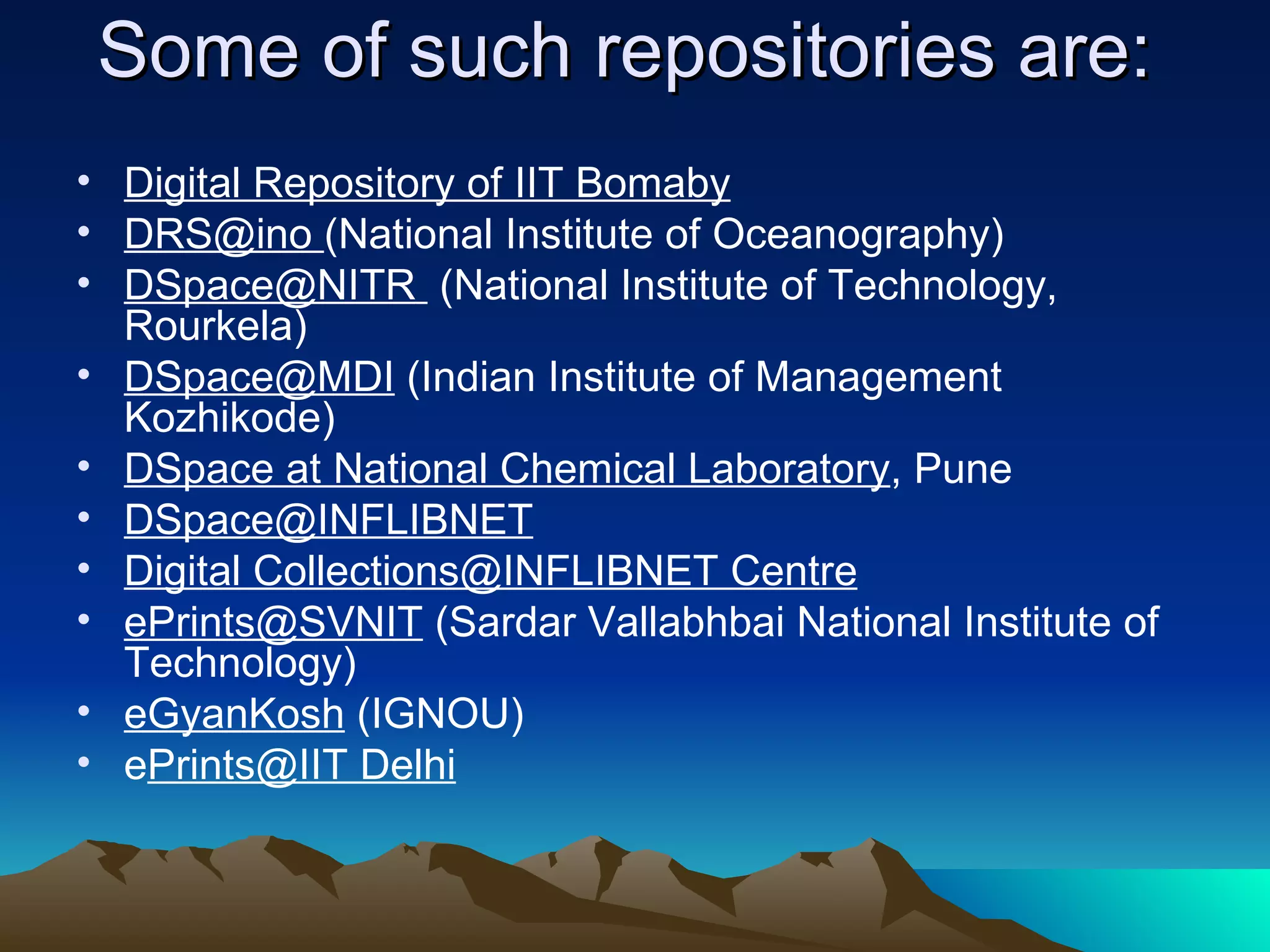
• Digital Repository of IIT Bomaby
• DRS@ino (National Institute of Oceanography)
• DSpace@NITR (National Institute of Technology,
  Rourkela)
• DSpace@MDI (Indian Institute of Management
  Kozhikode)
• DSpace at National Chemical Laboratory, Pune
• DSpace@INFLIBNET
• Digital Collections@INFLIBNET Centre
• ePrints@SVNIT (Sardar Vallabhbai National Institute of
  Technology)
• eGyanKosh (IGNOU)
• ePrints@IIT Delhi
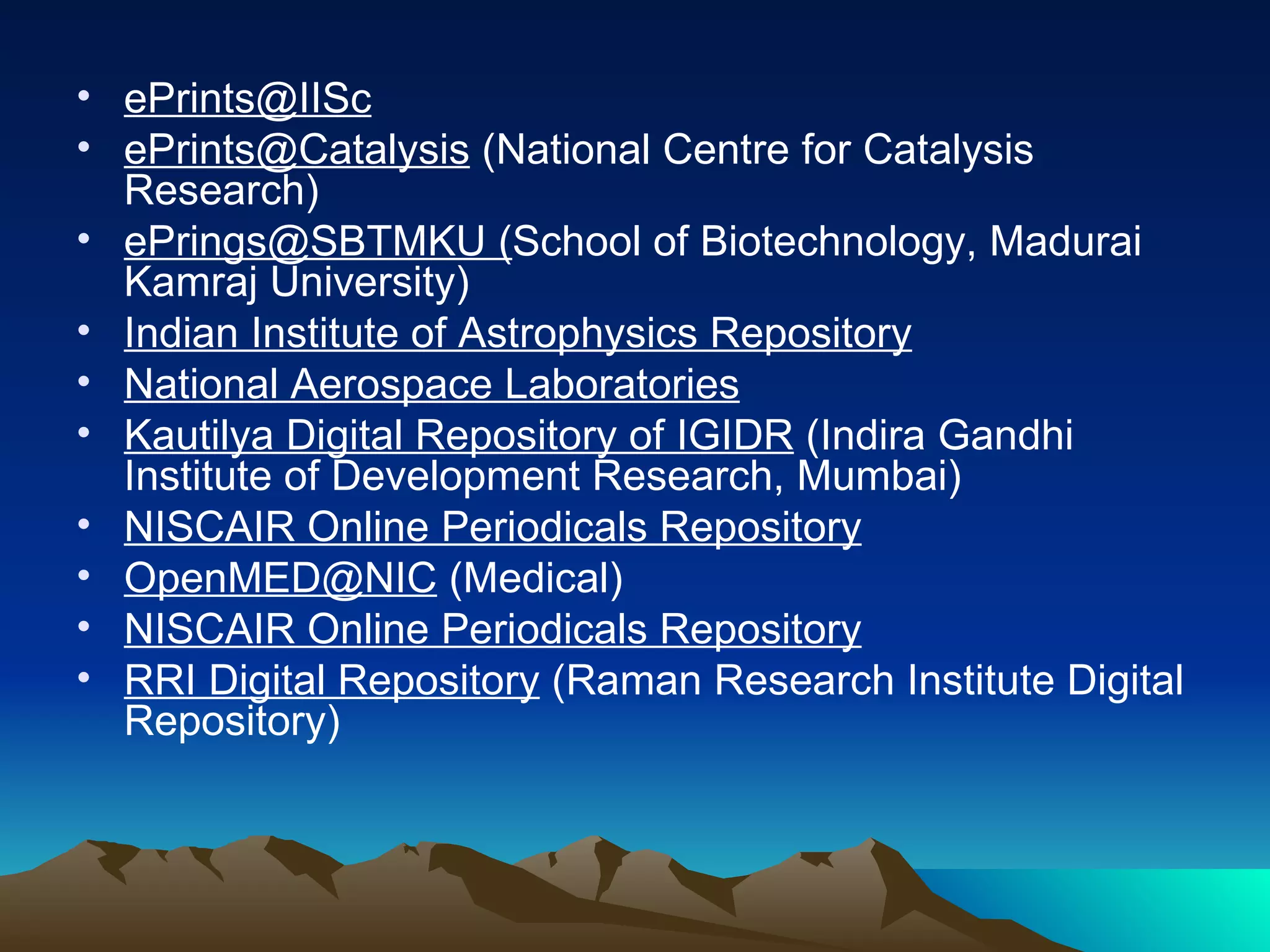
• ePrints@IISc
• ePrints@Catalysis (National Centre for Catalysis
  Research)
• ePrings@SBTMKU (School of Biotechnology, Madurai
  Kamraj University)
• Indian Institute of Astrophysics Repository
• National Aerospace Laboratories
• Kautilya Digital Repository of IGIDR (Indira Gandhi
  Institute of Development Research, Mumbai)
• NISCAIR Online Periodicals Repository
• OpenMED@NIC (Medical)
• NISCAIR Online Periodicals Repository
• RRI Digital Repository (Raman Research Institute Digital
  Repository)
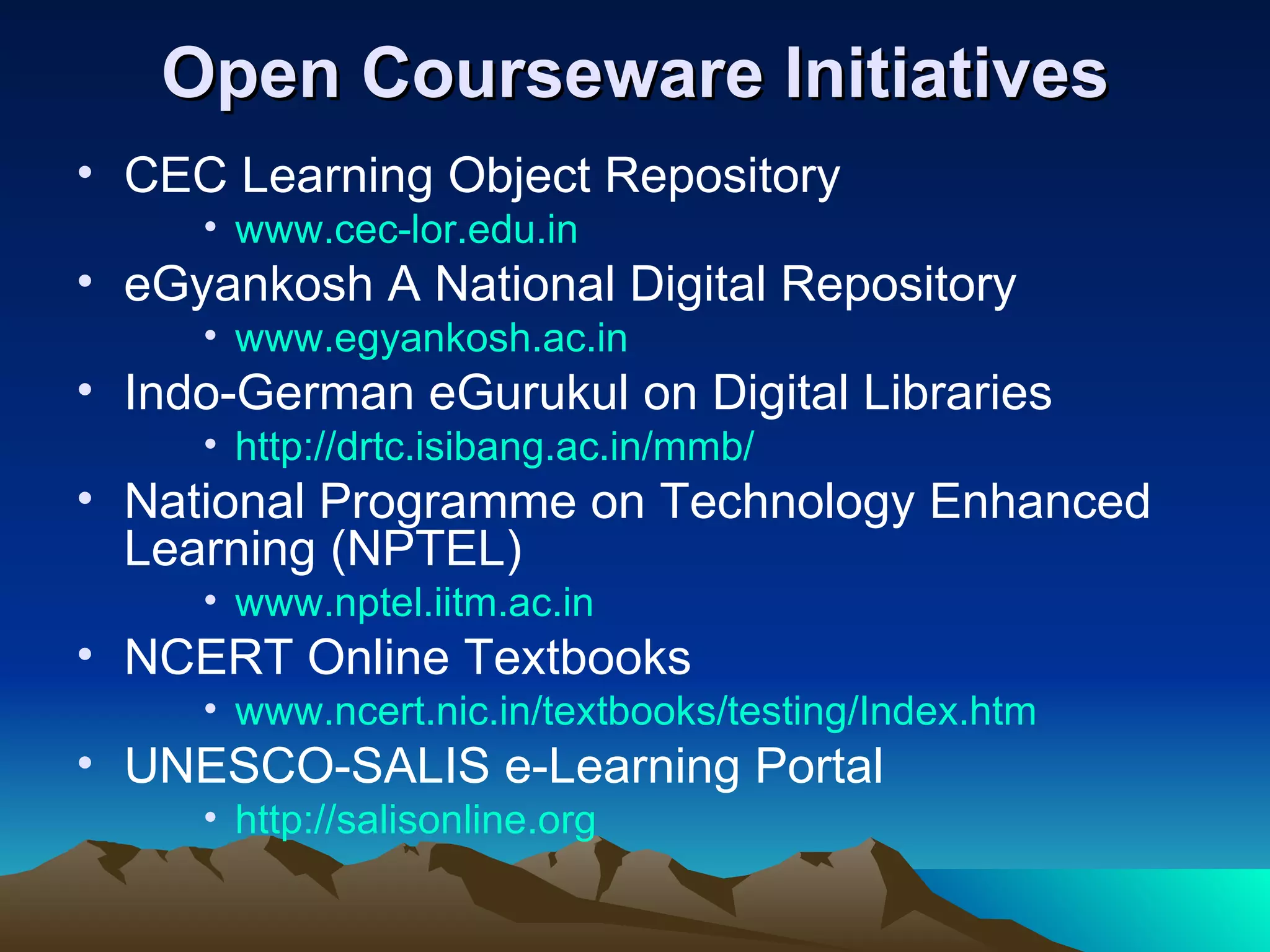
Open Courseware Initiatives
• CEC Learning Object Repository
     • www.cec-lor.edu.in
• eGyankosh A National Digital Repository
     • www.egyankosh.ac.in
• Indo-German eGurukul on Digital Libraries
     • http://drtc.isibang.ac.in/mmb/
• National Programme on Technology Enhanced
  Learning (NPTEL)
     • www.nptel.iitm.ac.in
• NCERT Online Textbooks
     • www.ncert.nic.in/textbooks/testing/Index.htm
• UNESCO-SALIS e-Learning Portal
     • http://salisonline.org
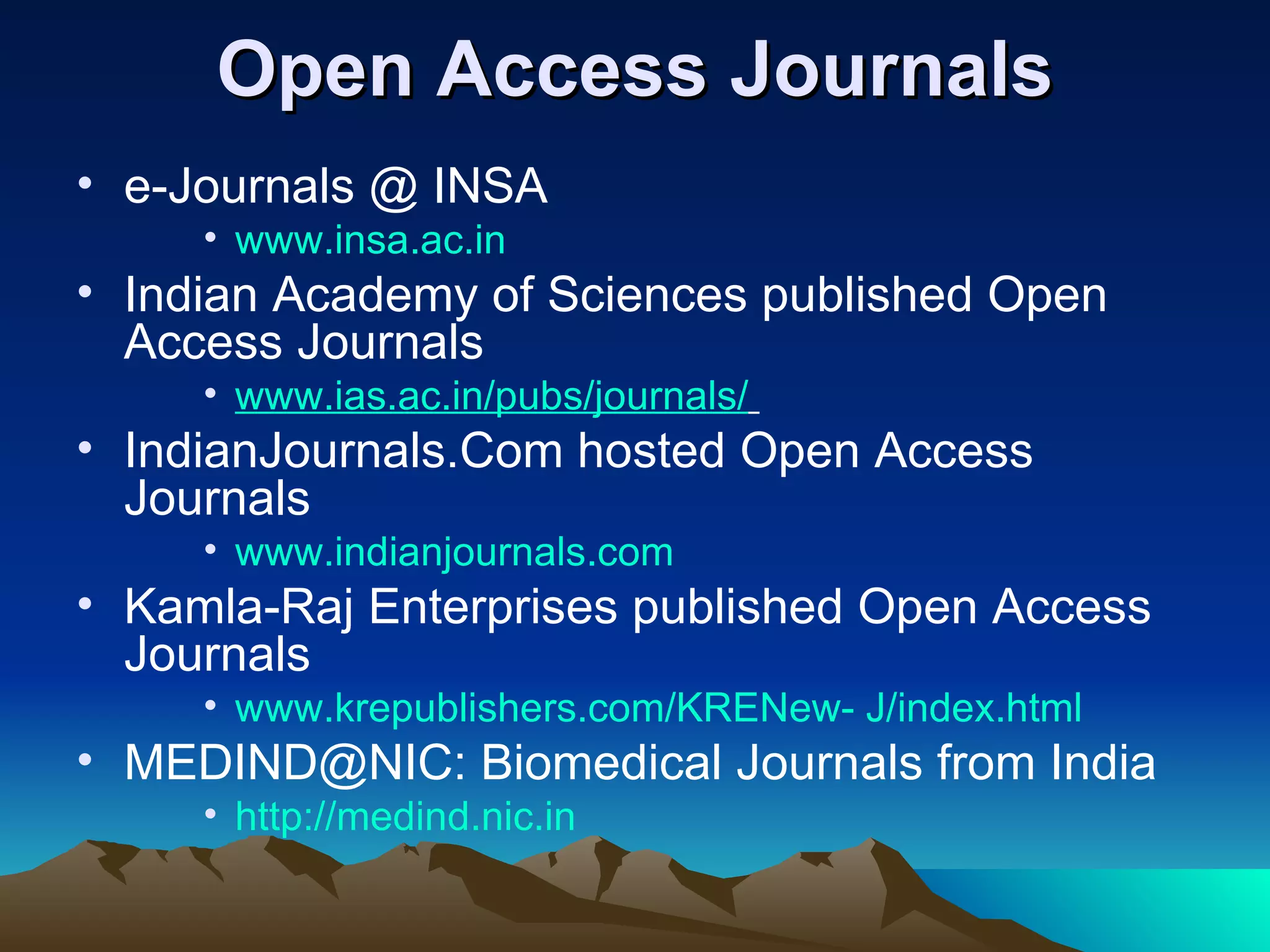
Open Access Journals
• e-Journals @ INSA
     • www.insa.ac.in
• Indian Academy of Sciences published Open
  Access Journals
     • www.ias.ac.in/pubs/journals/
• IndianJournals.Com hosted Open Access
  Journals
     • www.indianjournals.com
• Kamla-Raj Enterprises published Open Access
  Journals
     • www.krepublishers.com/KRENew- J/index.html
• MEDIND@NIC: Biomedical Journals from India
     • http://medind.nic.in
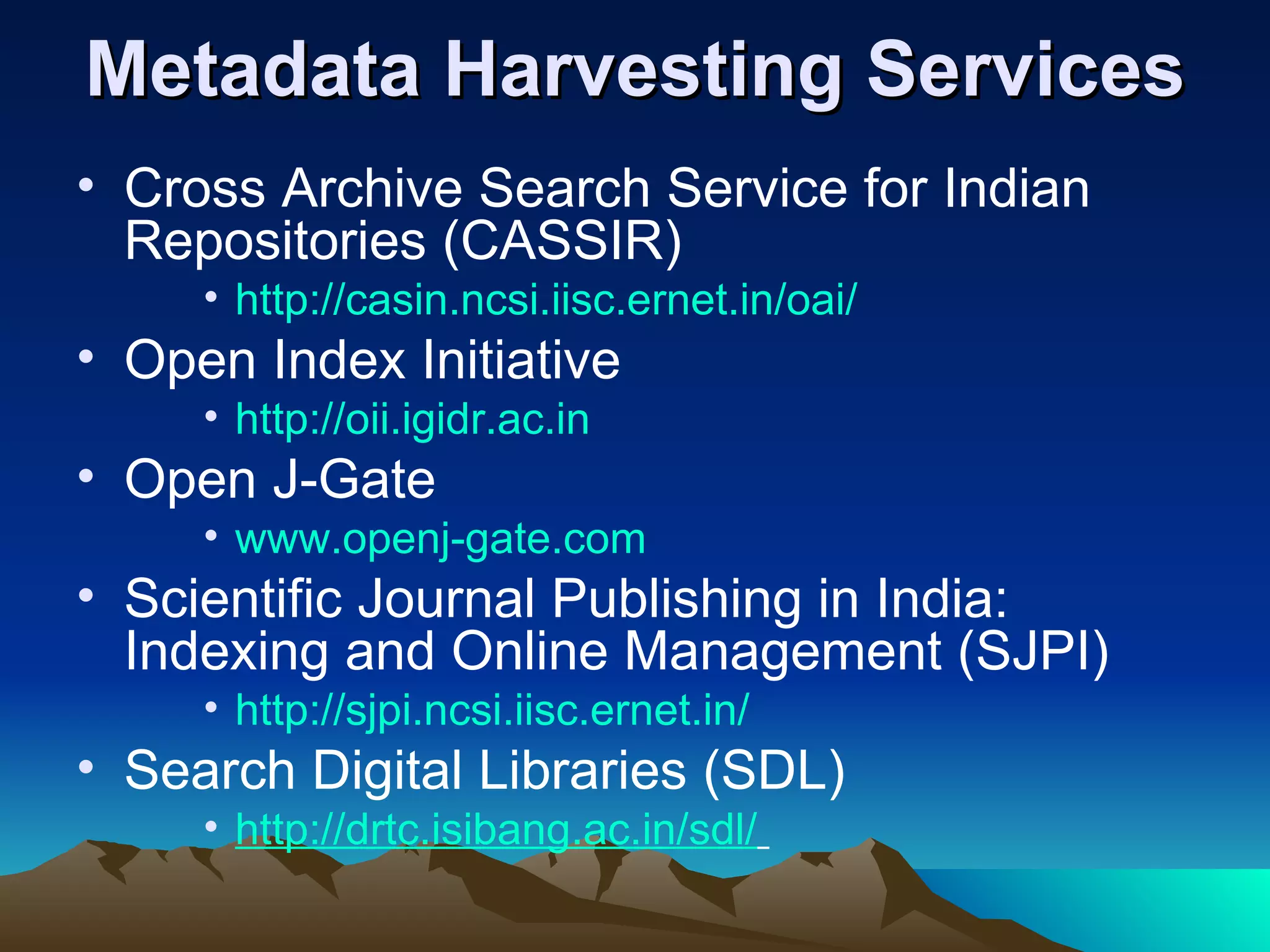
Metadata Harvesting Services
• Cross Archive Search Service for Indian
  Repositories (CASSIR)
     • http://casin.ncsi.iisc.ernet.in/oai/
• Open Index Initiative
     • http://oii.igidr.ac.in
• Open J-Gate
     • www.openj-gate.com
• Scientific Journal Publishing in India:
  Indexing and Online Management (SJPI)
     • http://sjpi.ncsi.iisc.ernet.in/
• Search Digital Libraries (SDL)
     • http://drtc.isibang.ac.in/sdl/
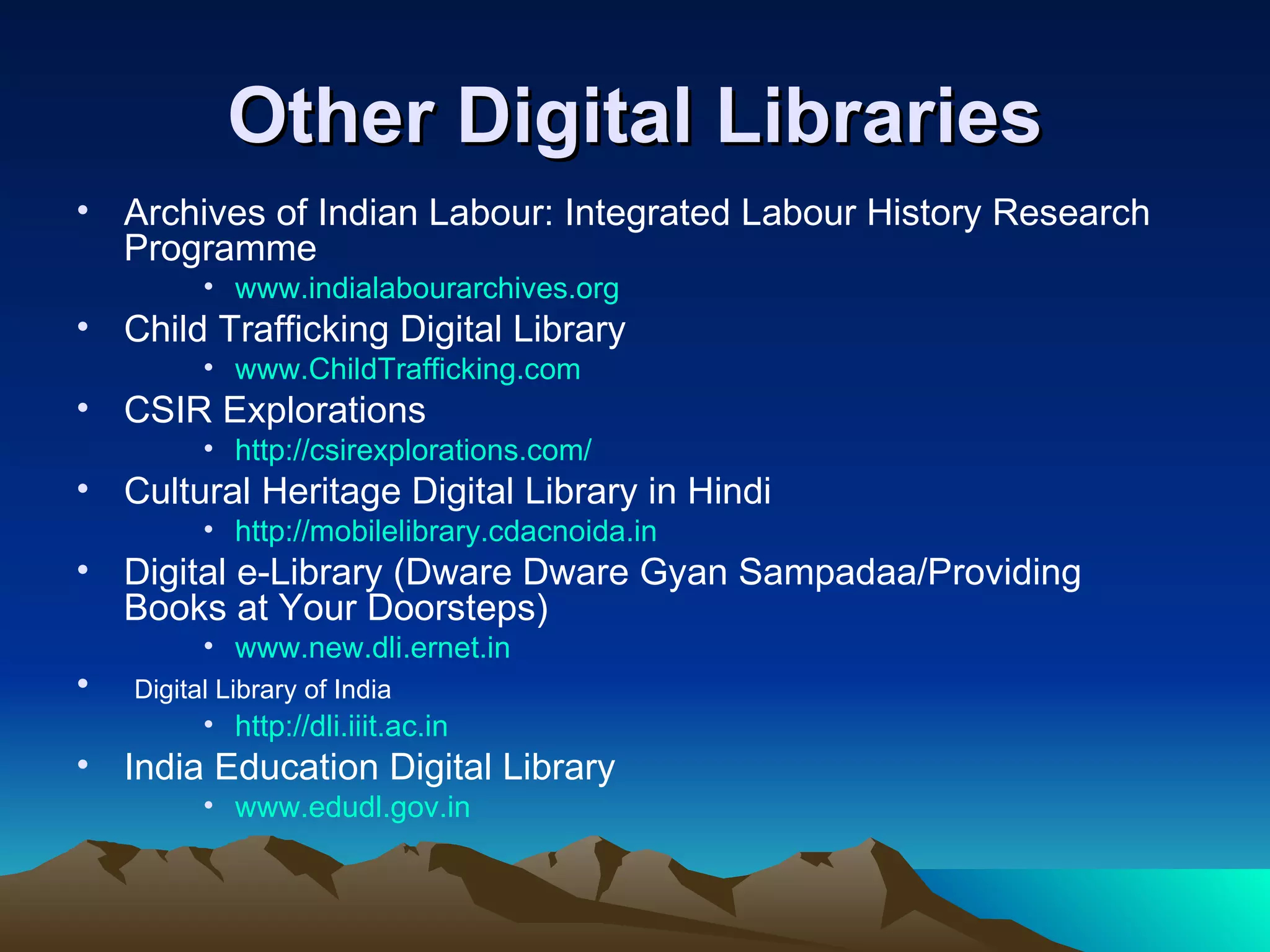
Other Digital Libraries
• Archives of Indian Labour: Integrated Labour History Research
  Programme
          • www.indialabourarchives.org
• Child Trafficking Digital Library
          • www.ChildTrafficking.com
• CSIR Explorations
          • http://csirexplorations.com/
• Cultural Heritage Digital Library in Hindi
          • http://mobilelibrary.cdacnoida.in
• Digital e-Library (Dware Dware Gyan Sampadaa/Providing
  Books at Your Doorsteps)
          • www.new.dli.ernet.in
•   Digital Library of India
          • http://dli.iiit.ac.in
• India Education Digital Library
          • www.edudl.gov.in
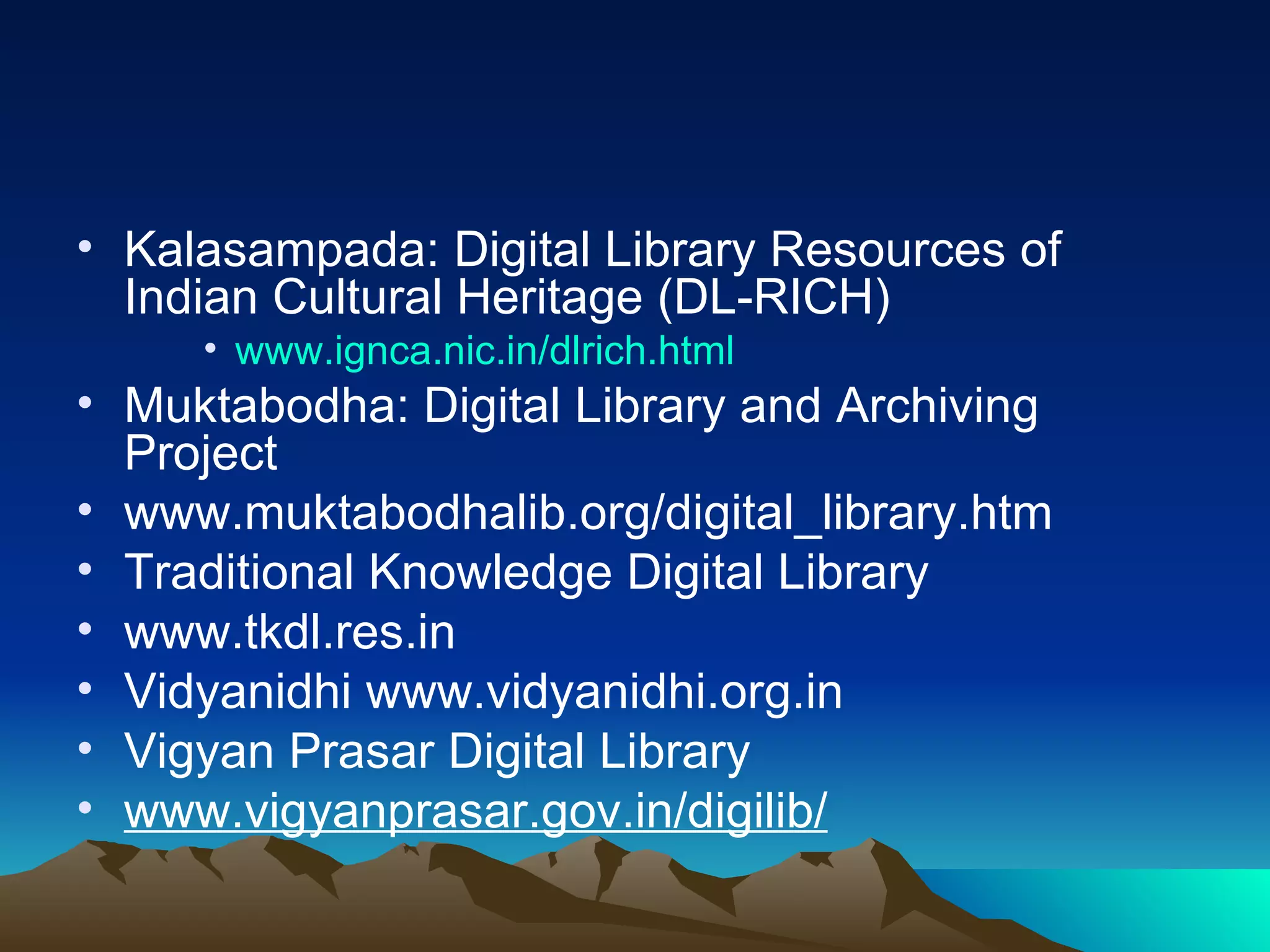
• Kalasampada: Digital Library Resources of
  Indian Cultural Heritage (DL-RICH)
     • www.ignca.nic.in/dlrich.html
• Muktabodha: Digital Library and Archiving
  Project
• www.muktabodhalib.org/digital_library.htm
• Traditional Knowledge Digital Library
• www.tkdl.res.in
• Vidyanidhi www.vidyanidhi.org.in
• Vigyan Prasar Digital Library
• www.vigyanprasar.gov.in/digilib/
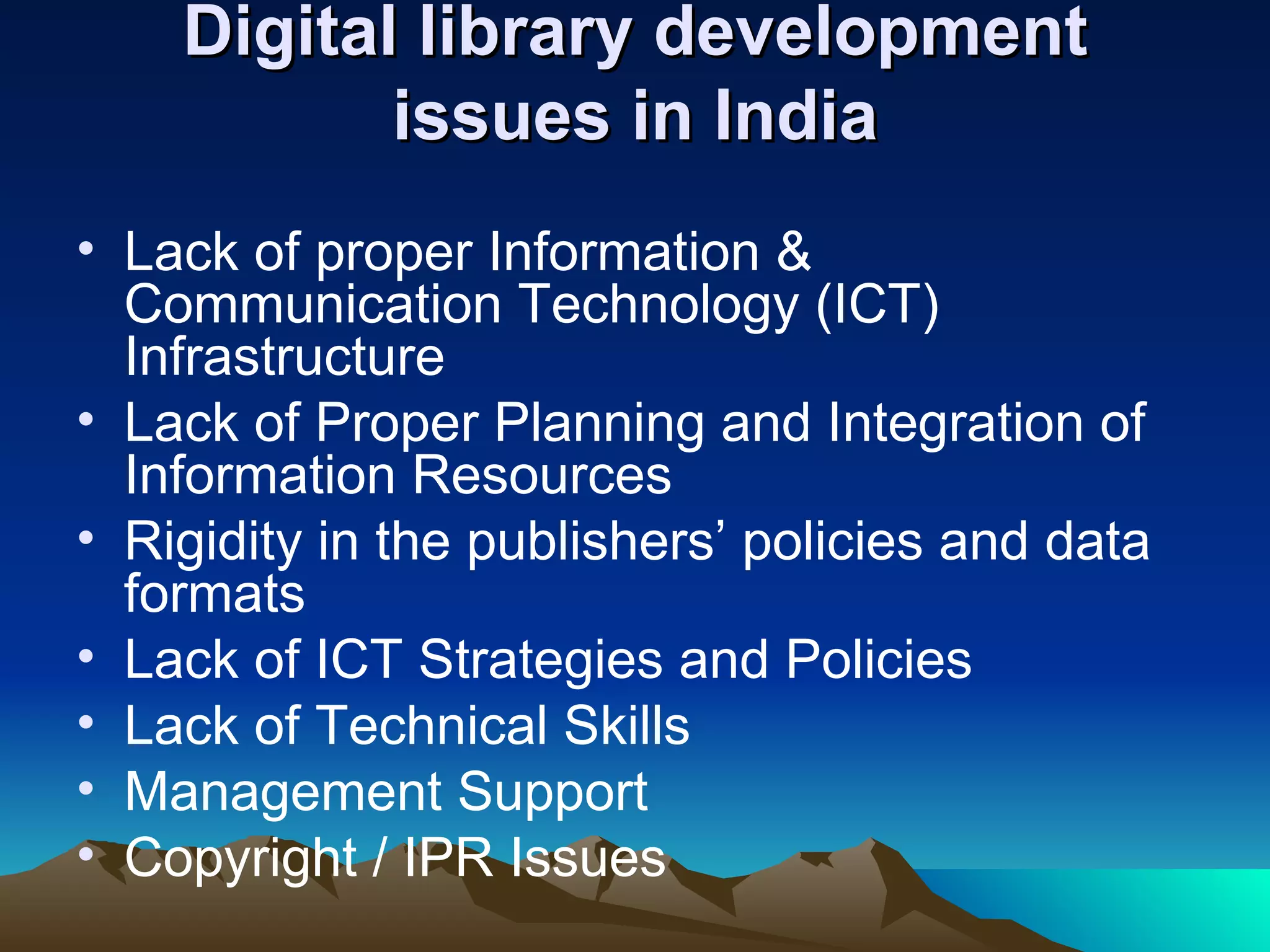
Digital library development
           issues in India
• Lack of proper Information &
  Communication Technology (ICT)
  Infrastructure
• Lack of Proper Planning and Integration of
  Information Resources
• Rigidity in the publishers’ policies and data
  formats
• Lack of ICT Strategies and Policies
• Lack of Technical Skills
• Management Support
• Copyright / IPR Issues
Conclusion
• The effect of focused capacity building programmers in
  the areas of digital preservation, digital libraries and
  open access to literature is encouraging in a country like
  India, where significant proliferation of open access and
  digital library initiatives have been achieved in the last
  decade, which has seen fantastic accomplishments and
  the future presents exciting possibilities and challenges.
  The key to commitment and development in this field lies
  in the sensitization of stakeholders as which has been
  done in India, in order to achieve that paradigm shift in
  universal access to information, knowledge and heritage
Bibliography
• Ambati, Vamshi... [et al] (2006). The Digital Library of India
  Project: Process, Policies and Architecture.
• Bhatnagar, S. & Schware, R. 2000. Technology in Development:
  Cases from India. Sage Publications.
• Bruce, B. C. (1997). Searching for digital libraries in education:
  Why computers cannot tell the story. Library Trends,
• 45(4), 746-770.
• Duncker, E., Yin Leng Theng, and Norlisa Mohd-Nasir. (2000).
  Cultural usability in digital libraries. Bulletin of the
• Jebaraj, F. 2003. “The Electronic Library: An Indian Scenario”.
  Library Philosophy and Practice. V5.N2. Spring 2003.
  www.webpages.uidaho.edu/~mbolin/jebaraj.pdf
• Ramdasi, N. Visualizing Indian Heritage Digital Library Model.
  Center for Development of Advanced Computing.
  www.cdacindia.com/html/pdf/ramdasi.pdf
• Sood, Aditya Dev and Chandrasekharan, Uma (2004). Digital
  Libraries in India: A
• Baseline Survey. New Delhi: Center for Knowledge Societies.

Digital Libraries: the process, initiatives and developmental issues in India-ETTLIS -2012

  • 1.
    Digital Libraries: the process,initiatives and developmental issues in India By Sudesh Kumar Sood Chief Librarian, H.P. Central State Library, Solan (H.P) sood_sk14@yahoo.co.in
  • 2.
    Features • A digitallibrary may allow either online or offline access to the elements it organizes and houses. • May include multimedia as well as multilingual data.
  • 3.
    Objectives and Workflow •Enhance the digital collection in a substantial way. • Embrace popular digital standards , formats and software platforms. • Emphasis on maximize the efficiency and effectiveness of the information access • Standard workflow patterns are to be identified for the system for: ‘content selection’, ‘content acquisition’, ‘ content publishing’, ‘content indexing and storage’, and ‘content accessing and delivery’. • The system should also concern about such related issues, – preservation, usage monitoring, access management, interoperability, administration and management etc.
  • 4.
    Meta-data Standards and Protocols • Metadata, or “data about data,” is a critical element for searching information through a database • A major governing body of the Web has developed de facto standards including RDF • At present, digital library initiatives in India make use of – Dublin Core for web-based publications, – Encoded Archival Description (EAD) for archiving and Visual Resources Association (VRA) for visual data. – Open Archives Initiative Protocol for Metadata Harvesting (OAI_PMH) to automatically extract metadata information from digital libraries and enhance interoperability between systems.
  • 5.
    Selection of theSoftware • It should be robust in technical architecture as well as the content architecture. • The system should address all major digital library related issues such as ‘design criteria’, ‘collection building’, ‘content organization’, ‘access’, ‘evaluation’, ‘policy and legal issues’ including ‘intellectual property rights’. • The system should also provide a powerful search engine and the interface should be easy to navigate and there should be provision for customization.
  • 6.
    • There aremany digital library soft wares available, proprietary as well as open source, and most of them conform to international standards. • VTLS and ACADO are the commercial ones available and popular in the Indian market. • Some of the popular Open Source Software for digital libraries, which are in use internationally, are ‘DSpace’, ‘Dienst’, ‘Eprints’, ‘Fedora’, ‘Greenstone’ etc.
  • 7.
    Some Initiatives ofIndia • Institutional Repositories • Open Courseware Initiatives • Open Access Journals • Metadata Harvesting Services • and Others
  • 8.
    Digital Repositories inIndia • Institutional repository (IR) systems by libraries, using • Greenstone • Dspace • EPrints • Some open access repositories are specially created to disseminate intellectual outputs of the country in the form of electronic theses and dissertations • Vidyanidhi • ETD@IISc. • Other national level open access repositories provide all kinds of scholarly materials on particular discipline. • The OpenMED@NIC • Librarians' Digital Library
  • 9.
    Some of suchrepositories are: • Digital Repository of IIT Bomaby • DRS@ino (National Institute of Oceanography) • DSpace@NITR (National Institute of Technology, Rourkela) • DSpace@MDI (Indian Institute of Management Kozhikode) • DSpace at National Chemical Laboratory, Pune • DSpace@INFLIBNET • Digital Collections@INFLIBNET Centre • ePrints@SVNIT (Sardar Vallabhbai National Institute of Technology) • eGyanKosh (IGNOU) • ePrints@IIT Delhi
  • 10.
    • ePrints@IISc • ePrints@Catalysis(National Centre for Catalysis Research) • ePrings@SBTMKU (School of Biotechnology, Madurai Kamraj University) • Indian Institute of Astrophysics Repository • National Aerospace Laboratories • Kautilya Digital Repository of IGIDR (Indira Gandhi Institute of Development Research, Mumbai) • NISCAIR Online Periodicals Repository • OpenMED@NIC (Medical) • NISCAIR Online Periodicals Repository • RRI Digital Repository (Raman Research Institute Digital Repository)
  • 11.
    Open Courseware Initiatives •CEC Learning Object Repository • www.cec-lor.edu.in • eGyankosh A National Digital Repository • www.egyankosh.ac.in • Indo-German eGurukul on Digital Libraries • http://drtc.isibang.ac.in/mmb/ • National Programme on Technology Enhanced Learning (NPTEL) • www.nptel.iitm.ac.in • NCERT Online Textbooks • www.ncert.nic.in/textbooks/testing/Index.htm • UNESCO-SALIS e-Learning Portal • http://salisonline.org
  • 12.
    Open Access Journals •e-Journals @ INSA • www.insa.ac.in • Indian Academy of Sciences published Open Access Journals • www.ias.ac.in/pubs/journals/ • IndianJournals.Com hosted Open Access Journals • www.indianjournals.com • Kamla-Raj Enterprises published Open Access Journals • www.krepublishers.com/KRENew- J/index.html • MEDIND@NIC: Biomedical Journals from India • http://medind.nic.in
  • 13.
    Metadata Harvesting Services •Cross Archive Search Service for Indian Repositories (CASSIR) • http://casin.ncsi.iisc.ernet.in/oai/ • Open Index Initiative • http://oii.igidr.ac.in • Open J-Gate • www.openj-gate.com • Scientific Journal Publishing in India: Indexing and Online Management (SJPI) • http://sjpi.ncsi.iisc.ernet.in/ • Search Digital Libraries (SDL) • http://drtc.isibang.ac.in/sdl/
  • 14.
    Other Digital Libraries •Archives of Indian Labour: Integrated Labour History Research Programme • www.indialabourarchives.org • Child Trafficking Digital Library • www.ChildTrafficking.com • CSIR Explorations • http://csirexplorations.com/ • Cultural Heritage Digital Library in Hindi • http://mobilelibrary.cdacnoida.in • Digital e-Library (Dware Dware Gyan Sampadaa/Providing Books at Your Doorsteps) • www.new.dli.ernet.in • Digital Library of India • http://dli.iiit.ac.in • India Education Digital Library • www.edudl.gov.in
  • 15.
    • Kalasampada: DigitalLibrary Resources of Indian Cultural Heritage (DL-RICH) • www.ignca.nic.in/dlrich.html • Muktabodha: Digital Library and Archiving Project • www.muktabodhalib.org/digital_library.htm • Traditional Knowledge Digital Library • www.tkdl.res.in • Vidyanidhi www.vidyanidhi.org.in • Vigyan Prasar Digital Library • www.vigyanprasar.gov.in/digilib/
  • 16.
    Digital library development issues in India • Lack of proper Information & Communication Technology (ICT) Infrastructure • Lack of Proper Planning and Integration of Information Resources • Rigidity in the publishers’ policies and data formats • Lack of ICT Strategies and Policies • Lack of Technical Skills • Management Support • Copyright / IPR Issues
  • 17.
    Conclusion • The effectof focused capacity building programmers in the areas of digital preservation, digital libraries and open access to literature is encouraging in a country like India, where significant proliferation of open access and digital library initiatives have been achieved in the last decade, which has seen fantastic accomplishments and the future presents exciting possibilities and challenges. The key to commitment and development in this field lies in the sensitization of stakeholders as which has been done in India, in order to achieve that paradigm shift in universal access to information, knowledge and heritage
  • 18.
    Bibliography • Ambati, Vamshi...[et al] (2006). The Digital Library of India Project: Process, Policies and Architecture. • Bhatnagar, S. & Schware, R. 2000. Technology in Development: Cases from India. Sage Publications. • Bruce, B. C. (1997). Searching for digital libraries in education: Why computers cannot tell the story. Library Trends, • 45(4), 746-770. • Duncker, E., Yin Leng Theng, and Norlisa Mohd-Nasir. (2000). Cultural usability in digital libraries. Bulletin of the • Jebaraj, F. 2003. “The Electronic Library: An Indian Scenario”. Library Philosophy and Practice. V5.N2. Spring 2003. www.webpages.uidaho.edu/~mbolin/jebaraj.pdf • Ramdasi, N. Visualizing Indian Heritage Digital Library Model. Center for Development of Advanced Computing. www.cdacindia.com/html/pdf/ramdasi.pdf • Sood, Aditya Dev and Chandrasekharan, Uma (2004). Digital Libraries in India: A • Baseline Survey. New Delhi: Center for Knowledge Societies.