
DIGITAL LIBRARYDIGITAL LIBRARY
By Ms. Sheila J. EchaluceBy Ms. Sheila J. Echaluce
DiscussantDiscussant
 Definition
 Brief History of Digital Library
 Role of Digital Libraries
 Major Issues and Challenges
 Advantages
 Disadvantages
 Example of Digital/Virtual/Electronic
Libraries
ContentsContents
What is a Digital Library?What is a Digital Library?
 Is a special library with a focused collection of digital objects
that can include text, visual material, audio material, video
material, stored as electronic media formats (as opposed to
print, microform, or other media), along with means for
organizing, storing, and retrieving the files and media
contained in the library collection.
 Can vary immensely in size and scope, and can be
maintained by individuals, organizations, or affiliated with
established physical library buildings or institutions, or with
academic institutions.
 The content may be stored locally, or accessed remotely via
computer networks.
 Is a type of information retrieval system.
HistoryHistory
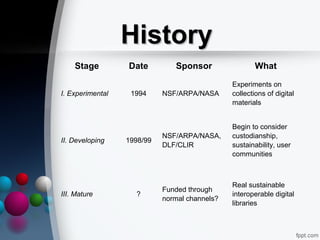
Stage Date Sponsor What
I. Experimental 1994 NSF/ARPA/NASA
Experiments on
collections of digital
materials
II. Developing 1998/99
NSF/ARPA/NASA,
DLF/CLIR
Begin to consider
custodianship,
sustainability, user
communities
III. Mature ?
Funded through
normal channels?
Real sustainable
interoperable digital
libraries
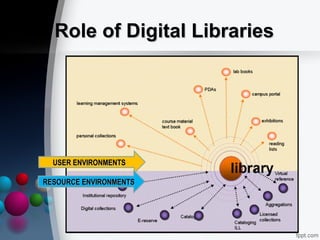
Role of Digital LibrariesRole of Digital Libraries
USER ENVIRONMENTSUSER ENVIRONMENTS
RESOURCE ENVIRONMENTSRESOURCE ENVIRONMENTS
Role of Digital LibrariesRole of Digital Libraries
 User EnvironmentUser Environment – Includes Personal– Includes Personal
collections, Learning management Systems,collections, Learning management Systems,
Course material text book, PDAs, Lab Books,Course material text book, PDAs, Lab Books,
Campus portal, Exhibitions, and Reading listCampus portal, Exhibitions, and Reading list
 Resource EnvironmentResource Environment – Includes– Includes
Institutional repository, Digital collections, E-Institutional repository, Digital collections, E-
reserve, Catalog, Cataloging Illustration,reserve, Catalog, Cataloging Illustration,
Licensed Collections, Aggregations, andLicensed Collections, Aggregations, and
Virtual reference.Virtual reference.
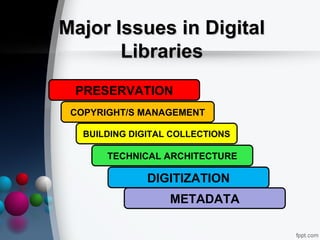
Major Issues in DigitalMajor Issues in Digital
LibrariesLibraries
PRESERVATION
COPYRIGHT/S MANAGEMENT
BUILDING DIGITAL COLLECTIONS
TECHNICAL ARCHITECTURE
DIGITIZATION
METADATA
PRESERVATION
This is very important issue for Digital
Libraries. In the preservation of digital
material, the real issue is technical
obsolescence. There are three issues of
preservation:
 Preservation of the storage medium – tapes, hard drives, floppy
discs
 Preservation have a short life span when considered in terms of
obsolescence
 Preservation of access to content – this form of preservation
involves preserving access to the content of the document
regardless of the format. While files can be moved from one
storage medium to another, what happens when the formats (e.g.,
Acrobat PDF) containing the information becomes obsolete?
COPYRIGHT/S MANAGEMENT
 Copyright is one of the most important barriers to
digital library development.
 The current paper- based concept of copyright
breaks down in the digital environment because the
control of copies is lost.
 Digital objects are less fixed, easily copied and
remotely accessible by multiple users
simultaneously.
 The problems of libraries are that they are for the
most part simply caretakers of information, they do
not own the copyright of the material they hold.
 So libraries will never be able to freely digitize and
provide access to the copyrighted material in their
collection.
 They have to develop a mechanism for managing
copyright.
BUILDING DIGITAL COLLECTIONS
 One of the most important issues in creating a
digital library
 Major issue that the degree to which libraries will
digitize existing material and acquire original digital
works.
 Old access versus ownership issue.
 How is the specific material to be digitized / to be
acquired to be identified by a given library.
 Who collects and/or digitizes which material could
be based on factors such as – collection strength,
unique collections, the priorities of user groups,
manageable portions of collection, technological
resources and skills of the staff
TECHNICAL ARCHITECTURE
High speed local network and fast
connection to internet
Relational database that supports a
variety of digital formats
Full text search engines to index
and provide access to resources
A variety of servers such as web
services and FTP servers
Digitization is conversion of any fixed or
analogue media – such as books, journal
articles, photos, paintings, microfilm into
electronic form either through scanning or
rekeying.
There are several approaches available, at
least theoretically.
- Making Digital
- Databasing
- Sharing Data
- Using Technology
- Governing Digitization
- Managing Data
DIGITIZATION
 The data that describe the content and attributes of any
particular item in a digital library. Metadata is important
for digital libraries because it is the key to resources,
discovery and use of any document like a library
catalogue. The “Dublin Core” is one of the prominent
schemes. There is the problem of naming, identifiers and
persistence. Naming is required to uniquely identify
digital objects. Any system of naming should be
permanent, lasting indefinitely. The names cannot be
bound with specific locations. A global scheme of unique
identifier is required. are PURLs, URNs, and digital
Three schemes proposed to get over the problems of
persistent naming object identifiers:
 Persistent URLs (PURLs) – a scheme developed by OCLC to
separate document name from its a location.
 Uniform Resource Name (URN) – have been developed by Internet
Engineering Task Force (IETF).
 Digital Object Identifier (DOI) – Developed by Association of
American Publishers and Corporation for National Research Initiatives
to provide a method by which digital object can be reliably identified
and accessed .
METADATA
 No physical boundary
 Round the clock availability
 Multiple access
 Information retrieval
 Preservation and conservation
 Space
 Added value
 Easily accessible
Advantages of DigitalAdvantages of Digital
LibrariesLibraries
Disadvantages of DigitalDisadvantages of Digital
LibrariesLibraries
Equity of access
Interoperability
User authentication
Information organization
Interface design
Digital preservation
Copyright
Budget
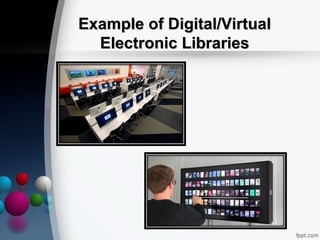
Example of Digital/VirtualExample of Digital/Virtual
Electronic LibrariesElectronic Libraries
Digital Library SoftwareDigital Library Software
 Greenstone Digital Library Software - is an open-source
system for the construction and presentation of information
collections. It builds collections with effective full-text searching
and metadata-based browsing facilities that are attractive and
easy to use.
 Dspace - is a groundbreaking digital institutional repository that
captures, stores, indexes, preserves, and redistributes the
intellectual output of a university’s research faculty in digital
formats.
 Eprints is an open source software package for building open
access repositories that are compliant with the Open Archives
Initiative Protocol for Metadata Harvesting.
 Fedora open source software - gives organizations a flexible
service-oriented architecture for managing and delivering their
digital content. At its core is a powerful digital object model that
supports multiple views of each digital object and the
relationships among digital objects.
ReferencesReferences
 http://www.dlib.org/dlib/march03/witten/03witten.html
 https://en.wikipedia.org/wiki/Digital_library
 https://www.mindmeister.com/32153085/digital-library
 https://www.wdl.org/en/
 https://whatis.techtarget.com/definition/digital-library
 https://library.si.edu/digital-library
 https://edoc.hu-
berlin.de/bitstream/handle/18452/9987/3.pdf?
sequence=1
 http://www.unesco.org/new/fileadmin/MULTIMEDIA/HQ/
CI/CI/pdf/programme_doc_wdl.pdf
ThankThank
You!!!You!!!
ThankThank
You!!!You!!!

Digital Libray

  • 1.
    DIGITAL LIBRARYDIGITAL LIBRARY ByMs. Sheila J. EchaluceBy Ms. Sheila J. Echaluce DiscussantDiscussant
  • 2.
     Definition  BriefHistory of Digital Library  Role of Digital Libraries  Major Issues and Challenges  Advantages  Disadvantages  Example of Digital/Virtual/Electronic Libraries ContentsContents
  • 3.
    What is aDigital Library?What is a Digital Library?  Is a special library with a focused collection of digital objects that can include text, visual material, audio material, video material, stored as electronic media formats (as opposed to print, microform, or other media), along with means for organizing, storing, and retrieving the files and media contained in the library collection.  Can vary immensely in size and scope, and can be maintained by individuals, organizations, or affiliated with established physical library buildings or institutions, or with academic institutions.  The content may be stored locally, or accessed remotely via computer networks.  Is a type of information retrieval system.
  • 4.
    HistoryHistory Stage Date SponsorWhat I. Experimental 1994 NSF/ARPA/NASA Experiments on collections of digital materials II. Developing 1998/99 NSF/ARPA/NASA, DLF/CLIR Begin to consider custodianship, sustainability, user communities III. Mature ? Funded through normal channels? Real sustainable interoperable digital libraries
  • 5.
    Role of DigitalLibrariesRole of Digital Libraries USER ENVIRONMENTSUSER ENVIRONMENTS RESOURCE ENVIRONMENTSRESOURCE ENVIRONMENTS
  • 6.
    Role of DigitalLibrariesRole of Digital Libraries  User EnvironmentUser Environment – Includes Personal– Includes Personal collections, Learning management Systems,collections, Learning management Systems, Course material text book, PDAs, Lab Books,Course material text book, PDAs, Lab Books, Campus portal, Exhibitions, and Reading listCampus portal, Exhibitions, and Reading list  Resource EnvironmentResource Environment – Includes– Includes Institutional repository, Digital collections, E-Institutional repository, Digital collections, E- reserve, Catalog, Cataloging Illustration,reserve, Catalog, Cataloging Illustration, Licensed Collections, Aggregations, andLicensed Collections, Aggregations, and Virtual reference.Virtual reference.
  • 7.
    Major Issues inDigitalMajor Issues in Digital LibrariesLibraries PRESERVATION COPYRIGHT/S MANAGEMENT BUILDING DIGITAL COLLECTIONS TECHNICAL ARCHITECTURE DIGITIZATION METADATA
  • 8.
    PRESERVATION This is veryimportant issue for Digital Libraries. In the preservation of digital material, the real issue is technical obsolescence. There are three issues of preservation:  Preservation of the storage medium – tapes, hard drives, floppy discs  Preservation have a short life span when considered in terms of obsolescence  Preservation of access to content – this form of preservation involves preserving access to the content of the document regardless of the format. While files can be moved from one storage medium to another, what happens when the formats (e.g., Acrobat PDF) containing the information becomes obsolete?
  • 9.
    COPYRIGHT/S MANAGEMENT  Copyrightis one of the most important barriers to digital library development.  The current paper- based concept of copyright breaks down in the digital environment because the control of copies is lost.  Digital objects are less fixed, easily copied and remotely accessible by multiple users simultaneously.  The problems of libraries are that they are for the most part simply caretakers of information, they do not own the copyright of the material they hold.  So libraries will never be able to freely digitize and provide access to the copyrighted material in their collection.  They have to develop a mechanism for managing copyright.
  • 10.
    BUILDING DIGITAL COLLECTIONS One of the most important issues in creating a digital library  Major issue that the degree to which libraries will digitize existing material and acquire original digital works.  Old access versus ownership issue.  How is the specific material to be digitized / to be acquired to be identified by a given library.  Who collects and/or digitizes which material could be based on factors such as – collection strength, unique collections, the priorities of user groups, manageable portions of collection, technological resources and skills of the staff
  • 11.
    TECHNICAL ARCHITECTURE High speedlocal network and fast connection to internet Relational database that supports a variety of digital formats Full text search engines to index and provide access to resources A variety of servers such as web services and FTP servers
  • 12.
    Digitization is conversionof any fixed or analogue media – such as books, journal articles, photos, paintings, microfilm into electronic form either through scanning or rekeying. There are several approaches available, at least theoretically. - Making Digital - Databasing - Sharing Data - Using Technology - Governing Digitization - Managing Data DIGITIZATION
  • 13.
     The datathat describe the content and attributes of any particular item in a digital library. Metadata is important for digital libraries because it is the key to resources, discovery and use of any document like a library catalogue. The “Dublin Core” is one of the prominent schemes. There is the problem of naming, identifiers and persistence. Naming is required to uniquely identify digital objects. Any system of naming should be permanent, lasting indefinitely. The names cannot be bound with specific locations. A global scheme of unique identifier is required. are PURLs, URNs, and digital Three schemes proposed to get over the problems of persistent naming object identifiers:  Persistent URLs (PURLs) – a scheme developed by OCLC to separate document name from its a location.  Uniform Resource Name (URN) – have been developed by Internet Engineering Task Force (IETF).  Digital Object Identifier (DOI) – Developed by Association of American Publishers and Corporation for National Research Initiatives to provide a method by which digital object can be reliably identified and accessed . METADATA
  • 14.
     No physicalboundary  Round the clock availability  Multiple access  Information retrieval  Preservation and conservation  Space  Added value  Easily accessible Advantages of DigitalAdvantages of Digital LibrariesLibraries
  • 15.
    Disadvantages of DigitalDisadvantagesof Digital LibrariesLibraries Equity of access Interoperability User authentication Information organization Interface design Digital preservation Copyright Budget
  • 16.
    Example of Digital/VirtualExampleof Digital/Virtual Electronic LibrariesElectronic Libraries
  • 17.
    Digital Library SoftwareDigitalLibrary Software  Greenstone Digital Library Software - is an open-source system for the construction and presentation of information collections. It builds collections with effective full-text searching and metadata-based browsing facilities that are attractive and easy to use.  Dspace - is a groundbreaking digital institutional repository that captures, stores, indexes, preserves, and redistributes the intellectual output of a university’s research faculty in digital formats.  Eprints is an open source software package for building open access repositories that are compliant with the Open Archives Initiative Protocol for Metadata Harvesting.  Fedora open source software - gives organizations a flexible service-oriented architecture for managing and delivering their digital content. At its core is a powerful digital object model that supports multiple views of each digital object and the relationships among digital objects.
  • 18.
    ReferencesReferences  http://www.dlib.org/dlib/march03/witten/03witten.html  https://en.wikipedia.org/wiki/Digital_library https://www.mindmeister.com/32153085/digital-library  https://www.wdl.org/en/  https://whatis.techtarget.com/definition/digital-library  https://library.si.edu/digital-library  https://edoc.hu- berlin.de/bitstream/handle/18452/9987/3.pdf? sequence=1  http://www.unesco.org/new/fileadmin/MULTIMEDIA/HQ/ CI/CI/pdf/programme_doc_wdl.pdf
  • 19.