Digital Libraries: Major issues/challenges
by
Dheeraj Singh Negi
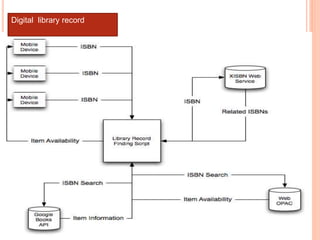
Digital library record
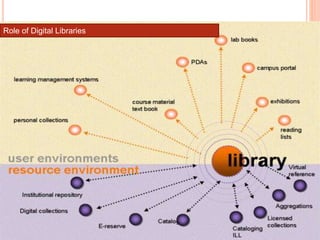
Role of Digital Libraries
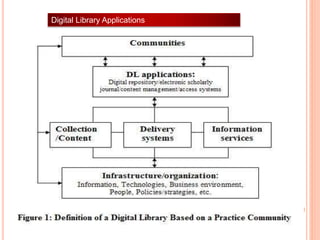
Digital Library Applications
MAJOR ISSUES/CHALLENGES
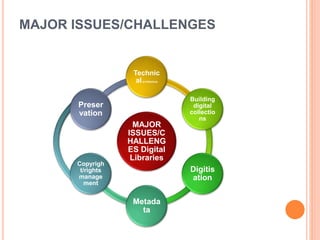
MAJOR
ISSUES/C
HALLENG
ES Digital
Libraries
Technic
alarchitecture
Building
digital
collectio
ns
Digitis
ation
Metada
ta
Copyrigh
t/rights
manage
ment
Preser
vation
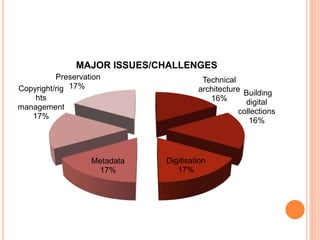
Technical
architecture
16%
Building
digital
collections
16%
Digitisation
17%
Metadata
17%
Copyright/rig
hts
management
17%
Preservation
17%
MAJOR ISSUES/CHALLENGES
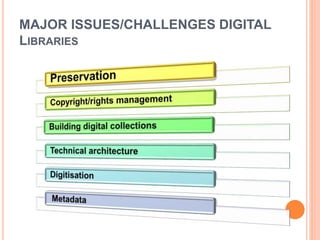
MAJOR ISSUES/CHALLENGES DIGITAL
LIBRARIES
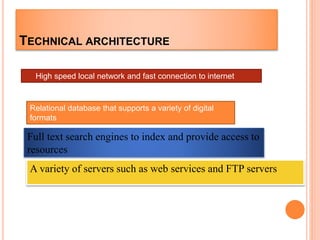
TECHNICAL ARCHITECTURE
High speed local network and fast connection to internet
Relational database that supports a variety of digital
formats
Full text search engines to index and provide access to
resources
A variety of servers such as web services and FTP servers
BUILDING DIGITAL COLLECTIONS -
 One of the most important issues in creating a
digital library is building of the digital collection. One
of the major issue is the degree to which libraries
will digitise existing material and acquire original
digitalworks. This is the old access versus
ownership issue. How is the specific material to be
digitised / to be acquired to be identified by a given
library. Who collects and/or digitises which material
could be based on factors such as – collection
strength, unique collections, the priorities of user
groups, manageable portions of collection,
technological resources and skills of the staff
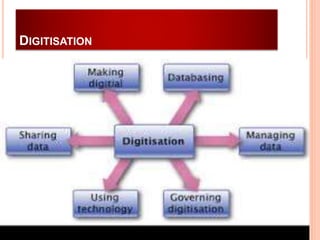
DIGITISATION
CONTD….
 . Digitisation is conversion of any fixed or analogue
media – such as books, journal articles, photos,
paintings, microfilm into electronic form either
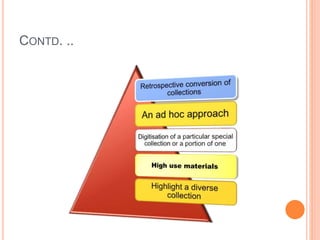
through scanning or rekeying. There are several
approaches available, at least theoretically.
CONTD. ..
METADATA
 Metadata is the data that describe the content and
attributes of any particular item in a digital library.
Metadata is important for digital libraries because it is
the key to resources, discovery and use of any
document like a library catalogue. The “Dublin Core” is
one of the prominent schemes. There is the problem of
naming, identifiers and persistence. Naming is required
to uniquely identify digital objects. Any system of naming
should be permanent, lasting indefinitely. The names
cannot be bound with specific locations. A global
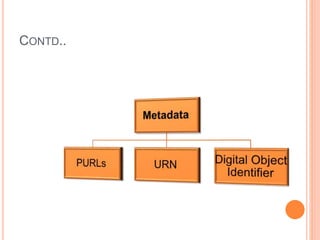
scheme of unique identifier is required. Three schemes
proposed to get over the problems of persistent naming
are PURLs, URNs, and digital object identifiers:
CONTD..
CONTD..
 PURLs – are persistent URLs, a scheme developed
by OCLC to separate document name from its a
location.
 URN – Uniform Resource Name have been
developed by Internet EngineeringTask Force
(IETF).
 Digital Object Identifier (DOI) – Developed by
Association of American Publishers and
Corporation for National Research Initiatives to
provide a method by which digital object can be
reliably identified and accessed .
COPYRIGHT/RIGHTS MANAGEMENT
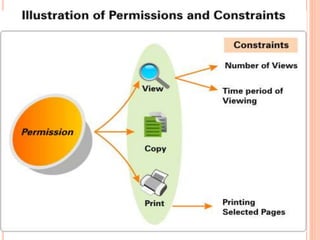
 Copyright is one of the most important barriers to
digital library development. The current paper-
based concept of copyright breaks down in the
digital environment because the control of copies is
lost. Digital objects are less fixed, easily copied and
remotely accessible by multiple users
simultaneously. The problems of libraries are that
they are for the most part simply caretakers of
information, they do not own the copyright of the
material they hold. So libraries will never be able to
freely digitise and provide access to the copyrighted
material in their collection. They have to develop a
mechanism for managing copyright.
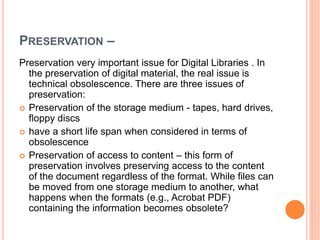
PRESERVATION –
Preservation very important issue for Digital Libraries . In
the preservation of digital material, the real issue is
technical obsolescence. There are three issues of
preservation:
 Preservation of the storage medium - tapes, hard drives,
floppy discs
 have a short life span when considered in terms of
obsolescence
 Preservation of access to content – this form of
preservation involves preserving access to the content
of the document regardless of the format. While files can
be moved from one storage medium to another, what
happens when the formats (e.g., Acrobat PDF)
containing the information becomes obsolete?
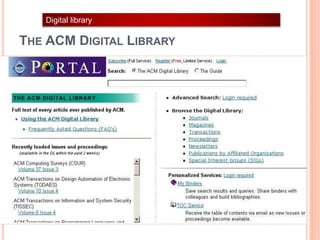
THE ACM DIGITAL LIBRARY
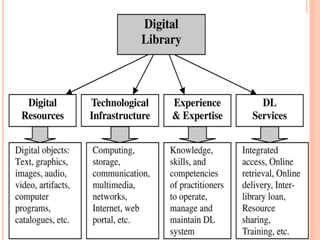
Digital library
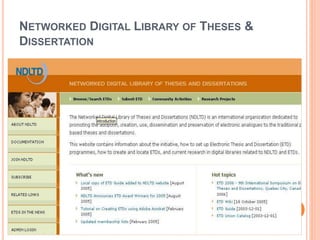
NETWORKED DIGITAL LIBRARY OF THESES &
DISSERTATION
Digital libraries

Digital libraries

  • 1.
    Digital Libraries: Majorissues/challenges by Dheeraj Singh Negi
  • 4.
  • 5.
    Role of DigitalLibraries
  • 6.
  • 8.
  • 9.
  • 10.
  • 11.
    TECHNICAL ARCHITECTURE High speedlocal network and fast connection to internet Relational database that supports a variety of digital formats Full text search engines to index and provide access to resources A variety of servers such as web services and FTP servers
  • 12.
    BUILDING DIGITAL COLLECTIONS-  One of the most important issues in creating a digital library is building of the digital collection. One of the major issue is the degree to which libraries will digitise existing material and acquire original digitalworks. This is the old access versus ownership issue. How is the specific material to be digitised / to be acquired to be identified by a given library. Who collects and/or digitises which material could be based on factors such as – collection strength, unique collections, the priorities of user groups, manageable portions of collection, technological resources and skills of the staff
  • 13.
  • 14.
    CONTD….  . Digitisationis conversion of any fixed or analogue media – such as books, journal articles, photos, paintings, microfilm into electronic form either through scanning or rekeying. There are several approaches available, at least theoretically.
  • 15.
  • 16.
    METADATA  Metadata isthe data that describe the content and attributes of any particular item in a digital library. Metadata is important for digital libraries because it is the key to resources, discovery and use of any document like a library catalogue. The “Dublin Core” is one of the prominent schemes. There is the problem of naming, identifiers and persistence. Naming is required to uniquely identify digital objects. Any system of naming should be permanent, lasting indefinitely. The names cannot be bound with specific locations. A global scheme of unique identifier is required. Three schemes proposed to get over the problems of persistent naming are PURLs, URNs, and digital object identifiers:
  • 17.
  • 18.
    CONTD..  PURLs –are persistent URLs, a scheme developed by OCLC to separate document name from its a location.  URN – Uniform Resource Name have been developed by Internet EngineeringTask Force (IETF).  Digital Object Identifier (DOI) – Developed by Association of American Publishers and Corporation for National Research Initiatives to provide a method by which digital object can be reliably identified and accessed .
  • 19.
    COPYRIGHT/RIGHTS MANAGEMENT  Copyrightis one of the most important barriers to digital library development. The current paper- based concept of copyright breaks down in the digital environment because the control of copies is lost. Digital objects are less fixed, easily copied and remotely accessible by multiple users simultaneously. The problems of libraries are that they are for the most part simply caretakers of information, they do not own the copyright of the material they hold. So libraries will never be able to freely digitise and provide access to the copyrighted material in their collection. They have to develop a mechanism for managing copyright.
  • 21.
    PRESERVATION – Preservation veryimportant issue for Digital Libraries . In the preservation of digital material, the real issue is technical obsolescence. There are three issues of preservation:  Preservation of the storage medium - tapes, hard drives, floppy discs  have a short life span when considered in terms of obsolescence  Preservation of access to content – this form of preservation involves preserving access to the content of the document regardless of the format. While files can be moved from one storage medium to another, what happens when the formats (e.g., Acrobat PDF) containing the information becomes obsolete?
  • 22.
    THE ACM DIGITALLIBRARY Digital library
  • 23.
    NETWORKED DIGITAL LIBRARYOF THESES & DISSERTATION