Building the
'digital' library
Routes to managing our
institutional digital learning,
teaching and research assets
together
Chris Awre
Open Repositories 2014
Helsinki
12th June 2014
Baseline
Libraries
 Collections of knowledge
 Acknowledging that libraries have always
been more than just collections
 Strong service emphasis
 Stewardship, incl. preservation
 Organisational sustainability
 Reaching out to other collections
 Ethical traditions
Howard Besser, 2002
Move to digital
 How well do our libraries have these
characteristics when managing digital
materials?
 Besser concluded there was some way to go
 12 years on, are we progressing?
 Initiatives looking ahead
 Academic Libraries of the Future, 2009-11
 ARL scenario planning, 2010
 Both agreed that the future will be digital
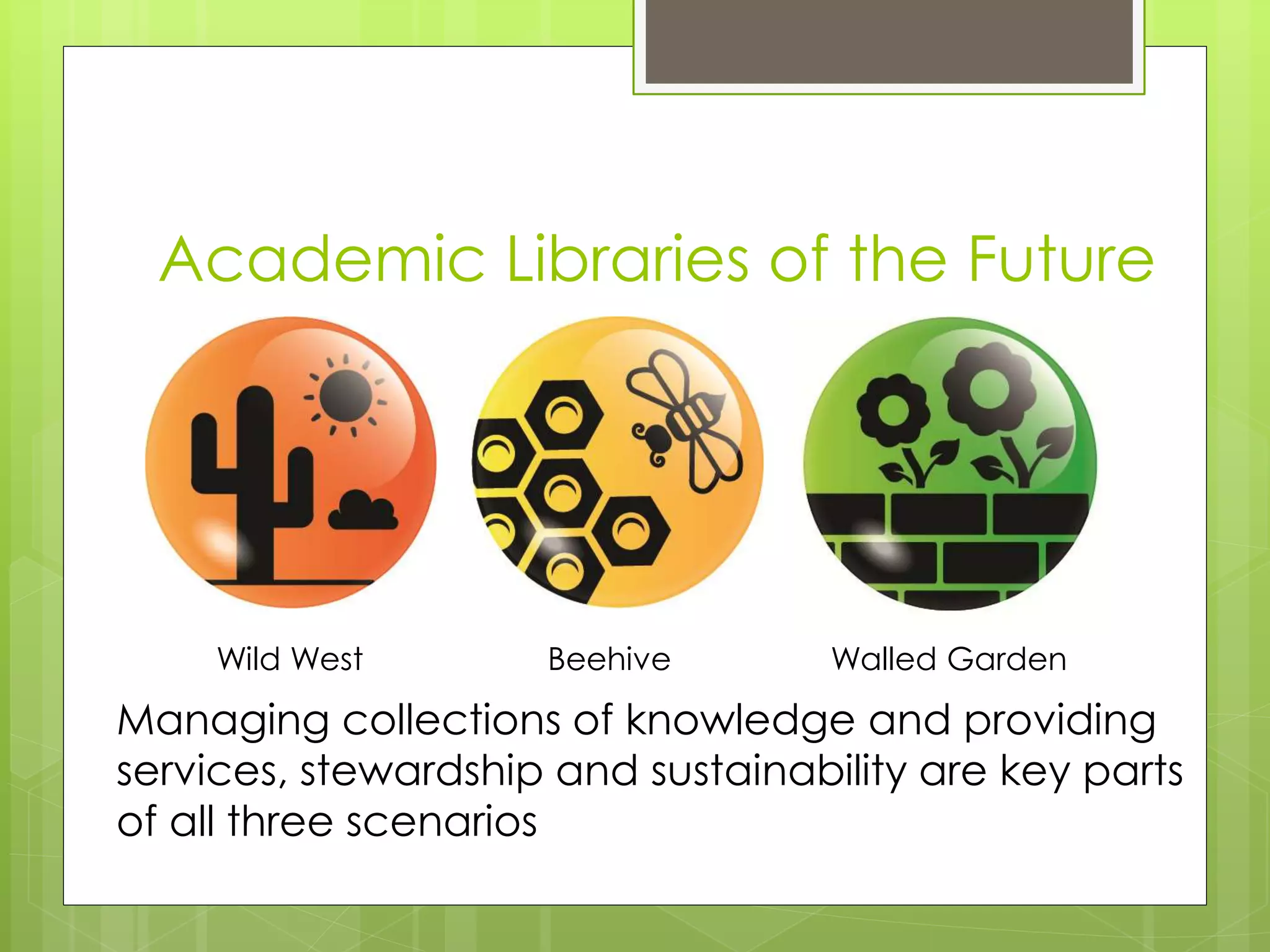
Academic Libraries of the Future
Managing collections of knowledge and providing
services, stewardship and sustainability are key parts
of all three scenarios
Wild West Beehive Walled Garden
Digital repositories
 An embedded part, more or less, of
academic library operation now
 OpenDOAR – 2212 institutional repositories
 Emphasis on digital
 Focus on local collections
 Drivers? Open access
Research data
Open educational resources
Images
Etc.
Questions
 Can digital repositories support the
development of the ‘digital’ library?
 If so, how do we enable this?
 Are we in a position where we can
develop ‘digital’ libraries on a 1-to-1 par
with our physical libraries?
Library trends
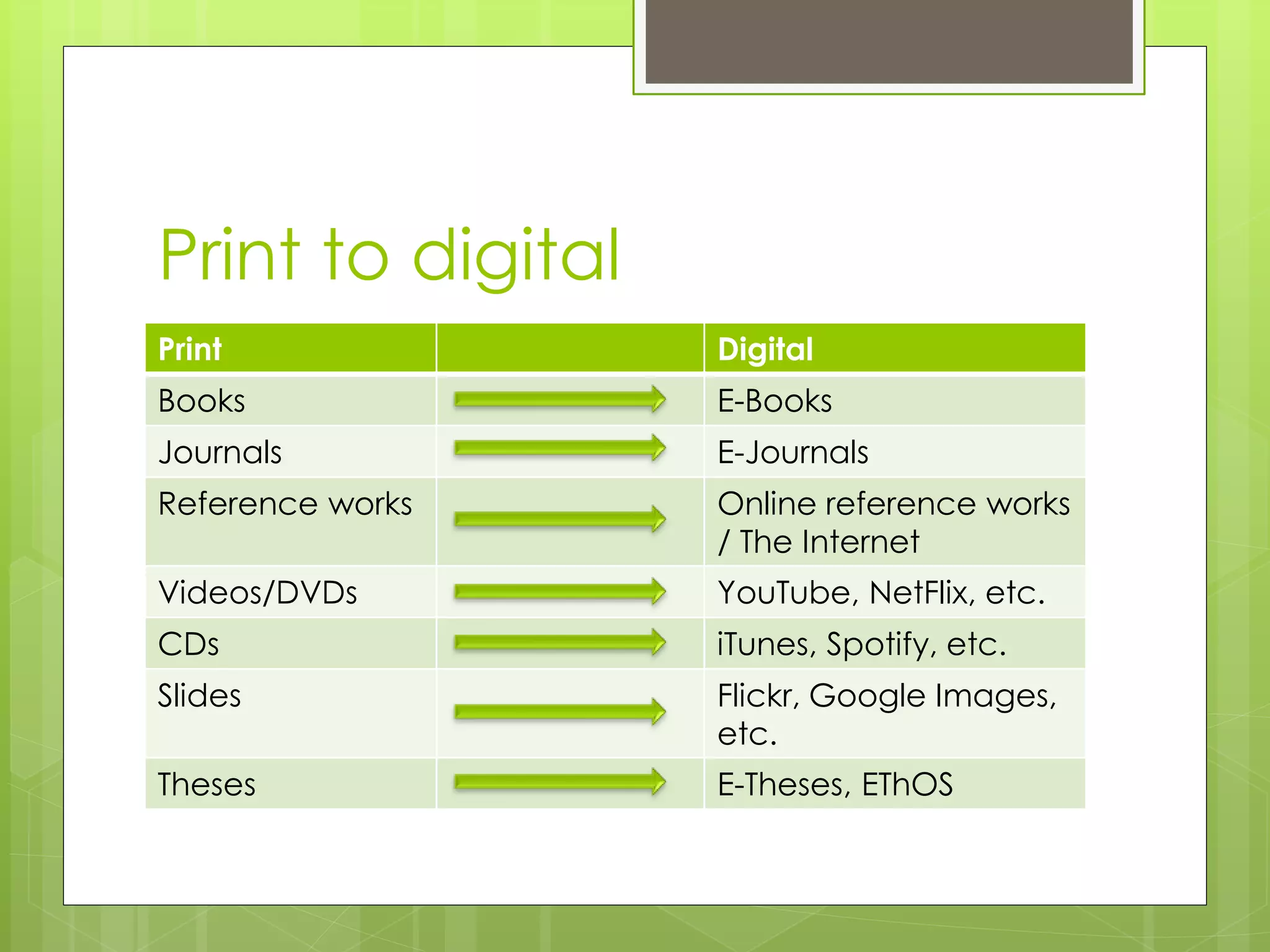
Print to digital
Print Digital
Books E-Books
Journals E-Journals
Reference works Online reference works
/ The Internet
Videos/DVDs YouTube, NetFlix, etc.
CDs iTunes, Spotify, etc.
Slides Flickr, Google Images,
etc.
Theses E-Theses, EThOS
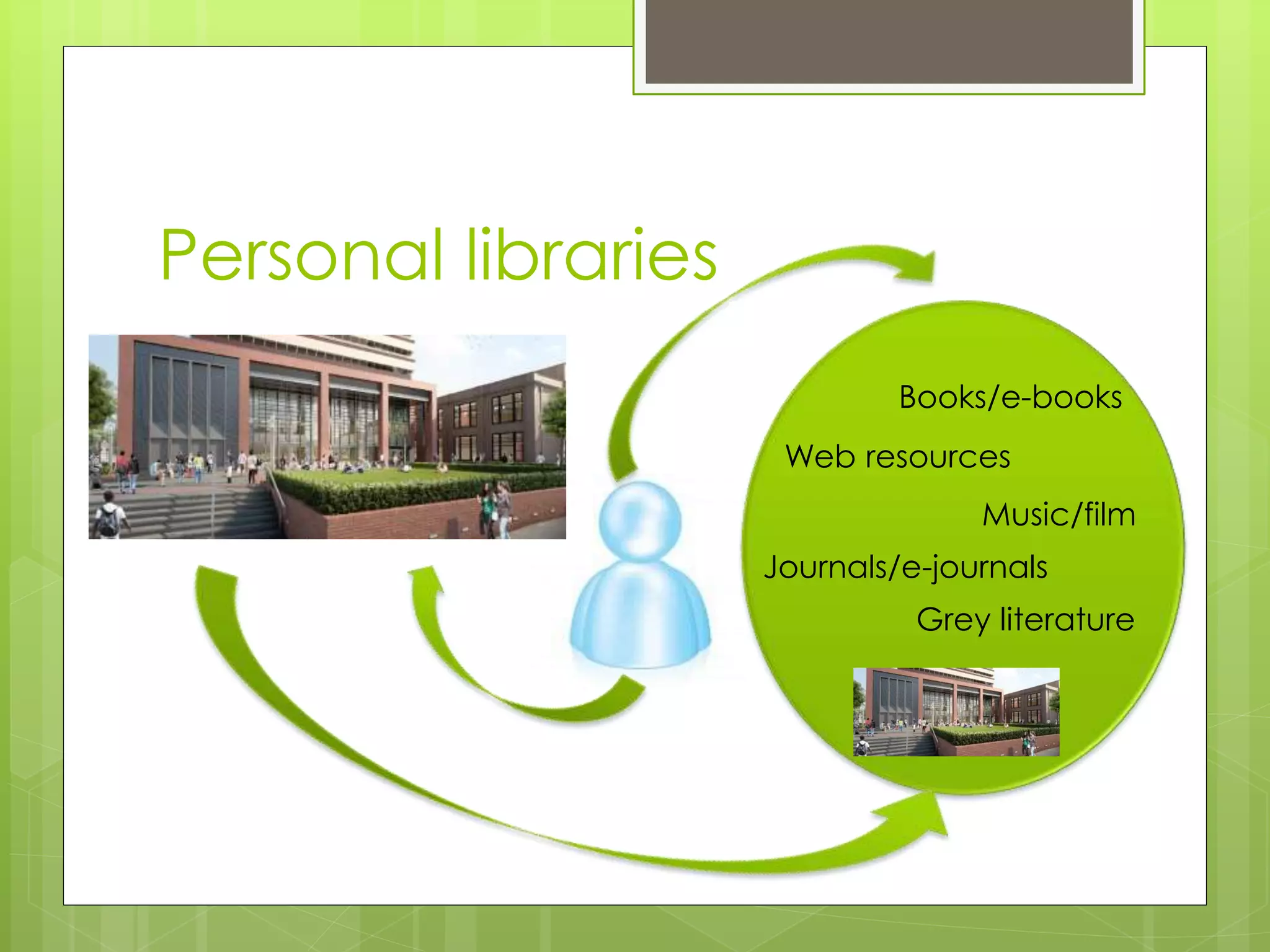
Personal libraries
Books/e-books
Web resources
Music/film
Journals/e-journals
Grey literature
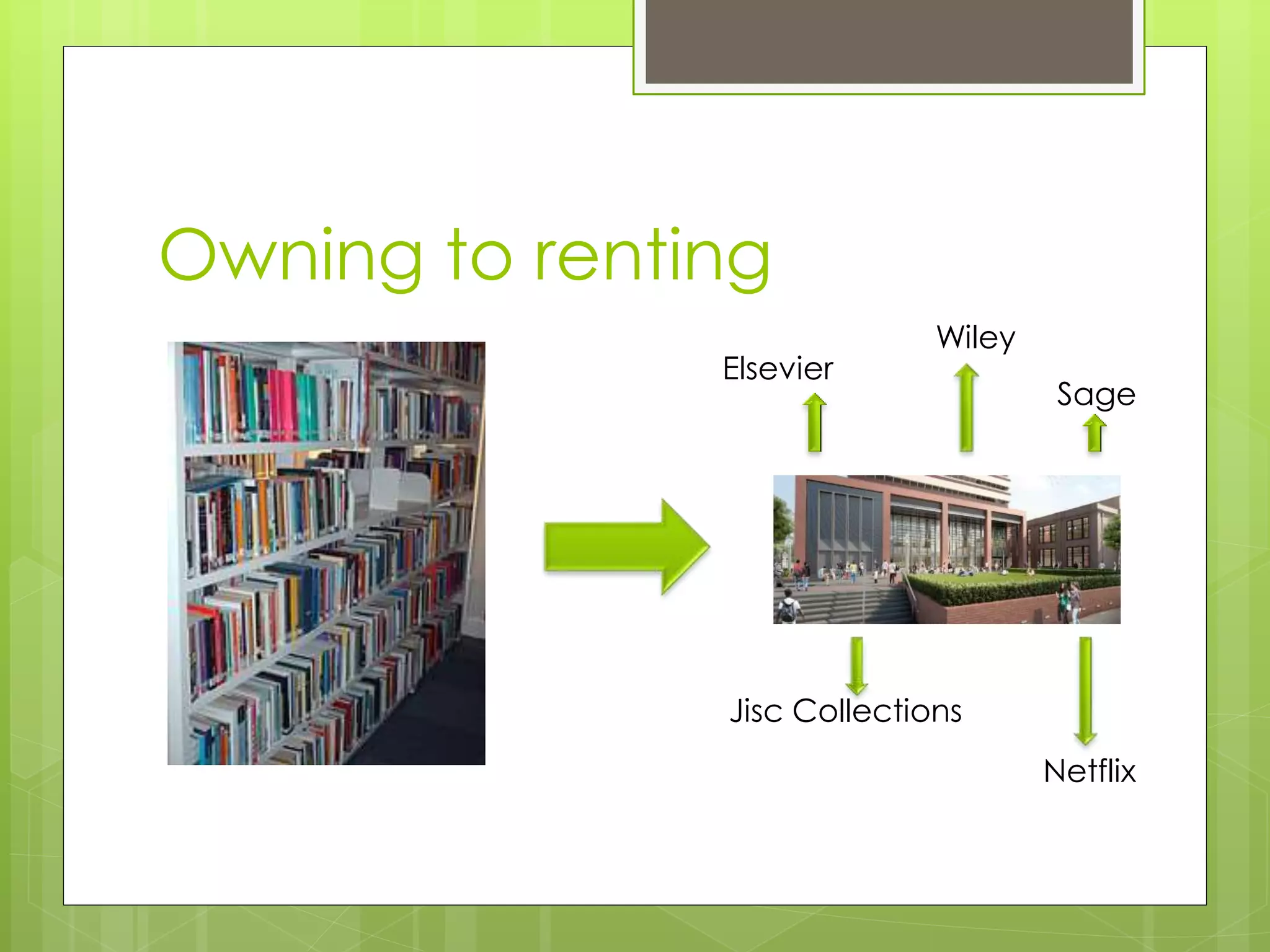
Owning to renting
Elsevier
Wiley
Sage
Netflix
Jisc Collections
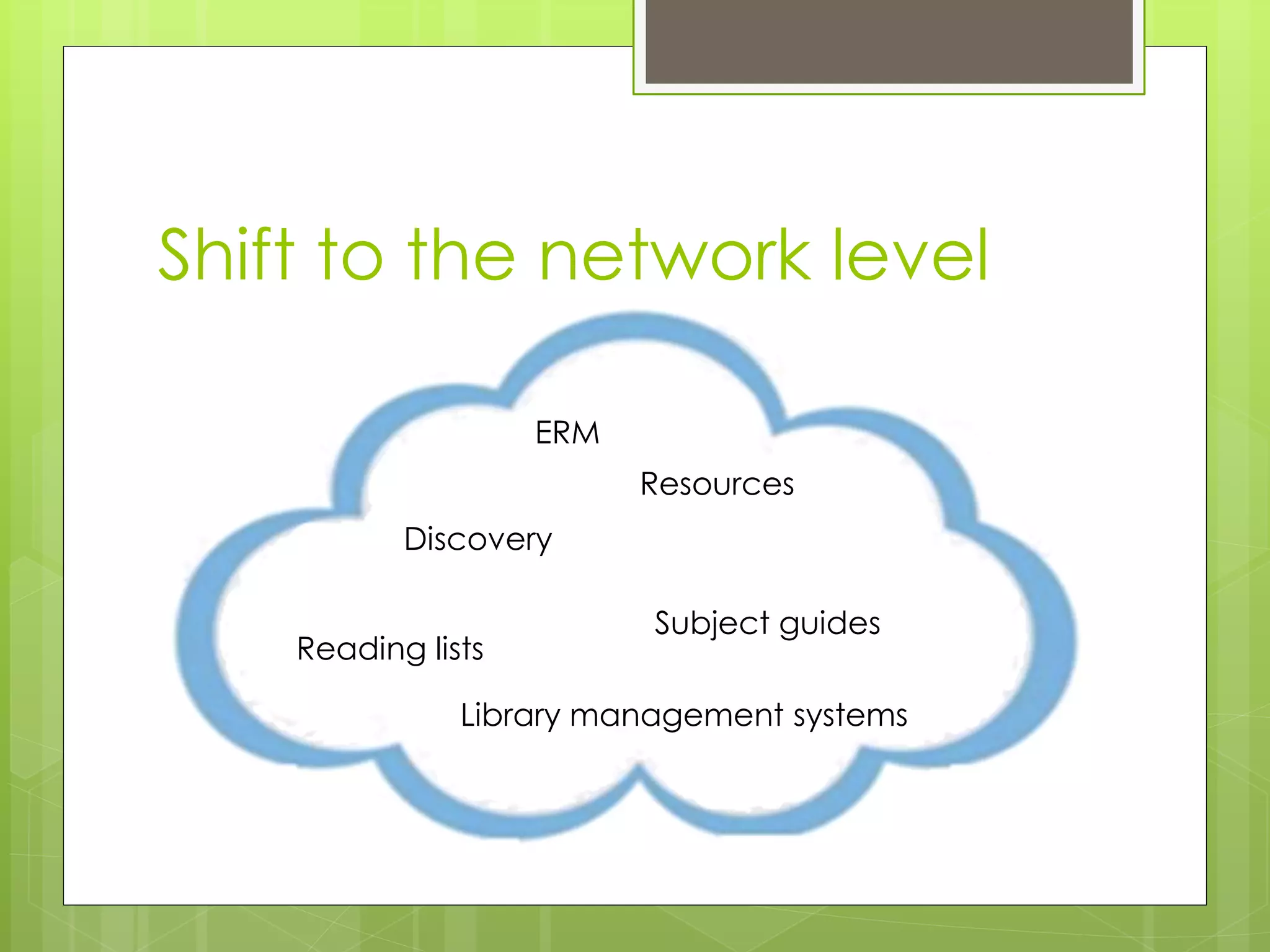
Shift to the network level
Resources
Discovery
Library management systems
Subject guides
Reading lists
ERM
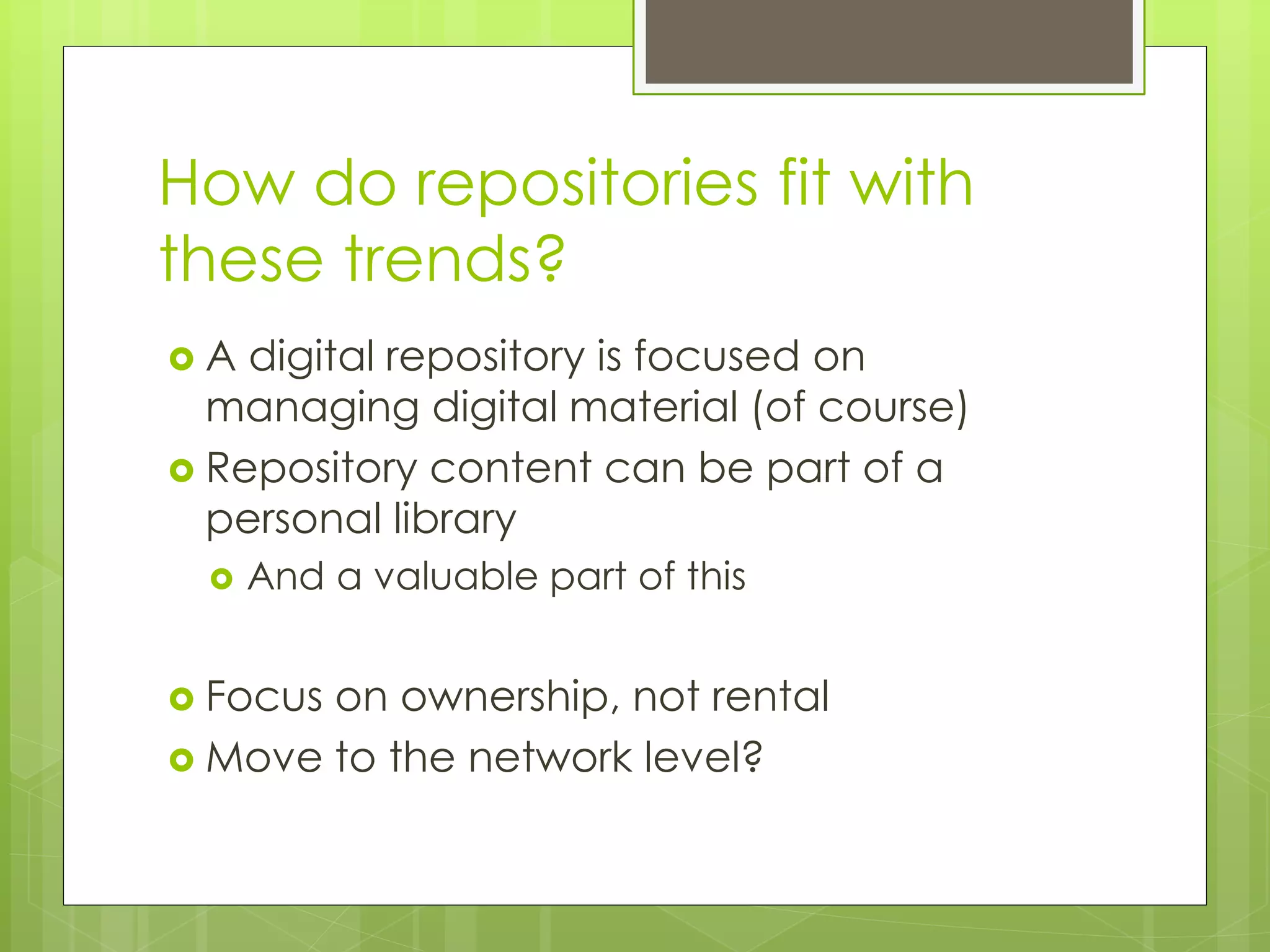
How do repositories fit with
these trends?
 A digital repository is focused on
managing digital material (of course)
 Repository content can be part of a
personal library
 And a valuable part of this
 Focus on ownership, not rental
 Move to the network level?
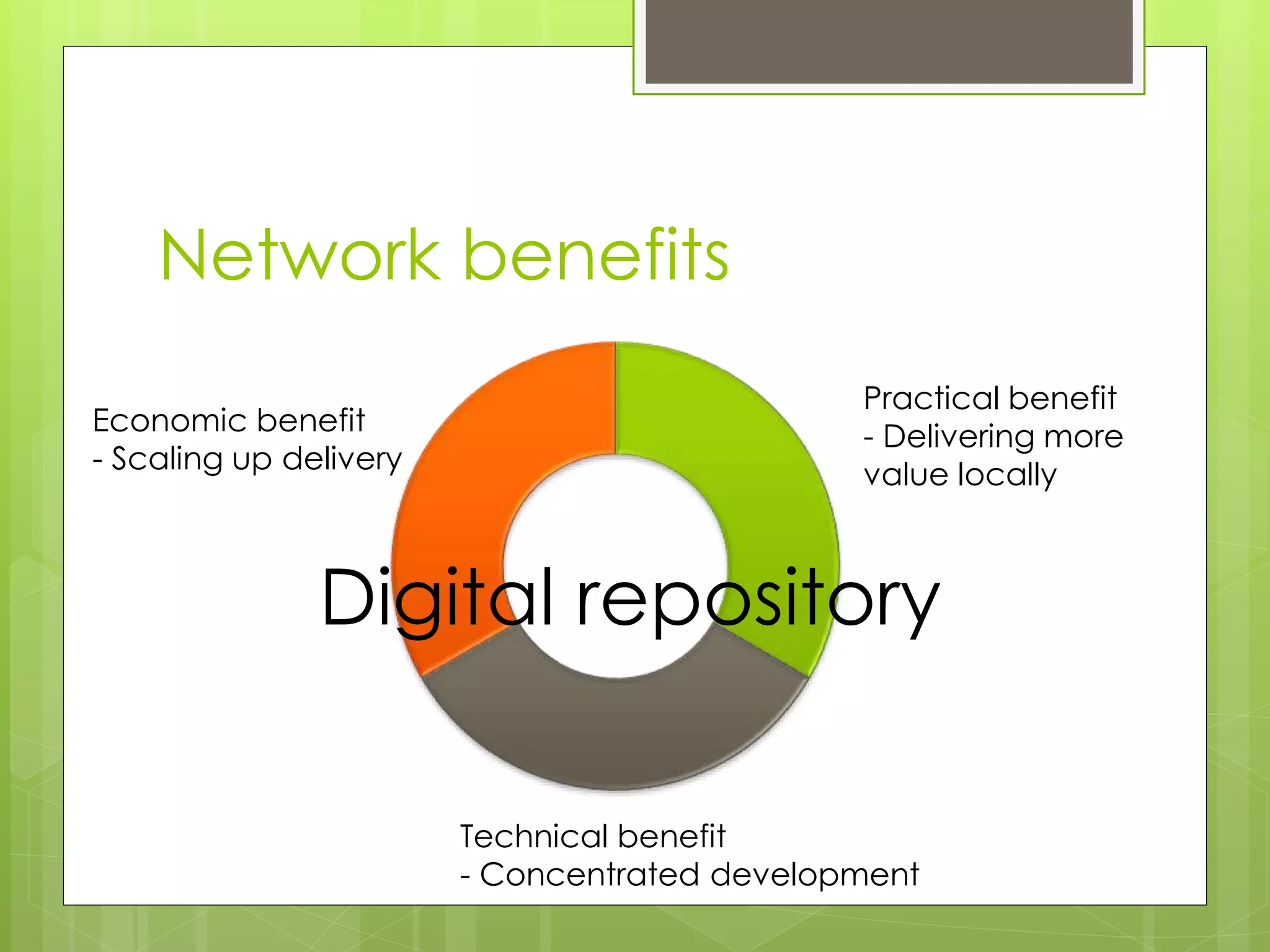
Network benefits
Economic benefit
- Scaling up delivery
Technical benefit
- Concentrated development
Practical benefit
- Delivering more
value locally
Digital repository
Jisc Spotlight on the Digital
 Focus on digitised collections and their
management/accessibility over time
 Highlighted need for
 Institutional capacity building
 Benefit of working with network level
services, e.g., aggregators
 Network level foresight and oversight of
collection management and delivery
Opportunity
Building a digital library
 Repository as home to a variety of local
digital assets
 Repository as infrastructure, not application
 What resource is needed to build a ‘digital’
library?
 Where does this come from?
 What skills are required?
 What can be learned from those who have built
digital libraries so far?
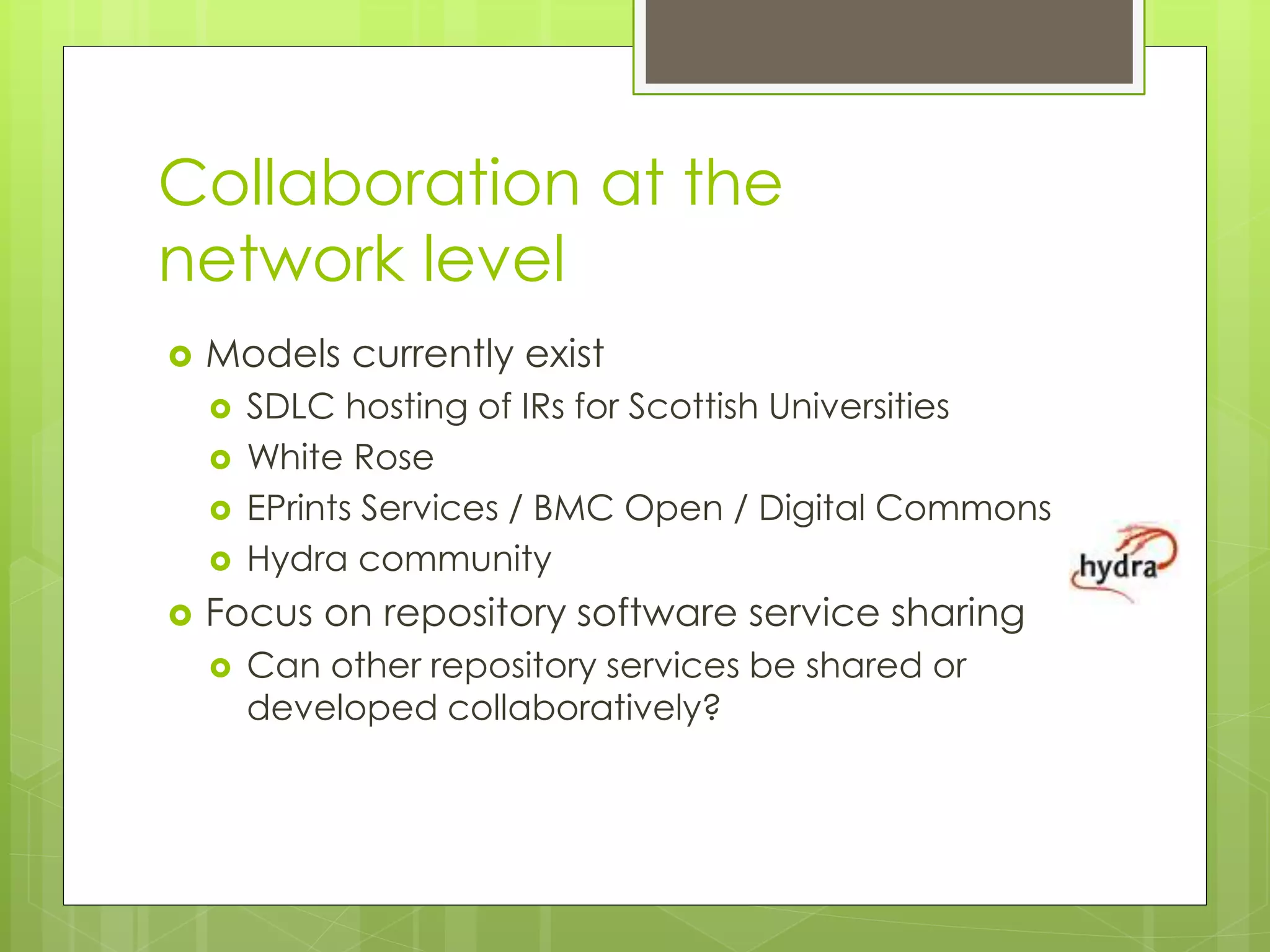
Collaboration at the
network level
 Models currently exist
 SDLC hosting of IRs for Scottish Universities
 White Rose
 EPrints Services / BMC Open / Digital Commons
 Hydra community
 Focus on repository software service sharing
 Can other repository services be shared or
developed collaboratively?
Northern Collaboration
 A grouping of 27 English University libraries
 Exploring areas where we can be more
effective working together
 Moving to the network level doesn’t
mean having to rely on outsourced staff
 Existing staff can be more than the sum of
their parts by collaborating
 Sharing Repository Services Working
Group
Areas to investigate
 Better understand our current repository
processes
 Examine feasibility of scaling up whole or
part processes to the network level
 Define and explore branding advantages
and potential added value services
 Review IT support and skills required
Areas to investigate
 Better understand our current repository
processes
 Examine feasibility of scaling up whole or
part processes to the network level
 Define and explore branding advantages
and potential added value services
 Review IT support and skills required
Areas to collaborate on now
 Advocacy / Content marketing &
promotion
 Discoverability of content
 Content licensing
 Impact measures
 Strategy / policy development
 Training
 Preservation
 Storage
Areas to ponder
 Maybe
 Hardware
 Already done for
hosted solutions
 Content re-use
and embedding
 Media specific
 Cataloguing/desc
ription
 Quality assurance
 Scaling up
required
 Not now
 Software
 Search interface
 Brand/design
 All still
establishing
local service
 Statistics
 IRUS-UK doing
this
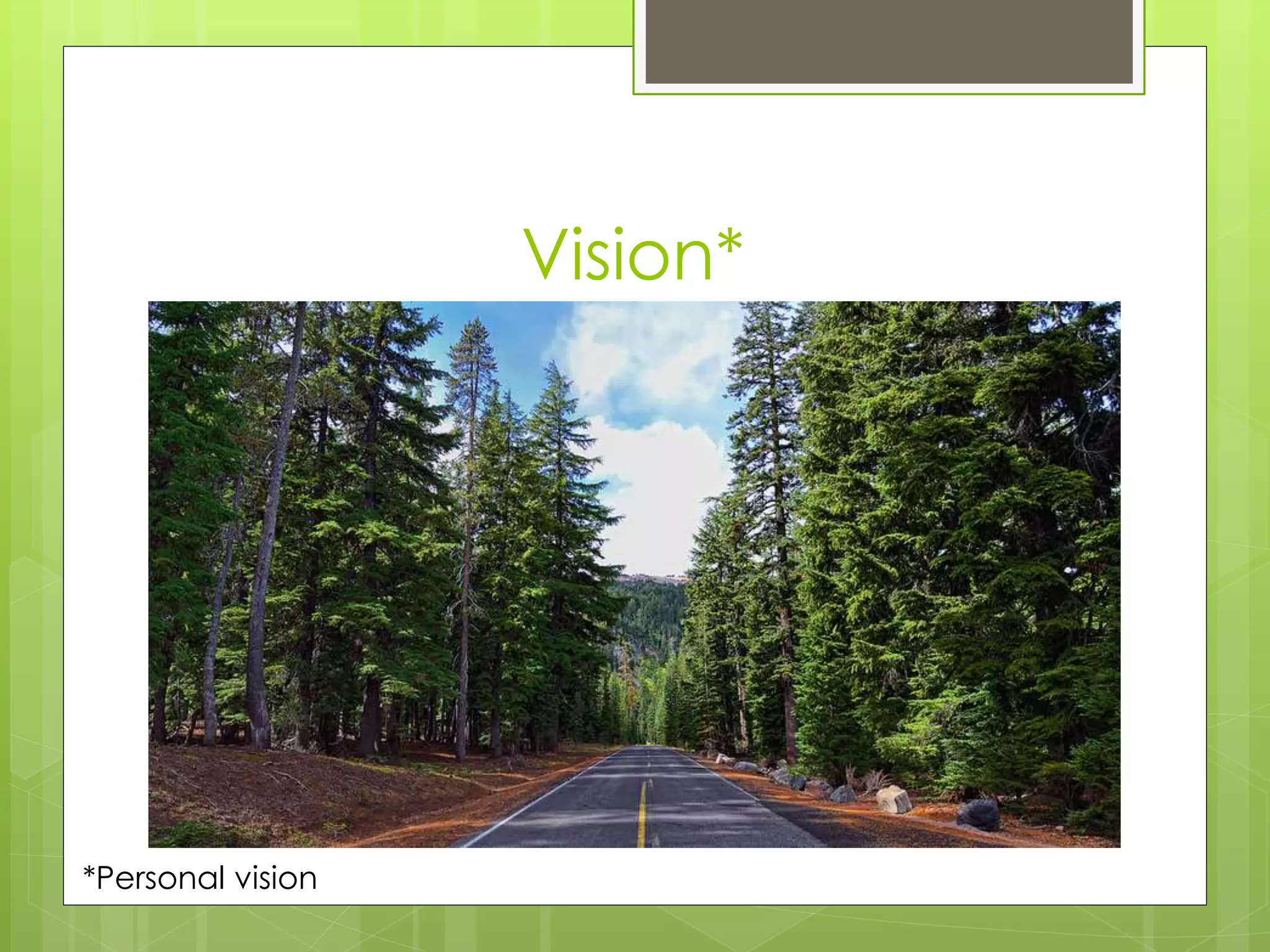
Vision*
*Personal vision
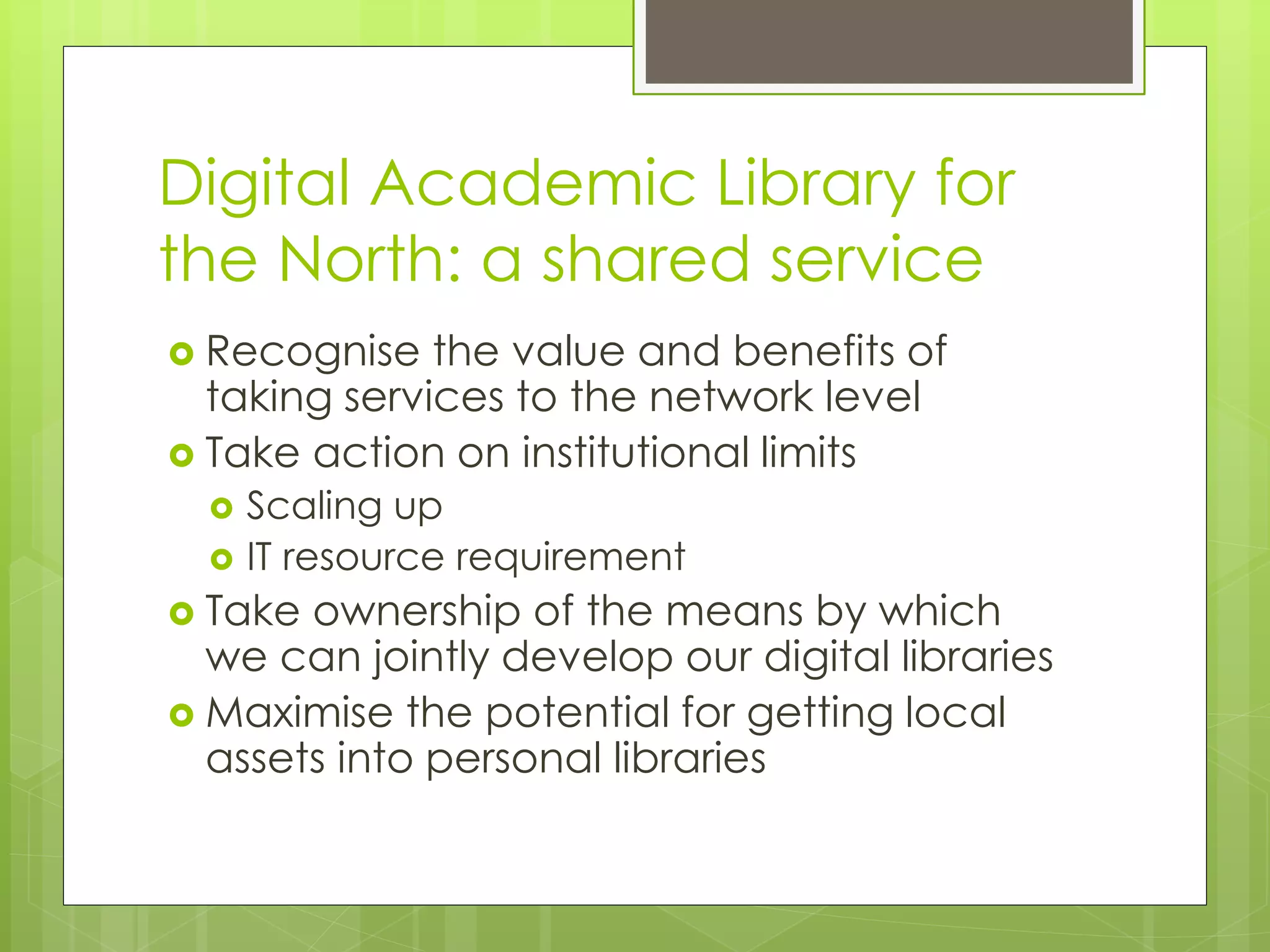
Digital Academic Library for
the North: a shared service
 Recognise the value and benefits of
taking services to the network level
 Take action on institutional limits
 Scaling up
 IT resource requirement
 Take ownership of the means by which
we can jointly develop our digital libraries
 Maximise the potential for getting local
assets into personal libraries
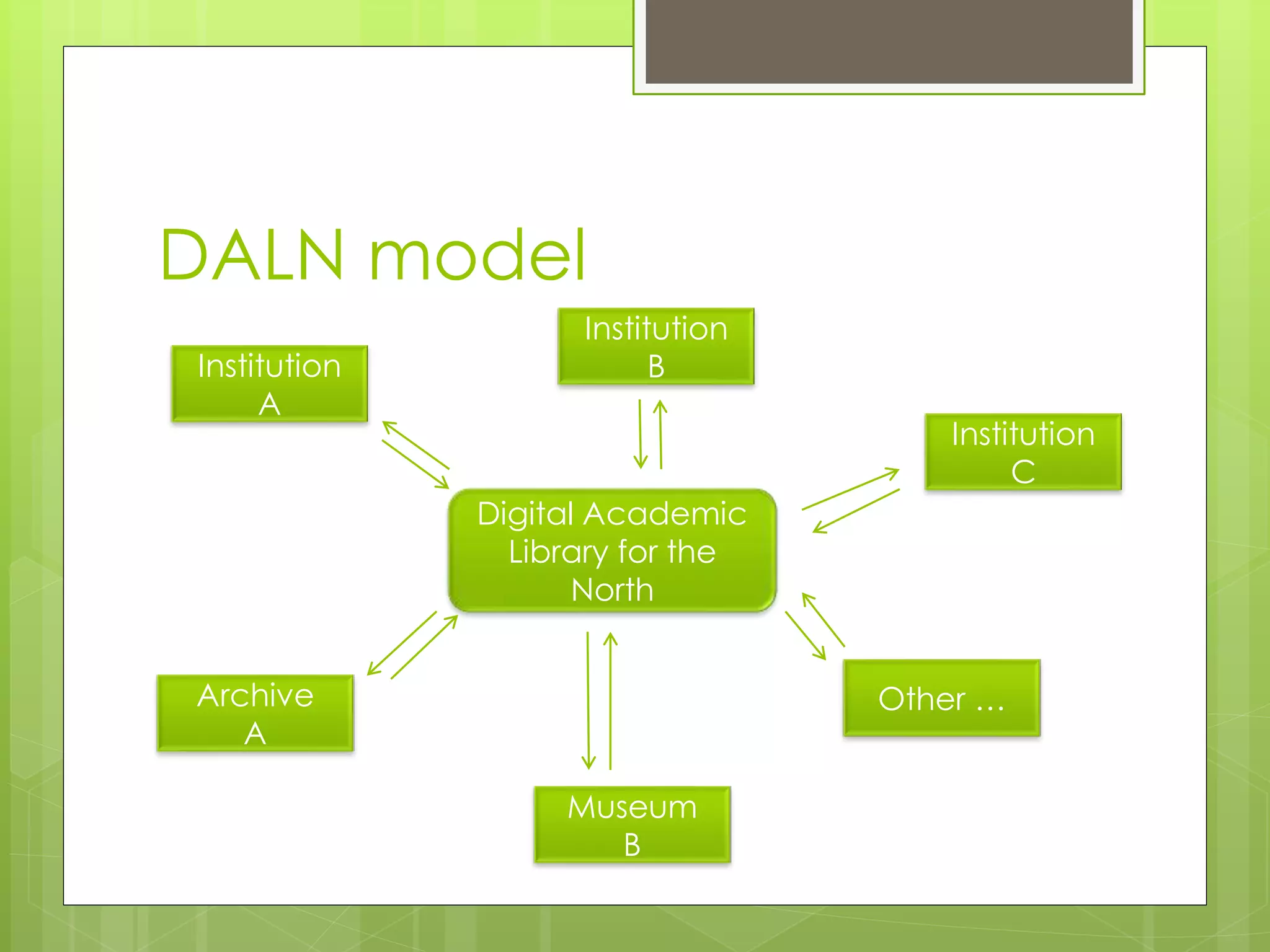
DALN model
Digital Academic
Library for the
North
Institution
A
Institution
B
Institution
C
Archive
A
Museum
B
Other …
To conclude
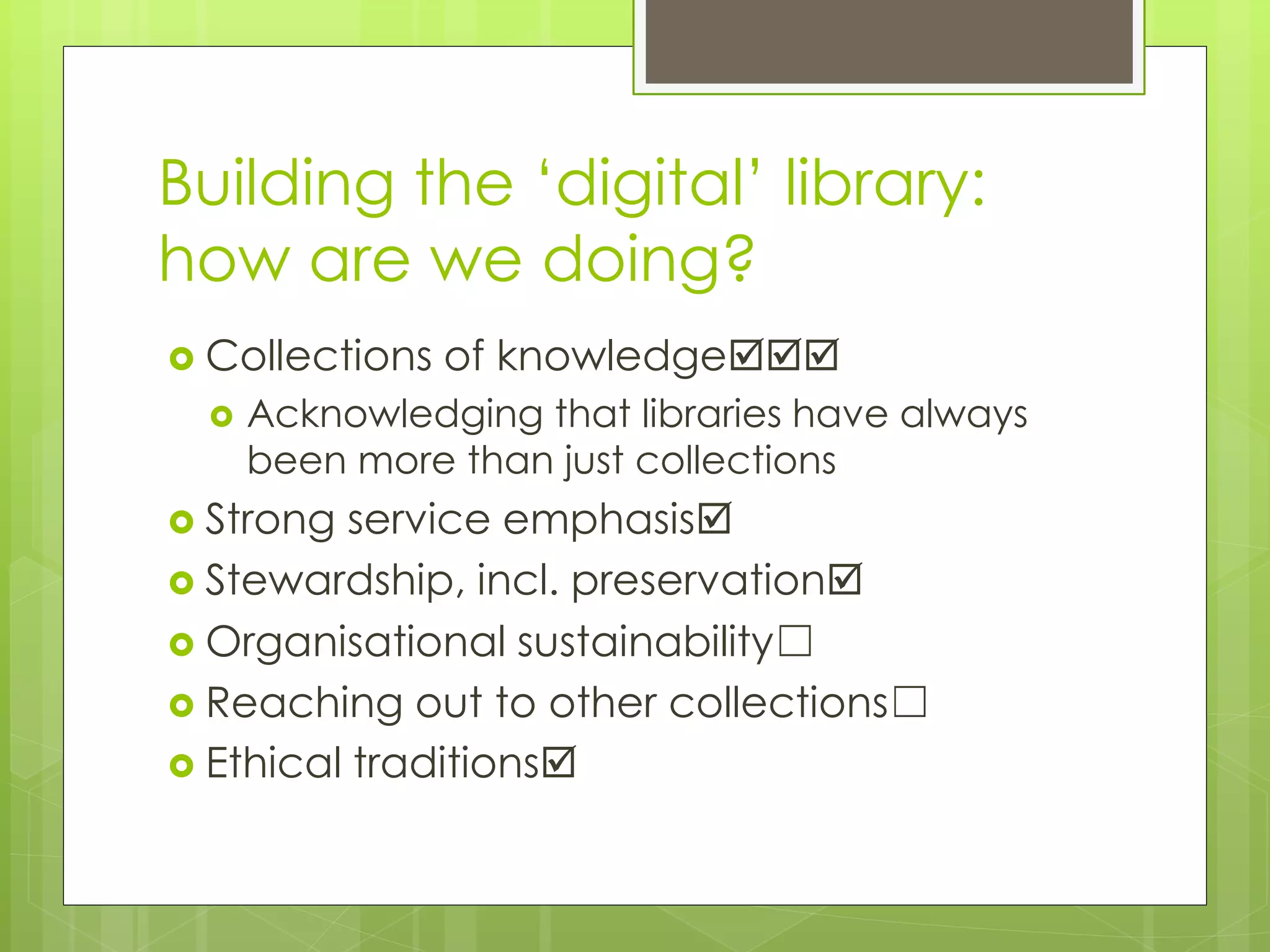
Building the ‘digital’ library:
how are we doing?
 Collections of knowledge
 Acknowledging that libraries have always
been more than just collections
 Strong service emphasis
 Stewardship, incl. preservation
 Organisational sustainability☐
 Reaching out to other collections☐
 Ethical traditions
Things to do
 Develop more, value-added, services
 Develop better stewardship capability
 For collections
 For repositories
 Make content seamless across repositories
 Enhance understanding of repository
ethical practice
 …and do it together ;-)
Thank you
Chris Awre
Head of Information Management
University of Hull
http://www.hull.ac.uk/lib
http://hydra.hull.ac.uk
Image attributions
 Paul Stainthorp, “IMAG2719”, 13 Aug 2005,
Online image, Flickr, 10 Sep 2013,
http://www.flickr.com/photos/pstainthorp
/4192270743/
 Mark Stevens, “The Road Ahead”, 14 Oct
2012, Online image, Flickr, 10 Sep 2013,
http://www.flickr.com/photos/14723335@
N05/9013482834/

Building the 'digital' library - Open Repositories 2014

  • 1.
    Building the 'digital' library Routesto managing our institutional digital learning, teaching and research assets together Chris Awre Open Repositories 2014 Helsinki 12th June 2014
  • 2.
  • 3.
    Libraries  Collections ofknowledge  Acknowledging that libraries have always been more than just collections  Strong service emphasis  Stewardship, incl. preservation  Organisational sustainability  Reaching out to other collections  Ethical traditions Howard Besser, 2002
  • 4.
    Move to digital How well do our libraries have these characteristics when managing digital materials?  Besser concluded there was some way to go  12 years on, are we progressing?  Initiatives looking ahead  Academic Libraries of the Future, 2009-11  ARL scenario planning, 2010  Both agreed that the future will be digital
  • 5.
    Academic Libraries ofthe Future Managing collections of knowledge and providing services, stewardship and sustainability are key parts of all three scenarios Wild West Beehive Walled Garden
  • 6.
    Digital repositories  Anembedded part, more or less, of academic library operation now  OpenDOAR – 2212 institutional repositories  Emphasis on digital  Focus on local collections  Drivers? Open access Research data Open educational resources Images Etc.
  • 7.
    Questions  Can digitalrepositories support the development of the ‘digital’ library?  If so, how do we enable this?  Are we in a position where we can develop ‘digital’ libraries on a 1-to-1 par with our physical libraries?
  • 8.
  • 9.
    Print to digital PrintDigital Books E-Books Journals E-Journals Reference works Online reference works / The Internet Videos/DVDs YouTube, NetFlix, etc. CDs iTunes, Spotify, etc. Slides Flickr, Google Images, etc. Theses E-Theses, EThOS
  • 10.
  • 11.
  • 12.
    Shift to thenetwork level Resources Discovery Library management systems Subject guides Reading lists ERM
  • 13.
    How do repositoriesfit with these trends?  A digital repository is focused on managing digital material (of course)  Repository content can be part of a personal library  And a valuable part of this  Focus on ownership, not rental  Move to the network level?
  • 14.
    Network benefits Economic benefit -Scaling up delivery Technical benefit - Concentrated development Practical benefit - Delivering more value locally Digital repository
  • 15.
    Jisc Spotlight onthe Digital  Focus on digitised collections and their management/accessibility over time  Highlighted need for  Institutional capacity building  Benefit of working with network level services, e.g., aggregators  Network level foresight and oversight of collection management and delivery
  • 16.
  • 17.
    Building a digitallibrary  Repository as home to a variety of local digital assets  Repository as infrastructure, not application  What resource is needed to build a ‘digital’ library?  Where does this come from?  What skills are required?  What can be learned from those who have built digital libraries so far?
  • 18.
    Collaboration at the networklevel  Models currently exist  SDLC hosting of IRs for Scottish Universities  White Rose  EPrints Services / BMC Open / Digital Commons  Hydra community  Focus on repository software service sharing  Can other repository services be shared or developed collaboratively?
  • 19.
    Northern Collaboration  Agrouping of 27 English University libraries  Exploring areas where we can be more effective working together  Moving to the network level doesn’t mean having to rely on outsourced staff  Existing staff can be more than the sum of their parts by collaborating  Sharing Repository Services Working Group
  • 20.
    Areas to investigate Better understand our current repository processes  Examine feasibility of scaling up whole or part processes to the network level  Define and explore branding advantages and potential added value services  Review IT support and skills required
  • 21.
    Areas to investigate Better understand our current repository processes  Examine feasibility of scaling up whole or part processes to the network level  Define and explore branding advantages and potential added value services  Review IT support and skills required
  • 22.
    Areas to collaborateon now  Advocacy / Content marketing & promotion  Discoverability of content  Content licensing  Impact measures  Strategy / policy development  Training  Preservation  Storage
  • 23.
    Areas to ponder Maybe  Hardware  Already done for hosted solutions  Content re-use and embedding  Media specific  Cataloguing/desc ription  Quality assurance  Scaling up required  Not now  Software  Search interface  Brand/design  All still establishing local service  Statistics  IRUS-UK doing this
  • 24.
  • 25.
    Digital Academic Libraryfor the North: a shared service  Recognise the value and benefits of taking services to the network level  Take action on institutional limits  Scaling up  IT resource requirement  Take ownership of the means by which we can jointly develop our digital libraries  Maximise the potential for getting local assets into personal libraries
  • 26.
    DALN model Digital Academic Libraryfor the North Institution A Institution B Institution C Archive A Museum B Other …
  • 27.
  • 28.
    Building the ‘digital’library: how are we doing?  Collections of knowledge  Acknowledging that libraries have always been more than just collections  Strong service emphasis  Stewardship, incl. preservation  Organisational sustainability☐  Reaching out to other collections☐  Ethical traditions
  • 29.
    Things to do Develop more, value-added, services  Develop better stewardship capability  For collections  For repositories  Make content seamless across repositories  Enhance understanding of repository ethical practice  …and do it together ;-)
  • 30.
    Thank you Chris Awre Headof Information Management University of Hull http://www.hull.ac.uk/lib http://hydra.hull.ac.uk
  • 31.
    Image attributions  PaulStainthorp, “IMAG2719”, 13 Aug 2005, Online image, Flickr, 10 Sep 2013, http://www.flickr.com/photos/pstainthorp /4192270743/  Mark Stevens, “The Road Ahead”, 14 Oct 2012, Online image, Flickr, 10 Sep 2013, http://www.flickr.com/photos/14723335@ N05/9013482834/