Digital Object Identifiers: Richard Bernier Reference & Electronic Services Librarian April 13, 2004 Affecting how libraries connect to online digital content
What is  DOI? An identification system for intellectual property in the digital environment Developed by the DOI foundation on  behalf behalf of the publishing industry to provide a framework for managing intellectual content, link customers with publishers, facilitate electronic commerce, and enable automated copyright management.
But what does it really do? A  persistent  identification number assigned to a unit of content and registered with a lookup service. Not only an identifier of digital objects, but also a digital identifier of objects. e.g non-digital entities, such as underlying abstractions (the “work”) and physical manifestations.
Implementations Journals or single journal articles Books or book chapters Entire opera or single bar of music. Digitized or non-digitized audio, video, images, text An article is Spanish and in English could have one DOI for both, or separate DOIs for each language
International DOI Foundation (IDF) DOI organization established to develop and manage the DOI system Launched in 1998 by the Association of American Publishers, International Publishers Association, and the International Association of Scientific Technical and Medical Publishers
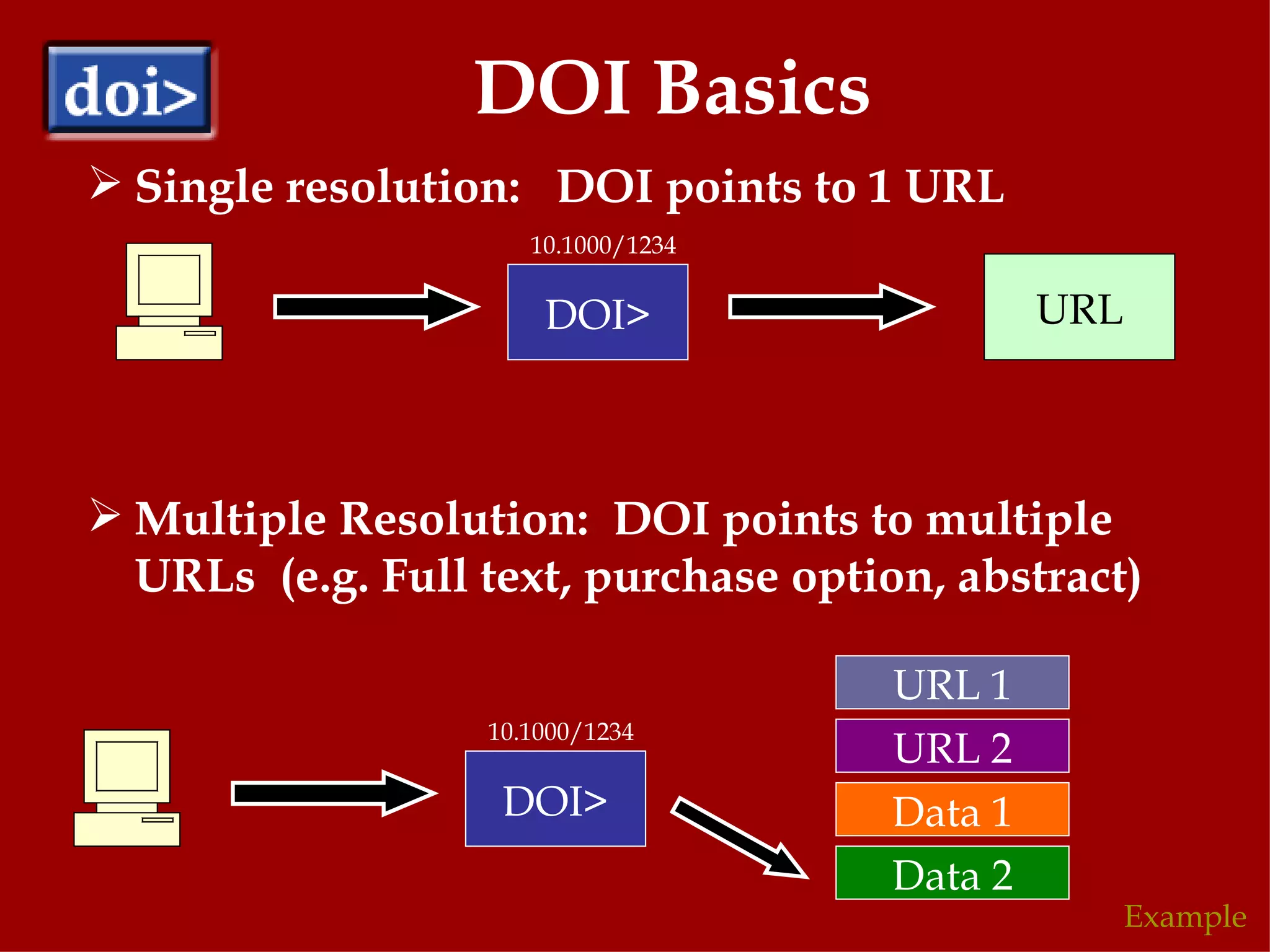
DOI Basics Single resolution:  DOI points to 1 URL Multiple Resolution:  DOI points to multiple URLs  (e.g. Full text, purchase option, abstract) DOI> 10.1000/1234 URL DOI> 10.1000/1234 URL 1 URL 2 Data 1 Data 2 Example
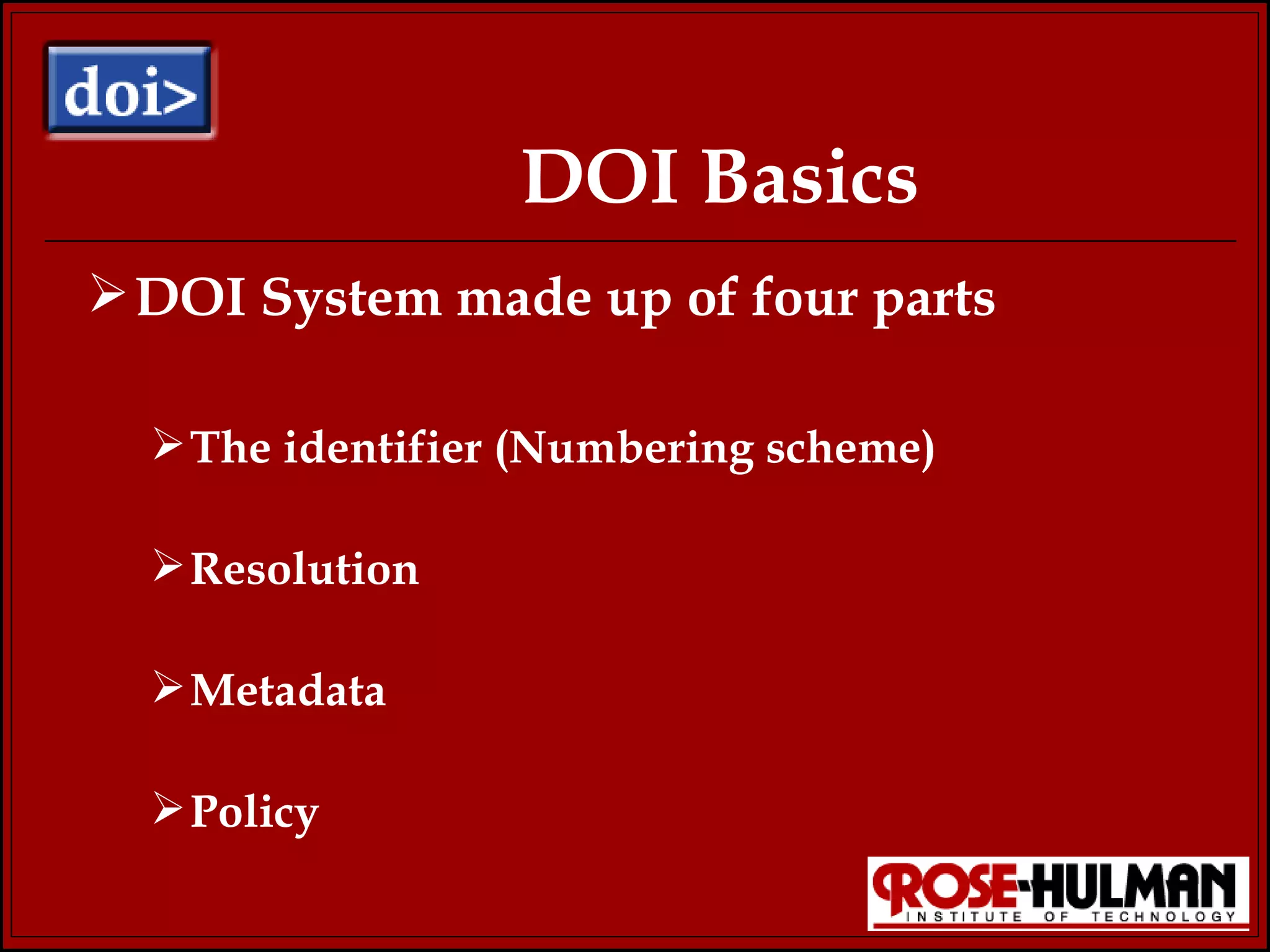
DOI Basics DOI System made up of four parts The identifier (Numbering scheme) Resolution Metadata Policy
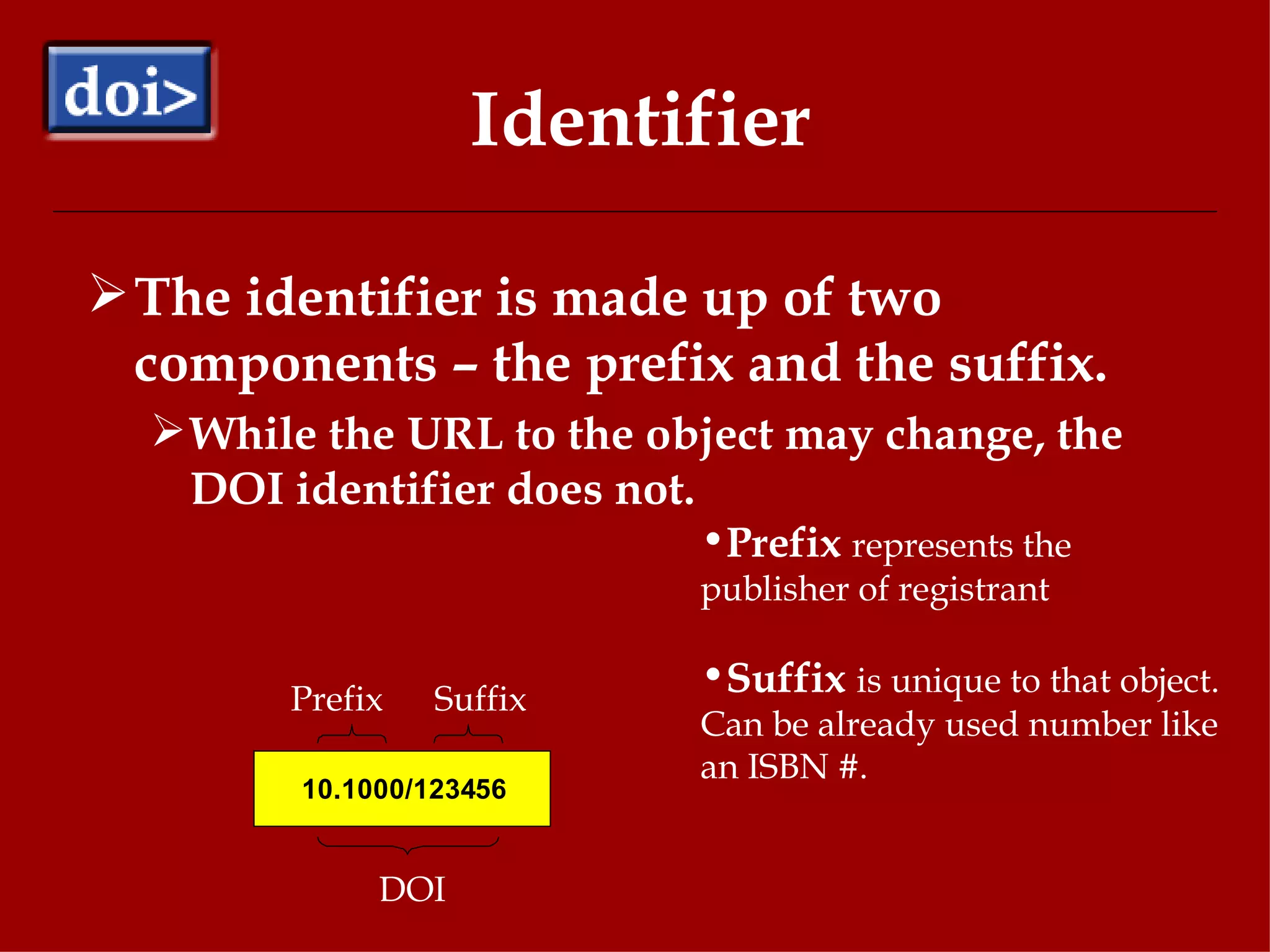
Identifier The identifier is made up of two components – the prefix and the suffix. While the URL to the object may change, the DOI identifier does not. Prefix  Suffix DOI Prefix  represents the  publisher of registrant Suffix  is unique to that object.  Can be already used number like an ISBN #.
 
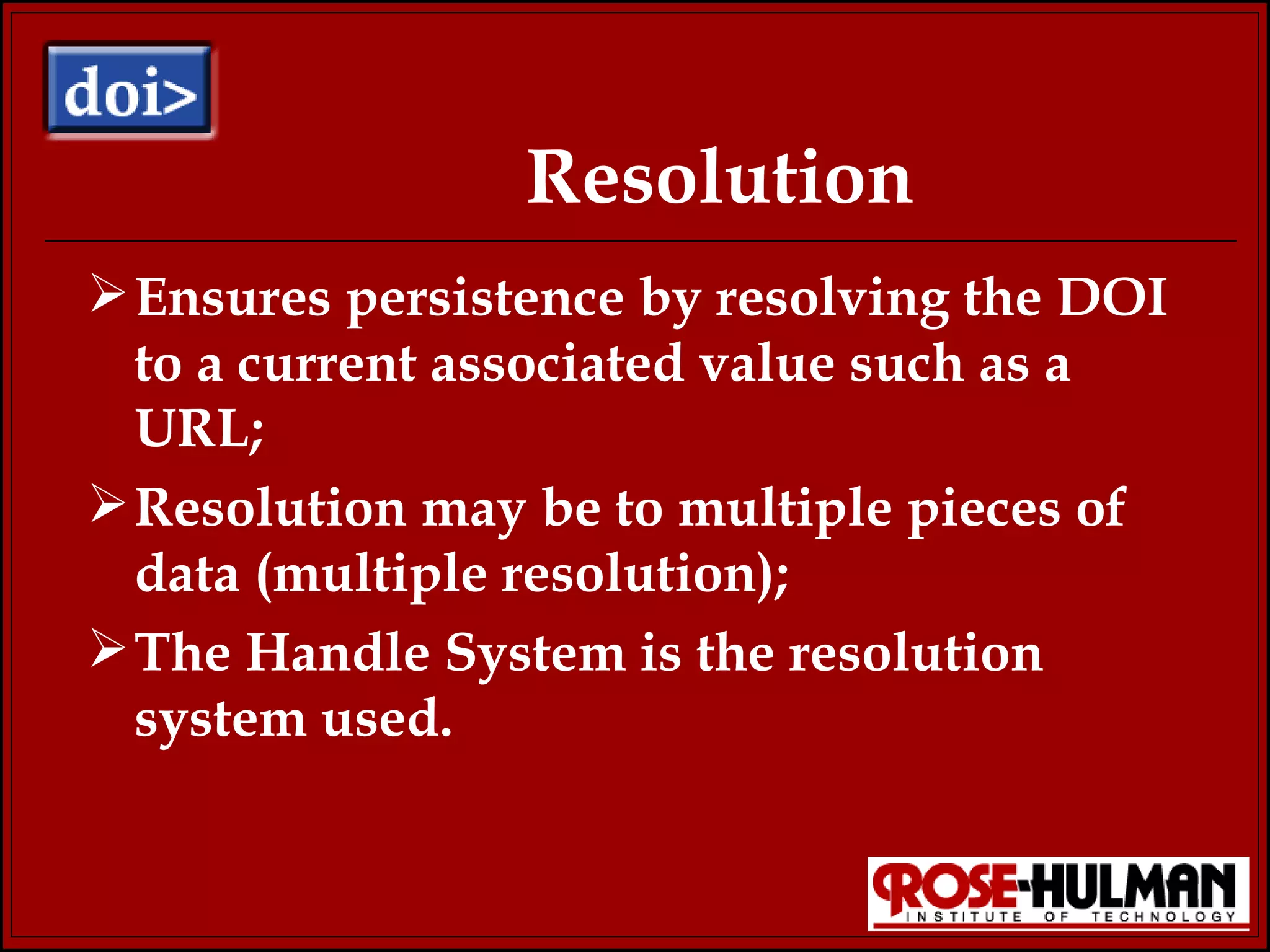
Resolution Ensures persistence by resolving the DOI to a current associated value such as a URL; Resolution may be to multiple pieces of data (multiple resolution); The Handle System is the resolution system used.
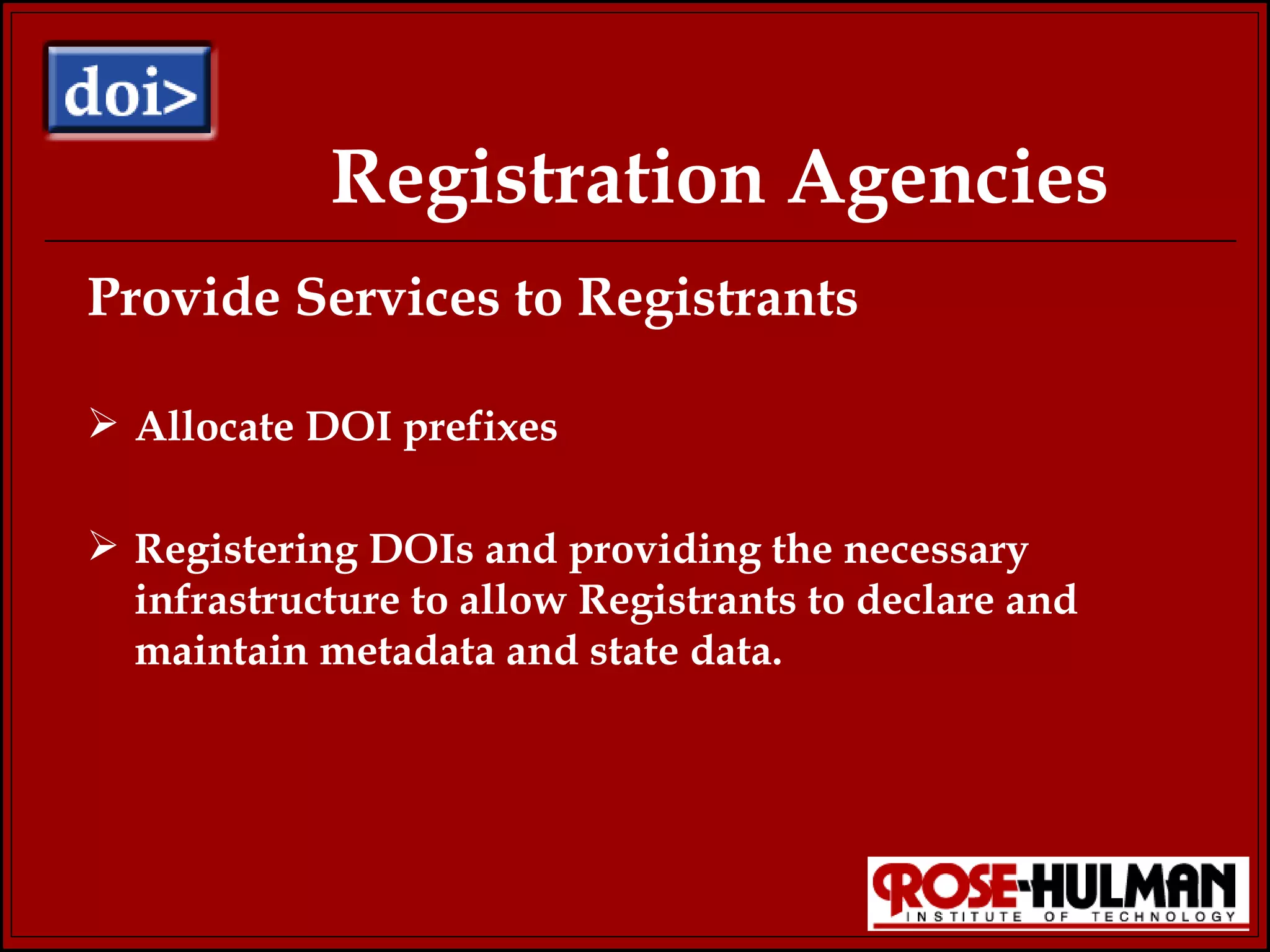
Registration Agencies Provide Services to Registrants Allocate DOI prefixes Registering DOIs and providing the necessary infrastructure to allow Registrants to declare and maintain metadata and state data.
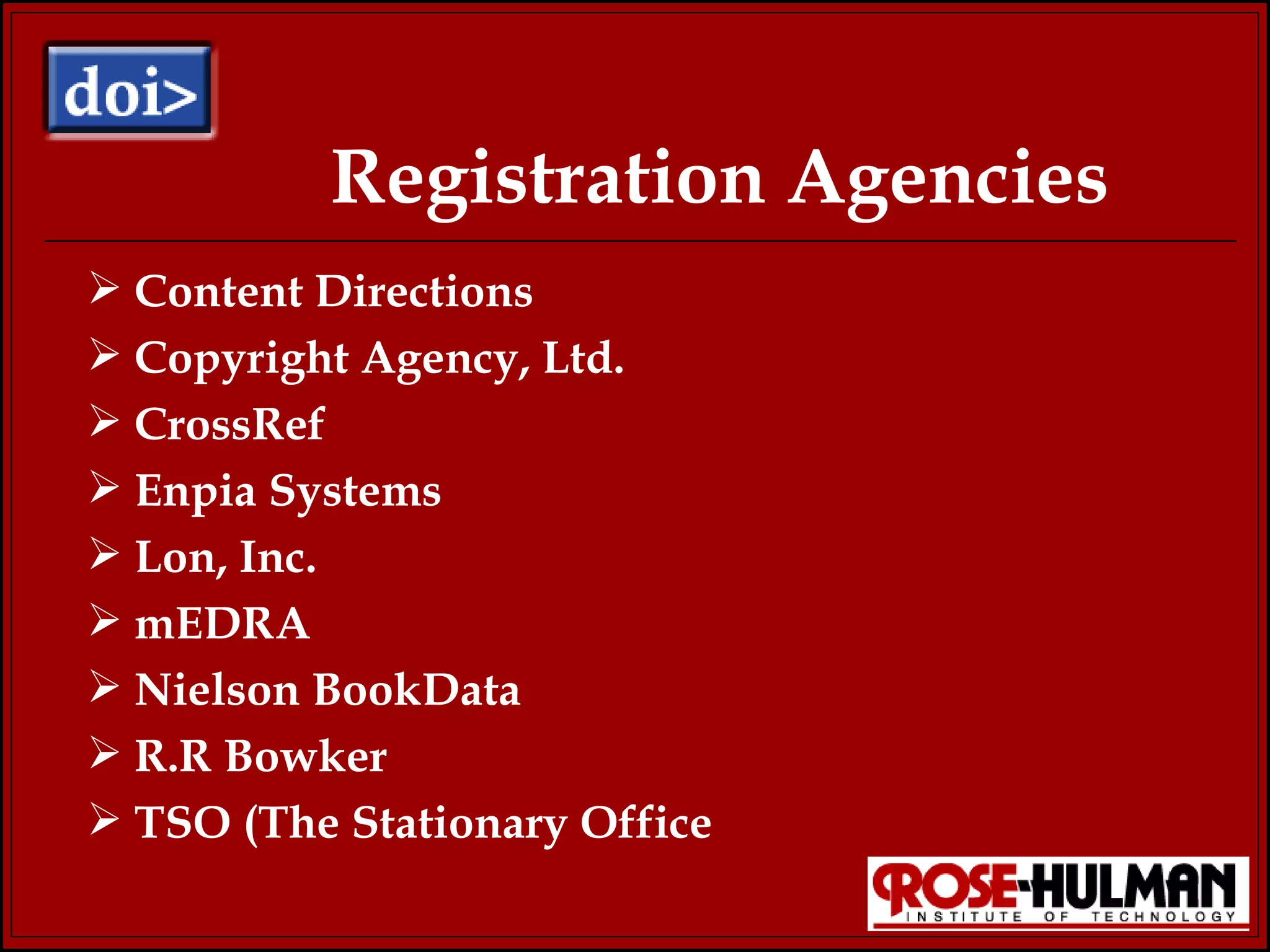
Registration Agencies Content Directions Copyright Agency, Ltd. CrossRef Enpia Systems Lon, Inc. mEDRA Nielson BookData R.R Bowker TSO (The Stationary Office
Metadata Each DOI has attached metadata set which describes it.  Standard metadata includes: What is the resource that is identified? Does it have another identifier that can be recognized (e.g. an ISBN)? Who are the parties responsible for its creation? What is it made of? (abstract, physical, digital) How is it perceived? (visual, audio, etc) Particular application type? (e.g article linking)?
Policy Rules determined by the International  DOI Foundation for the operation of the  DOI System  in a consistent, predictable, and controlled manner to ensure longevity of the system as infrastructure.  Use of Registration agencies which operate under same rules as an operational federation.
DOI Diagram Norman Paskin,  Digital Object Identifier: Overview , www.doi.org  Administrator (publisher.com) Identifier: DOI: 10.XXXX/1234 URL: http://publisher.com/10.X... Title:  New Horizona - Latin Jazz Agent = Author: John Jakob-Jemènez Type: digital file Mode:  Text:  250 pages Images:  20 Moving Images:  2 Audio:  20 Release Date: January 1, 2001 Rights Profile:  Translation   Paperback   Electronic Email Contact:  [email_address] Other Titles by Author:  Title 2 ;  Title 3 Retailers:  amazon ;  bol ;  DOI data and metadata (XMLbatch) DOI data and metadata Registration Agency Metadata Collection metadata DOI System DOI data
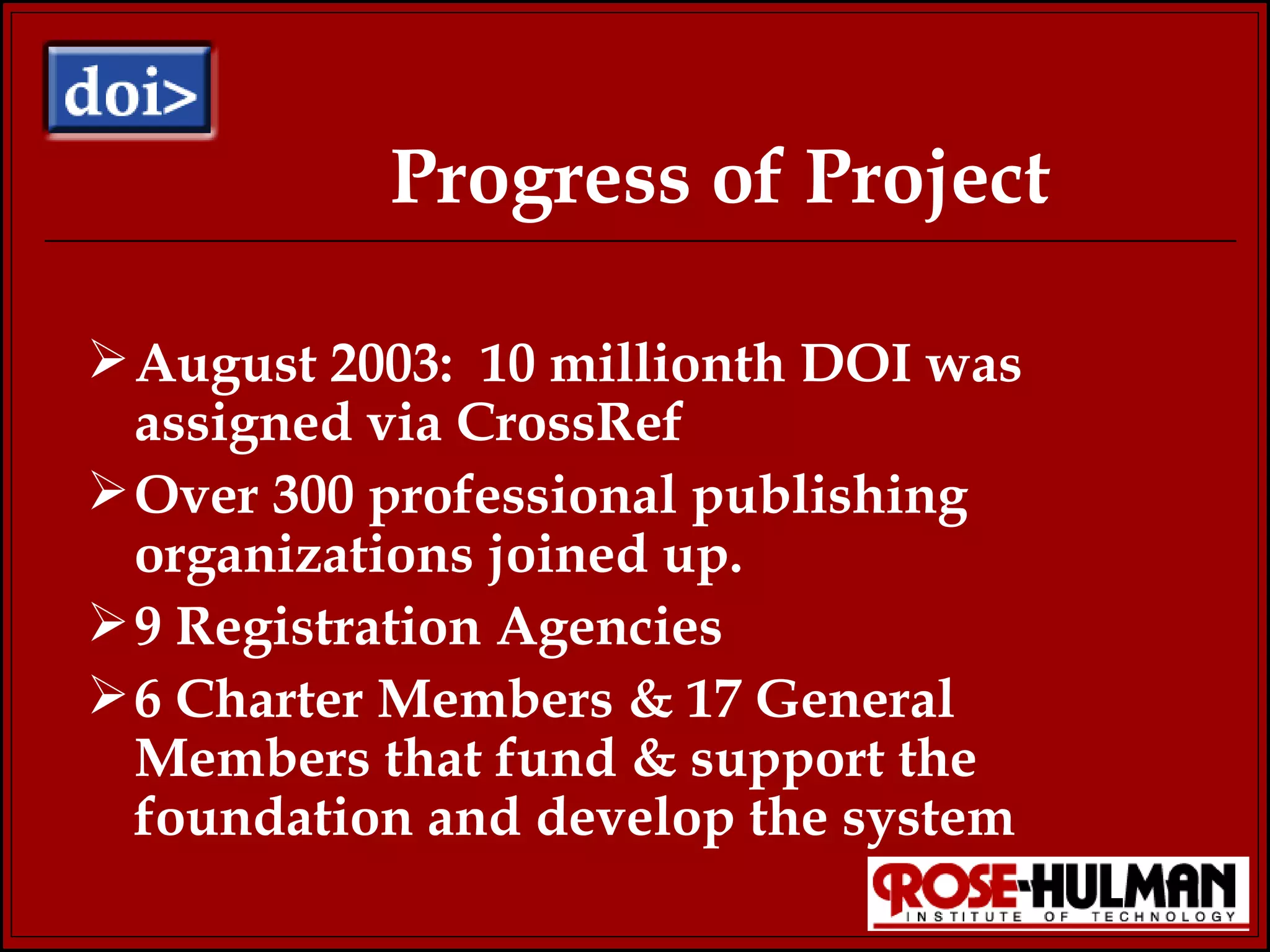
Progress of Project August 2003:  10 millionth DOI was assigned via CrossRef Over 300 professional publishing organizations joined up. 9 Registration Agencies 6 Charter Members & 17 General  Members that fund & support the foundation and develop the system
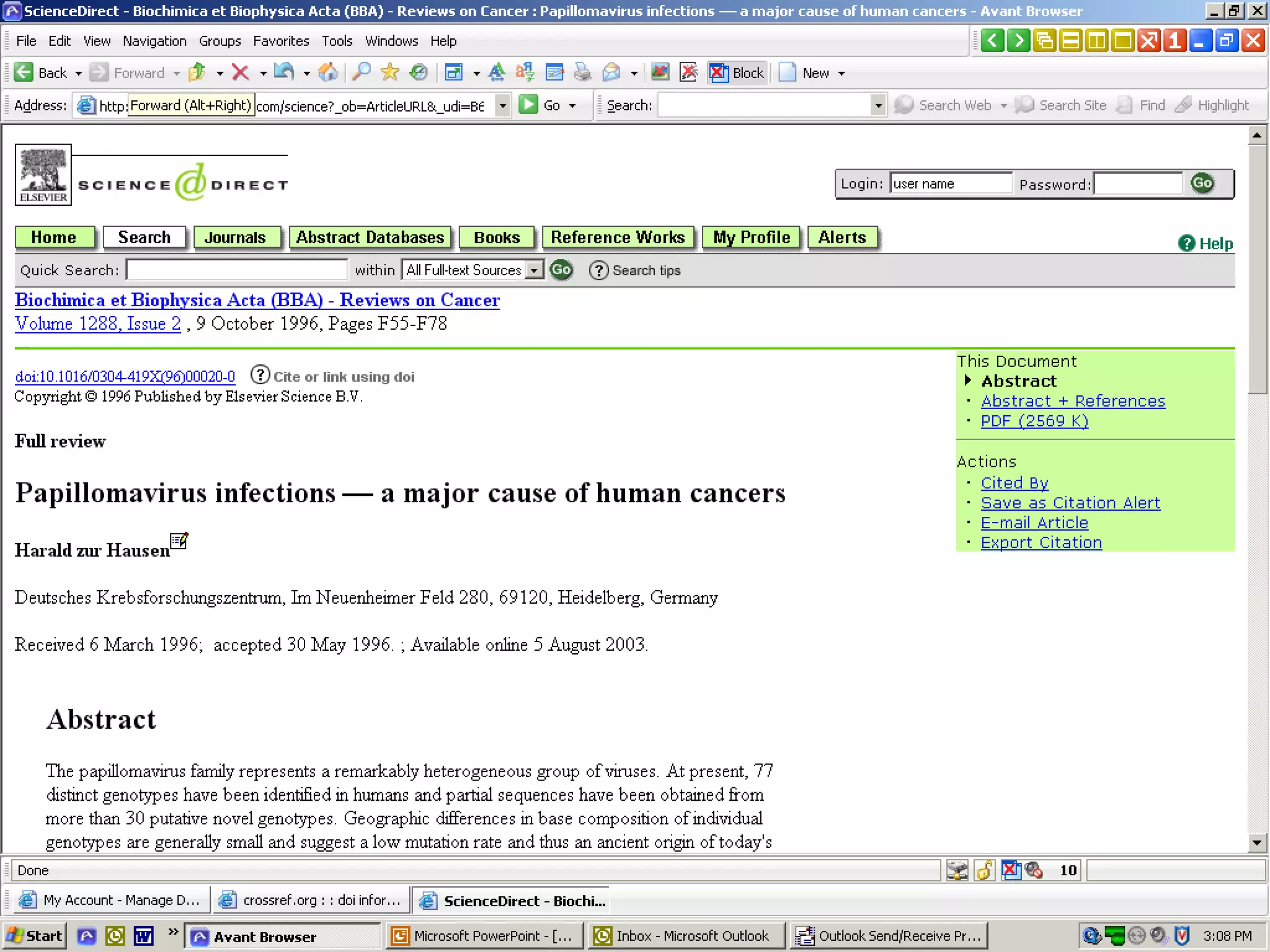
Benefits of the DOI system to libraries Persistence, persistence, persistence!!! Successful implementation of naming objects & treating content as information objects and intellectual content, not simply as packets of bits. DOIs are easy to use.  Simply click one or cut and paste it like you would a URL.
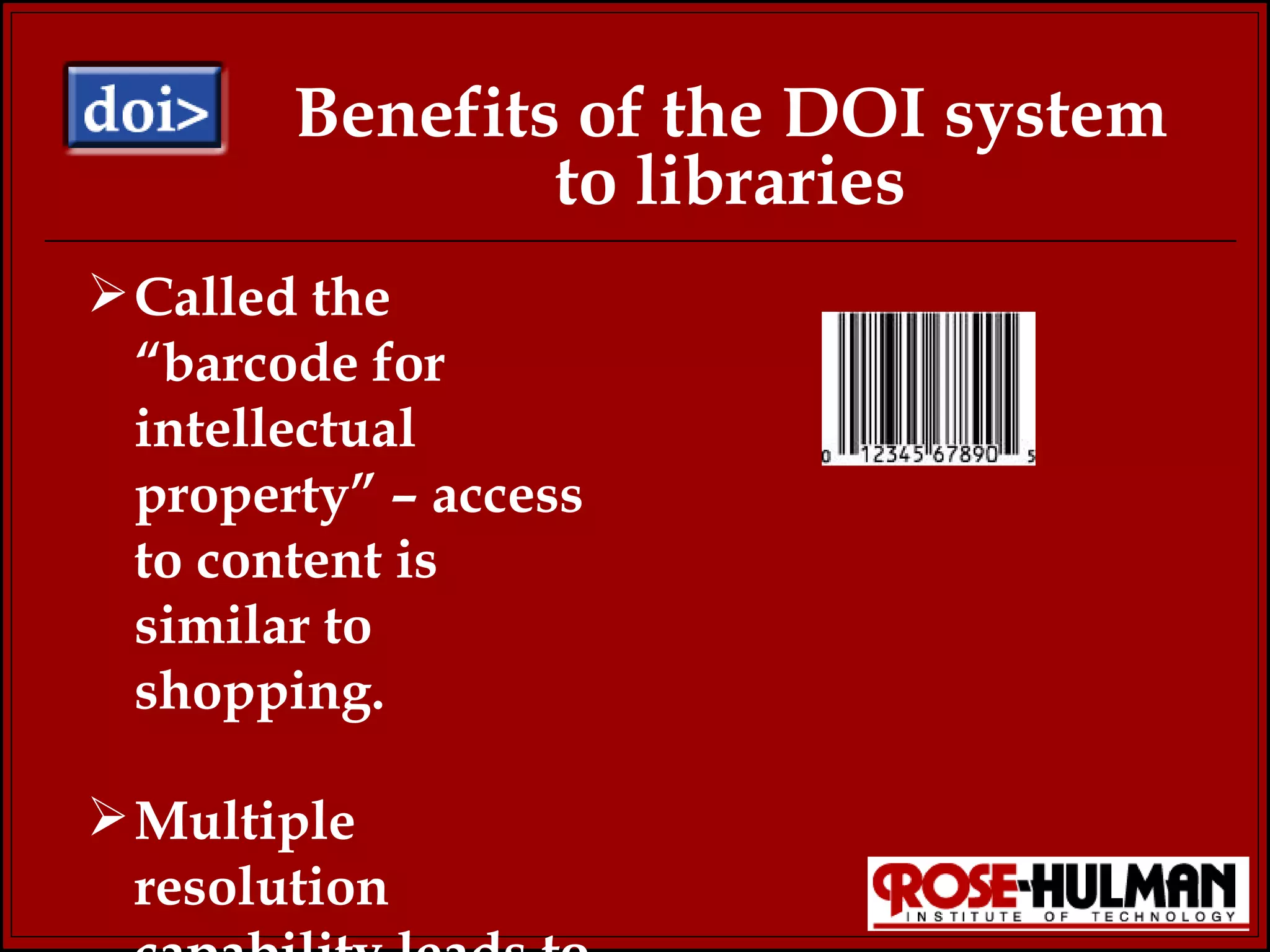
Benefits of the DOI system to libraries Called the “barcode for intellectual property” – access to content is similar to shopping. Multiple resolution capability leads to more options for researchers.
 
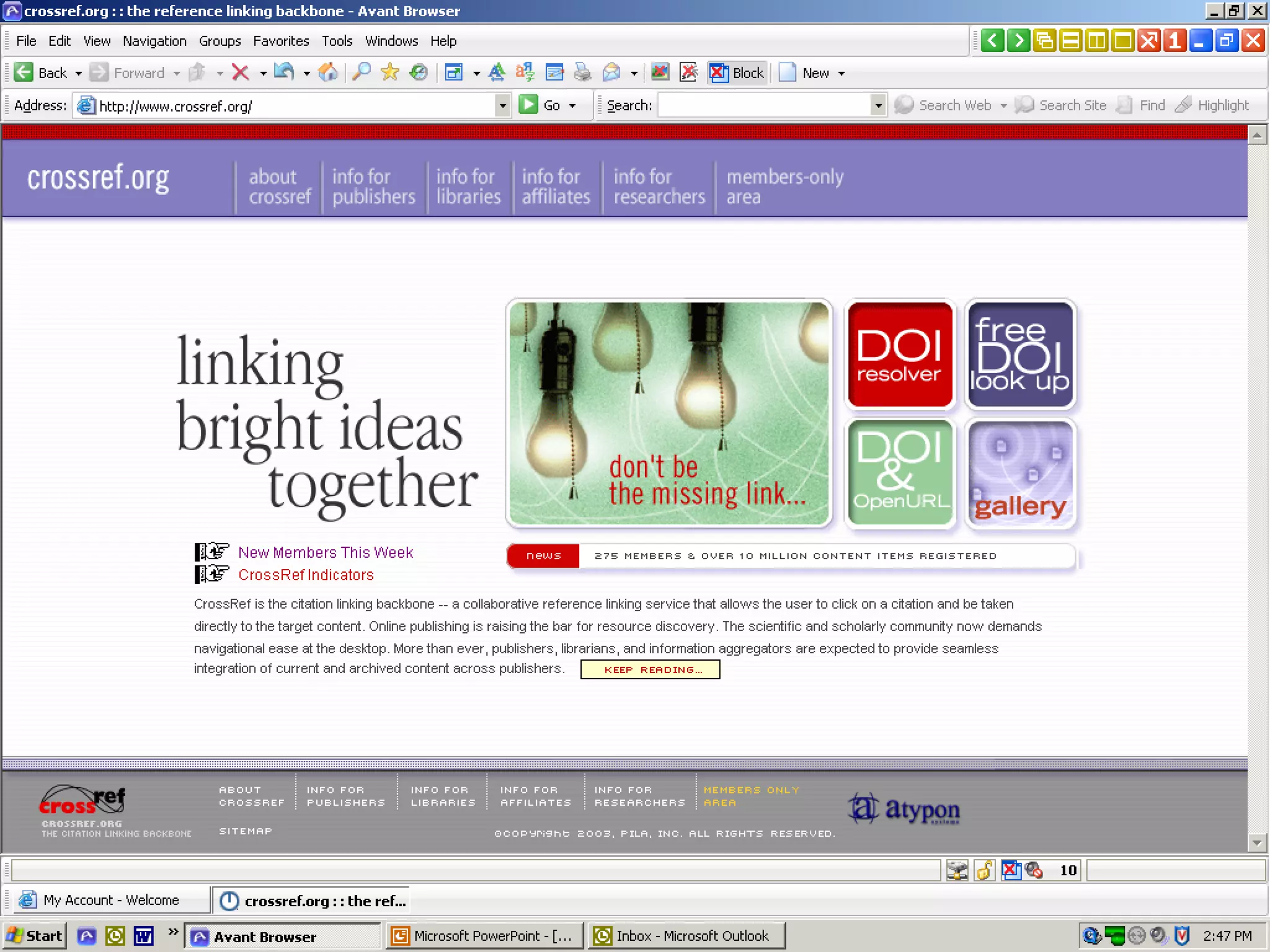
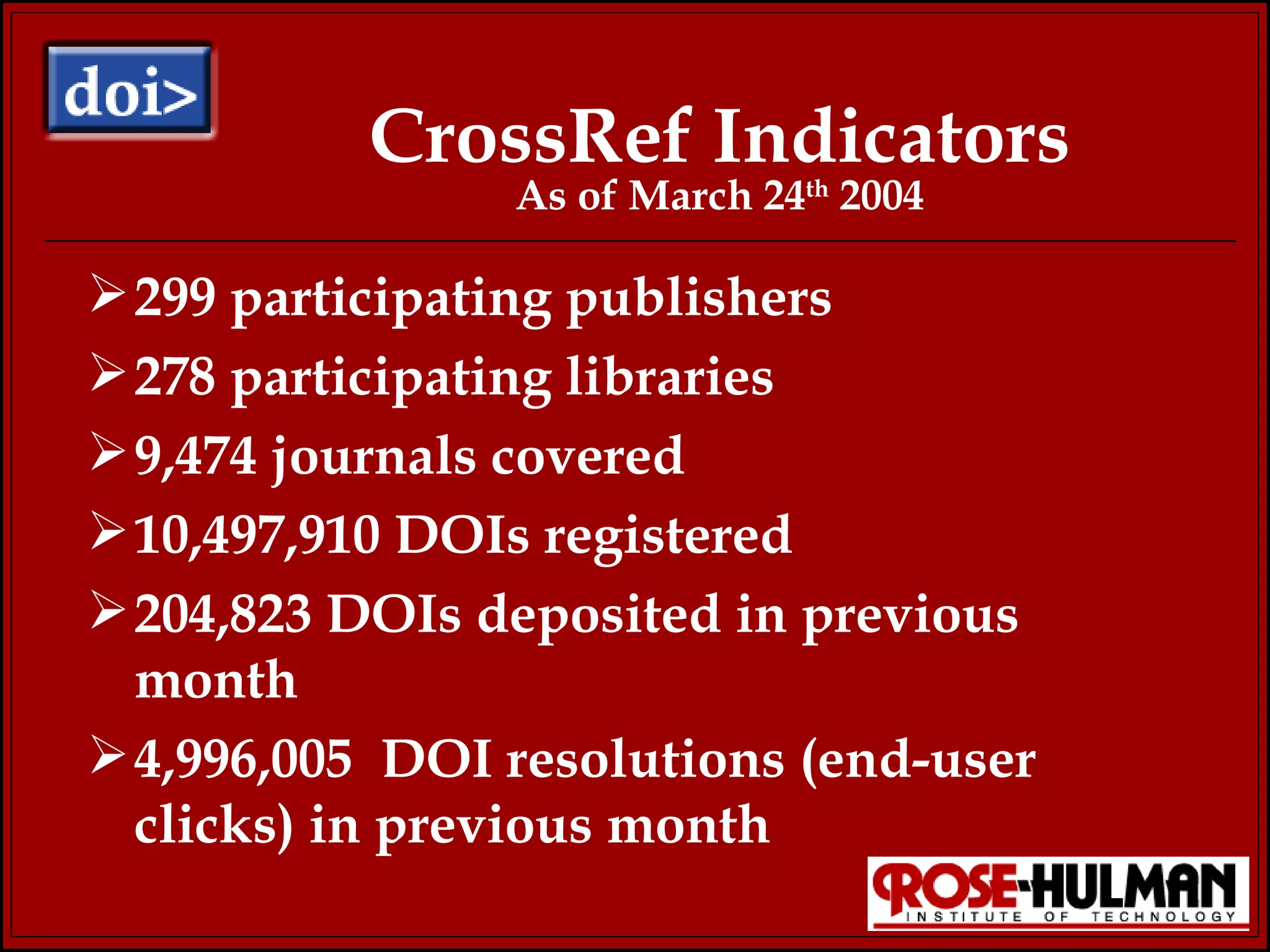
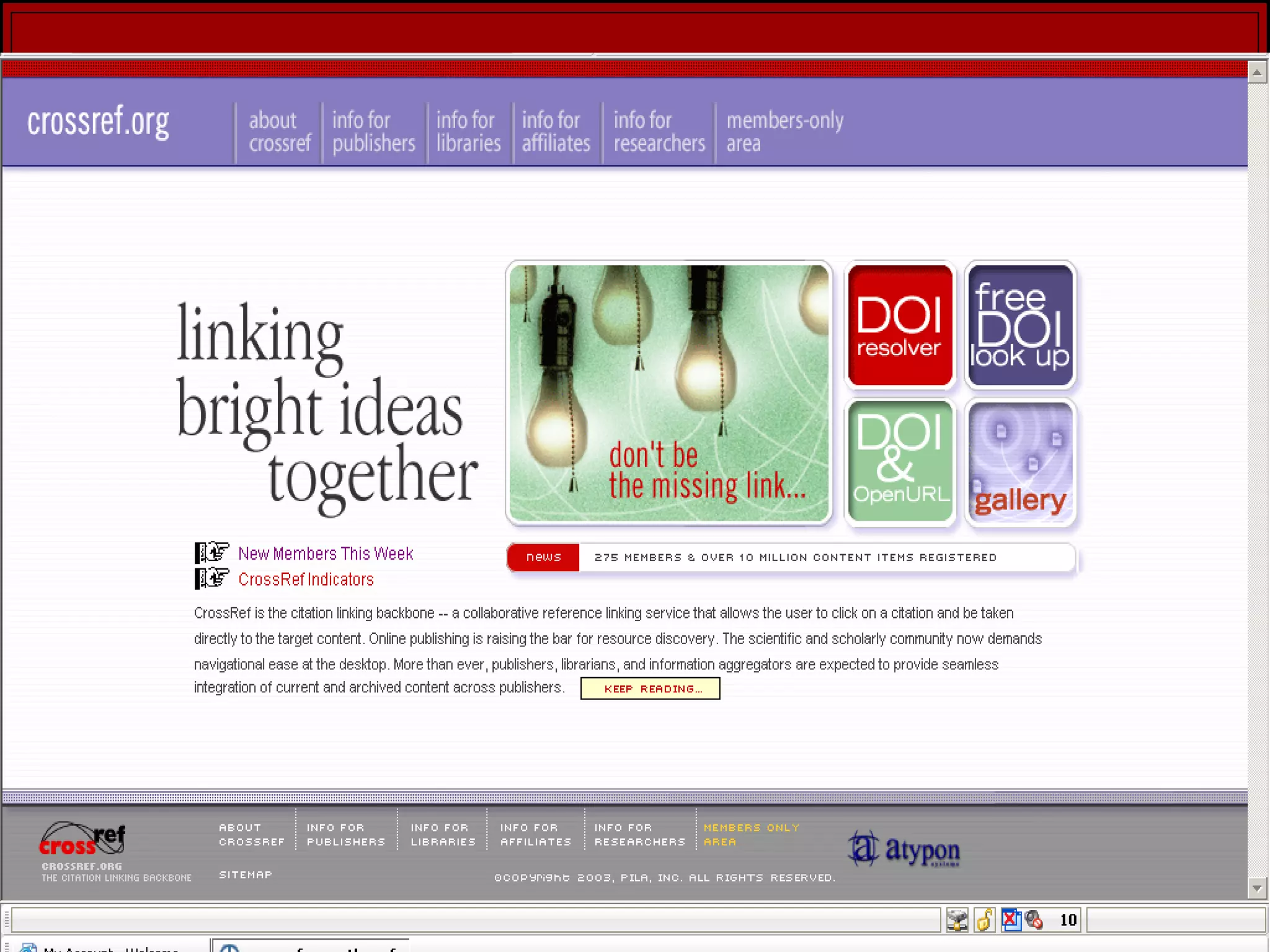
CrossRef Indicators As of March 24 th  2004 299 participating publishers 278 participating libraries 9,474 journals covered 10,497,910 DOIs registered 204,823 DOIs deposited in previous month 4,996,005  DOI resolutions (end-user  clicks) in previous month


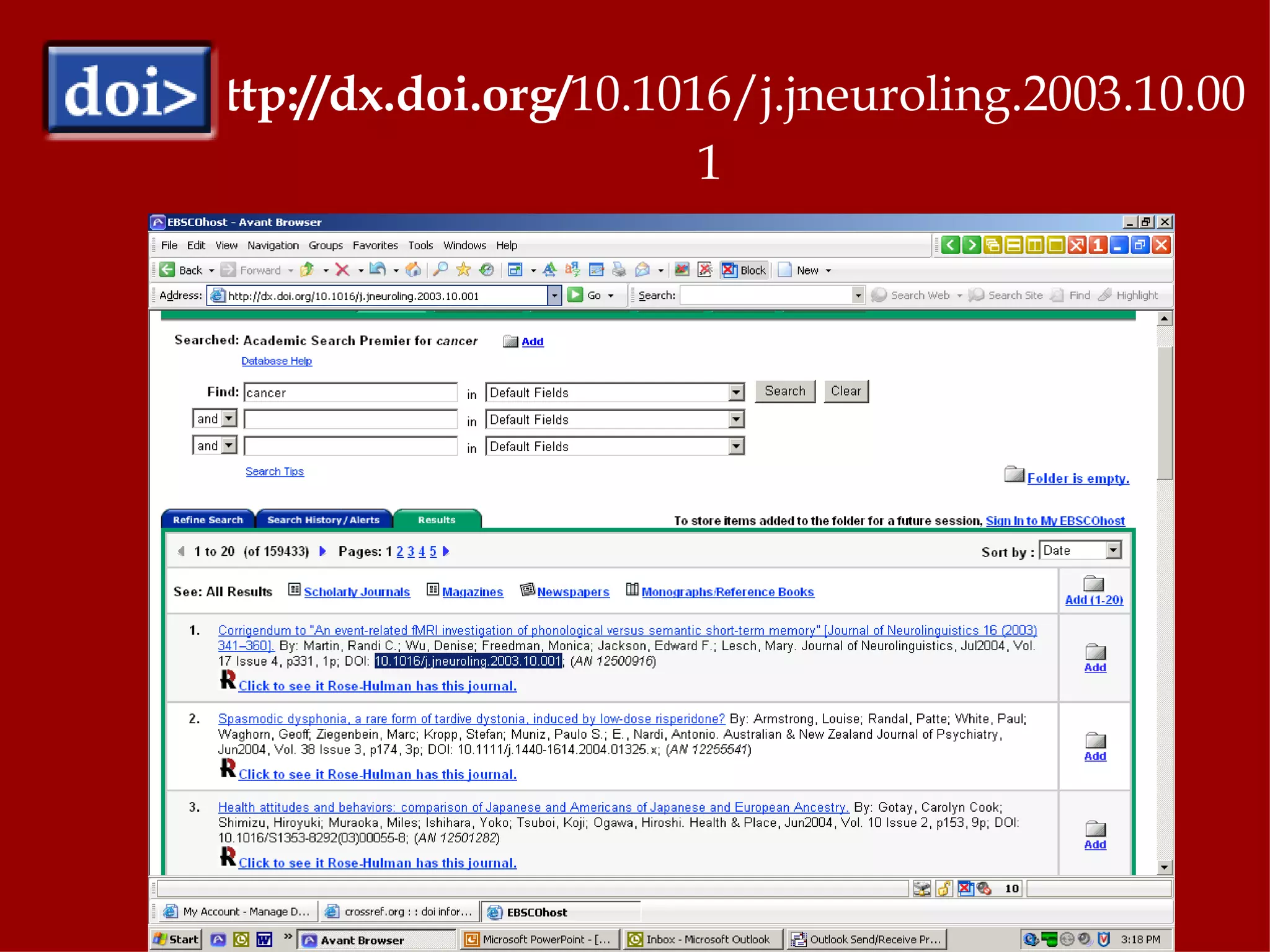
http://dx.doi.org/ 10.1016/j.jneuroling.2003.10.001
 
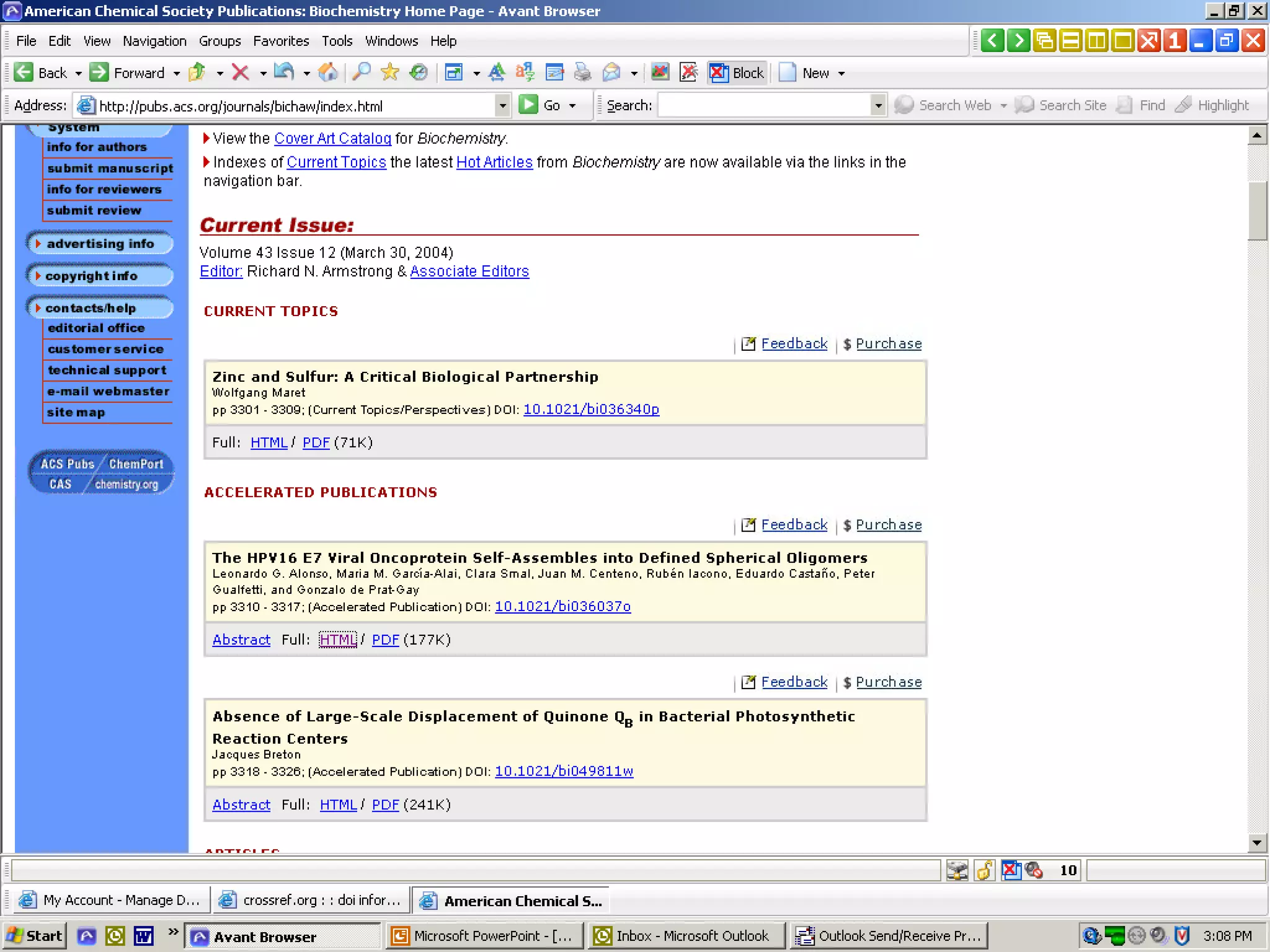
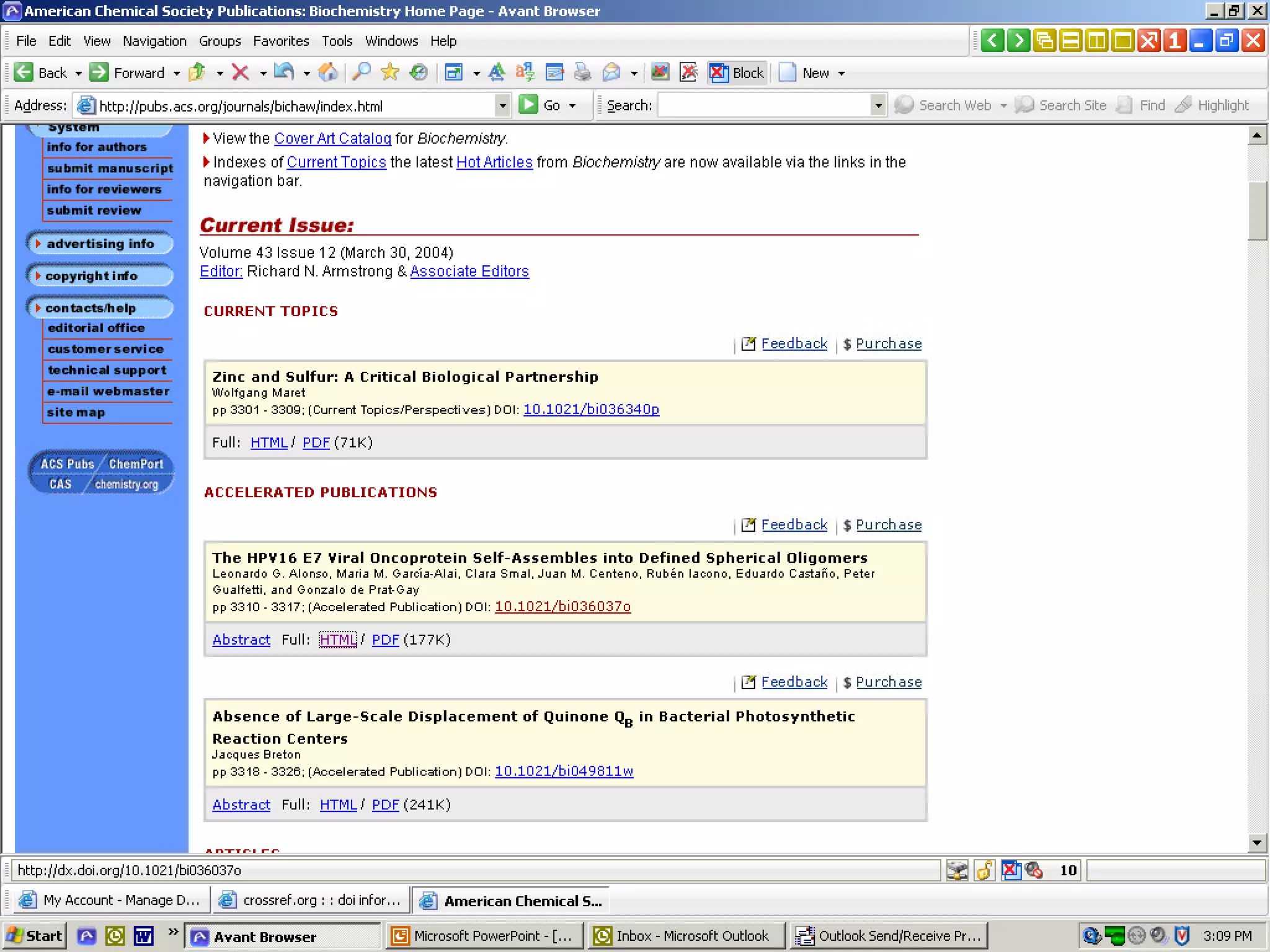
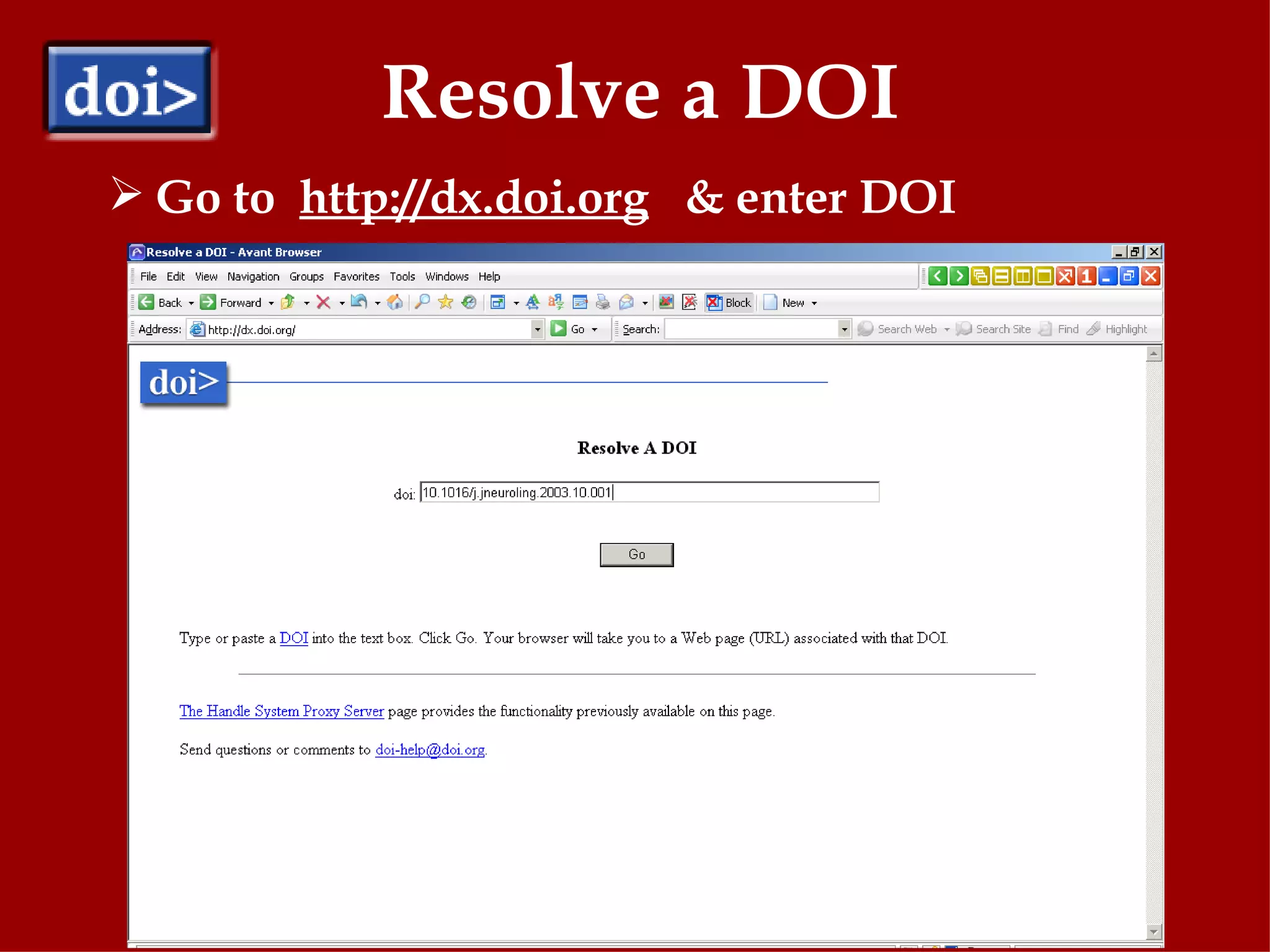
Resolve a DOI Go to  http://dx.doi.org   & enter DOI
 
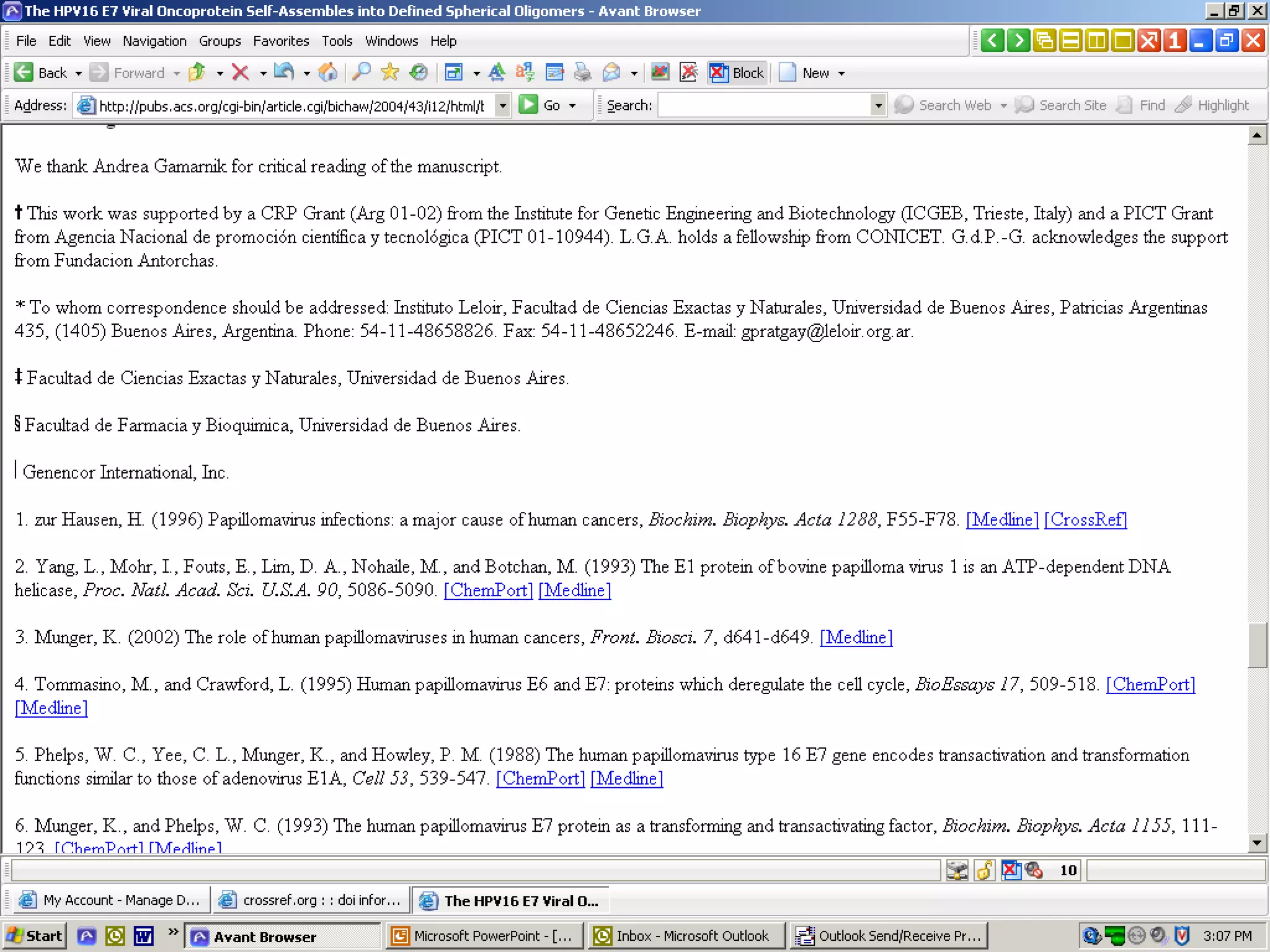
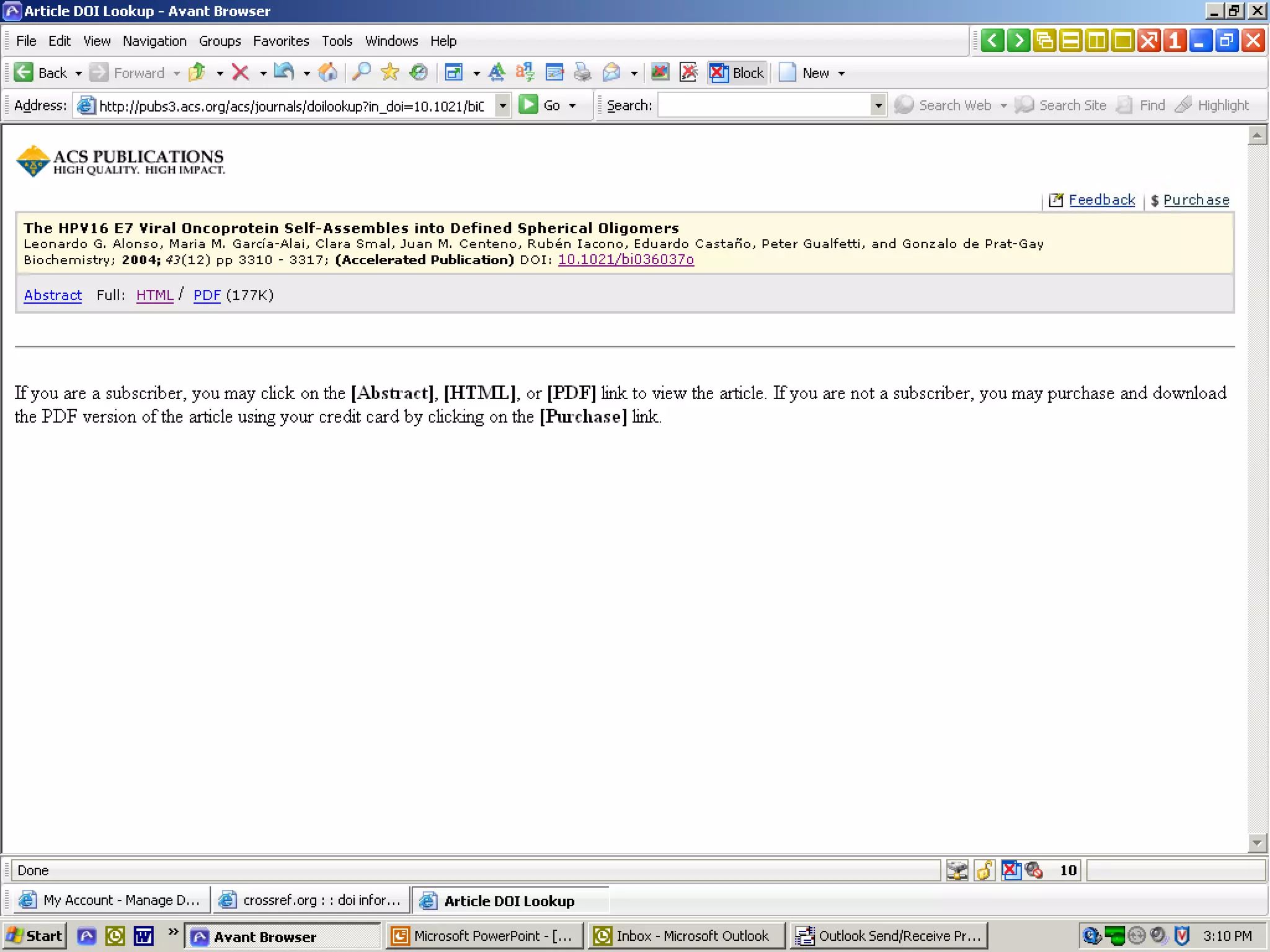
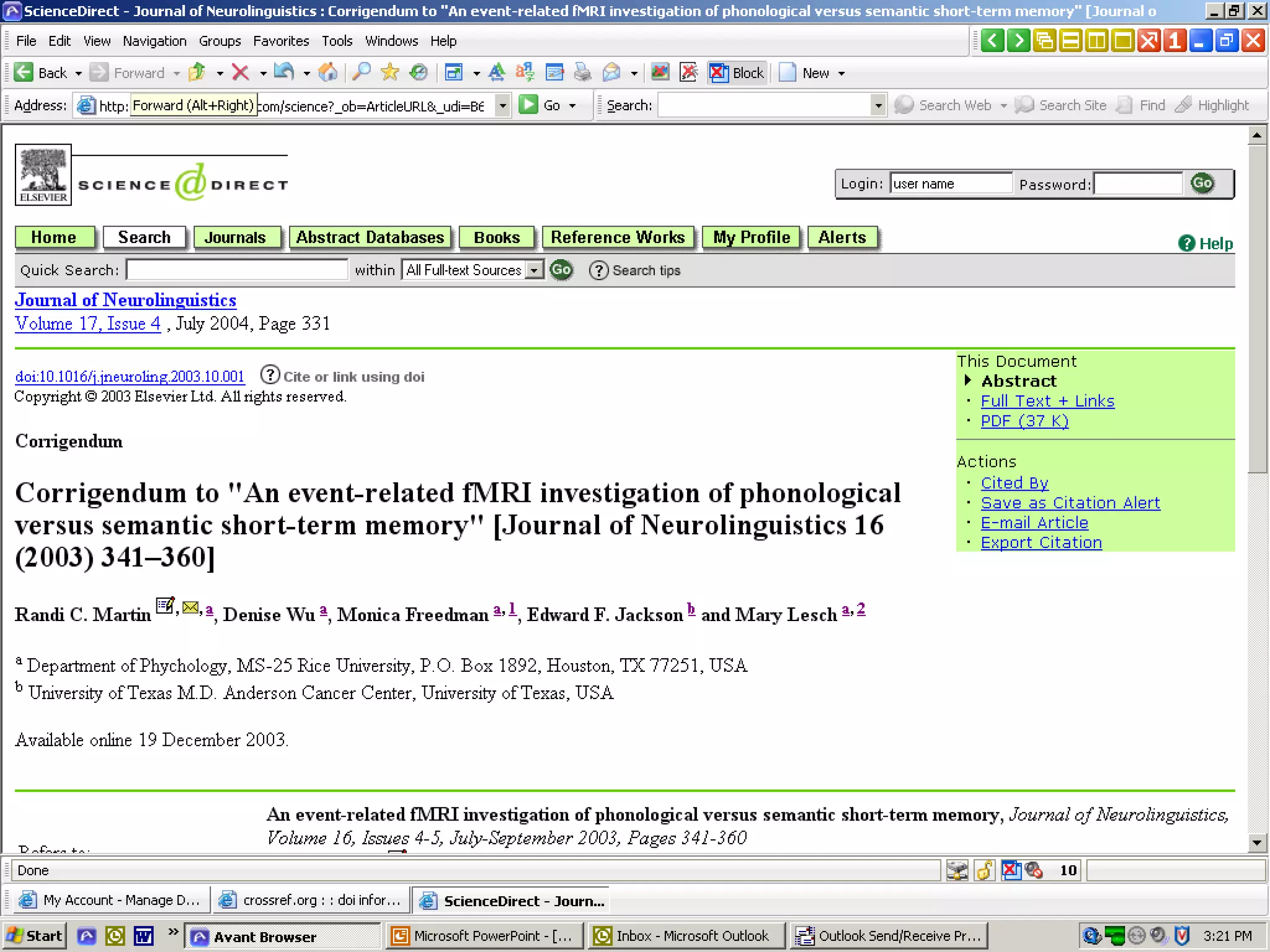
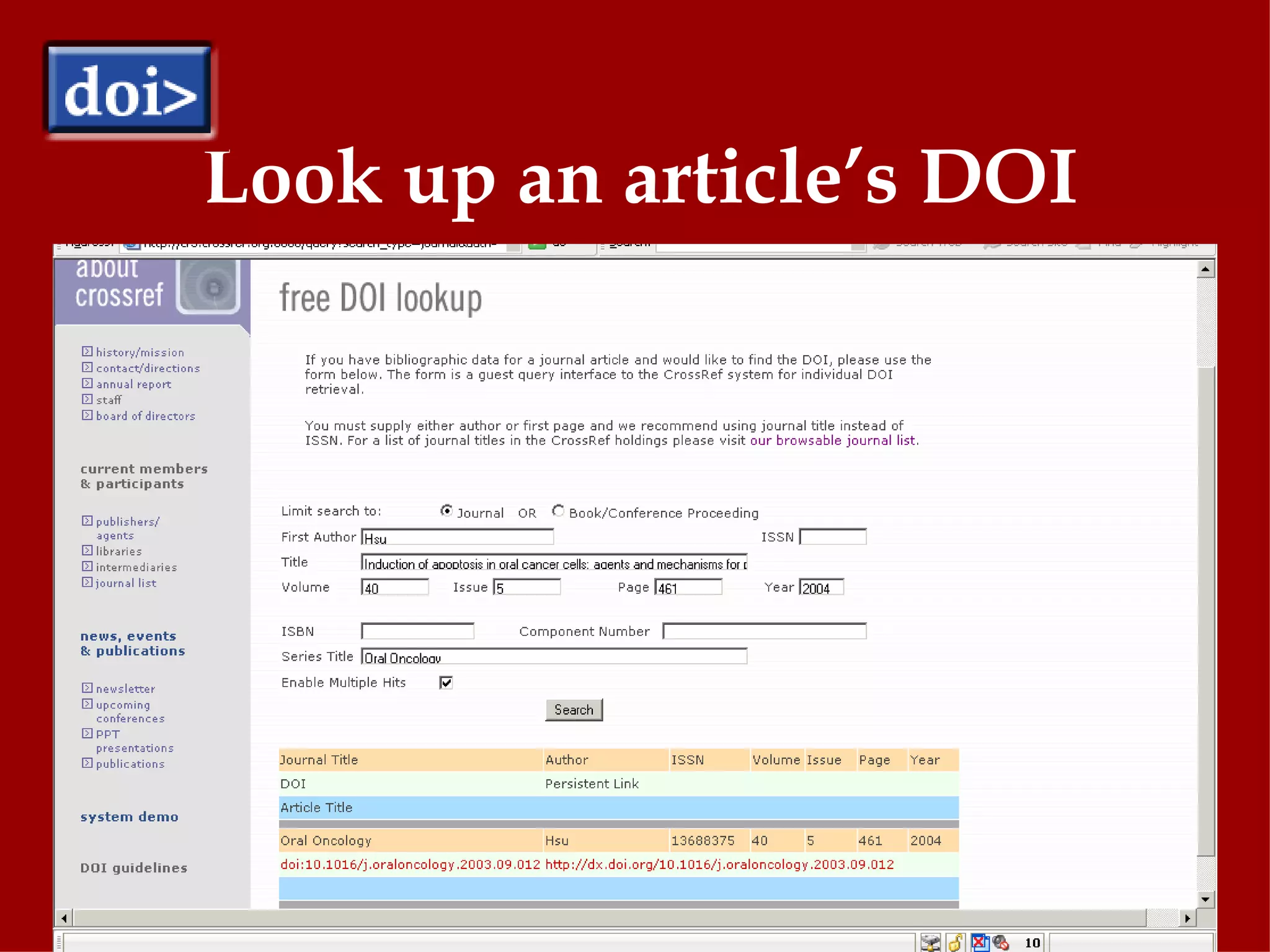
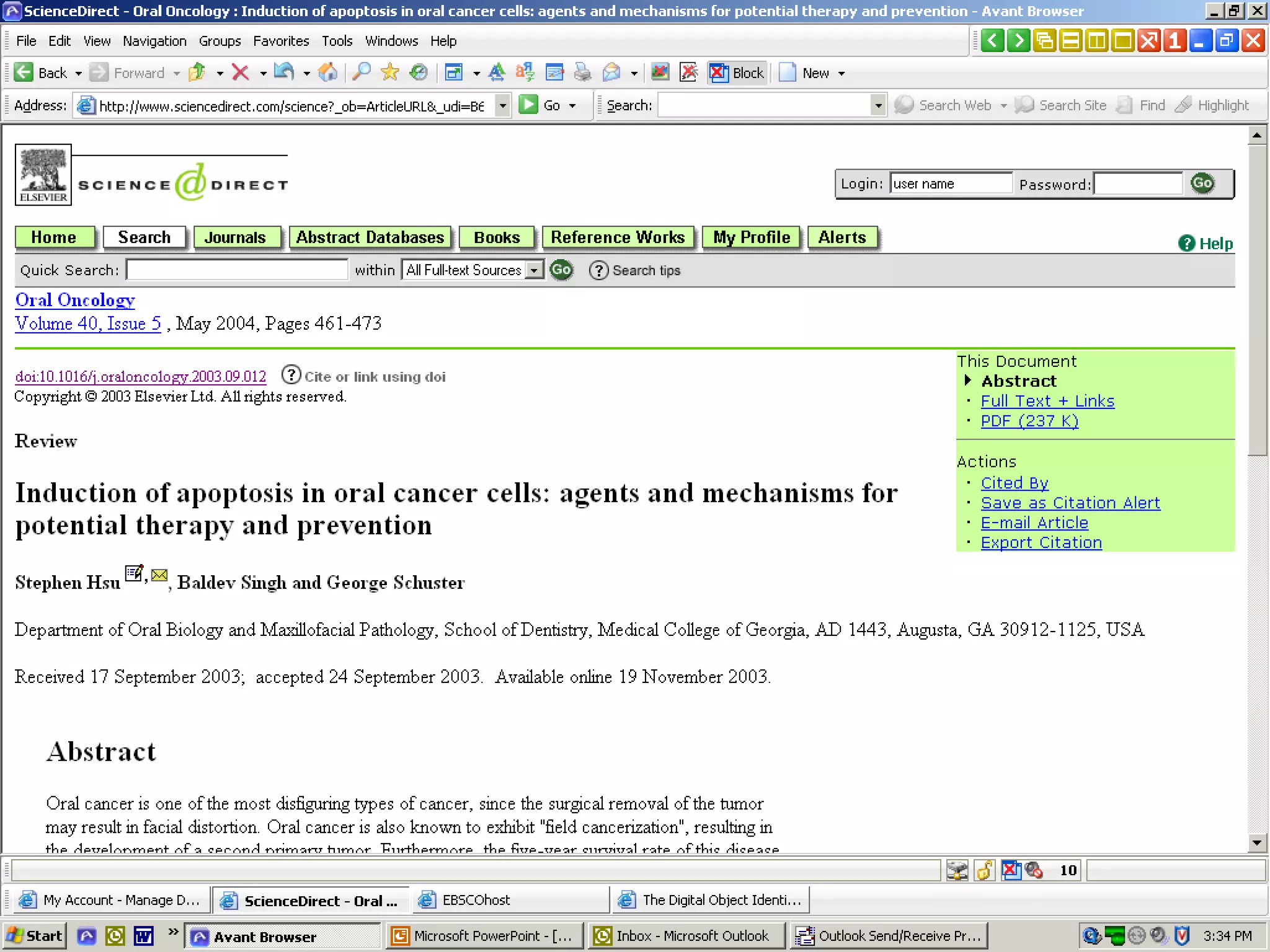
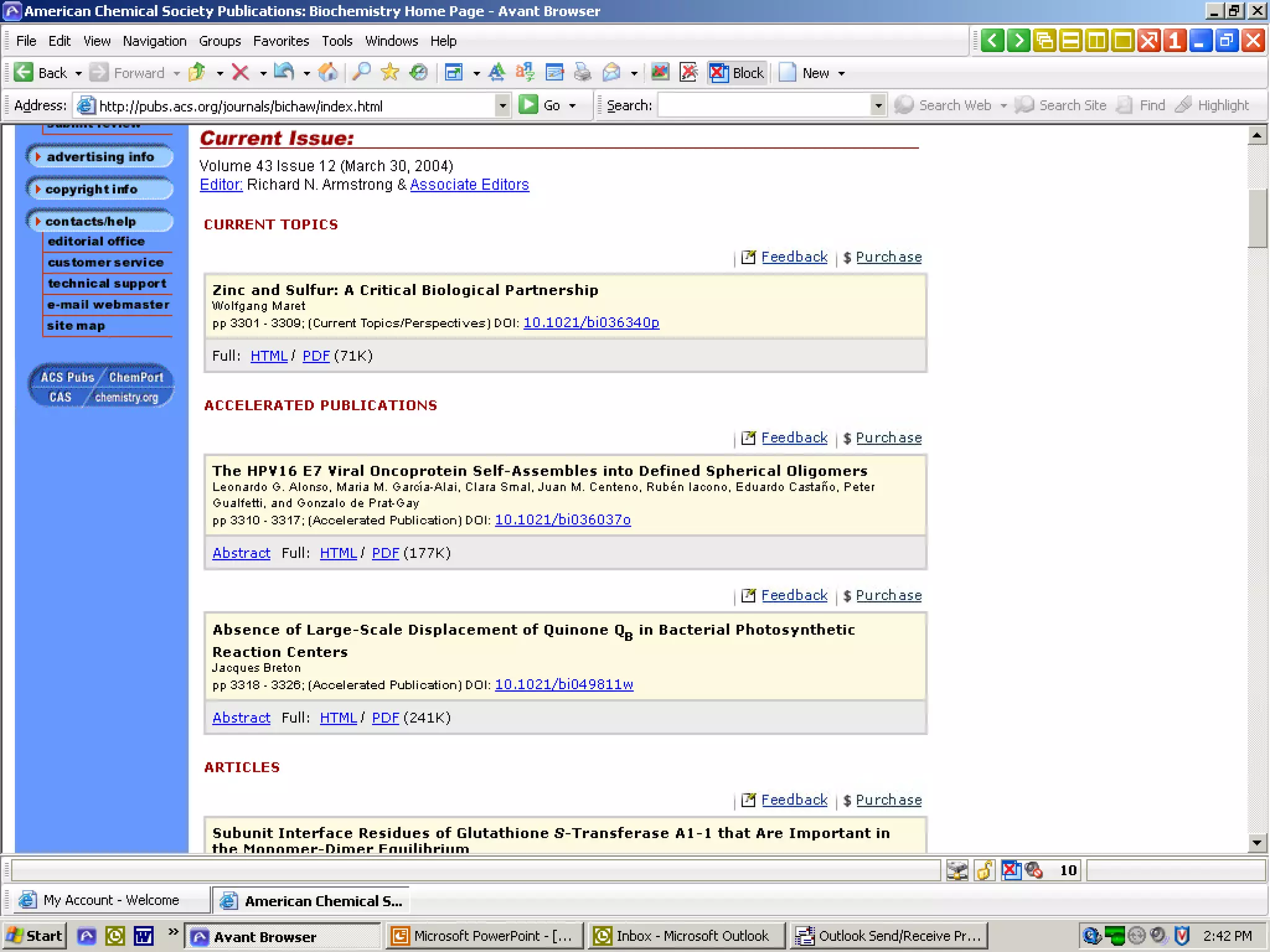
Look up an article’s DOI
 
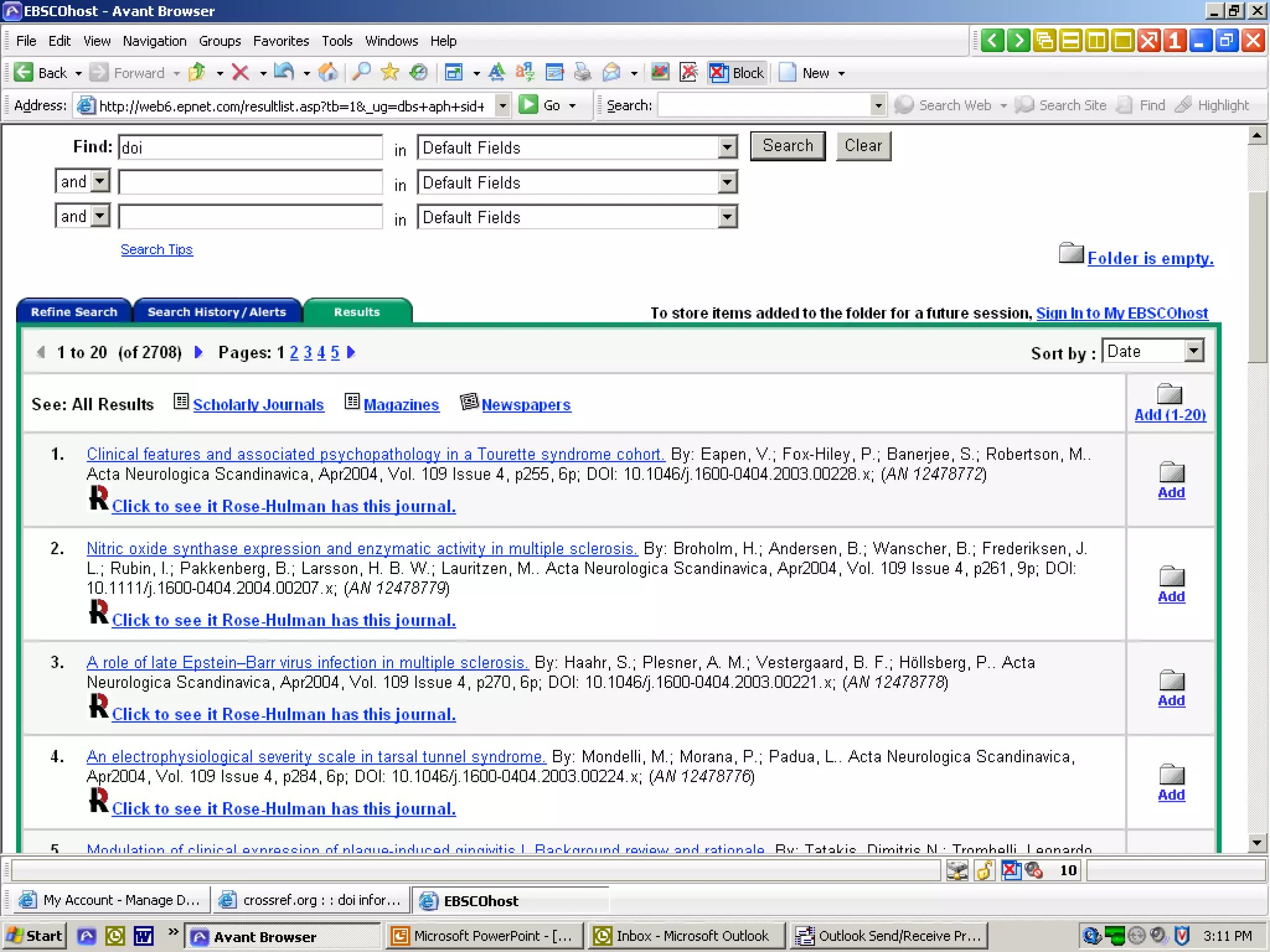
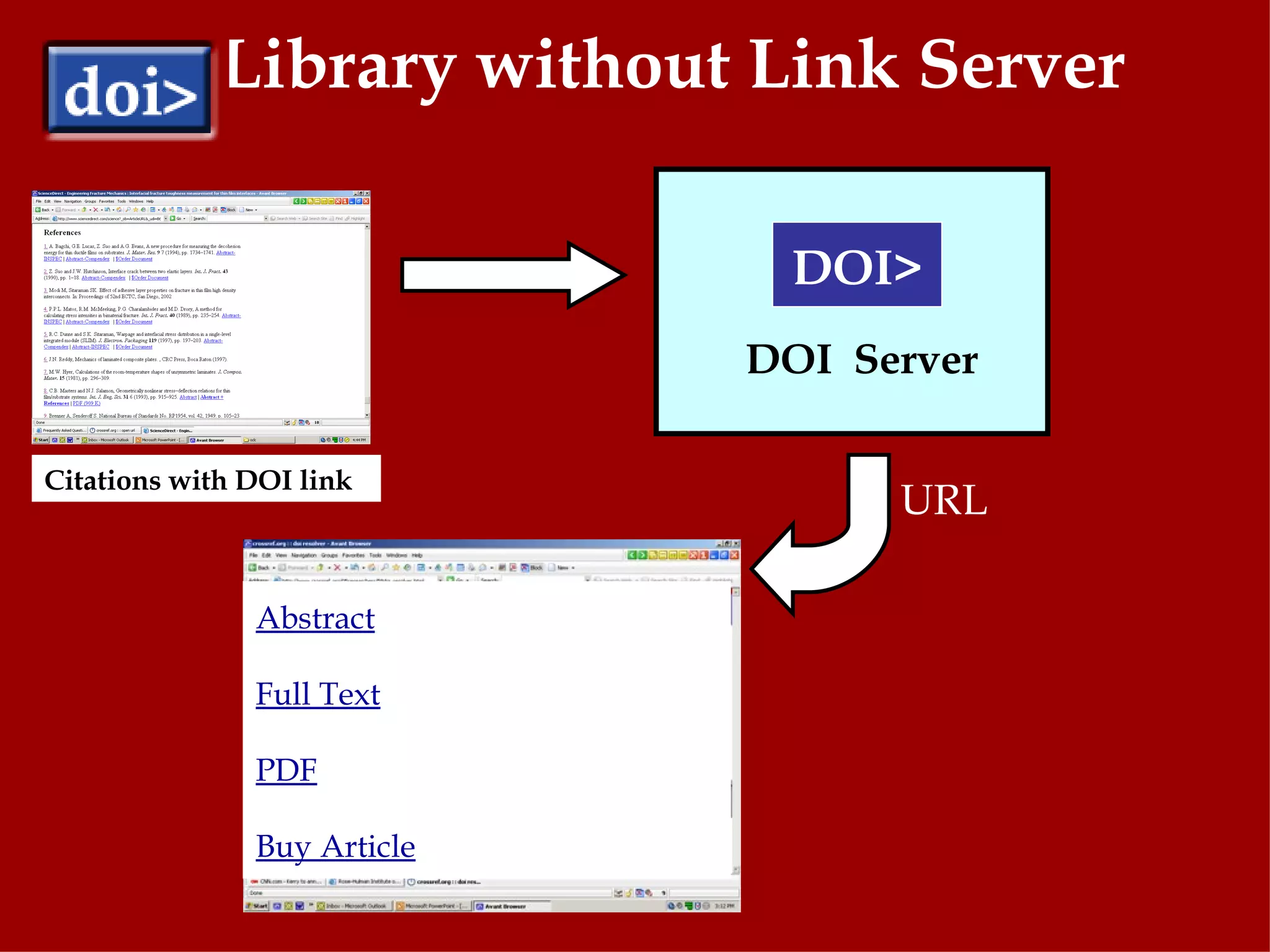
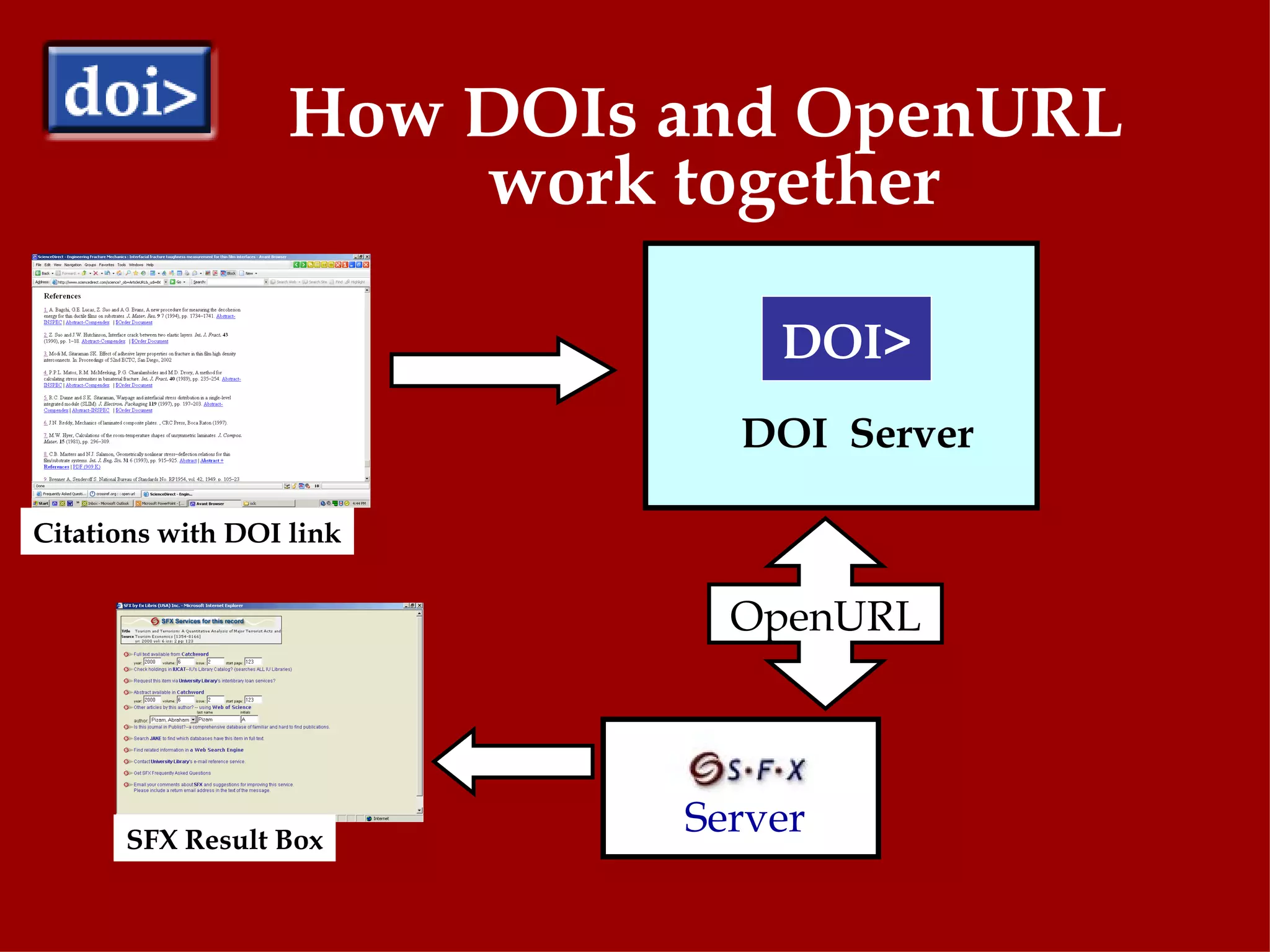
DOI and OpenURL standard OpenURL is a standard syntax that provides a universal way to define citation information as a URL. Metadata is passed to a link resolver via URL which determines a user’s content access permissions and directs them to the appropriate copy. SFX and EBSCO’s LinkSource are link resolvers.
DOIs on the other hand… Do not resolve appropriate copy issue alone. Are persistent and facilitate access to full text options, articles referenced, and times cited references.
Library without Link Server Citations with DOI link DOI> DOI  Server Abstract Full Text PDF Buy Article URL
How DOIs and OpenURL  work together DOI> DOI  Server OpenURL Server Citations with DOI link SFX Result Box
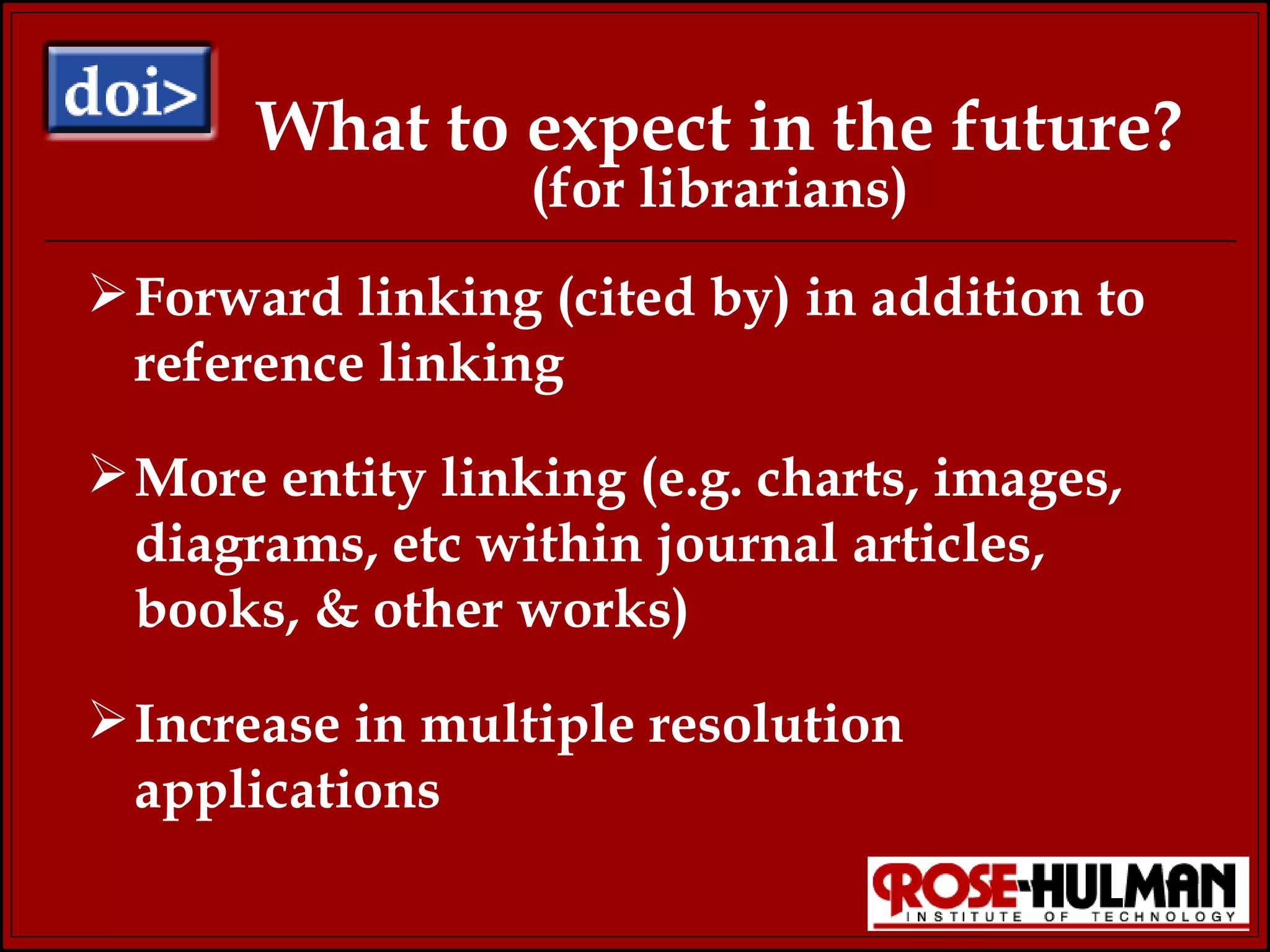
What to expect in the future? (for librarians) Forward linking (cited by) in addition to reference linking More entity linking (e.g. charts, images, diagrams, etc within journal articles, books, & other works) Increase in multiple resolution applications
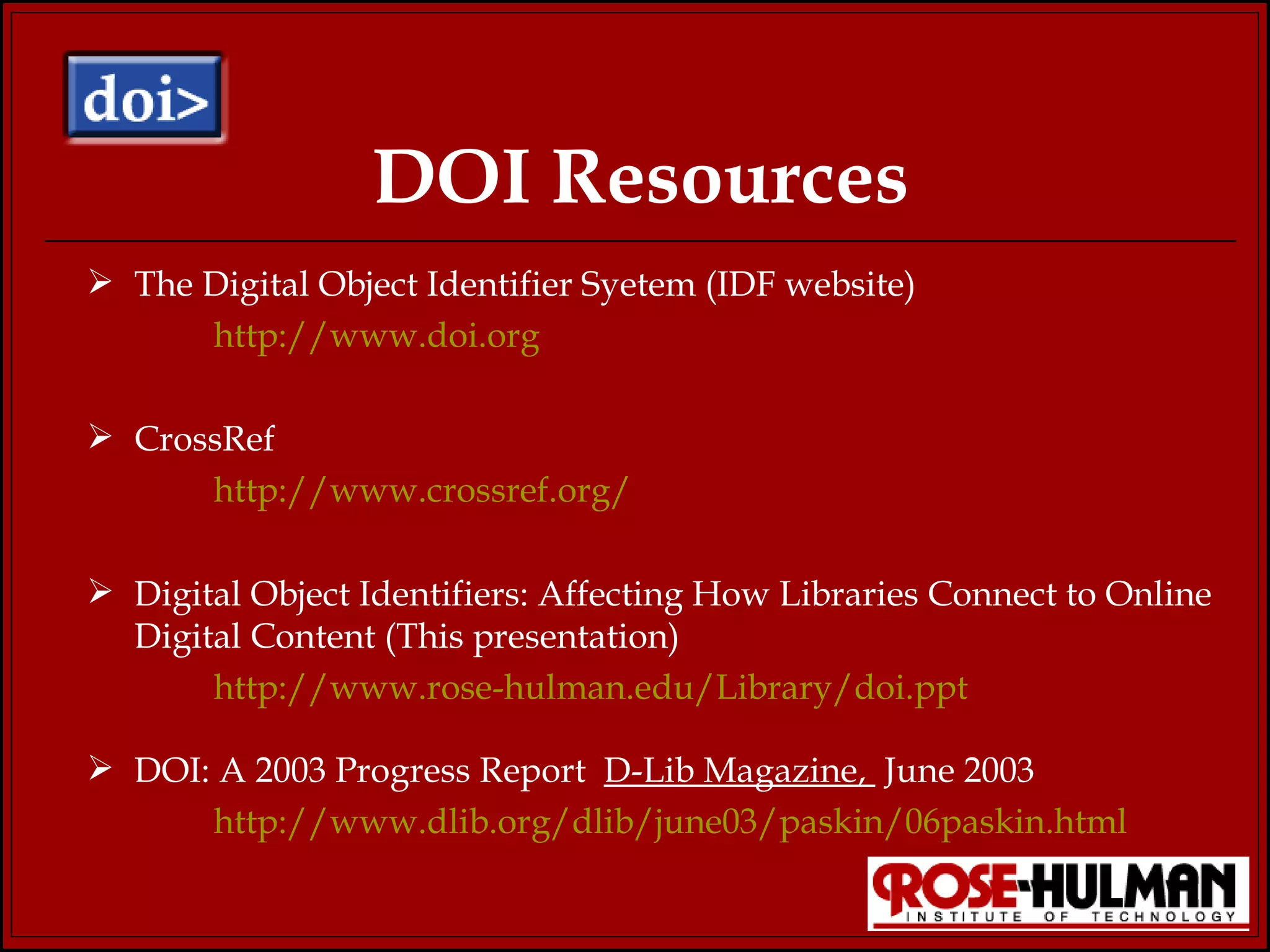
DOI Resources The Digital Object Identifier Syetem (IDF website) http://www.doi.org CrossRef http://www.crossref.org/   Digital Object Identifiers: Affecting How Libraries Connect to Online Digital Content (This presentation)  http://www.rose-hulman.edu/Library/doi.ppt DOI: A 2003 Progress Report  D-Lib Magazine,  June 2003 http://www.dlib.org/dlib/june03/paskin/06paskin.html
Thank You Richard Bernier Reference & Electronic Services Librarian Rose-Hulman Institute of Technology (812) 877-8199 [email_address]

Digital Object Identifiers: Affecting How Libraries Connect to Online Digital Content

  • 1.
    Digital Object Identifiers:Richard Bernier Reference & Electronic Services Librarian April 13, 2004 Affecting how libraries connect to online digital content
  • 2.
    What is DOI? An identification system for intellectual property in the digital environment Developed by the DOI foundation on behalf behalf of the publishing industry to provide a framework for managing intellectual content, link customers with publishers, facilitate electronic commerce, and enable automated copyright management.
  • 3.
    But what doesit really do? A persistent identification number assigned to a unit of content and registered with a lookup service. Not only an identifier of digital objects, but also a digital identifier of objects. e.g non-digital entities, such as underlying abstractions (the “work”) and physical manifestations.
  • 4.
    Implementations Journals orsingle journal articles Books or book chapters Entire opera or single bar of music. Digitized or non-digitized audio, video, images, text An article is Spanish and in English could have one DOI for both, or separate DOIs for each language
  • 5.
    International DOI Foundation(IDF) DOI organization established to develop and manage the DOI system Launched in 1998 by the Association of American Publishers, International Publishers Association, and the International Association of Scientific Technical and Medical Publishers
  • 6.
    DOI Basics Singleresolution: DOI points to 1 URL Multiple Resolution: DOI points to multiple URLs (e.g. Full text, purchase option, abstract) DOI> 10.1000/1234 URL DOI> 10.1000/1234 URL 1 URL 2 Data 1 Data 2 Example
  • 7.
    DOI Basics DOISystem made up of four parts The identifier (Numbering scheme) Resolution Metadata Policy
  • 8.
    Identifier The identifieris made up of two components – the prefix and the suffix. While the URL to the object may change, the DOI identifier does not. Prefix Suffix DOI Prefix represents the publisher of registrant Suffix is unique to that object. Can be already used number like an ISBN #.
  • 9.
  • 10.
    Resolution Ensures persistenceby resolving the DOI to a current associated value such as a URL; Resolution may be to multiple pieces of data (multiple resolution); The Handle System is the resolution system used.
  • 11.
    Registration Agencies ProvideServices to Registrants Allocate DOI prefixes Registering DOIs and providing the necessary infrastructure to allow Registrants to declare and maintain metadata and state data.
  • 12.
    Registration Agencies ContentDirections Copyright Agency, Ltd. CrossRef Enpia Systems Lon, Inc. mEDRA Nielson BookData R.R Bowker TSO (The Stationary Office
  • 13.
    Metadata Each DOIhas attached metadata set which describes it. Standard metadata includes: What is the resource that is identified? Does it have another identifier that can be recognized (e.g. an ISBN)? Who are the parties responsible for its creation? What is it made of? (abstract, physical, digital) How is it perceived? (visual, audio, etc) Particular application type? (e.g article linking)?
  • 14.
    Policy Rules determinedby the International DOI Foundation for the operation of the DOI System in a consistent, predictable, and controlled manner to ensure longevity of the system as infrastructure. Use of Registration agencies which operate under same rules as an operational federation.
  • 15.
    DOI Diagram NormanPaskin, Digital Object Identifier: Overview , www.doi.org Administrator (publisher.com) Identifier: DOI: 10.XXXX/1234 URL: http://publisher.com/10.X... Title: New Horizona - Latin Jazz Agent = Author: John Jakob-Jemènez Type: digital file Mode: Text: 250 pages Images: 20 Moving Images: 2 Audio: 20 Release Date: January 1, 2001 Rights Profile: Translation Paperback Electronic Email Contact: [email_address] Other Titles by Author: Title 2 ; Title 3 Retailers: amazon ; bol ; DOI data and metadata (XMLbatch) DOI data and metadata Registration Agency Metadata Collection metadata DOI System DOI data
  • 16.
    Progress of ProjectAugust 2003: 10 millionth DOI was assigned via CrossRef Over 300 professional publishing organizations joined up. 9 Registration Agencies 6 Charter Members & 17 General Members that fund & support the foundation and develop the system
  • 17.
    Benefits of theDOI system to libraries Persistence, persistence, persistence!!! Successful implementation of naming objects & treating content as information objects and intellectual content, not simply as packets of bits. DOIs are easy to use. Simply click one or cut and paste it like you would a URL.
  • 18.
    Benefits of theDOI system to libraries Called the “barcode for intellectual property” – access to content is similar to shopping. Multiple resolution capability leads to more options for researchers.
  • 19.
  • 20.
    CrossRef Indicators Asof March 24 th 2004 299 participating publishers 278 participating libraries 9,474 journals covered 10,497,910 DOIs registered 204,823 DOIs deposited in previous month 4,996,005 DOI resolutions (end-user clicks) in previous month
  • 21.
  • 22.
  • 23.
  • 24.
  • 25.
  • 26.
  • 27.
  • 28.
  • 29.
  • 30.
    Resolve a DOIGo to http://dx.doi.org & enter DOI
  • 31.
  • 32.
    Look up anarticle’s DOI
  • 33.
  • 34.
    DOI and OpenURLstandard OpenURL is a standard syntax that provides a universal way to define citation information as a URL. Metadata is passed to a link resolver via URL which determines a user’s content access permissions and directs them to the appropriate copy. SFX and EBSCO’s LinkSource are link resolvers.
  • 35.
    DOIs on theother hand… Do not resolve appropriate copy issue alone. Are persistent and facilitate access to full text options, articles referenced, and times cited references.
  • 36.
    Library without LinkServer Citations with DOI link DOI> DOI Server Abstract Full Text PDF Buy Article URL
  • 37.
    How DOIs andOpenURL work together DOI> DOI Server OpenURL Server Citations with DOI link SFX Result Box
  • 38.
    What to expectin the future? (for librarians) Forward linking (cited by) in addition to reference linking More entity linking (e.g. charts, images, diagrams, etc within journal articles, books, & other works) Increase in multiple resolution applications
  • 39.
    DOI Resources TheDigital Object Identifier Syetem (IDF website) http://www.doi.org CrossRef http://www.crossref.org/ Digital Object Identifiers: Affecting How Libraries Connect to Online Digital Content (This presentation) http://www.rose-hulman.edu/Library/doi.ppt DOI: A 2003 Progress Report D-Lib Magazine, June 2003 http://www.dlib.org/dlib/june03/paskin/06paskin.html
  • 40.
    Thank You RichardBernier Reference & Electronic Services Librarian Rose-Hulman Institute of Technology (812) 877-8199 [email_address]