T.Sharon-A.Frank
1
Internet Resources Discovery (IRD)
Views on
Digital Libraries
Thanks to Hadas Weinberger
2 T.Sharon-A.Frank
•Electronic Library
•Virtual Library
•Digital Library
•Portals -
Almost all, lately?!
Names of the New Paradigm
3 T.Sharon-A.Frank
Virtual Library (1)
• A "library without walls" in which the
collection does not exist on paper,
microform, or in any tangible form, but is
accessible electronically.
• Such libraries exist only on a very small
scale, but in many traditional libraries,
current and retrospective periodicals and
some reference works are being converted
to digital format.
4 T.Sharon-A.Frank
The term digital library is more appropriate
because the term virtual (borrowed from virtual
reality) suggests that the experience of using such
a library is not the same as the real thing,
when in fact, reading or viewing a document on
a computer screen may be qualitatively different
from reading a printed book or periodical, but the
information or knowledge imparted is the same
regardless of format.
http://www.wcsu.edu/library/odlis.html#virtuallibrary
Virtual Library (2)
5 T.Sharon-A.Frank
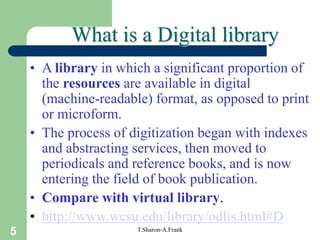
What is a Digital library
• A library in which a significant proportion of
the resources are available in digital
(machine-readable) format, as opposed to print
or microform.
• The process of digitization began with indexes
and abstracting services, then moved to
periodicals and reference books, and is now
entering the field of book publication.
• Compare with virtual library.
• http://www.wcsu.edu/library/odlis.html#D
6 T.Sharon-A.Frank
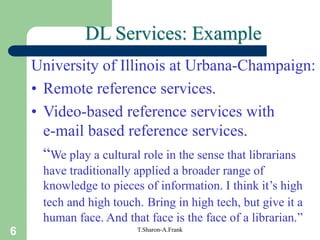
DL Services: Example
University of Illinois at Urbana-Champaign:
• Remote reference services.
• Video-based reference services with
e-mail based reference services.
“We play a cultural role in the sense that librarians
have traditionally applied a broader range of
knowledge to pieces of information. I think it’s high
tech and high touch. Bring in high tech, but give it a
human face. And that face is the face of a librarian.”
7 T.Sharon-A.Frank
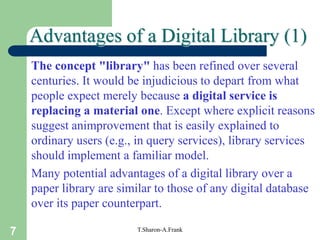
Advantages of a Digital Library (1)
The concept "library" has been refined over several
centuries. It would be injudicious to depart from what
people expect merely because a digital service is
replacing a material one. Except where explicit reasons
suggest animprovement that is easily explained to
ordinary users (e.g., in query services), library services
should implement a familiar model.
Many potential advantages of a digital library over a
paper library are similar to those of any digital database
over its paper counterpart.
8 T.Sharon-A.Frank
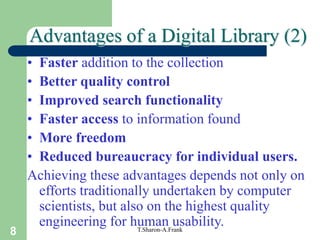
• Faster addition to the collection
• Better quality control
• Improved search functionality
• Faster access to information found
• More freedom
• Reduced bureaucracy for individual users.
Achieving these advantages depends not only on
efforts traditionally undertaken by computer
scientists, but also on the highest quality
engineering for human usability.
Advantages of a Digital Library (2)
9 T.Sharon-A.Frank
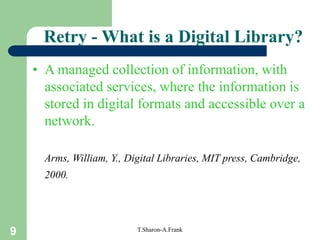
Retry - What is a Digital Library?
• A managed collection of information, with
associated services, where the information is
stored in digital formats and accessible over a
network.
Arms, William, Y., Digital Libraries, MIT press, Cambridge,
2000.
10 T.Sharon-A.Frank
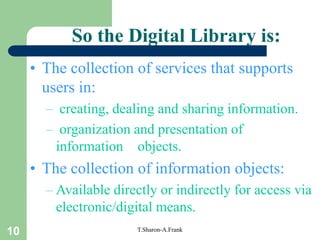
So the Digital Library is:
• The collection of services that supports
users in:
– creating, dealing and sharing information.
– organization and presentation of
information objects.
• The collection of information objects:
– Available directly or indirectly for access via
electronic/digital means.
11 T.Sharon-A.Frank
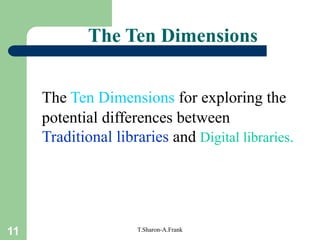
The Ten Dimensions
The Ten Dimensions for exploring the
potential differences between
Traditional libraries and Digital libraries.
12 T.Sharon-A.Frank
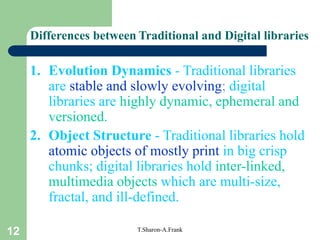
Differences between Traditional and Digital libraries
1. Evolution Dynamics - Traditional libraries
are stable and slowly evolving; digital
libraries are highly dynamic, ephemeral and
versioned.
2. Object Structure - Traditional libraries hold
atomic objects of mostly print in big crisp
chunks; digital libraries hold inter-linked,
multimedia objects which are multi-size,
fractal, and ill-defined.
13 T.Sharon-A.Frank
Differences between Traditional and Digital libraries
3. Structure - Traditional libraries hold
objects with largely flat structure and
minimal context and meta information;
digital libraries support documents with
significant internal scaffold structure and
significant context/meta information
which might be automatically extracted.
14 T.Sharon-A.Frank
4. Origin - Traditional (academic)
libraries hold objects which are scholar-
authored and pre-credentialled through
a ponderous publishing stream; digital
libraries allow anyone to publish in a
lightweight way, and can support pre-
credentialling or credentially through
use.
Differences between Traditional and Digital libraries
15 T.Sharon-A.Frank
5. Access Control - Traditional libraries are
based upon centralized control and relatively
few access locations; digital libraries can be
distributed and ubiquitous.
6. Object Structure - In traditional libraries the
objects are physically & logically co-controlled;
in digital libraries the physical and logical
organizations can be separated (allows virtual
collections).
Differences between Traditional and Digital libraries
16 T.Sharon-A.Frank
7. Free Access - The tradition of public libraries is
universal access and free; digital libraries could
be similar in this regard, or digital libraries
could support rich layers of access control and
management of terms and conditions.
8. Interaction - Traditional libraries support
one-way, loosely coupled (slow) interaction;
digital libraries support two-way
communication with tight, fast interaction.
Differences between Traditional and Digital libraries
17 T.Sharon-A.Frank
9. Simple Search - Traditional libraries are based
upon a model of one-way search (a consumer
looking for an object); digital libraries support
symmetric search (consumer looking for an object
an producer of the object looking for a consumer).
10. Interactive Complex Search - In traditional
libraries structured text queries (and some
browsing) are used to aid intellectual access; in
digital libraries complex interactions of query,
navigation/browsing, and social filtering can be
used.
Differences between Traditional and Digital libraries

ird3-2_lib.ppt

  • 1.
    T.Sharon-A.Frank 1 Internet Resources Discovery(IRD) Views on Digital Libraries Thanks to Hadas Weinberger
  • 2.
    2 T.Sharon-A.Frank •Electronic Library •VirtualLibrary •Digital Library •Portals - Almost all, lately?! Names of the New Paradigm
  • 3.
    3 T.Sharon-A.Frank Virtual Library(1) • A "library without walls" in which the collection does not exist on paper, microform, or in any tangible form, but is accessible electronically. • Such libraries exist only on a very small scale, but in many traditional libraries, current and retrospective periodicals and some reference works are being converted to digital format.
  • 4.
    4 T.Sharon-A.Frank The termdigital library is more appropriate because the term virtual (borrowed from virtual reality) suggests that the experience of using such a library is not the same as the real thing, when in fact, reading or viewing a document on a computer screen may be qualitatively different from reading a printed book or periodical, but the information or knowledge imparted is the same regardless of format. http://www.wcsu.edu/library/odlis.html#virtuallibrary Virtual Library (2)
  • 5.
    5 T.Sharon-A.Frank What isa Digital library • A library in which a significant proportion of the resources are available in digital (machine-readable) format, as opposed to print or microform. • The process of digitization began with indexes and abstracting services, then moved to periodicals and reference books, and is now entering the field of book publication. • Compare with virtual library. • http://www.wcsu.edu/library/odlis.html#D
  • 6.
    6 T.Sharon-A.Frank DL Services:Example University of Illinois at Urbana-Champaign: • Remote reference services. • Video-based reference services with e-mail based reference services. “We play a cultural role in the sense that librarians have traditionally applied a broader range of knowledge to pieces of information. I think it’s high tech and high touch. Bring in high tech, but give it a human face. And that face is the face of a librarian.”
  • 7.
    7 T.Sharon-A.Frank Advantages ofa Digital Library (1) The concept "library" has been refined over several centuries. It would be injudicious to depart from what people expect merely because a digital service is replacing a material one. Except where explicit reasons suggest animprovement that is easily explained to ordinary users (e.g., in query services), library services should implement a familiar model. Many potential advantages of a digital library over a paper library are similar to those of any digital database over its paper counterpart.
  • 8.
    8 T.Sharon-A.Frank • Fasteraddition to the collection • Better quality control • Improved search functionality • Faster access to information found • More freedom • Reduced bureaucracy for individual users. Achieving these advantages depends not only on efforts traditionally undertaken by computer scientists, but also on the highest quality engineering for human usability. Advantages of a Digital Library (2)
  • 9.
    9 T.Sharon-A.Frank Retry -What is a Digital Library? • A managed collection of information, with associated services, where the information is stored in digital formats and accessible over a network. Arms, William, Y., Digital Libraries, MIT press, Cambridge, 2000.
  • 10.
    10 T.Sharon-A.Frank So theDigital Library is: • The collection of services that supports users in: – creating, dealing and sharing information. – organization and presentation of information objects. • The collection of information objects: – Available directly or indirectly for access via electronic/digital means.
  • 11.
    11 T.Sharon-A.Frank The TenDimensions The Ten Dimensions for exploring the potential differences between Traditional libraries and Digital libraries.
  • 12.
    12 T.Sharon-A.Frank Differences betweenTraditional and Digital libraries 1. Evolution Dynamics - Traditional libraries are stable and slowly evolving; digital libraries are highly dynamic, ephemeral and versioned. 2. Object Structure - Traditional libraries hold atomic objects of mostly print in big crisp chunks; digital libraries hold inter-linked, multimedia objects which are multi-size, fractal, and ill-defined.
  • 13.
    13 T.Sharon-A.Frank Differences betweenTraditional and Digital libraries 3. Structure - Traditional libraries hold objects with largely flat structure and minimal context and meta information; digital libraries support documents with significant internal scaffold structure and significant context/meta information which might be automatically extracted.
  • 14.
    14 T.Sharon-A.Frank 4. Origin- Traditional (academic) libraries hold objects which are scholar- authored and pre-credentialled through a ponderous publishing stream; digital libraries allow anyone to publish in a lightweight way, and can support pre- credentialling or credentially through use. Differences between Traditional and Digital libraries
  • 15.
    15 T.Sharon-A.Frank 5. AccessControl - Traditional libraries are based upon centralized control and relatively few access locations; digital libraries can be distributed and ubiquitous. 6. Object Structure - In traditional libraries the objects are physically & logically co-controlled; in digital libraries the physical and logical organizations can be separated (allows virtual collections). Differences between Traditional and Digital libraries
  • 16.
    16 T.Sharon-A.Frank 7. FreeAccess - The tradition of public libraries is universal access and free; digital libraries could be similar in this regard, or digital libraries could support rich layers of access control and management of terms and conditions. 8. Interaction - Traditional libraries support one-way, loosely coupled (slow) interaction; digital libraries support two-way communication with tight, fast interaction. Differences between Traditional and Digital libraries
  • 17.
    17 T.Sharon-A.Frank 9. SimpleSearch - Traditional libraries are based upon a model of one-way search (a consumer looking for an object); digital libraries support symmetric search (consumer looking for an object an producer of the object looking for a consumer). 10. Interactive Complex Search - In traditional libraries structured text queries (and some browsing) are used to aid intellectual access; in digital libraries complex interactions of query, navigation/browsing, and social filtering can be used. Differences between Traditional and Digital libraries