Acharya N.G Ranga Agricultural University
S. V. Agricultural College, Tirupati
Department of Genetics and Plant Breeding
Topic : Breeding methods in cross pollinated crops
Mass selection, ear to row method
and Progeny selection schemes
Submitted by
M. Venkata Rama Sai
TAM/2022-24
Breeding method in Cross pollinated crops
 Population of Cross pollinated crops are highly heterozygous and
heterogenous
 They have broad genetic base and more adaptability and flexibility to the
environment
 Heterosis can be fully exploited
 They show variable inbreeding depression ranging from low to severe
 Breeding methods for cross pollinated crops are broadly categorised into
two types
1. Population improvement
2. Hybrid and Synthetic varieties
Methods of Breeding:
 Plant introduction
 Mass and Progeny selection
 Back cross method
 Heterosis breeding
 Synthetic breeding
 Composite breeding
 Polyploidy breeding
 Distant Hybridization
 Transgenic breeding
Population improvement:
 In cross pollinated crops for population improvement three
breeding approaches are made
1. Recurrent Selection
2. Disruptive Selection
3. Biparental mating
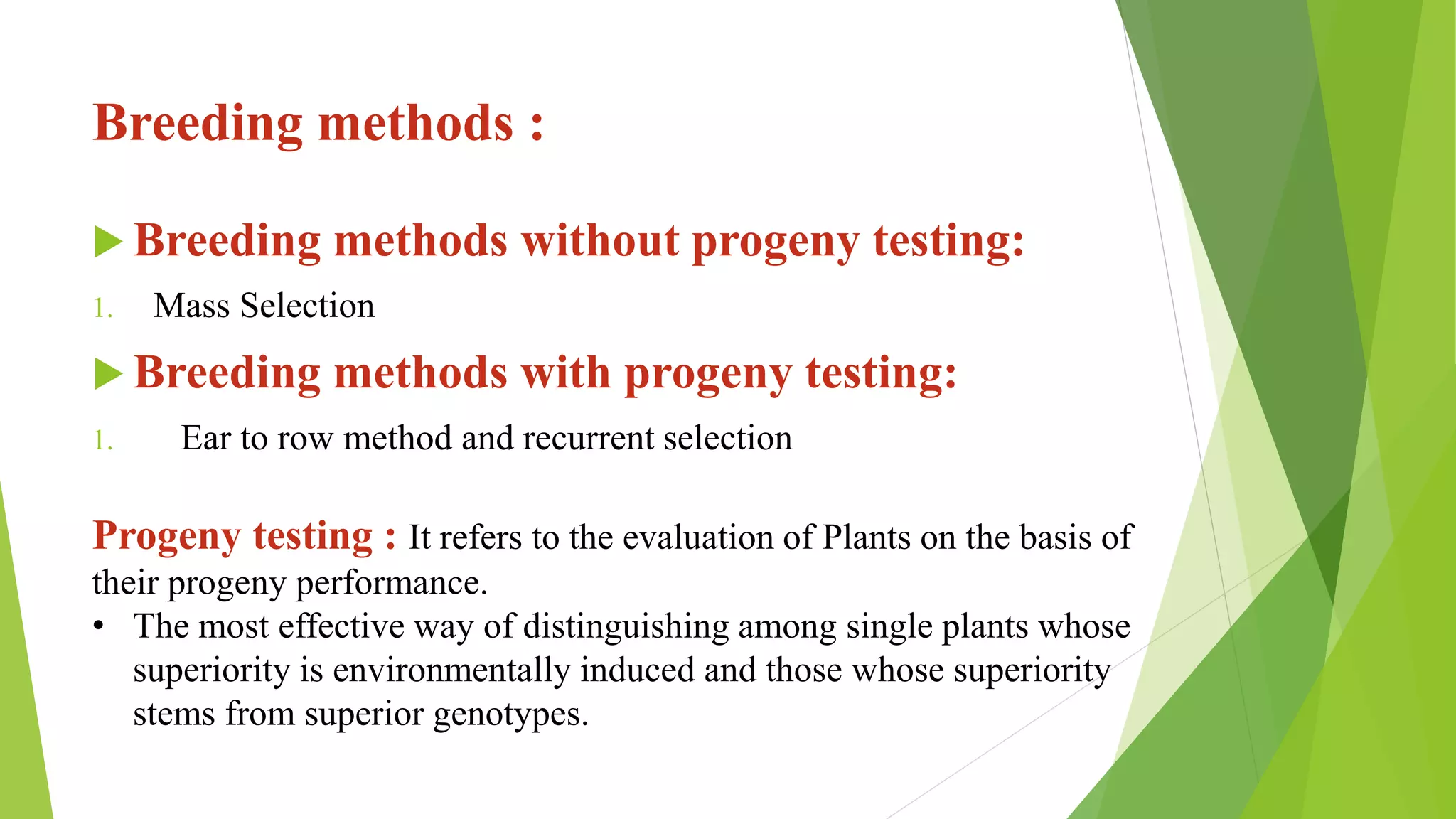
Breeding methods :
 Breeding methods without progeny testing:
1. Mass Selection
 Breeding methods with progeny testing:
1. Ear to row method and recurrent selection
Progeny testing : It refers to the evaluation of Plants on the basis of
their progeny performance.
• The most effective way of distinguishing among single plants whose
superiority is environmentally induced and those whose superiority
stems from superior genotypes.
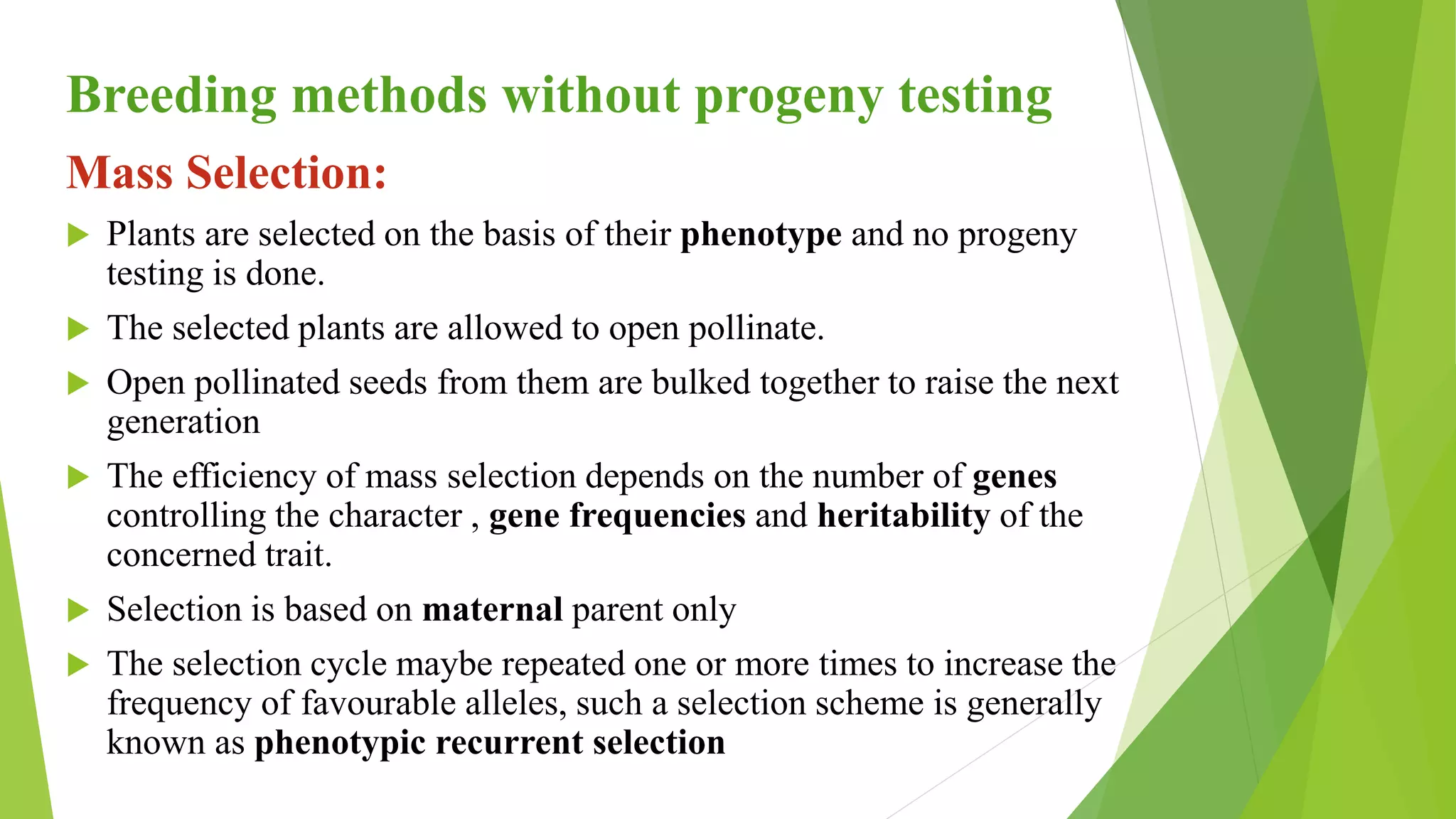
Breeding methods without progeny testing
Mass Selection:
 Plants are selected on the basis of their phenotype and no progeny
testing is done.
 The selected plants are allowed to open pollinate.
 Open pollinated seeds from them are bulked together to raise the next
generation
 The efficiency of mass selection depends on the number of genes
controlling the character , gene frequencies and heritability of the
concerned trait.
 Selection is based on maternal parent only
 The selection cycle maybe repeated one or more times to increase the
frequency of favourable alleles, such a selection scheme is generally
known as phenotypic recurrent selection
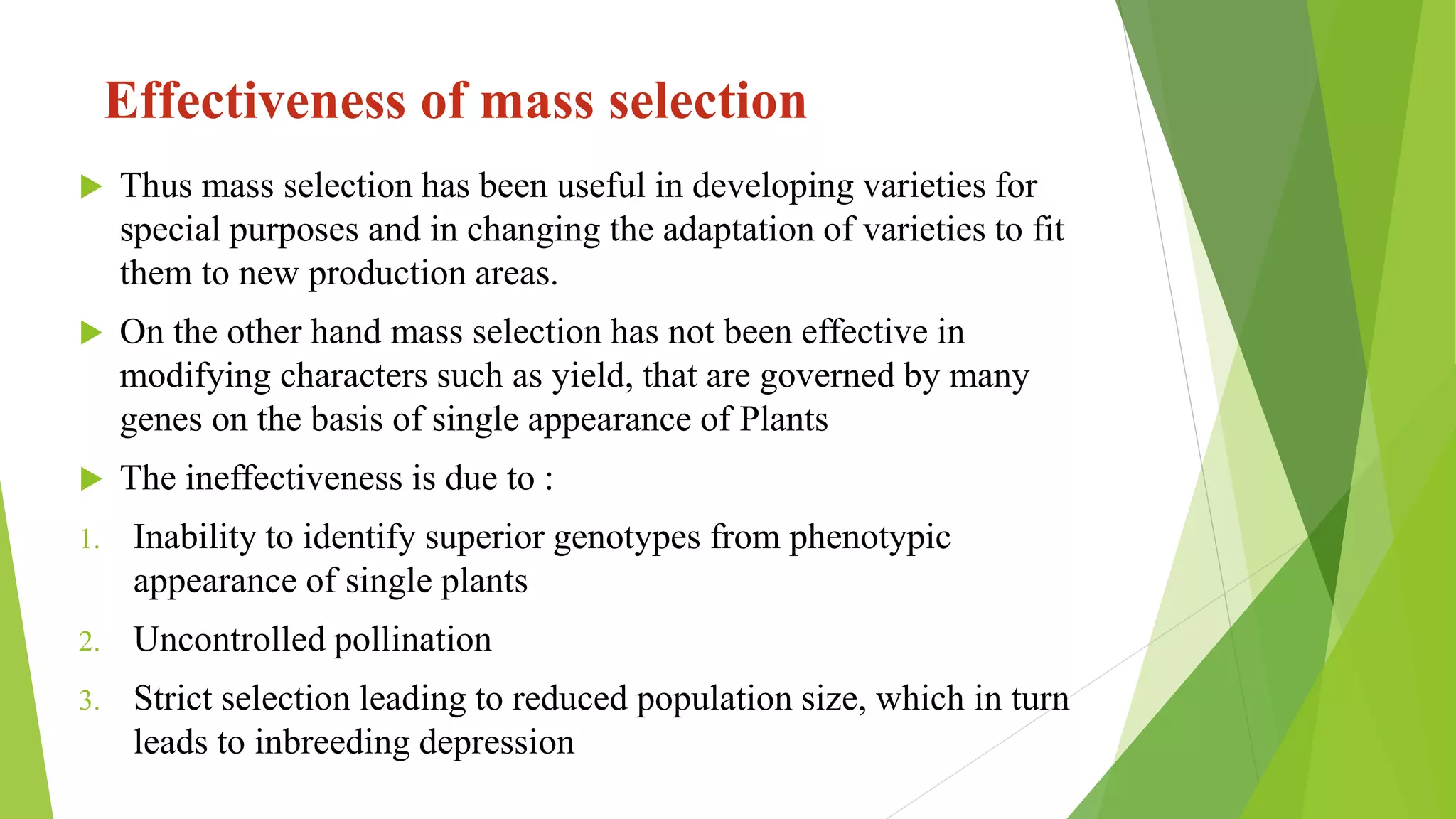
 Thus mass selection has been useful in developing varieties for
special purposes and in changing the adaptation of varieties to fit
them to new production areas.
 On the other hand mass selection has not been effective in
modifying characters such as yield, that are governed by many
genes on the basis of single appearance of Plants
 The ineffectiveness is due to :
1. Inability to identify superior genotypes from phenotypic
appearance of single plants
2. Uncontrolled pollination
3. Strict selection leading to reduced population size, which in turn
leads to inbreeding depression
Effectiveness of mass selection
Types of Mass Selection:
Positive Mass Selection
 Desirable plants are selected from a mixed population
 Base material is old varieties or land races.
Negative mass selection
 Undesirable plants are removed from mixed population.
 Used for varietal purification in seed production and certification
Programmes
Procedure:
1. From a variable population 200-2000 plants with Desirable
traits are selected
2. The seed from selected plant are composited.
1. The Composited yield is planted in a PLYT along with
standard check
2. Phenotype of the selected plants are clearly evaluated
1. The promising selections are evaluated in coordinated
yield trails at several locations
2. Outstanding lines are raised as new varieties
1. Seed multiplication for distribution
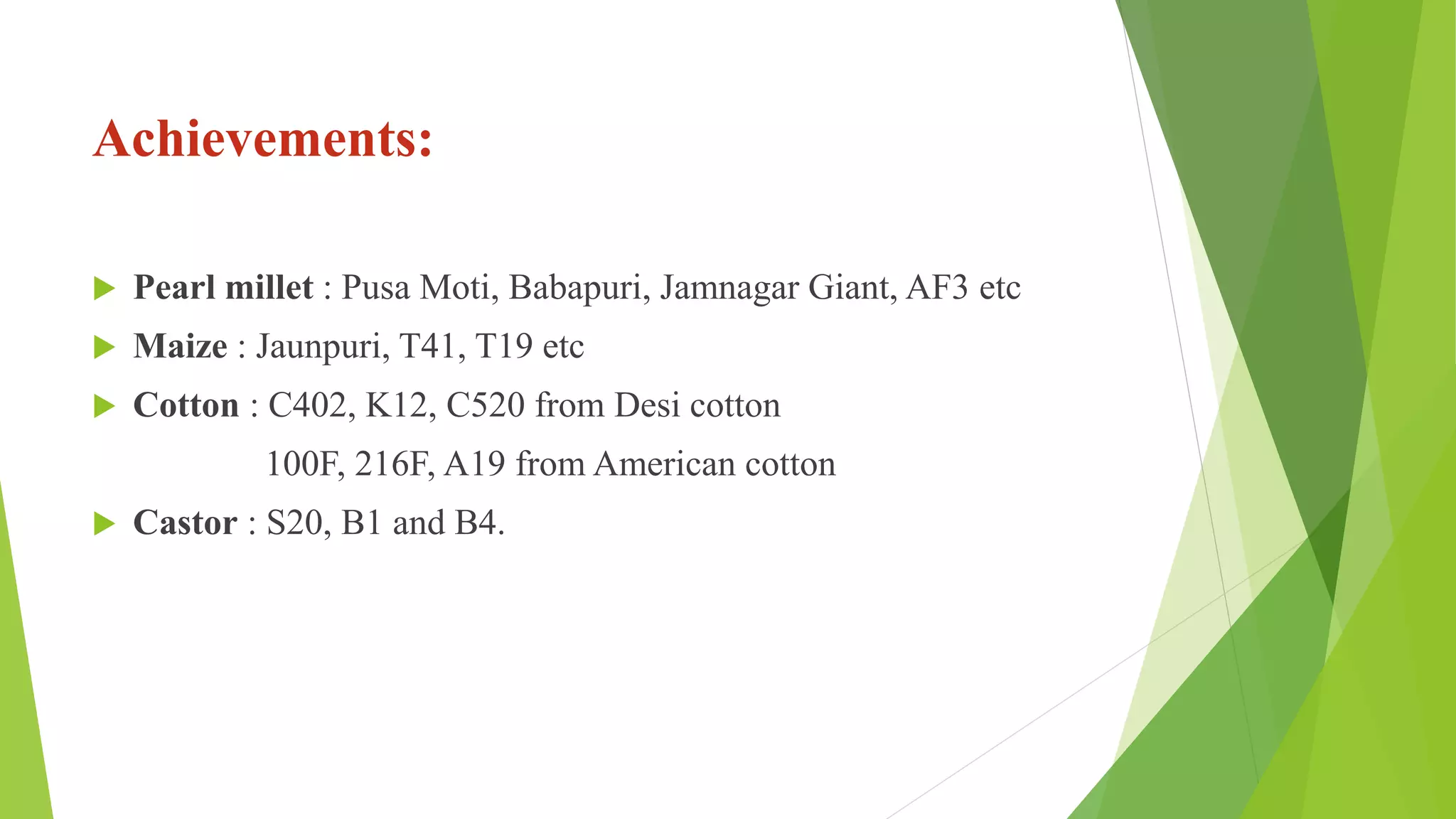
Achievements:
 Pearl millet : Pusa Moti, Babapuri, Jamnagar Giant, AF3 etc
 Maize : Jaunpuri, T41, T19 etc
 Cotton : C402, K12, C520 from Desi cotton
100F, 216F, A19 from American cotton
 Castor : S20, B1 and B4.
Merits:
 The varieties developed through mass selection has broad genetic base and
widely adoptable than pureline varieties.
 It retains considerable variability and hence further improvement is possible
in future by selection
 Useful for purification of varieties
 It is highly efficient in Improvement of Characters governed by few genes
with high heritability and characters that are easily identified visually.
 Extremely simple and work of breeder is kept to a minimum since selection is
based on phenotype
Demerits
 Varieties are not uniform
 Since no progeny testing is done, the genotype of the selected plants is
unknown
 Since selection is based on phenotype and no control over pollination
the improvement brought about is not permanent, since most of
quantitative characters are considerably effected by environment.
 It cannot create any new genotype but utilizes existing genetic
variability
 Characters which are governed by large number of genes and characters
which have low heritability cannot be improved
Modifications of mass selection:
 The two basic defects of mass selection 1) lack of control on pollen
source 2) Confusing effect of environment on phenotype
1) Inferior plants in the field are detasseled and plants are allowed to open
pollinate. This modification allows some control on pollen source
2) Pollen from selected plants is bulked and bulk pollen is used to
pollinate selected plants. This allows complete control over pollen source
 In both of these, identification of inferior plants is based on characters
expressed before flowering
3) Stratified Mass Selection: Suggested by Gardner in 1961, is also known as
grid method of mass selection. The field is divided into several small plots
each having 40-50 plants. Equal no. of superior plants are selected from each
plot i.e., selection is done within plots not among them. The seeds are bulked
 The basis for this modification is that variation due to environment, soil
heterogeneity will be much smaller within small plots and thus selection in
small plots is expected to be more effective
4) Plants of single genotype: A single cross hybrid, are planted as check after
every two or four plants of the variety under selection. The yields of Plants
under selection are expressed as percent of yield of nearest check plant
 This scheme is designed to minimize the environmental influence on the
yields of Plants being selected, and employs principle of contiguous
control.
Ear to row method:
 This is a modification of mass selection.
 This is proposed by Hopkins in 1896.
 The ear to row method attempts to determine the relative breeding value
of different ears by planting a portion of seed from them, an ear to row,
and measuring the yielding ability of resulting plots.
 The difference between simple mass selection and ear to row method is
in basing the selection on performance of progeny.
 Inbreeding depression can be avoided
 Each selection cycle has generally two years
Breeding methods with progeny testing
Procedure:
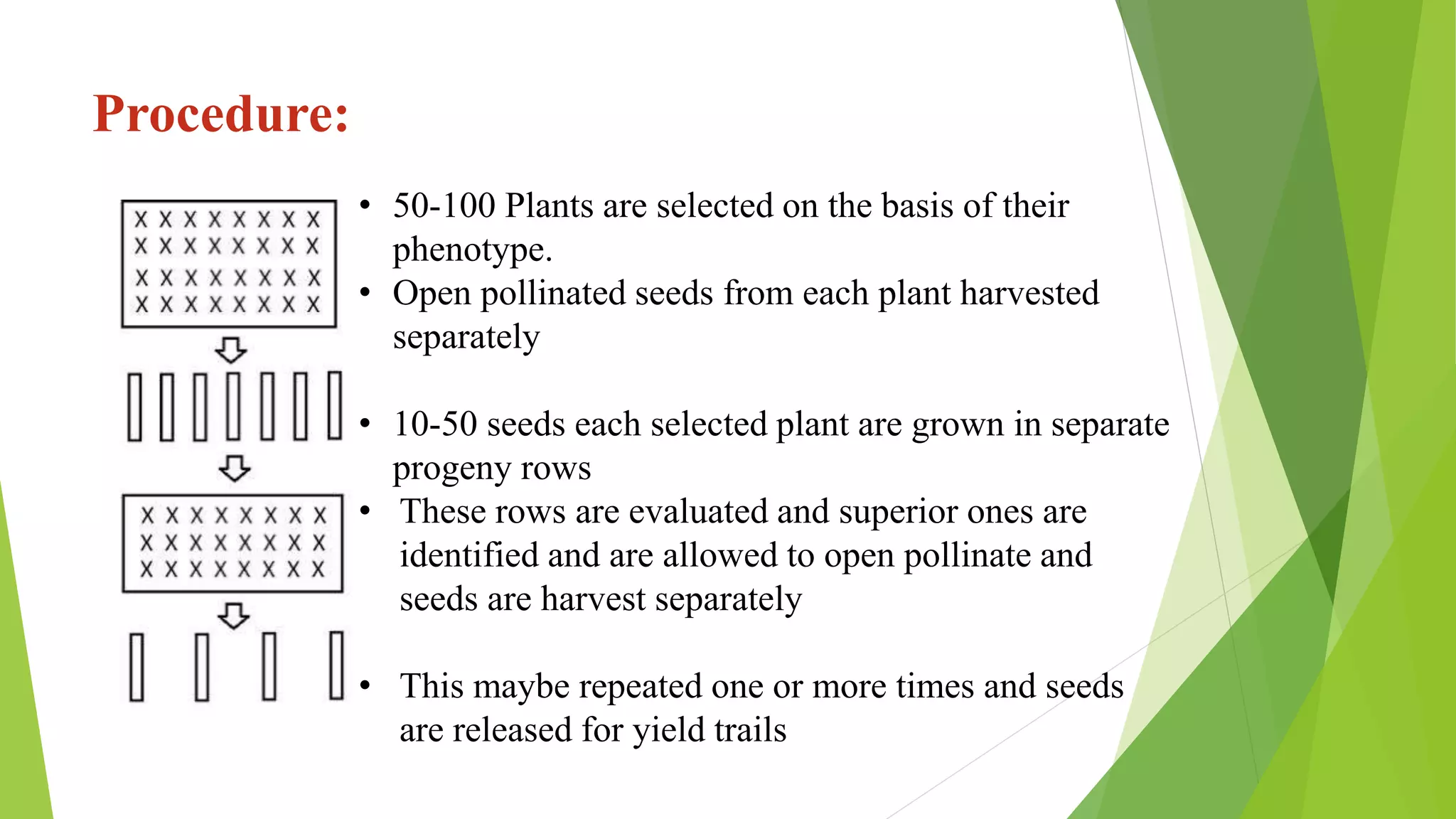
• 50-100 Plants are selected on the basis of their
phenotype.
• Open pollinated seeds from each plant harvested
separately
• 10-50 seeds each selected plant are grown in separate
progeny rows
• These rows are evaluated and superior ones are
identified and are allowed to open pollinate and
seeds are harvest separately
• This maybe repeated one or more times and seeds
are released for yield trails
Merits:
 Selection is based on progeny test and not merely on basis of
phenotype
 Selection cycle is of one year only
 Method is easy and simple
Demerits:
 No control on pollination and selection is based on maternal
parent.
 Superior progenies are re-pollinated by inferior pollen
Modification of ear to row method
 The ear to row method suffers from the effect that superior
progenies are pollinated by inferior plants since there is no
control over pollen source
 In order to mitigate the above, modified ear to row method is
based
Procedure:
 First year : Several plants are selected on the basis of their phenotype and
open pollinated seed from them are harvested separately
 Second year : Small progeny rows are grown, evaluated and superior ones
are identified and remaining seed from each of the plot are kept separately
 Third year: The remaining seed that produced superior progenies are
bulked and planted in the third year , this constitutes the selected version of
population . Plants are allowed to open pollinate and selection cycle is
repeated one or more times
 The difference is plants from superior progenies are only allowed to
mate among themselves which provides control over pollen source.
 This modification is widely used in breeding of Maize in USA
Modifications of progeny selection:
 Several other modifications of ear to row method of selection are
available
1) Seeds for progeny testing are obtained by selfing of the selected
plants in the place of open pollination. This is known as S1 Family
selection. This variation is the basis for simple recurrent selection.
 When the seeds for progeny test are obtained after two generations
of selfing, the scheme is termed as S2 Family selection
2) Seeds for progeny testing are obtained by crossing the selected
plants to a common tester – maybe an OPV, a hybrid or an inbred.
This variation has been refined as recurrent selection for SCA, GCA
and reciprocal recurrent selection
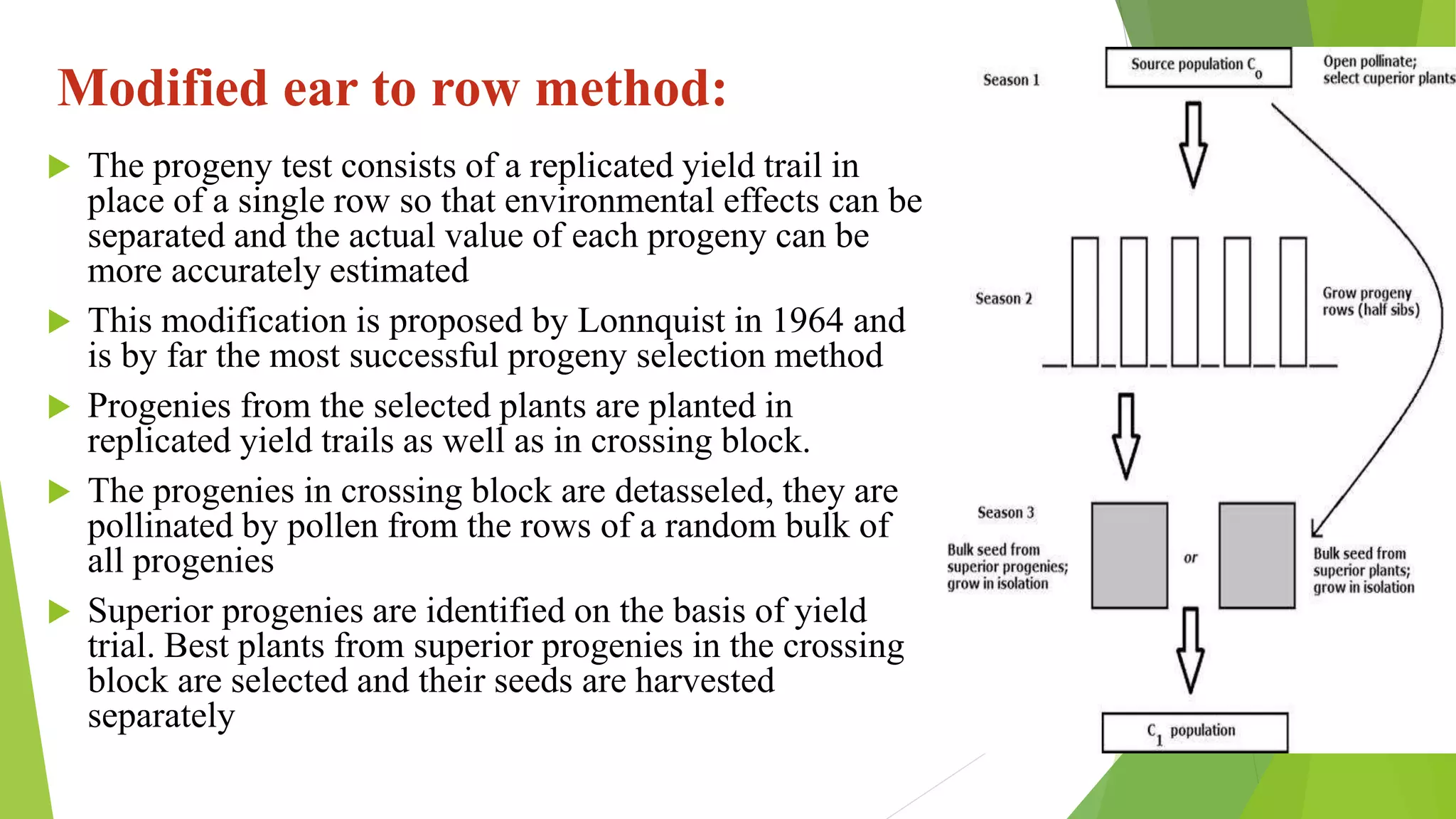
Modified ear to row method:
 The progeny test consists of a replicated yield trail in
place of a single row so that environmental effects can be
separated and the actual value of each progeny can be
more accurately estimated
 This modification is proposed by Lonnquist in 1964 and
is by far the most successful progeny selection method
 Progenies from the selected plants are planted in
replicated yield trails as well as in crossing block.
 The progenies in crossing block are detasseled, they are
pollinated by pollen from the rows of a random bulk of
all progenies
 Superior progenies are identified on the basis of yield
trial. Best plants from superior progenies in the crossing
block are selected and their seeds are harvested
separately
Merits of progeny selection
 Selection is not just based on phenotype but on progeny test which
provided dependable reflection of genotypic worth of selected plants
 More efficient than mass selection in improving the yielding ability
 Inbreeding maybe avoided if care is taken to select a sufficiently large
number of progenies and if selected progenies are not closely related
to each other
 The selection is still simple and easy, but some of it’s modifications
are tedious
Demerits of Progeny selection:
 The progeny selection scheme are allowed to open pollinate. As a
result selection is based on only maternal parent which reduces
efficiency of selection
 Many of modifications to schemes are complicated and involve
considerable work
 Selection cycle is usually of two years. It takes twice as much
time as mass selection

Breeding Methods in Cross Pollinated crops, Mass Selection, Ear to row method and Progeny Selection Schemes

  • 1.
    Acharya N.G RangaAgricultural University S. V. Agricultural College, Tirupati Department of Genetics and Plant Breeding Topic : Breeding methods in cross pollinated crops Mass selection, ear to row method and Progeny selection schemes Submitted by M. Venkata Rama Sai TAM/2022-24
  • 2.
    Breeding method inCross pollinated crops  Population of Cross pollinated crops are highly heterozygous and heterogenous  They have broad genetic base and more adaptability and flexibility to the environment  Heterosis can be fully exploited  They show variable inbreeding depression ranging from low to severe  Breeding methods for cross pollinated crops are broadly categorised into two types 1. Population improvement 2. Hybrid and Synthetic varieties
  • 3.
    Methods of Breeding: Plant introduction  Mass and Progeny selection  Back cross method  Heterosis breeding  Synthetic breeding  Composite breeding  Polyploidy breeding  Distant Hybridization  Transgenic breeding
  • 4.
    Population improvement:  Incross pollinated crops for population improvement three breeding approaches are made 1. Recurrent Selection 2. Disruptive Selection 3. Biparental mating
  • 5.
    Breeding methods : Breeding methods without progeny testing: 1. Mass Selection  Breeding methods with progeny testing: 1. Ear to row method and recurrent selection Progeny testing : It refers to the evaluation of Plants on the basis of their progeny performance. • The most effective way of distinguishing among single plants whose superiority is environmentally induced and those whose superiority stems from superior genotypes.
  • 6.
    Breeding methods withoutprogeny testing Mass Selection:  Plants are selected on the basis of their phenotype and no progeny testing is done.  The selected plants are allowed to open pollinate.  Open pollinated seeds from them are bulked together to raise the next generation  The efficiency of mass selection depends on the number of genes controlling the character , gene frequencies and heritability of the concerned trait.  Selection is based on maternal parent only  The selection cycle maybe repeated one or more times to increase the frequency of favourable alleles, such a selection scheme is generally known as phenotypic recurrent selection
  • 7.
     Thus massselection has been useful in developing varieties for special purposes and in changing the adaptation of varieties to fit them to new production areas.  On the other hand mass selection has not been effective in modifying characters such as yield, that are governed by many genes on the basis of single appearance of Plants  The ineffectiveness is due to : 1. Inability to identify superior genotypes from phenotypic appearance of single plants 2. Uncontrolled pollination 3. Strict selection leading to reduced population size, which in turn leads to inbreeding depression Effectiveness of mass selection
  • 8.
    Types of MassSelection: Positive Mass Selection  Desirable plants are selected from a mixed population  Base material is old varieties or land races. Negative mass selection  Undesirable plants are removed from mixed population.  Used for varietal purification in seed production and certification Programmes
  • 9.
    Procedure: 1. From avariable population 200-2000 plants with Desirable traits are selected 2. The seed from selected plant are composited. 1. The Composited yield is planted in a PLYT along with standard check 2. Phenotype of the selected plants are clearly evaluated 1. The promising selections are evaluated in coordinated yield trails at several locations 2. Outstanding lines are raised as new varieties 1. Seed multiplication for distribution
  • 10.
    Achievements:  Pearl millet: Pusa Moti, Babapuri, Jamnagar Giant, AF3 etc  Maize : Jaunpuri, T41, T19 etc  Cotton : C402, K12, C520 from Desi cotton 100F, 216F, A19 from American cotton  Castor : S20, B1 and B4.
  • 11.
    Merits:  The varietiesdeveloped through mass selection has broad genetic base and widely adoptable than pureline varieties.  It retains considerable variability and hence further improvement is possible in future by selection  Useful for purification of varieties  It is highly efficient in Improvement of Characters governed by few genes with high heritability and characters that are easily identified visually.  Extremely simple and work of breeder is kept to a minimum since selection is based on phenotype
  • 12.
    Demerits  Varieties arenot uniform  Since no progeny testing is done, the genotype of the selected plants is unknown  Since selection is based on phenotype and no control over pollination the improvement brought about is not permanent, since most of quantitative characters are considerably effected by environment.  It cannot create any new genotype but utilizes existing genetic variability  Characters which are governed by large number of genes and characters which have low heritability cannot be improved
  • 13.
    Modifications of massselection:  The two basic defects of mass selection 1) lack of control on pollen source 2) Confusing effect of environment on phenotype 1) Inferior plants in the field are detasseled and plants are allowed to open pollinate. This modification allows some control on pollen source 2) Pollen from selected plants is bulked and bulk pollen is used to pollinate selected plants. This allows complete control over pollen source  In both of these, identification of inferior plants is based on characters expressed before flowering
  • 14.
    3) Stratified MassSelection: Suggested by Gardner in 1961, is also known as grid method of mass selection. The field is divided into several small plots each having 40-50 plants. Equal no. of superior plants are selected from each plot i.e., selection is done within plots not among them. The seeds are bulked  The basis for this modification is that variation due to environment, soil heterogeneity will be much smaller within small plots and thus selection in small plots is expected to be more effective 4) Plants of single genotype: A single cross hybrid, are planted as check after every two or four plants of the variety under selection. The yields of Plants under selection are expressed as percent of yield of nearest check plant  This scheme is designed to minimize the environmental influence on the yields of Plants being selected, and employs principle of contiguous control.
  • 15.
    Ear to rowmethod:  This is a modification of mass selection.  This is proposed by Hopkins in 1896.  The ear to row method attempts to determine the relative breeding value of different ears by planting a portion of seed from them, an ear to row, and measuring the yielding ability of resulting plots.  The difference between simple mass selection and ear to row method is in basing the selection on performance of progeny.  Inbreeding depression can be avoided  Each selection cycle has generally two years Breeding methods with progeny testing
  • 16.
    Procedure: • 50-100 Plantsare selected on the basis of their phenotype. • Open pollinated seeds from each plant harvested separately • 10-50 seeds each selected plant are grown in separate progeny rows • These rows are evaluated and superior ones are identified and are allowed to open pollinate and seeds are harvest separately • This maybe repeated one or more times and seeds are released for yield trails
  • 17.
    Merits:  Selection isbased on progeny test and not merely on basis of phenotype  Selection cycle is of one year only  Method is easy and simple
  • 18.
    Demerits:  No controlon pollination and selection is based on maternal parent.  Superior progenies are re-pollinated by inferior pollen
  • 19.
    Modification of earto row method  The ear to row method suffers from the effect that superior progenies are pollinated by inferior plants since there is no control over pollen source  In order to mitigate the above, modified ear to row method is based
  • 20.
    Procedure:  First year: Several plants are selected on the basis of their phenotype and open pollinated seed from them are harvested separately  Second year : Small progeny rows are grown, evaluated and superior ones are identified and remaining seed from each of the plot are kept separately  Third year: The remaining seed that produced superior progenies are bulked and planted in the third year , this constitutes the selected version of population . Plants are allowed to open pollinate and selection cycle is repeated one or more times  The difference is plants from superior progenies are only allowed to mate among themselves which provides control over pollen source.  This modification is widely used in breeding of Maize in USA
  • 21.
    Modifications of progenyselection:  Several other modifications of ear to row method of selection are available 1) Seeds for progeny testing are obtained by selfing of the selected plants in the place of open pollination. This is known as S1 Family selection. This variation is the basis for simple recurrent selection.  When the seeds for progeny test are obtained after two generations of selfing, the scheme is termed as S2 Family selection 2) Seeds for progeny testing are obtained by crossing the selected plants to a common tester – maybe an OPV, a hybrid or an inbred. This variation has been refined as recurrent selection for SCA, GCA and reciprocal recurrent selection
  • 22.
    Modified ear torow method:  The progeny test consists of a replicated yield trail in place of a single row so that environmental effects can be separated and the actual value of each progeny can be more accurately estimated  This modification is proposed by Lonnquist in 1964 and is by far the most successful progeny selection method  Progenies from the selected plants are planted in replicated yield trails as well as in crossing block.  The progenies in crossing block are detasseled, they are pollinated by pollen from the rows of a random bulk of all progenies  Superior progenies are identified on the basis of yield trial. Best plants from superior progenies in the crossing block are selected and their seeds are harvested separately
  • 23.
    Merits of progenyselection  Selection is not just based on phenotype but on progeny test which provided dependable reflection of genotypic worth of selected plants  More efficient than mass selection in improving the yielding ability  Inbreeding maybe avoided if care is taken to select a sufficiently large number of progenies and if selected progenies are not closely related to each other  The selection is still simple and easy, but some of it’s modifications are tedious
  • 24.
    Demerits of Progenyselection:  The progeny selection scheme are allowed to open pollinate. As a result selection is based on only maternal parent which reduces efficiency of selection  Many of modifications to schemes are complicated and involve considerable work  Selection cycle is usually of two years. It takes twice as much time as mass selection