
SUBMITTED BY-
HIMANSHI SARASWAT
M. sc. 1st year (2nd sem.)
GENETICS AND PLANT BREEDING
DEPARTMENT
SUBMITTED TO –
DR. SANDEEP
INTRODUCTION
 Line x tester analysis is a modified form of a top cross used for measuring
general and specific combining ability variances and effects in a large
germplasm lines at a time.
 The concept of line x tester analysis was discovered by Kempthorne in
1957.
 Combining ability of crosses is the combination of potential line
concerning the transmission of desirable genes to their offspring .
 General combining ability defined as the average performance of a line in
a series of crosses and specific combining ability is referred to as
performance of inbred parents in specific combinations .
 In case of top cross only one tester is used, while in case of line x tester
cross several testers are used,
4/6/2022 2
CHARACTERISTICS
 ANALYSIS : the analysis of this technique is based on first order and
second order statistics.
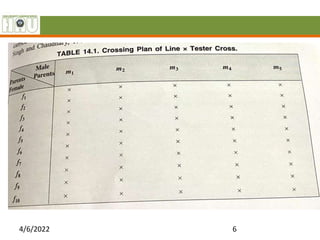
 RESTRICTED MATINGS : In this method, some of the parents are
designated as males (testers) and others as females(lines). Here each male
parent is mated to a common set of female parents. Male parents are not
crossed to each other. Also female parents are not crossed to each other.
 NUMBER OF CROSSES : In line x tester analysis total no. of crosses is
equal to m x f crosses, where m and f are number of male and female
parents involved in crossing.
 INFORMATION OBTAINED : It provides information about GCA and
SCA variances effects and also about D and H components of genetic
variances.
 ASSUMPTIONS : The analysis of line x tester analysis is based on seven
genetic assumptions
4/6/2022 3
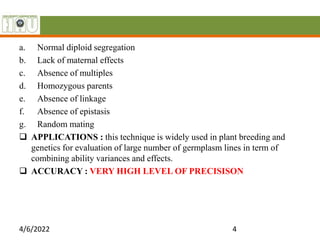
a. Normal diploid segregation
b. Lack of maternal effects
c. Absence of multiples
d. Homozygous parents
e. Absence of linkage
f. Absence of epistasis
g. Random mating
 APPLICATIONS : this technique is widely used in plant breeding and
genetics for evaluation of large number of germplasm lines in term of
combining ability variances and effects.
 ACCURACY : VERY HIGH LEVEL OF PRECISISON
4/6/2022 4
PROCEDURE
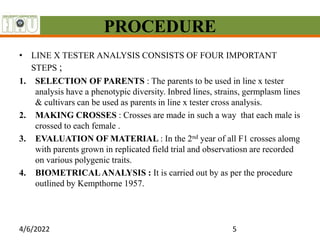
• LINE X TESTER ANALYSIS CONSISTS OF FOUR IMPORTANT
STEPS ;
1. SELECTION OF PARENTS : The parents to be used in line x tester
analysis have a phenotypic diversity. Inbred lines, strains, germplasm lines
& cultivars can be used as parents in line x tester cross analysis.
2. MAKING CROSSES : Crosses are made in such a way that each male is
crossed to each female .
3. EVALUATION OF MATERIAL : In the 2nd year of all F1 crosses alomg
with parents grown in replicated field trial and observatiosn are recorded
on various polygenic traits.
4. BIOMETRICALANALYSIS : It is carried out by as per the procedure
outlined by Kempthorne 1957.
4/6/2022 5
4/6/2022 6
INTERPRETATION
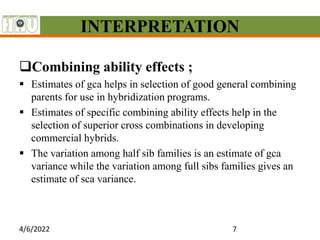
Combining ability effects ;
 Estimates of gca helps in selection of good general combining
parents for use in hybridization programs.
 Estimates of specific combining ability effects help in the
selection of superior cross combinations in developing
commercial hybrids.
 The variation among half sib families is an estimate of gca
variance while the variation among full sibs families gives an
estimate of sca variance.
4/6/2022 7
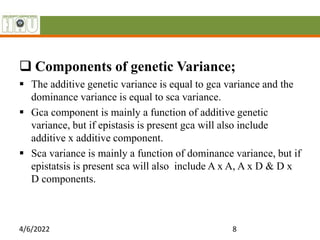
 Components of genetic Variance;
 The additive genetic variance is equal to gca variance and the
dominance variance is equal to sca variance.
 Gca component is mainly a function of additive genetic
variance, but if epistasis is present gca will also include
additive x additive component.
 Sca variance is mainly a function of dominance variance, but if
epistatsis is present sca will also include A x A, A x D & D x
D components.
4/6/2022 8
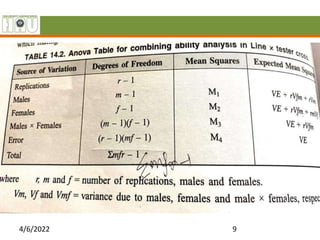
4/6/2022 9
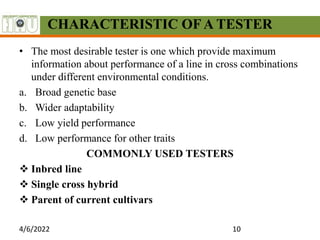
CHARACTERISTIC OFA TESTER
• The most desirable tester is one which provide maximum
information about performance of a line in cross combinations
under different environmental conditions.
a. Broad genetic base
b. Wider adaptability
c. Low yield performance
d. Low performance for other traits
COMMONLY USED TESTERS
 Inbred line
 Single cross hybrid
 Parent of current cultivars
4/6/2022 10
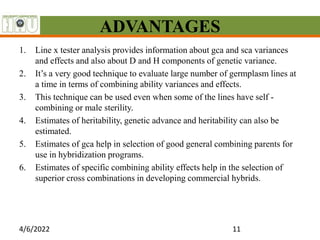
ADVANTAGES
1. Line x tester analysis provides information about gca and sca variances
and effects and also about D and H components of genetic variance.
2. It’s a very good technique to evaluate large number of germplasm lines at
a time in terms of combining ability variances and effects.
3. This technique can be used even when some of the lines have self -
combining or male sterility.
4. Estimates of heritability, genetic advance and heritability can also be
estimated.
5. Estimates of gca help in selection of good general combining parents for
use in hybridization programs.
6. Estimates of specific combining ability effects help in the selection of
superior cross combinations in developing commercial hybrids.
4/6/2022 11
DISADVANTAGES
• In this technique each parent does not have equal
opportunity to mate and recombine with every other
parent.
• This technique does not provide estimates of epistatic
variance unlike triallel and quadriallel analysis.
4/6/2022 12
SYMBOL OF TRUST

LINE X TESTER ANALYSIS

  • 1.
    SUBMITTED BY- HIMANSHI SARASWAT M.sc. 1st year (2nd sem.) GENETICS AND PLANT BREEDING DEPARTMENT SUBMITTED TO – DR. SANDEEP
  • 2.
    INTRODUCTION  Line xtester analysis is a modified form of a top cross used for measuring general and specific combining ability variances and effects in a large germplasm lines at a time.  The concept of line x tester analysis was discovered by Kempthorne in 1957.  Combining ability of crosses is the combination of potential line concerning the transmission of desirable genes to their offspring .  General combining ability defined as the average performance of a line in a series of crosses and specific combining ability is referred to as performance of inbred parents in specific combinations .  In case of top cross only one tester is used, while in case of line x tester cross several testers are used, 4/6/2022 2
  • 3.
    CHARACTERISTICS  ANALYSIS :the analysis of this technique is based on first order and second order statistics.  RESTRICTED MATINGS : In this method, some of the parents are designated as males (testers) and others as females(lines). Here each male parent is mated to a common set of female parents. Male parents are not crossed to each other. Also female parents are not crossed to each other.  NUMBER OF CROSSES : In line x tester analysis total no. of crosses is equal to m x f crosses, where m and f are number of male and female parents involved in crossing.  INFORMATION OBTAINED : It provides information about GCA and SCA variances effects and also about D and H components of genetic variances.  ASSUMPTIONS : The analysis of line x tester analysis is based on seven genetic assumptions 4/6/2022 3
  • 4.
    a. Normal diploidsegregation b. Lack of maternal effects c. Absence of multiples d. Homozygous parents e. Absence of linkage f. Absence of epistasis g. Random mating  APPLICATIONS : this technique is widely used in plant breeding and genetics for evaluation of large number of germplasm lines in term of combining ability variances and effects.  ACCURACY : VERY HIGH LEVEL OF PRECISISON 4/6/2022 4
  • 5.
    PROCEDURE • LINE XTESTER ANALYSIS CONSISTS OF FOUR IMPORTANT STEPS ; 1. SELECTION OF PARENTS : The parents to be used in line x tester analysis have a phenotypic diversity. Inbred lines, strains, germplasm lines & cultivars can be used as parents in line x tester cross analysis. 2. MAKING CROSSES : Crosses are made in such a way that each male is crossed to each female . 3. EVALUATION OF MATERIAL : In the 2nd year of all F1 crosses alomg with parents grown in replicated field trial and observatiosn are recorded on various polygenic traits. 4. BIOMETRICALANALYSIS : It is carried out by as per the procedure outlined by Kempthorne 1957. 4/6/2022 5
  • 6.
  • 7.
    INTERPRETATION Combining ability effects;  Estimates of gca helps in selection of good general combining parents for use in hybridization programs.  Estimates of specific combining ability effects help in the selection of superior cross combinations in developing commercial hybrids.  The variation among half sib families is an estimate of gca variance while the variation among full sibs families gives an estimate of sca variance. 4/6/2022 7
  • 8.
     Components ofgenetic Variance;  The additive genetic variance is equal to gca variance and the dominance variance is equal to sca variance.  Gca component is mainly a function of additive genetic variance, but if epistasis is present gca will also include additive x additive component.  Sca variance is mainly a function of dominance variance, but if epistatsis is present sca will also include A x A, A x D & D x D components. 4/6/2022 8
  • 9.
  • 10.
    CHARACTERISTIC OFA TESTER •The most desirable tester is one which provide maximum information about performance of a line in cross combinations under different environmental conditions. a. Broad genetic base b. Wider adaptability c. Low yield performance d. Low performance for other traits COMMONLY USED TESTERS  Inbred line  Single cross hybrid  Parent of current cultivars 4/6/2022 10
  • 11.
    ADVANTAGES 1. Line xtester analysis provides information about gca and sca variances and effects and also about D and H components of genetic variance. 2. It’s a very good technique to evaluate large number of germplasm lines at a time in terms of combining ability variances and effects. 3. This technique can be used even when some of the lines have self - combining or male sterility. 4. Estimates of heritability, genetic advance and heritability can also be estimated. 5. Estimates of gca help in selection of good general combining parents for use in hybridization programs. 6. Estimates of specific combining ability effects help in the selection of superior cross combinations in developing commercial hybrids. 4/6/2022 11
  • 12.
    DISADVANTAGES • In thistechnique each parent does not have equal opportunity to mate and recombine with every other parent. • This technique does not provide estimates of epistatic variance unlike triallel and quadriallel analysis. 4/6/2022 12
  • 13.