Pureline selection and
progeny test
Dr. Rajendragouda Patil
Assistant professor
Genetics and Plant Breeding
School of Agricultural Sciences and Technology (SAST), NMIMS, MPTP Shirpur
Pureline selection
• It is the progeny of single homozygous self pollinated
crop species
• All the plants in the Pureline has same genotype.
• The phenotypic differences within a Pureline is due to
environment. Hence variation within a Pureline is not
heritable – selection is not effective
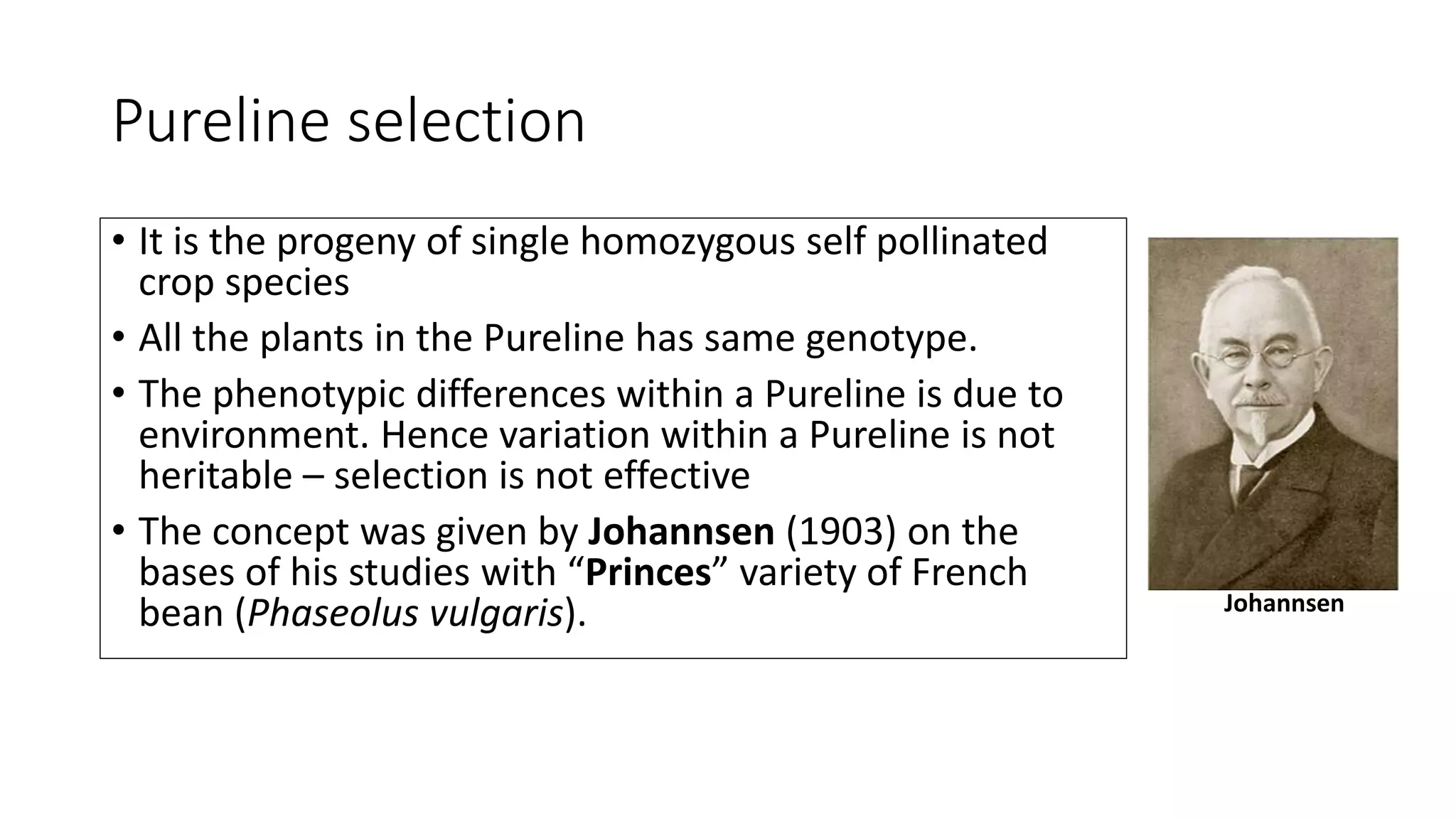
• The concept was given by Johannsen (1903) on the
bases of his studies with “Princes” variety of French
bean (Phaseolus vulgaris). Johannsen
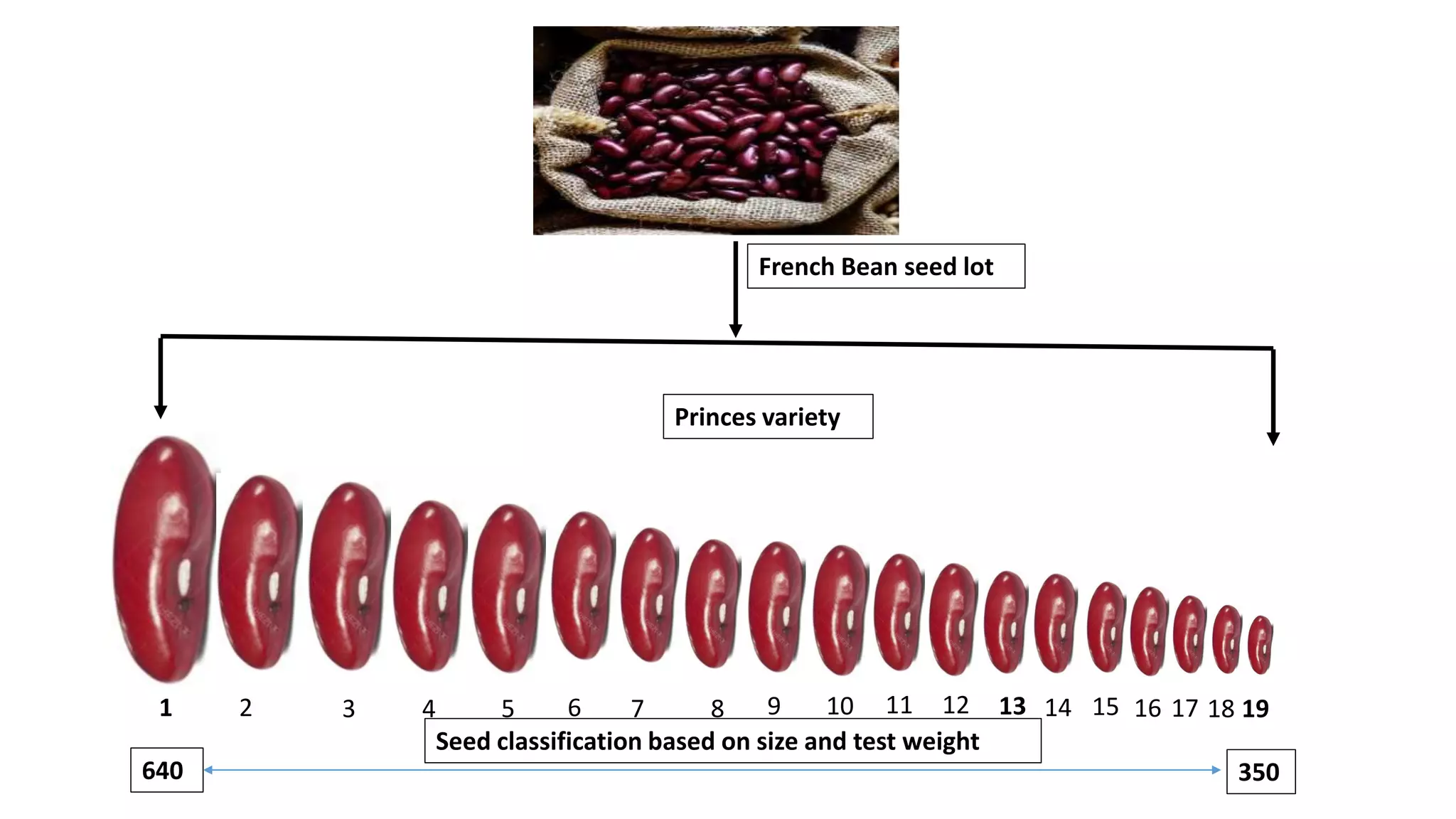
1 43 5 62 7 109 11 128 1413 15 16 17 1918
640 350
Princes variety
French Bean seed lot
Seed classification based on size and test weight
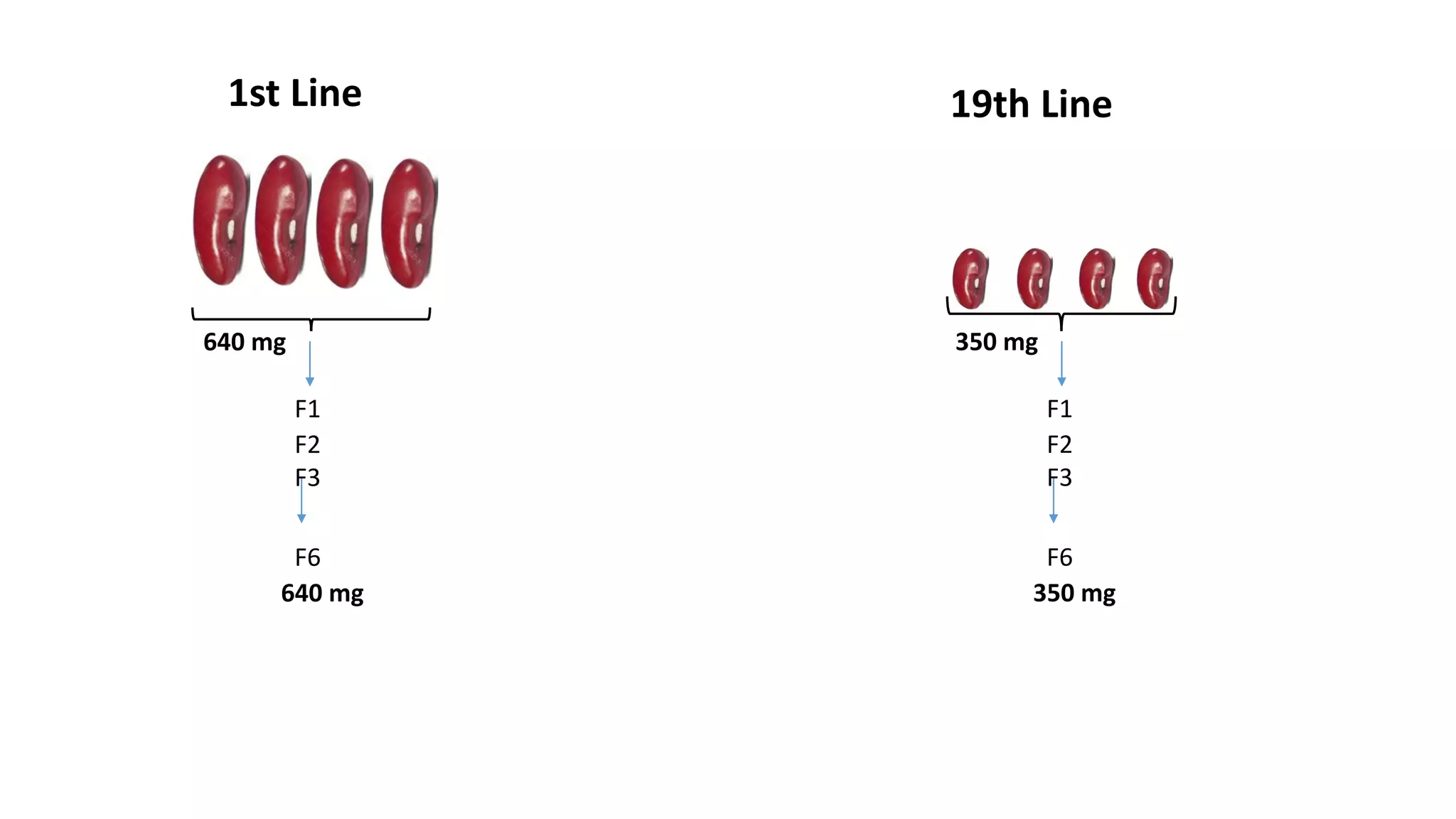
F1
F2
F3
F6
640 mg
640 mg
F1
F2
F3
F6
350 mg
350 mg
1st Line 19th Line
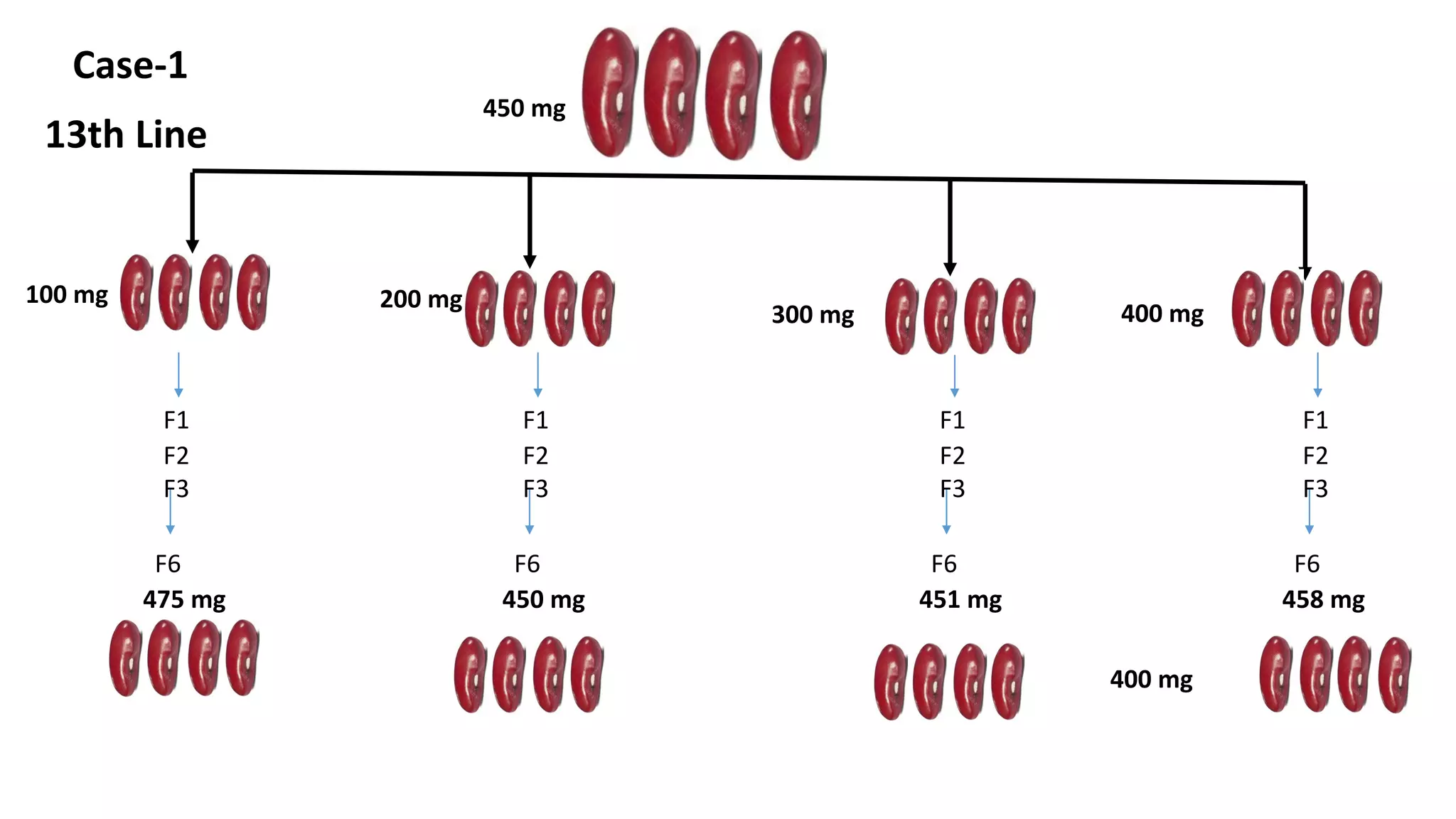
F1
F2
F3
F6
475 mg
13th Line
Case-1
450 mg
F1
F2
F3
F6
450 mg
F1
F2
F3
F6
451 mg
F1
F2
F3
F6
458 mg
100 mg 200 mg
300 mg 400 mg
400 mg
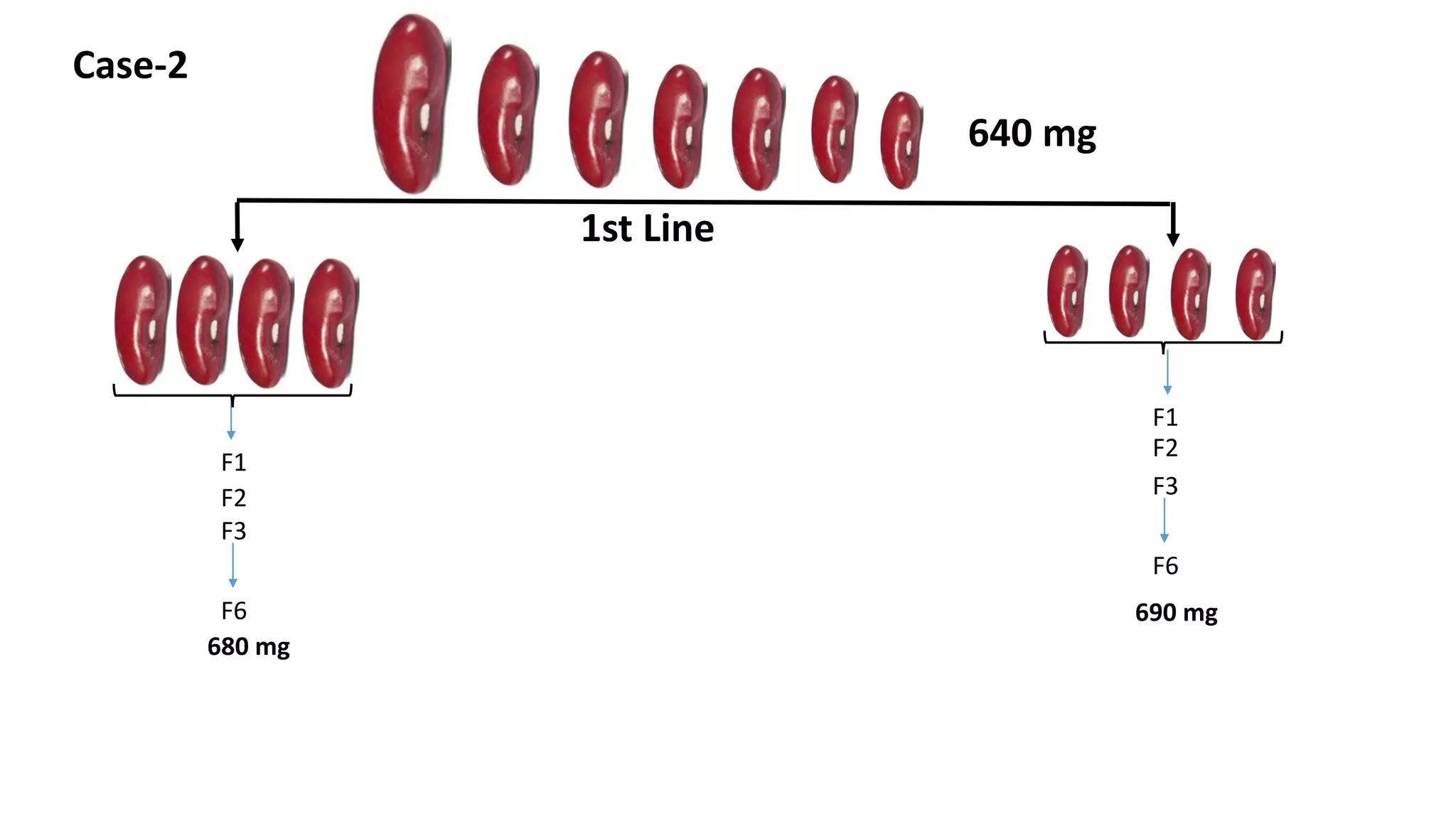
F1
F2
F3
F6
680 mg
1st Line
640 mg
F1
F2
F3
F6
690 mg
Case-2
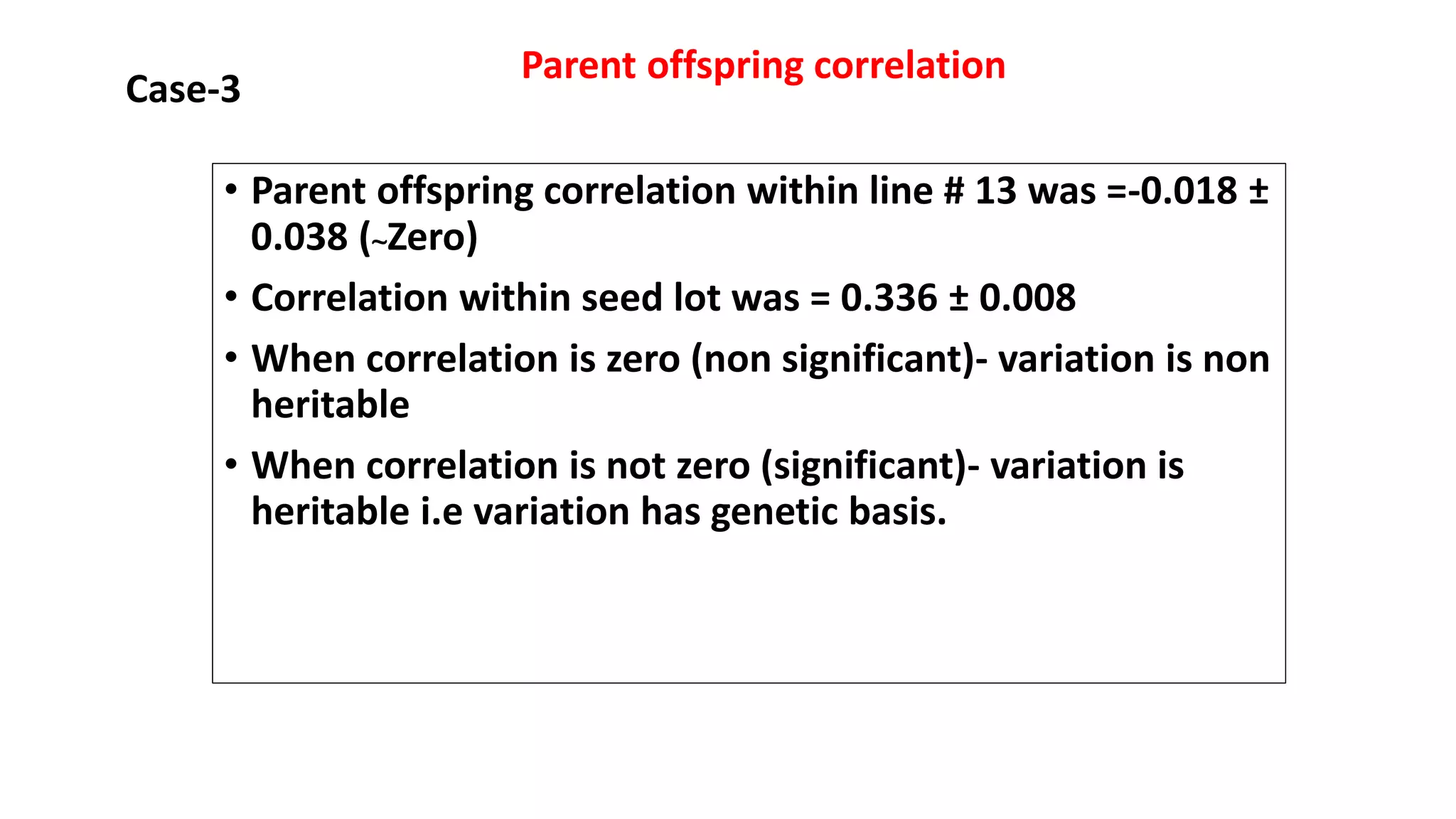
• Parent offspring correlation within line # 13 was =-0.018 ±
0.038 (~Zero)
• Correlation within seed lot was = 0.336 ± 0.008
• When correlation is zero (non significant)- variation is non
heritable
• When correlation is not zero (significant)- variation is
heritable i.e variation has genetic basis.
Case-3
Parent offspring correlation
1. Selection is effective in population since it contains mixture of
several lines/ genotypes
2. Selection is ineffective in Pureline, since it is a progeny of single, self
fertilized homozygous individual
Two main conclusions of Johannsen’s experiments are
Genetic Basis of Pureline
Number of
Generations
Frequency % Frequency %
AA Aa aa Homozygosity Heterozygosity
1 0 100 0 0 100
2 25 50 25 50 50
3 37.5 25 37.5 75 25
4 43.75 12.5 43.75 87.5 12.5
5 46.875 6.25 46.875 93.73 6.25
6 48.437 3.125 48.437 96.874 3.125
7 49.218 1.562 49.218 98.436 1.562
8 49.608 0.781 49.608 99.216 0.781
9 49.803 0.39 49.803 99.606 0.39
• Self pollination increases the homozygosity with corresponding
decreases in the heterozygosity.
• Suppose an individual heterozygous for a single gene (Aa) and the
successive generations derived from it are subjected to self-
pollination.
• Every generation of self-pollination will reduce the frequency of
heterozygote Aa to 50 per cent of that in the previous generation
• There is a corresponding increase in the frequency of the two
homozygotes AA and
• aa. As a result, after 10 generations of selfing, virtually all the plants
in the population would be homozygous, i.e., AA and aa.
• three genotypes AA, Aa and aa have equal survival, On the other
hand, the frequency of heterozygote Aa would be only 0.097 per cent,
which is negligible.
• If there is unequal survival, it may increase or decrease the rate at
which homozygosity is achieved.
• If Aa is favored, the rate of increase in homozygosity would be lower
than expected.
Pureline selection
• It is mainly used for the improvement of self pollinated crops.
• Present day varieties of self pollinated crops are purelines.
• It is mainly used to improve
• Local varieties
• Old purelines
• Introduced varieties
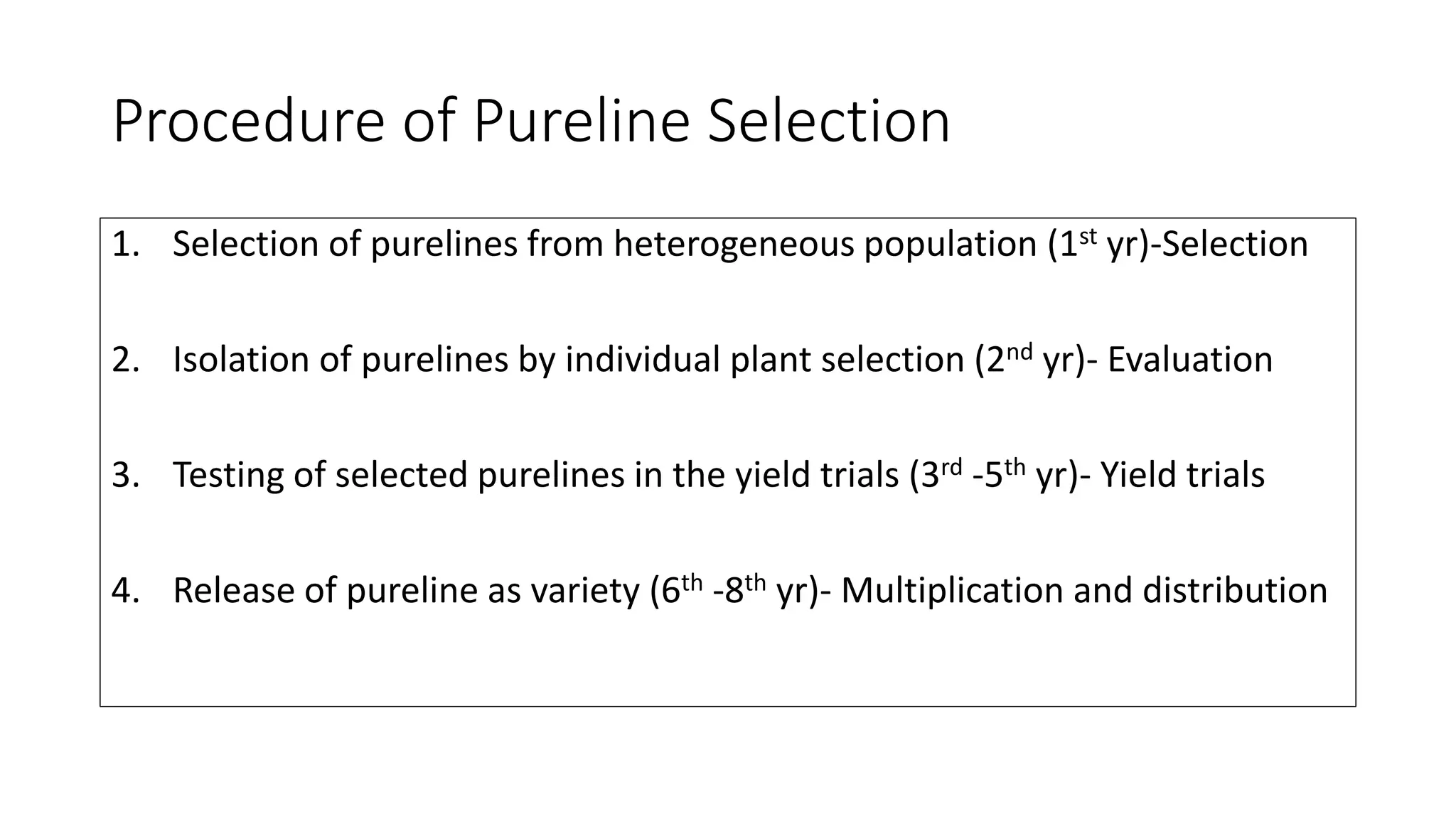
Procedure of Pureline Selection
1. Selection of purelines from heterogeneous population (1st yr)-Selection
2. Isolation of purelines by individual plant selection (2nd yr)- Evaluation
3. Testing of selected purelines in the yield trials (3rd -5th yr)- Yield trials
4. Release of pureline as variety (6th -8th yr)- Multiplication and distribution
Advantages of Pureline Selection
• Easy and cheap method of crop improvement
• Rapid method, lines are usually genetically fixed and yield trials can
be immediately conducted.
• Plants in such variety react in similar fashion to environmental
conditions, means they are uniform in performance and at the same
time in appearance too.
• Maximum possible improvement over the original variety can be
achieved
• Useful in improving low heritability traits as selection is based on
progeny performance
Disadvantages of Pureline Selection
• Purelines have poor adaptability due to narrow genetic base, just
opposite to mass selected variety
• Superior genotypes can only be isolated from the mixed population.
This selection is powerless to bring changes in hereditary factors i.e.
to develop new genotype.
• Mostly popular or in fact limited to self pollinated spp. only
• Time and space consuming
• Difficult to identify the small differences between the cultivars/lines
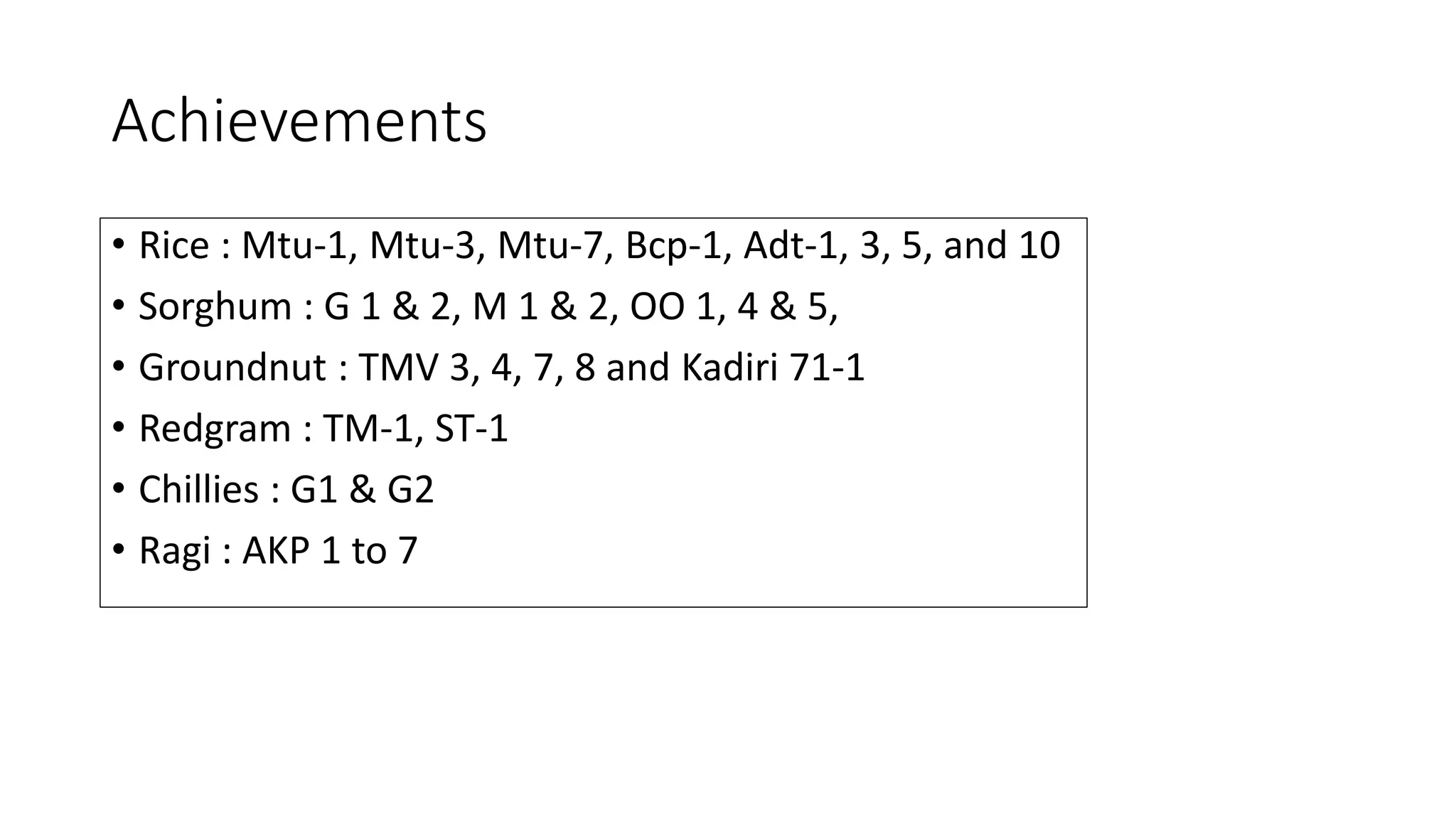
Achievements
• Rice : Mtu-1, Mtu-3, Mtu-7, Bcp-1, Adt-1, 3, 5, and 10
• Sorghum : G 1 & 2, M 1 & 2, OO 1, 4 & 5,
• Groundnut : TMV 3, 4, 7, 8 and Kadiri 71-1
• Redgram : TM-1, ST-1
• Chillies : G1 & G2
• Ragi : AKP 1 to 7
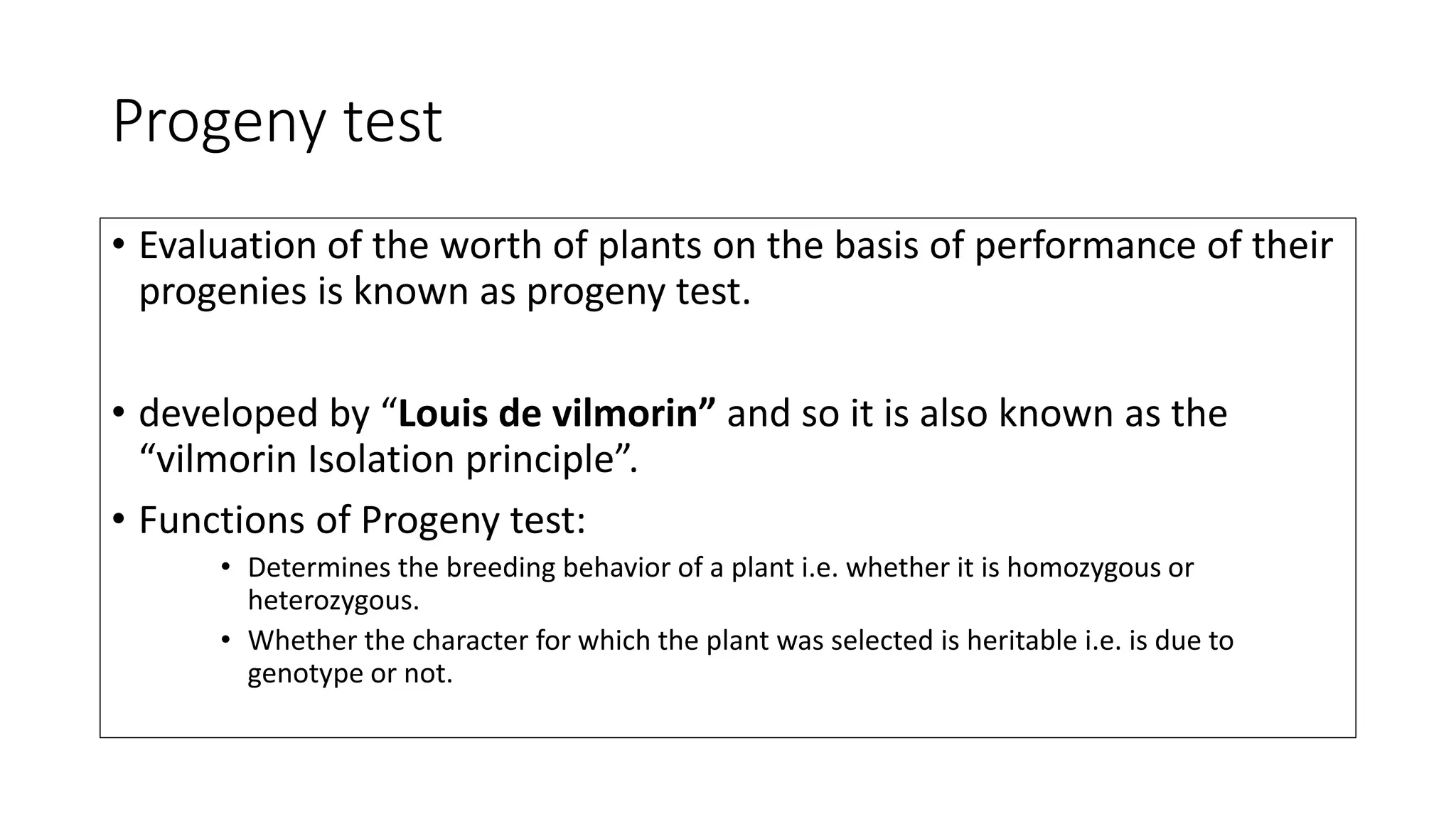
Progeny test
• Evaluation of the worth of plants on the basis of performance of their
progenies is known as progeny test.
• developed by “Louis de vilmorin” and so it is also known as the
“vilmorin Isolation principle”.
• Functions of Progeny test:
• Determines the breeding behavior of a plant i.e. whether it is homozygous or
heterozygous.
• Whether the character for which the plant was selected is heritable i.e. is due to
genotype or not.
Features
• The selection of superior plants based on the progeny performance
• Commonly used in the cross pollinated crops and often cross pollinated crops.
• In cross pollinated crops three types of material viz.,
1. Open pollinated seeds
2. Self seeds
3. Top cross or test cross seeds
• 10-15 seeds of each selected plants are grown for progeny test
• Test conducted in replicated trials to get reliable results.
• Superior progenies for the traits are bulked together to produce next generation
• The ear to row selection is used in maize is a simple form of progeny selection
• Line breeding: composition/mixing of several superior performing genotypes for
several traits to get one good variety is known as line breeding.
Pure line selection and Progeny test

Pure line selection and Progeny test

  • 1.
    Pureline selection and progenytest Dr. Rajendragouda Patil Assistant professor Genetics and Plant Breeding School of Agricultural Sciences and Technology (SAST), NMIMS, MPTP Shirpur
  • 2.
    Pureline selection • Itis the progeny of single homozygous self pollinated crop species • All the plants in the Pureline has same genotype. • The phenotypic differences within a Pureline is due to environment. Hence variation within a Pureline is not heritable – selection is not effective • The concept was given by Johannsen (1903) on the bases of his studies with “Princes” variety of French bean (Phaseolus vulgaris). Johannsen
  • 3.
    1 43 562 7 109 11 128 1413 15 16 17 1918 640 350 Princes variety French Bean seed lot Seed classification based on size and test weight
  • 4.
    F1 F2 F3 F6 640 mg 640 mg F1 F2 F3 F6 350mg 350 mg 1st Line 19th Line
  • 5.
    F1 F2 F3 F6 475 mg 13th Line Case-1 450mg F1 F2 F3 F6 450 mg F1 F2 F3 F6 451 mg F1 F2 F3 F6 458 mg 100 mg 200 mg 300 mg 400 mg 400 mg
  • 6.
    F1 F2 F3 F6 680 mg 1st Line 640mg F1 F2 F3 F6 690 mg Case-2
  • 7.
    • Parent offspringcorrelation within line # 13 was =-0.018 ± 0.038 (~Zero) • Correlation within seed lot was = 0.336 ± 0.008 • When correlation is zero (non significant)- variation is non heritable • When correlation is not zero (significant)- variation is heritable i.e variation has genetic basis. Case-3 Parent offspring correlation
  • 8.
    1. Selection iseffective in population since it contains mixture of several lines/ genotypes 2. Selection is ineffective in Pureline, since it is a progeny of single, self fertilized homozygous individual Two main conclusions of Johannsen’s experiments are
  • 9.
    Genetic Basis ofPureline Number of Generations Frequency % Frequency % AA Aa aa Homozygosity Heterozygosity 1 0 100 0 0 100 2 25 50 25 50 50 3 37.5 25 37.5 75 25 4 43.75 12.5 43.75 87.5 12.5 5 46.875 6.25 46.875 93.73 6.25 6 48.437 3.125 48.437 96.874 3.125 7 49.218 1.562 49.218 98.436 1.562 8 49.608 0.781 49.608 99.216 0.781 9 49.803 0.39 49.803 99.606 0.39
  • 10.
    • Self pollinationincreases the homozygosity with corresponding decreases in the heterozygosity. • Suppose an individual heterozygous for a single gene (Aa) and the successive generations derived from it are subjected to self- pollination. • Every generation of self-pollination will reduce the frequency of heterozygote Aa to 50 per cent of that in the previous generation • There is a corresponding increase in the frequency of the two homozygotes AA and
  • 11.
    • aa. Asa result, after 10 generations of selfing, virtually all the plants in the population would be homozygous, i.e., AA and aa. • three genotypes AA, Aa and aa have equal survival, On the other hand, the frequency of heterozygote Aa would be only 0.097 per cent, which is negligible. • If there is unequal survival, it may increase or decrease the rate at which homozygosity is achieved. • If Aa is favored, the rate of increase in homozygosity would be lower than expected.
  • 12.
    Pureline selection • Itis mainly used for the improvement of self pollinated crops. • Present day varieties of self pollinated crops are purelines. • It is mainly used to improve • Local varieties • Old purelines • Introduced varieties
  • 13.
    Procedure of PurelineSelection 1. Selection of purelines from heterogeneous population (1st yr)-Selection 2. Isolation of purelines by individual plant selection (2nd yr)- Evaluation 3. Testing of selected purelines in the yield trials (3rd -5th yr)- Yield trials 4. Release of pureline as variety (6th -8th yr)- Multiplication and distribution
  • 14.
    Advantages of PurelineSelection • Easy and cheap method of crop improvement • Rapid method, lines are usually genetically fixed and yield trials can be immediately conducted. • Plants in such variety react in similar fashion to environmental conditions, means they are uniform in performance and at the same time in appearance too. • Maximum possible improvement over the original variety can be achieved • Useful in improving low heritability traits as selection is based on progeny performance
  • 15.
    Disadvantages of PurelineSelection • Purelines have poor adaptability due to narrow genetic base, just opposite to mass selected variety • Superior genotypes can only be isolated from the mixed population. This selection is powerless to bring changes in hereditary factors i.e. to develop new genotype. • Mostly popular or in fact limited to self pollinated spp. only • Time and space consuming • Difficult to identify the small differences between the cultivars/lines
  • 16.
    Achievements • Rice :Mtu-1, Mtu-3, Mtu-7, Bcp-1, Adt-1, 3, 5, and 10 • Sorghum : G 1 & 2, M 1 & 2, OO 1, 4 & 5, • Groundnut : TMV 3, 4, 7, 8 and Kadiri 71-1 • Redgram : TM-1, ST-1 • Chillies : G1 & G2 • Ragi : AKP 1 to 7
  • 17.
    Progeny test • Evaluationof the worth of plants on the basis of performance of their progenies is known as progeny test. • developed by “Louis de vilmorin” and so it is also known as the “vilmorin Isolation principle”. • Functions of Progeny test: • Determines the breeding behavior of a plant i.e. whether it is homozygous or heterozygous. • Whether the character for which the plant was selected is heritable i.e. is due to genotype or not.
  • 18.
    Features • The selectionof superior plants based on the progeny performance • Commonly used in the cross pollinated crops and often cross pollinated crops. • In cross pollinated crops three types of material viz., 1. Open pollinated seeds 2. Self seeds 3. Top cross or test cross seeds • 10-15 seeds of each selected plants are grown for progeny test • Test conducted in replicated trials to get reliable results. • Superior progenies for the traits are bulked together to produce next generation • The ear to row selection is used in maize is a simple form of progeny selection • Line breeding: composition/mixing of several superior performing genotypes for several traits to get one good variety is known as line breeding.