A,B & R LINES DEVELOPMENT OF SELF AND
CROSS POLLINATED CROPS AND THEIR
MAINTENANCE BREEDING FOR HYBRID
SEED PRODUCTION
Lines defined as a group of genetically similar plants or Crops having
common parents or ancestors.
WHAT IS LINE DEVELOPEMENT ???
● Production or developement of particular type of desired lines.
● When we talk about development of lines in hybrid seed production then there
are three types of lines 1-A line
2-B line
3- R line
And two types of line system i.e. THREE LINE & TWO LINE SYSTEM
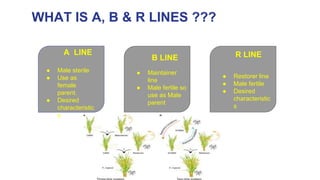
WHAT IS A, B & R LINES ???
A LINE
● Male sterile
● Use as
female
parent.
● Desired
characteristic
s
B LINE
● Maintainer
line
● Male fertile so
use as Male
parent
R LINE
● Restorer line
● Male fertile
● Desired
characteristic
s
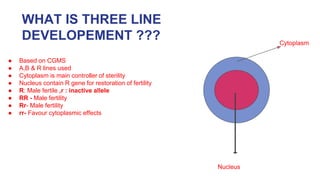
WHAT IS THREE LINE
DEVELOPEMENT ???
● Based on CGMS
● A,B & R lines used
● Cytoplasm is main controller of sterility
● Nucleus contain R gene for restoration of fertility
● R: Male fertile ,r : inactive allele
● RR - Male fertility
● Rr- Male fertility
● rr- Favour cytoplasmic effects
CGMS SYSTEM : –
Male fertile Male fertile Male
fertile
Male fertile Male fertile Male sterile
● This is the case of cytoplasmic Male sterility
where dominant nuclear gene restores fertility.
● Discovered by Jones and Davis in 1944 in
onion.
● Now CGMS has been reported in several
Crops like onion , rice , maize ..etc.
● Cytoplasmic Male sterile line can be
maintained by crossing the Male sterile
cytoplasmic line with Male fertile cytoplasmic
line as given below..
(ms/ms) S × ( ms/ ms) F —----> (
ms/ms) S
Male sterile Male fertile Male
sterile
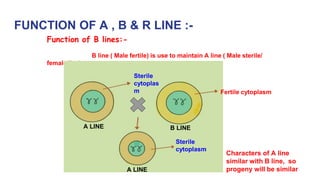
FUNCTION OF A , B & R LINE :-
Function of B lines:-
B line ( Male fertile) is use to maintain A line ( Male sterile/
female line)
Sterile
cytoplas
m
Sterile
cytoplasm
Characters of A line
similar with B line, so
progeny will be similar
A LINE B LINE
A LINE
MAINTENANCE OF A LINE IN FIELD:-
● A line is cross with B line
● Planting ratio should be 4 : 2 ( A : B )
A line (4)
B line ( 2)
HYBRID SEED PRODUCTION:-
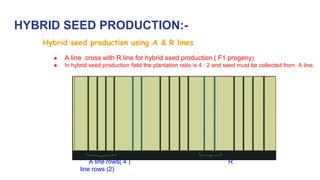
Hybrid seed production using A & R lines
● A line cross with R line for hybrid ssed production ( F1 progeny)
● In hybrid seed production field the plantation ratio is 4 : 2 and seed must be collected from A line.
A line rows( 4 ) R
line rows (2)
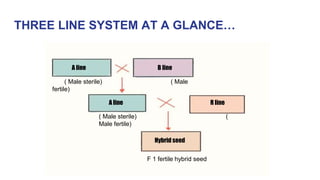
THREE LINE SYSTEM AT A GLANCE…
A line B line
A line R line
Hybrid seed
( Male sterile) ( Male
fertile)
( Male sterile) (
Male fertile)
F 1 fertile hybrid seed
TWO LINE SYSTEM :
Why two line system ???
● Difficult to maintain CGMS system.
● Problems in maintenance of A line
● High seed production cost
Generally there are two approaches
1.Environment sensitive Male sterility ( EGMS)
2. Chemically induced Male sterility ( CIMS)
ENVIRONMENT SENSITIVE MALE STERILITY (
EGMS)
Types of EGMS
1.PGMS ( PHOTOPERIOD SENSITIVE GENETIC MALE STERILITY)
2. TGMS ( TEMPERATURE SENSITIVE GENETIC MALE STERILITY)
3. PTGMS ( PHOTOTHERMO SENSITIVE GENETIC MALE STERILITY)
Interaction between nuclear genes and environmental factors . It is more popularly termed
as Two line hybrid breeding as against Three line hybrid breeding in case of CMS system
PGMS ( PHOTOPERIOD SENSITIVE GENETIC MALE
STERILITY)
Use in temprate countries having large changes in day length, usually practised in paddy
Crops.
Conditions :
Less Than 13 hours photo periods leads to complete Male fertile plant , and more than 14 Hours photo
period leads to complete Male sterile plant.
Maintenance of PGMS line: Photo period Less than 13 hours
PGMS LINE ( Male fertile)
Selfing in isolation
PGMS LINE ( fertile)
Hybrid seed production using PGMS line with normal Male fertile
line
Photo period more than 14 hours
PGMS line × Normal Male fertile
( Male sterile) ( Male fertile)
Hybrid seed
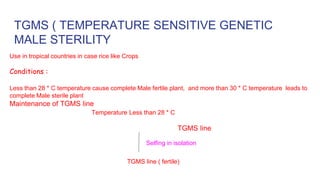
TGMS ( TEMPERATURE SENSITIVE GENETIC
MALE STERILITY
Use in tropical countries in case rice like Crops
Conditions :
Less than 28 * C temperature cause complete Male fertile plant, and more than 30 * C temperature leads to
complete Male sterile plant
Maintenance of TGMS line
Temperature Less than 28 * C
TGMS line
TGMS line ( fertile)
Selfing in isolation
Hybrid seed production using TGMS line and Normal Male fertile line
Temperature more than 30 * C
TGMS line × Normal fertile line
( Male sterile) ( Male fertile)
Hybrid seed
CIMS ( CHEMICAL INDUCED MALE STERILITY)
1. This non - genetic method including Male sterility involves the use of chemicals called
hybridizing agents or gametocides like GA3 , NAA, MH ,sodium/Zinc methyl arsonate.
2. This method is useful for plants with bisexual flowers in which it is difficult to obtain genetic or
cytoplasmic genetic Male sterility ( GMS or CGMS )
3. The ideal gametocides are
● Selectively induced Male sterility without adversely affecting the female sterility.
● Must not be mutagenic.
● Should consistently produce complete ( more than 95 % ) Male sterility.
● Should not be hazards to the environment.
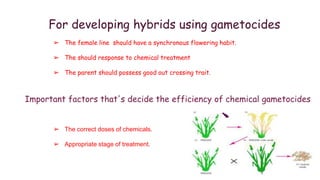
For developing hybrids using gametocides
➢ The female line should have a synchronous flowering habit.
➢ The should response to chemical treatment
➢ The parent should possess good out crossing trait.
Important factors that's decide the efficiency of chemical gametocides
➢ The correct doses of chemicals.
➢ Appropriate stage of treatment.
Advantages :
➢ Simplified procedure of hybrid seed production.
➢ Multiple and diverse germplasm available as parent .
➢ Any line could be taken as female .
➢ Increase Chance of developing desirable and heterotic hybrid.
➢ Multiple cytoplasm occurs as female parent .
Disadvantages :
➢ Environmental effect on sterility could cause seed purity problem .
➢ Incomplete Male sterility and not heritable.
➢ Multiple treatment required.
😊Thank You 😊

ABR LINE.pptx

  • 1.
    A,B & RLINES DEVELOPMENT OF SELF AND CROSS POLLINATED CROPS AND THEIR MAINTENANCE BREEDING FOR HYBRID SEED PRODUCTION
  • 2.
    Lines defined asa group of genetically similar plants or Crops having common parents or ancestors. WHAT IS LINE DEVELOPEMENT ??? ● Production or developement of particular type of desired lines. ● When we talk about development of lines in hybrid seed production then there are three types of lines 1-A line 2-B line 3- R line And two types of line system i.e. THREE LINE & TWO LINE SYSTEM
  • 3.
    WHAT IS A,B & R LINES ??? A LINE ● Male sterile ● Use as female parent. ● Desired characteristic s B LINE ● Maintainer line ● Male fertile so use as Male parent R LINE ● Restorer line ● Male fertile ● Desired characteristic s
  • 4.
    WHAT IS THREELINE DEVELOPEMENT ??? ● Based on CGMS ● A,B & R lines used ● Cytoplasm is main controller of sterility ● Nucleus contain R gene for restoration of fertility ● R: Male fertile ,r : inactive allele ● RR - Male fertility ● Rr- Male fertility ● rr- Favour cytoplasmic effects
  • 5.
    CGMS SYSTEM :– Male fertile Male fertile Male fertile Male fertile Male fertile Male sterile ● This is the case of cytoplasmic Male sterility where dominant nuclear gene restores fertility. ● Discovered by Jones and Davis in 1944 in onion. ● Now CGMS has been reported in several Crops like onion , rice , maize ..etc. ● Cytoplasmic Male sterile line can be maintained by crossing the Male sterile cytoplasmic line with Male fertile cytoplasmic line as given below.. (ms/ms) S × ( ms/ ms) F —----> ( ms/ms) S Male sterile Male fertile Male sterile
  • 6.
    FUNCTION OF A, B & R LINE :- Function of B lines:- B line ( Male fertile) is use to maintain A line ( Male sterile/ female line) Sterile cytoplas m Sterile cytoplasm Characters of A line similar with B line, so progeny will be similar A LINE B LINE A LINE
  • 7.
    MAINTENANCE OF ALINE IN FIELD:- ● A line is cross with B line ● Planting ratio should be 4 : 2 ( A : B ) A line (4) B line ( 2)
  • 8.
    HYBRID SEED PRODUCTION:- Hybridseed production using A & R lines ● A line cross with R line for hybrid ssed production ( F1 progeny) ● In hybrid seed production field the plantation ratio is 4 : 2 and seed must be collected from A line. A line rows( 4 ) R line rows (2)
  • 9.
    THREE LINE SYSTEMAT A GLANCE… A line B line A line R line Hybrid seed ( Male sterile) ( Male fertile) ( Male sterile) ( Male fertile) F 1 fertile hybrid seed
  • 10.
    TWO LINE SYSTEM: Why two line system ??? ● Difficult to maintain CGMS system. ● Problems in maintenance of A line ● High seed production cost Generally there are two approaches 1.Environment sensitive Male sterility ( EGMS) 2. Chemically induced Male sterility ( CIMS)
  • 11.
    ENVIRONMENT SENSITIVE MALESTERILITY ( EGMS) Types of EGMS 1.PGMS ( PHOTOPERIOD SENSITIVE GENETIC MALE STERILITY) 2. TGMS ( TEMPERATURE SENSITIVE GENETIC MALE STERILITY) 3. PTGMS ( PHOTOTHERMO SENSITIVE GENETIC MALE STERILITY) Interaction between nuclear genes and environmental factors . It is more popularly termed as Two line hybrid breeding as against Three line hybrid breeding in case of CMS system
  • 12.
    PGMS ( PHOTOPERIODSENSITIVE GENETIC MALE STERILITY) Use in temprate countries having large changes in day length, usually practised in paddy Crops. Conditions : Less Than 13 hours photo periods leads to complete Male fertile plant , and more than 14 Hours photo period leads to complete Male sterile plant. Maintenance of PGMS line: Photo period Less than 13 hours PGMS LINE ( Male fertile) Selfing in isolation PGMS LINE ( fertile)
  • 13.
    Hybrid seed productionusing PGMS line with normal Male fertile line Photo period more than 14 hours PGMS line × Normal Male fertile ( Male sterile) ( Male fertile) Hybrid seed
  • 14.
    TGMS ( TEMPERATURESENSITIVE GENETIC MALE STERILITY Use in tropical countries in case rice like Crops Conditions : Less than 28 * C temperature cause complete Male fertile plant, and more than 30 * C temperature leads to complete Male sterile plant Maintenance of TGMS line Temperature Less than 28 * C TGMS line TGMS line ( fertile) Selfing in isolation
  • 15.
    Hybrid seed productionusing TGMS line and Normal Male fertile line Temperature more than 30 * C TGMS line × Normal fertile line ( Male sterile) ( Male fertile) Hybrid seed
  • 16.
    CIMS ( CHEMICALINDUCED MALE STERILITY) 1. This non - genetic method including Male sterility involves the use of chemicals called hybridizing agents or gametocides like GA3 , NAA, MH ,sodium/Zinc methyl arsonate. 2. This method is useful for plants with bisexual flowers in which it is difficult to obtain genetic or cytoplasmic genetic Male sterility ( GMS or CGMS ) 3. The ideal gametocides are ● Selectively induced Male sterility without adversely affecting the female sterility. ● Must not be mutagenic. ● Should consistently produce complete ( more than 95 % ) Male sterility. ● Should not be hazards to the environment.
  • 17.
    For developing hybridsusing gametocides ➢ The female line should have a synchronous flowering habit. ➢ The should response to chemical treatment ➢ The parent should possess good out crossing trait. Important factors that's decide the efficiency of chemical gametocides ➢ The correct doses of chemicals. ➢ Appropriate stage of treatment.
  • 18.
    Advantages : ➢ Simplifiedprocedure of hybrid seed production. ➢ Multiple and diverse germplasm available as parent . ➢ Any line could be taken as female . ➢ Increase Chance of developing desirable and heterotic hybrid. ➢ Multiple cytoplasm occurs as female parent . Disadvantages : ➢ Environmental effect on sterility could cause seed purity problem . ➢ Incomplete Male sterility and not heritable. ➢ Multiple treatment required.
  • 19.