NAVEEN JAKHAR
 PLANT INTRODUCTION
 SELECTION-
(a) ASEXUALLY PROPOGATED PLANTS
Clonal selection
(b) SELF POLLINATED CROPS-
Pure line selection
Single plant selection
(c) CROSS POLLINATED CROPS-
Mass selection
 Line breeding
It is an important method for improvement of
vegetable crops particularly of introduced crop like
potato , tomato , capsicum , etc.
The introduction may constitute elite cultivar, true
breeding material, heterozygous and heterogeneous
materials.
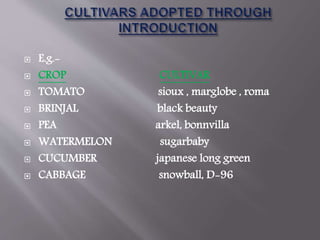
 E.g.-
 CROP CULTIVAR
 TOMATO sioux , marglobe , roma
 BRINJAL black beauty
 PEA arkel, bonnvilla
 WATERMELON sugarbaby
 CUCUMBER japanese long green
 CABBAGE snowball, D-96
 In asexually propagated vegetable crops, several
cultivars have been developed by clonal selection.
 A clone is referred to a group of plant produced
from single plant through asexual propagation.
 For e.g.- in potato, kufri red is a clonal selection
from a cultivar Darjeeling red round and kufri safed
from cultivar phulwa.
 Besides these, a number of cultivars of potato .
pointed gourd , sweet - potato, garlic etc have been
developed by clonal selection.

It is generally employed in self pollinated crop. In
this method it is necessary That the initial
population is highly heterozygous with superior
genes of Desired character . this procedure help in
stabilizing the heterozygous superior Genotypes
rather than making further improvement.
Eg. - Tomato- co-1, co-2, pant -3
Okra- Pusa makhmali, Gujarat bhindi-1
It is a selection of chance variants , off type or superior
types from the source material constituted of mixed
homozygous population.
Single plant selection from introduced materials is
important in developing many cultivars of different
crop in India like tomato, brinjal, chilli, pea,
Frenchbean , okra etc .
Eg- crop cultivar
Tomato Improved merruti, HS-110
Cauliflower Pusa drum head, hisar-1
Bitter gourd pusa do mousmi
Bottle gourd PSPL, PSPR
In cross pollinated vegetable crops systematic selection
followed by controlled pollination always improve the
population termed as population improvement.
This is done by different selection method like mass
selection , progeny testing and line breeding, family
breeding, mass pedigree selection,
recurrent selection, etc.
In this method of selection , the best individual plant
is selected from the Base population on the basis of
phenotype , their seeds are produced by open
pollination and then composited to raise the next
generation. After repeated selection in this way,
the improved population can be treated as a new
cultivar.
e.g.- most of the cultivars of onion and few
cultivars of radish, cauliflower, carrot and palak.
MASS-PEDIGREE METHOD
Mass pedigree method is useful for cabbage, cauliflower,
radish,and turnip showing high degree of self incompatibility.In
this method selected progenies are allowed to random mating in
isolation to develop new base population.It is subjected to 3-4
cycles of selection,after which it is regarded as a new cultivar.
In line breeding progeny of the selected plants from the base
population is raised by open pollination and grown
separately in rows for evolution. After several cycles of
selection,on the basis of progeny test,the almost similar
progeny lines are composited and treated as a new cultivar.
Eg.cauliflower,cabbage,radish,onion and carrot.
Family breeding is almost similar to line breeding but in
this method of population improvement,progenies are
tested more elaborately in more number of generations.
4 to 6 progeny families are composited to develop a
new synthetic variety.
Recurrent selection is a population improvement scheme designed
to concentrate favourable genes scattered among number of
individual in the base population.It is based on selection of
superior plants followed by controlled mating to produce the
progeny as new base population.
This method is effective in improving yield & other
quantitative traits by capitalige additive genetic variance in the
population
There are four types of recurrent selection methods –
(1) Simple recurrent selection – Eg. Improve carotene
content in carrot.
(2) Recurrent selection for GCA – other pollinated varities
as a tester.
(3) Recurrent selection for SCA – inbred as tester.
(4) Reciprocal recurrent selection –both the population
improved together..
In cross pollinated vegetable crops loss of vigour is
associated with inbreeding though the extent of such
depression varies with the crops and cultivars.
INBREEDING IS APPLIED AS A BREEDING METHOD TO –
(A) Improve the individual plant in CUCURBITS.
(B) Attain uniformity in plants chacters so that the improved
population can be regarded as a new cultivar.
(C) Develop inbred lines for utilization in the development
of synthetic or hybrid cultivar in the crops like –
cauliflower, cabbage,Broccoli, and carrot etc.
HYBRIDIZATION AND SLECTION FROM
ADVANCED GENERATION
• HYBRIDIZATION:-
Crossing of two genetically dissimilar
plants is known as hybridization when
genetic variability is not present in the
crop.
 Hybridization is basically employed to generate
variability in the genotype because selection for any
trait would become effective when genetic variability in
the population under improvement is high.
 Hybrid progenies of cross pollinated crops are handled
by two different approaches
1. Population Improvement – cabbage , cauliflower,
raddish, spinch , etc
2. Individual plant selection –cucurbits
CROP VARIETY
 TOMATO pusa early dwarf, marglobe,
pusa ruby, hisar lalima,
panjab chhuhara
 BRINJAL pusa kranti, sadabahar baingan,
pant rituraj
 PEA PH-1, GC-141, GC-195
 COWPEA Pusa Dofasli
 MUSK MELON Pusa sharbati,
 WATER MELON Arka manik
 RADISH pusa himani
 SWEET POTATO pusa sunehri
 Heterosis :-
superiority of an F1 hybrid over its parents.
 Heterosis breeding for the development of hybrid
cultivar mainly utilizes dominance variance in both
self and cross pollinated vegetable crops.
Development of hybrid varieties consists of three steps
namely-
1) Selection of parents (Inbred or homozygous line)
2) Testing the combining ability of parents.
3) Production of F1 hybrids.
 Method of Hybrid Seed Production:-
1) Emasculation and hand pollination:- Tomato,
brinjal ,okra, peas & beans .
2)Hand pollination without emasculation:-use of
male sterility
ex-tomato , brinjal, chilli.
Breeding  methods for  vegetables

Breeding methods for vegetables

  • 1.
  • 2.
     PLANT INTRODUCTION SELECTION- (a) ASEXUALLY PROPOGATED PLANTS Clonal selection (b) SELF POLLINATED CROPS- Pure line selection Single plant selection (c) CROSS POLLINATED CROPS- Mass selection  Line breeding
  • 4.
    It is animportant method for improvement of vegetable crops particularly of introduced crop like potato , tomato , capsicum , etc. The introduction may constitute elite cultivar, true breeding material, heterozygous and heterogeneous materials.
  • 5.
     E.g.-  CROPCULTIVAR  TOMATO sioux , marglobe , roma  BRINJAL black beauty  PEA arkel, bonnvilla  WATERMELON sugarbaby  CUCUMBER japanese long green  CABBAGE snowball, D-96
  • 6.
     In asexuallypropagated vegetable crops, several cultivars have been developed by clonal selection.  A clone is referred to a group of plant produced from single plant through asexual propagation.  For e.g.- in potato, kufri red is a clonal selection from a cultivar Darjeeling red round and kufri safed from cultivar phulwa.  Besides these, a number of cultivars of potato . pointed gourd , sweet - potato, garlic etc have been developed by clonal selection. 
  • 7.
    It is generallyemployed in self pollinated crop. In this method it is necessary That the initial population is highly heterozygous with superior genes of Desired character . this procedure help in stabilizing the heterozygous superior Genotypes rather than making further improvement. Eg. - Tomato- co-1, co-2, pant -3 Okra- Pusa makhmali, Gujarat bhindi-1
  • 8.
    It is aselection of chance variants , off type or superior types from the source material constituted of mixed homozygous population. Single plant selection from introduced materials is important in developing many cultivars of different crop in India like tomato, brinjal, chilli, pea, Frenchbean , okra etc . Eg- crop cultivar Tomato Improved merruti, HS-110 Cauliflower Pusa drum head, hisar-1 Bitter gourd pusa do mousmi Bottle gourd PSPL, PSPR
  • 9.
    In cross pollinatedvegetable crops systematic selection followed by controlled pollination always improve the population termed as population improvement. This is done by different selection method like mass selection , progeny testing and line breeding, family breeding, mass pedigree selection, recurrent selection, etc.
  • 10.
    In this methodof selection , the best individual plant is selected from the Base population on the basis of phenotype , their seeds are produced by open pollination and then composited to raise the next generation. After repeated selection in this way, the improved population can be treated as a new cultivar. e.g.- most of the cultivars of onion and few cultivars of radish, cauliflower, carrot and palak.
  • 11.
    MASS-PEDIGREE METHOD Mass pedigreemethod is useful for cabbage, cauliflower, radish,and turnip showing high degree of self incompatibility.In this method selected progenies are allowed to random mating in isolation to develop new base population.It is subjected to 3-4 cycles of selection,after which it is regarded as a new cultivar.
  • 12.
    In line breedingprogeny of the selected plants from the base population is raised by open pollination and grown separately in rows for evolution. After several cycles of selection,on the basis of progeny test,the almost similar progeny lines are composited and treated as a new cultivar. Eg.cauliflower,cabbage,radish,onion and carrot.
  • 13.
    Family breeding isalmost similar to line breeding but in this method of population improvement,progenies are tested more elaborately in more number of generations. 4 to 6 progeny families are composited to develop a new synthetic variety.
  • 14.
    Recurrent selection isa population improvement scheme designed to concentrate favourable genes scattered among number of individual in the base population.It is based on selection of superior plants followed by controlled mating to produce the progeny as new base population. This method is effective in improving yield & other quantitative traits by capitalige additive genetic variance in the population
  • 15.
    There are fourtypes of recurrent selection methods – (1) Simple recurrent selection – Eg. Improve carotene content in carrot. (2) Recurrent selection for GCA – other pollinated varities as a tester. (3) Recurrent selection for SCA – inbred as tester. (4) Reciprocal recurrent selection –both the population improved together..
  • 16.
    In cross pollinatedvegetable crops loss of vigour is associated with inbreeding though the extent of such depression varies with the crops and cultivars. INBREEDING IS APPLIED AS A BREEDING METHOD TO – (A) Improve the individual plant in CUCURBITS. (B) Attain uniformity in plants chacters so that the improved population can be regarded as a new cultivar. (C) Develop inbred lines for utilization in the development of synthetic or hybrid cultivar in the crops like – cauliflower, cabbage,Broccoli, and carrot etc.
  • 17.
    HYBRIDIZATION AND SLECTIONFROM ADVANCED GENERATION • HYBRIDIZATION:- Crossing of two genetically dissimilar plants is known as hybridization when genetic variability is not present in the crop.
  • 18.
     Hybridization isbasically employed to generate variability in the genotype because selection for any trait would become effective when genetic variability in the population under improvement is high.  Hybrid progenies of cross pollinated crops are handled by two different approaches 1. Population Improvement – cabbage , cauliflower, raddish, spinch , etc 2. Individual plant selection –cucurbits
  • 19.
    CROP VARIETY  TOMATOpusa early dwarf, marglobe, pusa ruby, hisar lalima, panjab chhuhara  BRINJAL pusa kranti, sadabahar baingan, pant rituraj
  • 20.
     PEA PH-1,GC-141, GC-195  COWPEA Pusa Dofasli  MUSK MELON Pusa sharbati,  WATER MELON Arka manik  RADISH pusa himani  SWEET POTATO pusa sunehri
  • 21.
     Heterosis :- superiorityof an F1 hybrid over its parents.  Heterosis breeding for the development of hybrid cultivar mainly utilizes dominance variance in both self and cross pollinated vegetable crops.
  • 22.
    Development of hybridvarieties consists of three steps namely- 1) Selection of parents (Inbred or homozygous line) 2) Testing the combining ability of parents. 3) Production of F1 hybrids.
  • 23.
     Method ofHybrid Seed Production:- 1) Emasculation and hand pollination:- Tomato, brinjal ,okra, peas & beans . 2)Hand pollination without emasculation:-use of male sterility ex-tomato , brinjal, chilli.