BULK METHOD OF PLANT BREEDING
COLLEGE OFAGRICULTURE
BHAWANIPATNA
OUAT
DR. CHANDANA BEHERA
ASSISTANT PROFESSOR
GENETICS AND PLANT BREEDING
It was first used by Nilsson Ehle in 1908.
It refers to a species is grown in bulk plot ( from F1 to
F5 ) with or without selection, a part of the bulk seed is
used to grow the next generation and individual plant
selection is practiced in F6 or later generation.
In this method duration of bulking may vary from 6-7
to 30 generation.
Bulk
This method is suitable and most convenient for handling the
segregating generation of cereals, smaller millet, grain legume and
oilseeds.
Application of Bulk Population Method:
Bulk
i) Isolation of homozygous lines.
ii) Waiting for the opportunity for selection.
iii) Opportunity for natural selection to change the composition of
the population.
This method is generally known as the mass- pedigree method of
Harlan and also termed as evolutionary method of breeding by
Suneson as it allows natural selection to act on the population
This may be used for three different purposes.
The exact procedure of bulk method would vary depending on the
objective of breeder.
1) Hybridization: Parents are selected according to the objective of the
breeding programme and crossed.
2) F1 Generation:
The F1 generation is space planted and harvested in bulk. The number
of F1 plants should be as large as possible; usually more than 20 plants
should be grown.
3) F2-F6 – Generation: F2 to F6 generations are planted at
commercial seed rate and spacing. These generations are harvested in
bulk. During these generations the population size should be as large as
possible, preferably 30 to 50 thousand plants should be grown in each
generation. Artificial selection is generally not done.
Procedure of Bulk Population Method:
4) F7 Generation: About 30 – 50 thousand plants are space planted and
out of this only 1000 to 5000 plants with superior phenotypes are
selected and their seeds harvested separately. Selection is made on the
basis of phenotypes of plants, grain characteristics etc.
5) F8 Generation: Individual plant progenies are grown in single or
multi row plots. Most of the progenies would be homozygous and are
harvested in bulk. Weak and inferior progenies are rejected and only
100- 300 individual plant progenies with desirable characters are
selected.
6) F9 Generation: Preliminary yield trial is conducted along with
standard variety as check. The evaluation of progeny is done for
important desirable characteristics (height, lodging resistance, maturity
date, disease resistance). Quality test may be conducted to reject the
undesirable progenies.
7) F10- F12 Generation: Replicated yield trails are conducted at
several locations using standard commercial varieties as check. If lines
are superior to the standard check, released as new varieties.
8) F13 Generation: Seed multiplication of the newly released variety
for distribution to the farmers
Procedure of Bulk Population Method:
Comments
1. Space planting of the F1 will increase the yield of F2 seed.
2. The breeder may screen the bulk population under different natural
environments in a rotation. There may be an increase in broad adaptation of
the cultivar.
3. Screening for photoperiodic response is desirable and advantageous in the
early stages to eliminate genotypes that are incapable of reproducing under the
environmental conditions.
3. Natural selection may be aided by artificial selection. Aggressive and highly
competitive but undesirable genotypes may be physically rogued out of the
population to avoid increasing the frequency of undesirable genes. Aiding
natural selection also accelerates the breeding program.
4. The degree of selection pressure applied, its consistency, duration, and the
heritability of traits, are all factors that impact the rate at which unadapted
segregates are eliminated from the bulk population.
1) This method simple, convenient and inexpensive.
2). Since, each F2 plant is equally represented till F6, no chance of
elimination of good genotypes in early generations.
3) Artificial or natural disease epiphytics, winter killing high temperature
increases the frequency of desirable type.
4) Progenies select from long term bulks are superior than the selection
from F2 or short term bulk.
5) Since, little work and attention is needed in F2 and subsequent
generation more no. of crosses can be handled.
6) No pedigree records which saves time
7) Since large population are grown, transgressive segregants are more
likely to appear and increase due to natural selection. Hence, there is a
greater chance to isolate good segregants than pedigree method.
Merits of Bulk Population Method:
1. It takes a much longer time to develop a new variety. Natural
selection becomes important only after F8 or F10, and bulking may
have to be done upto F20 or more. Thus the time required is
considerably longer, and most breeders do not use the bulk method
simply for this reason.
2. It provides little opportunity for the breeder to exercise his skill or
judgment in selection. But in the modified bulk method, the breeder has
ample opportunity for practicing selection in the early segregating
generations.
4. A large number of progenies have to be selected at the end of the
bulking period.
5. Information on the inheritance of characters cannot be obtained which
is often available from the pedigree method.
Demerits Bulk Population Method:
Bulk method has not been widely used in crop improvement possibly due to
(1) the long time required for natural selection to act and, therefore, for developing
a variety, and
(2) the lack of opportunity for the breeder to exercise his skill in selection of
superior plant types during the segregating generation.
In India only one variety of Brassica juncea “Narendra Rai” was developed through
selection for bold seed size in a composite of 90 crosses. Narendra rai represents an
improvement over national checks Varuna, Kranti and Krishna for seed size, seed and oil
yields/ha, oil content, and disease and pest reactions.. This method has a limited
application in practical plant breeding.
Achievement:
Crop Pedigree Varieties
Barley Atlas X Vaughn Arivat, Beecher, Glacier and
Gem etc.
Brassica juncea composite of 90
crosses
Narendra Rai
Single Seed Descent Method
This method is modification of bulk method. First proposed by Goulden
(1939) and later modified by Brim (1969).
Instead of bulking whole seed lot of selected plants, a single seed is
selected randomly from each selected plant to make bulk.
This method involves less record keeping (pedigree method) and works
better where the main focus is on improvement of
quantitative traits or characters such as yield and earliness, rather than
qualitative traits or characters such as flower color and disease
resistance.
But, it does not involve selection process mainly artificial, so chances of
loosing superior plants are comparatively more and because of the same
reason does not eliminate weak plants early such as in other methods.
Breeding Procedure:
Step Details
Hybridization Crossing of selected parents.
F1 generation F1 seeds grown and bulk harvested.
F2 generation F2 seeds grown. One seed from each plant is selected
randomly and mixed.
F3 generation F3 seeds are grown and harvested as above.
F4 and F5generation The similar procedure as above is carried out.
F6 generation F6 seeds are planted. Selection for superior plants is
conducted and selected ones are harvested separately.
Number of plants could range from200 to 500.
F7 generation The main point in this step is individual plant progenies
are grown and selected plants are harvested in bulk.
F8 generation Preliminary yield trials and quality tests are conducted.
F9 to F11 generation Co-ordinated yield trials and tests for resistance and
quality are conducted.
F12 generation Seed multiplication for distribution
Breeding Procedure:
1. It does not permit any form of selection in natural or artificial.
2. In each successive generation the population size between
progressively smaller due to poor germination and death of the plants
due to disease, insect pests and accidents.
Advantages:
Disadvantages:
1. Single seed descent method advance the generations with possible
speed in a conventional breeding method.
2. It requires very little space, effects and labours.
3. It makes the best use of green house and offseason nursery, facilitates
because in that two to three generations can be raised in each year.
4. It ensures that the plants retained at the end population are random
sample from F2 population.
Pedigree Method Bulk Method
1.Individuals plants are selected in
F2 and Segregation generation and
individual plant progenies are
grown
1.F2 and the subsequent generation
are maintained as bulk
2.Artificial selection, Artificial
disease epidemics are an integral
parts
2.Artificial selection, artificial
disease epidemic are created to
assist natural selection.
3.No role of Natural section 3.Natural selection determines the
composition of population.
4.Pedigree record have to be
maintained which is laborious and
time consuming
4.No pedigree records are
maintained
5.It takes 12 years to develop new
variety
5.More than 12 years bulk
population > 10 years for effective
natural selection
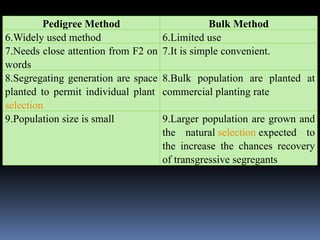
Pedigree Method Bulk Method
6.Widely used method 6.Limited use
7.Needs close attention from F2 on
words
7.It is simple convenient.
8.Segregating generation are space
planted to permit individual plant
selection
8.Bulk population are planted at
commercial planting rate
9.Population size is small 9.Larger population are grown and
the natural selection expected to
the increase the chances recovery
of transgressive segregants
THANK YOU

BULK.pptx...............................................

  • 1.
    BULK METHOD OFPLANT BREEDING COLLEGE OFAGRICULTURE BHAWANIPATNA OUAT DR. CHANDANA BEHERA ASSISTANT PROFESSOR GENETICS AND PLANT BREEDING
  • 2.
    It was firstused by Nilsson Ehle in 1908. It refers to a species is grown in bulk plot ( from F1 to F5 ) with or without selection, a part of the bulk seed is used to grow the next generation and individual plant selection is practiced in F6 or later generation. In this method duration of bulking may vary from 6-7 to 30 generation. Bulk This method is suitable and most convenient for handling the segregating generation of cereals, smaller millet, grain legume and oilseeds. Application of Bulk Population Method:
  • 3.
    Bulk i) Isolation ofhomozygous lines. ii) Waiting for the opportunity for selection. iii) Opportunity for natural selection to change the composition of the population. This method is generally known as the mass- pedigree method of Harlan and also termed as evolutionary method of breeding by Suneson as it allows natural selection to act on the population This may be used for three different purposes.
  • 4.
    The exact procedureof bulk method would vary depending on the objective of breeder. 1) Hybridization: Parents are selected according to the objective of the breeding programme and crossed. 2) F1 Generation: The F1 generation is space planted and harvested in bulk. The number of F1 plants should be as large as possible; usually more than 20 plants should be grown. 3) F2-F6 – Generation: F2 to F6 generations are planted at commercial seed rate and spacing. These generations are harvested in bulk. During these generations the population size should be as large as possible, preferably 30 to 50 thousand plants should be grown in each generation. Artificial selection is generally not done. Procedure of Bulk Population Method: 4) F7 Generation: About 30 – 50 thousand plants are space planted and out of this only 1000 to 5000 plants with superior phenotypes are selected and their seeds harvested separately. Selection is made on the basis of phenotypes of plants, grain characteristics etc.
  • 5.
    5) F8 Generation:Individual plant progenies are grown in single or multi row plots. Most of the progenies would be homozygous and are harvested in bulk. Weak and inferior progenies are rejected and only 100- 300 individual plant progenies with desirable characters are selected. 6) F9 Generation: Preliminary yield trial is conducted along with standard variety as check. The evaluation of progeny is done for important desirable characteristics (height, lodging resistance, maturity date, disease resistance). Quality test may be conducted to reject the undesirable progenies. 7) F10- F12 Generation: Replicated yield trails are conducted at several locations using standard commercial varieties as check. If lines are superior to the standard check, released as new varieties. 8) F13 Generation: Seed multiplication of the newly released variety for distribution to the farmers
  • 6.
    Procedure of BulkPopulation Method:
  • 7.
    Comments 1. Space plantingof the F1 will increase the yield of F2 seed. 2. The breeder may screen the bulk population under different natural environments in a rotation. There may be an increase in broad adaptation of the cultivar. 3. Screening for photoperiodic response is desirable and advantageous in the early stages to eliminate genotypes that are incapable of reproducing under the environmental conditions. 3. Natural selection may be aided by artificial selection. Aggressive and highly competitive but undesirable genotypes may be physically rogued out of the population to avoid increasing the frequency of undesirable genes. Aiding natural selection also accelerates the breeding program. 4. The degree of selection pressure applied, its consistency, duration, and the heritability of traits, are all factors that impact the rate at which unadapted segregates are eliminated from the bulk population.
  • 8.
    1) This methodsimple, convenient and inexpensive. 2). Since, each F2 plant is equally represented till F6, no chance of elimination of good genotypes in early generations. 3) Artificial or natural disease epiphytics, winter killing high temperature increases the frequency of desirable type. 4) Progenies select from long term bulks are superior than the selection from F2 or short term bulk. 5) Since, little work and attention is needed in F2 and subsequent generation more no. of crosses can be handled. 6) No pedigree records which saves time 7) Since large population are grown, transgressive segregants are more likely to appear and increase due to natural selection. Hence, there is a greater chance to isolate good segregants than pedigree method. Merits of Bulk Population Method:
  • 9.
    1. It takesa much longer time to develop a new variety. Natural selection becomes important only after F8 or F10, and bulking may have to be done upto F20 or more. Thus the time required is considerably longer, and most breeders do not use the bulk method simply for this reason. 2. It provides little opportunity for the breeder to exercise his skill or judgment in selection. But in the modified bulk method, the breeder has ample opportunity for practicing selection in the early segregating generations. 4. A large number of progenies have to be selected at the end of the bulking period. 5. Information on the inheritance of characters cannot be obtained which is often available from the pedigree method. Demerits Bulk Population Method:
  • 10.
    Bulk method hasnot been widely used in crop improvement possibly due to (1) the long time required for natural selection to act and, therefore, for developing a variety, and (2) the lack of opportunity for the breeder to exercise his skill in selection of superior plant types during the segregating generation. In India only one variety of Brassica juncea “Narendra Rai” was developed through selection for bold seed size in a composite of 90 crosses. Narendra rai represents an improvement over national checks Varuna, Kranti and Krishna for seed size, seed and oil yields/ha, oil content, and disease and pest reactions.. This method has a limited application in practical plant breeding. Achievement: Crop Pedigree Varieties Barley Atlas X Vaughn Arivat, Beecher, Glacier and Gem etc. Brassica juncea composite of 90 crosses Narendra Rai
  • 11.
    Single Seed DescentMethod This method is modification of bulk method. First proposed by Goulden (1939) and later modified by Brim (1969). Instead of bulking whole seed lot of selected plants, a single seed is selected randomly from each selected plant to make bulk. This method involves less record keeping (pedigree method) and works better where the main focus is on improvement of quantitative traits or characters such as yield and earliness, rather than qualitative traits or characters such as flower color and disease resistance. But, it does not involve selection process mainly artificial, so chances of loosing superior plants are comparatively more and because of the same reason does not eliminate weak plants early such as in other methods. Breeding Procedure:
  • 12.
    Step Details Hybridization Crossingof selected parents. F1 generation F1 seeds grown and bulk harvested. F2 generation F2 seeds grown. One seed from each plant is selected randomly and mixed. F3 generation F3 seeds are grown and harvested as above. F4 and F5generation The similar procedure as above is carried out. F6 generation F6 seeds are planted. Selection for superior plants is conducted and selected ones are harvested separately. Number of plants could range from200 to 500. F7 generation The main point in this step is individual plant progenies are grown and selected plants are harvested in bulk. F8 generation Preliminary yield trials and quality tests are conducted. F9 to F11 generation Co-ordinated yield trials and tests for resistance and quality are conducted. F12 generation Seed multiplication for distribution
  • 13.
  • 14.
    1. It doesnot permit any form of selection in natural or artificial. 2. In each successive generation the population size between progressively smaller due to poor germination and death of the plants due to disease, insect pests and accidents. Advantages: Disadvantages: 1. Single seed descent method advance the generations with possible speed in a conventional breeding method. 2. It requires very little space, effects and labours. 3. It makes the best use of green house and offseason nursery, facilitates because in that two to three generations can be raised in each year. 4. It ensures that the plants retained at the end population are random sample from F2 population.
  • 15.
    Pedigree Method BulkMethod 1.Individuals plants are selected in F2 and Segregation generation and individual plant progenies are grown 1.F2 and the subsequent generation are maintained as bulk 2.Artificial selection, Artificial disease epidemics are an integral parts 2.Artificial selection, artificial disease epidemic are created to assist natural selection. 3.No role of Natural section 3.Natural selection determines the composition of population. 4.Pedigree record have to be maintained which is laborious and time consuming 4.No pedigree records are maintained 5.It takes 12 years to develop new variety 5.More than 12 years bulk population > 10 years for effective natural selection
  • 16.
    Pedigree Method BulkMethod 6.Widely used method 6.Limited use 7.Needs close attention from F2 on words 7.It is simple convenient. 8.Segregating generation are space planted to permit individual plant selection 8.Bulk population are planted at commercial planting rate 9.Population size is small 9.Larger population are grown and the natural selection expected to the increase the chances recovery of transgressive segregants
  • 17.