Principles of Design
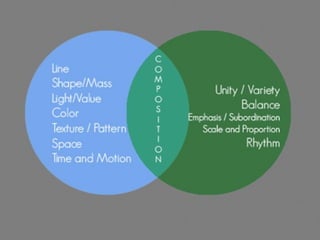
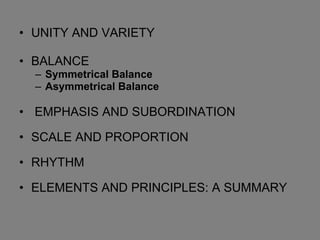
UNITY AND VARIETY BALANCE  Symmetrical Balance Asymmetrical Balance EMPHASIS AND SUBORDINATION SCALE AND PROPORTION RHYTHM ELEMENTS AND PRINCIPLES: A SUMMARY
Unity and Variety The result of bringing the elements of art into the appropriate ratio between harmony and variety to achieve a sense of oneness. Variety : Differences that provide interest and contrast. Unity : The sense of oneness, of things belonging together and making up a  coherent whole .
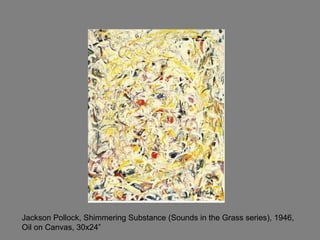
Jackson Pollock, Shimmering Substance (Sounds in the Grass series), 1946, Oil on Canvas, 30x24”
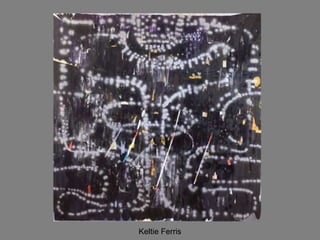
Keltie Ferris
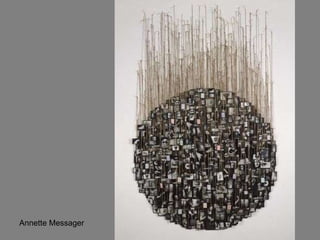
Annette Messager
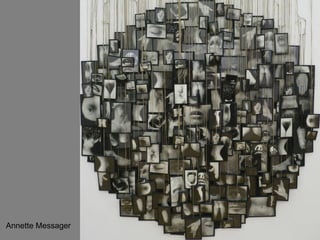
Annette Messager
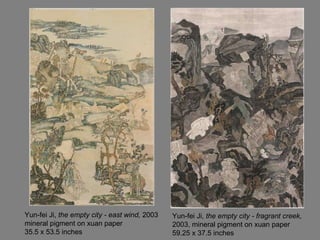
Yun-fei Ji,  the empty city - fragrant creek,  2003, mineral pigment on xuan paper 59.25 x 37.5 inches  Yun-fei Ji,  the empty city - east wind,  2003 mineral pigment on xuan paper 35.5 x 53.5 inches
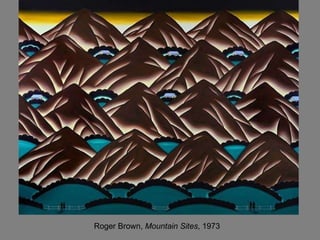
Roger Brown,  Mountain Sites , 1973
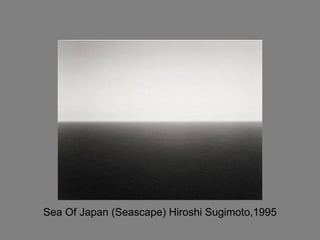
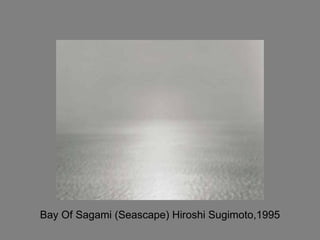
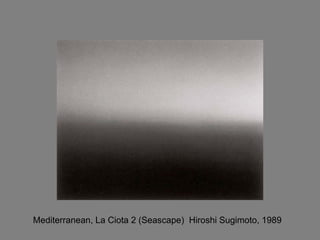
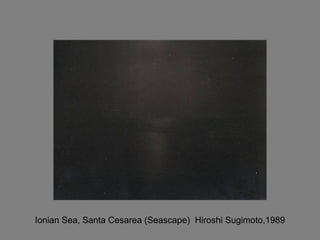
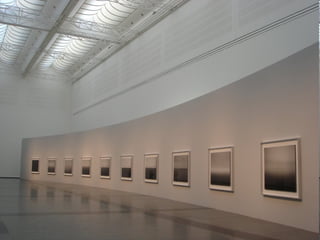
Harmony quality achieved by different elements of a composition interacting to form a whole. Harmony is often accomplished through repetition of the same or similar characteristics.
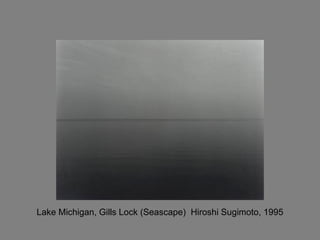
Lake Michigan, Gills Lock (Seascape)  Hiroshi Sugimoto, 1995
Sea Of Japan (Seascape) Hiroshi Sugimoto,1995
Bay Of Sagami (Seascape) Hiroshi Sugimoto,1995
Mediterranean, La Ciota 2 (Seascape)  Hiroshi Sugimoto, 1989
Ionian Sea, Santa Cesarea (Seascape)  Hiroshi Sugimoto,1989
 
Repetition use of the same visual effect a number of times in the came composition – may produce dominance, harmony, pattern, and/or rhythm
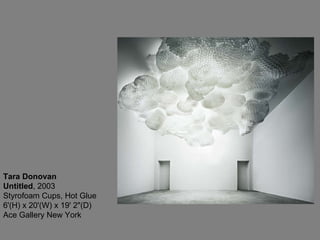
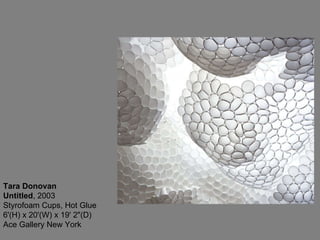
Tara Donovan Untitled , 2003  Styrofoam Cups, Hot Glue 6'(H) x 20'(W) x 19' 2"(D) Ace Gallery New York
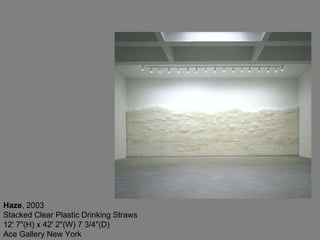
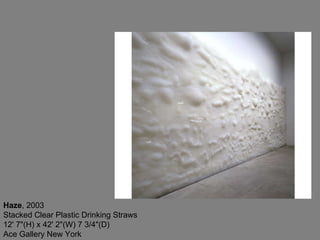
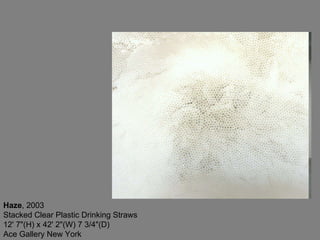
Haze , 2003  Stacked Clear Plastic Drinking Straws 12' 7"(H) x 42' 2"(W) 7 3/4"(D) Ace Gallery New York
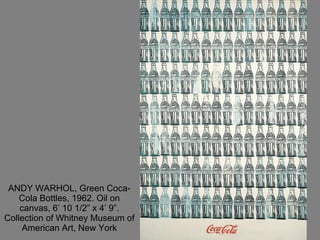
ANDY WARHOL, Green Coca-Cola Bottles, 1962. Oil on canvas, 6’ 10 1/2” x 4’ 9”. Collection of Whitney Museum of American Art, New York
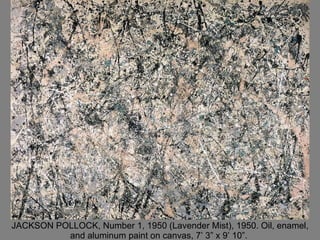
JACKSON POLLOCK, Number 1, 1950 (Lavender Mist), 1950. Oil, enamel, and aluminum paint on canvas, 7’ 3” x 9’ 10”.
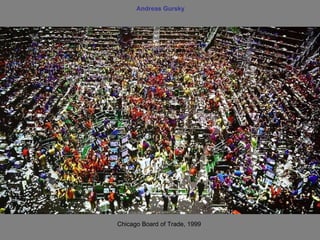
Andreas Gursky Chicago Board of Trade, 1999
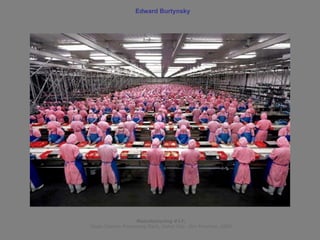
Manufacturing #17, Deda Chicken Processing Plant, Dehui City, Jilin Province, 2005 Edward Burtynsky
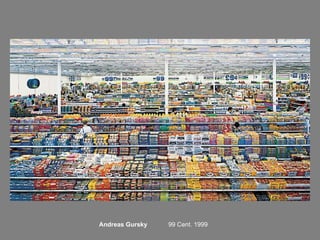
99 Cent. 1999 Andreas Gursky
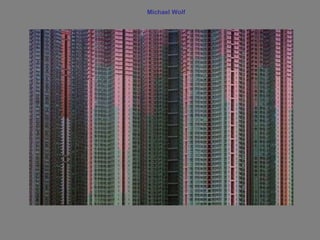
Michael Wolf
 
Repetition Steve Reich – “Piano Phase” – two pianists playing the same identical short repeating pattern; one player maintains a steady tempo – while the other slightly increases his tempo as gradually as possible until he is one note ahead of the first player – then increases again (two notes ahead) – until they have returned to unison playing.
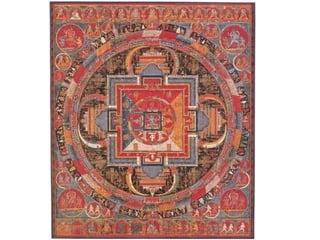
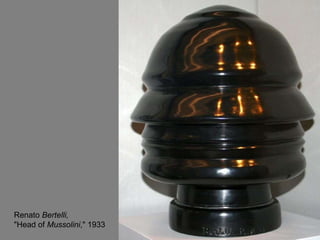
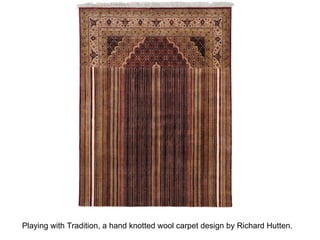
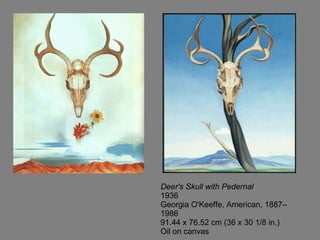
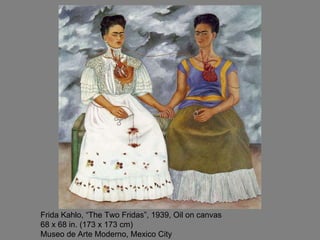
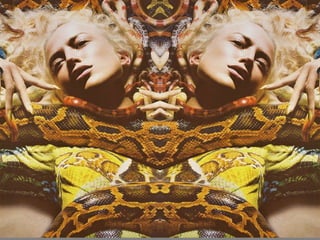
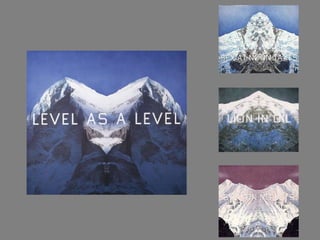
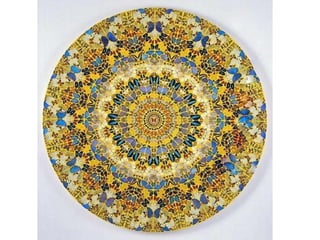
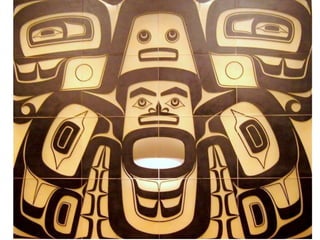
BALANCE A sense of equilibrium achieved through implied weight, attention, or attraction, by manipulating the visual elements within an artwork 1. Symmetrical - ½ and ½ a portion on one side of the format is repeated on the other Approximate Symmetry some variety, more interest but loss of some harmony Radial Balance distributed around a central point 2. Asymmetrical balance felt equilibrium between parts of a picture no center point or dividing axis


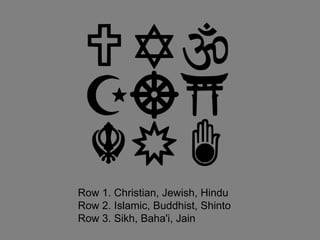
Row 1. Christian, Jewish, Hindu  Row 2. Islamic, Buddhist, Shinto  Row 3. Sikh, Baha'i, Jain
Renato  Bertelli,  "Head of  Mussolini ," 1933
Playing with Tradition, a hand knotted wool carpet design by Richard Hutten.
Deer's Skull with Pedernal 1936 Georgia O'Keeffe, American, 1887–1986 91.44 x 76.52 cm (36 x 30 1/8 in.) Oil on canvas
René Magritte  The Palace of Curtains, III [Le Palais des rideaux (III)]. (1928–29)  Oil on canvas, 32 x 45 7/8" (81.2 x 116.4 cm)
Frida Kahlo, “The Two Fridas”, 1939, Oil on canvas 68 x 68 in. (173 x 173 cm) Museo de Arte Moderno, Mexico City
 
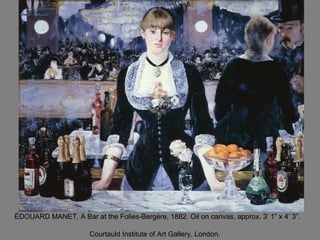
ÉDOUARD MANET, A Bar at the Folies-Bergère, 1882. Oil on canvas, approx. 3’ 1” x 4’ 3”. Courtauld Institute of Art Gallery, London.
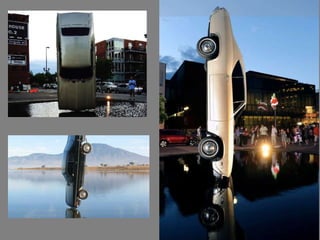
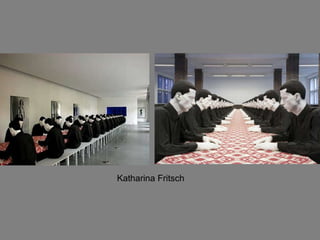
Katharina Fritsch
 
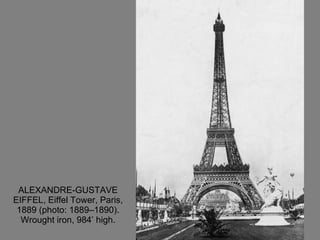
ALEXANDRE-GUSTAVE EIFFEL, Eiffel Tower, Paris, 1889 (photo: 1889–1890). Wrought iron, 984’ high.
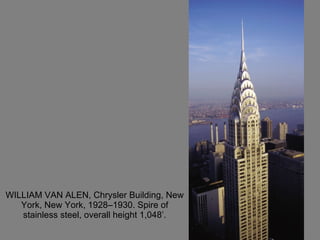
WILLIAM VAN ALEN, Chrysler Building, New York, New York, 1928–1930. Spire of stainless steel, overall height 1,048’.
 
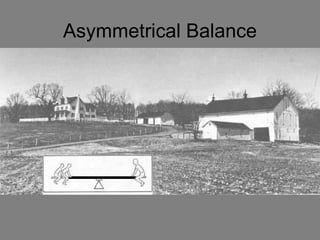
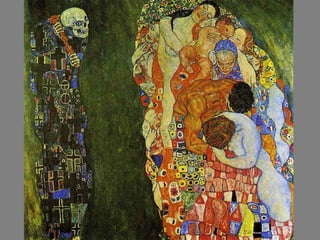
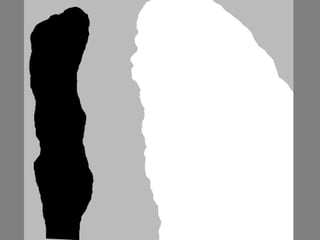
Asymmetrical Balance
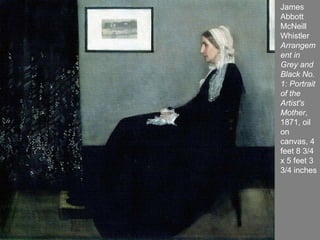
Asymmetrical Balance A large form is visually heavier than a smaller one A dark-value form is visually heavier than a lighter-value form A textured form is visually heavier than a smoother form of the same size A complex form is visually heavier than a simple form of the same size A smaller dark form can balance a light one
Asymmetrical Balance An object far from the center of the picture seems to have more weight than one near the center. Objects in the upper part of a picture seem heavier than objects of the same size in the lower part of a picture.  Isolation seems to increase the weight of an object. Intensely interesting objects seem to have more compositional weight.  Elements on the right side of an asymmetrical picture appear to have more weight than elements of the same size on the left side of the picture.
 
 
James Abbott McNeill Whistler  Arrangement in Grey and Black No. 1: Portrait of the Artist's Mother , 1871, oil  on canvas, 4 feet 8 3/4 x 5 feet 3 3/4 inches
 
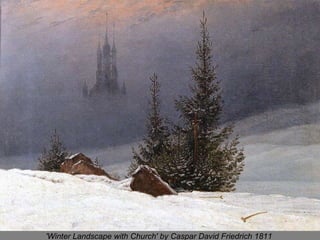
'Winter Landscape with Church' by Caspar David Friedrich 1811
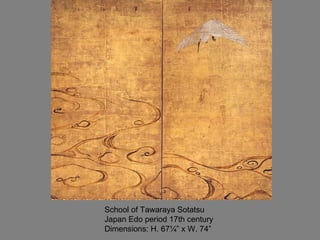
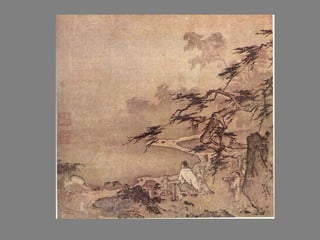
School of Tawaraya Sotatsu  Japan Edo period 17th century Dimensions: H. 67¼” x W. 74”
 
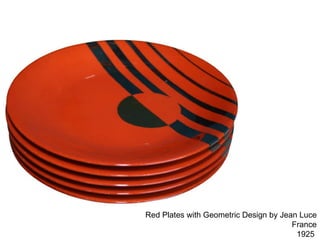
Red Plates with Geometric Design by Jean Luce France 1925
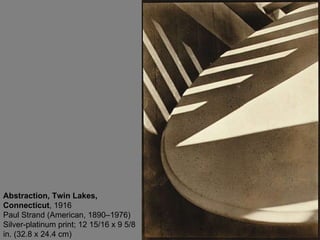
Abstraction, Twin Lakes, Connecticut , 1916 Paul Strand (American, 1890–1976) Silver-platinum print; 12 15/16 x 9 5/8 in. (32.8 x 24.4 cm)
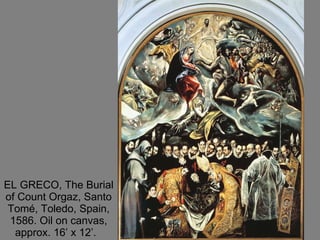
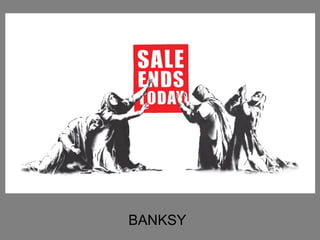
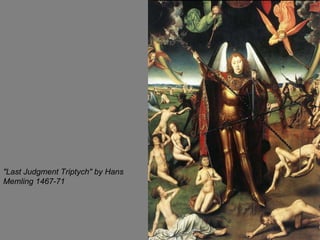
EMPHASIS AND SUBORDINATION Some visual elements dominate others Contrast Color/Value Scale – Proportion Shape Placement - Proximity or Isolation
 
EL GRECO, The Burial of Count Orgaz, Santo Tomé, Toledo, Spain, 1586. Oil on canvas, approx. 16’ x 12’.
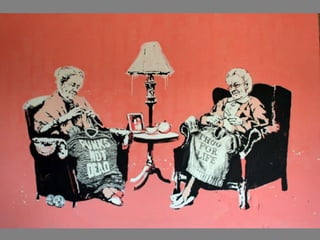
BANKSY
"Last Judgment Triptych" by Hans Memling 1467-71
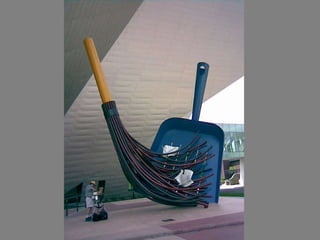
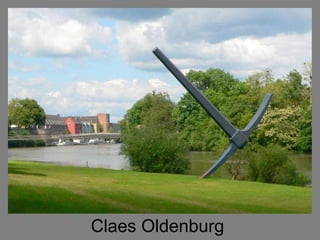
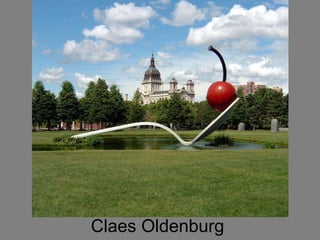
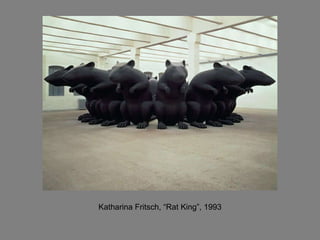
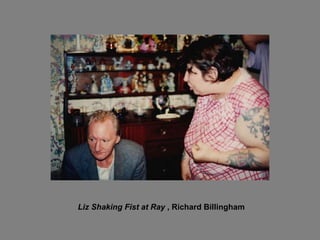
SCALE AND PROPORTION Scale – size in relation to a standard or “normal” size Proportion – size relationships between parts of a whole or between two or more items perceived as a unit “There is no excellent beauty that hath not some strangeness in the proportion.” – Francis Bacon


Claes Oldenburg
Claes Oldenburg
Katharina Fritsch, “Rat King”, 1993
Liz Shaking Fist at Ray  , Richard Billingham
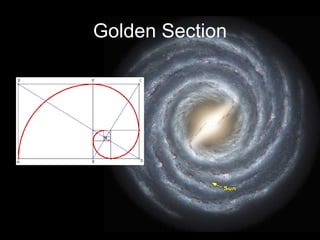
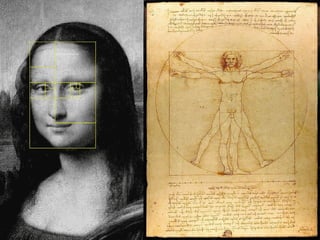
Golden Section
 
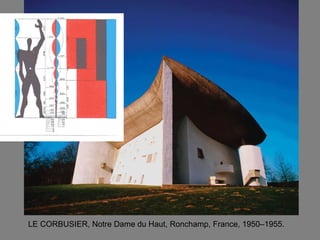
LE CORBUSIER, Notre Dame du Haut, Ronchamp, France, 1950–1955.
 
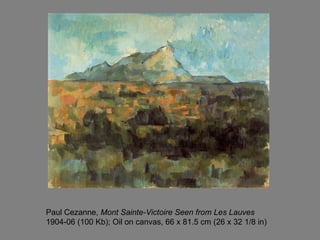
Paul Cezanne,  Mont Sainte-Victoire Seen from Les Lauves   1904-06 (100 Kb); Oil on canvas, 66 x 81.5 cm (26 x 32 1/8 in)
Rhythm a sense of movement achieved by the repetition of visual units (motifs) and elements – use of measured accents
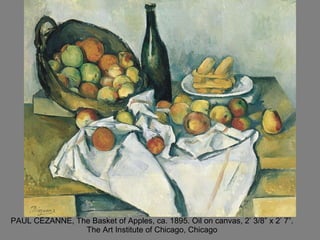
PAUL CÉZANNE, The Basket of Apples, ca. 1895. Oil on canvas, 2’ 3/8” x 2’ 7”. The Art Institute of Chicago, Chicago
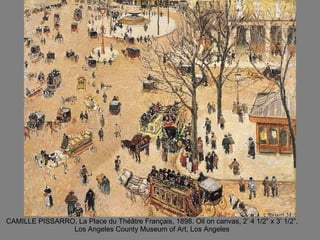
CAMILLE PISSARRO, La Place du Théâtre Français, 1898. Oil on canvas, 2’ 4 1/2” x 3’ 1/2”. Los Angeles County Museum of Art, Los Angeles


ELEMENTS AND PRINCIPLES: A SUMMARY
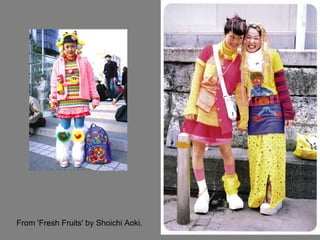
From 'Fresh Fruits' by Shoichi Aoki.
 
Writing About Art Title Does the title help you interpret what you see? Art Historical Context Does it remind you of other works – in what way? What do you know about the artist? Does this work fall into a particular theme in the history of art? Cubism, Impressionism, Etc. When and where was the work made? What was going on in the world at the time (war, economic depression, etc.)? What are the characteristics of the culture from which it emerges and how might the work reflect those characteristics?
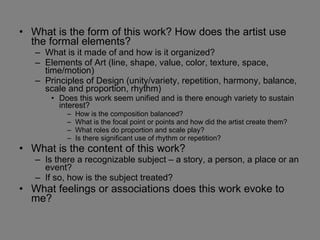
What is the form of this work? How does the artist use the formal elements? What is it made of and how is it organized? Elements of Art (line, shape, value, color, texture, space, time/motion) Principles of Design (unity/variety, repetition, harmony, balance, scale and proportion, rhythm) Does this work seem unified and is there enough variety to sustain interest?  How is the composition balanced?  What is the focal point or points and how did the artist create them? What roles do proportion and scale play? Is there significant use of rhythm or repetition? What is the content of this work?  Is there a recognizable subject – a story, a person, a place or an event?  If so, how is the subject treated? What feelings or associations does this work evoke to me?
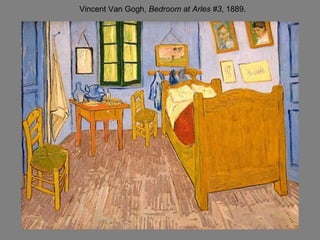
Vincent Van Gogh,  Bedroom at Arles #3 , 1889.
 

Week3 Principles Of Design

  • 1.
  • 2.
  • 3.
    UNITY AND VARIETYBALANCE Symmetrical Balance Asymmetrical Balance EMPHASIS AND SUBORDINATION SCALE AND PROPORTION RHYTHM ELEMENTS AND PRINCIPLES: A SUMMARY
  • 4.
    Unity and VarietyThe result of bringing the elements of art into the appropriate ratio between harmony and variety to achieve a sense of oneness. Variety : Differences that provide interest and contrast. Unity : The sense of oneness, of things belonging together and making up a coherent whole .
  • 5.
    Jackson Pollock, ShimmeringSubstance (Sounds in the Grass series), 1946, Oil on Canvas, 30x24”
  • 6.
  • 7.
  • 8.
  • 9.
    Yun-fei Ji, the empty city - fragrant creek, 2003, mineral pigment on xuan paper 59.25 x 37.5 inches Yun-fei Ji, the empty city - east wind, 2003 mineral pigment on xuan paper 35.5 x 53.5 inches
  • 10.
    Roger Brown, Mountain Sites , 1973
  • 11.
    Harmony quality achievedby different elements of a composition interacting to form a whole. Harmony is often accomplished through repetition of the same or similar characteristics.
  • 12.
    Lake Michigan, GillsLock (Seascape)  Hiroshi Sugimoto, 1995
  • 13.
    Sea Of Japan(Seascape) Hiroshi Sugimoto,1995
  • 14.
    Bay Of Sagami(Seascape) Hiroshi Sugimoto,1995
  • 15.
    Mediterranean, La Ciota2 (Seascape)  Hiroshi Sugimoto, 1989
  • 16.
    Ionian Sea, SantaCesarea (Seascape)  Hiroshi Sugimoto,1989
  • 17.
  • 18.
    Repetition use ofthe same visual effect a number of times in the came composition – may produce dominance, harmony, pattern, and/or rhythm
  • 19.
    Tara Donovan Untitled, 2003 Styrofoam Cups, Hot Glue 6'(H) x 20'(W) x 19' 2"(D) Ace Gallery New York
  • 20.
    Tara Donovan Untitled, 2003 Styrofoam Cups, Hot Glue 6'(H) x 20'(W) x 19' 2"(D) Ace Gallery New York
  • 21.
    Haze , 2003 Stacked Clear Plastic Drinking Straws 12' 7"(H) x 42' 2"(W) 7 3/4"(D) Ace Gallery New York
  • 22.
    Haze , 2003 Stacked Clear Plastic Drinking Straws 12' 7"(H) x 42' 2"(W) 7 3/4"(D) Ace Gallery New York
  • 23.
    Haze , 2003 Stacked Clear Plastic Drinking Straws 12' 7"(H) x 42' 2"(W) 7 3/4"(D) Ace Gallery New York
  • 24.
    ANDY WARHOL, GreenCoca-Cola Bottles, 1962. Oil on canvas, 6’ 10 1/2” x 4’ 9”. Collection of Whitney Museum of American Art, New York
  • 25.
    JACKSON POLLOCK, Number1, 1950 (Lavender Mist), 1950. Oil, enamel, and aluminum paint on canvas, 7’ 3” x 9’ 10”.
  • 26.
    Andreas Gursky ChicagoBoard of Trade, 1999
  • 27.
    Manufacturing #17, DedaChicken Processing Plant, Dehui City, Jilin Province, 2005 Edward Burtynsky
  • 28.
    99 Cent. 1999Andreas Gursky
  • 29.
  • 30.
  • 31.
    Repetition Steve Reich– “Piano Phase” – two pianists playing the same identical short repeating pattern; one player maintains a steady tempo – while the other slightly increases his tempo as gradually as possible until he is one note ahead of the first player – then increases again (two notes ahead) – until they have returned to unison playing.
  • 32.
    BALANCE A senseof equilibrium achieved through implied weight, attention, or attraction, by manipulating the visual elements within an artwork 1. Symmetrical - ½ and ½ a portion on one side of the format is repeated on the other Approximate Symmetry some variety, more interest but loss of some harmony Radial Balance distributed around a central point 2. Asymmetrical balance felt equilibrium between parts of a picture no center point or dividing axis
  • 33.
  • 34.
  • 35.
  • 36.
  • 37.
  • 38.
  • 39.
  • 40.
  • 41.
    Row 1. Christian,Jewish, Hindu Row 2. Islamic, Buddhist, Shinto Row 3. Sikh, Baha'i, Jain
  • 42.
    Renato Bertelli, "Head of Mussolini ," 1933
  • 43.
    Playing with Tradition,a hand knotted wool carpet design by Richard Hutten.
  • 44.
    Deer's Skull withPedernal 1936 Georgia O'Keeffe, American, 1887–1986 91.44 x 76.52 cm (36 x 30 1/8 in.) Oil on canvas
  • 45.
    René Magritte The Palace of Curtains, III [Le Palais des rideaux (III)]. (1928–29) Oil on canvas, 32 x 45 7/8" (81.2 x 116.4 cm)
  • 46.
    Frida Kahlo, “TheTwo Fridas”, 1939, Oil on canvas 68 x 68 in. (173 x 173 cm) Museo de Arte Moderno, Mexico City
  • 47.
  • 48.
    ÉDOUARD MANET, ABar at the Folies-Bergère, 1882. Oil on canvas, approx. 3’ 1” x 4’ 3”. Courtauld Institute of Art Gallery, London.
  • 49.
  • 50.
  • 51.
    ALEXANDRE-GUSTAVE EIFFEL, EiffelTower, Paris, 1889 (photo: 1889–1890). Wrought iron, 984’ high.
  • 52.
    WILLIAM VAN ALEN,Chrysler Building, New York, New York, 1928–1930. Spire of stainless steel, overall height 1,048’.
  • 53.
  • 54.
  • 55.
    Asymmetrical Balance Alarge form is visually heavier than a smaller one A dark-value form is visually heavier than a lighter-value form A textured form is visually heavier than a smoother form of the same size A complex form is visually heavier than a simple form of the same size A smaller dark form can balance a light one
  • 56.
    Asymmetrical Balance Anobject far from the center of the picture seems to have more weight than one near the center. Objects in the upper part of a picture seem heavier than objects of the same size in the lower part of a picture. Isolation seems to increase the weight of an object. Intensely interesting objects seem to have more compositional weight. Elements on the right side of an asymmetrical picture appear to have more weight than elements of the same size on the left side of the picture.
  • 57.
  • 58.
  • 59.
    James Abbott McNeillWhistler Arrangement in Grey and Black No. 1: Portrait of the Artist's Mother , 1871, oil on canvas, 4 feet 8 3/4 x 5 feet 3 3/4 inches
  • 60.
  • 61.
    'Winter Landscape withChurch' by Caspar David Friedrich 1811
  • 62.
    School of TawarayaSotatsu  Japan Edo period 17th century Dimensions: H. 67¼” x W. 74”
  • 63.
  • 64.
    Red Plates withGeometric Design by Jean Luce France 1925
  • 65.
    Abstraction, Twin Lakes,Connecticut , 1916 Paul Strand (American, 1890–1976) Silver-platinum print; 12 15/16 x 9 5/8 in. (32.8 x 24.4 cm)
  • 66.
    EMPHASIS AND SUBORDINATIONSome visual elements dominate others Contrast Color/Value Scale – Proportion Shape Placement - Proximity or Isolation
  • 67.
  • 68.
    EL GRECO, TheBurial of Count Orgaz, Santo Tomé, Toledo, Spain, 1586. Oil on canvas, approx. 16’ x 12’.
  • 69.
  • 70.
    "Last Judgment Triptych"by Hans Memling 1467-71
  • 71.
    SCALE AND PROPORTIONScale – size in relation to a standard or “normal” size Proportion – size relationships between parts of a whole or between two or more items perceived as a unit “There is no excellent beauty that hath not some strangeness in the proportion.” – Francis Bacon
  • 72.
  • 73.
  • 74.
  • 75.
  • 76.
  • 77.
  • 78.
    Liz Shaking Fistat Ray , Richard Billingham
  • 79.
  • 80.
  • 81.
    LE CORBUSIER, NotreDame du Haut, Ronchamp, France, 1950–1955.
  • 82.
  • 83.
    Paul Cezanne, Mont Sainte-Victoire Seen from Les Lauves 1904-06 (100 Kb); Oil on canvas, 66 x 81.5 cm (26 x 32 1/8 in)
  • 84.
    Rhythm a senseof movement achieved by the repetition of visual units (motifs) and elements – use of measured accents
  • 85.
    PAUL CÉZANNE, TheBasket of Apples, ca. 1895. Oil on canvas, 2’ 3/8” x 2’ 7”. The Art Institute of Chicago, Chicago
  • 86.
    CAMILLE PISSARRO, LaPlace du Théâtre Français, 1898. Oil on canvas, 2’ 4 1/2” x 3’ 1/2”. Los Angeles County Museum of Art, Los Angeles
  • 87.
  • 88.
  • 89.
  • 90.
  • 91.
  • 92.
  • 93.
    From 'Fresh Fruits'by Shoichi Aoki.
  • 94.
  • 95.
    Writing About ArtTitle Does the title help you interpret what you see? Art Historical Context Does it remind you of other works – in what way? What do you know about the artist? Does this work fall into a particular theme in the history of art? Cubism, Impressionism, Etc. When and where was the work made? What was going on in the world at the time (war, economic depression, etc.)? What are the characteristics of the culture from which it emerges and how might the work reflect those characteristics?
  • 96.
    What is theform of this work? How does the artist use the formal elements? What is it made of and how is it organized? Elements of Art (line, shape, value, color, texture, space, time/motion) Principles of Design (unity/variety, repetition, harmony, balance, scale and proportion, rhythm) Does this work seem unified and is there enough variety to sustain interest? How is the composition balanced? What is the focal point or points and how did the artist create them? What roles do proportion and scale play? Is there significant use of rhythm or repetition? What is the content of this work? Is there a recognizable subject – a story, a person, a place or an event? If so, how is the subject treated? What feelings or associations does this work evoke to me?
  • 97.
    Vincent Van Gogh, Bedroom at Arles #3 , 1889.
  • 98.

Editor's Notes

  • #28 BURTYNSKY - CHINA In the autumn of 2005, Edward Burtynsky presents his latest release of work, photographs of both remnant and newly established zones of Chinese industrialization. Using diplomatic channels Burtynsky has gained rare access to the extreme expressions of Chinese industry, creating images that are at once arresting and unsettling. These photographs afford us a privileged glimpse of the vast social and economic transformations currently underway in China.
  • #30 Michael Wolf : Architecture of Density January 6 - February 26, 2005 ROBERT KOCH GALLERY is pleased to present Architecture of Density , an exhibition of large scale color photographs by Michael Wolf. Wolf has lived and worked in Hong Kong for ten years. Stimulated by the region's complex urban dynamics, he makes dizzying photographs of its architecture. One of the most densely populated metropolitan areas in the world, Hong Kong has an overall density of nearly 6,700 people per square kilometer. The majority of its citizens live in flats in high-rise buildings. In Architecture of Density , Wolf investigates these vibrant city blocks, finding a mesmerizing abstraction in the buildings' facades. Some of the structures in the series are photographed without reference to the context of sky or ground, and many buildings are seen in a state of repair or construction: their walls covered with a grid of scaffolding or the soft colored curtains that protect the streets below from falling debris. From a distance, such elements become a part of the photograph's intricate design. Upon closer inspection of each photograph, the anonymous public face of the city is full of rewarding detail- suddenly public space is private space, and large swatches of color give way to smaller pieces of people's lives. The trappings of the people are still visible here: their days inform the detail of these buildings. Bits of laundry and hanging plants pepper the tiny rectangles of windows- the only irregularities in this orderly design. In 2002, the San Francisco Chronicle called Wolf's work in Hong Kong "most improbable and humanly alert". In previous series, Wolf described the vernacular culture of the street. His early vision of the region dwelt on personal aesthetic gestures left in back doors and alleyways, such as makeshift seating in the streets. In these photographs, small tokens of human presence took precedence over monumental architecture. Wolf continues to explore the theme of the organic metropolis- that which develops according to the caprice of its citizens as much as the planning of its architects. In Architecture of Density , his vision has evolved to evaluate the high-rises that shape the spatial experience of Hong Kong's citizens. Wolf finds in each building a singular character, despite its functional purpose and massive form. Wolf was born in Munich, Germany in 1954. He studied first at the North Toronto Collegiate Institute in Canada, then UC Berkeley and, in the mid 1970s, with Otto Steinert at the University of Essen, in Germany. Published monographs include Sitting in China (2002) and China im Wandel (China in Transition) (2001). Hong Kong: Front Door/Back Door will be published by Thames and Hudson in 2005.