Design Principles
                                                                   - Kabir Malkani

*   This presentation has been compiled from references available from the Internet. This is meant purely
    for educational purposes and the presenter does not claim to hold any ownership whatsoever; of the
    content (textual or graphical) included in this presentation. The ownership and copyrights of the following
    content belong to the respective brands /agencies / artists showcased in this presentation.
Topics Covered
O   Through this presentation we will learn about the:

O   Elements of Design

O   The 8 Principles of Design
     O   Balance
         O   Optical Center
         O   Types of Balance
         O   Rule of Thirds
         O   Whitespace
     O   Emphasis / Dominance
     O   Contrast
     O   Proximity
     O   Rhythm, Repetition & Movement
     O   Proportion
     O   Harmony
     O   Unity & Variety
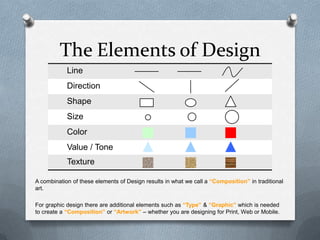
The Elements of Design
            Line
            Direction
            Shape
            Size
            Color
            Value / Tone
            Texture

A combination of these elements of Design results in what we call a “Composition” in traditional
art.

For graphic design there are additional elements such as “Type” & “Graphic” which is needed
to create a “Composition” or “Artwork” – whether you are designing for Print, Web or Mobile.
The 8 Principles of Design
1.   Balance
2.   Emphasis / Dominance
3.   Contrast
4.   Proximity
5.   Rhythm, Repetition & Movement
6.   Proportion
7.   Harmony
8.   Unity & Variety
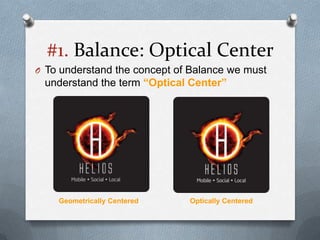
#1. Balance: Optical Center
O To understand the concept of Balance we must
 understand the term “Optical Center”


    Geometrically Centered    Optically Centered
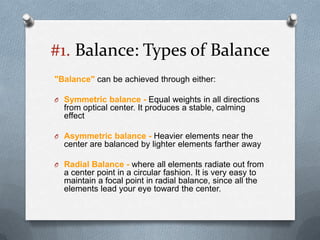
#1. Balance: Types of Balance
"Balance" can be achieved through either:

O Symmetric balance - Equal weights in all directions
  from optical center. It produces a stable, calming
  effect

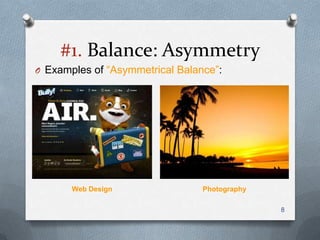
O Asymmetric balance - Heavier elements near the
  center are balanced by lighter elements farther away

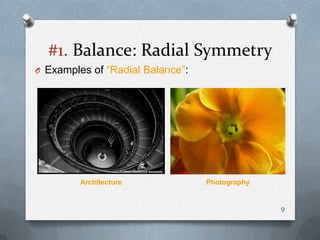
O Radial Balance - where all elements radiate out from
  a center point in a circular fashion. It is very easy to
  maintain a focal point in radial balance, since all the
  elements lead your eye toward the center.
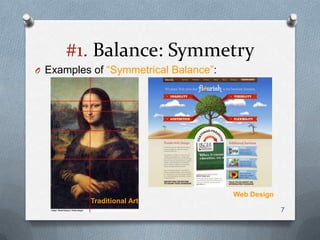
#1. Balance: Symmetry
O Examples of “Symmetrical Balance”:


                                       Web Design
          Traditional Art
                                                    7
#1. Balance: Asymmetry
O Examples of “Asymmetrical Balance”:


       Web Design                Photography

                                               8
#1. Balance: Radial Symmetry
O Examples of “Radial Balance”:


         Architecture             Photography


                                                9
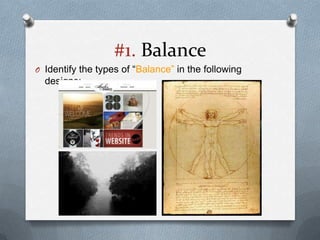
#1. Balance
O Identify the types of “Balance” in the following
  designs:
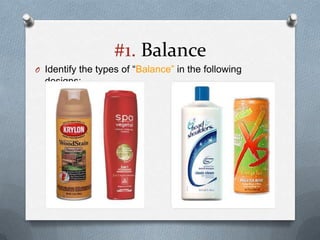
#1. Balance
O Identify the types of “Balance” in the following
  designs:
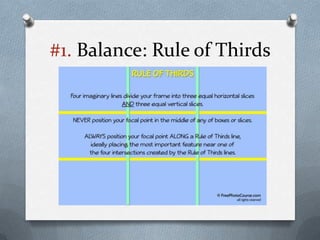
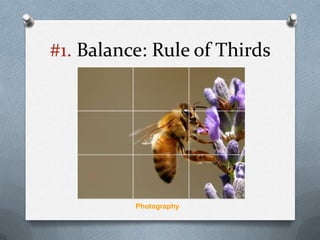
#1. Balance: Rule of Thirds


          Photography
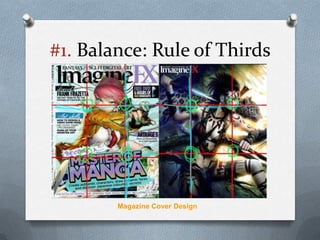
#1. Balance: Rule of Thirds


        Magazine Cover Design
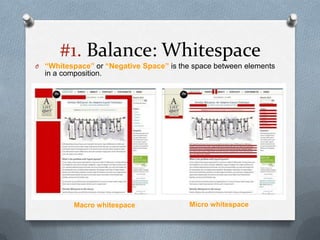
#1. Balance: Whitespace
O “Whitespace” or “Negative Space” is the space between elements
  in a composition.


          Macro whitespace               Micro whitespace
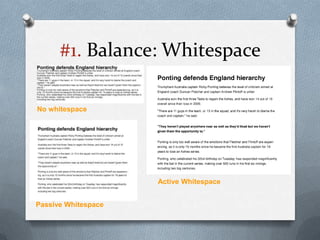
#1. Balance: Whitespace

No whitespace


                     Active Whitespace


Passive Whitespace
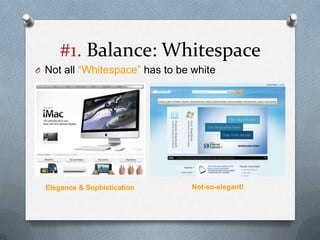
#1. Balance: Whitespace
O Not all “Whitespace” has to be white


  Elegance & Sophistication      Not-so-elegant!
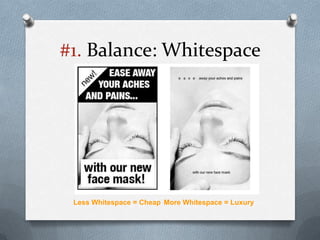
#1. Balance: Whitespace


 Less Whitespace = Cheap More Whitespace = Luxury
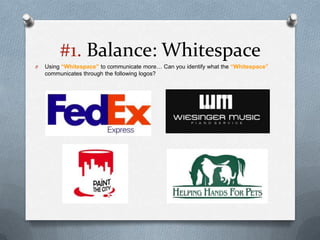
#1. Balance: Whitespace
O   Using “Whitespace” to communicate more… Can you identify what the “Whitespace”
    communicates through the following logos?
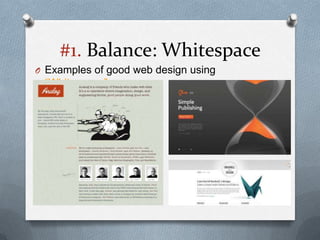
#1. Balance: Whitespace
O Examples of good web design using
 “Whitespace”
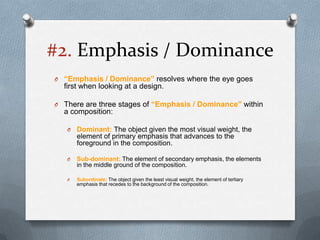
#2. Emphasis / Dominance
O “Emphasis / Dominance” resolves where the eye goes
  first when looking at a design.

O There are three stages of “Emphasis / Dominance” within
  a composition:

   O   Dominant: The object given the most visual weight, the
       element of primary emphasis that advances to the
       foreground in the composition.

   O   Sub-dominant: The element of secondary emphasis, the elements
       in the middle ground of the composition.

   O   Subordinate: The object given the least visual weight, the element of tertiary
       emphasis that recedes to the background of the composition.
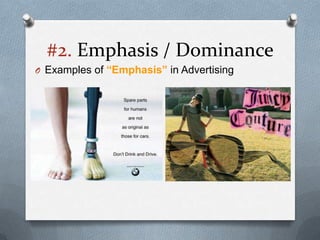
#2. Emphasis / Dominance
O Examples of “Emphasis” in Advertising
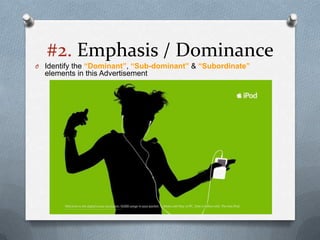
#2. Emphasis / Dominance
O Identify the “Dominant”, “Sub-dominant” & “Subordinate”
  elements in this Advertisement
#3. Contrast
O   “Contrast” occurs when two elements in a composition are different.

O   “Contrast” is NOT ONLY brought about using a stark difference in Color but
    other methods as well…For example:
     O   it could be different colors between the text and the background color.
     O   It could be a heading set in a big, bold, grungy font combined with a sans-serif
         font for the body text.
     O   It could be a difference between a large graphic and a small graphic or
     O   it could be a rough texture combined with a smooth texture.

O   Our eyes like contrast.

O   The important thing about “Contrast” is that the elements should be
    completely different. Not just a little bit different.
#3. Contrast
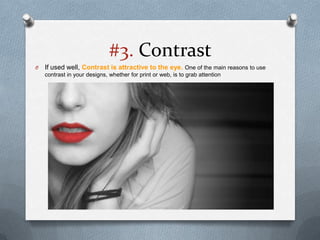
O   If used well, Contrast is attractive to the eye. One of the main reasons to use
    contrast in your designs, whether for print or web, is to grab attention
#3. Contrast
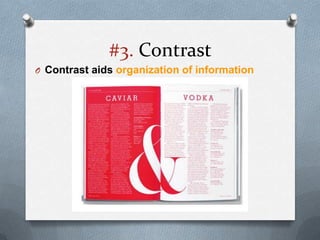
O Contrast aids organization of information
#3. Contrast
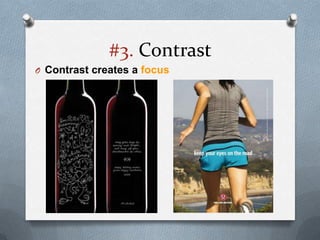
O Contrast creates a focus
#3. Contrast: Using Colors


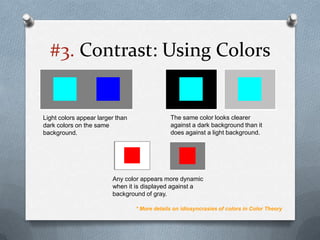
Light colors appear larger than                The same color looks clearer
dark colors on the same                        against a dark background than it
background.                                    does against a light background.


                         Any color appears more dynamic
                         when it is displayed against a
                         background of gray.

                                  * More details on idiosyncrasies of colors in Color Theory
#3. Contrast
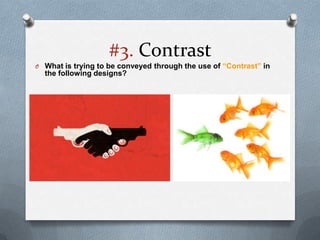
O What is trying to be conveyed through the use of “Contrast” in
  the following designs?
#4. Proximity
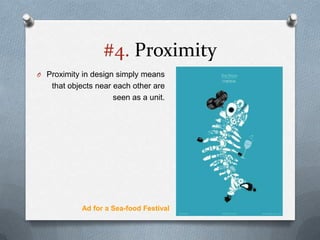
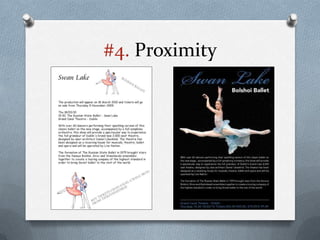
O Proximity in design simply means
   that objects near each other are
                     seen as a unit.


           Ad for a Sea-food Festival
#4. Proximity
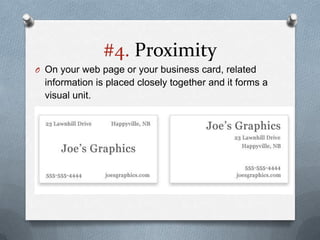
O On your web page or your business card, related
  information is placed closely together and it forms a
  visual unit.
#4. Proximity
#4. Proximity: Beware of the “Gestalt”
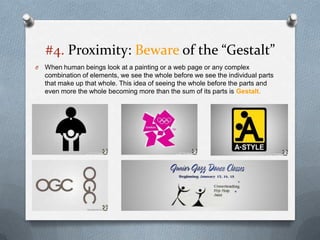
O   When human beings look at a painting or a web page or any complex
    combination of elements, we see the whole before we see the individual parts
    that make up that whole. This idea of seeing the whole before the parts and
    even more the whole becoming more than the sum of its parts is Gestalt.
#5. Rhythm, Repetition & Movement
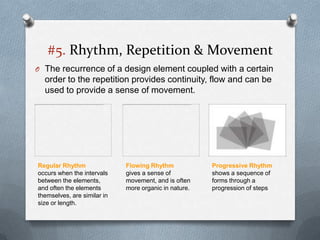
O The recurrence of a design element coupled with a certain
  order to the repetition provides continuity, flow and can be
  used to provide a sense of movement.


Regular Rhythm               Flowing Rhythm            Progressive Rhythm
occurs when the intervals    gives a sense of          shows a sequence of
between the elements,        movement, and is often    forms through a
and often the elements       more organic in nature.   progression of steps
themselves, are similar in
size or length.
#5. Rhythm, Repetition & Movement
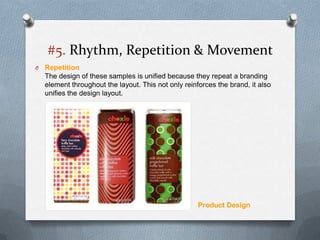
O   Repetition
    The design of these samples is unified because they repeat a branding
    element throughout the layout. This not only reinforces the brand, it also
    unifies the design layout.


                                                      Product Design
#5. Rhythm, Repetition & Movement
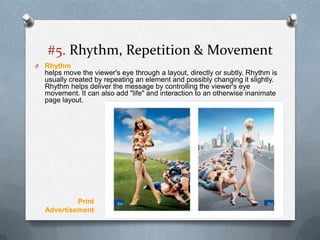
O   Rhythm
    helps move the viewer's eye through a layout, directly or subtly. Rhythm is
    usually created by repeating an element and possibly changing it slightly.
    Rhythm helps deliver the message by controlling the viewer's eye
    movement. It can also add "life" and interaction to an otherwise inanimate
    page layout.


             Print
    Advertisement
#5. Rhythm, Repetition & Movement
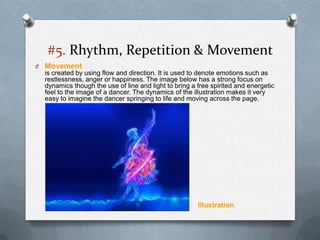
O Movement
  is created by using flow and direction. It is used to denote emotions such as
  restlessness, anger or happiness. The image below has a strong focus on
  dynamics though the use of line and light to bring a free spirited and energetic
  feel to the image of a dancer. The dynamics of the illustration makes it very
  easy to imagine the dancer springing to life and moving across the page.


                                                       Illustration
#5. Rhythm, Repetition & Movement
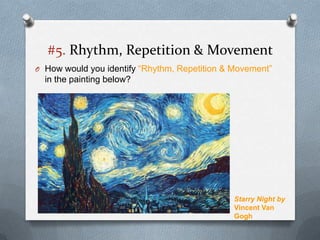
O How would you identify “Rhythm, Repetition & Movement”
  in the painting below?


                                               Starry Night by
                                               Vincent Van
                                               Gogh
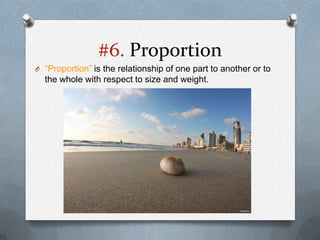
#6. Proportion
O “Proportion” is the relationship of one part to another or to
  the whole with respect to size and weight.
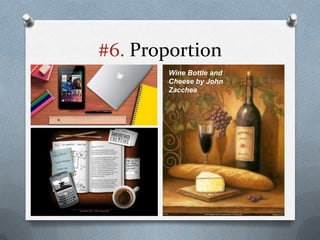
#6. Proportion
       Wine Bottle and
       Cheese by John
       Zacchea
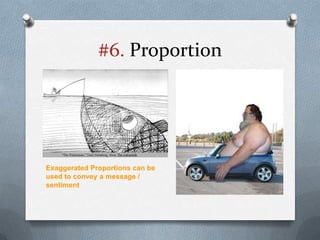
#6. Proportion


Exaggerated Proportions can be
used to convey a message /
sentiment
#7. Harmony
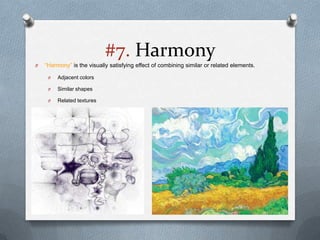
O   “Harmony” is the visually satisfying effect of combining similar or related elements.

     O   Adjacent colors

     O   Similar shapes

     O   Related textures
#7. Harmony
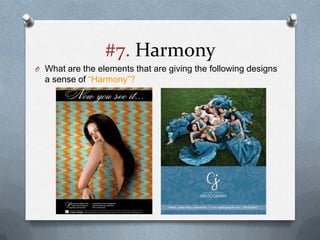
O What are the elements that are giving the following designs
  a sense of “Harmony”?
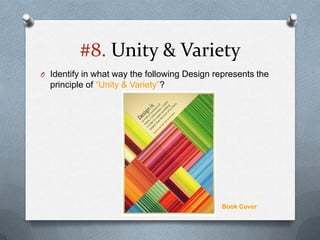
#8. Unity & Variety
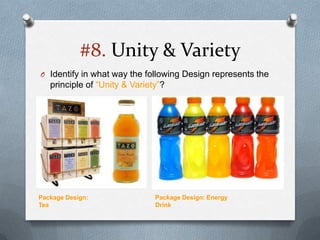
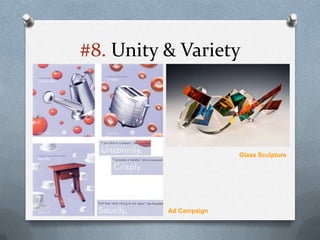
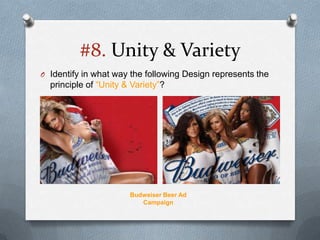
O   “Unity” and “Variety” are complementary concerns.

O   “Unity” is the appearance or condition of oneness. In design, unity
    describes the feeling that all the elements in a work belong together and
    make up a coherent and harmonious whole. When a work of art has unity,
    we feel that any change would diminish its quality.

O   “Variety”, on the other hand, provides diversity. Variety acts to counter
    unity. The sameness of too much unity is boring, and the diversity of
    uncontrolled variety is chaotic, but a balance between unity and variety
    creates life.
#8. Unity & Variety


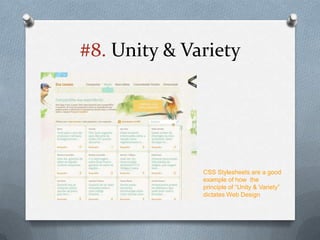
              CSS Stylesheets are a good
              example of how the
              principle of “Unity & Variety”
              dictates Web Design
#8. Unity & Variety
O Identify in what way the following Design represents the
  principle of “Unity & Variety”?


                                              Book Cover
#8. Unity & Variety
O Identify in what way the following Design represents the
   principle of “Unity & Variety”?


Package Design:                Package Design: Energy
Tea                            Drink
#8. Unity & Variety


                        Glass Sculpture


          Ad Campaign
#8. Unity & Variety
O Identify in what way the following Design represents the
  principle of “Unity & Variety”?


                       Budweiser Beer Ad
                          Campaign
Assignment
O Create an artwork which represents at least          5
  principles of Design discussed in this
  presentation

   O Choose from projects listed below:

       O Ad campaign (series of 3 or more Print Ads)
       O Package Design (at least a series of 3 different
         packaging samples)
       O Brochure Design (for a luxury or consumer brand)
       O Web Design (for a luxury or consumer brand)


* Final Date for submitting this assignment is the 31st of
March 2013

Design Principles

  • 1.
    Design Principles - Kabir Malkani * This presentation has been compiled from references available from the Internet. This is meant purely for educational purposes and the presenter does not claim to hold any ownership whatsoever; of the content (textual or graphical) included in this presentation. The ownership and copyrights of the following content belong to the respective brands /agencies / artists showcased in this presentation.
  • 2.
    Topics Covered O Through this presentation we will learn about the: O Elements of Design O The 8 Principles of Design O Balance O Optical Center O Types of Balance O Rule of Thirds O Whitespace O Emphasis / Dominance O Contrast O Proximity O Rhythm, Repetition & Movement O Proportion O Harmony O Unity & Variety
  • 3.
    The Elements ofDesign Line Direction Shape Size Color Value / Tone Texture A combination of these elements of Design results in what we call a “Composition” in traditional art. For graphic design there are additional elements such as “Type” & “Graphic” which is needed to create a “Composition” or “Artwork” – whether you are designing for Print, Web or Mobile.
  • 4.
    The 8 Principlesof Design 1. Balance 2. Emphasis / Dominance 3. Contrast 4. Proximity 5. Rhythm, Repetition & Movement 6. Proportion 7. Harmony 8. Unity & Variety
  • 5.
    #1. Balance: OpticalCenter O To understand the concept of Balance we must understand the term “Optical Center” Geometrically Centered Optically Centered
  • 6.
    #1. Balance: Typesof Balance "Balance" can be achieved through either: O Symmetric balance - Equal weights in all directions from optical center. It produces a stable, calming effect O Asymmetric balance - Heavier elements near the center are balanced by lighter elements farther away O Radial Balance - where all elements radiate out from a center point in a circular fashion. It is very easy to maintain a focal point in radial balance, since all the elements lead your eye toward the center.
  • 7.
    #1. Balance: Symmetry OExamples of “Symmetrical Balance”: Web Design Traditional Art 7
  • 8.
    #1. Balance: Asymmetry OExamples of “Asymmetrical Balance”: Web Design Photography 8
  • 9.
    #1. Balance: RadialSymmetry O Examples of “Radial Balance”: Architecture Photography 9
  • 10.
    #1. Balance O Identifythe types of “Balance” in the following designs:
  • 11.
    #1. Balance O Identifythe types of “Balance” in the following designs:
  • 12.
  • 13.
    #1. Balance: Ruleof Thirds Photography
  • 14.
    #1. Balance: Ruleof Thirds Magazine Cover Design
  • 15.
    #1. Balance: Whitespace O“Whitespace” or “Negative Space” is the space between elements in a composition. Macro whitespace Micro whitespace
  • 16.
    #1. Balance: Whitespace Nowhitespace Active Whitespace Passive Whitespace
  • 17.
    #1. Balance: Whitespace ONot all “Whitespace” has to be white Elegance & Sophistication Not-so-elegant!
  • 18.
    #1. Balance: Whitespace Less Whitespace = Cheap More Whitespace = Luxury
  • 19.
    #1. Balance: Whitespace O Using “Whitespace” to communicate more… Can you identify what the “Whitespace” communicates through the following logos?
  • 20.
    #1. Balance: Whitespace OExamples of good web design using “Whitespace”
  • 21.
    #2. Emphasis /Dominance O “Emphasis / Dominance” resolves where the eye goes first when looking at a design. O There are three stages of “Emphasis / Dominance” within a composition: O Dominant: The object given the most visual weight, the element of primary emphasis that advances to the foreground in the composition. O Sub-dominant: The element of secondary emphasis, the elements in the middle ground of the composition. O Subordinate: The object given the least visual weight, the element of tertiary emphasis that recedes to the background of the composition.
  • 22.
    #2. Emphasis /Dominance O Examples of “Emphasis” in Advertising
  • 23.
    #2. Emphasis /Dominance O Identify the “Dominant”, “Sub-dominant” & “Subordinate” elements in this Advertisement
  • 24.
    #3. Contrast O “Contrast” occurs when two elements in a composition are different. O “Contrast” is NOT ONLY brought about using a stark difference in Color but other methods as well…For example: O it could be different colors between the text and the background color. O It could be a heading set in a big, bold, grungy font combined with a sans-serif font for the body text. O It could be a difference between a large graphic and a small graphic or O it could be a rough texture combined with a smooth texture. O Our eyes like contrast. O The important thing about “Contrast” is that the elements should be completely different. Not just a little bit different.
  • 25.
    #3. Contrast O If used well, Contrast is attractive to the eye. One of the main reasons to use contrast in your designs, whether for print or web, is to grab attention
  • 26.
    #3. Contrast O Contrastaids organization of information
  • 27.
    #3. Contrast O Contrastcreates a focus
  • 28.
    #3. Contrast: UsingColors Light colors appear larger than The same color looks clearer dark colors on the same against a dark background than it background. does against a light background. Any color appears more dynamic when it is displayed against a background of gray. * More details on idiosyncrasies of colors in Color Theory
  • 29.
    #3. Contrast O Whatis trying to be conveyed through the use of “Contrast” in the following designs?
  • 30.
    #4. Proximity O Proximityin design simply means that objects near each other are seen as a unit. Ad for a Sea-food Festival
  • 31.
    #4. Proximity O Onyour web page or your business card, related information is placed closely together and it forms a visual unit.
  • 32.
  • 33.
    #4. Proximity: Bewareof the “Gestalt” O When human beings look at a painting or a web page or any complex combination of elements, we see the whole before we see the individual parts that make up that whole. This idea of seeing the whole before the parts and even more the whole becoming more than the sum of its parts is Gestalt.
  • 34.
    #5. Rhythm, Repetition& Movement O The recurrence of a design element coupled with a certain order to the repetition provides continuity, flow and can be used to provide a sense of movement. Regular Rhythm Flowing Rhythm Progressive Rhythm occurs when the intervals gives a sense of shows a sequence of between the elements, movement, and is often forms through a and often the elements more organic in nature. progression of steps themselves, are similar in size or length.
  • 35.
    #5. Rhythm, Repetition& Movement O Repetition The design of these samples is unified because they repeat a branding element throughout the layout. This not only reinforces the brand, it also unifies the design layout. Product Design
  • 36.
    #5. Rhythm, Repetition& Movement O Rhythm helps move the viewer's eye through a layout, directly or subtly. Rhythm is usually created by repeating an element and possibly changing it slightly. Rhythm helps deliver the message by controlling the viewer's eye movement. It can also add "life" and interaction to an otherwise inanimate page layout. Print Advertisement
  • 37.
    #5. Rhythm, Repetition& Movement O Movement is created by using flow and direction. It is used to denote emotions such as restlessness, anger or happiness. The image below has a strong focus on dynamics though the use of line and light to bring a free spirited and energetic feel to the image of a dancer. The dynamics of the illustration makes it very easy to imagine the dancer springing to life and moving across the page. Illustration
  • 38.
    #5. Rhythm, Repetition& Movement O How would you identify “Rhythm, Repetition & Movement” in the painting below? Starry Night by Vincent Van Gogh
  • 39.
    #6. Proportion O “Proportion”is the relationship of one part to another or to the whole with respect to size and weight.
  • 40.
    #6. Proportion Wine Bottle and Cheese by John Zacchea
  • 41.
    #6. Proportion Exaggerated Proportionscan be used to convey a message / sentiment
  • 42.
    #7. Harmony O “Harmony” is the visually satisfying effect of combining similar or related elements. O Adjacent colors O Similar shapes O Related textures
  • 43.
    #7. Harmony O Whatare the elements that are giving the following designs a sense of “Harmony”?
  • 44.
    #8. Unity &Variety O “Unity” and “Variety” are complementary concerns. O “Unity” is the appearance or condition of oneness. In design, unity describes the feeling that all the elements in a work belong together and make up a coherent and harmonious whole. When a work of art has unity, we feel that any change would diminish its quality. O “Variety”, on the other hand, provides diversity. Variety acts to counter unity. The sameness of too much unity is boring, and the diversity of uncontrolled variety is chaotic, but a balance between unity and variety creates life.
  • 45.
    #8. Unity &Variety CSS Stylesheets are a good example of how the principle of “Unity & Variety” dictates Web Design
  • 46.
    #8. Unity &Variety O Identify in what way the following Design represents the principle of “Unity & Variety”? Book Cover
  • 47.
    #8. Unity &Variety O Identify in what way the following Design represents the principle of “Unity & Variety”? Package Design: Package Design: Energy Tea Drink
  • 48.
    #8. Unity &Variety Glass Sculpture Ad Campaign
  • 49.
    #8. Unity &Variety O Identify in what way the following Design represents the principle of “Unity & Variety”? Budweiser Beer Ad Campaign
  • 50.
    Assignment O Create anartwork which represents at least 5 principles of Design discussed in this presentation O Choose from projects listed below: O Ad campaign (series of 3 or more Print Ads) O Package Design (at least a series of 3 different packaging samples) O Brochure Design (for a luxury or consumer brand) O Web Design (for a luxury or consumer brand) * Final Date for submitting this assignment is the 31st of March 2013