Organization of
  Visual Arts
 Principles of Design

            Prepared By :
              Santos, Mercy Amor T.
              David, Djoanna
Organization of Visual Arts

• Composition
   An orderly arrangement of
  elements using the principles of
  design.
Elements of Visual Arts
The elements are components or
parts which can be isolated and
defined in any visual design or
work of art. They are the structure
of the work, and can carry a wide
variety of messages.
POINT
–The line or shape basis.
LINES
– is a mark on a surface that
 describes a shape or outline.
– has a psychological impact
 according to its
 direction, weight, and the
 variations in its direction and
 weight.
Types of Line
• Horizontal Line
  – A line which is paralleled to the horizon or on
    the Earth’s surface.
  – suggests a feeling of rest or repose.
Types of Line
• Vertical Line
  – A straight line goes from top to bottom.
  – communicate a feeling of loftiness and
    spirituality.
  – Also imply that our body is
    stiff, dignified, formal or still.
Types of Line
• Diagonal Line
  – A line having a slanted or oblique direction.
  – Suggests a feeling of movement or direction.
  – Most active line.
Types of Line
• Curved Line
  – A line which is not straight.
  – Suggests comfort, safety, familiarity, relaxatio
    n.
Types of Line
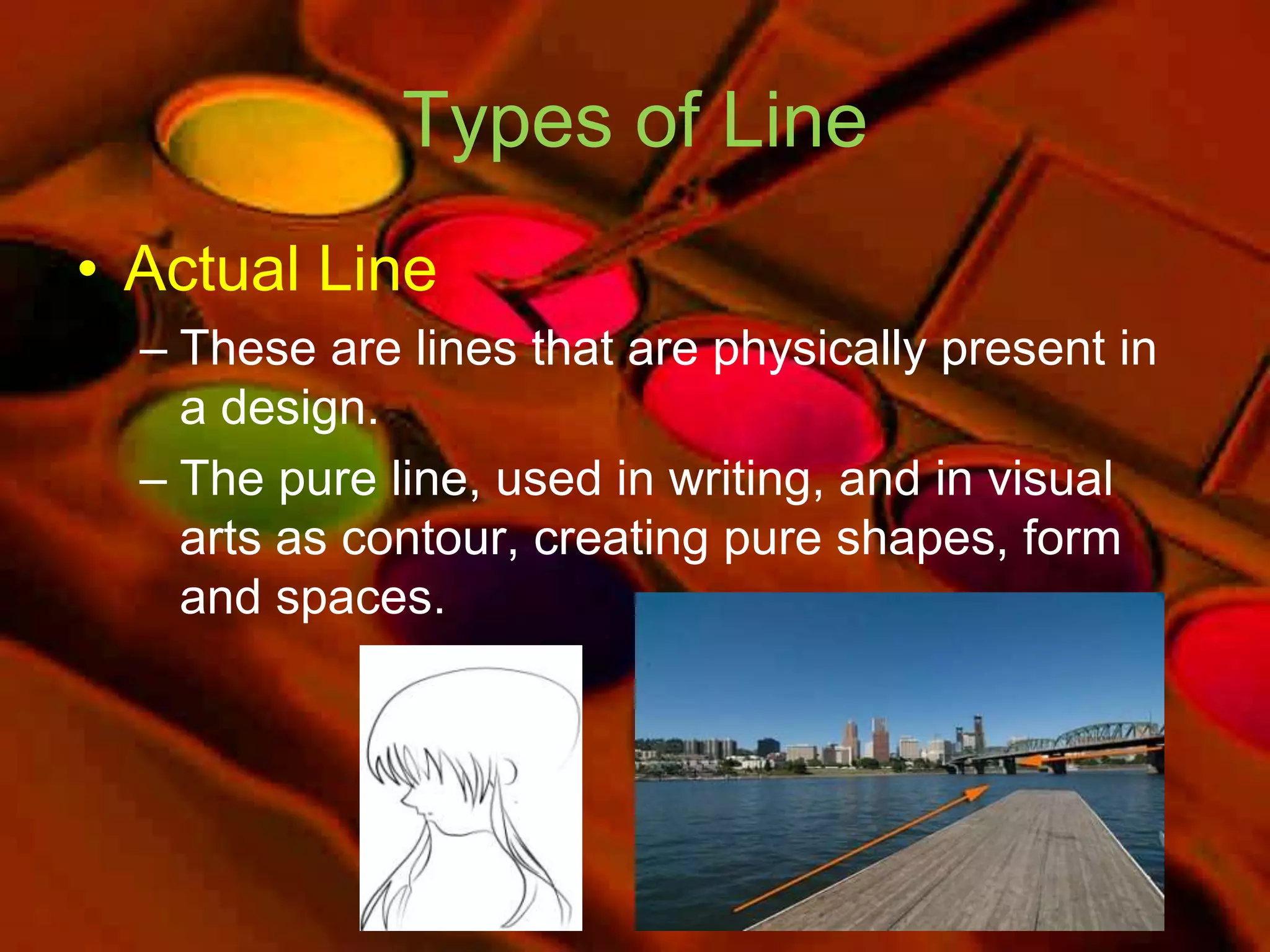
• Actual Line
  – These are lines that are physically present in
    a design.
  – The pure line, used in writing, and in visual
    arts as contour, creating pure shapes, form
    and spaces.
Types of Line
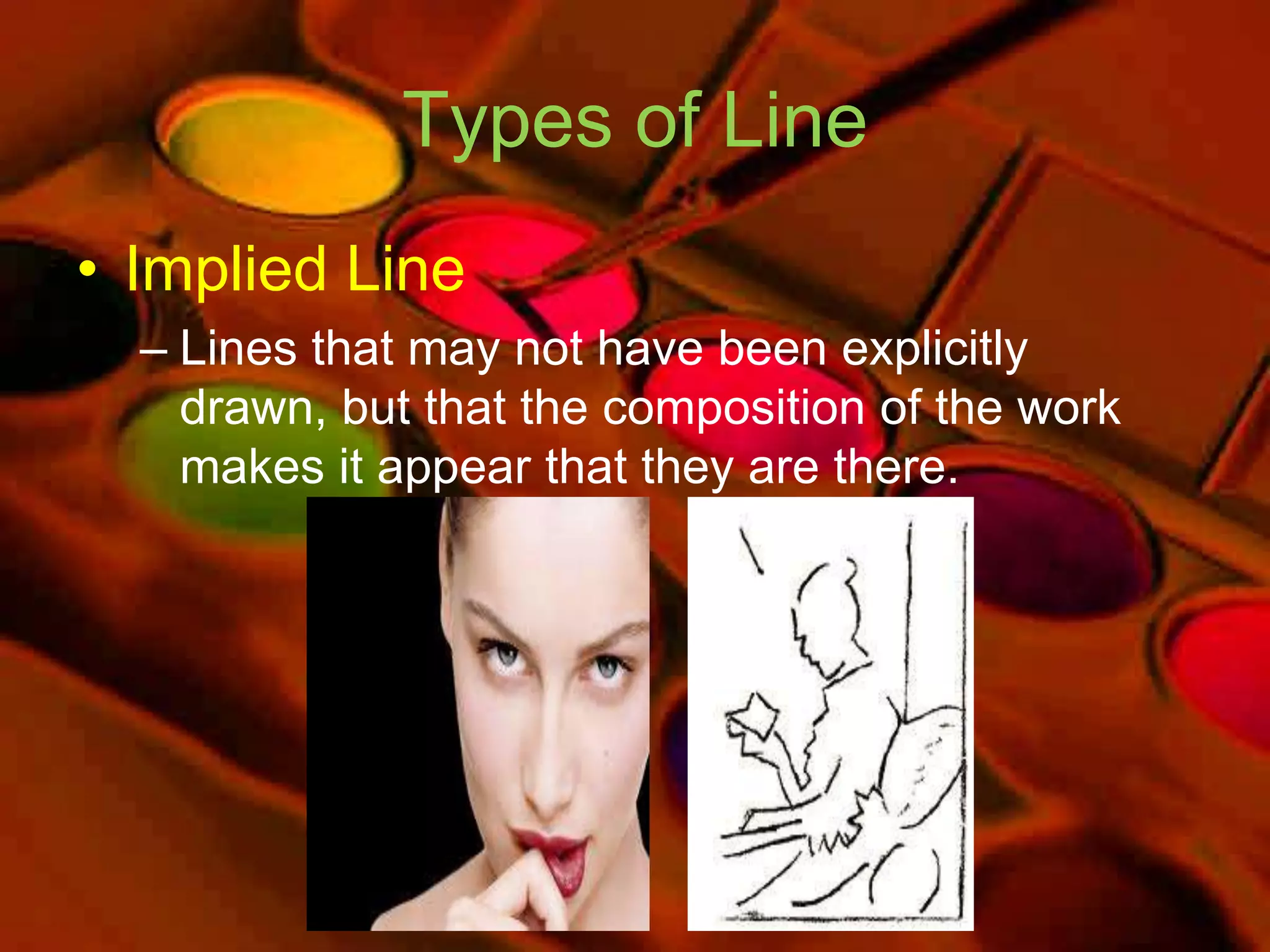
• Implied Line
  – Lines that may not have been explicitly
    drawn, but that the composition of the work
    makes it appear that they are there.
Types of Line
• Contour Line
  – It’s an outline.
  – A line that defines or bounds anything --
    defines its edge.
SHAPE/FORM
– Are formed from lines.
– Can be classified as two or
 three dimensional lines.
Categories of Shape
• Organic forms
  – are irregular in outline, and often
    asymmetrical.
  – are most often thought of as naturally
    occurring.
Categories of Shape
• Geometric forms
  – are those which correspond to named regular
    shapes, such as
    squares, rectangles, circles, cubes, spheres,
    cones, and other regular forms.
SPACE
–Where shapes/forms are
 implied.
– It can distract, focus, or alter
 our impression about the
 object.
COLOR
– is one of the most powerful
 of elements.
–It has tremendous
 expressive qualities.
–is the visual perceptual
 property corresponding
 in humans.
Dimensions of Color
• Hue
 – The name of the color, such as red, green or
   blue.
 – It indicates the color’s position on the color
   wheel.
Dimensions of Color
• Value
  – Defined as the relative lightness or darkness
    of a color.
  – It is an important tool for the designer/artist, in
    the way that it defines form and creates
    spatial illusions.
  – It is the contrast between black and white
    and all the tones in between.
Dimensions of Color
• Intensity or saturation
  – is the brightness of a color
Psychological Implications of Color

• Red
 – is associated with blood, and with feelings
   that are energetic, exciting, passionate or
   erotic.
Psychological Implications of Color

• Orange
 – is the color of flesh, or the friendly warmth of
   the hearth fire.
Psychological Implications of Color

• Yellow
  – is the color of sunshine. This color is
    optimistic, upbeat, modern.
Psychological Implications of Color

• Green
 – Suggests nature (plant
   life, forests), life, stability, restfulness, naturaln
   ess.
Psychological Implications of Color

• Blue
  – suggests coolness, distance, spirituality, or
    perhaps reserved elegance.
Psychological Implications of Color

• Violet
  – is the color of
    fantasy, playfulness, impulsiveness, and
    dream states.
MOVEMENT
– is the process of relocation
 of objects in space over time.
–We can speak of movement
 as; literal or compositional.
MOVEMENT
• Literal movement
 – is signaled by symbolic forms that suggest
   speed and motion.
MOVEMENT
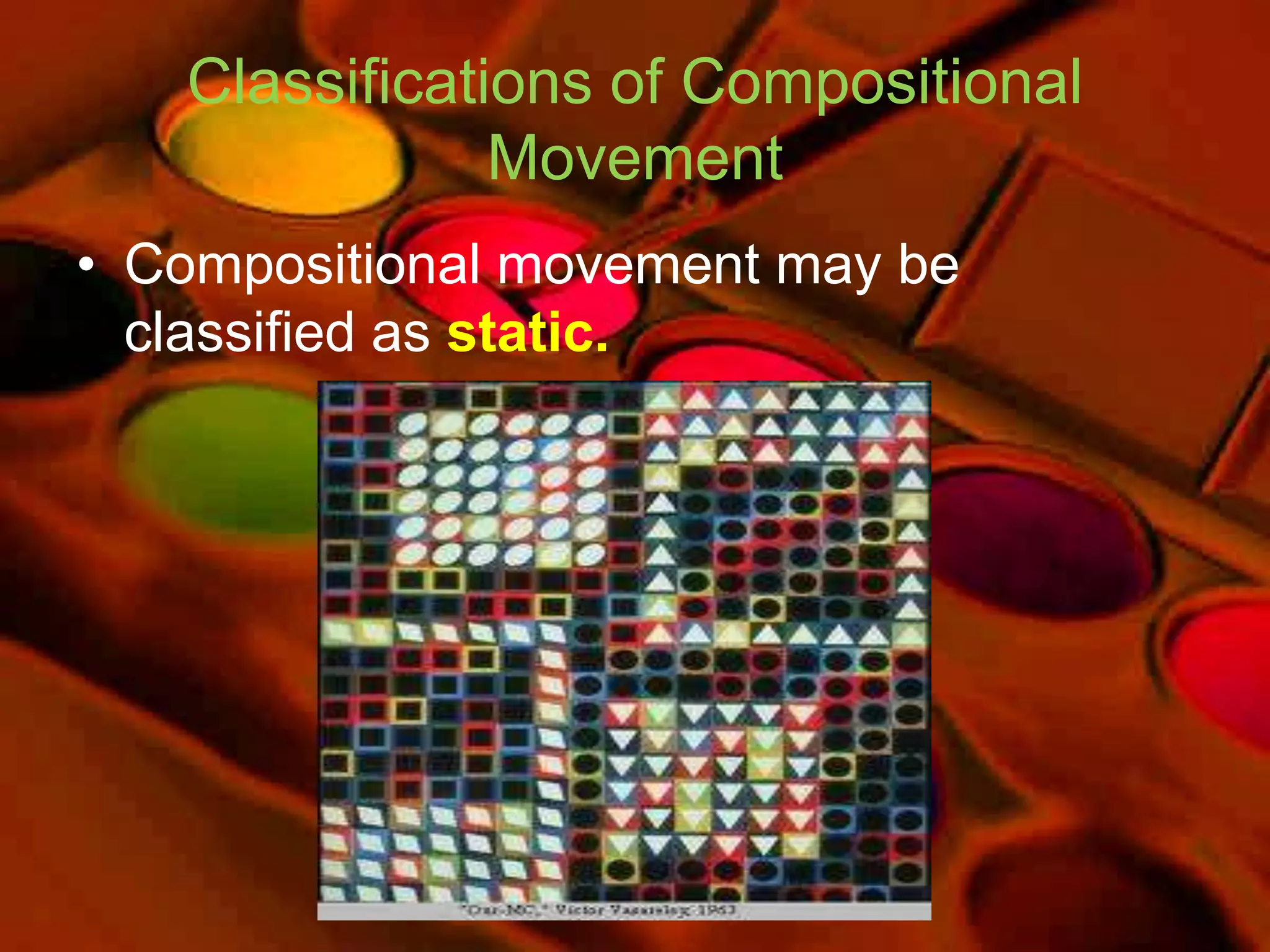
• Compositional movement
 – It consider how the viewer's eye moves
   through the composition.
 – How the components relate and lead the
   viewer's attention.
Classifications of Compositional
               Movement
• Compositional movement may be
  classified as static.
Classifications of Compositional
                Movement
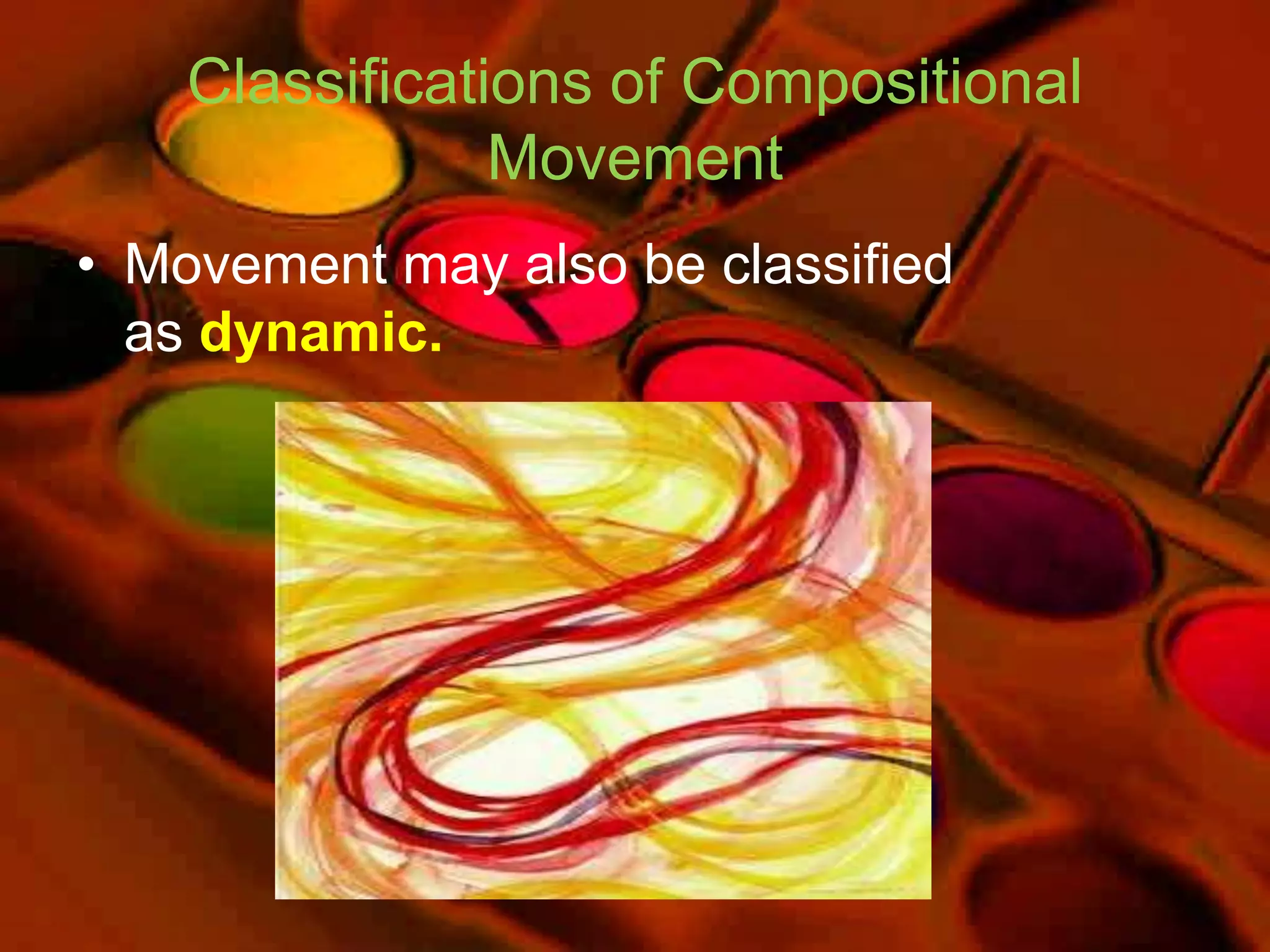
• Movement may also be classified
  as dynamic.
TEXTURE
– It is the quality of an object
 which we sense through
 touch.
SIZE
– relative magnitude of an
 object.
– refers to variations in the
 proportions of objects, lines
 or shapes.
SIZE
• Size Variation
  – Notice how size can effect how close or far
    something can appear to be from the viewer.
Principles of Design
• The principles of design are the recipe
  for a good work of art. The principles
  combine the elements to create an
  aesthetic placement of things that will
  produce a good design.
• The Principles of Design are concepts
  used to organize or arrange the structural
  elements of design.
Balance
– is a feeling of visual equality
 in
 shape, form, value, color, etc
 .
– It is a way to compare the
 right and left side of a
 composition.
Two ways of Balance

• Symmetrical or Formal Balance
  – When the elements are arranged equally on
    either side of a central axis.
Two ways of Balance

• Asymmetrical or Informal Balance
  – there are no mirror images in a composition.
Proportion
– refers to the relative size and
 scale of the various elements in
 a design.
Rhythm
– is a movement in which some
 elements recurs regularly.
– described as timed movement
 through space.
Rhythm may occur through:

• Repetition
  – involves the use of patterning to achieve
    timed movement and a visual "beat".
Rhythm may occur through:

• Alternation
  – is a specific instance of patterning in which a
    sequence of repeating motifs are presented in
    turn.
Rhythm may occur through:

• Gradation
  – employs a series of motifs patterned to relate
    to one another through a regular progression
    of steps.
Emphasis
– is the center of interest.
– is also referred to as point of
 focus, or interruption.
Emphasis can be achieved through :

• Repetition
  – creates emphasis by calling attention to the
    repeated element through sheer force of
    numbers.
Emphasis can be achieved through :

• Contrast
   achieves emphasis by setting the point of
   emphasis apart from the rest of its
   background.
Emphasis can be achieved through :

• Contrast
   Contrast of color, texture, or shape will call
   attention to a specific point.
Emphasis can be achieved through :

• Contrast
    Contrast of size or scale as well.
Emphasis can be achieved through :

• Contrast
 Placement in a strategic position will call
 attention to a particular element of a
 design.
Unity
– It refers to the coherence of
 the whole.
– harmony of all the parts.
References :
• http://www.princetonol.com/groups/iad/files/elements2.htm
• http://char.txa.cornell.edu/language/element/element.htm
• http://char.txa.cornell.edu/language/principl/principl.htm
• http://www.studiocodex.com/lines01.html#
• http://deviantnep.blogspot.com/2008/02/line.html
• http://www.msuiit.edu.ph/ipag/studies/humanities/organization.html
• http://budgetdecorating.about.com/od/usingcolor/ss/color_wheel_9.h
  tm
• http://www.ncsu.edu/scivis/lessons/colormodels/color_models2.html
• http://www.goshen.edu/art/ed/Compose.htm#size
for
Listening!!
    ^_^

Organization of Visual Arts

  • 2.
    Organization of Visual Arts Principles of Design Prepared By : Santos, Mercy Amor T. David, Djoanna
  • 3.
    Organization of VisualArts • Composition An orderly arrangement of elements using the principles of design.
  • 4.
    Elements of VisualArts The elements are components or parts which can be isolated and defined in any visual design or work of art. They are the structure of the work, and can carry a wide variety of messages.
  • 5.
  • 6.
    LINES – is amark on a surface that describes a shape or outline. – has a psychological impact according to its direction, weight, and the variations in its direction and weight.
  • 7.
    Types of Line •Horizontal Line – A line which is paralleled to the horizon or on the Earth’s surface. – suggests a feeling of rest or repose.
  • 8.
    Types of Line •Vertical Line – A straight line goes from top to bottom. – communicate a feeling of loftiness and spirituality. – Also imply that our body is stiff, dignified, formal or still.
  • 10.
    Types of Line •Diagonal Line – A line having a slanted or oblique direction. – Suggests a feeling of movement or direction. – Most active line.
  • 11.
    Types of Line •Curved Line – A line which is not straight. – Suggests comfort, safety, familiarity, relaxatio n.
  • 12.
    Types of Line •Actual Line – These are lines that are physically present in a design. – The pure line, used in writing, and in visual arts as contour, creating pure shapes, form and spaces.
  • 13.
    Types of Line •Implied Line – Lines that may not have been explicitly drawn, but that the composition of the work makes it appear that they are there.
  • 14.
    Types of Line •Contour Line – It’s an outline. – A line that defines or bounds anything -- defines its edge.
  • 15.
    SHAPE/FORM – Are formedfrom lines. – Can be classified as two or three dimensional lines.
  • 16.
    Categories of Shape •Organic forms – are irregular in outline, and often asymmetrical. – are most often thought of as naturally occurring.
  • 17.
    Categories of Shape •Geometric forms – are those which correspond to named regular shapes, such as squares, rectangles, circles, cubes, spheres, cones, and other regular forms.
  • 18.
    SPACE –Where shapes/forms are implied. – It can distract, focus, or alter our impression about the object.
  • 20.
    COLOR – is oneof the most powerful of elements. –It has tremendous expressive qualities. –is the visual perceptual property corresponding in humans.
  • 21.
    Dimensions of Color •Hue – The name of the color, such as red, green or blue. – It indicates the color’s position on the color wheel.
  • 22.
    Dimensions of Color •Value – Defined as the relative lightness or darkness of a color. – It is an important tool for the designer/artist, in the way that it defines form and creates spatial illusions. – It is the contrast between black and white and all the tones in between.
  • 24.
    Dimensions of Color •Intensity or saturation – is the brightness of a color
  • 26.
    Psychological Implications ofColor • Red – is associated with blood, and with feelings that are energetic, exciting, passionate or erotic.
  • 27.
    Psychological Implications ofColor • Orange – is the color of flesh, or the friendly warmth of the hearth fire.
  • 28.
    Psychological Implications ofColor • Yellow – is the color of sunshine. This color is optimistic, upbeat, modern.
  • 29.
    Psychological Implications ofColor • Green – Suggests nature (plant life, forests), life, stability, restfulness, naturaln ess.
  • 30.
    Psychological Implications ofColor • Blue – suggests coolness, distance, spirituality, or perhaps reserved elegance.
  • 31.
    Psychological Implications ofColor • Violet – is the color of fantasy, playfulness, impulsiveness, and dream states.
  • 32.
    MOVEMENT – is theprocess of relocation of objects in space over time. –We can speak of movement as; literal or compositional.
  • 33.
    MOVEMENT • Literal movement – is signaled by symbolic forms that suggest speed and motion.
  • 34.
    MOVEMENT • Compositional movement – It consider how the viewer's eye moves through the composition. – How the components relate and lead the viewer's attention.
  • 35.
    Classifications of Compositional Movement • Compositional movement may be classified as static.
  • 36.
    Classifications of Compositional Movement • Movement may also be classified as dynamic.
  • 37.
    TEXTURE – It isthe quality of an object which we sense through touch.
  • 39.
    SIZE – relative magnitudeof an object. – refers to variations in the proportions of objects, lines or shapes.
  • 40.
    SIZE • Size Variation – Notice how size can effect how close or far something can appear to be from the viewer.
  • 41.
    Principles of Design •The principles of design are the recipe for a good work of art. The principles combine the elements to create an aesthetic placement of things that will produce a good design. • The Principles of Design are concepts used to organize or arrange the structural elements of design.
  • 42.
    Balance – is afeeling of visual equality in shape, form, value, color, etc . – It is a way to compare the right and left side of a composition.
  • 43.
    Two ways ofBalance • Symmetrical or Formal Balance – When the elements are arranged equally on either side of a central axis.
  • 44.
    Two ways ofBalance • Asymmetrical or Informal Balance – there are no mirror images in a composition.
  • 45.
    Proportion – refers tothe relative size and scale of the various elements in a design.
  • 47.
    Rhythm – is amovement in which some elements recurs regularly. – described as timed movement through space.
  • 48.
    Rhythm may occurthrough: • Repetition – involves the use of patterning to achieve timed movement and a visual "beat".
  • 49.
    Rhythm may occurthrough: • Alternation – is a specific instance of patterning in which a sequence of repeating motifs are presented in turn.
  • 50.
    Rhythm may occurthrough: • Gradation – employs a series of motifs patterned to relate to one another through a regular progression of steps.
  • 51.
    Emphasis – is thecenter of interest. – is also referred to as point of focus, or interruption.
  • 52.
    Emphasis can beachieved through : • Repetition – creates emphasis by calling attention to the repeated element through sheer force of numbers.
  • 53.
    Emphasis can beachieved through : • Contrast achieves emphasis by setting the point of emphasis apart from the rest of its background.
  • 54.
    Emphasis can beachieved through : • Contrast Contrast of color, texture, or shape will call attention to a specific point.
  • 55.
    Emphasis can beachieved through : • Contrast Contrast of size or scale as well.
  • 56.
    Emphasis can beachieved through : • Contrast Placement in a strategic position will call attention to a particular element of a design.
  • 57.
    Unity – It refersto the coherence of the whole. – harmony of all the parts.
  • 59.
    References : • http://www.princetonol.com/groups/iad/files/elements2.htm •http://char.txa.cornell.edu/language/element/element.htm • http://char.txa.cornell.edu/language/principl/principl.htm • http://www.studiocodex.com/lines01.html# • http://deviantnep.blogspot.com/2008/02/line.html • http://www.msuiit.edu.ph/ipag/studies/humanities/organization.html • http://budgetdecorating.about.com/od/usingcolor/ss/color_wheel_9.h tm • http://www.ncsu.edu/scivis/lessons/colormodels/color_models2.html • http://www.goshen.edu/art/ed/Compose.htm#size
  • 60.