Course Abstract
Design Engineering – 2B (2160001) (6th
Semester)
Module 4: Building the Solution
Name of the Discipline & the Programme: Every discipline of the Engineering
Usual time of occurrence: 6th
Semester
Duration: Six (6) months
Course category: Core - Advance
Credits: 03
Examination Pattern: Only Practical/Viva exam at end of semester
Prerequisites: Design Engineering – 1A, Design Engineering – 1B, Design Engineering – 2A
Relevance
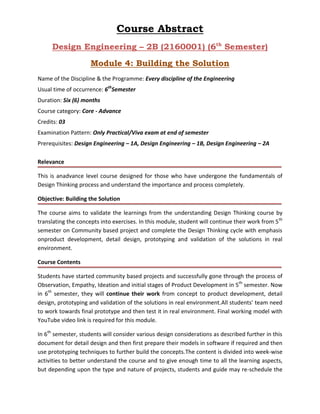
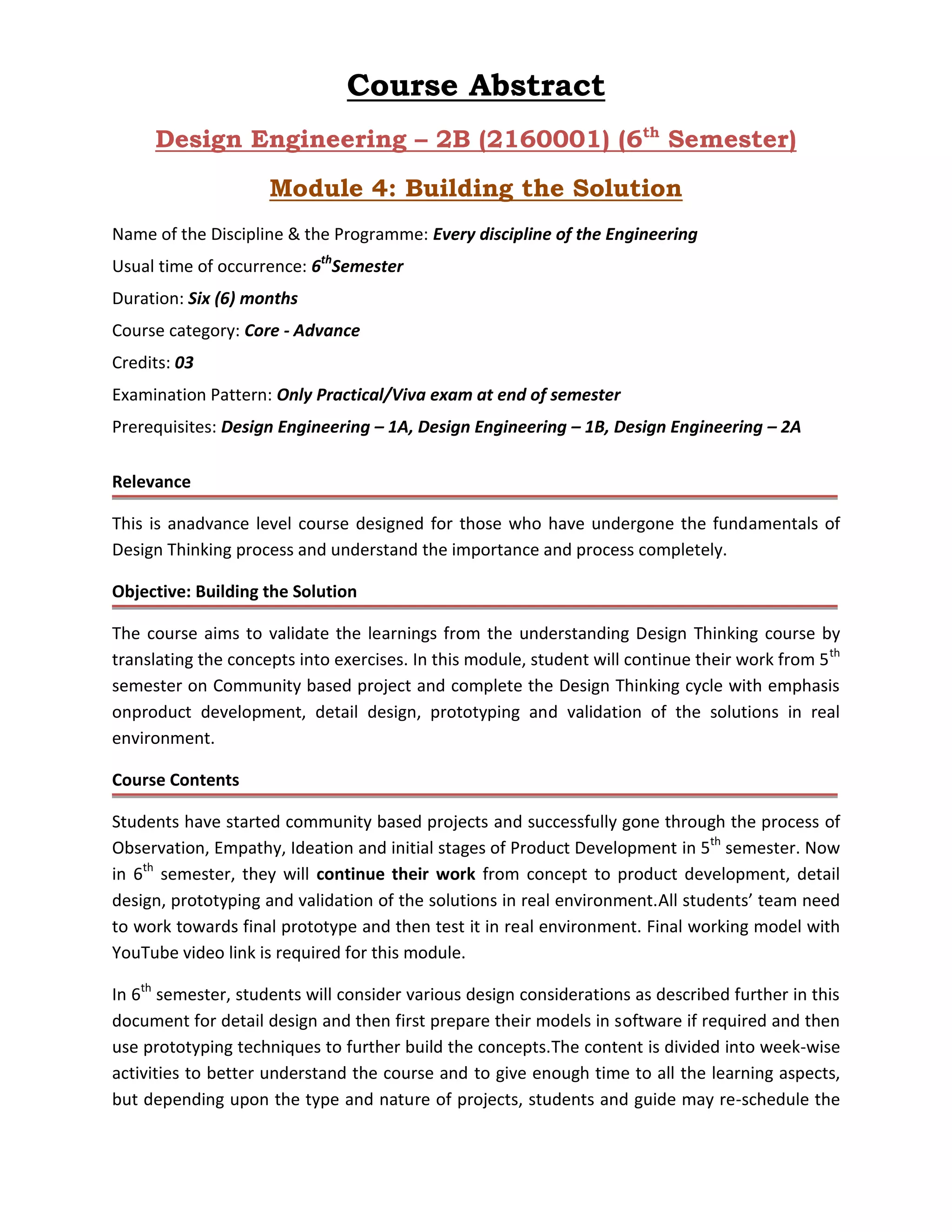
This is anadvance level course designed for those who have undergone the fundamentals of
Design Thinking process and understand the importance and process completely.
Objective: Building the Solution
The course aims to validate the learnings from the understanding Design Thinking course by
translating the concepts into exercises. In this module, student will continue their work from 5th
semester on Community based project and complete the Design Thinking cycle with emphasis
onproduct development, detail design, prototyping and validation of the solutions in real
environment.
Course Contents
Students have started community based projects and successfully gone through the process of
Observation, Empathy, Ideation and initial stages of Product Development in 5th
semester. Now
in 6th
semester, they will continue their work from concept to product development, detail
design, prototyping and validation of the solutions in real environment.All students’ team need
to work towards final prototype and then test it in real environment. Final working model with
YouTube video link is required for this module.
In 6th
semester, students will consider various design considerations as described further in this
document for detail design and then first prepare their models in software if required and then
use prototyping techniques to further build the concepts.The content is divided into week-wise
activities to better understand the course and to give enough time to all the learning aspects,
but depending upon the type and nature of projects, students and guide may re-schedule the
Post-graduate Research Centre for Industrial Design
OPEN DESIGN SCHOOL
Learning Design Thinking at Gujarat Technological University Page 2
For any query, kindly write to: design@gtu.edu.in
activities. Students in 6th
semester need to follow below week-wise activities to complete the
course requirement for 6th
semester.
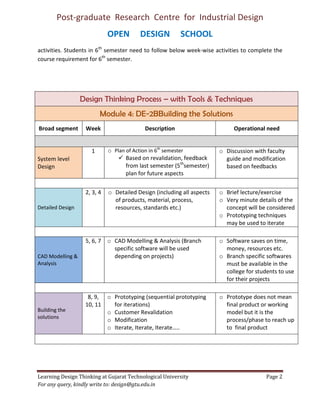
Design Thinking Process – with Tools & Techniques
Module 4: DE-2BBuilding the Solutions
Broad segment Week Description Operational need
System level
Design
1 o Plan of Action in 6th
semester
 Based on revalidation, feedback
from last semester (5th
semester)
plan for future aspects
o Discussion with faculty
guide and modification
based on feedbacks
Detailed Design
2, 3, 4 o Detailed Design (including all aspects
of products, material, process,
resources, standards etc.)
o Brief lecture/exercise
o Very minute details of the
concept will be considered
o Prototyping techniques
may be used to iterate
CAD Modelling &
Analysis
5, 6, 7 o CAD Modelling & Analysis (Branch
specific software will be used
depending on projects)
o Software saves on time,
money, resources etc.
o Branch specific softwares
must be available in the
college for students to use
for their projects
Building the
solutions
8, 9,
10, 11
o Prototyping (sequential prototyping
for iterations)
o Customer Revalidation
o Modification
o Iterate, Iterate, Iterate…..
o Prototype does not mean
final product or working
model but it is the
process/phase to reach up
to final product
Post-graduate Research Centre for Industrial Design
OPEN DESIGN SCHOOL
Learning Design Thinking at Gujarat Technological University Page 3
For any query, kindly write to: design@gtu.edu.in
In the 6th
semester, student’s team will validate their concept and detailed design part with
reference to (1) Design for performance, safety and reliability, (2) Design for Ergonomics and
Aesthetics, (3) Design for Manufacturing & Assembly (DFMA), (4) Design for cost &
Environment, (5) Modelling and Analysis of their design (6) Prototyping (7) Engineering
Economics of Design, (8) Design for Use, Reuse and Sustainability and (9) Test the prototype.
And additionally students will also learn topic like (10) Ethics in Design.
Following aspects should be taken into account while developing product.
1. Design for Performance, Safety and Reliability:
 Design for performance:The final product/process must perform for designed (projected
in Product Development Canvas - PDC) features and functions as per the requirement of
the user in actual working environment (revealed through rough-prototype validation).
 Design for Safety:Safety is the most important aspect of human centric product/process.
Reasonable factor of safety should be taken into account considering all adverse and
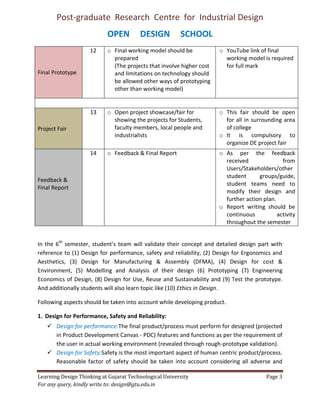
Final Prototype
12 o Final working model should be
prepared
(The projects that involve higher cost
and limitations on technology should
be allowed other ways of prototyping
other than working model)
o YouTube link of final
working model is required
for full mark
Project Fair
13 o Open project showcase/fair for
showing the projects for Students,
faculty members, local people and
industrialists
o This fair should be open
for all in surrounding area
of college
o It is compulsory to
organize DE project fair
Feedback &
Final Report
14 o Feedback & Final Report o As per the feedback
received from
Users/Stakeholders/other
student groups/guide,
student teams need to
modify their design and
further action plan.
o Report writing should be
continuous activity
throughout the semester
Post-graduate Research Centre for Industrial Design
OPEN DESIGN SCHOOL
Learning Design Thinking at Gujarat Technological University Page 4
For any query, kindly write to: design@gtu.edu.in
factual factors (Ideation canvas – location/context/situation may be referred back here)
as there is human interaction with product/process in manifold circumstances.
 Design for Reliability: Reliability is the ability of a system or component to perform its
required functions under stated conditions for a specified period of time1
. Your final
product/process should be reliable as required by the user and should perform its
desired functions as required for desired time period.
2. Design for Ergonomics and Aesthetics:
 Ergonomics is all about designing for human factors/comforts wherever they interact
with product/process and surrounding environments. According to the International
Ergonomics Association within the discipline of ergonomics there exist domains of
specialization: (a) Physical Ergonomics – is concerned with the human anatomy, bio
mechanical and physiological ability and its relevance to the product and surrounding
systems; (b) Cognitive Ergonomics – is concerned with the mental ability such as
perception, memory, reasoning and response power as they affect the interactions
between humans and products/systems ; (c) Organizational Ergonomics – is concerned
with the optimization of socio-technical systems including organizational structures,
policies and processes.
 Aesthetics is all about designing for physical appearance (looks) of the product. In
current time, customers are willing to buy the products which have stunning looks with
respect to their competitive products. Design for Aesthetics includes appearance, style,
colour, form/shape, visuals and so on.
3. Design for Manufacturability & Assembly (DFMA)
 DFMA stands for two terms; DFM – Design for Manufacturabilitywhich means for ease
of manufacturing of parts/components of final product. DFA – Design for Assembly
which means manufactured parts can be easily assembled to form a final product.
DFMA approach helps to design and manufacture/construct the product easily and
economically. Designer must design components/parts that can be easily manufactured
with available resources at minimum cost of production and can be easily assembled by
assembly personnel. The intentions behind implementing DFMA practice in product
development is to minimize manufacturing and assembly cost, improve efficiency,
eliminate waste of material and time. Iteration on involved raw materials may be
performed to check available alternatives – as materials play a major role in production
cost. Basic guidelines may be followed as below:
1
Definition by IEEE.
Post-graduate Research Centre for Industrial Design
OPEN DESIGN SCHOOL
Learning Design Thinking at Gujarat Technological University Page 5
For any query, kindly write to: design@gtu.edu.in
 Check for alternative and compatible raw materials (Refer/ revise to LNM)
 Minimize the number of parts (Refer/ revise to PDC)
 Develop a modular design
 Design parts to be multi-functional
 Design parts for multiple-use
 Design for ease of fabrication/ production/ assemble
 Minimize assembly paths
 Avoid separate fasteners (i.e. monolithic units)
 Eliminate adjustments as possible (i.e. movement in parts addressing multiple use –
it’s a trade-off)
 Design for minimum handling
 Avoid use of additional tools when possible
 Minimize subassemblies (i.e. joining and removing some of the parts)
 Use standard parts when possible (refer/ revise to LNM)
 Simplify operations
 Design for efficient and adequate testing (refer/ revise to LNM)
 Use repeatable & understood processes
 Analyze failures
 Rigorously assess value (i.e. cost of production against minimizing cost of human
efforts being done at present – Refer to AEIOU observation framework)
4. Design for Cost, Environment
 Design for cost means designing for lowest possible life cycle cost. It involves – assumed
product design cost (manufacturing), delivery cost (to the end-user) as well as cost of
operation and maintenance.
 Design for environment strategy describes best practices of designing a product/process
to minimize health and environmental ill-impacts. Four main concepts of Design for
Environment includes: (a) Design for Environmental aspects during Processing and
Manufacturing; (b) Design for Environmental aspects in Packaging; (c) Design for
Disposal or Reuse (i.e. after end of product/ process life-cycle as involved in one’s case);
(d) Design for Energy Efficiency (i.e. energy consumption during the product/ process
usable life)
5. Modelling and Analysis using Software:
 Branch Specific software can be used for simulation/analysis purpose to further refine
the design before investing more time, money and resources
Post-graduate Research Centre for Industrial Design
OPEN DESIGN SCHOOL
Learning Design Thinking at Gujarat Technological University Page 6
For any query, kindly write to: design@gtu.edu.in
6. Prototyping and Proofing of Concepts:
 Prototypes, Models and Proof of concepts
o Prototypes [1]
: Prototypes are the first full scale and usually a functional form of
design and in this sense, it is a working models of designed parts/artefacts. They
are tested in the same environments in which they are expected to perform as
final products.
o Models [1]
: A model is “a miniature representation of something”. They may be a
paper model or computer model or physical model. Models are usually a smaller
and made of different material than are of original products, and they are tested
in laboratory or controlled environment to validate their expected behaviour.
o Proof of Concepts [1]
: A proof of concept, in this context, refers to a model of
some part of a design that is used specifically to test whether a particular
concept will actually work as proposed. Proof of concept test will validate the
idea or concept in controlled environment.
 Building series of Prototypes to further refine the project
 How much it will cost?
7. Engineering Economics of Design:
 Cost Estimation
 Labour, Material and overhead cost
 The time value of money
8. Design for Use, Reuse and Sustainability
 Design for USE – How long this design will work?
o Reliability
o Maintainability
 Design for Reuse
 Design for Sustainability
9. Test the prototype
 Test your design in real operational environment and then iterate if required.
10. Ethics in Design
 Codes of Ethics
Post-graduate Research Centre for Industrial Design
OPEN DESIGN SCHOOL
Learning Design Thinking at Gujarat Technological University Page 7
For any query, kindly write to: design@gtu.edu.in
 Ethics: Understanding Obligations
 Ethics: on engineering practice and the welfare of the public
 Ethics: Always a part of engineering practice
[1]
Engineering Design – A project Based Introduction by Clive L. Dym, Patrick Little, Elizabeth J.
Orwin – Wiley publications
Optional Areas:
GTU Innovation Council will help in below areas for the students who really want to develop
their projects further. Visit http://www.gtuinnovationcouncil.ac.in/ for more info.
 Design Support
 Intellectual Property Right
 Business Model Canvas
 Student Start-up
 Incubation and Co-working space
Post-graduate Research Centre for Industrial Design
OPEN DESIGN SCHOOL
Learning Design Thinking at Gujarat Technological University Page 8
For any query, kindly write to: design@gtu.edu.in
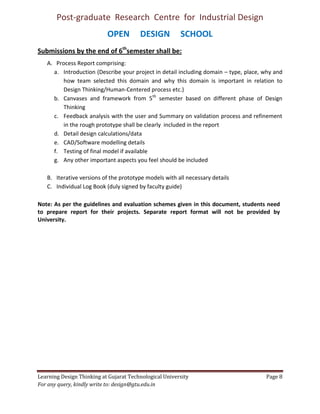
Submissions by the end of 6th
semester shall be:
A. Process Report comprising:
a. Introduction (Describe your project in detail including domain – type, place, why and
how team selected this domain and why this domain is important in relation to
Design Thinking/Human-Centered process etc.)
b. Canvases and framework from 5th
semester based on different phase of Design
Thinking
c. Feedback analysis with the user and Summary on validation process and refinement
in the rough prototype shall be clearly included in the report
d. Detail design calculations/data
e. CAD/Software modelling details
f. Testing of final model if available
g. Any other important aspects you feel should be included
B. Iterative versions of the prototype models with all necessary details
C. Individual Log Book (duly signed by faculty guide)
Note: As per the guidelines and evaluation schemes given in this document, students need
to prepare report for their projects. Separate report format will not be provided by
University.
Post-graduate Research Centre for Industrial Design
OPEN DESIGN SCHOOL
Learning Design Thinking at Gujarat Technological University Page 9
For any query, kindly write to: design@gtu.edu.in
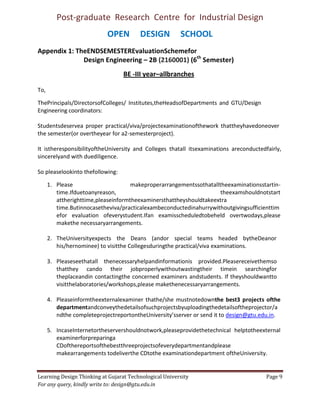
Appendix 1: TheENDSEMESTEREvaluationSchemefor
Design Engineering – 2B (2160001) (6th
Semester)
BE -III year–allbranches
To,
ThePrincipals/DirectorsofColleges/ Institutes,theHeadsofDepartments and GTU/Design
Engineering coordinators:
Studentsdeservea proper practical/viva/projectexaminationofthework thattheyhavedoneover
the semester(or overtheyear for a2-semesterproject).
It istheresponsibilityoftheUniversity and Colleges thatall itsexaminations areconductedfairly,
sincerelyand with duediligence.
So pleaselookinto thefollowing:
1. Please makeproperarrangementssothatalltheexaminationsstartin-
time.Ifduetoanyreason, theexamshouldnotstart
attherighttime,pleaseinformtheexaminersthattheyshouldtakeextra
time.Butinnocasetheviva/practicalexambeconductedinahurrywithoutgivingsufficienttim
efor evaluation ofeverystudent.Ifan examisscheduledtobeheld overtwodays,please
makethe necessaryarrangements.
2. TheUniversityexpects the Deans (andor special teams headed bytheDeanor
his/hernominee) to visitthe Collegesduringthe practical/viva examinations.
3. Pleaseseethatall thenecessaryhelpandinformationis provided.Pleasereceivethemso
thatthey cando their jobproperlywithoutwastingtheir timein searchingfor
theplaceandin contactingthe concerned examiners andstudents. If theyshouldwantto
visitthelaboratories/workshops,please makethenecessaryarrangements.
4. Pleaseinformtheexternalexaminer thathe/she mustnotedownthe best3 projects ofthe
departmentandconveythedetailsofsuchprojectsbyuploadingthedetailsoftheprojector/a
ndthe completeprojectreportontheUniversity’sserver or send it to design@gtu.edu.in.
5. IncaseInternetortheservershouldnotwork,pleaseprovidethetechnical helptotheexternal
examinerforpreparinga
CDofthereportsofthebestthreeprojectsofeverydepartmentandplease
makearrangements todeliverthe CDtothe examinationdepartment oftheUniversity.
Post-graduate Research Centre for Industrial Design
OPEN DESIGN SCHOOL
Learning Design Thinking at Gujarat Technological University Page 10
For any query, kindly write to: design@gtu.edu.in
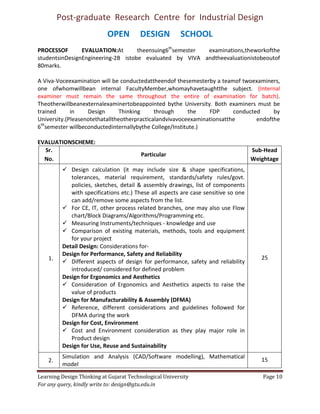
PROCESSOF EVALUATION:At theensuing6th
semester examinations,theworkofthe
studentsinDesignEngineering-2B istobe evaluated by VIVA andtheevaluationistobeoutof
80marks.
A Viva-Voceexamination will be conductedattheendof thesemesterby a teamof twoexaminers,
one ofwhomwillbean internal FacultyMember,whomayhavetaughtthe subject. (Internal
examiner must remain the same throughout the entire of examination for batch).
Theotherwillbeanexternalexaminertobeappointed bythe University. Both examiners must be
trained in Design Thinking through the FDP conducted by
University.(Pleasenotethatalltheotherpracticalandvivavoceexaminationsatthe endofthe
6th
semester willbeconductedinternallybythe College/Institute.)
EVALUATIONSCHEME:
Sr.
No.
Particular
Sub-Head
Weightage
1.
 Design calculation (it may include size & shape specifications,
tolerances, material requirement, standards/safety rules/govt.
policies, sketches, detail & assembly drawings, list of components
with specifications etc.) These all aspects are case sensitive so one
can add/remove some aspects from the list.
 For CE, IT, other process related branches, one may also use Flow
chart/Block Diagrams/Algorithms/Programming etc.
 Measuring Instruments/techniques - knowledge and use
 Comparison of existing materials, methods, tools and equipment
for your project
Detail Design: Considerations for-
Design for Performance, Safety and Reliability
 Different aspects of design for performance, safety and reliability
introduced/ considered for defined problem
Design for Ergonomics and Aesthetics
 Consideration of Ergonomics and Aesthetics aspects to raise the
value of products
Design for Manufacturability & Assembly (DFMA)
 Reference, different considerations and guidelines followed for
DFMA during the work
Design for Cost, Environment
 Cost and Environment consideration as they play major role in
Product design
Design for Use, Reuse and Sustainability
25
2.
Simulation and Analysis (CAD/Software modelling), Mathematical
model
15
Post-graduate Research Centre for Industrial Design
OPEN DESIGN SCHOOL
Learning Design Thinking at Gujarat Technological University Page 11
For any query, kindly write to: design@gtu.edu.in
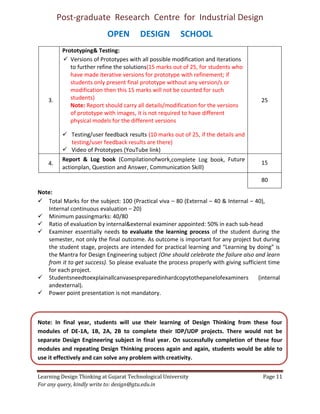
3.
Prototyping& Testing:
 Versions of Prototypes with all possible modification and iterations
to further refine the solutions(15 marks out of 25, for students who
have made iterative versions for prototype with refinement; if
students only present final prototype without any version/s or
modification then this 15 marks will not be counted for such
students)
Note: Report should carry all details/modification for the versions
of prototype with images, it is not required to have different
physical models for the different versions
 Testing/user feedback results (10 marks out of 25, if the details and
testing/user feedback results are there)
 Video of Prototypes (YouTube link)
25
4.
Report & Log book (Compilationofwork,complete Log book, Future
actionplan, Question and Answer, Communication Skill)
15
80
Note:
 Total Marks for the subject: 100 (Practical viva – 80 (External – 40 & Internal – 40),
Internal continuous evaluation – 20)
 Minimum passingmarks: 40/80
 Ratio of evaluation by internal&external examiner appointed: 50% in each sub-head
 Examiner essentially needs to evaluate the learning process of the student during the
semester, not only the final outcome. As outcome is important for any project but during
the student stage, projects are intended for practical learning and “Learning by doing” is
the Mantra for Design Engineering subject (One should celebrate the failure also and learn
from it to get success). So please evaluate the process properly with giving sufficient time
for each project.
 Studentsneedtoexplainallcanvasespreparedinhardcopytothepanelofexaminers (internal
andexternal).
 Power point presentation is not mandatory.
Note: In final year, students will use their learning of Design Thinking from these four
modules of DE-1A, 1B, 2A, 2B to complete their IDP/UDP projects. There would not be
separate Design Engineering subject in final year. On successfully completion of these four
modules and repeating Design Thinking process again and again, students would be able to
use it effectively and can solve any problem with creativity.

Design Engineering 2B Guidelines

  • 1.
    Course Abstract Design Engineering– 2B (2160001) (6th Semester) Module 4: Building the Solution Name of the Discipline & the Programme: Every discipline of the Engineering Usual time of occurrence: 6th Semester Duration: Six (6) months Course category: Core - Advance Credits: 03 Examination Pattern: Only Practical/Viva exam at end of semester Prerequisites: Design Engineering – 1A, Design Engineering – 1B, Design Engineering – 2A Relevance This is anadvance level course designed for those who have undergone the fundamentals of Design Thinking process and understand the importance and process completely. Objective: Building the Solution The course aims to validate the learnings from the understanding Design Thinking course by translating the concepts into exercises. In this module, student will continue their work from 5th semester on Community based project and complete the Design Thinking cycle with emphasis onproduct development, detail design, prototyping and validation of the solutions in real environment. Course Contents Students have started community based projects and successfully gone through the process of Observation, Empathy, Ideation and initial stages of Product Development in 5th semester. Now in 6th semester, they will continue their work from concept to product development, detail design, prototyping and validation of the solutions in real environment.All students’ team need to work towards final prototype and then test it in real environment. Final working model with YouTube video link is required for this module. In 6th semester, students will consider various design considerations as described further in this document for detail design and then first prepare their models in software if required and then use prototyping techniques to further build the concepts.The content is divided into week-wise activities to better understand the course and to give enough time to all the learning aspects, but depending upon the type and nature of projects, students and guide may re-schedule the
  • 2.
    Post-graduate Research Centrefor Industrial Design OPEN DESIGN SCHOOL Learning Design Thinking at Gujarat Technological University Page 2 For any query, kindly write to: design@gtu.edu.in activities. Students in 6th semester need to follow below week-wise activities to complete the course requirement for 6th semester. Design Thinking Process – with Tools & Techniques Module 4: DE-2BBuilding the Solutions Broad segment Week Description Operational need System level Design 1 o Plan of Action in 6th semester  Based on revalidation, feedback from last semester (5th semester) plan for future aspects o Discussion with faculty guide and modification based on feedbacks Detailed Design 2, 3, 4 o Detailed Design (including all aspects of products, material, process, resources, standards etc.) o Brief lecture/exercise o Very minute details of the concept will be considered o Prototyping techniques may be used to iterate CAD Modelling & Analysis 5, 6, 7 o CAD Modelling & Analysis (Branch specific software will be used depending on projects) o Software saves on time, money, resources etc. o Branch specific softwares must be available in the college for students to use for their projects Building the solutions 8, 9, 10, 11 o Prototyping (sequential prototyping for iterations) o Customer Revalidation o Modification o Iterate, Iterate, Iterate….. o Prototype does not mean final product or working model but it is the process/phase to reach up to final product
  • 3.
    Post-graduate Research Centrefor Industrial Design OPEN DESIGN SCHOOL Learning Design Thinking at Gujarat Technological University Page 3 For any query, kindly write to: design@gtu.edu.in In the 6th semester, student’s team will validate their concept and detailed design part with reference to (1) Design for performance, safety and reliability, (2) Design for Ergonomics and Aesthetics, (3) Design for Manufacturing & Assembly (DFMA), (4) Design for cost & Environment, (5) Modelling and Analysis of their design (6) Prototyping (7) Engineering Economics of Design, (8) Design for Use, Reuse and Sustainability and (9) Test the prototype. And additionally students will also learn topic like (10) Ethics in Design. Following aspects should be taken into account while developing product. 1. Design for Performance, Safety and Reliability:  Design for performance:The final product/process must perform for designed (projected in Product Development Canvas - PDC) features and functions as per the requirement of the user in actual working environment (revealed through rough-prototype validation).  Design for Safety:Safety is the most important aspect of human centric product/process. Reasonable factor of safety should be taken into account considering all adverse and Final Prototype 12 o Final working model should be prepared (The projects that involve higher cost and limitations on technology should be allowed other ways of prototyping other than working model) o YouTube link of final working model is required for full mark Project Fair 13 o Open project showcase/fair for showing the projects for Students, faculty members, local people and industrialists o This fair should be open for all in surrounding area of college o It is compulsory to organize DE project fair Feedback & Final Report 14 o Feedback & Final Report o As per the feedback received from Users/Stakeholders/other student groups/guide, student teams need to modify their design and further action plan. o Report writing should be continuous activity throughout the semester
  • 4.
    Post-graduate Research Centrefor Industrial Design OPEN DESIGN SCHOOL Learning Design Thinking at Gujarat Technological University Page 4 For any query, kindly write to: design@gtu.edu.in factual factors (Ideation canvas – location/context/situation may be referred back here) as there is human interaction with product/process in manifold circumstances.  Design for Reliability: Reliability is the ability of a system or component to perform its required functions under stated conditions for a specified period of time1 . Your final product/process should be reliable as required by the user and should perform its desired functions as required for desired time period. 2. Design for Ergonomics and Aesthetics:  Ergonomics is all about designing for human factors/comforts wherever they interact with product/process and surrounding environments. According to the International Ergonomics Association within the discipline of ergonomics there exist domains of specialization: (a) Physical Ergonomics – is concerned with the human anatomy, bio mechanical and physiological ability and its relevance to the product and surrounding systems; (b) Cognitive Ergonomics – is concerned with the mental ability such as perception, memory, reasoning and response power as they affect the interactions between humans and products/systems ; (c) Organizational Ergonomics – is concerned with the optimization of socio-technical systems including organizational structures, policies and processes.  Aesthetics is all about designing for physical appearance (looks) of the product. In current time, customers are willing to buy the products which have stunning looks with respect to their competitive products. Design for Aesthetics includes appearance, style, colour, form/shape, visuals and so on. 3. Design for Manufacturability & Assembly (DFMA)  DFMA stands for two terms; DFM – Design for Manufacturabilitywhich means for ease of manufacturing of parts/components of final product. DFA – Design for Assembly which means manufactured parts can be easily assembled to form a final product. DFMA approach helps to design and manufacture/construct the product easily and economically. Designer must design components/parts that can be easily manufactured with available resources at minimum cost of production and can be easily assembled by assembly personnel. The intentions behind implementing DFMA practice in product development is to minimize manufacturing and assembly cost, improve efficiency, eliminate waste of material and time. Iteration on involved raw materials may be performed to check available alternatives – as materials play a major role in production cost. Basic guidelines may be followed as below: 1 Definition by IEEE.
  • 5.
    Post-graduate Research Centrefor Industrial Design OPEN DESIGN SCHOOL Learning Design Thinking at Gujarat Technological University Page 5 For any query, kindly write to: design@gtu.edu.in  Check for alternative and compatible raw materials (Refer/ revise to LNM)  Minimize the number of parts (Refer/ revise to PDC)  Develop a modular design  Design parts to be multi-functional  Design parts for multiple-use  Design for ease of fabrication/ production/ assemble  Minimize assembly paths  Avoid separate fasteners (i.e. monolithic units)  Eliminate adjustments as possible (i.e. movement in parts addressing multiple use – it’s a trade-off)  Design for minimum handling  Avoid use of additional tools when possible  Minimize subassemblies (i.e. joining and removing some of the parts)  Use standard parts when possible (refer/ revise to LNM)  Simplify operations  Design for efficient and adequate testing (refer/ revise to LNM)  Use repeatable & understood processes  Analyze failures  Rigorously assess value (i.e. cost of production against minimizing cost of human efforts being done at present – Refer to AEIOU observation framework) 4. Design for Cost, Environment  Design for cost means designing for lowest possible life cycle cost. It involves – assumed product design cost (manufacturing), delivery cost (to the end-user) as well as cost of operation and maintenance.  Design for environment strategy describes best practices of designing a product/process to minimize health and environmental ill-impacts. Four main concepts of Design for Environment includes: (a) Design for Environmental aspects during Processing and Manufacturing; (b) Design for Environmental aspects in Packaging; (c) Design for Disposal or Reuse (i.e. after end of product/ process life-cycle as involved in one’s case); (d) Design for Energy Efficiency (i.e. energy consumption during the product/ process usable life) 5. Modelling and Analysis using Software:  Branch Specific software can be used for simulation/analysis purpose to further refine the design before investing more time, money and resources
  • 6.
    Post-graduate Research Centrefor Industrial Design OPEN DESIGN SCHOOL Learning Design Thinking at Gujarat Technological University Page 6 For any query, kindly write to: design@gtu.edu.in 6. Prototyping and Proofing of Concepts:  Prototypes, Models and Proof of concepts o Prototypes [1] : Prototypes are the first full scale and usually a functional form of design and in this sense, it is a working models of designed parts/artefacts. They are tested in the same environments in which they are expected to perform as final products. o Models [1] : A model is “a miniature representation of something”. They may be a paper model or computer model or physical model. Models are usually a smaller and made of different material than are of original products, and they are tested in laboratory or controlled environment to validate their expected behaviour. o Proof of Concepts [1] : A proof of concept, in this context, refers to a model of some part of a design that is used specifically to test whether a particular concept will actually work as proposed. Proof of concept test will validate the idea or concept in controlled environment.  Building series of Prototypes to further refine the project  How much it will cost? 7. Engineering Economics of Design:  Cost Estimation  Labour, Material and overhead cost  The time value of money 8. Design for Use, Reuse and Sustainability  Design for USE – How long this design will work? o Reliability o Maintainability  Design for Reuse  Design for Sustainability 9. Test the prototype  Test your design in real operational environment and then iterate if required. 10. Ethics in Design  Codes of Ethics
  • 7.
    Post-graduate Research Centrefor Industrial Design OPEN DESIGN SCHOOL Learning Design Thinking at Gujarat Technological University Page 7 For any query, kindly write to: design@gtu.edu.in  Ethics: Understanding Obligations  Ethics: on engineering practice and the welfare of the public  Ethics: Always a part of engineering practice [1] Engineering Design – A project Based Introduction by Clive L. Dym, Patrick Little, Elizabeth J. Orwin – Wiley publications Optional Areas: GTU Innovation Council will help in below areas for the students who really want to develop their projects further. Visit http://www.gtuinnovationcouncil.ac.in/ for more info.  Design Support  Intellectual Property Right  Business Model Canvas  Student Start-up  Incubation and Co-working space
  • 8.
    Post-graduate Research Centrefor Industrial Design OPEN DESIGN SCHOOL Learning Design Thinking at Gujarat Technological University Page 8 For any query, kindly write to: design@gtu.edu.in Submissions by the end of 6th semester shall be: A. Process Report comprising: a. Introduction (Describe your project in detail including domain – type, place, why and how team selected this domain and why this domain is important in relation to Design Thinking/Human-Centered process etc.) b. Canvases and framework from 5th semester based on different phase of Design Thinking c. Feedback analysis with the user and Summary on validation process and refinement in the rough prototype shall be clearly included in the report d. Detail design calculations/data e. CAD/Software modelling details f. Testing of final model if available g. Any other important aspects you feel should be included B. Iterative versions of the prototype models with all necessary details C. Individual Log Book (duly signed by faculty guide) Note: As per the guidelines and evaluation schemes given in this document, students need to prepare report for their projects. Separate report format will not be provided by University.
  • 9.
    Post-graduate Research Centrefor Industrial Design OPEN DESIGN SCHOOL Learning Design Thinking at Gujarat Technological University Page 9 For any query, kindly write to: design@gtu.edu.in Appendix 1: TheENDSEMESTEREvaluationSchemefor Design Engineering – 2B (2160001) (6th Semester) BE -III year–allbranches To, ThePrincipals/DirectorsofColleges/ Institutes,theHeadsofDepartments and GTU/Design Engineering coordinators: Studentsdeservea proper practical/viva/projectexaminationofthework thattheyhavedoneover the semester(or overtheyear for a2-semesterproject). It istheresponsibilityoftheUniversity and Colleges thatall itsexaminations areconductedfairly, sincerelyand with duediligence. So pleaselookinto thefollowing: 1. Please makeproperarrangementssothatalltheexaminationsstartin- time.Ifduetoanyreason, theexamshouldnotstart attherighttime,pleaseinformtheexaminersthattheyshouldtakeextra time.Butinnocasetheviva/practicalexambeconductedinahurrywithoutgivingsufficienttim efor evaluation ofeverystudent.Ifan examisscheduledtobeheld overtwodays,please makethe necessaryarrangements. 2. TheUniversityexpects the Deans (andor special teams headed bytheDeanor his/hernominee) to visitthe Collegesduringthe practical/viva examinations. 3. Pleaseseethatall thenecessaryhelpandinformationis provided.Pleasereceivethemso thatthey cando their jobproperlywithoutwastingtheir timein searchingfor theplaceandin contactingthe concerned examiners andstudents. If theyshouldwantto visitthelaboratories/workshops,please makethenecessaryarrangements. 4. Pleaseinformtheexternalexaminer thathe/she mustnotedownthe best3 projects ofthe departmentandconveythedetailsofsuchprojectsbyuploadingthedetailsoftheprojector/a ndthe completeprojectreportontheUniversity’sserver or send it to design@gtu.edu.in. 5. IncaseInternetortheservershouldnotwork,pleaseprovidethetechnical helptotheexternal examinerforpreparinga CDofthereportsofthebestthreeprojectsofeverydepartmentandplease makearrangements todeliverthe CDtothe examinationdepartment oftheUniversity.
  • 10.
    Post-graduate Research Centrefor Industrial Design OPEN DESIGN SCHOOL Learning Design Thinking at Gujarat Technological University Page 10 For any query, kindly write to: design@gtu.edu.in PROCESSOF EVALUATION:At theensuing6th semester examinations,theworkofthe studentsinDesignEngineering-2B istobe evaluated by VIVA andtheevaluationistobeoutof 80marks. A Viva-Voceexamination will be conductedattheendof thesemesterby a teamof twoexaminers, one ofwhomwillbean internal FacultyMember,whomayhavetaughtthe subject. (Internal examiner must remain the same throughout the entire of examination for batch). Theotherwillbeanexternalexaminertobeappointed bythe University. Both examiners must be trained in Design Thinking through the FDP conducted by University.(Pleasenotethatalltheotherpracticalandvivavoceexaminationsatthe endofthe 6th semester willbeconductedinternallybythe College/Institute.) EVALUATIONSCHEME: Sr. No. Particular Sub-Head Weightage 1.  Design calculation (it may include size & shape specifications, tolerances, material requirement, standards/safety rules/govt. policies, sketches, detail & assembly drawings, list of components with specifications etc.) These all aspects are case sensitive so one can add/remove some aspects from the list.  For CE, IT, other process related branches, one may also use Flow chart/Block Diagrams/Algorithms/Programming etc.  Measuring Instruments/techniques - knowledge and use  Comparison of existing materials, methods, tools and equipment for your project Detail Design: Considerations for- Design for Performance, Safety and Reliability  Different aspects of design for performance, safety and reliability introduced/ considered for defined problem Design for Ergonomics and Aesthetics  Consideration of Ergonomics and Aesthetics aspects to raise the value of products Design for Manufacturability & Assembly (DFMA)  Reference, different considerations and guidelines followed for DFMA during the work Design for Cost, Environment  Cost and Environment consideration as they play major role in Product design Design for Use, Reuse and Sustainability 25 2. Simulation and Analysis (CAD/Software modelling), Mathematical model 15
  • 11.
    Post-graduate Research Centrefor Industrial Design OPEN DESIGN SCHOOL Learning Design Thinking at Gujarat Technological University Page 11 For any query, kindly write to: design@gtu.edu.in 3. Prototyping& Testing:  Versions of Prototypes with all possible modification and iterations to further refine the solutions(15 marks out of 25, for students who have made iterative versions for prototype with refinement; if students only present final prototype without any version/s or modification then this 15 marks will not be counted for such students) Note: Report should carry all details/modification for the versions of prototype with images, it is not required to have different physical models for the different versions  Testing/user feedback results (10 marks out of 25, if the details and testing/user feedback results are there)  Video of Prototypes (YouTube link) 25 4. Report & Log book (Compilationofwork,complete Log book, Future actionplan, Question and Answer, Communication Skill) 15 80 Note:  Total Marks for the subject: 100 (Practical viva – 80 (External – 40 & Internal – 40), Internal continuous evaluation – 20)  Minimum passingmarks: 40/80  Ratio of evaluation by internal&external examiner appointed: 50% in each sub-head  Examiner essentially needs to evaluate the learning process of the student during the semester, not only the final outcome. As outcome is important for any project but during the student stage, projects are intended for practical learning and “Learning by doing” is the Mantra for Design Engineering subject (One should celebrate the failure also and learn from it to get success). So please evaluate the process properly with giving sufficient time for each project.  Studentsneedtoexplainallcanvasespreparedinhardcopytothepanelofexaminers (internal andexternal).  Power point presentation is not mandatory. Note: In final year, students will use their learning of Design Thinking from these four modules of DE-1A, 1B, 2A, 2B to complete their IDP/UDP projects. There would not be separate Design Engineering subject in final year. On successfully completion of these four modules and repeating Design Thinking process again and again, students would be able to use it effectively and can solve any problem with creativity.