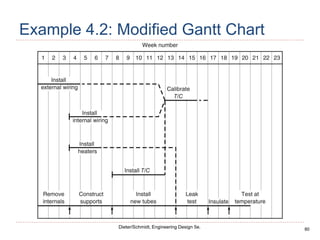
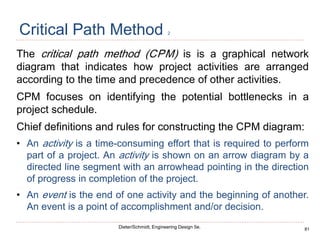
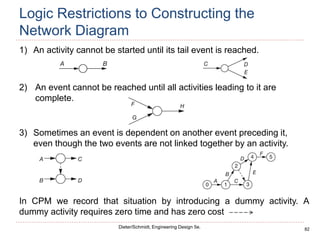
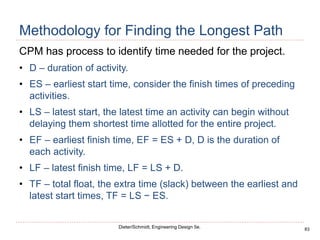
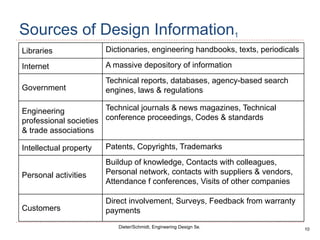
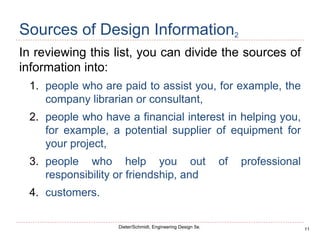
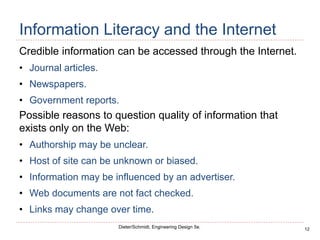
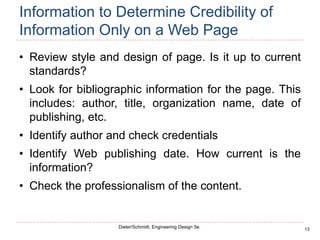
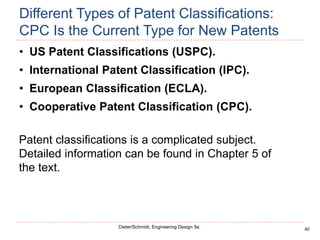
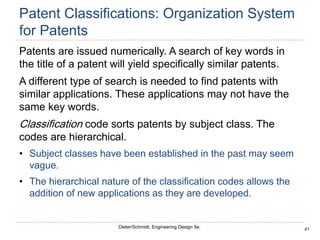
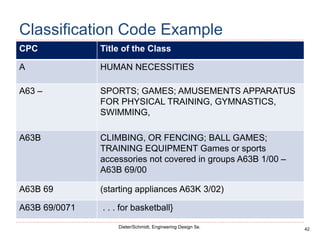
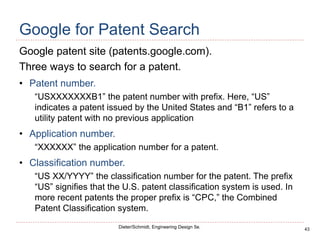
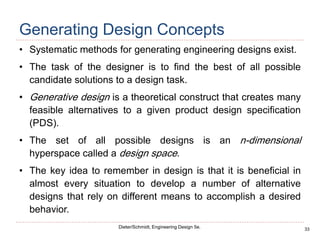
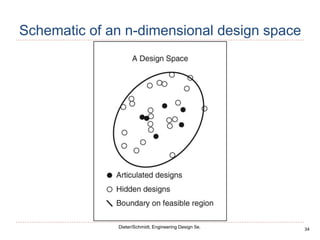
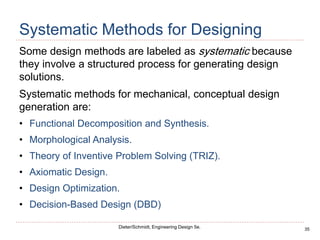
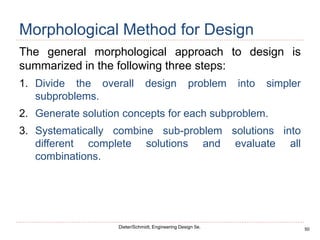
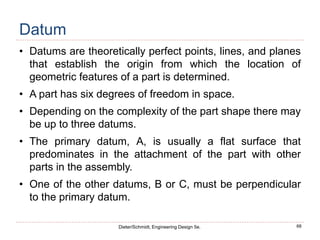
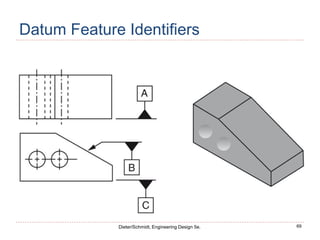
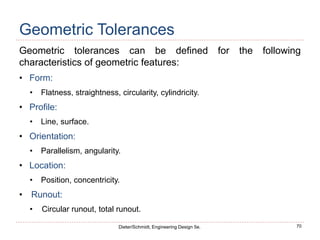
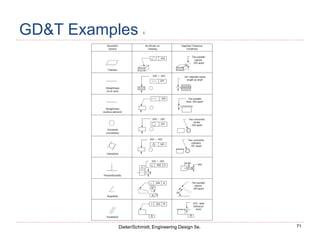
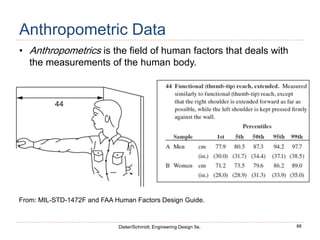
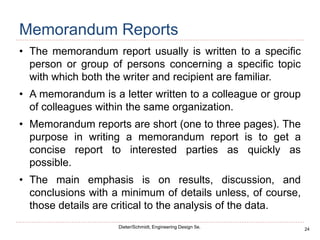
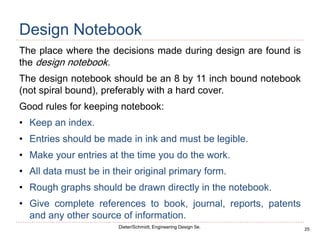
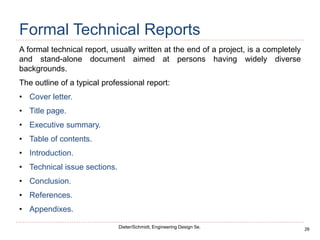
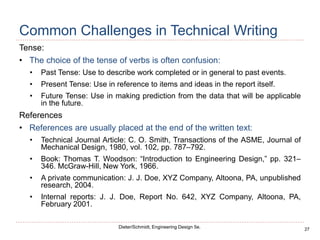
Engineering Design
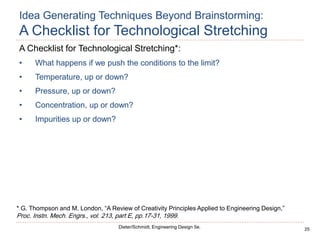
Chapter 1
8
1.1 Introduction
What is design?
9
What is design?
• “To fashion after a plan!”
• To design is:
“To design is to pull together something new or to
arrange existing things in a new way to satisfy a
recognized need of society.”
“Design establishes and defines solutions to and
pertinent structures for problems not solved before, or
new solutions to problems which have previously been
solved in a different way.”
10
The Four C’s of Design
• Creativity
• Requires creation of something that has not existed before or
has not existed in the designer’s mind before
• Complexity
• Requires decisions on many variables and parameters
• Choice
• Requires making choices between many possible solutions at
all levels, from basic concepts to the smallest detail of shape
• Compromise
• Requires balancing multiple and sometimes conflicting
requirements
11
1.2 Engineering Design Process
Why is engineering design process needed?
12
Importance of the Engineering Design
Process
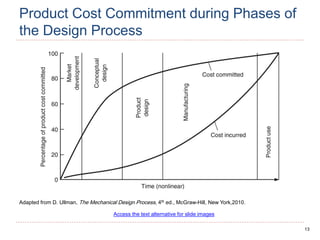
• Decisions made in the design process cost very little
in terms of the overall product cost but have a major
effect on the cost of the product.
• You cannot compensate in manufacturing for defects
introduced in the design phase.
• The design process should be conducted so as to
develop quality, cost-competitive products in the
shortest time possible.
13
Product Cost Commitment during Phases of
the Design Process
Adapted from D. Ullman, The Mechanical Design Process, 4th ed., McGraw-Hill, New York,2010.
Access the text alternative for slide images
14
Types of Designs
• Original Design: Innovative design.
• Adaptive Design.
• Redesign: Variant design.
• Selection design.
15
1.3 Ways to Think about the
Engineering Design Process
What do we mean by “designing a system”?
16
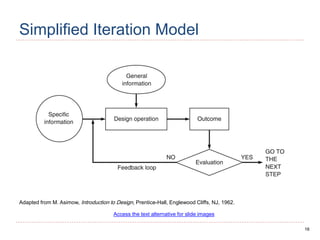
Simplified Iteration Model
Adapted from M. Asimow, Introduction to Design, Prentice-Hall, Englewood Cliffs, NJ, 1962.
Access the text alternative for slide images
17
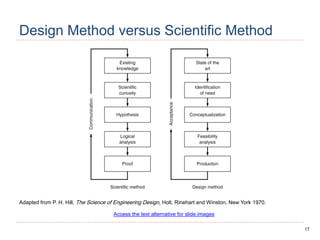
Design Method versus Scientific Method
Adapted from P. H. Hill, The Science of Engineering Design, Holt, Rinehart and Winston, New York 1970.
Access the text alternative for slide images
18
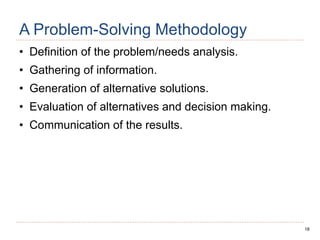
A Problem-Solving Methodology
• Definition of the problem/needs analysis.
• Gathering of information.
• Generation of alternative solutions.
• Evaluation of alternatives and decision making.
• Communication of the results.
19
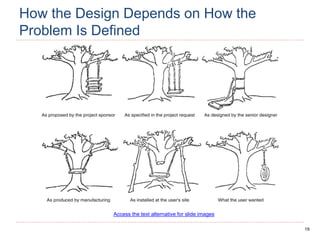
How the Design Depends on How the
Problem Is Defined
Access the text alternative for slide images
20
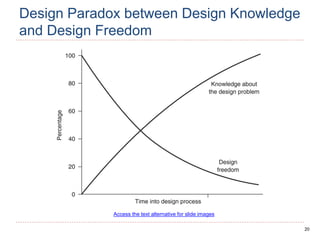
Design Paradox between Design Knowledge
and Design Freedom
Access the text alternative for slide images
21
1.4 Description of Design Process
What are the steps of Design Process?
22
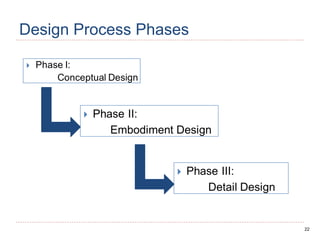
Design Process Phases
23
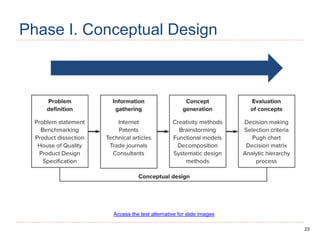
Phase I. Conceptual Design
Access the text alternative for slide images
24
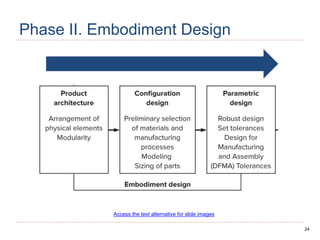
Phase II. Embodiment Design
Access the text alternative for slide images
25
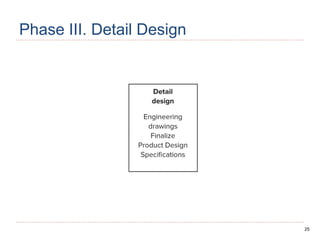
Phase III. Detail Design
26
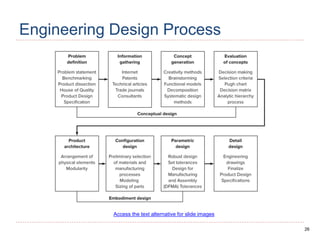
Engineering Design Process
Access the text alternative for slide images
27
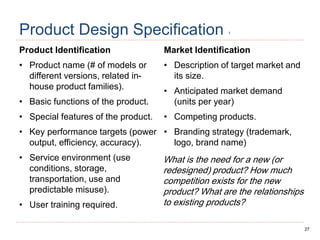
Product Design Specification 1
Product Identification
• Product name (# of models or
different versions, related in-
house product families).
• Basic functions of the product.
• Special features of the product.
• Key performance targets (power
output, efficiency, accuracy).
• Service environment (use
conditions, storage,
transportation, use and
predictable misuse).
• User training required.
Market Identification
• Description of target market and
its size.
• Anticipated market demand
(units per year)
• Competing products.
• Branding strategy (trademark,
logo, brand name)
What is the need for a new (or
redesigned) product? How much
competition exists for the new
product? What are the relationships
to existing products?
28
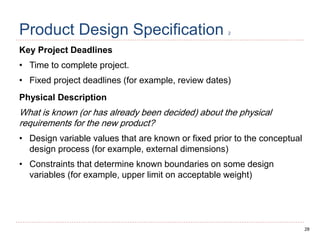
Product Design Specification 2
Key Project Deadlines
• Time to complete project.
• Fixed project deadlines (for example, review dates)
Physical Description
What is known (or has already been decided) about the physical
requirements for the new product?
• Design variable values that are known or fixed prior to the conceptual
design process (for example, external dimensions)
• Constraints that determine known boundaries on some design
variables (for example, upper limit on acceptable weight)
29
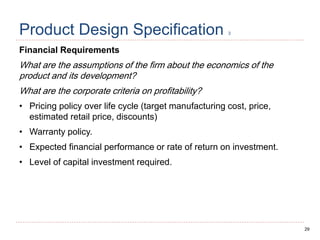
Product Design Specification 3
Financial Requirements
What are the assumptions of the firm about the economics of the
product and its development?
What are the corporate criteria on profitability?
• Pricing policy over life cycle (target manufacturing cost, price,
estimated retail price, discounts)
• Warranty policy.
• Expected financial performance or rate of return on investment.
• Level of capital investment required.
30
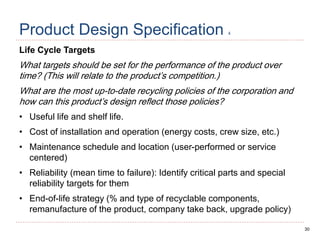
Product Design Specification 4
Life Cycle Targets
What targets should be set for the performance of the product over
time? (This will relate to the product’s competition.)
What are the most up-to-date recycling policies of the corporation and
how can this product’s design reflect those policies?
• Useful life and shelf life.
• Cost of installation and operation (energy costs, crew size, etc.)
• Maintenance schedule and location (user-performed or service
centered)
• Reliability (mean time to failure): Identify critical parts and special
reliability targets for them
• End-of-life strategy (% and type of recyclable components,
remanufacture of the product, company take back, upgrade policy)
31
Product Design Specification 5
Social, Political, and Legal Requirements
Are there government agencies, societies, or regulation boards that
control the markets in which this product is to be launched?
Are there opportunities to patent the product or some of its
subsystems?
• Safety and environmental regulations. Applicable government
regulations for all intended markets.
• Standards. Pertinent product standards that may be applicable
(Underwriters Laboratories, OSHA).
• Safety and product liability. Predictable unintended uses for the
product, safety label guidelines, applicable company safety
standards.
• Intellectual property. Patents related to product. Licensing strategy
for critical pieces of technology.
32
Product Design Specification 6
Manufacturing Specifications
Which parts or systems will be manufactured in-house?
• Manufacturing requirements. Processes and capacity necessary to
manufacture final product.
• Suppliers. Identify key suppliers and procurement strategy for
purchased parts.
33
1.5 Consideration of a Good Design
What are the various considerations of a good design?
34
Considerations of Good Design
1. Achievement of Performance Requirements
2. Life-Cycle Issues
3. Social and Regulatory Issues
35
Achievement of Performance Requirements
• A major characteristic of a design is its function.
• Performance Requirements:
Primary Performance Requirements
Complementary Performance Requirements
• Part (Component): A single piece requiring no
assembly.
• Assembly: When two or more parts are joined.
• Subassemblies: Smaller assemblies which compose
larger assemblies.
36
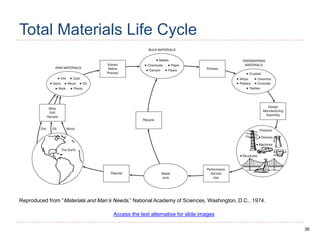
Total Materials Life Cycle
Reproduced from “Materials and Man’s Needs,” National Academy of Sciences, Washington, D.C., 1974.
Access the text alternative for slide images
37
Regulatory and Social Issues
• The code of ethics of all professional engineering
societies require the engineer to protect public
health and safety.
Example of Standards and Codes:
ASME: American Society of Mechanical Engineers
ASTM: American Society for Testing and Materials
OSHA: Occupational Safety and Health Administration
CPSC: Consumer Product Safety Commission
EPA: Environmental Protection Agency
DHS: Department of Homeland Security
38
1.6 Computer-Aided Engineering
What are the changes that plentiful computing has produced?
39
Computer-Aided Engineering (CAE)
CAE developed in two major domains:
• Computer graphics and modeling
• Mathematical analysis and simulation
Advantages of Computer-Aided Engineering:
Automated engineering drawing in two dimensions
Three dimensional modelling
Finite Element Modeling (F E M)
Rapid prototyping
Design optimization
Computer-Aided Design (C A D)
Computer-Aided Manufacturing (C A M)
Concurrent engineering
40
1.7 Designing to Codes and
Standards
What are the codes and standards?
41
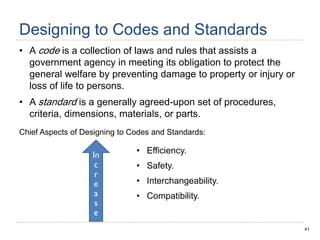
Designing to Codes and Standards
• A code is a collection of laws and rules that assists a
government agency in meeting its obligation to protect the
general welfare by preventing damage to property or injury or
loss of life to persons.
• A standard is a generally agreed-upon set of procedures,
criteria, dimensions, materials, or parts.
Chief Aspects of Designing to Codes and Standards:
In
c
r
e
a
s
e
• Efficiency.
• Safety.
• Interchangeability.
• Compatibility.
42
Two Broad Forms of Codes
Performance Codes Prescriptive Codes
• Performance Codes are stated in terms of the specific
requirement that is expected to be achieved.
• Prescriptive(specification) Codes state the
requirements in terms of specific details and leave no
discretion to the designer.
43
1.8 Design Review
What is design review?
44
Design Review
A design review is a retrospective study of the design up to that point in
time.
The essence of the technical review of the design is to compare the
findings against the detailed Product Design Specification (PDS).
The PDS is a detailed document that describes what the design must be
in terms of:
• Performance requirements.
• Environment in which it must operate.
• Product life.
• Quality.
• Reliability.
• Cost.
• Host of other design requirements.
45
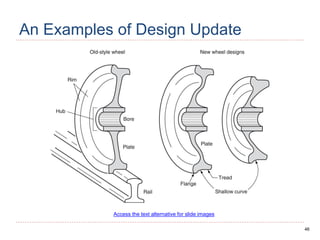
Redesign
Two categories of redesigns:
• Fixes.
• Updates.
A fix is a design modification that is required due to
less than acceptable performance once the product
has been introduced into the marketplace.
Updates are usually planned as part of the product’s
life cycle before the product is introduced to the
market.
46
An Examples of Design Update
Access the text alternative for slide images
47
1.9 Societal Considerations in
Engineering Design
What are the effects of engineering design on society?
48
Societal Considerations in Engineering
Design
ABET Code of Ethics:
“Engineers shall hold paramount the safety, health, and welfare of the
public in the performance of their profession.”
Some influences on the practice of engineering design due to
increased societal awareness of technology:
• Greater influence of lawyers on engineering decisions.
• More time spent in planning and predicting.
• Emphasis on “defensive research and development”
• More effort expended in research, development, and
engineering in environmental control and safety.
49
Keys Roles of Government in Interacting
with Technology
• As a stimulus to free enterprise through changes in
the tax system.
• By influencing interest rates and the supply of
venture capital through changes in fiscal policy to
control the growth of the economy.
• As a major customer for high technology, chiefly in
military, space, and energy systems.
• As a funding source (patron) for research and
development.
• As a regulator of technology.
50
TABLE 1.1: Characteristics of an
Environmentally Responsible Design
• Easy to dissassemble
• Able to be recycled
• Contains recycled materials
• Uses identifiable and recyclable plastics
• Reduces use of energy and natural materials in its
manufacture
• Manufactured without producing hazardous waste
• Avoids use of hazardous materials
• Reduces product chemical emissions
• Reduces product energy consumption
End of Main Content
Product-Development Process
Chapter 2
2
2.1 Introduction
What is the product development process?
3
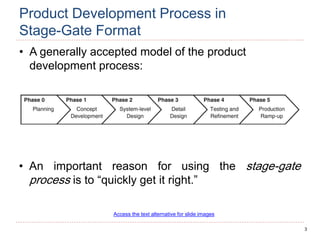
Product Development Process in
Stage-Gate Format
• A generally accepted model of the product
development process:
• An important reason for using the stage-gate
process is to “quickly get it right.”
Access the text alternative for slide images
4
Phases of PDP 1
• Phase 0: The planning that should be done before
the approval of the product development project.
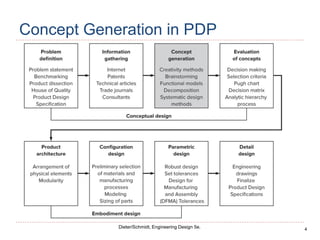
• Phase 1: Concept development considers the
different ways the product and each subsystem can
be designed.
• Phase 2: System-Level Design is where the functions
of the product are examined, leading to the division of
the product into various subsystems.
5
Phases of PDP 2
• Phase 3: Detail Design is the phase where the design
is brought to the state of a complete engineering
description of a tested and producible product.
• Phase 4: Testing and Refinement is concerned with
making and testing many preproduction versions of
the product.
• Phase 5: Production Ramp-Up is when the
manufacturing operations begins to make and
assembly the product using the intended production
system.
6
Factors for Success
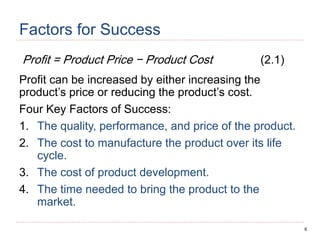
Profit = Product Price − Product Cost (2.1)
Profit can be increased by either increasing the
product’s price or reducing the product’s cost.
Four Key Factors of Success:
1. The quality, performance, and price of the product.
2. The cost to manufacture the product over its life
cycle.
3. The cost of product development.
4. The time needed to bring the product to the
market.
7
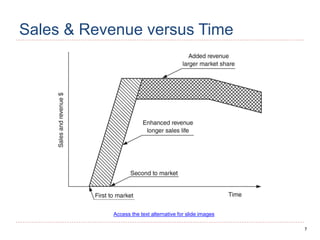
Sales & Revenue versus Time
Access the text alternative for slide images
8
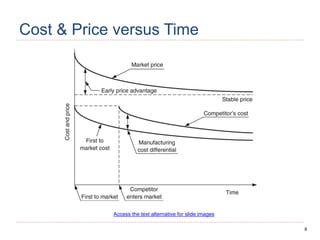
Cost & Price versus Time
Access the text alternative for slide images
9
Static versus Dynamic Products
Static Product: The changes in their design take place
over long time periods through incremental changes
occurring at the subsystem and component levels.
• Automobiles.
• Appliances: refrigerators, dishwashers.
Dynamic Products: Customers are willing to, and may
even demand, change.
• Wireless mobile phones.
• Digital video recorders and players.
• Software.
10
Market Pull versus Technology Push
• Market pull situation that the product is being
developed in response to an identified market need.
• This is a common situation in product development, but
there are other situations that need to be recognized.
• The opposite of market pull is technology push,
this is the situation where the company starts with a
new proprietary technology and looks for a market in
which to apply this technology.
• The development of a technology push product begins
with the assumption that the new technology will be
employed.
11
Variations on the Generic PDP 1
Platform Product is built around a preexisting
technological subsystem.
• Apple Macintosh operating system.
• Black & Decker doubly insulated universal motor.
Customized Products are those in which variations in
configuration and content are created in response to a
specific order of a customer.
In a highly competitive world marketplace, mass
customization appears to be one of the future trends.
12
2.2 Product and Process Cycles
What are the stages of product and process cycles?
13
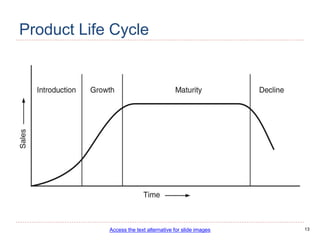
Product Life Cycle
Access the text alternative for slide images
14
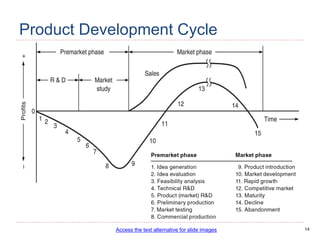
Product Development Cycle
Access the text alternative for slide images
15
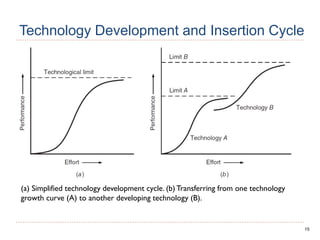
Technology Development and Insertion Cycle
(a) Simplified technology development cycle. (b) Transferring from one technology
growth curve (A) to another developing technology (B).
16
Process Development Cycle
The text emphasizes product development, but the
same general steps can be used for developing a
process.
New processes can be the impetus for developing new
products.
• Microelectromechanical systems (MEMS)
• Additive manufacturing.
17
2.3 Organization for Design and
Product Development
How can an organization affect the design and product
development?
18
Organization’s Effect on Design & Product
Development
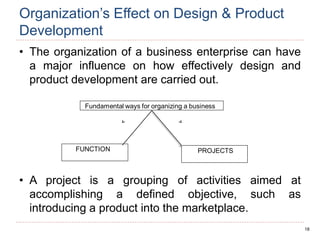
• The organization of a business enterprise can have
a major influence on how effectively design and
product development are carried out.
• A project is a grouping of activities aimed at
accomplishing a defined objective, such as
introducing a product into the marketplace.
19
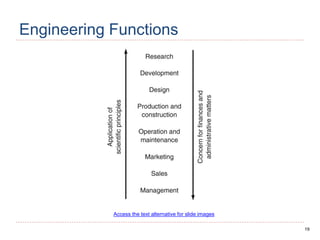
Engineering Functions
Access the text alternative for slide images
20
Links between Individuals
• Reporting Relationships: A subordinate is concerned
about who his or her supervisor is, since the
supervisor influences evaluations, salary increases,
promotions, and work assignments.
• Financial Arrangements: Another type of link is
budgetary. The source of funds to advance the
project, and who controls these funds, is a vital
consideration.
• Physical Arrangements: Studies have shown that
communication between individuals is enhanced if
their offices are within 50 feet of each other!
21
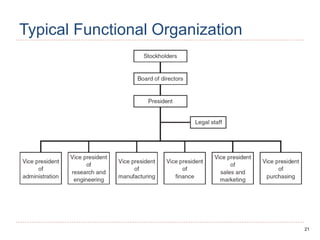
Typical Functional Organization
22
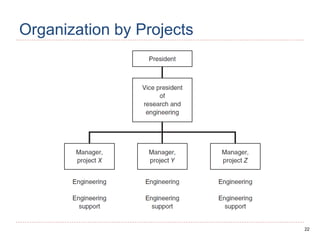
Organization by Projects
23
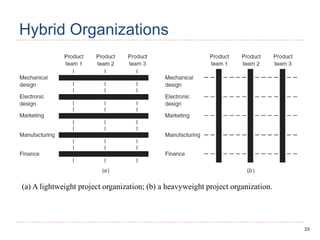
Hybrid Organizations
(a) A lightweight project organization; (b) a heavyweight project organization.
24
Concurrent Engineering Teams 1
Conventual Product Development Strategy.
• Product concept, product design, and product testing have been done
prior to process planning, manufacturing system design, and production.
• These serial functions were carried out in distinct and separate
organization with little interaction between them and without adequate
knowledge of the later steps, manufacturing and production.
Concurrent Engineering Teams.
• Product developers consider all aspects of the product life cycle,
from concept to disposal, including quality, cost, schedule, and user
requirements.
• A main objective is to bring many viewpoints and talents to the
design process so that these decisions will be valid for downstream
parts.
25
Concurrent Engineering Teams 2
Concurrent engineering has three main elements:
1. Cross-functional teams
• Having the skills from the functional areas embedded in the team
provides for quick and easy decision making, and aids in
communication with the functional units. For cross-functional teams
to work, their leader must be empowered by the managers of the
functional units with decision making authority.
2. Parallel design, sometimes called simultaneous engineering refers to
each functional.
• Each functional area implementing their aspect of the design at the
earliest possible time and roughly in parallel.
3. Vendor Partnering.
• Selected vendors are determined as suppliers for certain
components and becomes an integral member of the cross-
functional design team.
26
2.4 Markets and Marketing
How can we describe the market and marketing for
engineered products?
27
Markets
• Marketing is concerned with the interaction between
the corporation and the customer.
• We need to differentiate between the customer and
the user of the product.
• Market is an economic construct to identify those
persons or organizations that have an interest in
purchasing or selling a particular product, and to
create an arena for their transactions.
• Strong brand names evolved as a way of building
customer recognition and loyalty.
• Shift from national markets to overseas markets
28
Market Segmentation
Cooper suggests that four broad categories of variables are:
• State of Being:
• Sociological factors: age, gender, income, occupation.
• For industrial products: company size, industry classification,
• Location: urban, suburban, rural.
• State of Mind:
• Attitudes.
• Values.
• Life styles.
• Product Usage:
• Heavy user; light user; non user
• Loyalty: to your brand; to competitor’s brand; indifferent
• Benefit Segmentation: attempts to identify the benefits people
perceive in buying the product.
29
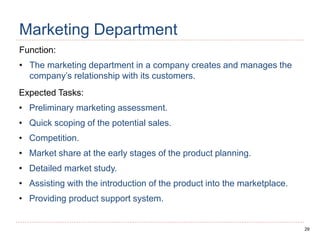
Marketing Department
Function:
• The marketing department in a company creates and manages the
company’s relationship with its customers.
Expected Tasks:
• Preliminary marketing assessment.
• Quick scoping of the potential sales.
• Competition.
• Market share at the early stages of the product planning.
• Detailed market study.
• Assisting with the introduction of the product into the marketplace.
• Providing product support system.
30
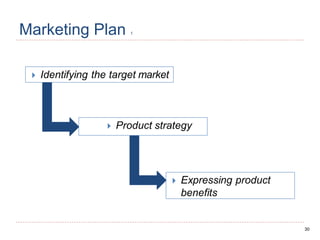
Marketing Plan 1
31
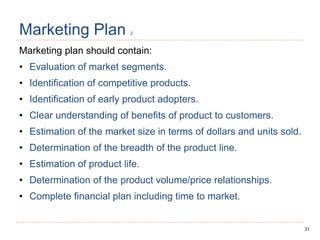
Marketing Plan 2
Marketing plan should contain:
• Evaluation of market segments.
• Identification of competitive products.
• Identification of early product adopters.
• Clear understanding of benefits of product to customers.
• Estimation of the market size in terms of dollars and units sold.
• Determination of the breadth of the product line.
• Estimation of product life.
• Determination of the product volume/price relationships.
• Complete financial plan including time to market.
32
2.5 Technological Innovation
How does technological innovation happen?
33
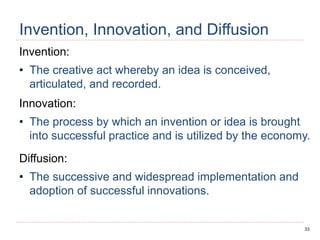
Invention, Innovation, and Diffusion
Invention:
• The creative act whereby an idea is conceived,
articulated, and recorded.
Innovation:
• The process by which an invention or idea is brought
into successful practice and is utilized by the economy.
Diffusion:
• The successive and widespread implementation and
adoption of successful innovations.
34
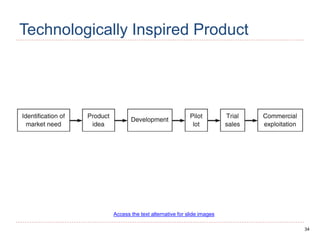
Technologically Inspired Product
Access the text alternative for slide images
35
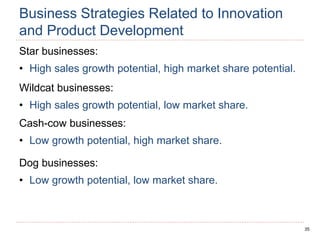
Business Strategies Related to Innovation
and Product Development
Star businesses:
• High sales growth potential, high market share potential.
Wildcat businesses:
• High sales growth potential, low market share.
Cash-cow businesses:
• Low growth potential, high market share.
Dog businesses:
• Low growth potential, low market share.
36
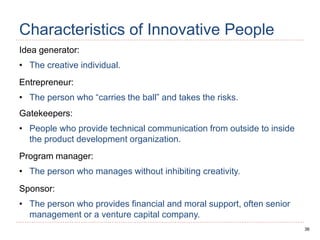
Characteristics of Innovative People
Idea generator:
• The creative individual.
Entrepreneur:
• The person who “carries the ball” and takes the risks.
Gatekeepers:
• People who provide technical communication from outside to inside
the product development organization.
Program manager:
• The person who manages without inhibiting creativity.
Sponsor:
• The person who provides financial and moral support, often senior
management or a venture capital company.
37
Types of Technology Innovation
There are two basic ways for the new technology to
arise
• Need-driven innovation, where the development
team seeks to fill an identified gap in performance or
product cost (technology pull)
• Radical innovation, which leads to widespread
change and a whole new technology, and arises
from basic research (technology push)
End of Main Content
Problem Definition and Need
Identification
Chapter 3
2
3.1 Introduction
What is problem definition step in PDP?
3
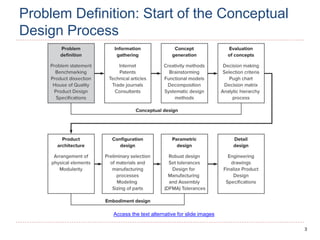
Problem Definition: Start of the Conceptual
Design Process
Access the text alternative for slide images
4
Problem Definition
• Product Development begins by determining what
the needs are that a product must meet.
• Problem definition is the most important of these
steps in the PDP.
• Understanding any problem thoroughly is crucial to
reaching an outstanding solution.
• The problem definition process is mainly the need
identification step.
5
3.2 Identifying Customer Needs
Who are my customers? What does the customer want?
6
Definition of Customer
Webster Definition of Customer:
• “One that purchases a product or service.”
• End user.
Total Quality Management Viewpoint of Customer:
• “Anyone who receives or uses what an individual or
organization provides.”
• However, not all customers who make purchasing decisions
are end users
• Internal customers vs. external customers
7
Preliminary Research on Customers’ Needs
In a large company, the research on customer needs for a particular
product or for the development of a new product is done using a
number of formal methods and by different business units.
The initial work may be done by:
• Marketing department specialist.
• Team made up of marketing and design professionals.
Designers focus on need that are:
• Unmet in the marketplace.
• Products that are similar to the proposed product.
• Historical ways of meeting the need.
• Technological approaches to engineering similar products of the type under
consideration.
8
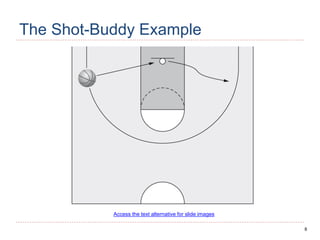
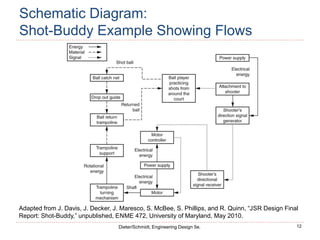
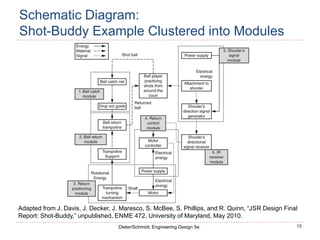
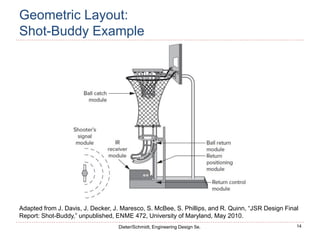
The Shot-Buddy Example
Access the text alternative for slide images
9
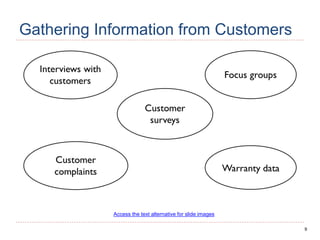
Gathering Information from Customers
Access the text alternative for slide images
10
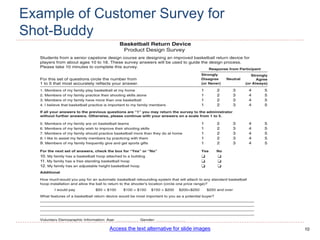
Example of Customer Survey for
Shot-Buddy
Access the text alternative for slide images
11
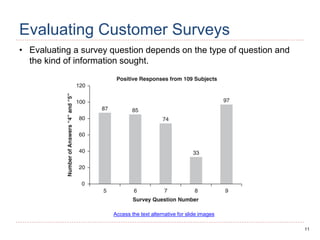
Evaluating Customer Surveys
• Evaluating a survey question depends on the type of question and
the kind of information sought.
Access the text alternative for slide images
12
Ethnographic Studies
• Ethnography is the process of investigation and
documentation of the behavior of a specific group of
people under particular conditions.
• Ethnography entails close observation, even to the point
of immersion, in the group being studied while they are
experiencing the conditions of interest.
• This way the observer can get a comprehensive and
integrated understanding of the scenario under
investigation.
• The design team can employ this method to determine
how a customer uses (or misuses) a product.
• Ethnographic study of products involves observing actual
end users interacting with the product under typical use
conditions.
13
3.3 Customer Requirements
What are customer requirements?
14
Design Point of View of Customer
Requirements
• Designers must compile a ranked listing of what
customers need and want from the product being
designed (customer requirements).
• Performance deals with what the design should do when
it is completed and in operation.
• The time dimension includes all time aspects of the
design.
• Cost pertains to all monetary aspects of the design.
• Quality is a complex characteristic with many aspects
and definitions.
• Value is the worth of a product or service.
15
Garvin’s Eight Dimensions of Quality 1
Dimension Description
Performance The primary operating characteristics of a product. This
dimension can be expressed in measurable quantities and
ranked objectively
Features Characteristics that supplement a product's basic functions.
Features customize or personalize a product to the customer's
needs or taste.
Reliability The probability of a product failing or malfunctioning within a
specified time period. See Chapter 14.
Durability A measure of the amount of use one gets from a product before
it breaks down and replacement is preferable to continued
repair. Durability is a measure of product life. Durability is not
the same as reliability.
Serviceability Ease of repair and time to repair after breakdown. Other issues
are courtesy and competence of repair personnel and cost and
ease of repair.
16
Garvin’s Eight Dimensions of Quality 2
Dimension Description
Conformance The degree to which a product meets both customer
expectations and established standards. These standards
include industry standards, government regulations. and safety
and environmental standards.
Aesthetics How a product looks, feels, sounds, tastes, and smells.
Customer response is a matter of personal judgment and
individual preference.
Perceived
Quality
Customers' judgment of the product prior to purchase. This
dimension is associated with past experience with similar
products or the same manufacturer's products. Advertising
seeks to influence this perception.
17
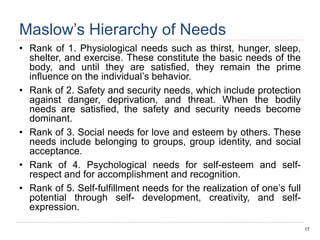
Maslow’s Hierarchy of Needs
• Rank of 1. Physiological needs such as thirst, hunger, sleep,
shelter, and exercise. These constitute the basic needs of the
body, and until they are satisfied, they remain the prime
influence on the individual’s behavior.
• Rank of 2. Safety and security needs, which include protection
against danger, deprivation, and threat. When the bodily
needs are satisfied, the safety and security needs become
dominant.
• Rank of 3. Social needs for love and esteem by others. These
needs include belonging to groups, group identity, and social
acceptance.
• Rank of 4. Psychological needs for self-esteem and self-
respect and for accomplishment and recognition.
• Rank of 5. Self-fulfillment needs for the realization of one’s full
potential through self- development, creativity, and self-
expression.
18
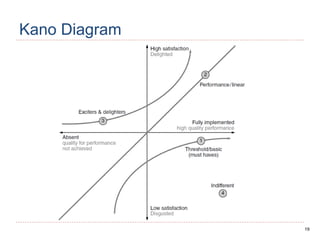
Classifying Customer Requirements
Kano recognized that there are four levels of customer
requirements:
• Expecters: These are the basic attributes that one would expect
to see in the product, i.e., standard features.
• Spokens: These are the specific features that customers say
they want in the product.
• Unspokens: These are product attributes the customer does not
generally talk about, but they remain important to him or her.
• Exciters: Often called delighters, these are product features that
make the product unique and distinguish it from the competition.
19
Kano Diagram
20
3.4 Gathering Information on Existing
Products
How can gathering information on existing products be done?
21
Product Dissection 1
• Observing a product during its use is one of the most
natural ways to gather information about it.
• The process of taking the object apart to see how it
works is known as both product dissection and
reverse engineering.
22
Product Dissection 2
The product dissection process includes four activities:
1) Discover the operational requirements of the product.
2) Examine how the product performs its functions.
3) Determine the relationship between parts of the product.
4) Determine the manufacturing and assembly processes used
to produce the product.
• Engineers do reverse engineering to discover information that
they cannot access any other way!
23
Product and Technical Literature
Consumer Product Literature:
• There are private nonprofit organization dedicated to informing consumers
about products (For example, Consumers Union).
Internet Shopping Sites:
• Internet sites exist to compile information for specialty products.
Technical Literature:
• In addition to information from special interest publications, there are
scholarly journals that publish research quality information.
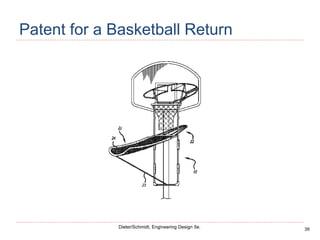
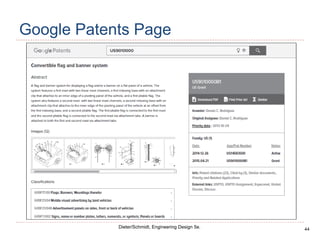
Patent Literature:
• Not all products are patented, but patent literature does include inventions
that have become successful products.
24
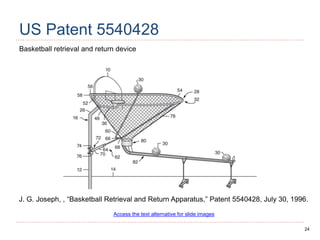
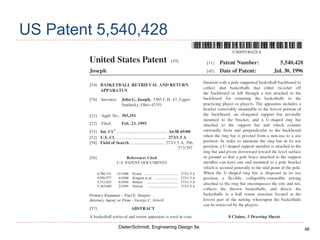
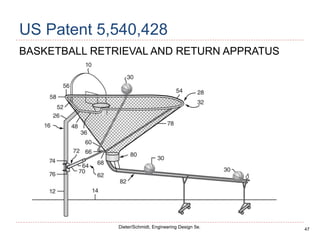
US Patent 5540428
Basketball retrieval and return device
J. G. Joseph, , “Basketball Retrieval and Return Apparatus,” Patent 5540428, July 30, 1996.
Access the text alternative for slide images
25
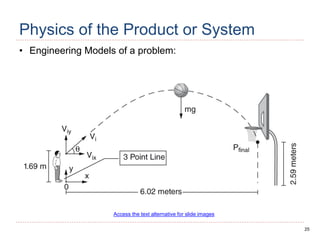
Physics of the Product or System
• Engineering Models of a problem:
Access the text alternative for slide images
26
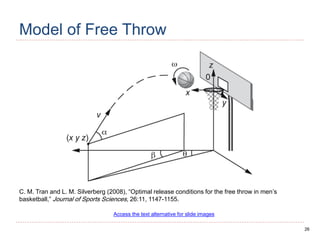
Model of Free Throw
C. M. Tran and L. M. Silverberg (2008), “Optimal release conditions for the free throw in men’s
basketball,” Journal of Sports Sciences, 26:11, 1147-1155.
Access the text alternative for slide images
27
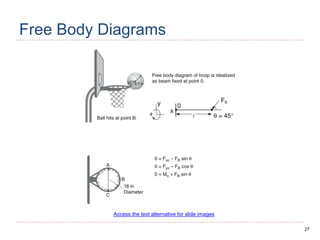
Free Body Diagrams
Access the text alternative for slide images
28
3.5 Establishing the Engineering
Characteristics
How does establishing the engineering characteristics help to write the
product design specifications?
29
Engineering Characteristics
• Establishing the engineering characteristics is a critical
step toward writing the product design specification.
• The process of identifying the needs that a product must
fill is a complicated undertaking.
• Just knowing what a customer or end user wants from a
product is not sufficient for generating designs.
• Concept generation starts when a good description of the
product is given.
• A “good description” of a product is comprised of
solution-neutral specifications.
30
Description of a Product
Design Parameters:
• Parameters are a set of physical properties whose values
determine the form and behavior of a design.
Design Variable:
• A design variable is a parameter over which the design
team has a choice.
Constraints:
• A design parameter whose value has been fixed
becomes a constraint during the design process.
31
General and Competitive Performance
Benchmarking
• Benchmarking is a process for measuring a company’s
operations against the best practices of companies both
inside and outside of their industry.
• Benchmarking operates most effectively on a quid pro
quo basis as an exchange of information between
companies that are not direct competitors.
• A company can look for benchmarks in many different
places.
32
Sources of Resistance to Benchmark
• Fear of being perceived as copiers.
• Fear of yielding competitive advantages if information is
traded/shared.
• Arrogance: A company may feel that there is nothing
useful to be learned by looking outside of the
organization.
• Impatience: Companies that engage in an improvement
program often want to begin making changes
immediately.
33
Two Initial Steps of Benchmarking
1. Select the product, process, or functional area of the
company that is to be benchmarked:
• That will influence the selection of key performance
metrics that will be measured and used for comparison.
2. Identify the best-in-class companies for each process to
benchmarked:
• A best-in-class company is one that performs the process
at the lowest cost with the highest degree of customer
satisfaction, or has the largest market share.
It is important to realize that benchmarking is not a one-
time effort.
• Benchmarking should be viewed as the first step in a
process of continuous improvement if an organization
intends to maintain operational advantages.
34
Competitive-Performance Benchmarking
• Competitive performance benchmarking involves testing a company’s
product against the best-in-class that can be found in the current
marketplace.
• The design engineer’s competitive-performance benchmarking procedure is
summarized in the following eight steps:
1. Determine features, functions, and any other factors that are the most important to end
user satisfaction.
2. Determine features and functions that are important to the technical success of the
product.
3. Determine the functions that markedly increase the costs of the product.
4. Determine the features and functions that differentiate the product from its competitors.
5. Determine which functions have the greatest potential for improvement.
6. Establish metrics by which the most important functions or features can be quantified
and evaluated.
7. Evaluate the product and its competing products using performance testing.
8. Generate a benchmarking report summarizing all information learned about the
product, data collected, and conclusions about competitors.
35
Determining Engineering Characteristics
• There is a need to translate the customer requirements into language that
expresses the parameters of interest in the language of engineering
characteristics. The set of parameters is as follows:
1. Catch area
2. Probability of jamming
3. Accuracy of ball return
4. Average time of ball return
5. Sensing position of shooter
6. Lane change time
7. Lane span
8. Energy or torque to rotate ball return subsystem
9. Weight
10. Time to install system
11. Material rigidity
12. Material toughness at attachment areas
13. Weather resistance
36
3.6 Quality Function Deployment
What is Quality Function Deployment?
37
Quality Function Deployment
Quality Function Deployment (QFD) is a planning and team
problem-solving tool that has been adopted by a wide variety of
companies as the tool of choice for focusing a design team’s
attention on satisfying customer needs throughout the product
development process.
The term deployment in QFD refers to the fact that this method
determines the important set of requirements for each phase of
PDP planning and uses them to identify the set of technical
characteristics of each phase that most contribute to the
satisfying the requirements.
• QFD process is known as a methodology for infusing the voice of the
customer into every aspect of the design process.
38
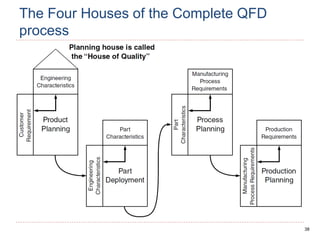
The Four Houses of the Complete QFD
process
39
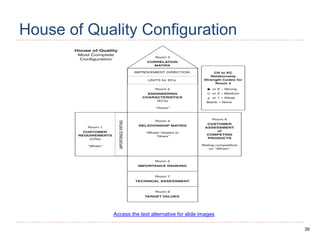
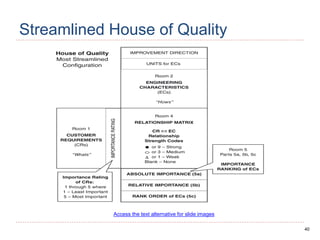
House of Quality Configuration
Access the text alternative for slide images
40
Streamlined House of Quality
Access the text alternative for slide images
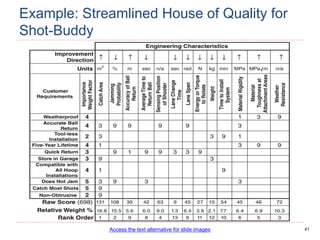
41
Example: Streamlined House of Quality for
Shot-Buddy
Access the text alternative for slide images
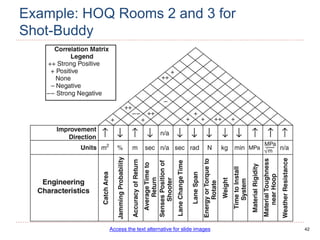
42
Example: HOQ Rooms 2 and 3 for
Shot-Buddy
Access the text alternative for slide images
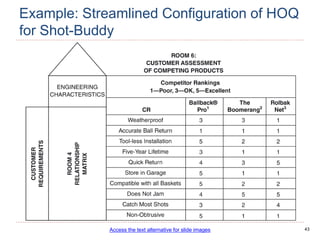
43
Example: Streamlined Configuration of HOQ
for Shot-Buddy
Access the text alternative for slide images
44
Interpreting Results of HOQ 1
• The Relationship Matrix (Room 4) provides information to review the work
on the HOQ before proceeding to determine the ranked ECs.
• An empty row signals that no ECs exist to meet the CR.
• An empty EC column signals that the characteristic is not pertinent to
customers.
• A row without a “strong relationship” to any of the ECs highlights a CR that
will be difficult to achieve.
• An EC column with too many relationships signals that it is really a cost,
reliability, or safety item that must be always considered as a constraint.
• Two EC columns similar ratings may mean that the ECs need to be
combined.
• An HOQ displaying a diagonal matrix (1:1 correspondence of CRs to ECs)
must be reviewed. 1 EC rately satisfies 1 CR.
45
Interpreting Results of HOQ 2
• The highest-ranking ECs from the HOQ are either constraints
or design variables whose values can be used as decision-
making criteria for evaluating candidate designs.
• If a high-ranking EC has only a few possible candidate values
then it may be appropriate to treat that EC as a constraint.
• There are certain design parameters that can only take a few
discreet values.
• The lowest-ranking ECs of the HOQ are not as critical to the
success of the design. These ECs allow freedom during the
design process because their values can be set according to
priorities of the designer or approving authority.
46
3.7 Product Design Specification
What is product design specification?
47
Product Design Specification 1
• In the product development process, the results of the
design planning process that governs the engineering
design tasks are compiled in the form of a set of product
design specification (PDS).
• The PDS is the basic control and reference document for
the design and manufacture of the product.
• The PDS is a document that contains all of the facts
related to the outcome of the product development.
• Creating the PDS finalizes the process of establishing
the customer needs and wants, prioritizing them, and
beginning to cast them into a technical framework so that
design concepts can be established.
48
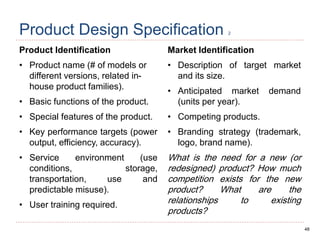
Product Design Specification 2
Product Identification
• Product name (# of models or
different versions, related in-
house product families).
• Basic functions of the product.
• Special features of the product.
• Key performance targets (power
output, efficiency, accuracy).
• Service environment (use
conditions, storage,
transportation, use and
predictable misuse).
• User training required.
Market Identification
• Description of target market
and its size.
• Anticipated market demand
(units per year).
• Competing products.
• Branding strategy (trademark,
logo, brand name).
What is the need for a new (or
redesigned) product? How much
competition exists for the new
product? What are the
relationships to existing
products?
49
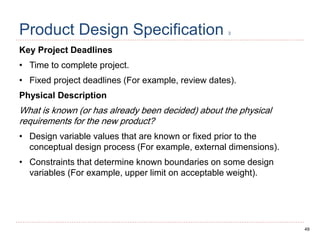
Product Design Specification 3
Key Project Deadlines
• Time to complete project.
• Fixed project deadlines (For example, review dates).
Physical Description
What is known (or has already been decided) about the physical
requirements for the new product?
• Design variable values that are known or fixed prior to the
conceptual design process (For example, external dimensions).
• Constraints that determine known boundaries on some design
variables (For example, upper limit on acceptable weight).
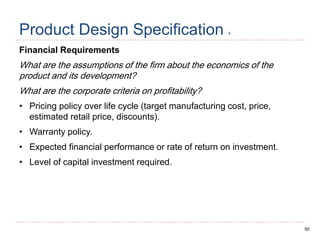
50
Product Design Specification 4
Financial Requirements
What are the assumptions of the firm about the economics of the
product and its development?
What are the corporate criteria on profitability?
• Pricing policy over life cycle (target manufacturing cost, price,
estimated retail price, discounts).
• Warranty policy.
• Expected financial performance or rate of return on investment.
• Level of capital investment required.
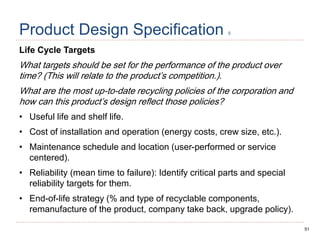
51
Product Design Specification 5
Life Cycle Targets
What targets should be set for the performance of the product over
time? (This will relate to the product’s competition.).
What are the most up-to-date recycling policies of the corporation and
how can this product’s design reflect those policies?
• Useful life and shelf life.
• Cost of installation and operation (energy costs, crew size, etc.).
• Maintenance schedule and location (user-performed or service
centered).
• Reliability (mean time to failure): Identify critical parts and special
reliability targets for them.
• End-of-life strategy (% and type of recyclable components,
remanufacture of the product, company take back, upgrade policy).
52
Product Design Specification 6
Social, Political, and Legal Requirements
Are there government agencies, societies, or regulation boards that
control the markets in which this product is to be launched?
Are there opportunities to patent the product or some of its
subsystems?
• Safety and environmental regulations. Applicable government
regulations for all intended markets.
• Standards. Pertinent product standards that may be applicable
(Underwriters Laboratories, OSHA).
• Safety and product liability. Predictable unintended uses for the
product, safety label guidelines, applicable company safety
standards.
• Intellectual property. Patents related to product. Licensing strategy
for critical pieces of technology.
53
Product Design Specification 7
Manufacturing Specifications
Which parts or systems will be manufactured in-house?
• Manufacturing requirements. Processes and capacity necessary to
manufacture final product.
• Suppliers. Identify key suppliers and procurement strategy for
purchased parts.
End of Main Content
Team Behavior and Tools
Chapter 4
2
4.1 Introduction
How can we be an effective team member?
3
Dieter/Schmidt, Engineering Design 5e.
Benefits of Teamwork
• A diversity of teammates with different educations
and life experiences results in a knowledge base
that is broader and often more creative than a single
individual
• By team members taking on different tasks and
responsibilities, the work gets finished more quickly.
4
Dieter/Schmidt, Engineering Design 5e.
Objectives
• To provide time-tested tips and advice for becoming
an effective team member.
• To introduce a set of problem-solving tools that are
useful in carrying our design project, as well as
everyday life.
• To emphasize the importance of project planning to
success in design, and to provide some ideas of how
to increase skill in this activity.
5
4.2 What It Means to Be an Effective
Team Member
Who is an effective team member?
6
Dieter/Schmidt, Engineering Design 5e.
A Good Team Member
There is a set of attitudes and work habits that you need to
adopt to be a good team member:
• Take responsibility for the success of the team.
• Be a person who delivers on commitments.
• Be a contributor to discussions.
• Give your full attention to whomever is speaking and
demonstrate this by asking helpful questions.
• Develop techniques for getting your message across the
team.
• Learn to give and receive useful feedback.
7
Dieter/Schmidt, Engineering Design 5e.
Characteristics of an Effective Team
• Team goals are as important as individual goals.
• The team understands the goals and is committed to
achieving them.
• Trust replaces fear, and people feel comfortable taking risks.
• Respect, collaboration, and open-mindedness are prevalent.
• Team members communicate readily; diversity of opinions is
encouraged.
• Decisions are made by consensus and have the acceptance
and support of the members of the team.
8
4.3 Team Leadership Roles
Who is a good team leader?
9
Dieter/Schmidt, Engineering Design 5e.
Student Design versus Business World Team
Student Design teams differ in several important
respects from a team in the business world:
• Team members are all close to the same age and level of
formal education.
• Team members are peers, and no one has authority over
the other team members.
• Team members often prefer to work without a designated
leader in a shared leadership environment.
10
Dieter/Schmidt, Engineering Design 5e.
Team Sponsor
• An important role that is external to the team but vital
to its performance is the team sponsor.
• The team sponsor is the manager who has the need
for the output of the team. In the case of the student
design project the sponsor is the course instructor or
a representative from a company proposing the
project.
• The team sponsor selects the team leader,
negotiates the participation of team members,
provides any special resources needed by the team,
and formally commissions the team.
11
Dieter/Schmidt, Engineering Design 5e.
Team Leader
The team leader convenes and chairs the team meetings
using effective meeting management practices.
He or she guides and manages the day-to-day activity of
the team by:
• Tracking the team’s accomplishment toward stated goals.
• Helping team members to develop their skills.
• Communicating with the sponsor about progress.
• Trying to remove barriers toward progress.
• Helping to resolve conflict within the team.
12
Dieter/Schmidt, Engineering Design 5e.
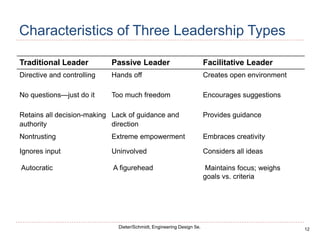
Characteristics of Three Leadership Types
Traditional Leader Passive Leader Facilitative Leader
Directive and controlling Hands off Creates open environment
No questions—just do it Too much freedom Encourages suggestions
Retains all decision-making
authority
Lack of guidance and
direction
Provides guidance
Nontrusting Extreme empowerment Embraces creativity
Ignores input Uninvolved Considers all ideas
Autocratic A figurehead Maintains focus; weighs
goals vs. criteria
13
Dieter/Schmidt, Engineering Design 5e.
Team Facilitator (often found in business)
The team facilitator is a person trained in group
dynamics who assists the leader and the team in
achieving its objectives by:
• Coaching them in team skills.
• Problem-solving tools.
• Assisting in data-collection activities.
While the facilitator functions as a team member in
most respects, she or he must remain neutral in team
discussions.
A key role of the facilitator is to keep the group focused
on its task.
14
4.4 Team Dynamics
What are the stages of team development?
15
Dieter/Schmidt, Engineering Design 5e.
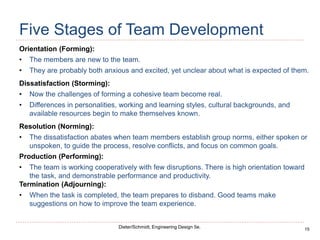
Five Stages of Team Development
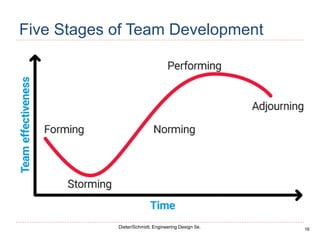
Orientation (Forming):
• The members are new to the team.
• They are probably both anxious and excited, yet unclear about what is expected of them.
Dissatisfaction (Storming):
• Now the challenges of forming a cohesive team become real.
• Differences in personalities, working and learning styles, cultural backgrounds, and
available resources begin to make themselves known.
Resolution (Norming):
• The dissatisfaction abates when team members establish group norms, either spoken or
unspoken, to guide the process, resolve conflicts, and focus on common goals.
Production (Performing):
• The team is working cooperatively with few disruptions. There is high orientation toward
the task, and demonstrable performance and productivity.
Termination (Adjourning):
• When the task is completed, the team prepares to disband. Good teams make
suggestions on how to improve the team experience.
16
Dieter/Schmidt, Engineering Design 5e.
Five Stages of Team Development
17
Dieter/Schmidt, Engineering Design 5e.
Important Team Challenges 1
Safety:
• Are the members of the team safe from destructive personal attacks?
• Can team members freely speak and act without feeling threatened?
Inclusion:
• Team members need to be allowed equal opportunities to participate.
• Rank is not important inside the team.
Appropriate level of interdependence:
• Is there an appropriate balance between the individuals’ needs and the
team needs?
Cohesiveness:
• Is there appropriate bonding between members of the team?
18
Dieter/Schmidt, Engineering Design 5e.
Important Team Challenges 2
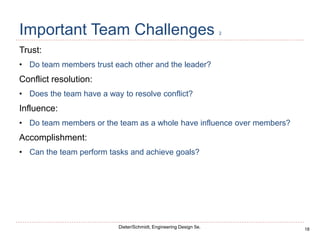
Trust:
• Do team members trust each other and the leader?
Conflict resolution:
• Does the team have a way to resolve conflict?
Influence:
• Do team members or the team as a whole have influence over members?
Accomplishment:
• Can the team perform tasks and achieve goals?
19
Dieter/Schmidt, Engineering Design 5e.
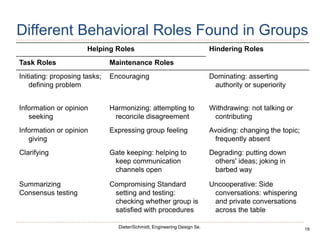
Different Behavioral Roles Found in Groups
Helping Roles Hindering Roles
Task Roles Maintenance Roles
Initiating: proposing tasks;
defining problem
Encouraging Dominating: asserting
authority or superiority
Information or opinion
seeking
Harmonizing: attempting to
reconcile disagreement
Withdrawing: not talking or
contributing
Information or opinion
giving
Expressing group feeling Avoiding: changing the topic;
frequently absent
Clarifying Gate keeping: helping to
keep communication
channels open
Degrading: putting down
others' ideas; joking in
barbed way
Summarizing
Consensus testing
Compromising Standard
setting and testing:
checking whether group is
satisfied with procedures
Uncooperative: Side
conversations: whispering
and private conversations
across the table
20
4.5 Effective Team Meetings
How can team meetings help?
21
Dieter/Schmidt, Engineering Design 5e.
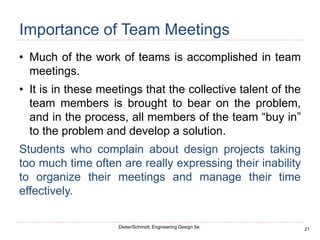
Importance of Team Meetings
• Much of the work of teams is accomplished in team
meetings.
• It is in these meetings that the collective talent of the
team members is brought to bear on the problem,
and in the process, all members of the team “buy in”
to the problem and develop a solution.
Students who complain about design projects taking
too much time often are really expressing their inability
to organize their meetings and manage their time
effectively.
22
Dieter/Schmidt, Engineering Design 5e.
Planning for Meeting Success
Successful meetings are planned.
Meeting leader prepares an agenda:
• Topics listed.
• Presenter and allotted time for each topic.
Team leader directs meeting without controlling it.
Discussion begins when the team understand the issue.
Every member contribute to the discussion
Decisions are the result of consensus.
23
Dieter/Schmidt, Engineering Design 5e.
Helpful Rules for Meeting Success
1. Pick a regular meeting location and try not to change it.
2. Pick a meeting location that:
• Is agreeable, accessible to all, and conducive to work!
• Has breathing room when there is full attendance!
• Has a pad and easel in the room!
• Is not too hot, too cold, or too close to noisy distractions!
3. Regular meeting times are not as important as confirming the
time of meetings.
4. Send an email reminder to team members just before the first
of several meeting.
5. If you send materials out in advance of a meeting, bring extra
copies.
6. Start on time!
7. Pass out an agenda at the beginning of the meeting and get
the team’s concurrence with the agenda.
24
Dieter/Schmidt, Engineering Design 5e.
Helpful Rules for Meeting Success
8. Rotate the responsibility for writing summaries of each meeting:
• when did the team meet and who attended,
• what were the issues discussed (in outline form),
• decisions, agreements, or apparent consensus on issues,
• next meeting date and time,
• action items, with assignment to team members for completion by the next meeting.
9. Notice members who come late, leave early, or miss meetings.
10. Observe team members who are not speaking.
11. Occasionally use meeting evaluations to gather anonymous
feedback on how the group is working together.
12. Do not bring guests or staff support or add team members without
seeking the permission of the team.
13. Avoid canceling meetings!
14. End every meeting by creating a list of action items.
15. Follow up with any person who does not attend.
25
Dieter/Schmidt, Engineering Design 5e.
Factors to Have Smooth Team Operation
Create a team roster:
• Ask team members to verify mailing addresses, e-mail
addresses, names, and phone numbers or a team website.
• Include information about the team sponsor.
• Use e-mail addresses to set up a distribution list for your
team.
Organize important material in team binders or a team
website:
• Include the team roster, team charter, essential
background information, data, critical articles, and so on.
26
4.6 Problem-Solving Tools
What are different problem-solving tools that are useful in any
problem situation?
27
Dieter/Schmidt, Engineering Design 5e.
Origin of Problem-Solving Tools
• Problem-Solving tools are effective for teams.
• Total Quality Management (TQM) is a system that
codified many of these tools.
• TQM is a popular problem-solving tool used in business.
• TQM’s tools can be applied to engineering activities.
Engineering use of TQM uses a three-phase process:
• Step 1. Problem definition.
• Step 2. Cause finding.
• Step 3. Solution finding and implementation.
28
Dieter/Schmidt, Engineering Design 5e.
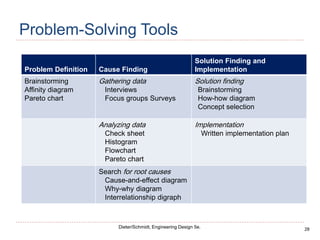
Problem-Solving Tools
Problem Definition Cause Finding
Solution Finding and
Implementation
Brainstorming
Affinity diagram
Pareto chart
Gathering data
Interviews
Focus groups Surveys
Solution finding
Brainstorming
How-how diagram
Concept selection
Analyzing data
Check sheet
Histogram
Flowchart
Pareto chart
Implementation
Written implementation plan
Search for root causes
Cause-and-effect diagram
Why-why diagram
Interrelationship digraph
29
Dieter/Schmidt, Engineering Design 5e.
Step 1. Problem Definition Tools
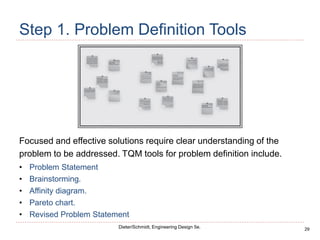
Focused and effective solutions require clear understanding of the
problem to be addressed. TQM tools for problem definition include.
• Problem Statement
• Brainstorming.
• Affinity diagram.
• Pareto chart.
• Revised Problem Statement
30
Dieter/Schmidt, Engineering Design 5e.
Problem Definition Tool: Problem Statement
• Problem definition is particularly important, since it provides the
basis for the rest of the design.
• A problem must be well understood and stated in an explicit form
before the project team proceeds with the rest of the design.
• Recognition of the problem is normally stimulated by internal or
external organizational needs or requirements.
• Once the problem is recognized, its formulation should be viewed
from a systems perspective.
• For example: the team brainstormed about the question, “Why do
so few senior engineering students choose to do a research
project?”
31
Dieter/Schmidt, Engineering Design 5e.
Problem Definition Tool: Brainstorming
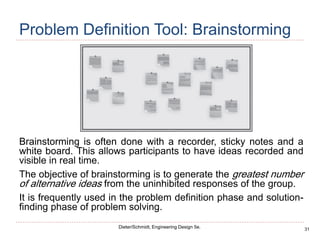
Brainstorming is often done with a recorder, sticky notes and a
white board. This allows participants to have ideas recorded and
visible in real time.
The objective of brainstorming is to generate the greatest number
of alternative ideas from the uninhibited responses of the group.
It is frequently used in the problem definition phase and solution-
finding phase of problem solving.
32
Dieter/Schmidt, Engineering Design 5e.
Brainstorming to Generate Ideas in Many
Situations
Brainstorming is a process to lead many participants
into generating problem solutions.
Key principles guide the process.
• Criticism is not allowed.
• Ideas should be picked and built upon by other
participants of the group.
• Participants reveal all ideas as they arise. The goal of
brainstorming is quantity of ideas, not quality.
A properly planned brainstorming process results in a
positive and fun session that yields many potential
ides.
33
Dieter/Schmidt, Engineering Design 5e.
Brainstorming Guidelines
Prepare a problem statement to lead off the participants.
All participants need to understand the problem.
Invite appropriate participants – all knowledgeable people
should be included in the group. This enhances the
knowledge available to the group.
Select or arrange for a facilitator – a facilitator leads the
session while upholding the key principles of the process.
The facilitator can also assure participation by all.
Identify a recorder – use a method to record all ideas so
that can be visible by all participants.
CONVENE shortly (but not immediately) after the session
to review ideas.
34
Dieter/Schmidt, Engineering Design 5e.
Example
Problem Definition Tool: Brainstorming
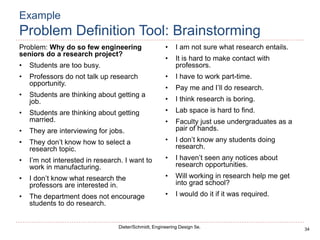
Problem: Why do so few engineering
seniors do a research project?
• Students are too busy.
• Professors do not talk up research
opportunity.
• Students are thinking about getting a
job.
• Students are thinking about getting
married.
• They are interviewing for jobs.
• They don’t know how to select a
research topic.
• I’m not interested in research. I want to
work in manufacturing.
• I don’t know what research the
professors are interested in.
• The department does not encourage
students to do research.
• I am not sure what research entails.
• It is hard to make contact with
professors.
• I have to work part-time.
• Pay me and I’ll do research.
• I think research is boring.
• Lab space is hard to find.
• Faculty just use undergraduates as a
pair of hands.
• I don’t know any students doing
research.
• I haven’t seen any notices about
research opportunities.
• Will working in research help me get
into grad school?
• I would do it if it was required.
35
Dieter/Schmidt, Engineering Design 5e.
Problem Definition Tool: Affinity Diagram
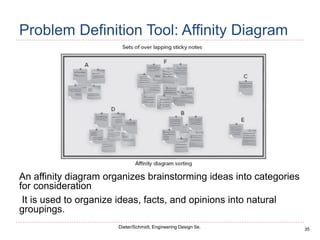
An affinity diagram organizes brainstorming ideas into categories
for consideration
It is used to organize ideas, facts, and opinions into natural
groupings.
36
Dieter/Schmidt, Engineering Design 5e.
Problem Definition Tool: Affinity Diagram
Time constraints
• Students are too busy.
• Students are interviewing for jobs.
• I have to work part-time.
Faculty issues
• Professors don’t talk up research
opportunities.
• The department does not encourage
students to do research.
• It is hard to make contact with professors.
• Faculty just use undergraduates as a pair of
hands.
Lack of interest
• Students are thinking about getting a job.
• [They are thinking about getting married.]
• I’m not interested in research. I want to work
in manufacturing.
• [Pay me and I’ll do research.]
• I think research is boring.
• I would do it if it was required.
Lack of information
• They don’t know how to select a research
topic.
• I don’t know what research the professors
are interested in.
• I’m not sure what research entails.
• I don’t know any students doing research.
• I haven’t seen any notices about research
opportunities.
• Will working in research help me get into
graduate school?
Other
• Lab space is hard to find.
37
Dieter/Schmidt, Engineering Design 5e.
Problem Definition Tool: Affinity Diagram
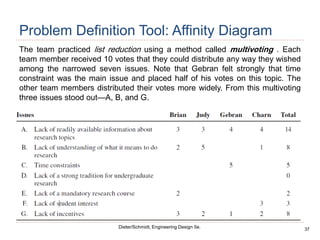
The team practiced list reduction using a method called multivoting . Each
team member received 10 votes that they could distribute any way they wished
among the narrowed seven issues. Note that Gebran felt strongly that time
constraint was the main issue and placed half of his votes on this topic. The
other team members distributed their votes more widely. From this multivoting
three issues stood out—A, B, and G.
38
Dieter/Schmidt, Engineering Design 5e.
Problem Definition Tool: Affinity Diagram
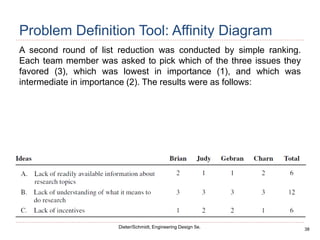
A second round of list reduction was conducted by simple ranking.
Each team member was asked to pick which of the three issues they
favored (3), which was lowest in importance (1), and which was
intermediate in importance (2). The results were as follows:
39
Dieter/Schmidt, Engineering Design 5e.
Revised Problem Statement
• Evaluation of the problem includes refinement of
needs and requirements, and information from the
evaluation phase may change the original
formulation of the problem.
• The lack of information among undergraduate engineering
students about what it means to do research, including the
lack of information on specific research opportunities with
faculty, is responsible for the low participation of students in
elective research courses.
• However, the team realized that they were but four
students, whose ideas might be different from a wider group
of engineering students. They realized that a larger
database was needed as they went into the cause-finding
stage of problem solving.
40
Dieter/Schmidt, Engineering Design 5e.
Step 2. Cause Finding Tools 1
After understanding of the problem TQM tools lead to finding the
key causes of the problem.
TQM tools designed for finding root causes:
• Survey
• Pareto Chart
• Cause-and-effect diagram.
• Why-why diagram.
• Interrelationship digraph.
41
Dieter/Schmidt, Engineering Design 5e.
Cause Finding Tool: Survey
• One hundred surveys were distributed to senior
engineering students.
• The questions were based on the A to G issues listed
previously, with issue D omitted.
• The students were asked to rank the importance of each
issue on a 1–7 Likert scale, and they were asked
whether they were interested doing a research project.
• Of the 75 surveys received from undergraduate students,
a surprising 93 percent said they were interested in doing
a research project, while 79 percent felt there was a lack
of undergraduate involvement in research. A very similar
survey was given to faculty.
42
Dieter/Schmidt, Engineering Design 5e.
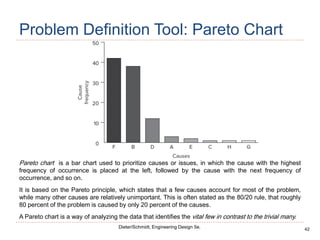
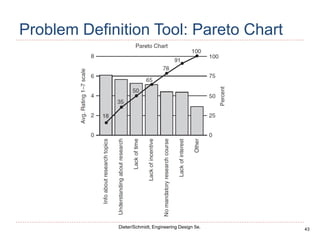
Problem Definition Tool: Pareto Chart
Pareto chart is a bar chart used to prioritize causes or issues, in which the cause with the highest
frequency of occurrence is placed at the left, followed by the cause with the next frequency of
occurrence, and so on.
It is based on the Pareto principle, which states that a few causes account for most of the problem,
while many other causes are relatively unimportant. This is often stated as the 80/20 rule, that roughly
80 percent of the problem is caused by only 20 percent of the causes.
A Pareto chart is a way of analyzing the data that identifies the vital few in contrast to the trivial many.
43
Dieter/Schmidt, Engineering Design 5e.
Problem Definition Tool: Pareto Chart
44
Dieter/Schmidt, Engineering Design 5e.
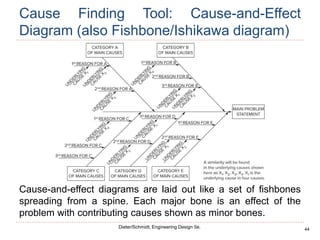
Cause Finding Tool: Cause-and-Effect
Diagram (also Fishbone/Ishikawa diagram)
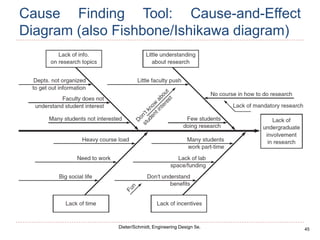
Cause-and-effect diagrams are laid out like a set of fishbones
spreading from a spine. Each major bone is an effect of the
problem with contributing causes shown as minor bones.
45
Dieter/Schmidt, Engineering Design 5e.
Cause Finding Tool: Cause-and-Effect
Diagram (also Fishbone/Ishikawa diagram)
46
Dieter/Schmidt, Engineering Design 5e.
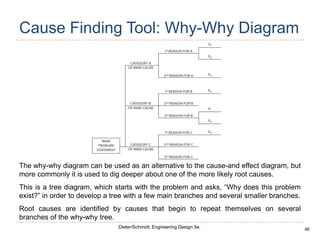
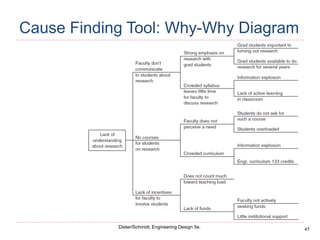
Cause Finding Tool: Why-Why Diagram
The why-why diagram can be used as an alternative to the cause-and effect diagram, but
more commonly it is used to dig deeper about one of the more likely root causes.
This is a tree diagram, which starts with the problem and asks, “Why does this problem
exist?” in order to develop a tree with a few main branches and several smaller branches.
Root causes are identified by causes that begin to repeat themselves on several
branches of the why-why tree.
47
Dieter/Schmidt, Engineering Design 5e.
Cause Finding Tool: Why-Why Diagram
48
Dieter/Schmidt, Engineering Design 5e.
Cause Finding Tool: Interrelationship
Digraph
• Interrelationship Digraph is a tool that explores the
cause-and-effect relationships among issues and
identifies the root causes.
• Start with a clear statement of the problem. The
causes that you examine with the IR digraph will be
suggested by common issues appearing in the
fishbone or why-why diagram, or that are clearly
defined by the team as being important.
• Generally try to limit the possible root causes to six.
• The cause and influence relationships are identified
by the team between each cause or factor in turn.
49
Dieter/Schmidt, Engineering Design 5e.
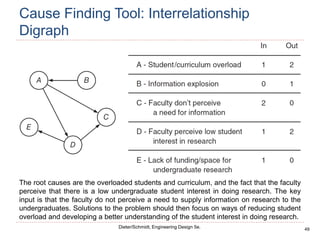
Cause Finding Tool: Interrelationship
Digraph
The root causes are the overloaded students and curriculum, and the fact that the faculty
perceive that there is a low undergraduate student interest in doing research. The key
input is that the faculty do not perceive a need to supply information on research to the
undergraduates. Solutions to the problem should then focus on ways of reducing student
overload and developing a better understanding of the student interest in doing research.
50
Dieter/Schmidt, Engineering Design 5e.
Step 3. Solution Planning and Implementation
• TQM tools exist to identify solutions and implement
them.
• Tools to identify solutions
• How-How diagram
• Force Field Analysis
• Implementation Plan
51
Dieter/Schmidt, Engineering Design 5e.
Step 3. Solution Planning and Implementation:
How-How diagram
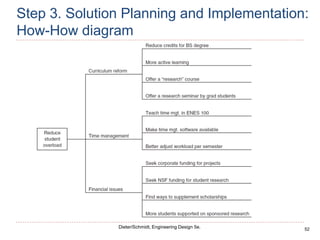
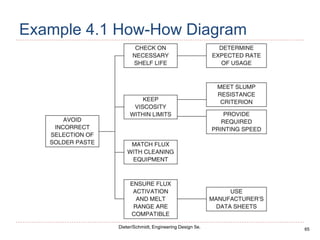
• How-How diagram – This tool is very similar to a
Why-why diagram.
• The user(s) create a horizontal tree graph beginning
with a single node that displays the proposed
solution and grows as suggestions are made on how
to accomplish the solution.
• The how-how diagram is best used after
brainstorming has generated a set of solutions
and an evaluation method has narrowed them to
a small set.
52
Dieter/Schmidt, Engineering Design 5e.
Step 3. Solution Planning and Implementation:
How-How diagram
53
Dieter/Schmidt, Engineering Design 5e.
Step 3. Solution Planning and Implementation:
Force Field Analysis
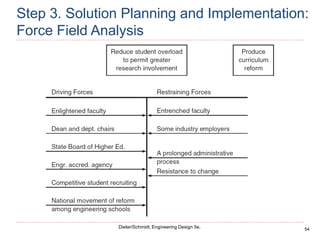
• Force field analysis is a technique that identifies
those forces that both help (drive) and hinder
(restrain) the implementation of the solution of a
problem.
• In effect, it is a chart of the pros and cons of a
solution, and as such, it helps in developing
strategies for implementation of the solution.
• This forces team members to think together about all
the aspects of making the desired change a
permanent change, and it encourages honest
reflection on the root causes of the problem and its
solution.
54
Dieter/Schmidt, Engineering Design 5e.
Step 3. Solution Planning and Implementation:
Force Field Analysis
55
Dieter/Schmidt, Engineering Design 5e.
Step 3. Solution Planning and Implementation:
Implementation Plan
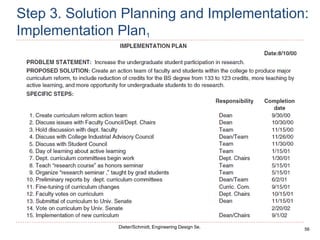
• The implementation plan takes the specific actions listed
on the how-how diagram and lists the specific steps, in
the order that must be taken.
• It also assigns responsibility to each task and gives a
required completion date. The implementation plan also
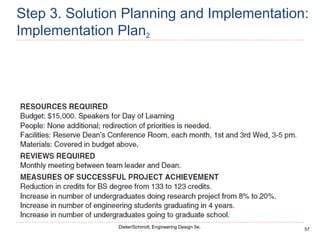
gives an estimate of the resources (money, people,
facilities, material) required to carry out the solution.
• In addition, it prescribes what level of review and
frequency of review of the solution implementation will be
followed.
• A final, but a very important part of the plan, is to list the
metrics that will measure a successful completion of the
plan.
56
Dieter/Schmidt, Engineering Design 5e.
Step 3. Solution Planning and Implementation:
Implementation Plan1
57
Dieter/Schmidt, Engineering Design 5e.
Step 3. Solution Planning and Implementation:
Implementation Plan2
58
Examples of Problem-Solving Tools
Created in Example 4.1
59
Dieter/Schmidt, Engineering Design 5e.
Example 4.1: Applying the Problem-Solving
Tools in Design
Early prototype testing of a new game box with a selected
group of energetic 10-year-olds revealed that in 20 out of
100 units the indicator light failed to function after three
weeks of active use.
Problem Definition:
• The indicator light on the SKX-7 game box does not have
the required durability to perform its function.
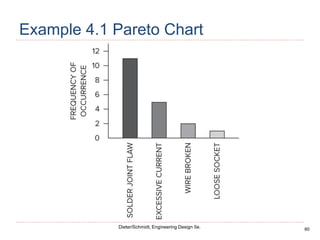
The nature of the failures could be characterized as either
a poorly made solder joints, a break in the wiring to the
bulb, a loose socket, or excessive current passing through
the filament.
60
Dieter/Schmidt, Engineering Design 5e.
Example 4.1 Pareto Chart
61
Dieter/Schmidt, Engineering Design 5e.
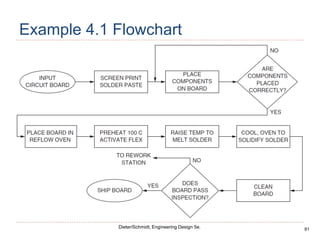
Example 4.1 Flowchart
62
Dieter/Schmidt, Engineering Design 5e.
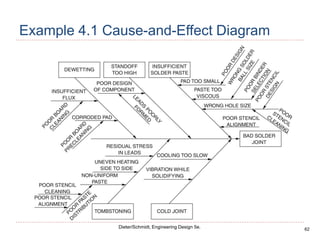
Example 4.1 Cause-and-Effect Diagram
63
Dieter/Schmidt, Engineering Design 5e.
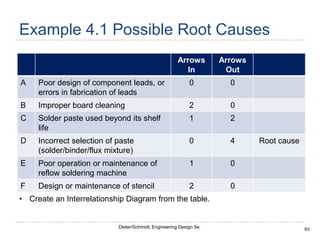
Example 4.1 Possible Root Causes
Arrows
In
Arrows
Out
A Poor design of component leads, or
errors in fabrication of leads
0 0
B Improper board cleaning 2 0
C Solder paste used beyond its shelf
life
1 2
D Incorrect selection of paste
(solder/binder/flux mixture)
0 4 Root cause
E Poor operation or maintenance of
reflow soldering machine
1 0
F Design or maintenance of stencil 2 0
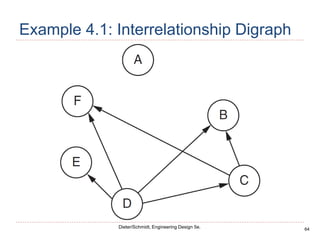
• Create an Interrelationship Diagram from the table.
64
Dieter/Schmidt, Engineering Design 5e.
Example 4.1: Interrelationship Digraph
65
Dieter/Schmidt, Engineering Design 5e.
Example 4.1 How-How Diagram
66
Dieter/Schmidt, Engineering Design 5e.
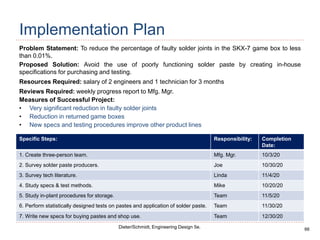
Implementation Plan
Problem Statement: To reduce the percentage of faulty solder joints in the SKX-7 game box to less
than 0.01%.
Proposed Solution: Avoid the use of poorly functioning solder paste by creating in-house
specifications for purchasing and testing.
Resources Required: salary of 2 engineers and 1 technician for 3 months
Reviews Required: weekly progress report to Mfg. Mgr.
Measures of Successful Project:
• Very significant reduction in faulty solder joints
• Reduction in returned game boxes
• New specs and testing procedures improve other product lines
Specific Steps: Responsibility: Completion
Date:
1. Create three-person team. Mfg. Mgr. 10/3/20
2. Survey solder paste producers. Joe 10/30/20
3. Survey tech literature. Linda 11/4/20
4. Study specs & test methods. Mike 10/20/20
5. Study in-plant procedures for storage. Team 11/5/20
6. Perform statistically designed tests on pastes and application of solder paste. Team 11/30/20
7. Write new specs for buying pastes and shop use. Team 12/30/20
67
4.7 Time Management
How can time management help a project?
68
Dieter/Schmidt, Engineering Design 5e.
Time
• Time is an invaluable and irreplaceable commodity.
• You will never recover the hour you squandered last
Tuesday!
• The chief difference between time management in
college and as a practicing engineer is that time
management in the world of work is less repetitive
and predictable than when you are in college.
• Effectiveness is doing the right things, but
efficiency is doing those things the right way, in the
shortest possible time!
69
Dieter/Schmidt, Engineering Design 5e.
Time-Tested Points
• Find a place for everything.
• Schedule your work.
• Stay current with the little stuff.
• Learn to say no.
• Find the “sweet spot” of time and use it.
70
4.8 Planning and Scheduling
How can planning and scheduling help a project?
71
Dieter/Schmidt, Engineering Design 5e.
Planning and Scheduling
Planning:
• Consists of identifying the key activities in a project and
ordering them in the sequence in which they should be
performed.
Scheduling:
• Consists of putting the plan into the time frame of the
calendar.
72
Dieter/Schmidt, Engineering Design 5e.
Four Major Decisions
Performance:
• The design must possess an acceptable level of operational
capability or the resources expended on it will be wasted.
Time:
• In the early phases of a project the emphasis is on accurately
estimating the length of time required to accomplish the various
tasks and scheduling to ensure that sufficient time is available to
complete those tasks.
Cost:
• Keeping costs and resources within approved limits is one of the
chief functions of the project manager.
Risk:
• Acceptable levels of risk must be established for the parameters
of performance, time, and cost, and they must be monitored
throughout the project.
73
Dieter/Schmidt, Engineering Design 5e.
Work Breakdown Structure (WBS)
Work Breakdown Structure (WBS) is a tool used to
divide a project into manageable segments to ensure
that the complete scope of work is understood.
The WBS lists the tasks that need to be done.
The tasks are expresses as outcomes (deliverables)
instead of planned actions.
Outcomes are used instead of actions because they
are easier to predict accurately at the beginning of a
project.
• Example of WBS can be seen in Table 3.4.
74
Dieter/Schmidt, Engineering Design 5e.
Work Breakdown Structure 1
1.0 Development Process for Appliance Time (Person-Weeks)
1.1 Product specification
1.1.1 Identify customer needs (market surveys, quality function
deployment [QFD])
4
1.1.2 Conduct benchmarking 2
1.1.3 Establish and approve product design specifications (PDS) 2
1.2 Concept generation
1.2.1 Develop alternative concepts 8
1.2.2 Select most suitable concept 2
1.3 Embodiment design
1.3.1 Determine product architecture 2
1.3.2 Complete part configurations 5
1.3.3 Select materials. Analyze for design for manufacture &
assembly
2
1.3.4 Design for robustness for critical to quality (CTQ)
requirements
4
1.3.5 Analyze for reliability and failure with failure modes and effects
analysis (FMEA) and root cause analysis
2
75
Dieter/Schmidt, Engineering Design 5e.
Work Breakdown Structure 2
1.0 Development Process for Appliance Time (Person-Weeks)
1.4 Detail design
1.4.1 Integration check of subsystems; tolerance analysis 4
1.4.2 Finish detail drawings and bill of materials 6
1.4.3 Prototype test results 8
1.4.4 Correct product deficiencies 4
1.5 Production
1.5.1 Design production system 15
1.5.2 Design tooling 20
1.5.3 Procure tooling 18
1.5.4 Make final adjustments to tooling 6
1.5.5 Make pilot manufacturing run 2
1.5.6 Complete distribution strategy 8
1.5.7 Ramp-up to full production 16
1.5.8 Ongoing product production 20
1.6 Life cycle tracking Ongoing
TOTAL TIME (if done sequentially) 160
76
Dieter/Schmidt, Engineering Design 5e.
Gantt Chart
This Gantt chart is made for the first three phases of the work breakdown
structure mentioned in Table 3.4.
77
Dieter/Schmidt, Engineering Design 5e.
Example 4.2: Installing a Prototype of a New
Design of Heat Transfer Tubes
• The Project Objective of a development team is to install
a prototype of a new design of heat transfer tubes in an
existing shell and determine the performance of the new
tube bundle design.
• Note that the process proceeds along two paths:
1) Remove the internals from the shell and install the new
tubes.
2) Install the wiring and instrumentation.
78
Dieter/Schmidt, Engineering Design 5e.
Example 4.2: Gantt Chart
• Gantt chart for prototype testing a heat exchanger:
79
Dieter/Schmidt, Engineering Design 5e.
Example 4.2: Network Logic Diagram
80
Dieter/Schmidt, Engineering Design 5e.
Example 4.2: Modified Gantt Chart
81
Dieter/Schmidt, Engineering Design 5e.
Critical Path Method 2
The critical path method (CPM) is is a graphical network
diagram that indicates how project activities are arranged
according to the time and precedence of other activities.
CPM focuses on identifying the potential bottlenecks in a
project schedule.
Chief definitions and rules for constructing the CPM diagram:
• An activity is a time-consuming effort that is required to perform
part of a project. An activity is shown on an arrow diagram by a
directed line segment with an arrowhead pointing in the direction
of progress in completion of the project.
• An event is the end of one activity and the beginning of another.
An event is a point of accomplishment and/or decision.
82
Dieter/Schmidt, Engineering Design 5e.
Logic Restrictions to Constructing the
Network Diagram
1) An activity cannot be started until its tail event is reached.
3) Sometimes an event is dependent on another event preceding it,
even though the two events are not linked together by an activity.
2) An event cannot be reached until all activities leading to it are
complete.
In CPM we record that situation by introducing a dummy activity. A
dummy activity requires zero time and has zero cost
83
Dieter/Schmidt, Engineering Design 5e.
Methodology for Finding the Longest Path
CPM has process to identify time needed for the project.
• D – duration of activity.
• ES – earliest start time, consider the finish times of preceding
activities.
• LS – latest start, the latest time an activity can begin without
delaying them shortest time allotted for the entire project.
• EF – earliest finish time, EF = ES + D, D is the duration of
each activity.
• LF – latest finish time, LF = LS + D.
• TF – total float, the extra time (slack) between the earliest and
latest start times, TF = LS − ES.
84
Dieter/Schmidt, Engineering Design 5e.
E XAMPLE 4.3: CPM Network for Prototype
Testing of New Heat Exchanger Design
85
Dieter/Schmidt, Engineering Design 5e.
E XAMPLE 4.3: Calculation of Early Start
Times
Event Activity ES Comment
1 A, B 0 Conventional to use ES = 0 for the initial event
2 C, D, F 3 ES2 = ES1 + D = 0 + 3 = 3
3 E, G 7 ES3 = ES1 + D = 7
4 I 12 At a merge like 4 the largest ES + D of the merging activities is used
5 H 13 ES5 = ES3 + 6 = 13
6 J 16 ES6 = ES5 + 3 = 16
7 K 18
8 — 20
86
Dieter/Schmidt, Engineering Design 5e.
E XAMPLE 4.3: Calculation of Late Start
Times
Event Activity LS
8 — 20
8–7 K 18
7–6 J 16
6–5 H 13
6–4 I 13
5–3 G 7
Event Activity LS
5–2 F 10
4–3 E 8
4–2 C 10
4–1 B 9
3–2 D 3
2–1 A 0
87
Dieter/Schmidt, Engineering Design 5e.
E XAMPLE 4.3: Summary of Scheduling
Parameters for Prototype Testing Project
Activity Description D, weeks ES LS TF
A Remove internals 3 0 0 0
B Install external wiring 4 0 9 9
C Install internal wiring 3 3 10 7
D Construct supports 4 3 3 0
E Install thermocouples 5 7 8 1
F Install heaters 3 3 10 7
G Install new tubes 6 7 7 0
H Leak test 3 13 13 0
I Check thermocouples 3 12 13 1
J Insulate 2 16 16 0
K Test prototype at temperature 2 18 18 0
88
Dieter/Schmidt, Engineering Design 5e.
CPM Using PERT
• Program evaluation and review technique (PERT) is
a method of CPM in which the duration times are not
deterministic
• PERT uses a probabilistic approach to setting the
durations of activities.
89
4.9 Summary
Attitudes and techniques
90
Dieter/Schmidt, Engineering Design 5e.
Attitudes
Under attitudes we stress:
• The importance of delivering on your commitments and of
being on time
• The importance of preparation—for a meeting, for
benchmarking tests, and so on
• The importance of giving and learning from feedback
• The importance of using a structured problem-solving
methodology
• The importance of managing your time
91
Dieter/Schmidt, Engineering Design 5e.
techniques
Team processes:
• Team guidelines (rules of the
road for teams)
• Rules for successful meetings
Problem-solving tools
(TQM):
• Brainstorming
• Affinity diagram
• Multivoting
• Pareto chart
• Cause-and-effect diagram
• Why-why diagram
• Interrelationship digraph
• How-how diagram
• Force field analysis
• Implementation plan
Scheduling tools:
• Gantt chart
• Critical path method (CPM)
92
Assignments
93
Dieter/Schmidt, Engineering Design 5e.
Assignments
• Brainstorm about uses for old newspapers
• To learn to use the TQM tools described in Sec. 4.7,
spend about four hours total of team time to arrive at
a solution for some problem that you feel there are
needs improvement. Be alert to how you can use the
TQM tools in your design project.
94
Dieter/Schmidt, Engineering Design 5e.
Assignments
The development of an electronic widget is expected to follow steps. Determine
the arrow network diagram and determine the critical path by using the CPM
technique.
End of Main Content
Gathering Information
Chapter 5
2
5.1 The Information Challenge
How important is gathering information in the design process?
3
Dieter/Schmidt, Engineering Design 5e.
Gathering Information Step Is Early in the PDP
Process and Continues Throughout
4
Dieter/Schmidt, Engineering Design 5e.
Data, Information, and Knowledge
• Data is a set of discrete, objective facts about events.
• These data may be experimental observations about the testing
of a new product, or data on sales that are part of a marketing
study.
• Information is data that has been treated in some way that
is conveys a message.
• The word inform originally meant “to give shape to.”
5
Dieter/Schmidt, Engineering Design 5e.
Ways That Data Become Information
Data becomes information when its creator adds
meaning. This can be done in the following ways:
• Contextualized: We know for what purpose the data
was gathered.
• Categorized: We know the units of analysis or key
components of the data.
• Calculated: The data have been analyzed
mathematically or statistically.
• Corrected: Errors have been removed from the data.
• Condensed: The data have been summarized in a
more concise form.
6
Dieter/Schmidt, Engineering Design 5e.
Knowledge
Knowledge is broader, deeper, and richer than data or
information.
Knowledge is a mix of experience, values, contextual information,
and expert insight that provides a framework for evaluating and
incorporating new experiences and information.
Transformation from information to knowledge happened
through:
• Comparison – with other situations one has known.
• Consequence – implications does the situation has for actions.
• Connections – relationships between bits of information.
• Conversation – what others think about this information.
7
5.2 Types Of Design Information
What types of design information?
8
Dieter/Schmidt, Engineering Design 5e.
Types of Design Information
Customer Surveys & Feedback, Marketing Data
Related Designs Specs & Drawings for previous versions
Similar designs of competitors (reverse engineering)
Analysis Methods Technical reports
Specialized computer programs, e.g. finite element analysis
Materials Performance in past designs, Properties
Manufacturing Capability of Processes, Capacity analysis
Manufacturing sources, Assembly methods
Cost Cost history, Current material & manufacturing costs
Standard Components Availability & Quality of vendors, Size & Technical Data
Technical standards ISO, ASTM, Company specific
Governmental Regulations Performance-based, Safety requirements
Life Cycle issues Maintenance/service feedback, Reliability/quality/warranty
data
9
5.3 Sources Of Design Information
What sources can engineers use to find design information?
10
Dieter/Schmidt, Engineering Design 5e.
Sources of Design Information1
Libraries Dictionaries, engineering handbooks, texts, periodicals
Internet A massive depository of information
Government
Technical reports, databases, agency-based search
engines, laws & regulations
Engineering
professional societies
& trade associations
Technical journals & news magazines, Technical
conference proceedings, Codes & standards
Intellectual property Patents, Copyrights, Trademarks
Personal activities
Buildup of knowledge, Contacts with colleagues,
Personal network, contacts with suppliers & vendors,
Attendance f conferences, Visits of other companies
Customers
Direct involvement, Surveys, Feedback from warranty
payments
11
Dieter/Schmidt, Engineering Design 5e.
Sources of Design Information2
In reviewing this list, you can divide the sources of
information into:
1. people who are paid to assist you, for example, the
company librarian or consultant,
2. people who have a financial interest in helping you,
for example, a potential supplier of equipment for
your project,
3. people who help you out of professional
responsibility or friendship, and
4. customers.
12
Dieter/Schmidt, Engineering Design 5e.
Information Literacy and the Internet
Credible information can be accessed through the Internet.
• Journal articles.
• Newspapers.
• Government reports.
Possible reasons to question quality of information that
exists only on the Web:
• Authorship may be unclear.
• Host of site can be unknown or biased.
• Information may be influenced by an advertiser.
• Web documents are not fact checked.
• Links may change over time.
13
Dieter/Schmidt, Engineering Design 5e.
Information to Determine Credibility of
Information Only on a Web Page
• Review style and design of page. Is it up to current
standards?
• Look for bibliographic information for the page. This
includes: author, title, organization name, date of
publishing, etc.
• Identify author and check credentials
• Identify Web publishing date. How current is the
information?
• Check the professionalism of the content.
14
5.4 Library Sources of Information
What are the library sources?
15
Dieter/Schmidt, Engineering Design 5e.
Types of Library Sources
Dictionaries and Encyclopedias:
• McGraw-Hill Encyclopedia of Environmental Science and
Engineering, 3d ed., McGraw-Hill, New York, 1993.
Handbooks:
• Handbook of Engineering Fundamentals.
• Handbook of Mechanical Engineering.
Textbooks and Monographs:
• Monographs are books with a narrower and more specialized
content that the books used as texts.
Periodicals.
• Periodicals are publications that are issued periodically.
Catalogs, Brochures, and Business Information
• Thomas Register of American Manufacturers (www.thomasnet.com)
16
Dieter/Schmidt, Engineering Design 5e.
Common Database for Electronic Access
Name Description
Academic Search Premier Abstracts and indexing for over 7000 journals. Many full text.
Aerospace Database Indexes journals, conferences, reports by AIAA, IEEE, ASME.
Applied Science & Technology Includes buyers guides, conf. proceedings. Most applied of group.
ASCE Database All American Society of Civil Engineers documents.
Compendex Electronic replacement for Engineering Index.
Engineered Materials Covers polymers, ceramics, composites.
General Science Abstracts Coverage of 265 leading journals in U.S. and UK.
INSPEC Covers 4000 journals in physics, EE, computing and info. techn.
Mechanical Engineering Covers 730 journals and magazines.
METADEX Covers metallurgy and materials science.
Safety Science and Risk Abstracts from 1579 periodicals.
Science Citation Index
(Web of Science)
Covers 5700 journals in 164 science and technology disciplines.
Science Direct Coverage of 1800 journals; full text for 800.
17
5.5 Government Sources of
Information
How does government help in gathering information?
18
Dieter/Schmidt, Engineering Design 5e.
Government Role in Research
In 2015 the federal government either conducted or paid for
about 35 percent of the research and performed in USA.
• That generates an enormous amount of information, mostly in the
form of technical reports.
Government-sponsored reports are only one segment of what is
known among information specialists as the gray literature.
The Government Printing Office (GPO) is the federal agency
with the responsibility of reproducing and distributing federal
documents.
Reports prepared under contract by industrial and university
R&D organizations may be obtained from the National
Technical Information Service (NTIS).
19
5.6 Information from the Internet
How can Internet information help a design project?
20
Dieter/Schmidt, Engineering Design 5e.
Google Scholar (scholar.google.com)
• Searching on Google Scholar is like doing a search for
any scholarly work (for example, by bibliographic data).
Search results can be successively narrowed by addling
additional terms.
• For example, a search for “proportional control” can
proceed as shown in the table.
Search Term Number of Results
proportional OR control 8,540,000
proportional control 4,670,000
proportional control AND engineering 2,360,000
"proportional control" 42,600
“proportional control”-temperature 18,200
21
Dieter/Schmidt, Engineering Design 5e.
Directories
Directories are collections of websites on specific
topics, like mechanical engineering or manufacturing
engineering.
Using directories narrows down the huge number of
hits you get when using a search engine.
• Virtual Library: http://vlib.org/Engineering
• Intute: www.intute.ac.uk/sciences/engineering/
• Wikipedia.com is the popular online encyclopedia.
22
Dieter/Schmidt, Engineering Design 5e.
Supply Houses
Vendors.
• McMaster-Carr Supply Co. http://www.mcmaster.com.
• Grainger Industrial Supply. http://www.grainger.com.
• MSC Industrial Supply Co. http://www1.mscdirect.com.
• Thomas Register of American Manufacturers
www.thomasnet.com.
23
Dieter/Schmidt, Engineering Design 5e.
Other Specialized Sources
Technical Information: example,
• www.howstuffworks.com.
General Websites: example,
• Business Source Complete,
• Available through EBSCO at www.ebsco.com/products/research-
databases/business-source-complete.
Marketing: example.
• North Americal Industry Classification System (NAIC).
• Standard & Poor’s Net Advantage, https://library.ccis.edu/company-
industryinfo/netadvantage.
Business Statistics Bureau of Labor Statistics.
24
5.7 Professional Societies and Trade
Associations
What do professional societies do?
25
Dieter/Schmidt, Engineering Design 5e.
Professional Societies 1
Professional societies are organized to advance a particular profession and to
honor those in the profession for outstanding accomplishments.
Engineering societies rarely lobby for specific legislation that will benefit their
membership.
Professional Societies:
• American Society of Civil Engineers (ASCE),
• American Society of Mining, Metallurgical and Petroleum Engineers (AIME),
• American Society of Mechanical Engineers (ASME),
• Institute of Electrical and Electronic Engineers (IEEE),
• American Institute of Chemical Engineers (AIChE).
• American Society of Heating Refrigerating, and Air-conditioning Engineers (ASHRAE),
• International Society for Optical Engineering (SPIE),
• Biomedical Engineering Society and the American Society for Engineering Education
(ASEE).
26
Dieter/Schmidt, Engineering Design 5e.
Professional Societies 2
• Tend to be specialized, which impedes their ability
to promote their image and represent their interests
with the federal government.
• The American Association of Engineering Societies
(AAES) is an umbrella organization that is a step
toward a coalition of engineering societies.
• The National Academy of Engineering (NAE) is
similar to the National Academy of Science (NAS).
It exists to honor outstanding members of the
profession and provide guidance to government
agencies.
27
Dieter/Schmidt, Engineering Design 5e.
Trade Associations
• American Iron and Steel Institute (AISI)
• Electric Power Research Institute (EPRI)
• National Association of Manufacturers is a multi-
industry association
• Others like the Steel Tank Institute are much more
focused and issue such things as Standards for
Inspection of Above Ground Storage Tanks.
• Yahoo gives a good listing of trade associations of
all kinds at Business→Trade Associations.
28
5.8 Codes and Standards
How can codes and standards help?
29
Dieter/Schmidt, Engineering Design 5e.
Codes, Standards, and Specifications
Codes:
• A code is a set of rules for performing some task, as in the local city
building code or fire code.
Standards:
• A standard is less prescriptive and can be defined as a set of
technical definitions and guidelines.
Specification:
• A specification describes how a system should work, and is usually
is much more specific and detailed than a standard, but sometimes it
is difficult to differentiate between documents that are called
standards and those called specifications.
30
Dieter/Schmidt, Engineering Design 5e.
ANSI, NIST, ASTM, ASME, ISO
• The American National Standards Institute (ANSI) is the coordinating
organization for the voluntary standards system for the United
States. (www.ansi.org).
• The standards responsibility of the U.S. government is carried out by
the National Institute for Standards and Technology (NIST).
• ASTM International is the major organization that prepares
standards in the field of materials and product systems.
• The ASME prepares the well-known Boiler and Pressure Vessel
Code that is incorporated into the laws of most states.
• ISO is the international organization for standardization
(www.iso.org).
31
Dieter/Schmidt, Engineering Design 5e.
DOD, DOE, OSHA, CPSC, BSI, DIN
• Department of Defense (DOD) has developed a large number of
standards, generally by the three services, Army, Navy, and Air
Force.
• Department of Energy (DOE)
• Occupational Safety and Health Administration (OSHA)
• Consumer Product Safety Commission (CPSC)
• British Standards Institution (BSI); http://www.bsigroup.com
• DIN (Deutsches Institut fur Normung), the German standards
organization. Copies of all DIN standards that have been translated
into English can be purchased from ANSI at http://webstore.ansi.org
32
5.9 Patents and Other Intellectual
Property
What is a patent? How can a patent provide information?
33
Dieter/Schmidt, Engineering Design 5e.
Patent and Other Intellectual Property
Patent:
• A patent, granted by a government, gives its owner the right to prevent
others from making, using, or selling the patented invention.
Copyright:
• A copyright gives its owner the exclusive right to publish and sell a written or
artistic work.
Trademark:
• A trademark is any name, word, symbol, or device that is used by a company
to identify its goods or services and distinguish them from those made or sold
by others.
Trade Secret:
• A trade secret is any formula, pattern, device, or compilation of information that
is used in a business to create an opportunity over competitors who do not
have this information.
34
Dieter/Schmidt, Engineering Design 5e.
Intellectual Property
Intellectual Property has received increasing attention in the high-tech
world. For example, IBM has over 40,000 patents and adds about 3000
annually.
• The technology in the information technology and telecommunication
businesses has become so complex that there is a greater
willingness to accept the innovations of other companies.
• Since the technology is moving fast there is a tendency for cutting-
edge technology to quickly change to a commodity-type business.
• Customers are demanding common standards and interoperability
between systems.
• For start-up companies, patents are important because they
represent assets that can be sold in case the company is not
successful and goes out of business.
35
Dieter/Schmidt, Engineering Design 5e.
The Patent System
Patents are so important that they were included in the
Constitution of the United States.
Three types of patents are:
• Utility patent – for artifacts that are new and useful machines,
processes, articles of manufacture, or compositions of matter.
• Design patent – for ornamental designs (not the artifact itself).
• Plant patent – for a new variety of plant.
There are three general criteria for awarding a patent:
• The invention must be new or novel. The key requirement.
• The invention must be useful.
• It must not be obvious to a person skilled in the art covered by the
patent.
36
Dieter/Schmidt, Engineering Design 5e.
Technology Licensing
• The right to exclusive use of technology that is
granted by a patent may be transferred to another
party through a licensing agreement.
• A license may be either an exclusive license, in
which it is agreed not to grant any further licenses,
or a nonexclusive license.
37
Dieter/Schmidt, Engineering Design 5e.
Patent Searches
The U.S. Patent and Trademark Office (USPTO) has
holds one of the largest collections of inventions in the
world www.uspto.gov.
The U.S. Patent system is the largest body of
information about technology in the world!
• 7 million patents exist.
• The number increases by 190,000 each year.
38
Dieter/Schmidt, Engineering Design 5e.
Patent Literature
The U.S. Patent and Trademark Office (USPTO) has been
highly computerized.
Typical reasons for making a patent search are:
• You have been asked to comment on a patent used by a
competitor.
• You are looking for ideas to improve your design concept.
• You have conceived of a novel design concept, and you want
to determine if the idea is novel enough to warrant the
expense of preparing a patent submission.
• You want to continue to update yourself on a particular
technology of interest.
39
Dieter/Schmidt, Engineering Design 5e.
Patent for a Basketball Return
40
Dieter/Schmidt, Engineering Design 5e.
Different Types of Patent Classifications:
CPC Is the Current Type for New Patents
• US Patent Classifications (USPC).
• International Patent Classification (IPC).
• European Classification (ECLA).
• Cooperative Patent Classification (CPC).
Patent classifications is a complicated subject.
Detailed information can be found in Chapter 5 of
the text.
41
Dieter/Schmidt, Engineering Design 5e.
Patent Classifications: Organization System
for Patents
Patents are issued numerically. A search of key words in
the title of a patent will yield specifically similar patents.
A different type of search is needed to find patents with
similar applications. These applications may not have the
same key words.
Classification code sorts patents by subject class. The
codes are hierarchical.
• Subject classes have been established in the past may seem
vague.
• The hierarchical nature of the classification codes allows the
addition of new applications as they are developed.
42
Dieter/Schmidt, Engineering Design 5e.
Classification Code Example
CPC Title of the Class
A HUMAN NECESSITIES
A63 – SPORTS; GAMES; AMUSEMENTS APPARATUS
FOR PHYSICAL TRAINING, GYMNASTICS,
SWIMMING,
A63B CLIMBING, OR FENCING; BALL GAMES;
TRAINING EQUIPMENT Games or sports
accessories not covered in groups A63B 1/00 –
A63B 69/00
A63B 69 (starting appliances A63K 3/02)
A63B 69/0071 . . . for basketball}
43
Dieter/Schmidt, Engineering Design 5e.
Google for Patent Search
Google patent site (patents.google.com).
Three ways to search for a patent.
• Patent number.
“USXXXXXXXB1” the patent number with prefix. Here, “US”
indicates a patent issued by the United States and “B1” refers to a
utility patent with no previous application
• Application number.
“XXXXXX” the application number for a patent.
• Classification number.
“US XX/YYYY” the classification number for the patent. The prefix
“US” signifies that the U.S. patent classification system is used. In
more recent patents the proper prefix is “CPC,” the Combined
Patent Classification system.
44
Dieter/Schmidt, Engineering Design 5e.
Google Patents Page
45
Dieter/Schmidt, Engineering Design 5e.
Reading a Patent
Because a patent is a legal document, it is organized
and written in a style much different from the style of
the usual technical paper.
Patents must stand on their own and contain sufficient
disclosure to permit the public to practice the invention
after the patent expires.
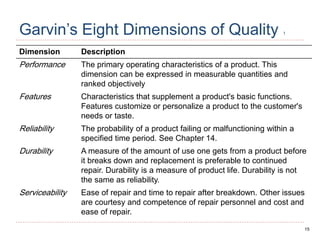
Each patent is a complete:
• Detailed explanation of the problem.
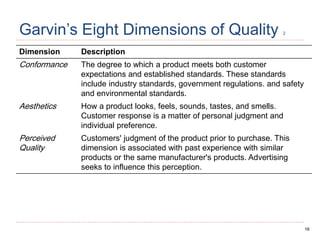
• Solution to the problem.
• The applications for the invention in practical use.
46
Dieter/Schmidt, Engineering Design 5e.
US Patent 5,540,428
47
Dieter/Schmidt, Engineering Design 5e.
US Patent 5,540,428
BASKETBALL RETRIEVAL AND RETURN APPRATUS
48
Dieter/Schmidt, Engineering Design 5e.
Copyrights
A copyright is the exclusive legal right to publish a tangible
expression of literary, scientific, or artistic work, whether it
appears in digital, print, audio, or visual form.
While the U.S. Copyright Act does not directly define fair
use, it does base it on four factors:
• The purpose and character of the use.
• The nature of the copyrighted work.
• The amount of the work used in relation to the copyrighted
work as a whole.
• The effect of the use on the potential market value of the
copyrighted work.
49
5.10 Company-Centered Information
What is the importance of gaining information by networking?
50
Dieter/Schmidt, Engineering Design 5e.
Finding Information
The degree to which individual engineers pursue
information:
• The nature of the project.
• The personality and temperament of the individual.
• Conversations are sometimes crucial to the solution of a
problem.
• The corporate culture concerning knowledge generation
and management.
• Perhaps the necessary information is known to exist but it
is classified, available only to those with a need to know.
51
Dieter/Schmidt, Engineering Design 5e.
Information Gathered in a Company
The amount of design information that can be obtained from within the
company is quite considerable and of many varieties such as:
• Product specifications.
• Concept designs for previous products.
• Test data on previous products.
• Bill of material on previous products.
• Cost data on previous projects.
• Reports on previous design projects.
• Marketing data on previous products.
• Sales data on previous products.
• Warranty reports on previous products.
• Manufacturing data.
• Design guides prepared for new employees.
• Company standards.
52
5.11 Summary
What is the importance of gaining information by networking?
53
Dieter/Schmidt, Engineering Design 5e.
Summary
• The gathering of design information is not a trivial task.
It requires knowledge of a wide spectrum of information
sources. These sources are, in increasing order of
specificity:
• The World Wide Web, and its access to digital databases
• Business catalogs and other trade literature
• Government technical reports and business data
• Published technical literature, including trade magazines
• Network of professional friends, aided by e-mail
• Network of professional colleagues at work
• Corporate consultants
54
Assignments
55
Dieter/Schmidt, Engineering Design 5e.
Assignments
• Use the indexing and abstracting services to obtain at
least 20 current references on a technical topic of
interest to you. Use appropriate indexes to find 10
government reports related to your topic.
• Find and read a technical standard on the air flow
performance characteristics of vacuum cleaners in the
ASTM Standards. List some other standards concerning
vacuum cleaners. Write a brief report about the kind of
information covered in a standard.
End of Main Content
Concept Generation
Chapter 6
2
6.1 Introduction to Creative Thinking
How does brain process information and creates thoughts?
3
Dieter/Schmidt, Engineering Design 5e.
Creativity in Engineering
Engineers are called up to solve all the challenges in
the world – and that takes creativity.
Tasks for engineers:
• Improve level of creativity.
• Learn design methods that improve ability to find creative
solutions.
Some concept generation design methods blend
engineering knowledge with creativity techniques.
No engineering activity requires more creativity than
design.
4
Dieter/Schmidt, Engineering Design 5e.
Concept Generation in PDP
5
6.2 Creativity and Problem Solving
How can creativity help design projects?
6
Dieter/Schmidt, Engineering Design 5e.
Creativity and Problem Solving
• Creative thinkers are distinguished by their ability to
synthesize new combinations of ideas and concepts into
meaningful and useful forms.
• A creative engineer is one who produces a lot of useful ideas.
• A creative person is adept at breaking a problem-solving task
down to take a fresh look at its parts, or in making connections
between the current problem and seemingly unrelated
observations or facts.
• There is the popular myth that creative ideas arrive with flash-
like spontaneity.
• A characteristic of the creative process is that initially the idea
is only imperfectly understood.
7
Dieter/Schmidt, Engineering Design 5e.
Supports to Creative Thinking1
1. Develop a creative attitude:
• To be creative it is essential to develop confidence that
you can provide a creative solution to a problem.
2. Unlock your imagination:
• Scholars of the creative process have developed
thought games.
3. Be persistent:
• Creativity often required hard work!
8
Dieter/Schmidt, Engineering Design 5e.
Supports to Creative Thinking2
4. Develop an open mind:
• Having an open mind means being receptive to ideas
from any and all sources
5. Suspend your judgment:
• Nothing inhibits the creative process more than critical
judgment of an emerging idea.
6. Set problem boundaries:
• We place great emphasis on proper problem definition
as a step toward problem solution.
9
Dieter/Schmidt, Engineering Design 5e.
Four-Stage Model of Creative Thinking
Process and Problem Solving
1. Preparation (stage 1):
• The elements of the problem are examined and their
interrelations are studied.
2. Incubation (stage 2):
• You “sleep on the problem”. Sleep disengages your conscious
mind, allowing the unconscious mind to work on a problem
freely.
3. Inspiration (stage 3):
• A solution or a path toward the solution emerges.
4. Verification (stage 4):
• The inspired solution is checked against the desired result.
10
Dieter/Schmidt, Engineering Design 5e.
Barriers to Creative Thinking
• It is important to recognize how mental blocks
interfere with creative thinking.
• A mental block is a mental wall that prevents the
problem solver from correctly perceiving a problem
or conceiving its solution.
• A mental block is an event that inhibits the
successful use of normal cognitive processes to
come to a solution.
11
Dieter/Schmidt, Engineering Design 5e.
Types of Mental Blocks
Perceptual Blocks:
• Have to do with not properly defining the problem and not
recognizing the information needed to solve it.
Emotional Blocks:
• Obstacles that are concerned with the psychological safety of
the individual.
Intellectual Blocks:
• They arise from a poor choice of the problem-solving strategy
or having inadequate background and knowledge.
Environmental Blocks:
• These are blocks that are imposed by the immediate physical
or social environment.
12
Dieter/Schmidt, Engineering Design 5e.
Perceptual Blocks 1
Stereotyping:
• Thinking conventionally or in a formulaic way about an event,
person, or way of doing something.
Information overload:
• You become so overloaded with minute details that you are unable to
sort out the critical aspects of the problem.
• “NOT BEING ABLE TO SEE THE FOREST FOR THE TREES!”
Limiting the problem unnecessarily:
• Broad statements of the problem help keep the mind open to a wider
range of ideas.
13
Dieter/Schmidt, Engineering Design 5e.
Perceptual Blocks 2
Fixation:
• People’s thinking can be influenced so greatly by their previous
experience or some other bias that they are not able to sufficiently
recognize alternative ideas.
Priming or provision of cues:
• If the thinking process is started by giving examples or solution cues,
it is possible for thinking to stay within the realm of solutions
suggested by those initial starting points.
14
Dieter/Schmidt, Engineering Design 5e.
Emotional Blocks
Fear of risk taking:
• This is the fear of proposing an idea that is ultimately found to be
faulty.
Unease with chaos:
• People in general, and many engineers in particular, are
uncomfortable with highly unstructured situations.
Inability or unwillingness to incubate new ideas:
• In our busy lives, we often don’t take the time to let ideas lie dormant
so they can incubate properly.
Motivation:
• People differ considerably in their motivation to seek creative
solutions to challenging problems.
15
Dieter/Schmidt, Engineering Design 5e.
Intellectual Blocks
Poor choice of problem-solving language or problem
representation:
• It is important to make a conscious decision concerning the
“language” for your creative problem solving.
Memory block:
• Memory holds strategies and tactics for finding solutions as well as
solutions themselves.
Insufficient knowledge base:
• Generally, ideas are generated from a person’s education and
experience.
Incorrect information:
• It is obvious that using incorrect information can lead to poor results.
16
Dieter/Schmidt, Engineering Design 5e.
Environmental Blocks
Physical environment:
• This is a very personal factor in its effects on creativity.
Criticism:
• Non-supportive remarks about your ideas can be personally
hurtful and harmful to your creativity.
17
6.3 Creative Thinking Methods
How can we improve our creativity?
18
Dieter/Schmidt, Engineering Design 5e.
Improving Creativity
Improving creativity is a popular endeavor.
Over 150 creativity improvement methods have been
cataloged
These methods are aimed at improving the following
characteristics of the problem solver:
• Sensitivity: The ability to recognize that a problem exists.
• Fluency: The ability to produce a large number of alternative
solutions to a problem.
• Flexibility: The ability to develop a wide range of approaches
to a problem.
• Originality: The ability to produce original solutions to a
problem.
19
Dieter/Schmidt, Engineering Design 5e.
Brainstorming
• Brainstorming is the most common method used by
design teams for generating ideas.
• The word brainstorming has come into general usage in
the language to denote any kind of idea generation.
• Brainstorming is a carefully orchestrated process.
• A well-done brainstorming session is an enthusiastic
session of rapid, free-flowing ideas:
• To achieve a good brainstorming session, it is important to
carefully define the problem at the start.
• An important attribute of brainstorming is to create a large number
of ideas, some of which will be creative.
• The evaluation of your ideas should be done at a meeting on a
day soon after the brainstorming session.
20
Dieter/Schmidt, Engineering Design 5e.
SCAMPER Checklist to Aid in Brainstorming
Proposed Change Description
Substitute What if used in a different material, process, person, power
source, place, or approach?
Combine Could I combine units, purposes, or ideas?
Adapt What else is like this? What other idea does it suggest? Does the
past offer a parallel? What can I copy?
Modify, magnify,
minify
Could I add a new twist? Could I change the meaning, color,
motion, form, or shape? Could I add something? Make stronger,
higher, longer, thicker? Could I subtract something?
Put to other uses Are there new ways to use this as is? If I modify it, does it have
other uses?
Eliminate Can I remove a part, function, person without affecting outcome?
Rearrange, reverse Could I interchange components? Could I use a different layout
or sequence? What if I transpose cause and effect? Could I
transpose positive and negative? What if I turn it backward,
upside down, or inside out?
21
Dieter/Schmidt, Engineering Design 5e.
Refinement and Evaluation of Ideas
• The primary purpose of the refinement and evaluation
step in concept generation is the identification of creative,
feasible, yet still practical ideas.
• The type of thinking used in refining the set of creative
ideas is more focused than the divergent type of thinking
that was used in generating creative ideas.
• The first step is to sort the ideas into feasibility
categories:
• Ideas that are feasible as they stand.
• Ideas that may have potential after more thought or research
are applied.
• Ideas that are very unfeasible and have no chance of
becoming good solutions.
22
Dieter/Schmidt, Engineering Design 5e.
Creative Idea Evaluation Process
23
Dieter/Schmidt, Engineering Design 5e.
Idea Generating Techniques Beyond Brainstorming:
Six Key Questions
1. Who?
• Who uses it, wants it, will benefit by it?
2. What?
• What happens if X occurs? What resulted in success? What resulted in failure?
3. When?
• Can it be speeded up or slowed down? Is sooner better than later?
4. Where?
• Where will X occur? Where else is possible?
5. Why?
• Why is this done? Why is that particular rule, action, solution, problem, failure
involved?
6. How?
• How could it be done, should it be done, prevented, improved, changed, made?
24
Dieter/Schmidt, Engineering Design 5e.
1. Why has the machine stopped?
• A fuse blew because of fan overload.
2. Why was there an overload?
• There was inadequate lubrication for the bearings.
3. Why wasn’t there enough lubrication?
• The lube pump wasn’t working.
4. Why wasn’t the pump working?
• The pump shaft was vibrating because it had worn due to abrasion.
5. Why was there abrasion?
• There was no filter on the lube pump, allowing debris into the pump.
Idea Generating Techniques Beyond Brainstorming:
Five Whys
25
Dieter/Schmidt, Engineering Design 5e.
A Checklist for Technological Stretching*:
• What happens if we push the conditions to the limit?
• Temperature, up or down?
• Pressure, up or down?
• Concentration, up or down?
• Impurities up or down?
* G. Thompson and M. London, “A Review of Creativity Principles Applied to Engineering Design,”
Proc. Instn. Mech. Engrs., vol. 213, part E, pp.17-31, 1999.
Idea Generating Techniques Beyond Brainstorming:
A Checklist for Technological Stretching
26
Dieter/Schmidt, Engineering Design 5e.
This can be done by posing questions in an “invitational way” so as to
encourage an upbeat, positive climate for idea generation. Typical
questions would be:
• Wouldn’t be nice if . . . . ?
• What I really want to do is . . . .
• If I did not have to consider cost, . . .
• I wish . . .
The use of an invitational turn of phrase is critical to the success of this
approach. For example, rather than stating, “this design is too
heavy,” it would be much better to say “how can we make the design
lighter?” The first phrase implies criticism, the latter suggests
improvement for use.
Idea Generating Techniques Beyond Brainstorming:
Fantasy or Wishful Thinking
27
Dieter/Schmidt, Engineering Design 5e.
Synectics: An Inventive Method Based on
Analogy
In design, like in everyday life, many problems are solved
by analogy.
The designer recognizes the similarity between the design
under study and a previously solved problem.
Synectics is a methodology or creativity based on
reasoning by analogy.
Synectics recognizes four types of analogy:
• Direct Analogy.
• Fantasy Analogy.
• Personal Analogy.
• Symbolic Analogy.
28
Dieter/Schmidt, Engineering Design 5e.
Biomimicry
A particularly intriguing source of direct analogies is
those that are inspired by biological systems.
Biomimetic is the mimicking of biological system such
as:
• The invention of the Velcro fasteners.
The challenge for designers is twofold:
1) engineering designer are not trained in a wide variety of
biological systems.
2) the words engineers use to express behavior do not
always match words used to describe biological
systems.
29
Dieter/Schmidt, Engineering Design 5e.
Concept Map
• Concept map is a tool for the generation of ideas by
association, for organizing information in preparation for
writing a report, for generating and recording ideas during
brainstorming and in generating solution concepts.
• A concise label for the problem or issue is placed at the center
of the sheet. Then the team is asked to think about what
concepts, ideas, or factors are related to the problem.
• Write down team-generated thoughts surrounding the central problem
label.
• Underline or circle them and connect them to the central focus.
• Use an arrow to show which issue drives what.
• Create new major branches of concepts to represent major subtopics.
• If the process develops a secondary or separate map, label it and
connect it to the rest of the map.
30
Dieter/Schmidt, Engineering Design 5e.
Concept Map for the Recycling of a Metal
31
6.4 Creative Methods for Design
How does creativity fit into a design task?
32
Dieter/Schmidt, Engineering Design 5e.
Creativity Techniques for a Design
• The motivation for applying any creativity technique to a
design task is to generate as many ideas as possible.
• Quantity counts above quality, and wild ideas are
encouraged at the early stages of the design work.
• Once an initial pool of concepts for alternative designs
exists, these alternatives can be reviewed more critically.
• The goal becomes sorting out infeasible ideas.
• The team is identifying a smaller subset of ideas that can
be developed into practical solutions.
33
Dieter/Schmidt, Engineering Design 5e.
Generating Design Concepts
• Systematic methods for generating engineering designs exist.
• The task of the designer is to find the best of all possible
candidate solutions to a design task.
• Generative design is a theoretical construct that creates many
feasible alternatives to a given product design specification
(PDS).
• The set of all possible designs is an n-dimensional
hyperspace called a design space.
• The key idea to remember in design is that it is beneficial in
almost every situation to develop a number of alternative
designs that rely on different means to accomplish a desired
behavior.
34
Dieter/Schmidt, Engineering Design 5e.
Schematic of an n-dimensional design space
35
Dieter/Schmidt, Engineering Design 5e.
Systematic Methods for Designing
Some design methods are labeled as systematic because
they involve a structured process for generating design
solutions.
Systematic methods for mechanical, conceptual design
generation are:
• Functional Decomposition and Synthesis.
• Morphological Analysis.
• Theory of Inventive Problem Solving (TRIZ).
• Axiomatic Design.
• Design Optimization.
• Decision-Based Design (DBD)
36
6.5 Functional Decomposition and
Synthesis
How does functional decomposition help a design?
37
Dieter/Schmidt, Engineering Design 5e.
Functional Decomposition and Synthesis
A common strategy for solving any complex task or describing any
complex system is to decompose it into smaller units that are easier to
manage.
Decomposing must result in units that meaningfully represent the
original entity.
Mechanical design is recursive:
• That means the same design process applied to the overall product applies
to the units of the product and can be repeated until a successful outcome is
achieved.
Functional decomposition method has solution-neutrality:
• Functional decomposition is a top-down strategy where a general
description of a device is refined into more specific arrangements of
functions and sub- functions.
• It does not initially impose a design, allowing more leeway for creativity and
generates a wide variety of alternative solutions.
38
Dieter/Schmidt, Engineering Design 5e.
Physical Decomposition of a Bicycle
39
Dieter/Schmidt, Engineering Design 5e.
Creating a Physical Decomposition
• The steps to create a physical decomposition tree diagram are:
1. Define the physical system in total and draw it as the root block of a tree
diagram.
2. Identify and define the first major subassembly of the system described
by the root block and draw it as a new block below the root.
3. Identify and draw in the physical connections between the subassembly
represented by the newly drawn block and all other blocks in the next
higher level of the hierarchy in the decomposition diagram.
4. Identify and draw in the physical connections between the subassembly
and any other subassemblies on the same hierarchical level of the
diagram’s structure.
5. Examine the first subassembly block in the now complete level of the
diagram.
6. End the process when there are no more blocks anywhere in the
hierarchical diagram that can be physically decomposed in a
meaningful way.
• Physical decomposition is a top-down approach to understanding the
physical nature of the product.
40
Dieter/Schmidt, Engineering Design 5e.
Functional Representation:
Standard Flow Classes and Member Flow
Flow classes
Energy Material Signal
Human Human Status
Hydraulic Solid • Auditory.
Pneumatic Gas • Olfactory.
Mechanical Liquid • Tactile.
• Translational. Plasma • Taste.
• Rotational. Mixture • Visual.
Electrical Control
Acoustic • Analog.
Thermal • Discrete.
Electromagnetic
Chemical
Biological
R. E. Stone, “Functional Basis”, Design Engineering Lab Webpage,
designengineeringlab.org/FunctionCAD/FB.htm, accessed November 10, 2011.
41
Dieter/Schmidt, Engineering Design 5e.
Components Abstracted into Function
Blocks
42
Dieter/Schmidt, Engineering Design 5e.
Performing Functional Decomposition
• Functional decomposition produces a diagram called
a function structure.
• A function structure is a block diagram depicting
flows of energy, material, and signal as labeled
arrows taking paths between function blocks.
• The most general function structure is a single
function block description of a device.
• This type of function structure (a single function
block) is called a black box representation of a
device.
43
Dieter/Schmidt, Engineering Design 5e.
Function Structure Black Box for a
Basketball Ball Return
Note: A moving basketball will always possess direction and kinetic energy.
44
Dieter/Schmidt, Engineering Design 5e.
Function Structure for a Mechanical Pencil
45
Dieter/Schmidt, Engineering Design 5e.
Creating a Function Structure
A simplified method for creating a function structure is described in the following
steps. The example used is that of a lead pencil.
1. Identify the overall function that needs to be accomplished using function basis
terms.
2. Using everyday language, write a description of the individual functions that are
required to accomplish the overall task described in the black box.
3. Having thought about the details of accomplishing the pencil’s function described
in the black box, identify more precise functions necessary to fulfill the more
detailed description of the pencil’s function in solution-neutral language.
4. Arrange the function blocks in the order that they must take place for the desired
functions.
5. Add the energy, material, and signal flows between the function blocks.
6. Examine each block in the function structure to determine if additional energy,
material, or signal flows are necessary to perform the function
7. Review each function block again to see if additional refinement is necessary.
46
Dieter/Schmidt, Engineering Design 5e.
Function Structure for a Basketball Return
Device
47
Dieter/Schmidt, Engineering Design 5e.
Strengths and Weaknesses of Functional
Synthesis
Strengths:
• First, creating function structures forces re-representation into a
language that is useful for the manipulation for mechanical design
problems.
• Second, using a function structure to represent a design lends
functional labels to potential solution components, and these labels
serve as hints for new memory searches.
Weaknesses:
• Some products are better suited to representation and design by
functional decomposition and synthesis than are others.
• The function structure is a flow diagram where flows are connecting
different functions performed by the product the structure represents.
48
6.6 Morphological Method
How can morphology aid in design generation?
49
Dieter/Schmidt, Engineering Design 5e.
Morphological Methods
• Morphological analysis is a method for representing and
exploring all the relationships in multidimensional
problems.
• The word morphology means the study of shape and
form. Morphological analysis is a way of creating new
forms.
• Generating product design concepts from a given set of
components is one such problem.
• There are many different combinations of components that can
satisfy the same functionality required in a new product.
• Success with morphological methods requires broad
knowledge of a wide variety of components and their uses,
and the time to examine them.
50
Dieter/Schmidt, Engineering Design 5e.
Morphological Method for Design
The general morphological approach to design is
summarized in the following three steps:
1. Divide the overall design problem into simpler
subproblems.
2. Generate solution concepts for each subproblem.
3. Systematically combine sub-problem solutions into
different complete solutions and evaluate all
combinations.
51
Dieter/Schmidt, Engineering Design 5e.
Morphological Chart for Shot Buddy
Basketball Return System
Sub-problem Solution Concepts
Channel Moving
Basketball
Change Direction
of Basketball
Sense Shooter's
Position
Guide Basketball
to Return Device
Inlet
Rotate Return
Device Outlet
Toward Shooter
Catch net Sheet of flexible
material
RFID tag worn by
shooter
Funnel(net or solid
material)
Ratchet device
Plastic sheeting
with wire ribs
Solid deflector
panels
Motion sensor Set of rails None (rely on ball's
direction and
gravity)
Finger-like
converging
structure
Shaped foam Optical sensor Tube of netting Cam mechanism
Tubing (partially
open or closed)
Paddle arms Acoustic sensor Metal guide
(moving or
stationary)
Geared shaft
52
Dieter/Schmidt, Engineering Design 5e.
Sketch of Shot-Buddy Concept
Adapted from J. Davis, J. Decker, J. Maresco, S. McBee, S. Phillips, and R. Quinn, “JSR Design Final
Report: Shot-Buddy,” unpublished, ENME 472, University of Maryland, May 2010.
53
6.7 TRIZ: The Theory of Inventive
Problem Solving
What is TRIZ?
54
Dieter/Schmidt, Engineering Design 5e.
TRIZ
The Theory of Inventive Problem Solving, known by the acronym
“TRIZ,” is a problem-solving methodology tailored to provide
innovative solutions for scientific and engineering problems.
Genrich Altshuller, a Russian inventor, developed TRIZ in the
late 1940s and 1950s.
TRIZ offers four different strategies for generating an innovative
solution to a design problem:
1. Increase the “ideality” of a product or system.
2. Identify the product’s place in its evolution to ideality and force the next
step.
3. Identify key physical or technological contradictions in the product and
revise the design to overcome them using inventive principles.
4. Model a product or system using substance-field analysis and apply
candidate modifications.
55
Dieter/Schmidt, Engineering Design 5e.
Invention: Evolution to Increased Ideality
Altshuller’s examination of inventions led to his observation that
systems had a level of goodness he called ideality and that
invention result when changes were made to improve this
attribute of a product or system.
Six specific design suggestions to examine for improving the
ideality of a system are as follows:
1. Exclude auxiliary functions.
2. Exclude elements in the existing system.
3. Identify self-service functions.
4. Replace elements or parts of the total system.
5. Change the system’s basic principle of operation.
6. Utilize resources in system and surroundings.
56
Dieter/Schmidt, Engineering Design 5e.
Innovation by Overcoming Contradictions
The following list describes each innovation level and shows its
relative frequency:
• Level 1: (32%) Conventional design solutions arrived at by methods
well known in the technology area of the system.
• Level 2: (45%) Minor corrections made to an existing system by well-
known methods at the expense of some compromise in behavior.
• Level 3: (18%) Substantial improvement in an existing system that
resolves a basic behavior compromise by using the knowledge of the
same technology area; the improvement typically involves adding a
component or subsystem.
• Level 4: (4%) Solutions based on application of a new scientific
principle to eliminate basic performance compromises.
• Level 5: (1% or less) Pioneering inventions based on a discovery
outside of known science and known technology.
57
Dieter/Schmidt, Engineering Design 5e.
TRIZ List of 39 Engineering Parameters 1
Engineering Parameters Used to Represent Contradictions in TRIZ
1. Weight of moving object.
2. Weight of nonmoving object.
3. Length of moving object.
4. Length of nonmoving object.
5. Area of moving object.
6. Area of nonmoving object.
7. Volume of moving object.
8. Volume of nonmoving object.
9. Speed.
10. Force.
11. Tension, pressure.
12. Shape.
13. Stability of object.
14. Strength.
15. Durability of moving object.
16. Durability of nonmoving object.
17. Temperature.
18. Brightness.
19. Energy spent by moving object.
20. Energy spent by nonmoving object.
21. Power.
22. Waste of energy.
58
Dieter/Schmidt, Engineering Design 5e.
TRIZ List of 39 Engineering Parameters 2
Engineering Parameters Used to Represent Contradictions in TRIZ
23. Waste of substance.
24. Loss of information.
25. Waste of time.
26. Amount of substance.
27. Reliability.
28. Accuracy of measurement.
29. Accuracy of manufacturing.
30. Harmful factors acting on
object.
31. Harmful side effects.
32. Manufacturability.
33. Convenience of use.
34. Repairability.
35. Adaptability.
36. Complexity of device.
37. Complexity of control.
38. Level of automation.
39. Productivity.
59
Dieter/Schmidt, Engineering Design 5e.
TRIZ List of 40 Inventive Principles 1
Names of TRIZ Inventive Principles
1. Segmentation.
2. Extraction.
3. Local quality.
4. Asymmetry.
5. Combining.
6. Universality.
7. Nesting.
8. Counterweight.
9. Prior counteraction.
10. Prior action.
11. Cushion in advance.
12. Equipotentiality.
13. Inversion.
14. Spheroidality-Curvature.
15. Dynamicity.
16. Partial or overdone action.
17. Moving to a new dimension.
18. Mechanical vibration.
19. Periodic action.
20. Continuity of useful action.
21. Rushing through.
22. Convert harm into benefit.
60
Dieter/Schmidt, Engineering Design 5e.
TRIZ List of 40 Inventive Principles 2
Names of TRIZ Inventive Principles
23. Feedback.
24. Mediator.
25. Self-service.
26. Copying.
27. An inexpensive short-lived
object instead of an expensive
durable one.
28. Replacement of a mechanical
system.
29. Use of a pneumatic or hydraulic
construction.
30. Flexible film or thin membranes.
31. Use of porous material.
32. Change the color.
33. Homogeneity.
34. Rejecting and regenerating parts.
35. Transformation of physical and
chemical states of an object.
36. Phase transition.
37. Thermal expansion.
38. Use of strong oxidizers.
39. Inert environment.
40. Composite materials.
61
Dieter/Schmidt, Engineering Design 5e.
TRIZ Applications
• The 40 principles of TRIZ have a remarkably broad range
of application.
• Complete listings of the 40 Inventive Principles are
available in book form and online through the TRIZ
Journal website.
• There, the TRIZ principles are listed with explanations
and examples.
• The TRIZ Journal has also published listings of the
principles interpreted for non-engineering application
areas, including business, architecture, food
technology, and microelectronics, to name a few.
62
Dieter/Schmidt, Engineering Design 5e.
Five Most Frequently Used Inventive
Principles of TRIZ
• Principle 1: Segmentation.
• Principle 2: Extraction.
• Principle 10: Prior action.
• Principle 28: Replacement of mechanical system.
• Principle 35: Transformation of properties.
63
Dieter/Schmidt, Engineering Design 5e.
Principle 1: Segmentation
a. Divide an object into independent parts.
• Replace mainframe computer with personal computers.
• Replace a large truck with a truck and trailer.
• Use a work breakdown structure for a large project.
b. Make an object easy to disassemble.
c. Increase the degree of fragmentation or
segmentation.
• Replace solid shades with Venetian blinds.
• Use powdered welding metal instead of foil or rod to get
better penetration of the joint.
64
Dieter/Schmidt, Engineering Design 5e.
Principle 2: Extraction
• Separate an interfering part or property from an
object, or single out the only necessary part (or
property) of an object.
• Locate a noisy compressor outside the building
where the air is used.
• Use the sound of a barking dog, without the dog, as
a burglar alarm.
65
Dieter/Schmidt, Engineering Design 5e.
Principle 10: Prior action
• Perform the required change (fully or partially)
before it is needed.
• Prepasted wallpaper.
• Sterilize all instruments needed for a surgical procedure
on a sealed tray.
• Prearrange objects such that they can come into
action from the most convenient place and without
losing time for their delivery.
• Kanban arrangements in a just-in-time factory.
• Flexible manufacturing cell.
66
Dieter/Schmidt, Engineering Design 5e.
Principle 28: Replacement of mechanical
system
a. Replace a mechanical means with a sensory
(optical, acoustic, taste or smell) means.
• Replace a physical fence to confine a dog or cat with an
acoustic “fence” (signal audible to the animal).
• Use a bad-smelling compound in natural gas to alert
users to leakage, instead of a mechanical or electrical
sensor.
b. Use electric, magnetic, and electromagnetic fields
to interact with the object.
c. Change from static to movable fields or from
unstructured to structured.
67
Dieter/Schmidt, Engineering Design 5e.
Principle 35: Transformation of properties
a. Change an object’s physical state (e.g. to a gas,
liquid, or solid).
• Freeze the liquid centers of filled candies prior to coating
them.
• Transport oxygen or nitrogen or natural gas as a liquid,
instead of a gas, to reduce volume.
b. Change the concentration or consistency.
c. Change the degree of flexibility.
d. Change the temperature.
68
Dieter/Schmidt, Engineering Design 5e.
TRIZ Contradiction Matrix
“TRIZ 40 Principles,” www.TRIZ40.com, Solid Creativity, 2004, accessed November 10, 2011.
69
Dieter/Schmidt, Engineering Design 5e.
EXAMPLE 6.1
Metal Powder Hitting Bend in Pipe
Problem:
Metal powder flows through a
pipe and impinges on the
bend causing erosion.
Objective:
Increase the speed at which
the particles flow through the
system and at the same time
reduce the energy
requirements.
70
Dieter/Schmidt, Engineering Design 5e.
Technical Contradictions
Technical Contradictions for Improving Speed of Metal
Powder and Principles to Eliminate Them:
Improved Speed (9)
Degraded Parameter Parameter Number
Principle to be Applied to
Eliminate Contradiction
Force 10 13, 15, 19, 28
Durability 15 8, 3, 14, 26
Loss of matter 23 10, 13, 28,38
Quantity of substance 26 10, 19, 29, 38
71
Dieter/Schmidt, Engineering Design 5e.
Technical Contradictions
Solution Idea 1: Principle 13, inversion, requires the designer to look at the problem in
reverse or the other way around. In this problem, we should look at the next step of the
processing of the metal powder and see what kind of solution can come from bringing
materials for the next step to the location of the metal powder. This eliminates the
contradiction by removing the need to transport the powder through any kind of direction
changing flow.
Solution Idea 2: Principle 15, dynamicity or dynamics, suggests: (a) allowing the
characteristics of an object to change to become more beneficial to the process; and (b)
make a rigid or inflexible object moveable or adaptable. We could apply this principle by
redesigning the elbow bend in the pipe to have a higher wall thickness through the bend
so that the erosion of the inner surface will not compromise the structure of the bend.
Another option might be to make the bend area elastic so that the metal particles would
transmit some of their impact energy to deformation instead of erosion. Other
interpretations are possible.
Solution Idea 3: Principle 28, Replacement of mechanical system suggest: a. Replace a
mechanical system with an optical, acoustical, or odor system; b. Use an electrical,
magnetic, or electromagnetic field for interaction with the object; c. Replace fields.
Example: (1) stationary field change to rotating fields; (2) fixed fields become fields that
change in time; (3) random fields change to structured ones; c. Use a field in conjunction
with ferromagnetic particles.
72
Dieter/Schmidt, Engineering Design 5e.
Strengths of TRIZ
• The principles at the hear of TRIZ are based on designs
that are certified as inventive through the patent-type
system of the country of the inventor.
• The developers of T R I Z continued to expand their
database of inventive designs beyond the original
200,000.
• A dedicated TRIZ user community (including students of
Altshuller) continues to expand the examples of inventive
principles, keeping the TRIZ examples contemporary.
• The TRIZ user community has made the contradiction
matrix web-accessible through sites like The T R I Z
Journal found at www.triz-journal.com.
73
Dieter/Schmidt, Engineering Design 5e.
Weaknesses of TRIZ
• Inventive Principles are guidelines subject to designer
interpretation.
• The principles are too general for application in a
particular design domain.
• The designer must develop her own analogous design
solution for the given problem.
• There are differences in the interpretation of T R I Z
concepts.
• There are aspects of TRIZ that are less intuitive.
74
6.8 Summary
75
Dieter/Schmidt, Engineering Design 5e.
Summary
• Engineering design success requires the ability to generate concepts
that are broad in how they accomplish their functions but are also
feasible.
• Current research on creativity shows that all people naturally perform
basic intellectual functions required to find creative solutions to
problems, including design problems.
• The chapter introduced several specific methods for generating
conceptual design solutions.
• Three formal methods for design are introduced in this chapter.
• Systematic design’s functional decomposition process works on intended
behavior like physical decomposition works on the form of an existing
design.
• Morphological analysis is a method that works well with a decomposed
structure to guide in the identification of subproblem solutions that can be
combined into alternative design concepts.
• TRIZ is one of the most recognized and commercially successful design
methods today.
76
Assignments
77
Dieter/Schmidt, Engineering Design 5e.
Assignments
• Go to an online catalog of personal use items. Randomly
select two products from their inventory and combine
them into a useful innovation. Describe the key
functionality.
• Dissect a small appliance and create a physical
decomposition diagram, and create a function structure.
Write a narrative accompanying the diagram to explain
how the product works.
• Return to Example 6.1, the metal powder transport
through an elbow bend. The second engineering
parameter to improve is 19. Use the TRIZ Contradiction
Matrix to identify inventive principles and generate new
solutions to the problem.
End of Main Content
Embodiment Design
Chapter 8
2
Dieter/Schmidt, Engineering Design 5e.
Embodiment Design in PDP
3
8.1 Introduction
What is embodiment design?
4
Dieter/Schmidt, Engineering Design 5e.
Introduction
We have divided the embodiment phase of design into three
groups of:
• Product Architecture:
• Arranging the physical elements of a design in order to carry out it’s
functions
• Setting the arrangement of the physical elements of the design into
groupings, called modules.
• Configuration Design:
• The design of special-purpose parts and the selection of standard
components, like pumps or motors.
• Parametric Design:
• Determining the exact values, dimensions, or tolerances of the
components or component features that are deemed critical-to-quality.
5
8.2 Product Architecture
What is product architecture?
6
Dieter/Schmidt, Engineering Design 5e.
Product Architecture
Product architecture is the arrangement of the physical
elements of a product to carry out its required functions.
A product’s architecture is related to its function structure, but
it does not have to match it.
A product’s architecture is selected to establish the best
system for functional success once a design concept has
been chosen.
There are two entirely opposite styles of product architecture:
• Modular.
• Integral.
7
Dieter/Schmidt, Engineering Design 5e.
Integral Architecture
• In an integral architecture the implementation of functions
is accomplished by only one or a few modules.
• In integral product architectures, components perform
multiple functions.
• When a component provides more than one function it
enables function sharing.
• Integral product architecture is often adopted when
constraints of weight, space, or cost make it difficult to
achieve required performance.
• Another driver toward integration of components is the
design for manufacturing and assembly (DFMA) strategy,
which calls for minimizing the number of parts in a product.
8
Dieter/Schmidt, Engineering Design 5e.
Modular Architecture
• A modular architecture makes it easier to evolve a design
over time.
• The product can be adapted to the needs of different
customers by adding or deleting modules.
• Modular design may even be carried to the point of using
the same set of basic components in multiple products,
creating a product family.
9
Dieter/Schmidt, Engineering Design 5e.
Modularity and Mass Customization
• There is growing interest in finding ways to produce products
at a reasonable cost but also with enough variety and
customization (mass customization) so that everyone can buy
exactly what they want.
• There are four distinct strategies for using modularity:
1. Component-sharing modularity: This type of modularity exists when
a family of dissimilar products uses the same assembly or
component.
2. Component-swapping modularity: This type of modularity exists in a
product that is differentiated only by a single component or
assembly.
3. Cut-to-fit modularity: This is a customization strategy whereby a
component’s parameters or features can be adjusted within a given
range to provide a variety of products.
4. Platform modularity: This form of modularity describes products that
consist of different combinations of modules assembled on the
same basic structure.
10
8.3 Steps in Developing Product
Architecture
What are the steps in developing product architecture?
11
Dieter/Schmidt, Engineering Design 5e.
Four-Step Process for Establishing Product
Architecture
Ulrich and Eppinger propose a four-step process for
establishing product architecture:
1. Create a schematic diagram of the product.
2. Cluster the elements of the schematic.
3. Create a rough geometric layout.
4. Identify the interactions between modules.
12
Dieter/Schmidt, Engineering Design 5e.
Schematic Diagram:
Shot-Buddy Example Showing Flows
Adapted from J. Davis, J. Decker, J. Maresco, S. McBee, S. Phillips, and R. Quinn, “JSR Design Final
Report: Shot-Buddy,” unpublished, ENME 472, University of Maryland, May 2010.
13
Dieter/Schmidt, Engineering Design 5e.
Schematic Diagram:
Shot-Buddy Example Clustered into Modules
Adapted from J. Davis, J. Decker, J. Maresco, S. McBee, S. Phillips, and R. Quinn, “JSR Design Final
Report: Shot-Buddy,” unpublished, ENME 472, University of Maryland, May 2010.
14
Dieter/Schmidt, Engineering Design 5e.
Geometric Layout:
Shot-Buddy Example
Adapted from J. Davis, J. Decker, J. Maresco, S. McBee, S. Phillips, and R. Quinn, “JSR Design Final
Report: Shot-Buddy,” unpublished, ENME 472, University of Maryland, May 2010.
15
Dieter/Schmidt, Engineering Design 5e.
Define Interactions & Determine
Performance Characteristics
• The most critical task in determining a product’s
architecture is accurately modeling the interactions
between the modules and setting the performance
characteristics for the modules.
• Function happens primarily at the interfaces between
modules, and unless modules are carefully thought
out, complexity can build up at these interfaces.
• The most critical items in the module description are
the descriptions of the interfaces and the modeling of
interactions between neighboring modules.
16
Dieter/Schmidt, Engineering Design 5e.
Documentation of Module
The documentation on each module should include:
• Functional requirements.
• Drawings or sketches of the module and its component
parts.
• Preliminary component selection for the module.
• Detailed description of placement within the product.
• Detailed descriptions of interfaces with neighboring
modules.
• Accurate models for expected interactions with
neighboring modules.
17
Dieter/Schmidt, Engineering Design 5e.
Interactions Between Component Modules
There are four types of interactions possible between
component modules:
1. Spatial interactions describe physical interfaces between
modules.
2. Energy flows between modules represent another
important type of interaction.
3. Information flow between modules often takes the form of
signals to control the product’s operation or feedback
relative to that operation.
4. Material can flow between product modules if that is an
element of the product’s functionality.
18
8.4 Configuration Design
What is configuration design?
19
Dieter/Schmidt, Engineering Design 5e.
Configuration Design
• In configuration design we establish the shape and general
dimensions of components.
• Exact dimensions and tolerances are established in
parametric design.
• The term component is used in the generic sense to
include special-purpose parts, standard parts, and
standard assemblies.
• A part is characterized by its geometric features such as
holes, slots, walls, ribs, projections, fillets, and chamfers.
• The arrangement of features includes both the location
and orientation of the geometric features
20
Dieter/Schmidt, Engineering Design 5e.
Terms Used in Configuration Design
A standard part is one that has a generic function and is
manufactured routinely without regard to a particular product.
• Bolts, Washers, Rivets, and I-beams.
A special-purpose part is designed and manufactured for a specific
purpose in a specific product line.
An assembly is a collection of two or more parts.
A subassembly is an assembly that is included within another
assembly or subassembly.
A standard assembly is an assembly or subassembly that has a
generic function and is manufactured routinely.
• Electric motors, Pumps, Gearboxes.
21
Dieter/Schmidt, Engineering Design 5e.
Possible Configurations of Features
• Four possible configurations of features for a right-angle
bracket:
a. Bent from a flat plate.
b. Machined from a solid block.
c. Bracket welded from three pieces.
d. Cast bracket.
22
Dieter/Schmidt, Engineering Design 5e.
Interrelationship between Function and
Form
Adapted from D. Ullman, The Mechanical Design Process, 4th ed., McGraw-Hill, New York,2010.
23
Dieter/Schmidt, Engineering Design 5e.
Starting Steps for Configuration Design
• Review the product design specification and any
specifications developed for the particular subassembly
to which the component belongs.
• Establish the spatial constraints that pertain to the
product or the subassembly being designed.
• Create and refine the interfaces or connections between
components.
• Before spending much time on the design, answer the
following questions: Can the part be eliminated or
combined with another part?
• Can a standard part or subassembly be used?
24
Dieter/Schmidt, Engineering Design 5e.
Progression of a Design Configuration
25
Dieter/Schmidt, Engineering Design 5e.
Activities of Configuration Design
• Refining is a natural activity as we move through the design process in which
we develop more specificity about the object as we move from an abstract to a
highly detailed description.
• Patching is the activity of changing a design without changing its level of
abstraction.
• Substituting looks for other concepts, components, or features that will work in
place of the current idea.
• Combining aims to make one component replace multiple components or
serve multiple functions.
• Decomposing is the opposite approach from combining.
• Magnifying involves making some feature of a component larger relative to
adjacent components.
• Minifying involves making some feature of a component smaller.
• Rearranging involves reconfiguring the components or their features.
26
Dieter/Schmidt, Engineering Design 5e.
Details a Designer Must Consider in
Configuring a Bolted Connection
Y. Hatamura, The Practice of Machine Design, Oxford University Press, Oxford, UK, 1999, p. 78.
27
Dieter/Schmidt, Engineering Design 5e.
Analyzing and Evaluating Configuration
Designs
• The first step in analyzing the configuration design of a
part is the degree to which it satisfies the functional
requirement and product design specification (PDS).
• Alternative configuration designs of a part should be
evaluated at the same level of abstraction.
• The analysis used for this decision is fairly rudimentary,
because the objective at this stage is to select the best of
several possible configurations.
• A body of guidelines that result in best practice for design
for manufacture and design for assembly have been
developed to assist designers in this area.
28
Dieter/Schmidt, Engineering Design 5e.
Typical Design for Function 1
Factor Issues
Strength Can the part be dimensioned to keep stresses below yield levels?
Fatigue If cyclic loads, can stresses be kept below the fatigue limit?
Stress concentrations Can the part be configured to keep local stress concentration low?
Buckling Can the part be configured to prevent buckling under compressive loads?
Shock loading Will the material and structure have sufficient fracture toughness?
Strain and deformations Does part have required stiffness or flexibility ?
Creep If creep is a possibility, will it result in loss of functionality?
Thermal deformation Will thermal expansion compromise functionality? Can this be handled by
design?
Vibration Has design incorporated features to minimize vibration?
Noise Has frequency spectrum been determined, and noise abatement
considered in design?
Heat transfer Will heat generation/transfer be an issue to degrade performance?
29
Dieter/Schmidt, Engineering Design 5e.
Typical Design for Function 2
Factor Issues
Fluids transport/storage Has this been adequately considered in design ? Does it meet all
regulations?
Energy efficiency Has the design specifically considered energy consumption and efficiency?
Durability Estimated service life? How has degradation from corrosion and wear been
handled?
Reliability What is the predicted mean time to failure?
Maintainability Is the prescribed maintenance typical for this type of design? Can it be
done by the user ?
Serviceability Has a specific design study been done for this factor? Is cost for repair
reasonable?
Life-cycle costs Has a credible study been done on LCC?
Design for environment Has reuse and disposal of product been explicitly considered in the
design?
Human factors/ergonomics Are all controls/adjustments logically labeled and located?
Ease of use Are written installation and operating instructions clear?
30
Dieter/Schmidt, Engineering Design 5e.
Typical Design for Function 3
Factor Issues
Safety Does design go beyond safety regulations in preventing accidents?
Styling/aesthetics Have styling consultants adequately determined customer taste and
wants?
31
8.5 Best Practices for Configuration
Design
What is configuration design?
32
Dieter/Schmidt, Engineering Design 5e.
Best Practices for Configuration Design
• Clarity of function pertains to an unambiguous
relationship between the various functions and the
appropriate inputs and outputs of energy, material,
and information flow.
• Simplicity refers to a design that is not complex and is
easily understood and readily produced.
• Safety should be guaranteed by direct design, not by
secondary methods such as guards or warning labels.
• Minimal impact on the environment is of growing
important, and should be listed as a fourth basic
guideline.
33
Dieter/Schmidt, Engineering Design 5e.
Design Guidelines
Four special mentioned design guidelines given by Pahl
and Beitz:
• Force Transmission.
• Division of Tasks.
• Self-help.
• Stability.
G. Pahl and W. Beitz, Engineering Design: A Systematic Approach, 2d ed. English
translation by K. Wallace, Springer-Verlag, Berlin, 1996.
34
Dieter/Schmidt, Engineering Design 5e.
Force Transmission
• In mechanical systems the function of many components is
to transmit forces and moments between two points.
• This is usually accomplished through a physical
connection between components.
• The force should be accommodated in such as way as to
produce a uniformly distributed stress on the cross section
of the part.
• A method for visualizing how forces are transmitted
through components and assemblies called force-flow
visualization is to think of forces as flow lines, analogous to
low-turbulence fluid flow streamlines or magnetic flux.
35
Dieter/Schmidt, Engineering Design 5e.
Force-flow Lines and Critical Sections in A
Yoke Connection
Adapted from R. C. Juvinall, K.M. Marshek, Fundamentals of Machine Component Design, 4th ed.,
John Wiley & Sons, Hoboken, NJ, 2006.
36
Dieter/Schmidt, Engineering Design 5e.
Division of Tasks
• The question of how rigorously to adhere to the
principle of clarity of function is ever present in
mechanical design.
• A component should be designed for a single
function when the function is deemed critical and will
be optimized for robustness.
• Assigning several functions to a single component
(integral architecture) results in savings in weight,
space, and cost by may compromise the
performance of individual functions, and it may
unnecessarily complicate the design.
37
Dieter/Schmidt, Engineering Design 5e.
Self-Help
• The idea of self-help concerns the improvement of a
function by the way in which the components interact
with each other.
• A self-reinforcing element is one in which the required
effect increases with increasing need for the effect.
• A self-damaging effect is the opposite.
• A self-protecting element is designed to survive in the
event of an overload.
• One way to do this is to provide an additional force-
transmission path that takes over at high loads, or a
mechanical stop that limits deflection.
38
Dieter/Schmidt, Engineering Design 5e.
Stability
The stability of a design determines whether the
system will recover appropriately from a disturbance to
the system.
The ability of a ship to right itself in high seas is a
classic example.
Sometimes a design is purposely planned for
instability:
• Toggle device on a light switch.
39
Dieter/Schmidt, Engineering Design 5e.
Additional Design Suggestions
• Tailor the shape to the stress or load distribution.
• Avoid geometry that is prone to buckling.
• Use triangular shapes and structures.
• Don’t ignore strain considerations in design.
Figure above right J. G. Skakoon, “Detailed Mechanical Design,” ASME Press, New York, 2009, p. 114.
40
Dieter/Schmidt, Engineering Design 5e.
Interfaces and Connections
• Fixed, nonadjustable connection.
• Adjustable connection.
• Separable connection.
• Locator connection.
• Hinged or pivoting connection.
41
Dieter/Schmidt, Engineering Design 5e.
Geometrical Constraint in 2-D
J. G. Skakoon, “Detailed Mechanical Design,” ASME Press, New York, 2009.
42
Dieter/Schmidt, Engineering Design 5e.
Checklist for Configuration Design 1
Identify the likely ways the part might fail in service:
• Excessive plastic deformation.
• Fatigue failure.
• Stress Concentrations.
• Buckling
• Shock or Impact loads.
Identify likely ways that part functionality might be
compromised:
• Tolerances.
• Creep.
• Thermal deformation.
43
Dieter/Schmidt, Engineering Design 5e.
Checklist for Configuration Design 2
Materials and manufacturing issues:
• Prevent failure modes in service.
• History of use for the material.
• Form and features.
• Standard quality specifications.
• Material & manufacturing process.
Design knowledge base:
• Knowledge of the team.
• Unfortunate, unlikely, or unlucky event.
44
Dieter/Schmidt, Engineering Design 5e.
Design Catalogs
Design catalogs are collections of known and proven
solutions to design problems.
They contain a variety of information useful to design,
such as:
• Physical principles to achieve a function.
• Solutions of particular machine design problems.
• Standard components.
• Properties of materials.
45
Dieter/Schmidt, Engineering Design 5e.
Designs for Fixing and Connecting two
Components
Y. Hatamura, The Practice of Machine Design, Oxford University Press, Oxford, UK, 1999.
46
8.6 Parametric Design
What is parametric design?
47
Dieter/Schmidt, Engineering Design 5e.
Parametric Design
• In configuration design the emphasis was on starting with the product
architecture and then working out the best form of each component.
• Qualitative reasoning about physical principles and manufacturing
processes played a major role.
• In parametric design the attributes of components identified during
configuration design become the design variables for parametric
design.
• A design variable is an attribute of a part whose value is under the
control of the designer.
• This aspect of design is much more analytical than conceptual or
configuration design.
• The objective of parametric design is to set values for the design
variables that will produce the best possible design considering both
performance and cost.
48
Dieter/Schmidt, Engineering Design 5e.
Systematic Steps in Parametric Design
• Step 1: Formulate the parametric design problem.
• Step 2: Generate alternative designs.
• Step 3: Analyze the alternative designs.
• Step 4: Evaluate the results of the analyses.
• Step 5: Refine/Optimize.
49
Dieter/Schmidt, Engineering Design 5e.
Design for Manufacturing (DFM) and Design
for Assembly (DFA)
• It is imperative that during embodiment design decisions
concerning shape, dimensions, and tolerances be closely
integrated with manufacturing and assembly decisions.
• This is achieved by having a member of the manufacturing
staff as part of the design team.
• Generalized DFM and DFA guidelines have been developed.
• Many companies have specific guidelines in their design
manuals.
• The reason for the strong emphasis on DFM/DFA is the
realization by U.S. manufacturers in the 1980s that
manufacturing needs to be linked with design to produce
quality and cost-effective designs.
50
Dieter/Schmidt, Engineering Design 5e.
Failure Modes and Effect Analysis (FMEA)
• A failure is any aspect of the design or manufacturing process
that renders a component, assembly, or system incapable of
performing its intended function.
• FMEA is a methodology for determining all possible ways that
components can fail and establishing the effect of failure on
the system.
• FMEA analysis is routinely performed during embodiment
design.
51
Dieter/Schmidt, Engineering Design 5e.
Design for Reliability and Safety
• Reliability is a measurement of the ability of a
component or system to operate without interruption
of service or failure in the service environment.
• It is expressed as the probability of the component
functioning for a given time without failure.
• Durability is the amount of use that a person gets out
of a product before it deteriorates.(it is a measure of
the product lifetime)
• Safety involves designing products that will not
injure people or damage property.
• A safe design is one that instills confidence in the
customer and does not incur product liability costs.
52
Dieter/Schmidt, Engineering Design 5e.
Design for Quality and Robustness
• Achieving a quality design places great emphasis on
understanding the needs and wants of the customer, In the
1980s there was the realization that the only way to ensure
quality products is to design quality into the product.
• Other contributions to design from the quality movement are the
simple total quality management tools.
• Another important tie between quality and design is the use of
statistics to set the limits on tolerances in design and the
relationship to the capability of a manufacturing process to
achieve a specified quality (defect) level.
• A robust design is one whose performance is insensitive to
variations in the manufacturing processes by which it has been
made or in the environment in which it operates.
• The methods used to achieve robustness are termed robust
design. These are basically the work of a Japanese engineer,
Genichi Taguchi.
53
8.7 Dimensions and Tolerances
How do dimensions and tolerances impact design drawings?
54
Dieter/Schmidt, Engineering Design 5e.
Dimensions 1
Dimensions are used on engineering drawing to specify
size, location, and orientation of features of components.
Dimensions are as important as the geometric information
that is conveyed by the drawing.
Each drawing must contain the following information:
• The size of each feature.
• The relative position between features.
• The required precision(tolerance) of sizing and positioning
features.
• The type of material, and how it should be processed to obtain
its expected mechanical properties.
55
Dieter/Schmidt, Engineering Design 5e.
Tolerances
• A tolerance is the acceptable variation in the dimension.
• Tolerances must be placed on a dimension or geometric feature
of a part to limit the permissible variations in size because it is
impossible to repeatedly manufacture a part exactly to a given
dimension.
56
Dieter/Schmidt, Engineering Design 5e.
Dimensions 2
Dimensions indicate size, location, and orientation of all part features.
• ASME publishes standards.
• Most recent standard for dimensioning and tolerancing are Geometric
Dimensions and Tolerances (GS&T).
57
Dieter/Schmidt, Engineering Design 5e.
Dimensions 3
58
Dieter/Schmidt, Engineering Design 5e.
Dimensions 4
59
Dieter/Schmidt, Engineering Design 5e.
Fit
• Fit describes the nature of the space between two mating
parts. There are three zones of tolerance when dealing with
fits:
1. Clearance fit – the hole is at the maximum tolerance and the shaft is
at its minimum tolerance. There is some space between the two
parts.
2. Interference fit – the shaft diameter is always larger that the hole
diameter. A press fit is needed to assemble the two pieces.
3. Transition fit – the maximum clearance is positive and the minimum
clearance is negative. Slight clearance or slight interference are the
possible results.
• Another way of stating clearance fit is to give the allowance.
Allowance is the tightest possible fit between two mating parts,
that is, the minimum clearance or the maximum interference
60
Dieter/Schmidt, Engineering Design 5e.
Fit
61
Dieter/Schmidt, Engineering Design 5e.
Tolerance Stackup
• Tolerance stackup occurs when two or more parts must be assembled in
contact. Stackup occurs from the cumulative effects of multiple tolerances
• In the worst-case tolerance design scenario the assumption is made that
the dimension of each component is at either its maximum or minimum
limit of the tolerance.
62
Dieter/Schmidt, Engineering Design 5e.
Finding Tolerance Stackup
Example 8.1
63
Dieter/Schmidt, Engineering Design 5e.
Determination of Gap and Its Tolerance:
Example 8.2
64
Dieter/Schmidt, Engineering Design 5e.
Determination of Variation Contribution of Each Part in
an Assembly (Statistical Tolerancing): Example 8.2
Part T Tolerance range  2
 % Contribution To Variation
Pin 0.005 0.010 −
 6
1.666 10 −
 6
2.777 10 80.6
Washer 0.001 0.002
−
 6
0.333 10 −
 6
0.111 10 3.2
Sleeve 0.002 0.004 −
 6
0.667 10 −
 6
0.445 10 13.0
Snap ring 0.001 0.002
−
 6
0.333 10 −
 6
0.111 10 3.2
−
 6
3.444 10
65
Dieter/Schmidt, Engineering Design 5e.
Normal Distribution (Review)
x
Z


−
=
66
Dieter/Schmidt, Engineering Design 5e.
Advanced Tolerance Analysis
• When many dimensions are involved, and the
mechanism is definitely three-dimensional, a system of
tolerance charts has been developed.
• For tolerance analysis on three-dimensional problems,
specialized computer programs are almost mandatory.
• Some of these are standalone software applications, but
most major CAD systems have packages to perform
tolerance analysis.
• They also typically support the Geometric Dimensioning
and Tolerancing (GD&T) system.
67
Dieter/Schmidt, Engineering Design 5e.
Geometric Dimensioning and Tolerancing
In engineering practice this and many other tolerance issues
are described and specified by a system of Geometric
Dimensioning and Tolerancing (GD&T) based on ASME
standard Y14.5–2009.
GD&T is a universal design language to precisely convey
design intent.
Two important pieces of information in an engineering
drawing brought by GD&T:
• It clearly defines the datum surfaces from which dimensions are
measured.
• It specifies a tolerance zone that must contain all points of a
geometric feature.
68
Dieter/Schmidt, Engineering Design 5e.
Datum
• Datums are theoretically perfect points, lines, and planes
that establish the origin from which the location of
geometric features of a part is determined.
• A part has six degrees of freedom in space.
• Depending on the complexity of the part shape there may
be up to three datums.
• The primary datum, A, is usually a flat surface that
predominates in the attachment of the part with other
parts in the assembly.
• One of the other datums, B or C, must be perpendicular
to the primary datum.
69
Dieter/Schmidt, Engineering Design 5e.
Datum Feature Identifiers
70
Dieter/Schmidt, Engineering Design 5e.
Geometric Tolerances
Geometric tolerances can be defined for the following
characteristics of geometric features:
• Form:
• Flatness, straightness, circularity, cylindricity.
• Profile:
• Line, surface.
• Orientation:
• Parallelism, angularity.
• Location:
• Position, concentricity.
• Runout:
• Circular runout, total runout.
71
Dieter/Schmidt, Engineering Design 5e.
GD&T Examples 1
72
Dieter/Schmidt, Engineering Design 5e.
GD&T Examples 2
73
Dieter/Schmidt, Engineering Design 5e.
Material Condition Modifiers
Another aspect of GD&T is the ability to modify the size of the
tolerance zone of a feature depending on the size of the feature.
There are three possible material condition modifiers:
• Maximum material condition (MMC) is the condition in which an
external feature like a shaft is at its largest allowable by the size
tolerance.
• Least material condition (LMC) is the opposite of MMC, that is, a shaft
that is its smallest allowed by the size tolerance or a hole at its largest
allowable size.
• Regardless of feature size (RFS) means that the tolerance zone is the
same no matter what the size of the feature.
BONUS TOELRANCE: The increase in the tolerance zone with size of
the feature is usually called a bonus tolerance because it allows extra
flexibility in manufacturing.
74
Dieter/Schmidt, Engineering Design 5e.
Guidelines for Tolerance Design 1
• Focus on the critical-to-quality dimensions that most affect fit
and function.
• For the noncritical dimensions, use a commercial tolerance
recommended for the production process of the components.
• A possible alternative for handling a difficult tolerance problem
might be to redesign a component to move it to the noncritical
classification.
• A difficult problem with tolerance stackup often indicates that the
design is over constrained to cause undesirable interactions
between the assembled components.
• If tolerance stackup cannot be avoided, it often is possible to
minimize its impact by careful design of assembly fixtures.
75
Dieter/Schmidt, Engineering Design 5e.
Guidelines for Tolerance Design 2
• Another approach is to use selective assembly where critical
components are sorted into narrow dimensional ranges before
assembling mating components.
• Make sure that you have the agreement from manufacturing that
the product is receiving components from a well-controlled
process with the appropriate level of process capability.
• Consider carefully the establishment of the datum surfaces.
76
8.8 Industrial Design
How can we do industrial design?
77
Dieter/Schmidt, Engineering Design 5e.
Industrial Design
Industrial design, also often called just product design, is
concerned with the visual appearance of the product and
the way it interfaces with the customer.
Industrial design deals chiefly with the aspects of a product
that relate to the user:
• Aesthetics appeal:
• Aesthetics deal with the interaction of the product with the human
senses-how it looks, feels, smells, or sounds.
• Ergonomics (usability):
• This activity deals with the user interactions with the product and
making sure that it is easy to use and maintain.
78
Dieter/Schmidt, Engineering Design 5e.
Visual Aesthetics
• Aesthetics relate to our emotions.
• Since aesthetic emotions are spontaneous and develop beneath our
level of consciousness, they satisfy one of our basic human needs.
• Visual aesthetic values can be considered as a hierarchy of human
responses to visual stimuli.
Z. M. Lewalski, Product Esthetics, Design & Development Engineering Press, Carson
City, NV.
79
8.9 Human Factors Design
What is human factors design?
80
Dieter/Schmidt, Engineering Design 5e.
Human Factors Design
• Human factors is the study of the interaction between
people, the products and systems they use, and the
environments in which they work and live.
• This field also is described by the terms human factors
engineering and ergonomics.
• Human factors design applies information about human
characteristics to the creation of objects, facilities, and
environments that people use.
• Human factors expertise is found in industrial designers,
who focus on ease of use of products, and in industrial
engineers, who focus on design of production systems for
productivity.
81
Dieter/Schmidt, Engineering Design 5e.
Human Physical Effort
• Measurement of the physical effort that a man could
perform in the manual handling of materials (shoveling
coal) and supplies was one of the first studies made in
human factors engineering.
Correspondence Between Human Factors Characteristics & Product
Performance
Product Performance Human Factors Characteristic
Comfortable to use Good match between product and person in the
workspace
Easy to use Requires minimal human power; clarity of use
Operating condition easily sensed Human sensing
Product is user-friendly Control logic is natural to the human
82
Dieter/Schmidt, Engineering Design 5e.
Muscle Strength of Arm, Hand, Thumb
MIL-STD-14 72F, p. 95.
83
Dieter/Schmidt, Engineering Design 5e.
Sensory Input
• The human senses of sight, touch, hearing, taste, and
smell are chiefly used for purposes of controlling devices
or systems.
• In selecting visual displays remember that individuals
differ in their ability to see, so provide sufficient
illumination.
• Different types of visual displays differ in their ability to
provide on-off information, or exact values and rate of
change information.
84
Dieter/Schmidt, Engineering Design 5e.
Types of Visual Displays
Adapted from D. Ullman, The Mechanical Design Process, 4th ed., McGraw-Hill, New York, 2010.
85
Dieter/Schmidt, Engineering Design 5e.
Characteristics of Common Visual Displays
Adapted from D. Ullman, The Mechanical Design Process, 4th ed., McGraw-Hill, New York, 2010.
86
Dieter/Schmidt, Engineering Design 5e.
User-Friendly Design
• Simplify tasks.
• Make the controls and their functions obvious.
• Make controls easy to use.
• Match the intentions of the human with the actions required by
the system.
• Use mapping.
• Displays should be clear, visible, large enough to ready easily,
and consistent in direction.
• Provide feedback.
• Utilize constraints to prevent incorrect action.
• Standardize.
87
Dieter/Schmidt, Engineering Design 5e.
Reaction Time
• The reaction time is the time to initiate a response
when a sensory signal has been received.
• The reaction time is made up of several actions.
• We receive information in the form of a sensory
signal, interpret it in the form of a set of choices,
predict the outcomes of each choice, evaluate the
consequence of each choice, and then select the
best choice.
88
Dieter/Schmidt, Engineering Design 5e.
Anthropometric Data
• Anthropometrics is the field of human factors that deals with
the measurements of the human body.
From: MIL-STD-1472F and FAA Human Factors Design Guide.
89
Dieter/Schmidt, Engineering Design 5e.
Design for Serviceability
Serviceability is concerned with the ease with which
maintenance can be performed on a product.
There are two general classes of maintenance:
• Preventive maintenance is routine service required to prevent
operating failures, such as changing the oil in your car.
• Breakdown maintenance is the service that must take place
after some failure or decline in function has occurred.
• Testability is concerned with the ease with which faults
can be isolated in defective components and
subassemblies.
• In complicated electronic and electromechanical products,
testability must be designed into the product.
90
Dieter/Schmidt, Engineering Design 5e.
Design for Packaging
• Packaging is related to visual aesthetics because
attractive, distinctive product packaging is typically used
to attract customers and to identify product brands.
• Packaging provides physical protection against
mechanical shock, vibration, and extreme temperatures
in shipping and storage.
• Different packaging is required for liquids, gases and
powders than for solid objects.
• A shipping package provides information about the
recipient, tracking information, instructions regarding
hazardous materials, and disposal.
91
8.10 Life-Cycle Design
What is life-cycle design?
92
Dieter/Schmidt, Engineering Design 5e.
Life-Cycle Design
The worldwide concern over global warming coupled
with concerns over energy supply and stability have
moved design for the environment (DFE) to a top
consideration in design for all types of engineering
systems and consumer products.
The major issues of life-cycle design are:
• Design for packaging and shipping.
• Design for serviceability and maintenance.
• Design for testability.
• Design for disposal.
93
Dieter/Schmidt, Engineering Design 5e.
Extending Product Useful Life
• The following design strategies can be used to
extend a product’s useful life:
• Design for durability
• Design for reliability
• Create an adaptable design
• Repair
• Remanufacture
• Reuse
94
8.11 Prototyping and Testing
How can we do prototyping and testing?
95
Dieter/Schmidt, Engineering Design 5e.
Prototype
• Prototypes are physical models of the product that are tested in
some way to validate the design decisions that have been made up
to that point in the design process.
• Prototypes come in various forms and are used in different ways
throughout the design process.
• A prototype is a physical model of the product, as opposed to a
computer model (CAD model) of the product or other simulation of
the design.
• Computer modeling provides insights faster and with less cost than building
and testing a physical model or prototype.
• Finite element analysis or some other CAE tool can provide technical
answers that may not be available any other way.
• Both prototypes and computer models are valuable tools in carrying out the
design process.
96
Dieter/Schmidt, Engineering Design 5e.
Prototype & Model Testing Throughout the
Design Process
Phase Zero:
• Product Concept Model.
Conceptual Design:
• Proof-of Concept Prototype.
Embodiment Design:
• Alpha-Prototype Testing.
Detail Design:
• Beta-Prototype Testing.
Manufacturing:
• Preproduction Prototype Testing.
97
Dieter/Schmidt, Engineering Design 5e.
Rapid Prototyping
Create a CAD model.
Convert the CAD model to
the STL file format.
Slice the STL file into thin
layers.
Make the prototype.
Postprocessing:
• Removing and cleaning any
support structures.
R. Noorani, Rapid Prototyping, John Wiley & Sons, New York, 2006, p. 37.
98
Dieter/Schmidt, Engineering Design 5e.
RP Processes
Stereolithography (SL): This process uses a UV laser beam to
build up layers of solid polymer by scanning on the surface of a bath of
photosensitive polymer.
Selective laser sintering (SLS): This process was developed to
use stronger, higher-melting-temperature materials than polymers in
the RP process.
Laminated Object Modeling (LOM): This process is an older
method that continues to have useful applications because of the
simplicity of the equipment that is needed.
Fused-Deposition Modeling (DFM): This process is an example
of several liquid-state deposition processes used to make prototypes.
Three-dimensional Printing (3DP): This process is a RP process
that is based on the principle of the inkjet printer.
99
Dieter/Schmidt, Engineering Design 5e.
Student Made Prototypes
Injection Molded Part
Plastic Prototype Made by DFM
Paper Prototype Made by LOM
100
Dieter/Schmidt, Engineering Design 5e.
Test Plan
• Test plan gives a description of the types of tests to be performed, when the test will be
made in the design process, and the cost of the tests.
• Test plan should be part of the PDS.
• There are many kinds of tests that may be needed in a design project:
• Testing of design prototypes
• Modeling and simulations.
• Testing for all mechanical and electrical modes of failure.
• Specialized tests on seals, or for thermal shock, vibration, acceleration, or moisture resistance.
• Accelerated life testing. Evaluating the useful life of the critical-to-quality components.
• Testing at the environmental limits. Testing at specification extremes of temperature, pressure,
humidity, etc.
• Human engineering and repair test. Evaluate all human interfaces with actual users. Check
maintenance procedures and support equipment in a user environment.
• Safety and risk test. Determine likelihood of injury to users and prospect of product liability litigation.
Check for compliance with safety codes and standards in all countries where product will be sold.
• Built-in test and diagnostics. Evaluate the capability and quality of built-in test, self-diagnosis, and
self-maintenance systems.
• Manufacturing supplier qualification. Determine the capability of suppliers with regard to quality, on-
time delivery, and cost.
• Packaging. Evaluate the ability of the packaging to protect the product.
101
Dieter/Schmidt, Engineering Design 5e.
Statistical Design of Testing
The discipline of statistics has provided us with the tools to
do just that in the subject called Design of Experiments
(DoE). Benefits from statistically designed experiments:
• more information per experiment will be obtained than with
unplanned experimentation.
• statistical design results in an organized approach to the
collection and analysis of information.
• credibility that is given to the conclusions of an experimental
program when the variability and sources of experimental
error are made clear by statistical analysis.
• ability to confirm and quantify interactions between
experimental variables.
102
Dieter/Schmidt, Engineering Design 5e.
Different Behavior of Response y
103
Dieter/Schmidt, Engineering Design 5e.
Classes of Statistically Designed Experiments
Factorial designs:
• Experiments in which all levels of each factor in an experiment are
combined with all levels of all other factors.
Blocking designs:
• Use techniques to remove the effect of background variables from
the experimental error.
Response surface designs:
• Used to determine the empirical relation between the factors
(independent variables) and the response (performance variable).
10
4
8.12 Design for X (DFX)
What is DFX?
105
Dieter/Schmidt, Engineering Design 5e.
Design for X (DFX)
Effort has been given to improving many other “ilities” such as
manufacturability, maintainability, testability, and serviceability
The terminology to describe a design methodology became
known as Design for X, where X represents a performance
measure of design, as in:
• Design for Manufacture (DFM).
• Design for Assembly (DFA).
• Design for the Environment (DFE).
The development of the DFX methodologies was accelerated by
the growing emphasis on concurrent engineering.
Today, design improvement goals are often labeled, “Design for
X,”
106
Dieter/Schmidt, Engineering Design 5e.
Steps of DFX Strategy
• Determine the issue (X) targeted for consideration
• Determine where to place your focus: the product
as a whole, an individual component, a
subassembly, or a process plan.
• Identify methods for measuring the X characteristics
and techniques to improve them.
• The DFX strategy is implemented by insisting the
product development team focus on the X and by
using parametric measurements and improvement
techniques as early in the design process as
possible.
107
Dieter/Schmidt, Engineering Design 5e.
Design Issues
Issue Location
Cost estimation of the
product
Chaps. 16,
17
Design for X
- Assembly
- Environment
- Manufacture
- Quality
- Reliability
- Safety
- Serviceability
- Tolerances
Chap. 13
Chap. 10
Chap. 13
Chap. 15
Chap. 14
Chap. 14
Sec. 8.9.4
Sec. 8.7
Failure modes and
effect analysis
Sec. 14.5
Human factors design Sec. 8.9
Industrial design Sec. 8.8
Issue Location
Legal and regulatory
issues
Chap. 18
Life-cycle cost Secs. 8.10,
17.15
Materials selection Chap. 11
Mistake-proofing Sec. 13.8
Product liability Chap. 18
Robust design Chap. 15
Standardization in
design and
manufacturing
Sec. 13.7
Testing Sec. 8.11.1
User-friendly design Sec. 8.9
10
8
8.13 Summary
109
Dieter/Schmidt, Engineering Design 5e.
Summary
• Embodiment design is the phase in the design process where the design
concept is invested with physical form. It is the stage where the 4Fs of
design (function, form, fit, and finish) gain major attention.
• In accordance with a growing trend in the design community, we have
divided embodiment design into three parts:
• Establishment of the product architecture
• Configuration design
• Parametric design
• By the conclusion of embodiment design a full-scale working prototype of
the product will be constructed and tested.
• A successful design requires considering a large number of factors. It is in
the embodiment phase of design that studies are made to satisfy these
requirements.
• More issues remain to be considered in the rest of this text. A number of
these are contained within the rubric DFX, such as design for assembly and
design for manufacturability.
11
0
Assignments
111
Dieter/Schmidt, Engineering Design 5e.
Assignments
• Look around your environment to find some common
consumer products. Identify which are primarily
modular, integral, or mixed product architecture.
• Look at the website
http://www.baddesigns.com/examples.html for examples
of poor user-friendly designs. Then, from your
everyday environment, identify five other examples.
How would you change these designs to be more user-
friendly?
End of Main Content
Detail Design
Chapter 9
2
Dieter/Schmidt, Engineering Design 5e.
Detail Design in PDP
3
9.1 Introduction
What is Detail Design?
4
Dieter/Schmidt, Engineering Design 5e.
Detail Design - Introduction
Detail design is the phase where all of the details are
brought together, all decisions are finalized, and a
decision is made by management to release the
design for production.
Detail design is the lowest level in the hierarchy of
design abstraction.
Detail design is a very specific and concrete activity.
Poor detail design can ruin a brilliant design concept
and lead to manufacturing defects, high costs, and
poor reliability in service.
• THE REVERSE IS NOT TRUE!
5
9.2 Activities and Decisions in Detail
Design
What are the tasks needed to be accomplished in Detail Design?
6
Dieter/Schmidt, Engineering Design 5e.
Chief Activities of Detail Design
7
Dieter/Schmidt, Engineering Design 5e.
Make/Buy Decision
• This type of decision will be made chiefly on the
basis of cost and manufacturing capacity, with due
consideration given to issues of quality and reliability
of delivery of components.
• The decision to manufacture a critical component in-
house is based solely on the need to protect trade
secrets concerned with a critical manufacturing
process.
• An important reason for making this decision early is
so you can bring the supplier into the design effort
as an extended team member.
8
Dieter/Schmidt, Engineering Design 5e.
Complete the Selection and Sizing of
Components
It is necessary to complete these activities before the
design can be complete.
If the product design is at all complex, it most likely will
be necessary to impose a design freeze at some point
prior to completion.
• Design Freeze: Beyond a certain point in time no
changes to the design will be permitted unless they
go through a formal review by a design control
board.
With a design freeze, only those last-minute changes
that truly affect performance, safety, or cost are
approved.
9
Dieter/Schmidt, Engineering Design 5e.
Complete Engineering Drawings
• A major task in the detail design phase is to
complete the engineering drawings.
• Drawings of individual parts are usually called detail
drawings.
• Detail drawings show the geometric features,
dimensions, and tolerances of the parts.
• Assembly drawings show how the parts are put
together to create the product or system.
10
Dieter/Schmidt, Engineering Design 5e.
Complete the Bill of Materials
• The bill of materials (BOM) or parts list is a list of
each individual component in the product.
• BOM is used in planning for manufacture and in
determining the best estimate product cost.
11
Dieter/Schmidt, Engineering Design 5e.
Revise the Product Design Specification
In detail design the PDS should be updated to include all current
requirements that the design must meet.
There is difference between the part specification and the
product design specification.
For individual parts the drawing and the specification are often
the same document.
When a part specification is issued it contains information on:
• Technical performance part.
• Dimensions.
• Test requirements.
• Materials requirements.
• Reliability requirement.
• Design life.
• Packaging requirement.
• Marking for shipment.
12
Dieter/Schmidt, Engineering Design 5e.
Complete Verification Prototype Testing
Once the design is finalized, a beta-prototype is built
and verification tested to ensure that the design meets
the PDS and that it is safe and reliable.
• Beta-Prototype: It is made with the same materials
and manufacturing processes as the product but not
necessarily from the actual production line.
Depending on the complexity of the product, the
verification testing may simply be to run the product
during an expected duty cycle and under overload
conditions, or it may be a series of statistically planned
tests.
13
Dieter/Schmidt, Engineering Design 5e.
Final Cost Estimate
• The detail drawings allow the determination of final
cost estimates.
• Knowledge of the material, the dimensions,
tolerances, and finish of each part are needed to
determine manufacturing cost.
• Cost analysis also needs specific information about
the particular machines and process steps that will
be used to make each part.
• Note: Cost estimates will have been made at each
step of the product design process with successively
smaller margins for error.
14
Dieter/Schmidt, Engineering Design 5e.
Prepare Design Project Report
• A design project report usually is written at the
conclusion of a project to describe the tasks
undertaken and to discuss the design in detail.
• A design project report is a vital document for
passing on design know-how to a subsequent
design team engages in a product redesign project.
• A design project report may be an important
document if the product becomes involved in either
product liability or patent litigation.
15
Dieter/Schmidt, Engineering Design 5e.
Final Design Review
Many formal meetings or reviews will have preceded the
final design review.
These meetings include:
• An initial product concept meeting to begin the
establishment of the PDS,
• A review at the end of conceptual design to decide
whether to proceed with full-scale product development.
• A review after embodiment design to decide whether to
move into detail design.
The final design review results in a decision by
management on whether the product design is ready for
production.
16
Dieter/Schmidt, Engineering Design 5e.
Release Design to Manufacturing
• The release of the product design to manufacturing ends
the main activity of the design personnel on that product.
• The release may be done unconditionally, or under
pressure to introduce a new product it may be done
conditionally.
• The increasing use of the concurrent engineering
approach to minimize the product development time blurs
the boundary between detail design and manufacturing.
• It is common to release the design to manufacturing in
two or three “waves,” with those designs that have the
longest lead time for designing and making tooling being
released first.
17
9.3 Communicating Design and
Manufacturing Information
How can we communicate the design into another party?
18
Dieter/Schmidt, Engineering Design 5e.
Engineering Drawings
The information on a detail drawing includes:
• Standard view of orthogonal projection - top, front, side views
• Auxiliary views - such as sections, enlarged views, or
isometric views.
• Dimensions - presented according to the GD&T standard ANSI
Y14.5M.
• Tolerances.
• Material specification.
• Manufacturing details - such as parting line location, draft
angle, surface finish.
Design layouts show the spatial relationships of all components
in the assembled product (the system).
Assembly drawings are created in detail design as tools for
passing design intent to the production department.
19
Dieter/Schmidt, Engineering Design 5e.
Detail Drawing of a Lever
20
Dieter/Schmidt, Engineering Design 5e.
Exploded Assembly Drawing: Gear Reducer
21
Dieter/Schmidt, Engineering Design 5e.
Bill of Material (BOM)
ASM Handbook, vol. 20, p. 228, ASM International.
22
Dieter/Schmidt, Engineering Design 5e.
Written Documents
Design engineers prepare both informal and formal
documents as part of their daily routines:
• Informal:
• Email-messages.
• Brief memoranda and daily entries in a design journal.
• Formal:
• Letters.
• Technical reports.
• Technical Papers.
• Proposals.
23
Dieter/Schmidt, Engineering Design 5e.
Electronic Mail
No form of communication has grown so rapidly as electronic mail (e-
mail).
• Well over eight trillion e-mail messages are sent each year!
Guidelines for professional e-mail writing:
• For formal business correspondence, write as you in a business letter.
Use proper capitalization, spelling and sentence structure.
• Use information and brief subject lines in all your messages.
• Keep your messages short.
• Compress any attachments.
• Do NOT use emoticons or other informal visuals.
• In addition to an informal signature use a formal signature block.
• Delete unnecessary or repetitive information.
• Include relevant detail when you are responding to a sender.
24
Dieter/Schmidt, Engineering Design 5e.
Memorandum Reports
• The memorandum report usually is written to a specific
person or group of persons concerning a specific topic
with which both the writer and recipient are familiar.
• A memorandum is a letter written to a colleague or group
of colleagues within the same organization.
• Memorandum reports are short (one to three pages). The
purpose in writing a memorandum report is to get a
concise report to interested parties as quickly as
possible.
• The main emphasis is on results, discussion, and
conclusions with a minimum of details unless, of course,
those details are critical to the analysis of the data.
25
Dieter/Schmidt, Engineering Design 5e.
Design Notebook
The place where the decisions made during design are found is
the design notebook.
The design notebook should be an 8 by 11 inch bound notebook
(not spiral bound), preferably with a hard cover.
Good rules for keeping notebook:
• Keep an index.
• Entries should be made in ink and must be legible.
• Make your entries at the time you do the work.
• All data must be in their original primary form.
• Rough graphs should be drawn directly in the notebook.
• Give complete references to book, journal, reports, patents
and any other source of information.
26
Dieter/Schmidt, Engineering Design 5e.
Formal Technical Reports
A formal technical report, usually written at the end of a project, is a completely
and stand-alone document aimed at persons having widely diverse
backgrounds.
The outline of a typical professional report:
• Cover letter.
• Title page.
• Executive summary.
• Table of contents.
• Introduction.
• Technical issue sections.
• Conclusion.
• References.
• Appendixes.
27
Dieter/Schmidt, Engineering Design 5e.
Common Challenges in Technical Writing
Tense:
• The choice of the tense of verbs is often confusion:
• Past Tense: Use to describe work completed or in general to past events.
• Present Tense: Use in reference to items and ideas in the report itself.
• Future Tense: Use in making prediction from the data that will be applicable
in the future.
References
• References are usually placed at the end of the written text:
• Technical Journal Article: C. O. Smith, Transactions of the ASME, Journal of
Mechanical Design, 1980, vol. 102, pp. 787–792.
• Book: Thomas T. Woodson: “Introduction to Engineering Design,” pp. 321–
346. McGraw-Hill, New York, 1966.
• A private communication: J. J. Doe, XYZ Company, Altoona, PA, unpublished
research, 2004.
• Internal reports: J. J. Doe, Report No. 642, XYZ Company, Altoona, PA,
February 2001.
28
Dieter/Schmidt, Engineering Design 5e.
Meetings
• The business world is full of meetings that are held to
exchange information and plan activities.
• At the lowest level of this hierarchy is the design team
meeting.
• The purpose of the meeting is to share the progress that
has been made, identify problem, and find help and
support in solving the problems.
• Design briefing or design review meeting for high-level
management must be short and to the point.
• If you are speaking to an audience of technical
managers, they will be more interested in the important
technical details, but don’t forget also to cover
information on schedule and costs.
29
Dieter/Schmidt, Engineering Design 5e.
Oral Presentation
Impressions and reputations are made most quickly by
audience reaction to an oral presentation.
Oral communication has several special
characteristics:
• quick feedback by questions and dialogue;
• impact of personal enthusiasm;
• impact of visual aids; and
• influence of tone, emphasis, and gesture.
30
Dieter/Schmidt, Engineering Design 5e.
Design Briefing
• You should know the purpose of your talk and have
a good idea of who will be attending your
presentation.
• The most appropriate type of delivery for most
business-oriented talks is an extemporaneous-
prepared talk.
• Develop the material in your talk in terms of the
interest of the audience.
• Organize it on a thought-by-thought rather than a
word-by-word basis.
• Write your conclusions first!
31
9.4 Final Design Review
What is final design review?
32
Dieter/Schmidt, Engineering Design 5e.
Final Design Review
• The final design review should be conducted when the
detail drawings are complete and ready for release to
manufacturing.
• The purpose of the final design review is to compare the
design against the most updated version of the product
design specification (PDS) and a design review checklist,
and to decide whether the design is ready for production.
• The intent is to have a group comprised of people with
different expertise, interests, and agendas.
• An effective design review consists of three elements:
• input documents,
• effective meeting process,
• appropriate output.
33
Dieter/Schmidt, Engineering Design 5e.
Input Documents
The input for the review consists of documents such as:
• PDS.
• QFD analysis.
• Key technical analyses like FEA, CFD.
• FMEAs.
• Quality Plan.
• Testing plan and results of the verification tests.
• Detail and assembly drawings.
• Product specifications.
• Cost projections.
34
Dieter/Schmidt, Engineering Design 5e.
Review Meeting Process
• The design review meeting should be formally
structured with a well-planned agenda.
• The final design review is more of an audit in
contrast to the earlier reviews which are more
multifunctional problem-solving sessions.
• The review uses a checklist of items that need to be
considered. Each item is discussed and it is decided
whether it passes the review.
• Any items that do not pass the review are tagged as
action items with the name of the individual
responsible for corrective action.
35
Dieter/Schmidt, Engineering Design 5e.
Items on a Final Design Review Checklist1
36
Dieter/Schmidt, Engineering Design 5e.
Items on a Final Design Review Checklist2
37
Dieter/Schmidt, Engineering Design 5e.
Output from Review
• The output from the design review is a decision as
whether the product is ready to release to the
manufacturing department.
• Sometimes the decision to proceed is tentative,
with several open issues that need to be
resolved, but in the judgment of management the
fixes can be made before product launch.
38
9.5 Design and Business Activities
Beyond Detail Design
What are the design and business activities required?
39
Dieter/Schmidt, Engineering Design 5e.
Design and Business Activities
• In this section we briefly discuss each activity
from the viewpoint of the engineering information
that must be supplied to each of these business
functions.
• These activities are divided into two groups:
• technical (manufacturing or design) and
• business (marketing or purchasing).
40
Dieter/Schmidt, Engineering Design 5e.
Technical Activities
• Process planning.
• Develop production control plan.
• Designing for tooling and fixtures.
• Develop quality assurance plan.
• Develop maintenance plan.
• Develop plan for retirement from service.
• Manufacturing production acceptance test.
41
Dieter/Schmidt, Engineering Design 5e.
Business Activities
• Negotiate with suppliers.
• Develop distribution plan.
• Write the user manual.
• Decide on warranty.
• Develop a plan for customer service.
42
9.6 Facilitating Design & Manufacturing
with Computer-Based Methods
How can computer-based methods help design and
manufacturing?
43
Dieter/Schmidt, Engineering Design 5e.
CAE and CAD
Computer-aided engineering (CAE) has had an
important and growing influence on:
• Reducing the product design cycle time.
• Improving the quality of the product.
• Decreasing manufacturing cost.
The ability to store standard details in a CAD system
for retrieval when needed saves much drafting labor.
CAD integrated with such powerful CAE tools as finite
element analysis (FEA) and computational fluid
dynamics (CFD).
44
Dieter/Schmidt, Engineering Design 5e.
Product Lifecycle Management (PLM)
• Product lifecycle management (PLM) refers to a set
of computer-based tools that has been developed to
assist a company to more effectively perform the
product design and manufacturing functions from
conceptual design to product retirement.
• The software provides complete integration of
the engineering workflow from start to finish of
product design.
• PLM systems are specifically designed to
increase the effectiveness of the product design
process.
45
Dieter/Schmidt, Engineering Design 5e.
Three Subsystems to PLM
Product data management (PDM):
• Provides a link between product design and
manufacturing.
Manufacturing process management (MPM):
• Bridges the gap between product design and
production control.
Customer relationship management (CRM):
• Provides integrated support to marketing, sales, and
the customer service functions.
46
Dieter/Schmidt, Engineering Design 5e.
Enterprise Resource Planning (ERP)
• Enterprise Resource Planning (ERP) systems
are aimed at integrating the basic business
processes of an organization.
• Originally ERP dealt with manufacturing issues like
order entry, purchasing execution, inventory
management, and MRP.
• Today the scope of ERP is very broad and includes
every aspect of the business enterprise. This
includes human resources, payroll, accounting,
financial management, and supply chain
management.
47
9.7 Summary
48
Dieter/Schmidt, Engineering Design 5e.
Summary
• Detail design is the phase of the design process where all of the details are
brought together, decisions finalized, and a decision is made by
management whether to release the design for production.
• The detail design phase also involves verification testing of a prototype, the
generation of a bill of materials (BOM) from the assembly drawings, a final
cost estimate, and decisions on whether to make each part in-house or to
obtain it from an outside supplier.
• Detail design ends when the design is reviewed and accepted by a formal
design review process. The review consists of comparing the design
documentation (drawings, analyses, simulations, test results, HOQ, FMEAs,
etc.) against a checklist of design requirements.
• While detail design is the end of the design process, it is not the end of the
product development process.
• The engineering design process, and in particular the detail design phase,
requires considerable skill and effort in communication on the part of design
team members.
49
Assignments
50
Dieter/Schmidt, Engineering Design 5e.
Assignments
• Prepare a final design review checklist for your design
project.
• Prepare a PowerPoint presentation for the first design
review of your team project.
• Prepare a poster for the final presentation for your design
project. A poster is a large visual display, with a series of
graphics, containing text, mounted on a large sheet of
poster board. The display should be self-contained, such
that a technical person will be able to understand what
you did.
End of Main Content

Product design.pdf

  • 1.
  • 2.
  • 3.
    9 What is design? •“To fashion after a plan!” • To design is: “To design is to pull together something new or to arrange existing things in a new way to satisfy a recognized need of society.” “Design establishes and defines solutions to and pertinent structures for problems not solved before, or new solutions to problems which have previously been solved in a different way.”
  • 4.
    10 The Four C’sof Design • Creativity • Requires creation of something that has not existed before or has not existed in the designer’s mind before • Complexity • Requires decisions on many variables and parameters • Choice • Requires making choices between many possible solutions at all levels, from basic concepts to the smallest detail of shape • Compromise • Requires balancing multiple and sometimes conflicting requirements
  • 5.
    11 1.2 Engineering DesignProcess Why is engineering design process needed?
  • 6.
    12 Importance of theEngineering Design Process • Decisions made in the design process cost very little in terms of the overall product cost but have a major effect on the cost of the product. • You cannot compensate in manufacturing for defects introduced in the design phase. • The design process should be conducted so as to develop quality, cost-competitive products in the shortest time possible.
  • 7.
    13 Product Cost Commitmentduring Phases of the Design Process Adapted from D. Ullman, The Mechanical Design Process, 4th ed., McGraw-Hill, New York,2010. Access the text alternative for slide images
  • 8.
    14 Types of Designs •Original Design: Innovative design. • Adaptive Design. • Redesign: Variant design. • Selection design.
  • 9.
    15 1.3 Ways toThink about the Engineering Design Process What do we mean by “designing a system”?
  • 10.
    16 Simplified Iteration Model Adaptedfrom M. Asimow, Introduction to Design, Prentice-Hall, Englewood Cliffs, NJ, 1962. Access the text alternative for slide images
  • 11.
    17 Design Method versusScientific Method Adapted from P. H. Hill, The Science of Engineering Design, Holt, Rinehart and Winston, New York 1970. Access the text alternative for slide images
  • 12.
    18 A Problem-Solving Methodology •Definition of the problem/needs analysis. • Gathering of information. • Generation of alternative solutions. • Evaluation of alternatives and decision making. • Communication of the results.
  • 13.
    19 How the DesignDepends on How the Problem Is Defined Access the text alternative for slide images
  • 14.
    20 Design Paradox betweenDesign Knowledge and Design Freedom Access the text alternative for slide images
  • 15.
    21 1.4 Description ofDesign Process What are the steps of Design Process?
  • 16.
  • 17.
    23 Phase I. ConceptualDesign Access the text alternative for slide images
  • 18.
    24 Phase II. EmbodimentDesign Access the text alternative for slide images
  • 19.
  • 20.
    26 Engineering Design Process Accessthe text alternative for slide images
  • 21.
    27 Product Design Specification1 Product Identification • Product name (# of models or different versions, related in- house product families). • Basic functions of the product. • Special features of the product. • Key performance targets (power output, efficiency, accuracy). • Service environment (use conditions, storage, transportation, use and predictable misuse). • User training required. Market Identification • Description of target market and its size. • Anticipated market demand (units per year) • Competing products. • Branding strategy (trademark, logo, brand name) What is the need for a new (or redesigned) product? How much competition exists for the new product? What are the relationships to existing products?
  • 22.
    28 Product Design Specification2 Key Project Deadlines • Time to complete project. • Fixed project deadlines (for example, review dates) Physical Description What is known (or has already been decided) about the physical requirements for the new product? • Design variable values that are known or fixed prior to the conceptual design process (for example, external dimensions) • Constraints that determine known boundaries on some design variables (for example, upper limit on acceptable weight)
  • 23.
    29 Product Design Specification3 Financial Requirements What are the assumptions of the firm about the economics of the product and its development? What are the corporate criteria on profitability? • Pricing policy over life cycle (target manufacturing cost, price, estimated retail price, discounts) • Warranty policy. • Expected financial performance or rate of return on investment. • Level of capital investment required.
  • 24.
    30 Product Design Specification4 Life Cycle Targets What targets should be set for the performance of the product over time? (This will relate to the product’s competition.) What are the most up-to-date recycling policies of the corporation and how can this product’s design reflect those policies? • Useful life and shelf life. • Cost of installation and operation (energy costs, crew size, etc.) • Maintenance schedule and location (user-performed or service centered) • Reliability (mean time to failure): Identify critical parts and special reliability targets for them • End-of-life strategy (% and type of recyclable components, remanufacture of the product, company take back, upgrade policy)
  • 25.
    31 Product Design Specification5 Social, Political, and Legal Requirements Are there government agencies, societies, or regulation boards that control the markets in which this product is to be launched? Are there opportunities to patent the product or some of its subsystems? • Safety and environmental regulations. Applicable government regulations for all intended markets. • Standards. Pertinent product standards that may be applicable (Underwriters Laboratories, OSHA). • Safety and product liability. Predictable unintended uses for the product, safety label guidelines, applicable company safety standards. • Intellectual property. Patents related to product. Licensing strategy for critical pieces of technology.
  • 26.
    32 Product Design Specification6 Manufacturing Specifications Which parts or systems will be manufactured in-house? • Manufacturing requirements. Processes and capacity necessary to manufacture final product. • Suppliers. Identify key suppliers and procurement strategy for purchased parts.
  • 27.
    33 1.5 Consideration ofa Good Design What are the various considerations of a good design?
  • 28.
    34 Considerations of GoodDesign 1. Achievement of Performance Requirements 2. Life-Cycle Issues 3. Social and Regulatory Issues
  • 29.
    35 Achievement of PerformanceRequirements • A major characteristic of a design is its function. • Performance Requirements: Primary Performance Requirements Complementary Performance Requirements • Part (Component): A single piece requiring no assembly. • Assembly: When two or more parts are joined. • Subassemblies: Smaller assemblies which compose larger assemblies.
  • 30.
    36 Total Materials LifeCycle Reproduced from “Materials and Man’s Needs,” National Academy of Sciences, Washington, D.C., 1974. Access the text alternative for slide images
  • 31.
    37 Regulatory and SocialIssues • The code of ethics of all professional engineering societies require the engineer to protect public health and safety. Example of Standards and Codes: ASME: American Society of Mechanical Engineers ASTM: American Society for Testing and Materials OSHA: Occupational Safety and Health Administration CPSC: Consumer Product Safety Commission EPA: Environmental Protection Agency DHS: Department of Homeland Security
  • 32.
    38 1.6 Computer-Aided Engineering Whatare the changes that plentiful computing has produced?
  • 33.
    39 Computer-Aided Engineering (CAE) CAEdeveloped in two major domains: • Computer graphics and modeling • Mathematical analysis and simulation Advantages of Computer-Aided Engineering: Automated engineering drawing in two dimensions Three dimensional modelling Finite Element Modeling (F E M) Rapid prototyping Design optimization Computer-Aided Design (C A D) Computer-Aided Manufacturing (C A M) Concurrent engineering
  • 34.
    40 1.7 Designing toCodes and Standards What are the codes and standards?
  • 35.
    41 Designing to Codesand Standards • A code is a collection of laws and rules that assists a government agency in meeting its obligation to protect the general welfare by preventing damage to property or injury or loss of life to persons. • A standard is a generally agreed-upon set of procedures, criteria, dimensions, materials, or parts. Chief Aspects of Designing to Codes and Standards: In c r e a s e • Efficiency. • Safety. • Interchangeability. • Compatibility.
  • 36.
    42 Two Broad Formsof Codes Performance Codes Prescriptive Codes • Performance Codes are stated in terms of the specific requirement that is expected to be achieved. • Prescriptive(specification) Codes state the requirements in terms of specific details and leave no discretion to the designer.
  • 37.
    43 1.8 Design Review Whatis design review?
  • 38.
    44 Design Review A designreview is a retrospective study of the design up to that point in time. The essence of the technical review of the design is to compare the findings against the detailed Product Design Specification (PDS). The PDS is a detailed document that describes what the design must be in terms of: • Performance requirements. • Environment in which it must operate. • Product life. • Quality. • Reliability. • Cost. • Host of other design requirements.
  • 39.
    45 Redesign Two categories ofredesigns: • Fixes. • Updates. A fix is a design modification that is required due to less than acceptable performance once the product has been introduced into the marketplace. Updates are usually planned as part of the product’s life cycle before the product is introduced to the market.
  • 40.
    46 An Examples ofDesign Update Access the text alternative for slide images
  • 41.
    47 1.9 Societal Considerationsin Engineering Design What are the effects of engineering design on society?
  • 42.
    48 Societal Considerations inEngineering Design ABET Code of Ethics: “Engineers shall hold paramount the safety, health, and welfare of the public in the performance of their profession.” Some influences on the practice of engineering design due to increased societal awareness of technology: • Greater influence of lawyers on engineering decisions. • More time spent in planning and predicting. • Emphasis on “defensive research and development” • More effort expended in research, development, and engineering in environmental control and safety.
  • 43.
    49 Keys Roles ofGovernment in Interacting with Technology • As a stimulus to free enterprise through changes in the tax system. • By influencing interest rates and the supply of venture capital through changes in fiscal policy to control the growth of the economy. • As a major customer for high technology, chiefly in military, space, and energy systems. • As a funding source (patron) for research and development. • As a regulator of technology.
  • 44.
    50 TABLE 1.1: Characteristicsof an Environmentally Responsible Design • Easy to dissassemble • Able to be recycled • Contains recycled materials • Uses identifiable and recyclable plastics • Reduces use of energy and natural materials in its manufacture • Manufactured without producing hazardous waste • Avoids use of hazardous materials • Reduces product chemical emissions • Reduces product energy consumption
  • 45.
    End of MainContent
  • 46.
  • 47.
    2 2.1 Introduction What isthe product development process?
  • 48.
    3 Product Development Processin Stage-Gate Format • A generally accepted model of the product development process: • An important reason for using the stage-gate process is to “quickly get it right.” Access the text alternative for slide images
  • 49.
    4 Phases of PDP1 • Phase 0: The planning that should be done before the approval of the product development project. • Phase 1: Concept development considers the different ways the product and each subsystem can be designed. • Phase 2: System-Level Design is where the functions of the product are examined, leading to the division of the product into various subsystems.
  • 50.
    5 Phases of PDP2 • Phase 3: Detail Design is the phase where the design is brought to the state of a complete engineering description of a tested and producible product. • Phase 4: Testing and Refinement is concerned with making and testing many preproduction versions of the product. • Phase 5: Production Ramp-Up is when the manufacturing operations begins to make and assembly the product using the intended production system.
  • 51.
    6 Factors for Success Profit= Product Price − Product Cost (2.1) Profit can be increased by either increasing the product’s price or reducing the product’s cost. Four Key Factors of Success: 1. The quality, performance, and price of the product. 2. The cost to manufacture the product over its life cycle. 3. The cost of product development. 4. The time needed to bring the product to the market.
  • 52.
    7 Sales & Revenueversus Time Access the text alternative for slide images
  • 53.
    8 Cost & Priceversus Time Access the text alternative for slide images
  • 54.
    9 Static versus DynamicProducts Static Product: The changes in their design take place over long time periods through incremental changes occurring at the subsystem and component levels. • Automobiles. • Appliances: refrigerators, dishwashers. Dynamic Products: Customers are willing to, and may even demand, change. • Wireless mobile phones. • Digital video recorders and players. • Software.
  • 55.
    10 Market Pull versusTechnology Push • Market pull situation that the product is being developed in response to an identified market need. • This is a common situation in product development, but there are other situations that need to be recognized. • The opposite of market pull is technology push, this is the situation where the company starts with a new proprietary technology and looks for a market in which to apply this technology. • The development of a technology push product begins with the assumption that the new technology will be employed.
  • 56.
    11 Variations on theGeneric PDP 1 Platform Product is built around a preexisting technological subsystem. • Apple Macintosh operating system. • Black & Decker doubly insulated universal motor. Customized Products are those in which variations in configuration and content are created in response to a specific order of a customer. In a highly competitive world marketplace, mass customization appears to be one of the future trends.
  • 57.
    12 2.2 Product andProcess Cycles What are the stages of product and process cycles?
  • 58.
    13 Product Life Cycle Accessthe text alternative for slide images
  • 59.
    14 Product Development Cycle Accessthe text alternative for slide images
  • 60.
    15 Technology Development andInsertion Cycle (a) Simplified technology development cycle. (b) Transferring from one technology growth curve (A) to another developing technology (B).
  • 61.
    16 Process Development Cycle Thetext emphasizes product development, but the same general steps can be used for developing a process. New processes can be the impetus for developing new products. • Microelectromechanical systems (MEMS) • Additive manufacturing.
  • 62.
    17 2.3 Organization forDesign and Product Development How can an organization affect the design and product development?
  • 63.
    18 Organization’s Effect onDesign & Product Development • The organization of a business enterprise can have a major influence on how effectively design and product development are carried out. • A project is a grouping of activities aimed at accomplishing a defined objective, such as introducing a product into the marketplace.
  • 64.
    19 Engineering Functions Access thetext alternative for slide images
  • 65.
    20 Links between Individuals •Reporting Relationships: A subordinate is concerned about who his or her supervisor is, since the supervisor influences evaluations, salary increases, promotions, and work assignments. • Financial Arrangements: Another type of link is budgetary. The source of funds to advance the project, and who controls these funds, is a vital consideration. • Physical Arrangements: Studies have shown that communication between individuals is enhanced if their offices are within 50 feet of each other!
  • 66.
  • 67.
  • 68.
    23 Hybrid Organizations (a) Alightweight project organization; (b) a heavyweight project organization.
  • 69.
    24 Concurrent Engineering Teams1 Conventual Product Development Strategy. • Product concept, product design, and product testing have been done prior to process planning, manufacturing system design, and production. • These serial functions were carried out in distinct and separate organization with little interaction between them and without adequate knowledge of the later steps, manufacturing and production. Concurrent Engineering Teams. • Product developers consider all aspects of the product life cycle, from concept to disposal, including quality, cost, schedule, and user requirements. • A main objective is to bring many viewpoints and talents to the design process so that these decisions will be valid for downstream parts.
  • 70.
    25 Concurrent Engineering Teams2 Concurrent engineering has three main elements: 1. Cross-functional teams • Having the skills from the functional areas embedded in the team provides for quick and easy decision making, and aids in communication with the functional units. For cross-functional teams to work, their leader must be empowered by the managers of the functional units with decision making authority. 2. Parallel design, sometimes called simultaneous engineering refers to each functional. • Each functional area implementing their aspect of the design at the earliest possible time and roughly in parallel. 3. Vendor Partnering. • Selected vendors are determined as suppliers for certain components and becomes an integral member of the cross- functional design team.
  • 71.
    26 2.4 Markets andMarketing How can we describe the market and marketing for engineered products?
  • 72.
    27 Markets • Marketing isconcerned with the interaction between the corporation and the customer. • We need to differentiate between the customer and the user of the product. • Market is an economic construct to identify those persons or organizations that have an interest in purchasing or selling a particular product, and to create an arena for their transactions. • Strong brand names evolved as a way of building customer recognition and loyalty. • Shift from national markets to overseas markets
  • 73.
    28 Market Segmentation Cooper suggeststhat four broad categories of variables are: • State of Being: • Sociological factors: age, gender, income, occupation. • For industrial products: company size, industry classification, • Location: urban, suburban, rural. • State of Mind: • Attitudes. • Values. • Life styles. • Product Usage: • Heavy user; light user; non user • Loyalty: to your brand; to competitor’s brand; indifferent • Benefit Segmentation: attempts to identify the benefits people perceive in buying the product.
  • 74.
    29 Marketing Department Function: • Themarketing department in a company creates and manages the company’s relationship with its customers. Expected Tasks: • Preliminary marketing assessment. • Quick scoping of the potential sales. • Competition. • Market share at the early stages of the product planning. • Detailed market study. • Assisting with the introduction of the product into the marketplace. • Providing product support system.
  • 75.
  • 76.
    31 Marketing Plan 2 Marketingplan should contain: • Evaluation of market segments. • Identification of competitive products. • Identification of early product adopters. • Clear understanding of benefits of product to customers. • Estimation of the market size in terms of dollars and units sold. • Determination of the breadth of the product line. • Estimation of product life. • Determination of the product volume/price relationships. • Complete financial plan including time to market.
  • 77.
    32 2.5 Technological Innovation Howdoes technological innovation happen?
  • 78.
    33 Invention, Innovation, andDiffusion Invention: • The creative act whereby an idea is conceived, articulated, and recorded. Innovation: • The process by which an invention or idea is brought into successful practice and is utilized by the economy. Diffusion: • The successive and widespread implementation and adoption of successful innovations.
  • 79.
    34 Technologically Inspired Product Accessthe text alternative for slide images
  • 80.
    35 Business Strategies Relatedto Innovation and Product Development Star businesses: • High sales growth potential, high market share potential. Wildcat businesses: • High sales growth potential, low market share. Cash-cow businesses: • Low growth potential, high market share. Dog businesses: • Low growth potential, low market share.
  • 81.
    36 Characteristics of InnovativePeople Idea generator: • The creative individual. Entrepreneur: • The person who “carries the ball” and takes the risks. Gatekeepers: • People who provide technical communication from outside to inside the product development organization. Program manager: • The person who manages without inhibiting creativity. Sponsor: • The person who provides financial and moral support, often senior management or a venture capital company.
  • 82.
    37 Types of TechnologyInnovation There are two basic ways for the new technology to arise • Need-driven innovation, where the development team seeks to fill an identified gap in performance or product cost (technology pull) • Radical innovation, which leads to widespread change and a whole new technology, and arises from basic research (technology push)
  • 83.
    End of MainContent
  • 84.
    Problem Definition andNeed Identification Chapter 3
  • 85.
    2 3.1 Introduction What isproblem definition step in PDP?
  • 86.
    3 Problem Definition: Startof the Conceptual Design Process Access the text alternative for slide images
  • 87.
    4 Problem Definition • ProductDevelopment begins by determining what the needs are that a product must meet. • Problem definition is the most important of these steps in the PDP. • Understanding any problem thoroughly is crucial to reaching an outstanding solution. • The problem definition process is mainly the need identification step.
  • 88.
    5 3.2 Identifying CustomerNeeds Who are my customers? What does the customer want?
  • 89.
    6 Definition of Customer WebsterDefinition of Customer: • “One that purchases a product or service.” • End user. Total Quality Management Viewpoint of Customer: • “Anyone who receives or uses what an individual or organization provides.” • However, not all customers who make purchasing decisions are end users • Internal customers vs. external customers
  • 90.
    7 Preliminary Research onCustomers’ Needs In a large company, the research on customer needs for a particular product or for the development of a new product is done using a number of formal methods and by different business units. The initial work may be done by: • Marketing department specialist. • Team made up of marketing and design professionals. Designers focus on need that are: • Unmet in the marketplace. • Products that are similar to the proposed product. • Historical ways of meeting the need. • Technological approaches to engineering similar products of the type under consideration.
  • 91.
    8 The Shot-Buddy Example Accessthe text alternative for slide images
  • 92.
    9 Gathering Information fromCustomers Access the text alternative for slide images
  • 93.
    10 Example of CustomerSurvey for Shot-Buddy Access the text alternative for slide images
  • 94.
    11 Evaluating Customer Surveys •Evaluating a survey question depends on the type of question and the kind of information sought. Access the text alternative for slide images
  • 95.
    12 Ethnographic Studies • Ethnographyis the process of investigation and documentation of the behavior of a specific group of people under particular conditions. • Ethnography entails close observation, even to the point of immersion, in the group being studied while they are experiencing the conditions of interest. • This way the observer can get a comprehensive and integrated understanding of the scenario under investigation. • The design team can employ this method to determine how a customer uses (or misuses) a product. • Ethnographic study of products involves observing actual end users interacting with the product under typical use conditions.
  • 96.
    13 3.3 Customer Requirements Whatare customer requirements?
  • 97.
    14 Design Point ofView of Customer Requirements • Designers must compile a ranked listing of what customers need and want from the product being designed (customer requirements). • Performance deals with what the design should do when it is completed and in operation. • The time dimension includes all time aspects of the design. • Cost pertains to all monetary aspects of the design. • Quality is a complex characteristic with many aspects and definitions. • Value is the worth of a product or service.
  • 98.
    15 Garvin’s Eight Dimensionsof Quality 1 Dimension Description Performance The primary operating characteristics of a product. This dimension can be expressed in measurable quantities and ranked objectively Features Characteristics that supplement a product's basic functions. Features customize or personalize a product to the customer's needs or taste. Reliability The probability of a product failing or malfunctioning within a specified time period. See Chapter 14. Durability A measure of the amount of use one gets from a product before it breaks down and replacement is preferable to continued repair. Durability is a measure of product life. Durability is not the same as reliability. Serviceability Ease of repair and time to repair after breakdown. Other issues are courtesy and competence of repair personnel and cost and ease of repair.
  • 99.
    16 Garvin’s Eight Dimensionsof Quality 2 Dimension Description Conformance The degree to which a product meets both customer expectations and established standards. These standards include industry standards, government regulations. and safety and environmental standards. Aesthetics How a product looks, feels, sounds, tastes, and smells. Customer response is a matter of personal judgment and individual preference. Perceived Quality Customers' judgment of the product prior to purchase. This dimension is associated with past experience with similar products or the same manufacturer's products. Advertising seeks to influence this perception.
  • 100.
    17 Maslow’s Hierarchy ofNeeds • Rank of 1. Physiological needs such as thirst, hunger, sleep, shelter, and exercise. These constitute the basic needs of the body, and until they are satisfied, they remain the prime influence on the individual’s behavior. • Rank of 2. Safety and security needs, which include protection against danger, deprivation, and threat. When the bodily needs are satisfied, the safety and security needs become dominant. • Rank of 3. Social needs for love and esteem by others. These needs include belonging to groups, group identity, and social acceptance. • Rank of 4. Psychological needs for self-esteem and self- respect and for accomplishment and recognition. • Rank of 5. Self-fulfillment needs for the realization of one’s full potential through self- development, creativity, and self- expression.
  • 101.
    18 Classifying Customer Requirements Kanorecognized that there are four levels of customer requirements: • Expecters: These are the basic attributes that one would expect to see in the product, i.e., standard features. • Spokens: These are the specific features that customers say they want in the product. • Unspokens: These are product attributes the customer does not generally talk about, but they remain important to him or her. • Exciters: Often called delighters, these are product features that make the product unique and distinguish it from the competition.
  • 102.
  • 103.
    20 3.4 Gathering Informationon Existing Products How can gathering information on existing products be done?
  • 104.
    21 Product Dissection 1 •Observing a product during its use is one of the most natural ways to gather information about it. • The process of taking the object apart to see how it works is known as both product dissection and reverse engineering.
  • 105.
    22 Product Dissection 2 Theproduct dissection process includes four activities: 1) Discover the operational requirements of the product. 2) Examine how the product performs its functions. 3) Determine the relationship between parts of the product. 4) Determine the manufacturing and assembly processes used to produce the product. • Engineers do reverse engineering to discover information that they cannot access any other way!
  • 106.
    23 Product and TechnicalLiterature Consumer Product Literature: • There are private nonprofit organization dedicated to informing consumers about products (For example, Consumers Union). Internet Shopping Sites: • Internet sites exist to compile information for specialty products. Technical Literature: • In addition to information from special interest publications, there are scholarly journals that publish research quality information. Patent Literature: • Not all products are patented, but patent literature does include inventions that have become successful products.
  • 107.
    24 US Patent 5540428 Basketballretrieval and return device J. G. Joseph, , “Basketball Retrieval and Return Apparatus,” Patent 5540428, July 30, 1996. Access the text alternative for slide images
  • 108.
    25 Physics of theProduct or System • Engineering Models of a problem: Access the text alternative for slide images
  • 109.
    26 Model of FreeThrow C. M. Tran and L. M. Silverberg (2008), “Optimal release conditions for the free throw in men’s basketball,” Journal of Sports Sciences, 26:11, 1147-1155. Access the text alternative for slide images
  • 110.
    27 Free Body Diagrams Accessthe text alternative for slide images
  • 111.
    28 3.5 Establishing theEngineering Characteristics How does establishing the engineering characteristics help to write the product design specifications?
  • 112.
    29 Engineering Characteristics • Establishingthe engineering characteristics is a critical step toward writing the product design specification. • The process of identifying the needs that a product must fill is a complicated undertaking. • Just knowing what a customer or end user wants from a product is not sufficient for generating designs. • Concept generation starts when a good description of the product is given. • A “good description” of a product is comprised of solution-neutral specifications.
  • 113.
    30 Description of aProduct Design Parameters: • Parameters are a set of physical properties whose values determine the form and behavior of a design. Design Variable: • A design variable is a parameter over which the design team has a choice. Constraints: • A design parameter whose value has been fixed becomes a constraint during the design process.
  • 114.
    31 General and CompetitivePerformance Benchmarking • Benchmarking is a process for measuring a company’s operations against the best practices of companies both inside and outside of their industry. • Benchmarking operates most effectively on a quid pro quo basis as an exchange of information between companies that are not direct competitors. • A company can look for benchmarks in many different places.
  • 115.
    32 Sources of Resistanceto Benchmark • Fear of being perceived as copiers. • Fear of yielding competitive advantages if information is traded/shared. • Arrogance: A company may feel that there is nothing useful to be learned by looking outside of the organization. • Impatience: Companies that engage in an improvement program often want to begin making changes immediately.
  • 116.
    33 Two Initial Stepsof Benchmarking 1. Select the product, process, or functional area of the company that is to be benchmarked: • That will influence the selection of key performance metrics that will be measured and used for comparison. 2. Identify the best-in-class companies for each process to benchmarked: • A best-in-class company is one that performs the process at the lowest cost with the highest degree of customer satisfaction, or has the largest market share. It is important to realize that benchmarking is not a one- time effort. • Benchmarking should be viewed as the first step in a process of continuous improvement if an organization intends to maintain operational advantages.
  • 117.
    34 Competitive-Performance Benchmarking • Competitiveperformance benchmarking involves testing a company’s product against the best-in-class that can be found in the current marketplace. • The design engineer’s competitive-performance benchmarking procedure is summarized in the following eight steps: 1. Determine features, functions, and any other factors that are the most important to end user satisfaction. 2. Determine features and functions that are important to the technical success of the product. 3. Determine the functions that markedly increase the costs of the product. 4. Determine the features and functions that differentiate the product from its competitors. 5. Determine which functions have the greatest potential for improvement. 6. Establish metrics by which the most important functions or features can be quantified and evaluated. 7. Evaluate the product and its competing products using performance testing. 8. Generate a benchmarking report summarizing all information learned about the product, data collected, and conclusions about competitors.
  • 118.
    35 Determining Engineering Characteristics •There is a need to translate the customer requirements into language that expresses the parameters of interest in the language of engineering characteristics. The set of parameters is as follows: 1. Catch area 2. Probability of jamming 3. Accuracy of ball return 4. Average time of ball return 5. Sensing position of shooter 6. Lane change time 7. Lane span 8. Energy or torque to rotate ball return subsystem 9. Weight 10. Time to install system 11. Material rigidity 12. Material toughness at attachment areas 13. Weather resistance
  • 119.
    36 3.6 Quality FunctionDeployment What is Quality Function Deployment?
  • 120.
    37 Quality Function Deployment QualityFunction Deployment (QFD) is a planning and team problem-solving tool that has been adopted by a wide variety of companies as the tool of choice for focusing a design team’s attention on satisfying customer needs throughout the product development process. The term deployment in QFD refers to the fact that this method determines the important set of requirements for each phase of PDP planning and uses them to identify the set of technical characteristics of each phase that most contribute to the satisfying the requirements. • QFD process is known as a methodology for infusing the voice of the customer into every aspect of the design process.
  • 121.
    38 The Four Housesof the Complete QFD process
  • 122.
    39 House of QualityConfiguration Access the text alternative for slide images
  • 123.
    40 Streamlined House ofQuality Access the text alternative for slide images
  • 124.
    41 Example: Streamlined Houseof Quality for Shot-Buddy Access the text alternative for slide images
  • 125.
    42 Example: HOQ Rooms2 and 3 for Shot-Buddy Access the text alternative for slide images
  • 126.
    43 Example: Streamlined Configurationof HOQ for Shot-Buddy Access the text alternative for slide images
  • 127.
    44 Interpreting Results ofHOQ 1 • The Relationship Matrix (Room 4) provides information to review the work on the HOQ before proceeding to determine the ranked ECs. • An empty row signals that no ECs exist to meet the CR. • An empty EC column signals that the characteristic is not pertinent to customers. • A row without a “strong relationship” to any of the ECs highlights a CR that will be difficult to achieve. • An EC column with too many relationships signals that it is really a cost, reliability, or safety item that must be always considered as a constraint. • Two EC columns similar ratings may mean that the ECs need to be combined. • An HOQ displaying a diagonal matrix (1:1 correspondence of CRs to ECs) must be reviewed. 1 EC rately satisfies 1 CR.
  • 128.
    45 Interpreting Results ofHOQ 2 • The highest-ranking ECs from the HOQ are either constraints or design variables whose values can be used as decision- making criteria for evaluating candidate designs. • If a high-ranking EC has only a few possible candidate values then it may be appropriate to treat that EC as a constraint. • There are certain design parameters that can only take a few discreet values. • The lowest-ranking ECs of the HOQ are not as critical to the success of the design. These ECs allow freedom during the design process because their values can be set according to priorities of the designer or approving authority.
  • 129.
    46 3.7 Product DesignSpecification What is product design specification?
  • 130.
    47 Product Design Specification1 • In the product development process, the results of the design planning process that governs the engineering design tasks are compiled in the form of a set of product design specification (PDS). • The PDS is the basic control and reference document for the design and manufacture of the product. • The PDS is a document that contains all of the facts related to the outcome of the product development. • Creating the PDS finalizes the process of establishing the customer needs and wants, prioritizing them, and beginning to cast them into a technical framework so that design concepts can be established.
  • 131.
    48 Product Design Specification2 Product Identification • Product name (# of models or different versions, related in- house product families). • Basic functions of the product. • Special features of the product. • Key performance targets (power output, efficiency, accuracy). • Service environment (use conditions, storage, transportation, use and predictable misuse). • User training required. Market Identification • Description of target market and its size. • Anticipated market demand (units per year). • Competing products. • Branding strategy (trademark, logo, brand name). What is the need for a new (or redesigned) product? How much competition exists for the new product? What are the relationships to existing products?
  • 132.
    49 Product Design Specification3 Key Project Deadlines • Time to complete project. • Fixed project deadlines (For example, review dates). Physical Description What is known (or has already been decided) about the physical requirements for the new product? • Design variable values that are known or fixed prior to the conceptual design process (For example, external dimensions). • Constraints that determine known boundaries on some design variables (For example, upper limit on acceptable weight).
  • 133.
    50 Product Design Specification4 Financial Requirements What are the assumptions of the firm about the economics of the product and its development? What are the corporate criteria on profitability? • Pricing policy over life cycle (target manufacturing cost, price, estimated retail price, discounts). • Warranty policy. • Expected financial performance or rate of return on investment. • Level of capital investment required.
  • 134.
    51 Product Design Specification5 Life Cycle Targets What targets should be set for the performance of the product over time? (This will relate to the product’s competition.). What are the most up-to-date recycling policies of the corporation and how can this product’s design reflect those policies? • Useful life and shelf life. • Cost of installation and operation (energy costs, crew size, etc.). • Maintenance schedule and location (user-performed or service centered). • Reliability (mean time to failure): Identify critical parts and special reliability targets for them. • End-of-life strategy (% and type of recyclable components, remanufacture of the product, company take back, upgrade policy).
  • 135.
    52 Product Design Specification6 Social, Political, and Legal Requirements Are there government agencies, societies, or regulation boards that control the markets in which this product is to be launched? Are there opportunities to patent the product or some of its subsystems? • Safety and environmental regulations. Applicable government regulations for all intended markets. • Standards. Pertinent product standards that may be applicable (Underwriters Laboratories, OSHA). • Safety and product liability. Predictable unintended uses for the product, safety label guidelines, applicable company safety standards. • Intellectual property. Patents related to product. Licensing strategy for critical pieces of technology.
  • 136.
    53 Product Design Specification7 Manufacturing Specifications Which parts or systems will be manufactured in-house? • Manufacturing requirements. Processes and capacity necessary to manufacture final product. • Suppliers. Identify key suppliers and procurement strategy for purchased parts.
  • 137.
    End of MainContent
  • 138.
    Team Behavior andTools Chapter 4
  • 139.
    2 4.1 Introduction How canwe be an effective team member?
  • 140.
    3 Dieter/Schmidt, Engineering Design5e. Benefits of Teamwork • A diversity of teammates with different educations and life experiences results in a knowledge base that is broader and often more creative than a single individual • By team members taking on different tasks and responsibilities, the work gets finished more quickly.
  • 141.
    4 Dieter/Schmidt, Engineering Design5e. Objectives • To provide time-tested tips and advice for becoming an effective team member. • To introduce a set of problem-solving tools that are useful in carrying our design project, as well as everyday life. • To emphasize the importance of project planning to success in design, and to provide some ideas of how to increase skill in this activity.
  • 142.
    5 4.2 What ItMeans to Be an Effective Team Member Who is an effective team member?
  • 143.
    6 Dieter/Schmidt, Engineering Design5e. A Good Team Member There is a set of attitudes and work habits that you need to adopt to be a good team member: • Take responsibility for the success of the team. • Be a person who delivers on commitments. • Be a contributor to discussions. • Give your full attention to whomever is speaking and demonstrate this by asking helpful questions. • Develop techniques for getting your message across the team. • Learn to give and receive useful feedback.
  • 144.
    7 Dieter/Schmidt, Engineering Design5e. Characteristics of an Effective Team • Team goals are as important as individual goals. • The team understands the goals and is committed to achieving them. • Trust replaces fear, and people feel comfortable taking risks. • Respect, collaboration, and open-mindedness are prevalent. • Team members communicate readily; diversity of opinions is encouraged. • Decisions are made by consensus and have the acceptance and support of the members of the team.
  • 145.
    8 4.3 Team LeadershipRoles Who is a good team leader?
  • 146.
    9 Dieter/Schmidt, Engineering Design5e. Student Design versus Business World Team Student Design teams differ in several important respects from a team in the business world: • Team members are all close to the same age and level of formal education. • Team members are peers, and no one has authority over the other team members. • Team members often prefer to work without a designated leader in a shared leadership environment.
  • 147.
    10 Dieter/Schmidt, Engineering Design5e. Team Sponsor • An important role that is external to the team but vital to its performance is the team sponsor. • The team sponsor is the manager who has the need for the output of the team. In the case of the student design project the sponsor is the course instructor or a representative from a company proposing the project. • The team sponsor selects the team leader, negotiates the participation of team members, provides any special resources needed by the team, and formally commissions the team.
  • 148.
    11 Dieter/Schmidt, Engineering Design5e. Team Leader The team leader convenes and chairs the team meetings using effective meeting management practices. He or she guides and manages the day-to-day activity of the team by: • Tracking the team’s accomplishment toward stated goals. • Helping team members to develop their skills. • Communicating with the sponsor about progress. • Trying to remove barriers toward progress. • Helping to resolve conflict within the team.
  • 149.
    12 Dieter/Schmidt, Engineering Design5e. Characteristics of Three Leadership Types Traditional Leader Passive Leader Facilitative Leader Directive and controlling Hands off Creates open environment No questions—just do it Too much freedom Encourages suggestions Retains all decision-making authority Lack of guidance and direction Provides guidance Nontrusting Extreme empowerment Embraces creativity Ignores input Uninvolved Considers all ideas Autocratic A figurehead Maintains focus; weighs goals vs. criteria
  • 150.
    13 Dieter/Schmidt, Engineering Design5e. Team Facilitator (often found in business) The team facilitator is a person trained in group dynamics who assists the leader and the team in achieving its objectives by: • Coaching them in team skills. • Problem-solving tools. • Assisting in data-collection activities. While the facilitator functions as a team member in most respects, she or he must remain neutral in team discussions. A key role of the facilitator is to keep the group focused on its task.
  • 151.
    14 4.4 Team Dynamics Whatare the stages of team development?
  • 152.
    15 Dieter/Schmidt, Engineering Design5e. Five Stages of Team Development Orientation (Forming): • The members are new to the team. • They are probably both anxious and excited, yet unclear about what is expected of them. Dissatisfaction (Storming): • Now the challenges of forming a cohesive team become real. • Differences in personalities, working and learning styles, cultural backgrounds, and available resources begin to make themselves known. Resolution (Norming): • The dissatisfaction abates when team members establish group norms, either spoken or unspoken, to guide the process, resolve conflicts, and focus on common goals. Production (Performing): • The team is working cooperatively with few disruptions. There is high orientation toward the task, and demonstrable performance and productivity. Termination (Adjourning): • When the task is completed, the team prepares to disband. Good teams make suggestions on how to improve the team experience.
  • 153.
    16 Dieter/Schmidt, Engineering Design5e. Five Stages of Team Development
  • 154.
    17 Dieter/Schmidt, Engineering Design5e. Important Team Challenges 1 Safety: • Are the members of the team safe from destructive personal attacks? • Can team members freely speak and act without feeling threatened? Inclusion: • Team members need to be allowed equal opportunities to participate. • Rank is not important inside the team. Appropriate level of interdependence: • Is there an appropriate balance between the individuals’ needs and the team needs? Cohesiveness: • Is there appropriate bonding between members of the team?
  • 155.
    18 Dieter/Schmidt, Engineering Design5e. Important Team Challenges 2 Trust: • Do team members trust each other and the leader? Conflict resolution: • Does the team have a way to resolve conflict? Influence: • Do team members or the team as a whole have influence over members? Accomplishment: • Can the team perform tasks and achieve goals?
  • 156.
    19 Dieter/Schmidt, Engineering Design5e. Different Behavioral Roles Found in Groups Helping Roles Hindering Roles Task Roles Maintenance Roles Initiating: proposing tasks; defining problem Encouraging Dominating: asserting authority or superiority Information or opinion seeking Harmonizing: attempting to reconcile disagreement Withdrawing: not talking or contributing Information or opinion giving Expressing group feeling Avoiding: changing the topic; frequently absent Clarifying Gate keeping: helping to keep communication channels open Degrading: putting down others' ideas; joking in barbed way Summarizing Consensus testing Compromising Standard setting and testing: checking whether group is satisfied with procedures Uncooperative: Side conversations: whispering and private conversations across the table
  • 157.
    20 4.5 Effective TeamMeetings How can team meetings help?
  • 158.
    21 Dieter/Schmidt, Engineering Design5e. Importance of Team Meetings • Much of the work of teams is accomplished in team meetings. • It is in these meetings that the collective talent of the team members is brought to bear on the problem, and in the process, all members of the team “buy in” to the problem and develop a solution. Students who complain about design projects taking too much time often are really expressing their inability to organize their meetings and manage their time effectively.
  • 159.
    22 Dieter/Schmidt, Engineering Design5e. Planning for Meeting Success Successful meetings are planned. Meeting leader prepares an agenda: • Topics listed. • Presenter and allotted time for each topic. Team leader directs meeting without controlling it. Discussion begins when the team understand the issue. Every member contribute to the discussion Decisions are the result of consensus.
  • 160.
    23 Dieter/Schmidt, Engineering Design5e. Helpful Rules for Meeting Success 1. Pick a regular meeting location and try not to change it. 2. Pick a meeting location that: • Is agreeable, accessible to all, and conducive to work! • Has breathing room when there is full attendance! • Has a pad and easel in the room! • Is not too hot, too cold, or too close to noisy distractions! 3. Regular meeting times are not as important as confirming the time of meetings. 4. Send an email reminder to team members just before the first of several meeting. 5. If you send materials out in advance of a meeting, bring extra copies. 6. Start on time! 7. Pass out an agenda at the beginning of the meeting and get the team’s concurrence with the agenda.
  • 161.
    24 Dieter/Schmidt, Engineering Design5e. Helpful Rules for Meeting Success 8. Rotate the responsibility for writing summaries of each meeting: • when did the team meet and who attended, • what were the issues discussed (in outline form), • decisions, agreements, or apparent consensus on issues, • next meeting date and time, • action items, with assignment to team members for completion by the next meeting. 9. Notice members who come late, leave early, or miss meetings. 10. Observe team members who are not speaking. 11. Occasionally use meeting evaluations to gather anonymous feedback on how the group is working together. 12. Do not bring guests or staff support or add team members without seeking the permission of the team. 13. Avoid canceling meetings! 14. End every meeting by creating a list of action items. 15. Follow up with any person who does not attend.
  • 162.
    25 Dieter/Schmidt, Engineering Design5e. Factors to Have Smooth Team Operation Create a team roster: • Ask team members to verify mailing addresses, e-mail addresses, names, and phone numbers or a team website. • Include information about the team sponsor. • Use e-mail addresses to set up a distribution list for your team. Organize important material in team binders or a team website: • Include the team roster, team charter, essential background information, data, critical articles, and so on.
  • 163.
    26 4.6 Problem-Solving Tools Whatare different problem-solving tools that are useful in any problem situation?
  • 164.
    27 Dieter/Schmidt, Engineering Design5e. Origin of Problem-Solving Tools • Problem-Solving tools are effective for teams. • Total Quality Management (TQM) is a system that codified many of these tools. • TQM is a popular problem-solving tool used in business. • TQM’s tools can be applied to engineering activities. Engineering use of TQM uses a three-phase process: • Step 1. Problem definition. • Step 2. Cause finding. • Step 3. Solution finding and implementation.
  • 165.
    28 Dieter/Schmidt, Engineering Design5e. Problem-Solving Tools Problem Definition Cause Finding Solution Finding and Implementation Brainstorming Affinity diagram Pareto chart Gathering data Interviews Focus groups Surveys Solution finding Brainstorming How-how diagram Concept selection Analyzing data Check sheet Histogram Flowchart Pareto chart Implementation Written implementation plan Search for root causes Cause-and-effect diagram Why-why diagram Interrelationship digraph
  • 166.
    29 Dieter/Schmidt, Engineering Design5e. Step 1. Problem Definition Tools Focused and effective solutions require clear understanding of the problem to be addressed. TQM tools for problem definition include. • Problem Statement • Brainstorming. • Affinity diagram. • Pareto chart. • Revised Problem Statement
  • 167.
    30 Dieter/Schmidt, Engineering Design5e. Problem Definition Tool: Problem Statement • Problem definition is particularly important, since it provides the basis for the rest of the design. • A problem must be well understood and stated in an explicit form before the project team proceeds with the rest of the design. • Recognition of the problem is normally stimulated by internal or external organizational needs or requirements. • Once the problem is recognized, its formulation should be viewed from a systems perspective. • For example: the team brainstormed about the question, “Why do so few senior engineering students choose to do a research project?”
  • 168.
    31 Dieter/Schmidt, Engineering Design5e. Problem Definition Tool: Brainstorming Brainstorming is often done with a recorder, sticky notes and a white board. This allows participants to have ideas recorded and visible in real time. The objective of brainstorming is to generate the greatest number of alternative ideas from the uninhibited responses of the group. It is frequently used in the problem definition phase and solution- finding phase of problem solving.
  • 169.
    32 Dieter/Schmidt, Engineering Design5e. Brainstorming to Generate Ideas in Many Situations Brainstorming is a process to lead many participants into generating problem solutions. Key principles guide the process. • Criticism is not allowed. • Ideas should be picked and built upon by other participants of the group. • Participants reveal all ideas as they arise. The goal of brainstorming is quantity of ideas, not quality. A properly planned brainstorming process results in a positive and fun session that yields many potential ides.
  • 170.
    33 Dieter/Schmidt, Engineering Design5e. Brainstorming Guidelines Prepare a problem statement to lead off the participants. All participants need to understand the problem. Invite appropriate participants – all knowledgeable people should be included in the group. This enhances the knowledge available to the group. Select or arrange for a facilitator – a facilitator leads the session while upholding the key principles of the process. The facilitator can also assure participation by all. Identify a recorder – use a method to record all ideas so that can be visible by all participants. CONVENE shortly (but not immediately) after the session to review ideas.
  • 171.
    34 Dieter/Schmidt, Engineering Design5e. Example Problem Definition Tool: Brainstorming Problem: Why do so few engineering seniors do a research project? • Students are too busy. • Professors do not talk up research opportunity. • Students are thinking about getting a job. • Students are thinking about getting married. • They are interviewing for jobs. • They don’t know how to select a research topic. • I’m not interested in research. I want to work in manufacturing. • I don’t know what research the professors are interested in. • The department does not encourage students to do research. • I am not sure what research entails. • It is hard to make contact with professors. • I have to work part-time. • Pay me and I’ll do research. • I think research is boring. • Lab space is hard to find. • Faculty just use undergraduates as a pair of hands. • I don’t know any students doing research. • I haven’t seen any notices about research opportunities. • Will working in research help me get into grad school? • I would do it if it was required.
  • 172.
    35 Dieter/Schmidt, Engineering Design5e. Problem Definition Tool: Affinity Diagram An affinity diagram organizes brainstorming ideas into categories for consideration It is used to organize ideas, facts, and opinions into natural groupings.
  • 173.
    36 Dieter/Schmidt, Engineering Design5e. Problem Definition Tool: Affinity Diagram Time constraints • Students are too busy. • Students are interviewing for jobs. • I have to work part-time. Faculty issues • Professors don’t talk up research opportunities. • The department does not encourage students to do research. • It is hard to make contact with professors. • Faculty just use undergraduates as a pair of hands. Lack of interest • Students are thinking about getting a job. • [They are thinking about getting married.] • I’m not interested in research. I want to work in manufacturing. • [Pay me and I’ll do research.] • I think research is boring. • I would do it if it was required. Lack of information • They don’t know how to select a research topic. • I don’t know what research the professors are interested in. • I’m not sure what research entails. • I don’t know any students doing research. • I haven’t seen any notices about research opportunities. • Will working in research help me get into graduate school? Other • Lab space is hard to find.
  • 174.
    37 Dieter/Schmidt, Engineering Design5e. Problem Definition Tool: Affinity Diagram The team practiced list reduction using a method called multivoting . Each team member received 10 votes that they could distribute any way they wished among the narrowed seven issues. Note that Gebran felt strongly that time constraint was the main issue and placed half of his votes on this topic. The other team members distributed their votes more widely. From this multivoting three issues stood out—A, B, and G.
  • 175.
    38 Dieter/Schmidt, Engineering Design5e. Problem Definition Tool: Affinity Diagram A second round of list reduction was conducted by simple ranking. Each team member was asked to pick which of the three issues they favored (3), which was lowest in importance (1), and which was intermediate in importance (2). The results were as follows:
  • 176.
    39 Dieter/Schmidt, Engineering Design5e. Revised Problem Statement • Evaluation of the problem includes refinement of needs and requirements, and information from the evaluation phase may change the original formulation of the problem. • The lack of information among undergraduate engineering students about what it means to do research, including the lack of information on specific research opportunities with faculty, is responsible for the low participation of students in elective research courses. • However, the team realized that they were but four students, whose ideas might be different from a wider group of engineering students. They realized that a larger database was needed as they went into the cause-finding stage of problem solving.
  • 177.
    40 Dieter/Schmidt, Engineering Design5e. Step 2. Cause Finding Tools 1 After understanding of the problem TQM tools lead to finding the key causes of the problem. TQM tools designed for finding root causes: • Survey • Pareto Chart • Cause-and-effect diagram. • Why-why diagram. • Interrelationship digraph.
  • 178.
    41 Dieter/Schmidt, Engineering Design5e. Cause Finding Tool: Survey • One hundred surveys were distributed to senior engineering students. • The questions were based on the A to G issues listed previously, with issue D omitted. • The students were asked to rank the importance of each issue on a 1–7 Likert scale, and they were asked whether they were interested doing a research project. • Of the 75 surveys received from undergraduate students, a surprising 93 percent said they were interested in doing a research project, while 79 percent felt there was a lack of undergraduate involvement in research. A very similar survey was given to faculty.
  • 179.
    42 Dieter/Schmidt, Engineering Design5e. Problem Definition Tool: Pareto Chart Pareto chart is a bar chart used to prioritize causes or issues, in which the cause with the highest frequency of occurrence is placed at the left, followed by the cause with the next frequency of occurrence, and so on. It is based on the Pareto principle, which states that a few causes account for most of the problem, while many other causes are relatively unimportant. This is often stated as the 80/20 rule, that roughly 80 percent of the problem is caused by only 20 percent of the causes. A Pareto chart is a way of analyzing the data that identifies the vital few in contrast to the trivial many.
  • 180.
    43 Dieter/Schmidt, Engineering Design5e. Problem Definition Tool: Pareto Chart
  • 181.
    44 Dieter/Schmidt, Engineering Design5e. Cause Finding Tool: Cause-and-Effect Diagram (also Fishbone/Ishikawa diagram) Cause-and-effect diagrams are laid out like a set of fishbones spreading from a spine. Each major bone is an effect of the problem with contributing causes shown as minor bones.
  • 182.
    45 Dieter/Schmidt, Engineering Design5e. Cause Finding Tool: Cause-and-Effect Diagram (also Fishbone/Ishikawa diagram)
  • 183.
    46 Dieter/Schmidt, Engineering Design5e. Cause Finding Tool: Why-Why Diagram The why-why diagram can be used as an alternative to the cause-and effect diagram, but more commonly it is used to dig deeper about one of the more likely root causes. This is a tree diagram, which starts with the problem and asks, “Why does this problem exist?” in order to develop a tree with a few main branches and several smaller branches. Root causes are identified by causes that begin to repeat themselves on several branches of the why-why tree.
  • 184.
    47 Dieter/Schmidt, Engineering Design5e. Cause Finding Tool: Why-Why Diagram
  • 185.
    48 Dieter/Schmidt, Engineering Design5e. Cause Finding Tool: Interrelationship Digraph • Interrelationship Digraph is a tool that explores the cause-and-effect relationships among issues and identifies the root causes. • Start with a clear statement of the problem. The causes that you examine with the IR digraph will be suggested by common issues appearing in the fishbone or why-why diagram, or that are clearly defined by the team as being important. • Generally try to limit the possible root causes to six. • The cause and influence relationships are identified by the team between each cause or factor in turn.
  • 186.
    49 Dieter/Schmidt, Engineering Design5e. Cause Finding Tool: Interrelationship Digraph The root causes are the overloaded students and curriculum, and the fact that the faculty perceive that there is a low undergraduate student interest in doing research. The key input is that the faculty do not perceive a need to supply information on research to the undergraduates. Solutions to the problem should then focus on ways of reducing student overload and developing a better understanding of the student interest in doing research.
  • 187.
    50 Dieter/Schmidt, Engineering Design5e. Step 3. Solution Planning and Implementation • TQM tools exist to identify solutions and implement them. • Tools to identify solutions • How-How diagram • Force Field Analysis • Implementation Plan
  • 188.
    51 Dieter/Schmidt, Engineering Design5e. Step 3. Solution Planning and Implementation: How-How diagram • How-How diagram – This tool is very similar to a Why-why diagram. • The user(s) create a horizontal tree graph beginning with a single node that displays the proposed solution and grows as suggestions are made on how to accomplish the solution. • The how-how diagram is best used after brainstorming has generated a set of solutions and an evaluation method has narrowed them to a small set.
  • 189.
    52 Dieter/Schmidt, Engineering Design5e. Step 3. Solution Planning and Implementation: How-How diagram
  • 190.
    53 Dieter/Schmidt, Engineering Design5e. Step 3. Solution Planning and Implementation: Force Field Analysis • Force field analysis is a technique that identifies those forces that both help (drive) and hinder (restrain) the implementation of the solution of a problem. • In effect, it is a chart of the pros and cons of a solution, and as such, it helps in developing strategies for implementation of the solution. • This forces team members to think together about all the aspects of making the desired change a permanent change, and it encourages honest reflection on the root causes of the problem and its solution.
  • 191.
    54 Dieter/Schmidt, Engineering Design5e. Step 3. Solution Planning and Implementation: Force Field Analysis
  • 192.
    55 Dieter/Schmidt, Engineering Design5e. Step 3. Solution Planning and Implementation: Implementation Plan • The implementation plan takes the specific actions listed on the how-how diagram and lists the specific steps, in the order that must be taken. • It also assigns responsibility to each task and gives a required completion date. The implementation plan also gives an estimate of the resources (money, people, facilities, material) required to carry out the solution. • In addition, it prescribes what level of review and frequency of review of the solution implementation will be followed. • A final, but a very important part of the plan, is to list the metrics that will measure a successful completion of the plan.
  • 193.
    56 Dieter/Schmidt, Engineering Design5e. Step 3. Solution Planning and Implementation: Implementation Plan1
  • 194.
    57 Dieter/Schmidt, Engineering Design5e. Step 3. Solution Planning and Implementation: Implementation Plan2
  • 195.
    58 Examples of Problem-SolvingTools Created in Example 4.1
  • 196.
    59 Dieter/Schmidt, Engineering Design5e. Example 4.1: Applying the Problem-Solving Tools in Design Early prototype testing of a new game box with a selected group of energetic 10-year-olds revealed that in 20 out of 100 units the indicator light failed to function after three weeks of active use. Problem Definition: • The indicator light on the SKX-7 game box does not have the required durability to perform its function. The nature of the failures could be characterized as either a poorly made solder joints, a break in the wiring to the bulb, a loose socket, or excessive current passing through the filament.
  • 197.
    60 Dieter/Schmidt, Engineering Design5e. Example 4.1 Pareto Chart
  • 198.
    61 Dieter/Schmidt, Engineering Design5e. Example 4.1 Flowchart
  • 199.
    62 Dieter/Schmidt, Engineering Design5e. Example 4.1 Cause-and-Effect Diagram
  • 200.
    63 Dieter/Schmidt, Engineering Design5e. Example 4.1 Possible Root Causes Arrows In Arrows Out A Poor design of component leads, or errors in fabrication of leads 0 0 B Improper board cleaning 2 0 C Solder paste used beyond its shelf life 1 2 D Incorrect selection of paste (solder/binder/flux mixture) 0 4 Root cause E Poor operation or maintenance of reflow soldering machine 1 0 F Design or maintenance of stencil 2 0 • Create an Interrelationship Diagram from the table.
  • 201.
    64 Dieter/Schmidt, Engineering Design5e. Example 4.1: Interrelationship Digraph
  • 202.
    65 Dieter/Schmidt, Engineering Design5e. Example 4.1 How-How Diagram
  • 203.
    66 Dieter/Schmidt, Engineering Design5e. Implementation Plan Problem Statement: To reduce the percentage of faulty solder joints in the SKX-7 game box to less than 0.01%. Proposed Solution: Avoid the use of poorly functioning solder paste by creating in-house specifications for purchasing and testing. Resources Required: salary of 2 engineers and 1 technician for 3 months Reviews Required: weekly progress report to Mfg. Mgr. Measures of Successful Project: • Very significant reduction in faulty solder joints • Reduction in returned game boxes • New specs and testing procedures improve other product lines Specific Steps: Responsibility: Completion Date: 1. Create three-person team. Mfg. Mgr. 10/3/20 2. Survey solder paste producers. Joe 10/30/20 3. Survey tech literature. Linda 11/4/20 4. Study specs & test methods. Mike 10/20/20 5. Study in-plant procedures for storage. Team 11/5/20 6. Perform statistically designed tests on pastes and application of solder paste. Team 11/30/20 7. Write new specs for buying pastes and shop use. Team 12/30/20
  • 204.
    67 4.7 Time Management Howcan time management help a project?
  • 205.
    68 Dieter/Schmidt, Engineering Design5e. Time • Time is an invaluable and irreplaceable commodity. • You will never recover the hour you squandered last Tuesday! • The chief difference between time management in college and as a practicing engineer is that time management in the world of work is less repetitive and predictable than when you are in college. • Effectiveness is doing the right things, but efficiency is doing those things the right way, in the shortest possible time!
  • 206.
    69 Dieter/Schmidt, Engineering Design5e. Time-Tested Points • Find a place for everything. • Schedule your work. • Stay current with the little stuff. • Learn to say no. • Find the “sweet spot” of time and use it.
  • 207.
    70 4.8 Planning andScheduling How can planning and scheduling help a project?
  • 208.
    71 Dieter/Schmidt, Engineering Design5e. Planning and Scheduling Planning: • Consists of identifying the key activities in a project and ordering them in the sequence in which they should be performed. Scheduling: • Consists of putting the plan into the time frame of the calendar.
  • 209.
    72 Dieter/Schmidt, Engineering Design5e. Four Major Decisions Performance: • The design must possess an acceptable level of operational capability or the resources expended on it will be wasted. Time: • In the early phases of a project the emphasis is on accurately estimating the length of time required to accomplish the various tasks and scheduling to ensure that sufficient time is available to complete those tasks. Cost: • Keeping costs and resources within approved limits is one of the chief functions of the project manager. Risk: • Acceptable levels of risk must be established for the parameters of performance, time, and cost, and they must be monitored throughout the project.
  • 210.
    73 Dieter/Schmidt, Engineering Design5e. Work Breakdown Structure (WBS) Work Breakdown Structure (WBS) is a tool used to divide a project into manageable segments to ensure that the complete scope of work is understood. The WBS lists the tasks that need to be done. The tasks are expresses as outcomes (deliverables) instead of planned actions. Outcomes are used instead of actions because they are easier to predict accurately at the beginning of a project. • Example of WBS can be seen in Table 3.4.
  • 211.
    74 Dieter/Schmidt, Engineering Design5e. Work Breakdown Structure 1 1.0 Development Process for Appliance Time (Person-Weeks) 1.1 Product specification 1.1.1 Identify customer needs (market surveys, quality function deployment [QFD]) 4 1.1.2 Conduct benchmarking 2 1.1.3 Establish and approve product design specifications (PDS) 2 1.2 Concept generation 1.2.1 Develop alternative concepts 8 1.2.2 Select most suitable concept 2 1.3 Embodiment design 1.3.1 Determine product architecture 2 1.3.2 Complete part configurations 5 1.3.3 Select materials. Analyze for design for manufacture & assembly 2 1.3.4 Design for robustness for critical to quality (CTQ) requirements 4 1.3.5 Analyze for reliability and failure with failure modes and effects analysis (FMEA) and root cause analysis 2
  • 212.
    75 Dieter/Schmidt, Engineering Design5e. Work Breakdown Structure 2 1.0 Development Process for Appliance Time (Person-Weeks) 1.4 Detail design 1.4.1 Integration check of subsystems; tolerance analysis 4 1.4.2 Finish detail drawings and bill of materials 6 1.4.3 Prototype test results 8 1.4.4 Correct product deficiencies 4 1.5 Production 1.5.1 Design production system 15 1.5.2 Design tooling 20 1.5.3 Procure tooling 18 1.5.4 Make final adjustments to tooling 6 1.5.5 Make pilot manufacturing run 2 1.5.6 Complete distribution strategy 8 1.5.7 Ramp-up to full production 16 1.5.8 Ongoing product production 20 1.6 Life cycle tracking Ongoing TOTAL TIME (if done sequentially) 160
  • 213.
    76 Dieter/Schmidt, Engineering Design5e. Gantt Chart This Gantt chart is made for the first three phases of the work breakdown structure mentioned in Table 3.4.
  • 214.
    77 Dieter/Schmidt, Engineering Design5e. Example 4.2: Installing a Prototype of a New Design of Heat Transfer Tubes • The Project Objective of a development team is to install a prototype of a new design of heat transfer tubes in an existing shell and determine the performance of the new tube bundle design. • Note that the process proceeds along two paths: 1) Remove the internals from the shell and install the new tubes. 2) Install the wiring and instrumentation.
  • 215.
    78 Dieter/Schmidt, Engineering Design5e. Example 4.2: Gantt Chart • Gantt chart for prototype testing a heat exchanger:
  • 216.
    79 Dieter/Schmidt, Engineering Design5e. Example 4.2: Network Logic Diagram
  • 217.
    80 Dieter/Schmidt, Engineering Design5e. Example 4.2: Modified Gantt Chart
  • 218.
    81 Dieter/Schmidt, Engineering Design5e. Critical Path Method 2 The critical path method (CPM) is is a graphical network diagram that indicates how project activities are arranged according to the time and precedence of other activities. CPM focuses on identifying the potential bottlenecks in a project schedule. Chief definitions and rules for constructing the CPM diagram: • An activity is a time-consuming effort that is required to perform part of a project. An activity is shown on an arrow diagram by a directed line segment with an arrowhead pointing in the direction of progress in completion of the project. • An event is the end of one activity and the beginning of another. An event is a point of accomplishment and/or decision.
  • 219.
    82 Dieter/Schmidt, Engineering Design5e. Logic Restrictions to Constructing the Network Diagram 1) An activity cannot be started until its tail event is reached. 3) Sometimes an event is dependent on another event preceding it, even though the two events are not linked together by an activity. 2) An event cannot be reached until all activities leading to it are complete. In CPM we record that situation by introducing a dummy activity. A dummy activity requires zero time and has zero cost
  • 220.
    83 Dieter/Schmidt, Engineering Design5e. Methodology for Finding the Longest Path CPM has process to identify time needed for the project. • D – duration of activity. • ES – earliest start time, consider the finish times of preceding activities. • LS – latest start, the latest time an activity can begin without delaying them shortest time allotted for the entire project. • EF – earliest finish time, EF = ES + D, D is the duration of each activity. • LF – latest finish time, LF = LS + D. • TF – total float, the extra time (slack) between the earliest and latest start times, TF = LS − ES.
  • 221.
    84 Dieter/Schmidt, Engineering Design5e. E XAMPLE 4.3: CPM Network for Prototype Testing of New Heat Exchanger Design
  • 222.
    85 Dieter/Schmidt, Engineering Design5e. E XAMPLE 4.3: Calculation of Early Start Times Event Activity ES Comment 1 A, B 0 Conventional to use ES = 0 for the initial event 2 C, D, F 3 ES2 = ES1 + D = 0 + 3 = 3 3 E, G 7 ES3 = ES1 + D = 7 4 I 12 At a merge like 4 the largest ES + D of the merging activities is used 5 H 13 ES5 = ES3 + 6 = 13 6 J 16 ES6 = ES5 + 3 = 16 7 K 18 8 — 20
  • 223.
    86 Dieter/Schmidt, Engineering Design5e. E XAMPLE 4.3: Calculation of Late Start Times Event Activity LS 8 — 20 8–7 K 18 7–6 J 16 6–5 H 13 6–4 I 13 5–3 G 7 Event Activity LS 5–2 F 10 4–3 E 8 4–2 C 10 4–1 B 9 3–2 D 3 2–1 A 0
  • 224.
    87 Dieter/Schmidt, Engineering Design5e. E XAMPLE 4.3: Summary of Scheduling Parameters for Prototype Testing Project Activity Description D, weeks ES LS TF A Remove internals 3 0 0 0 B Install external wiring 4 0 9 9 C Install internal wiring 3 3 10 7 D Construct supports 4 3 3 0 E Install thermocouples 5 7 8 1 F Install heaters 3 3 10 7 G Install new tubes 6 7 7 0 H Leak test 3 13 13 0 I Check thermocouples 3 12 13 1 J Insulate 2 16 16 0 K Test prototype at temperature 2 18 18 0
  • 225.
    88 Dieter/Schmidt, Engineering Design5e. CPM Using PERT • Program evaluation and review technique (PERT) is a method of CPM in which the duration times are not deterministic • PERT uses a probabilistic approach to setting the durations of activities.
  • 226.
  • 227.
    90 Dieter/Schmidt, Engineering Design5e. Attitudes Under attitudes we stress: • The importance of delivering on your commitments and of being on time • The importance of preparation—for a meeting, for benchmarking tests, and so on • The importance of giving and learning from feedback • The importance of using a structured problem-solving methodology • The importance of managing your time
  • 228.
    91 Dieter/Schmidt, Engineering Design5e. techniques Team processes: • Team guidelines (rules of the road for teams) • Rules for successful meetings Problem-solving tools (TQM): • Brainstorming • Affinity diagram • Multivoting • Pareto chart • Cause-and-effect diagram • Why-why diagram • Interrelationship digraph • How-how diagram • Force field analysis • Implementation plan Scheduling tools: • Gantt chart • Critical path method (CPM)
  • 229.
  • 230.
    93 Dieter/Schmidt, Engineering Design5e. Assignments • Brainstorm about uses for old newspapers • To learn to use the TQM tools described in Sec. 4.7, spend about four hours total of team time to arrive at a solution for some problem that you feel there are needs improvement. Be alert to how you can use the TQM tools in your design project.
  • 231.
    94 Dieter/Schmidt, Engineering Design5e. Assignments The development of an electronic widget is expected to follow steps. Determine the arrow network diagram and determine the critical path by using the CPM technique.
  • 232.
    End of MainContent
  • 233.
  • 234.
    2 5.1 The InformationChallenge How important is gathering information in the design process?
  • 235.
    3 Dieter/Schmidt, Engineering Design5e. Gathering Information Step Is Early in the PDP Process and Continues Throughout
  • 236.
    4 Dieter/Schmidt, Engineering Design5e. Data, Information, and Knowledge • Data is a set of discrete, objective facts about events. • These data may be experimental observations about the testing of a new product, or data on sales that are part of a marketing study. • Information is data that has been treated in some way that is conveys a message. • The word inform originally meant “to give shape to.”
  • 237.
    5 Dieter/Schmidt, Engineering Design5e. Ways That Data Become Information Data becomes information when its creator adds meaning. This can be done in the following ways: • Contextualized: We know for what purpose the data was gathered. • Categorized: We know the units of analysis or key components of the data. • Calculated: The data have been analyzed mathematically or statistically. • Corrected: Errors have been removed from the data. • Condensed: The data have been summarized in a more concise form.
  • 238.
    6 Dieter/Schmidt, Engineering Design5e. Knowledge Knowledge is broader, deeper, and richer than data or information. Knowledge is a mix of experience, values, contextual information, and expert insight that provides a framework for evaluating and incorporating new experiences and information. Transformation from information to knowledge happened through: • Comparison – with other situations one has known. • Consequence – implications does the situation has for actions. • Connections – relationships between bits of information. • Conversation – what others think about this information.
  • 239.
    7 5.2 Types OfDesign Information What types of design information?
  • 240.
    8 Dieter/Schmidt, Engineering Design5e. Types of Design Information Customer Surveys & Feedback, Marketing Data Related Designs Specs & Drawings for previous versions Similar designs of competitors (reverse engineering) Analysis Methods Technical reports Specialized computer programs, e.g. finite element analysis Materials Performance in past designs, Properties Manufacturing Capability of Processes, Capacity analysis Manufacturing sources, Assembly methods Cost Cost history, Current material & manufacturing costs Standard Components Availability & Quality of vendors, Size & Technical Data Technical standards ISO, ASTM, Company specific Governmental Regulations Performance-based, Safety requirements Life Cycle issues Maintenance/service feedback, Reliability/quality/warranty data

  • 241.
    9 5.3 Sources OfDesign Information What sources can engineers use to find design information?
  • 242.
    10 Dieter/Schmidt, Engineering Design5e. Sources of Design Information1 Libraries Dictionaries, engineering handbooks, texts, periodicals Internet A massive depository of information Government Technical reports, databases, agency-based search engines, laws & regulations Engineering professional societies & trade associations Technical journals & news magazines, Technical conference proceedings, Codes & standards Intellectual property Patents, Copyrights, Trademarks Personal activities Buildup of knowledge, Contacts with colleagues, Personal network, contacts with suppliers & vendors, Attendance f conferences, Visits of other companies Customers Direct involvement, Surveys, Feedback from warranty payments
  • 243.
    11 Dieter/Schmidt, Engineering Design5e. Sources of Design Information2 In reviewing this list, you can divide the sources of information into: 1. people who are paid to assist you, for example, the company librarian or consultant, 2. people who have a financial interest in helping you, for example, a potential supplier of equipment for your project, 3. people who help you out of professional responsibility or friendship, and 4. customers.
  • 244.
    12 Dieter/Schmidt, Engineering Design5e. Information Literacy and the Internet Credible information can be accessed through the Internet. • Journal articles. • Newspapers. • Government reports. Possible reasons to question quality of information that exists only on the Web: • Authorship may be unclear. • Host of site can be unknown or biased. • Information may be influenced by an advertiser. • Web documents are not fact checked. • Links may change over time.
  • 245.
    13 Dieter/Schmidt, Engineering Design5e. Information to Determine Credibility of Information Only on a Web Page • Review style and design of page. Is it up to current standards? • Look for bibliographic information for the page. This includes: author, title, organization name, date of publishing, etc. • Identify author and check credentials • Identify Web publishing date. How current is the information? • Check the professionalism of the content.
  • 246.
    14 5.4 Library Sourcesof Information What are the library sources?
  • 247.
    15 Dieter/Schmidt, Engineering Design5e. Types of Library Sources Dictionaries and Encyclopedias: • McGraw-Hill Encyclopedia of Environmental Science and Engineering, 3d ed., McGraw-Hill, New York, 1993. Handbooks: • Handbook of Engineering Fundamentals. • Handbook of Mechanical Engineering. Textbooks and Monographs: • Monographs are books with a narrower and more specialized content that the books used as texts. Periodicals. • Periodicals are publications that are issued periodically. Catalogs, Brochures, and Business Information • Thomas Register of American Manufacturers (www.thomasnet.com)
  • 248.
    16 Dieter/Schmidt, Engineering Design5e. Common Database for Electronic Access Name Description Academic Search Premier Abstracts and indexing for over 7000 journals. Many full text. Aerospace Database Indexes journals, conferences, reports by AIAA, IEEE, ASME. Applied Science & Technology Includes buyers guides, conf. proceedings. Most applied of group. ASCE Database All American Society of Civil Engineers documents. Compendex Electronic replacement for Engineering Index. Engineered Materials Covers polymers, ceramics, composites. General Science Abstracts Coverage of 265 leading journals in U.S. and UK. INSPEC Covers 4000 journals in physics, EE, computing and info. techn. Mechanical Engineering Covers 730 journals and magazines. METADEX Covers metallurgy and materials science. Safety Science and Risk Abstracts from 1579 periodicals. Science Citation Index (Web of Science) Covers 5700 journals in 164 science and technology disciplines. Science Direct Coverage of 1800 journals; full text for 800.
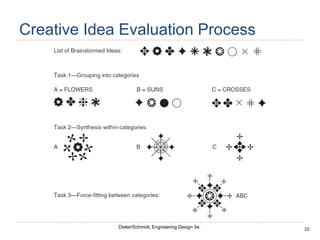
  • 249.
    17 5.5 Government Sourcesof Information How does government help in gathering information?
  • 250.
    18 Dieter/Schmidt, Engineering Design5e. Government Role in Research In 2015 the federal government either conducted or paid for about 35 percent of the research and performed in USA. • That generates an enormous amount of information, mostly in the form of technical reports. Government-sponsored reports are only one segment of what is known among information specialists as the gray literature. The Government Printing Office (GPO) is the federal agency with the responsibility of reproducing and distributing federal documents. Reports prepared under contract by industrial and university R&D organizations may be obtained from the National Technical Information Service (NTIS).
  • 251.
    19 5.6 Information fromthe Internet How can Internet information help a design project?
  • 252.
    20 Dieter/Schmidt, Engineering Design5e. Google Scholar (scholar.google.com) • Searching on Google Scholar is like doing a search for any scholarly work (for example, by bibliographic data). Search results can be successively narrowed by addling additional terms. • For example, a search for “proportional control” can proceed as shown in the table. Search Term Number of Results proportional OR control 8,540,000 proportional control 4,670,000 proportional control AND engineering 2,360,000 "proportional control" 42,600 “proportional control”-temperature 18,200
  • 253.
    21 Dieter/Schmidt, Engineering Design5e. Directories Directories are collections of websites on specific topics, like mechanical engineering or manufacturing engineering. Using directories narrows down the huge number of hits you get when using a search engine. • Virtual Library: http://vlib.org/Engineering • Intute: www.intute.ac.uk/sciences/engineering/ • Wikipedia.com is the popular online encyclopedia.
  • 254.
    22 Dieter/Schmidt, Engineering Design5e. Supply Houses Vendors. • McMaster-Carr Supply Co. http://www.mcmaster.com. • Grainger Industrial Supply. http://www.grainger.com. • MSC Industrial Supply Co. http://www1.mscdirect.com. • Thomas Register of American Manufacturers www.thomasnet.com.
  • 255.
    23 Dieter/Schmidt, Engineering Design5e. Other Specialized Sources Technical Information: example, • www.howstuffworks.com. General Websites: example, • Business Source Complete, • Available through EBSCO at www.ebsco.com/products/research- databases/business-source-complete. Marketing: example. • North Americal Industry Classification System (NAIC). • Standard & Poor’s Net Advantage, https://library.ccis.edu/company- industryinfo/netadvantage. Business Statistics Bureau of Labor Statistics.
  • 256.
    24 5.7 Professional Societiesand Trade Associations What do professional societies do?
  • 257.
    25 Dieter/Schmidt, Engineering Design5e. Professional Societies 1 Professional societies are organized to advance a particular profession and to honor those in the profession for outstanding accomplishments. Engineering societies rarely lobby for specific legislation that will benefit their membership. Professional Societies: • American Society of Civil Engineers (ASCE), • American Society of Mining, Metallurgical and Petroleum Engineers (AIME), • American Society of Mechanical Engineers (ASME), • Institute of Electrical and Electronic Engineers (IEEE), • American Institute of Chemical Engineers (AIChE). • American Society of Heating Refrigerating, and Air-conditioning Engineers (ASHRAE), • International Society for Optical Engineering (SPIE), • Biomedical Engineering Society and the American Society for Engineering Education (ASEE).
  • 258.
    26 Dieter/Schmidt, Engineering Design5e. Professional Societies 2 • Tend to be specialized, which impedes their ability to promote their image and represent their interests with the federal government. • The American Association of Engineering Societies (AAES) is an umbrella organization that is a step toward a coalition of engineering societies. • The National Academy of Engineering (NAE) is similar to the National Academy of Science (NAS). It exists to honor outstanding members of the profession and provide guidance to government agencies.
  • 259.
    27 Dieter/Schmidt, Engineering Design5e. Trade Associations • American Iron and Steel Institute (AISI) • Electric Power Research Institute (EPRI) • National Association of Manufacturers is a multi- industry association • Others like the Steel Tank Institute are much more focused and issue such things as Standards for Inspection of Above Ground Storage Tanks. • Yahoo gives a good listing of trade associations of all kinds at Business→Trade Associations.
  • 260.
    28 5.8 Codes andStandards How can codes and standards help?
  • 261.
    29 Dieter/Schmidt, Engineering Design5e. Codes, Standards, and Specifications Codes: • A code is a set of rules for performing some task, as in the local city building code or fire code. Standards: • A standard is less prescriptive and can be defined as a set of technical definitions and guidelines. Specification: • A specification describes how a system should work, and is usually is much more specific and detailed than a standard, but sometimes it is difficult to differentiate between documents that are called standards and those called specifications.
  • 262.
    30 Dieter/Schmidt, Engineering Design5e. ANSI, NIST, ASTM, ASME, ISO • The American National Standards Institute (ANSI) is the coordinating organization for the voluntary standards system for the United States. (www.ansi.org). • The standards responsibility of the U.S. government is carried out by the National Institute for Standards and Technology (NIST). • ASTM International is the major organization that prepares standards in the field of materials and product systems. • The ASME prepares the well-known Boiler and Pressure Vessel Code that is incorporated into the laws of most states. • ISO is the international organization for standardization (www.iso.org).
  • 263.
    31 Dieter/Schmidt, Engineering Design5e. DOD, DOE, OSHA, CPSC, BSI, DIN • Department of Defense (DOD) has developed a large number of standards, generally by the three services, Army, Navy, and Air Force. • Department of Energy (DOE) • Occupational Safety and Health Administration (OSHA) • Consumer Product Safety Commission (CPSC) • British Standards Institution (BSI); http://www.bsigroup.com • DIN (Deutsches Institut fur Normung), the German standards organization. Copies of all DIN standards that have been translated into English can be purchased from ANSI at http://webstore.ansi.org
  • 264.
    32 5.9 Patents andOther Intellectual Property What is a patent? How can a patent provide information?
  • 265.
    33 Dieter/Schmidt, Engineering Design5e. Patent and Other Intellectual Property Patent: • A patent, granted by a government, gives its owner the right to prevent others from making, using, or selling the patented invention. Copyright: • A copyright gives its owner the exclusive right to publish and sell a written or artistic work. Trademark: • A trademark is any name, word, symbol, or device that is used by a company to identify its goods or services and distinguish them from those made or sold by others. Trade Secret: • A trade secret is any formula, pattern, device, or compilation of information that is used in a business to create an opportunity over competitors who do not have this information.
  • 266.
    34 Dieter/Schmidt, Engineering Design5e. Intellectual Property Intellectual Property has received increasing attention in the high-tech world. For example, IBM has over 40,000 patents and adds about 3000 annually. • The technology in the information technology and telecommunication businesses has become so complex that there is a greater willingness to accept the innovations of other companies. • Since the technology is moving fast there is a tendency for cutting- edge technology to quickly change to a commodity-type business. • Customers are demanding common standards and interoperability between systems. • For start-up companies, patents are important because they represent assets that can be sold in case the company is not successful and goes out of business.
  • 267.
    35 Dieter/Schmidt, Engineering Design5e. The Patent System Patents are so important that they were included in the Constitution of the United States. Three types of patents are: • Utility patent – for artifacts that are new and useful machines, processes, articles of manufacture, or compositions of matter. • Design patent – for ornamental designs (not the artifact itself). • Plant patent – for a new variety of plant. There are three general criteria for awarding a patent: • The invention must be new or novel. The key requirement. • The invention must be useful. • It must not be obvious to a person skilled in the art covered by the patent.
  • 268.
    36 Dieter/Schmidt, Engineering Design5e. Technology Licensing • The right to exclusive use of technology that is granted by a patent may be transferred to another party through a licensing agreement. • A license may be either an exclusive license, in which it is agreed not to grant any further licenses, or a nonexclusive license.
  • 269.
    37 Dieter/Schmidt, Engineering Design5e. Patent Searches The U.S. Patent and Trademark Office (USPTO) has holds one of the largest collections of inventions in the world www.uspto.gov. The U.S. Patent system is the largest body of information about technology in the world! • 7 million patents exist. • The number increases by 190,000 each year.
  • 270.
    38 Dieter/Schmidt, Engineering Design5e. Patent Literature The U.S. Patent and Trademark Office (USPTO) has been highly computerized. Typical reasons for making a patent search are: • You have been asked to comment on a patent used by a competitor. • You are looking for ideas to improve your design concept. • You have conceived of a novel design concept, and you want to determine if the idea is novel enough to warrant the expense of preparing a patent submission. • You want to continue to update yourself on a particular technology of interest.
  • 271.
    39 Dieter/Schmidt, Engineering Design5e. Patent for a Basketball Return
  • 272.
    40 Dieter/Schmidt, Engineering Design5e. Different Types of Patent Classifications: CPC Is the Current Type for New Patents • US Patent Classifications (USPC). • International Patent Classification (IPC). • European Classification (ECLA). • Cooperative Patent Classification (CPC). Patent classifications is a complicated subject. Detailed information can be found in Chapter 5 of the text.
  • 273.
    41 Dieter/Schmidt, Engineering Design5e. Patent Classifications: Organization System for Patents Patents are issued numerically. A search of key words in the title of a patent will yield specifically similar patents. A different type of search is needed to find patents with similar applications. These applications may not have the same key words. Classification code sorts patents by subject class. The codes are hierarchical. • Subject classes have been established in the past may seem vague. • The hierarchical nature of the classification codes allows the addition of new applications as they are developed.
  • 274.
    42 Dieter/Schmidt, Engineering Design5e. Classification Code Example CPC Title of the Class A HUMAN NECESSITIES A63 – SPORTS; GAMES; AMUSEMENTS APPARATUS FOR PHYSICAL TRAINING, GYMNASTICS, SWIMMING, A63B CLIMBING, OR FENCING; BALL GAMES; TRAINING EQUIPMENT Games or sports accessories not covered in groups A63B 1/00 – A63B 69/00 A63B 69 (starting appliances A63K 3/02) A63B 69/0071 . . . for basketball}
  • 275.
    43 Dieter/Schmidt, Engineering Design5e. Google for Patent Search Google patent site (patents.google.com). Three ways to search for a patent. • Patent number. “USXXXXXXXB1” the patent number with prefix. Here, “US” indicates a patent issued by the United States and “B1” refers to a utility patent with no previous application • Application number. “XXXXXX” the application number for a patent. • Classification number. “US XX/YYYY” the classification number for the patent. The prefix “US” signifies that the U.S. patent classification system is used. In more recent patents the proper prefix is “CPC,” the Combined Patent Classification system.
  • 276.
  • 277.
    45 Dieter/Schmidt, Engineering Design5e. Reading a Patent Because a patent is a legal document, it is organized and written in a style much different from the style of the usual technical paper. Patents must stand on their own and contain sufficient disclosure to permit the public to practice the invention after the patent expires. Each patent is a complete: • Detailed explanation of the problem. • Solution to the problem. • The applications for the invention in practical use.
  • 278.
  • 279.
    47 Dieter/Schmidt, Engineering Design5e. US Patent 5,540,428 BASKETBALL RETRIEVAL AND RETURN APPRATUS
  • 280.
    48 Dieter/Schmidt, Engineering Design5e. Copyrights A copyright is the exclusive legal right to publish a tangible expression of literary, scientific, or artistic work, whether it appears in digital, print, audio, or visual form. While the U.S. Copyright Act does not directly define fair use, it does base it on four factors: • The purpose and character of the use. • The nature of the copyrighted work. • The amount of the work used in relation to the copyrighted work as a whole. • The effect of the use on the potential market value of the copyrighted work.
  • 281.
    49 5.10 Company-Centered Information Whatis the importance of gaining information by networking?
  • 282.
    50 Dieter/Schmidt, Engineering Design5e. Finding Information The degree to which individual engineers pursue information: • The nature of the project. • The personality and temperament of the individual. • Conversations are sometimes crucial to the solution of a problem. • The corporate culture concerning knowledge generation and management. • Perhaps the necessary information is known to exist but it is classified, available only to those with a need to know.
  • 283.
    51 Dieter/Schmidt, Engineering Design5e. Information Gathered in a Company The amount of design information that can be obtained from within the company is quite considerable and of many varieties such as: • Product specifications. • Concept designs for previous products. • Test data on previous products. • Bill of material on previous products. • Cost data on previous projects. • Reports on previous design projects. • Marketing data on previous products. • Sales data on previous products. • Warranty reports on previous products. • Manufacturing data. • Design guides prepared for new employees. • Company standards.
  • 284.
    52 5.11 Summary What isthe importance of gaining information by networking?
  • 285.
    53 Dieter/Schmidt, Engineering Design5e. Summary • The gathering of design information is not a trivial task. It requires knowledge of a wide spectrum of information sources. These sources are, in increasing order of specificity: • The World Wide Web, and its access to digital databases • Business catalogs and other trade literature • Government technical reports and business data • Published technical literature, including trade magazines • Network of professional friends, aided by e-mail • Network of professional colleagues at work • Corporate consultants
  • 286.
  • 287.
    55 Dieter/Schmidt, Engineering Design5e. Assignments • Use the indexing and abstracting services to obtain at least 20 current references on a technical topic of interest to you. Use appropriate indexes to find 10 government reports related to your topic. • Find and read a technical standard on the air flow performance characteristics of vacuum cleaners in the ASTM Standards. List some other standards concerning vacuum cleaners. Write a brief report about the kind of information covered in a standard.
  • 288.
    End of MainContent
  • 289.
  • 290.
    2 6.1 Introduction toCreative Thinking How does brain process information and creates thoughts?
  • 291.
    3 Dieter/Schmidt, Engineering Design5e. Creativity in Engineering Engineers are called up to solve all the challenges in the world – and that takes creativity. Tasks for engineers: • Improve level of creativity. • Learn design methods that improve ability to find creative solutions. Some concept generation design methods blend engineering knowledge with creativity techniques. No engineering activity requires more creativity than design.
  • 292.
    4 Dieter/Schmidt, Engineering Design5e. Concept Generation in PDP
  • 293.
    5 6.2 Creativity andProblem Solving How can creativity help design projects?
  • 294.
    6 Dieter/Schmidt, Engineering Design5e. Creativity and Problem Solving • Creative thinkers are distinguished by their ability to synthesize new combinations of ideas and concepts into meaningful and useful forms. • A creative engineer is one who produces a lot of useful ideas. • A creative person is adept at breaking a problem-solving task down to take a fresh look at its parts, or in making connections between the current problem and seemingly unrelated observations or facts. • There is the popular myth that creative ideas arrive with flash- like spontaneity. • A characteristic of the creative process is that initially the idea is only imperfectly understood.
  • 295.
    7 Dieter/Schmidt, Engineering Design5e. Supports to Creative Thinking1 1. Develop a creative attitude: • To be creative it is essential to develop confidence that you can provide a creative solution to a problem. 2. Unlock your imagination: • Scholars of the creative process have developed thought games. 3. Be persistent: • Creativity often required hard work!
  • 296.
    8 Dieter/Schmidt, Engineering Design5e. Supports to Creative Thinking2 4. Develop an open mind: • Having an open mind means being receptive to ideas from any and all sources 5. Suspend your judgment: • Nothing inhibits the creative process more than critical judgment of an emerging idea. 6. Set problem boundaries: • We place great emphasis on proper problem definition as a step toward problem solution.
  • 297.
    9 Dieter/Schmidt, Engineering Design5e. Four-Stage Model of Creative Thinking Process and Problem Solving 1. Preparation (stage 1): • The elements of the problem are examined and their interrelations are studied. 2. Incubation (stage 2): • You “sleep on the problem”. Sleep disengages your conscious mind, allowing the unconscious mind to work on a problem freely. 3. Inspiration (stage 3): • A solution or a path toward the solution emerges. 4. Verification (stage 4): • The inspired solution is checked against the desired result.
  • 298.
    10 Dieter/Schmidt, Engineering Design5e. Barriers to Creative Thinking • It is important to recognize how mental blocks interfere with creative thinking. • A mental block is a mental wall that prevents the problem solver from correctly perceiving a problem or conceiving its solution. • A mental block is an event that inhibits the successful use of normal cognitive processes to come to a solution.
  • 299.
    11 Dieter/Schmidt, Engineering Design5e. Types of Mental Blocks Perceptual Blocks: • Have to do with not properly defining the problem and not recognizing the information needed to solve it. Emotional Blocks: • Obstacles that are concerned with the psychological safety of the individual. Intellectual Blocks: • They arise from a poor choice of the problem-solving strategy or having inadequate background and knowledge. Environmental Blocks: • These are blocks that are imposed by the immediate physical or social environment.
  • 300.
    12 Dieter/Schmidt, Engineering Design5e. Perceptual Blocks 1 Stereotyping: • Thinking conventionally or in a formulaic way about an event, person, or way of doing something. Information overload: • You become so overloaded with minute details that you are unable to sort out the critical aspects of the problem. • “NOT BEING ABLE TO SEE THE FOREST FOR THE TREES!” Limiting the problem unnecessarily: • Broad statements of the problem help keep the mind open to a wider range of ideas.
  • 301.
    13 Dieter/Schmidt, Engineering Design5e. Perceptual Blocks 2 Fixation: • People’s thinking can be influenced so greatly by their previous experience or some other bias that they are not able to sufficiently recognize alternative ideas. Priming or provision of cues: • If the thinking process is started by giving examples or solution cues, it is possible for thinking to stay within the realm of solutions suggested by those initial starting points.
  • 302.
    14 Dieter/Schmidt, Engineering Design5e. Emotional Blocks Fear of risk taking: • This is the fear of proposing an idea that is ultimately found to be faulty. Unease with chaos: • People in general, and many engineers in particular, are uncomfortable with highly unstructured situations. Inability or unwillingness to incubate new ideas: • In our busy lives, we often don’t take the time to let ideas lie dormant so they can incubate properly. Motivation: • People differ considerably in their motivation to seek creative solutions to challenging problems.
  • 303.
    15 Dieter/Schmidt, Engineering Design5e. Intellectual Blocks Poor choice of problem-solving language or problem representation: • It is important to make a conscious decision concerning the “language” for your creative problem solving. Memory block: • Memory holds strategies and tactics for finding solutions as well as solutions themselves. Insufficient knowledge base: • Generally, ideas are generated from a person’s education and experience. Incorrect information: • It is obvious that using incorrect information can lead to poor results.
  • 304.
    16 Dieter/Schmidt, Engineering Design5e. Environmental Blocks Physical environment: • This is a very personal factor in its effects on creativity. Criticism: • Non-supportive remarks about your ideas can be personally hurtful and harmful to your creativity.
  • 305.
    17 6.3 Creative ThinkingMethods How can we improve our creativity?
  • 306.
    18 Dieter/Schmidt, Engineering Design5e. Improving Creativity Improving creativity is a popular endeavor. Over 150 creativity improvement methods have been cataloged These methods are aimed at improving the following characteristics of the problem solver: • Sensitivity: The ability to recognize that a problem exists. • Fluency: The ability to produce a large number of alternative solutions to a problem. • Flexibility: The ability to develop a wide range of approaches to a problem. • Originality: The ability to produce original solutions to a problem.
  • 307.
    19 Dieter/Schmidt, Engineering Design5e. Brainstorming • Brainstorming is the most common method used by design teams for generating ideas. • The word brainstorming has come into general usage in the language to denote any kind of idea generation. • Brainstorming is a carefully orchestrated process. • A well-done brainstorming session is an enthusiastic session of rapid, free-flowing ideas: • To achieve a good brainstorming session, it is important to carefully define the problem at the start. • An important attribute of brainstorming is to create a large number of ideas, some of which will be creative. • The evaluation of your ideas should be done at a meeting on a day soon after the brainstorming session.
  • 308.
    20 Dieter/Schmidt, Engineering Design5e. SCAMPER Checklist to Aid in Brainstorming Proposed Change Description Substitute What if used in a different material, process, person, power source, place, or approach? Combine Could I combine units, purposes, or ideas? Adapt What else is like this? What other idea does it suggest? Does the past offer a parallel? What can I copy? Modify, magnify, minify Could I add a new twist? Could I change the meaning, color, motion, form, or shape? Could I add something? Make stronger, higher, longer, thicker? Could I subtract something? Put to other uses Are there new ways to use this as is? If I modify it, does it have other uses? Eliminate Can I remove a part, function, person without affecting outcome? Rearrange, reverse Could I interchange components? Could I use a different layout or sequence? What if I transpose cause and effect? Could I transpose positive and negative? What if I turn it backward, upside down, or inside out?
  • 309.
    21 Dieter/Schmidt, Engineering Design5e. Refinement and Evaluation of Ideas • The primary purpose of the refinement and evaluation step in concept generation is the identification of creative, feasible, yet still practical ideas. • The type of thinking used in refining the set of creative ideas is more focused than the divergent type of thinking that was used in generating creative ideas. • The first step is to sort the ideas into feasibility categories: • Ideas that are feasible as they stand. • Ideas that may have potential after more thought or research are applied. • Ideas that are very unfeasible and have no chance of becoming good solutions.
  • 310.
    22 Dieter/Schmidt, Engineering Design5e. Creative Idea Evaluation Process
  • 311.
    23 Dieter/Schmidt, Engineering Design5e. Idea Generating Techniques Beyond Brainstorming: Six Key Questions 1. Who? • Who uses it, wants it, will benefit by it? 2. What? • What happens if X occurs? What resulted in success? What resulted in failure? 3. When? • Can it be speeded up or slowed down? Is sooner better than later? 4. Where? • Where will X occur? Where else is possible? 5. Why? • Why is this done? Why is that particular rule, action, solution, problem, failure involved? 6. How? • How could it be done, should it be done, prevented, improved, changed, made?
  • 312.
    24 Dieter/Schmidt, Engineering Design5e. 1. Why has the machine stopped? • A fuse blew because of fan overload. 2. Why was there an overload? • There was inadequate lubrication for the bearings. 3. Why wasn’t there enough lubrication? • The lube pump wasn’t working. 4. Why wasn’t the pump working? • The pump shaft was vibrating because it had worn due to abrasion. 5. Why was there abrasion? • There was no filter on the lube pump, allowing debris into the pump. Idea Generating Techniques Beyond Brainstorming: Five Whys
  • 313.
    25 Dieter/Schmidt, Engineering Design5e. A Checklist for Technological Stretching*: • What happens if we push the conditions to the limit? • Temperature, up or down? • Pressure, up or down? • Concentration, up or down? • Impurities up or down? * G. Thompson and M. London, “A Review of Creativity Principles Applied to Engineering Design,” Proc. Instn. Mech. Engrs., vol. 213, part E, pp.17-31, 1999. Idea Generating Techniques Beyond Brainstorming: A Checklist for Technological Stretching
  • 314.
    26 Dieter/Schmidt, Engineering Design5e. This can be done by posing questions in an “invitational way” so as to encourage an upbeat, positive climate for idea generation. Typical questions would be: • Wouldn’t be nice if . . . . ? • What I really want to do is . . . . • If I did not have to consider cost, . . . • I wish . . . The use of an invitational turn of phrase is critical to the success of this approach. For example, rather than stating, “this design is too heavy,” it would be much better to say “how can we make the design lighter?” The first phrase implies criticism, the latter suggests improvement for use. Idea Generating Techniques Beyond Brainstorming: Fantasy or Wishful Thinking
  • 315.
    27 Dieter/Schmidt, Engineering Design5e. Synectics: An Inventive Method Based on Analogy In design, like in everyday life, many problems are solved by analogy. The designer recognizes the similarity between the design under study and a previously solved problem. Synectics is a methodology or creativity based on reasoning by analogy. Synectics recognizes four types of analogy: • Direct Analogy. • Fantasy Analogy. • Personal Analogy. • Symbolic Analogy.
  • 316.
    28 Dieter/Schmidt, Engineering Design5e. Biomimicry A particularly intriguing source of direct analogies is those that are inspired by biological systems. Biomimetic is the mimicking of biological system such as: • The invention of the Velcro fasteners. The challenge for designers is twofold: 1) engineering designer are not trained in a wide variety of biological systems. 2) the words engineers use to express behavior do not always match words used to describe biological systems.
  • 317.
    29 Dieter/Schmidt, Engineering Design5e. Concept Map • Concept map is a tool for the generation of ideas by association, for organizing information in preparation for writing a report, for generating and recording ideas during brainstorming and in generating solution concepts. • A concise label for the problem or issue is placed at the center of the sheet. Then the team is asked to think about what concepts, ideas, or factors are related to the problem. • Write down team-generated thoughts surrounding the central problem label. • Underline or circle them and connect them to the central focus. • Use an arrow to show which issue drives what. • Create new major branches of concepts to represent major subtopics. • If the process develops a secondary or separate map, label it and connect it to the rest of the map.
  • 318.
    30 Dieter/Schmidt, Engineering Design5e. Concept Map for the Recycling of a Metal
  • 319.
    31 6.4 Creative Methodsfor Design How does creativity fit into a design task?
  • 320.
    32 Dieter/Schmidt, Engineering Design5e. Creativity Techniques for a Design • The motivation for applying any creativity technique to a design task is to generate as many ideas as possible. • Quantity counts above quality, and wild ideas are encouraged at the early stages of the design work. • Once an initial pool of concepts for alternative designs exists, these alternatives can be reviewed more critically. • The goal becomes sorting out infeasible ideas. • The team is identifying a smaller subset of ideas that can be developed into practical solutions.
  • 321.
    33 Dieter/Schmidt, Engineering Design5e. Generating Design Concepts • Systematic methods for generating engineering designs exist. • The task of the designer is to find the best of all possible candidate solutions to a design task. • Generative design is a theoretical construct that creates many feasible alternatives to a given product design specification (PDS). • The set of all possible designs is an n-dimensional hyperspace called a design space. • The key idea to remember in design is that it is beneficial in almost every situation to develop a number of alternative designs that rely on different means to accomplish a desired behavior.
  • 322.
    34 Dieter/Schmidt, Engineering Design5e. Schematic of an n-dimensional design space
  • 323.
    35 Dieter/Schmidt, Engineering Design5e. Systematic Methods for Designing Some design methods are labeled as systematic because they involve a structured process for generating design solutions. Systematic methods for mechanical, conceptual design generation are: • Functional Decomposition and Synthesis. • Morphological Analysis. • Theory of Inventive Problem Solving (TRIZ). • Axiomatic Design. • Design Optimization. • Decision-Based Design (DBD)
  • 324.
    36 6.5 Functional Decompositionand Synthesis How does functional decomposition help a design?
  • 325.
    37 Dieter/Schmidt, Engineering Design5e. Functional Decomposition and Synthesis A common strategy for solving any complex task or describing any complex system is to decompose it into smaller units that are easier to manage. Decomposing must result in units that meaningfully represent the original entity. Mechanical design is recursive: • That means the same design process applied to the overall product applies to the units of the product and can be repeated until a successful outcome is achieved. Functional decomposition method has solution-neutrality: • Functional decomposition is a top-down strategy where a general description of a device is refined into more specific arrangements of functions and sub- functions. • It does not initially impose a design, allowing more leeway for creativity and generates a wide variety of alternative solutions.
  • 326.
    38 Dieter/Schmidt, Engineering Design5e. Physical Decomposition of a Bicycle
  • 327.
    39 Dieter/Schmidt, Engineering Design5e. Creating a Physical Decomposition • The steps to create a physical decomposition tree diagram are: 1. Define the physical system in total and draw it as the root block of a tree diagram. 2. Identify and define the first major subassembly of the system described by the root block and draw it as a new block below the root. 3. Identify and draw in the physical connections between the subassembly represented by the newly drawn block and all other blocks in the next higher level of the hierarchy in the decomposition diagram. 4. Identify and draw in the physical connections between the subassembly and any other subassemblies on the same hierarchical level of the diagram’s structure. 5. Examine the first subassembly block in the now complete level of the diagram. 6. End the process when there are no more blocks anywhere in the hierarchical diagram that can be physically decomposed in a meaningful way. • Physical decomposition is a top-down approach to understanding the physical nature of the product.
  • 328.
    40 Dieter/Schmidt, Engineering Design5e. Functional Representation: Standard Flow Classes and Member Flow Flow classes Energy Material Signal Human Human Status Hydraulic Solid • Auditory. Pneumatic Gas • Olfactory. Mechanical Liquid • Tactile. • Translational. Plasma • Taste. • Rotational. Mixture • Visual. Electrical Control Acoustic • Analog. Thermal • Discrete. Electromagnetic Chemical Biological R. E. Stone, “Functional Basis”, Design Engineering Lab Webpage, designengineeringlab.org/FunctionCAD/FB.htm, accessed November 10, 2011.
  • 329.
    41 Dieter/Schmidt, Engineering Design5e. Components Abstracted into Function Blocks
  • 330.
    42 Dieter/Schmidt, Engineering Design5e. Performing Functional Decomposition • Functional decomposition produces a diagram called a function structure. • A function structure is a block diagram depicting flows of energy, material, and signal as labeled arrows taking paths between function blocks. • The most general function structure is a single function block description of a device. • This type of function structure (a single function block) is called a black box representation of a device.
  • 331.
    43 Dieter/Schmidt, Engineering Design5e. Function Structure Black Box for a Basketball Ball Return Note: A moving basketball will always possess direction and kinetic energy.
  • 332.
    44 Dieter/Schmidt, Engineering Design5e. Function Structure for a Mechanical Pencil
  • 333.
    45 Dieter/Schmidt, Engineering Design5e. Creating a Function Structure A simplified method for creating a function structure is described in the following steps. The example used is that of a lead pencil. 1. Identify the overall function that needs to be accomplished using function basis terms. 2. Using everyday language, write a description of the individual functions that are required to accomplish the overall task described in the black box. 3. Having thought about the details of accomplishing the pencil’s function described in the black box, identify more precise functions necessary to fulfill the more detailed description of the pencil’s function in solution-neutral language. 4. Arrange the function blocks in the order that they must take place for the desired functions. 5. Add the energy, material, and signal flows between the function blocks. 6. Examine each block in the function structure to determine if additional energy, material, or signal flows are necessary to perform the function 7. Review each function block again to see if additional refinement is necessary.
  • 334.
    46 Dieter/Schmidt, Engineering Design5e. Function Structure for a Basketball Return Device
  • 335.
    47 Dieter/Schmidt, Engineering Design5e. Strengths and Weaknesses of Functional Synthesis Strengths: • First, creating function structures forces re-representation into a language that is useful for the manipulation for mechanical design problems. • Second, using a function structure to represent a design lends functional labels to potential solution components, and these labels serve as hints for new memory searches. Weaknesses: • Some products are better suited to representation and design by functional decomposition and synthesis than are others. • The function structure is a flow diagram where flows are connecting different functions performed by the product the structure represents.
  • 336.
    48 6.6 Morphological Method Howcan morphology aid in design generation?
  • 337.
    49 Dieter/Schmidt, Engineering Design5e. Morphological Methods • Morphological analysis is a method for representing and exploring all the relationships in multidimensional problems. • The word morphology means the study of shape and form. Morphological analysis is a way of creating new forms. • Generating product design concepts from a given set of components is one such problem. • There are many different combinations of components that can satisfy the same functionality required in a new product. • Success with morphological methods requires broad knowledge of a wide variety of components and their uses, and the time to examine them.
  • 338.
    50 Dieter/Schmidt, Engineering Design5e. Morphological Method for Design The general morphological approach to design is summarized in the following three steps: 1. Divide the overall design problem into simpler subproblems. 2. Generate solution concepts for each subproblem. 3. Systematically combine sub-problem solutions into different complete solutions and evaluate all combinations.
  • 339.
    51 Dieter/Schmidt, Engineering Design5e. Morphological Chart for Shot Buddy Basketball Return System Sub-problem Solution Concepts Channel Moving Basketball Change Direction of Basketball Sense Shooter's Position Guide Basketball to Return Device Inlet Rotate Return Device Outlet Toward Shooter Catch net Sheet of flexible material RFID tag worn by shooter Funnel(net or solid material) Ratchet device Plastic sheeting with wire ribs Solid deflector panels Motion sensor Set of rails None (rely on ball's direction and gravity) Finger-like converging structure Shaped foam Optical sensor Tube of netting Cam mechanism Tubing (partially open or closed) Paddle arms Acoustic sensor Metal guide (moving or stationary) Geared shaft
  • 340.
    52 Dieter/Schmidt, Engineering Design5e. Sketch of Shot-Buddy Concept Adapted from J. Davis, J. Decker, J. Maresco, S. McBee, S. Phillips, and R. Quinn, “JSR Design Final Report: Shot-Buddy,” unpublished, ENME 472, University of Maryland, May 2010.
  • 341.
    53 6.7 TRIZ: TheTheory of Inventive Problem Solving What is TRIZ?
  • 342.
    54 Dieter/Schmidt, Engineering Design5e. TRIZ The Theory of Inventive Problem Solving, known by the acronym “TRIZ,” is a problem-solving methodology tailored to provide innovative solutions for scientific and engineering problems. Genrich Altshuller, a Russian inventor, developed TRIZ in the late 1940s and 1950s. TRIZ offers four different strategies for generating an innovative solution to a design problem: 1. Increase the “ideality” of a product or system. 2. Identify the product’s place in its evolution to ideality and force the next step. 3. Identify key physical or technological contradictions in the product and revise the design to overcome them using inventive principles. 4. Model a product or system using substance-field analysis and apply candidate modifications.
  • 343.
    55 Dieter/Schmidt, Engineering Design5e. Invention: Evolution to Increased Ideality Altshuller’s examination of inventions led to his observation that systems had a level of goodness he called ideality and that invention result when changes were made to improve this attribute of a product or system. Six specific design suggestions to examine for improving the ideality of a system are as follows: 1. Exclude auxiliary functions. 2. Exclude elements in the existing system. 3. Identify self-service functions. 4. Replace elements or parts of the total system. 5. Change the system’s basic principle of operation. 6. Utilize resources in system and surroundings.
  • 344.
    56 Dieter/Schmidt, Engineering Design5e. Innovation by Overcoming Contradictions The following list describes each innovation level and shows its relative frequency: • Level 1: (32%) Conventional design solutions arrived at by methods well known in the technology area of the system. • Level 2: (45%) Minor corrections made to an existing system by well- known methods at the expense of some compromise in behavior. • Level 3: (18%) Substantial improvement in an existing system that resolves a basic behavior compromise by using the knowledge of the same technology area; the improvement typically involves adding a component or subsystem. • Level 4: (4%) Solutions based on application of a new scientific principle to eliminate basic performance compromises. • Level 5: (1% or less) Pioneering inventions based on a discovery outside of known science and known technology.
  • 345.
    57 Dieter/Schmidt, Engineering Design5e. TRIZ List of 39 Engineering Parameters 1 Engineering Parameters Used to Represent Contradictions in TRIZ 1. Weight of moving object. 2. Weight of nonmoving object. 3. Length of moving object. 4. Length of nonmoving object. 5. Area of moving object. 6. Area of nonmoving object. 7. Volume of moving object. 8. Volume of nonmoving object. 9. Speed. 10. Force. 11. Tension, pressure. 12. Shape. 13. Stability of object. 14. Strength. 15. Durability of moving object. 16. Durability of nonmoving object. 17. Temperature. 18. Brightness. 19. Energy spent by moving object. 20. Energy spent by nonmoving object. 21. Power. 22. Waste of energy.
  • 346.
    58 Dieter/Schmidt, Engineering Design5e. TRIZ List of 39 Engineering Parameters 2 Engineering Parameters Used to Represent Contradictions in TRIZ 23. Waste of substance. 24. Loss of information. 25. Waste of time. 26. Amount of substance. 27. Reliability. 28. Accuracy of measurement. 29. Accuracy of manufacturing. 30. Harmful factors acting on object. 31. Harmful side effects. 32. Manufacturability. 33. Convenience of use. 34. Repairability. 35. Adaptability. 36. Complexity of device. 37. Complexity of control. 38. Level of automation. 39. Productivity.
  • 347.
    59 Dieter/Schmidt, Engineering Design5e. TRIZ List of 40 Inventive Principles 1 Names of TRIZ Inventive Principles 1. Segmentation. 2. Extraction. 3. Local quality. 4. Asymmetry. 5. Combining. 6. Universality. 7. Nesting. 8. Counterweight. 9. Prior counteraction. 10. Prior action. 11. Cushion in advance. 12. Equipotentiality. 13. Inversion. 14. Spheroidality-Curvature. 15. Dynamicity. 16. Partial or overdone action. 17. Moving to a new dimension. 18. Mechanical vibration. 19. Periodic action. 20. Continuity of useful action. 21. Rushing through. 22. Convert harm into benefit.
  • 348.
    60 Dieter/Schmidt, Engineering Design5e. TRIZ List of 40 Inventive Principles 2 Names of TRIZ Inventive Principles 23. Feedback. 24. Mediator. 25. Self-service. 26. Copying. 27. An inexpensive short-lived object instead of an expensive durable one. 28. Replacement of a mechanical system. 29. Use of a pneumatic or hydraulic construction. 30. Flexible film or thin membranes. 31. Use of porous material. 32. Change the color. 33. Homogeneity. 34. Rejecting and regenerating parts. 35. Transformation of physical and chemical states of an object. 36. Phase transition. 37. Thermal expansion. 38. Use of strong oxidizers. 39. Inert environment. 40. Composite materials.
  • 349.
    61 Dieter/Schmidt, Engineering Design5e. TRIZ Applications • The 40 principles of TRIZ have a remarkably broad range of application. • Complete listings of the 40 Inventive Principles are available in book form and online through the TRIZ Journal website. • There, the TRIZ principles are listed with explanations and examples. • The TRIZ Journal has also published listings of the principles interpreted for non-engineering application areas, including business, architecture, food technology, and microelectronics, to name a few.
  • 350.
    62 Dieter/Schmidt, Engineering Design5e. Five Most Frequently Used Inventive Principles of TRIZ • Principle 1: Segmentation. • Principle 2: Extraction. • Principle 10: Prior action. • Principle 28: Replacement of mechanical system. • Principle 35: Transformation of properties.
  • 351.
    63 Dieter/Schmidt, Engineering Design5e. Principle 1: Segmentation a. Divide an object into independent parts. • Replace mainframe computer with personal computers. • Replace a large truck with a truck and trailer. • Use a work breakdown structure for a large project. b. Make an object easy to disassemble. c. Increase the degree of fragmentation or segmentation. • Replace solid shades with Venetian blinds. • Use powdered welding metal instead of foil or rod to get better penetration of the joint.
  • 352.
    64 Dieter/Schmidt, Engineering Design5e. Principle 2: Extraction • Separate an interfering part or property from an object, or single out the only necessary part (or property) of an object. • Locate a noisy compressor outside the building where the air is used. • Use the sound of a barking dog, without the dog, as a burglar alarm.
  • 353.
    65 Dieter/Schmidt, Engineering Design5e. Principle 10: Prior action • Perform the required change (fully or partially) before it is needed. • Prepasted wallpaper. • Sterilize all instruments needed for a surgical procedure on a sealed tray. • Prearrange objects such that they can come into action from the most convenient place and without losing time for their delivery. • Kanban arrangements in a just-in-time factory. • Flexible manufacturing cell.
  • 354.
    66 Dieter/Schmidt, Engineering Design5e. Principle 28: Replacement of mechanical system a. Replace a mechanical means with a sensory (optical, acoustic, taste or smell) means. • Replace a physical fence to confine a dog or cat with an acoustic “fence” (signal audible to the animal). • Use a bad-smelling compound in natural gas to alert users to leakage, instead of a mechanical or electrical sensor. b. Use electric, magnetic, and electromagnetic fields to interact with the object. c. Change from static to movable fields or from unstructured to structured.
  • 355.
    67 Dieter/Schmidt, Engineering Design5e. Principle 35: Transformation of properties a. Change an object’s physical state (e.g. to a gas, liquid, or solid). • Freeze the liquid centers of filled candies prior to coating them. • Transport oxygen or nitrogen or natural gas as a liquid, instead of a gas, to reduce volume. b. Change the concentration or consistency. c. Change the degree of flexibility. d. Change the temperature.
  • 356.
    68 Dieter/Schmidt, Engineering Design5e. TRIZ Contradiction Matrix “TRIZ 40 Principles,” www.TRIZ40.com, Solid Creativity, 2004, accessed November 10, 2011.
  • 357.
    69 Dieter/Schmidt, Engineering Design5e. EXAMPLE 6.1 Metal Powder Hitting Bend in Pipe Problem: Metal powder flows through a pipe and impinges on the bend causing erosion. Objective: Increase the speed at which the particles flow through the system and at the same time reduce the energy requirements.
  • 358.
    70 Dieter/Schmidt, Engineering Design5e. Technical Contradictions Technical Contradictions for Improving Speed of Metal Powder and Principles to Eliminate Them: Improved Speed (9) Degraded Parameter Parameter Number Principle to be Applied to Eliminate Contradiction Force 10 13, 15, 19, 28 Durability 15 8, 3, 14, 26 Loss of matter 23 10, 13, 28,38 Quantity of substance 26 10, 19, 29, 38
  • 359.
    71 Dieter/Schmidt, Engineering Design5e. Technical Contradictions Solution Idea 1: Principle 13, inversion, requires the designer to look at the problem in reverse or the other way around. In this problem, we should look at the next step of the processing of the metal powder and see what kind of solution can come from bringing materials for the next step to the location of the metal powder. This eliminates the contradiction by removing the need to transport the powder through any kind of direction changing flow. Solution Idea 2: Principle 15, dynamicity or dynamics, suggests: (a) allowing the characteristics of an object to change to become more beneficial to the process; and (b) make a rigid or inflexible object moveable or adaptable. We could apply this principle by redesigning the elbow bend in the pipe to have a higher wall thickness through the bend so that the erosion of the inner surface will not compromise the structure of the bend. Another option might be to make the bend area elastic so that the metal particles would transmit some of their impact energy to deformation instead of erosion. Other interpretations are possible. Solution Idea 3: Principle 28, Replacement of mechanical system suggest: a. Replace a mechanical system with an optical, acoustical, or odor system; b. Use an electrical, magnetic, or electromagnetic field for interaction with the object; c. Replace fields. Example: (1) stationary field change to rotating fields; (2) fixed fields become fields that change in time; (3) random fields change to structured ones; c. Use a field in conjunction with ferromagnetic particles.
  • 360.
    72 Dieter/Schmidt, Engineering Design5e. Strengths of TRIZ • The principles at the hear of TRIZ are based on designs that are certified as inventive through the patent-type system of the country of the inventor. • The developers of T R I Z continued to expand their database of inventive designs beyond the original 200,000. • A dedicated TRIZ user community (including students of Altshuller) continues to expand the examples of inventive principles, keeping the TRIZ examples contemporary. • The TRIZ user community has made the contradiction matrix web-accessible through sites like The T R I Z Journal found at www.triz-journal.com.
  • 361.
    73 Dieter/Schmidt, Engineering Design5e. Weaknesses of TRIZ • Inventive Principles are guidelines subject to designer interpretation. • The principles are too general for application in a particular design domain. • The designer must develop her own analogous design solution for the given problem. • There are differences in the interpretation of T R I Z concepts. • There are aspects of TRIZ that are less intuitive.
  • 362.
  • 363.
    75 Dieter/Schmidt, Engineering Design5e. Summary • Engineering design success requires the ability to generate concepts that are broad in how they accomplish their functions but are also feasible. • Current research on creativity shows that all people naturally perform basic intellectual functions required to find creative solutions to problems, including design problems. • The chapter introduced several specific methods for generating conceptual design solutions. • Three formal methods for design are introduced in this chapter. • Systematic design’s functional decomposition process works on intended behavior like physical decomposition works on the form of an existing design. • Morphological analysis is a method that works well with a decomposed structure to guide in the identification of subproblem solutions that can be combined into alternative design concepts. • TRIZ is one of the most recognized and commercially successful design methods today.
  • 364.
  • 365.
    77 Dieter/Schmidt, Engineering Design5e. Assignments • Go to an online catalog of personal use items. Randomly select two products from their inventory and combine them into a useful innovation. Describe the key functionality. • Dissect a small appliance and create a physical decomposition diagram, and create a function structure. Write a narrative accompanying the diagram to explain how the product works. • Return to Example 6.1, the metal powder transport through an elbow bend. The second engineering parameter to improve is 19. Use the TRIZ Contradiction Matrix to identify inventive principles and generate new solutions to the problem.
  • 366.
    End of MainContent
  • 367.
  • 368.
    2 Dieter/Schmidt, Engineering Design5e. Embodiment Design in PDP
  • 369.
    3 8.1 Introduction What isembodiment design?
  • 370.
    4 Dieter/Schmidt, Engineering Design5e. Introduction We have divided the embodiment phase of design into three groups of: • Product Architecture: • Arranging the physical elements of a design in order to carry out it’s functions • Setting the arrangement of the physical elements of the design into groupings, called modules. • Configuration Design: • The design of special-purpose parts and the selection of standard components, like pumps or motors. • Parametric Design: • Determining the exact values, dimensions, or tolerances of the components or component features that are deemed critical-to-quality.
  • 371.
    5 8.2 Product Architecture Whatis product architecture?
  • 372.
    6 Dieter/Schmidt, Engineering Design5e. Product Architecture Product architecture is the arrangement of the physical elements of a product to carry out its required functions. A product’s architecture is related to its function structure, but it does not have to match it. A product’s architecture is selected to establish the best system for functional success once a design concept has been chosen. There are two entirely opposite styles of product architecture: • Modular. • Integral.
  • 373.
    7 Dieter/Schmidt, Engineering Design5e. Integral Architecture • In an integral architecture the implementation of functions is accomplished by only one or a few modules. • In integral product architectures, components perform multiple functions. • When a component provides more than one function it enables function sharing. • Integral product architecture is often adopted when constraints of weight, space, or cost make it difficult to achieve required performance. • Another driver toward integration of components is the design for manufacturing and assembly (DFMA) strategy, which calls for minimizing the number of parts in a product.
  • 374.
    8 Dieter/Schmidt, Engineering Design5e. Modular Architecture • A modular architecture makes it easier to evolve a design over time. • The product can be adapted to the needs of different customers by adding or deleting modules. • Modular design may even be carried to the point of using the same set of basic components in multiple products, creating a product family.
  • 375.
    9 Dieter/Schmidt, Engineering Design5e. Modularity and Mass Customization • There is growing interest in finding ways to produce products at a reasonable cost but also with enough variety and customization (mass customization) so that everyone can buy exactly what they want. • There are four distinct strategies for using modularity: 1. Component-sharing modularity: This type of modularity exists when a family of dissimilar products uses the same assembly or component. 2. Component-swapping modularity: This type of modularity exists in a product that is differentiated only by a single component or assembly. 3. Cut-to-fit modularity: This is a customization strategy whereby a component’s parameters or features can be adjusted within a given range to provide a variety of products. 4. Platform modularity: This form of modularity describes products that consist of different combinations of modules assembled on the same basic structure.
  • 376.
    10 8.3 Steps inDeveloping Product Architecture What are the steps in developing product architecture?
  • 377.
    11 Dieter/Schmidt, Engineering Design5e. Four-Step Process for Establishing Product Architecture Ulrich and Eppinger propose a four-step process for establishing product architecture: 1. Create a schematic diagram of the product. 2. Cluster the elements of the schematic. 3. Create a rough geometric layout. 4. Identify the interactions between modules.
  • 378.
    12 Dieter/Schmidt, Engineering Design5e. Schematic Diagram: Shot-Buddy Example Showing Flows Adapted from J. Davis, J. Decker, J. Maresco, S. McBee, S. Phillips, and R. Quinn, “JSR Design Final Report: Shot-Buddy,” unpublished, ENME 472, University of Maryland, May 2010.
  • 379.
    13 Dieter/Schmidt, Engineering Design5e. Schematic Diagram: Shot-Buddy Example Clustered into Modules Adapted from J. Davis, J. Decker, J. Maresco, S. McBee, S. Phillips, and R. Quinn, “JSR Design Final Report: Shot-Buddy,” unpublished, ENME 472, University of Maryland, May 2010.
  • 380.
    14 Dieter/Schmidt, Engineering Design5e. Geometric Layout: Shot-Buddy Example Adapted from J. Davis, J. Decker, J. Maresco, S. McBee, S. Phillips, and R. Quinn, “JSR Design Final Report: Shot-Buddy,” unpublished, ENME 472, University of Maryland, May 2010.
  • 381.
    15 Dieter/Schmidt, Engineering Design5e. Define Interactions & Determine Performance Characteristics • The most critical task in determining a product’s architecture is accurately modeling the interactions between the modules and setting the performance characteristics for the modules. • Function happens primarily at the interfaces between modules, and unless modules are carefully thought out, complexity can build up at these interfaces. • The most critical items in the module description are the descriptions of the interfaces and the modeling of interactions between neighboring modules.
  • 382.
    16 Dieter/Schmidt, Engineering Design5e. Documentation of Module The documentation on each module should include: • Functional requirements. • Drawings or sketches of the module and its component parts. • Preliminary component selection for the module. • Detailed description of placement within the product. • Detailed descriptions of interfaces with neighboring modules. • Accurate models for expected interactions with neighboring modules.
  • 383.
    17 Dieter/Schmidt, Engineering Design5e. Interactions Between Component Modules There are four types of interactions possible between component modules: 1. Spatial interactions describe physical interfaces between modules. 2. Energy flows between modules represent another important type of interaction. 3. Information flow between modules often takes the form of signals to control the product’s operation or feedback relative to that operation. 4. Material can flow between product modules if that is an element of the product’s functionality.
  • 384.
    18 8.4 Configuration Design Whatis configuration design?
  • 385.
    19 Dieter/Schmidt, Engineering Design5e. Configuration Design • In configuration design we establish the shape and general dimensions of components. • Exact dimensions and tolerances are established in parametric design. • The term component is used in the generic sense to include special-purpose parts, standard parts, and standard assemblies. • A part is characterized by its geometric features such as holes, slots, walls, ribs, projections, fillets, and chamfers. • The arrangement of features includes both the location and orientation of the geometric features
  • 386.
    20 Dieter/Schmidt, Engineering Design5e. Terms Used in Configuration Design A standard part is one that has a generic function and is manufactured routinely without regard to a particular product. • Bolts, Washers, Rivets, and I-beams. A special-purpose part is designed and manufactured for a specific purpose in a specific product line. An assembly is a collection of two or more parts. A subassembly is an assembly that is included within another assembly or subassembly. A standard assembly is an assembly or subassembly that has a generic function and is manufactured routinely. • Electric motors, Pumps, Gearboxes.
  • 387.
    21 Dieter/Schmidt, Engineering Design5e. Possible Configurations of Features • Four possible configurations of features for a right-angle bracket: a. Bent from a flat plate. b. Machined from a solid block. c. Bracket welded from three pieces. d. Cast bracket.
  • 388.
    22 Dieter/Schmidt, Engineering Design5e. Interrelationship between Function and Form Adapted from D. Ullman, The Mechanical Design Process, 4th ed., McGraw-Hill, New York,2010.
  • 389.
    23 Dieter/Schmidt, Engineering Design5e. Starting Steps for Configuration Design • Review the product design specification and any specifications developed for the particular subassembly to which the component belongs. • Establish the spatial constraints that pertain to the product or the subassembly being designed. • Create and refine the interfaces or connections between components. • Before spending much time on the design, answer the following questions: Can the part be eliminated or combined with another part? • Can a standard part or subassembly be used?
  • 390.
    24 Dieter/Schmidt, Engineering Design5e. Progression of a Design Configuration
  • 391.
    25 Dieter/Schmidt, Engineering Design5e. Activities of Configuration Design • Refining is a natural activity as we move through the design process in which we develop more specificity about the object as we move from an abstract to a highly detailed description. • Patching is the activity of changing a design without changing its level of abstraction. • Substituting looks for other concepts, components, or features that will work in place of the current idea. • Combining aims to make one component replace multiple components or serve multiple functions. • Decomposing is the opposite approach from combining. • Magnifying involves making some feature of a component larger relative to adjacent components. • Minifying involves making some feature of a component smaller. • Rearranging involves reconfiguring the components or their features.
  • 392.
    26 Dieter/Schmidt, Engineering Design5e. Details a Designer Must Consider in Configuring a Bolted Connection Y. Hatamura, The Practice of Machine Design, Oxford University Press, Oxford, UK, 1999, p. 78.
  • 393.
    27 Dieter/Schmidt, Engineering Design5e. Analyzing and Evaluating Configuration Designs • The first step in analyzing the configuration design of a part is the degree to which it satisfies the functional requirement and product design specification (PDS). • Alternative configuration designs of a part should be evaluated at the same level of abstraction. • The analysis used for this decision is fairly rudimentary, because the objective at this stage is to select the best of several possible configurations. • A body of guidelines that result in best practice for design for manufacture and design for assembly have been developed to assist designers in this area.
  • 394.
    28 Dieter/Schmidt, Engineering Design5e. Typical Design for Function 1 Factor Issues Strength Can the part be dimensioned to keep stresses below yield levels? Fatigue If cyclic loads, can stresses be kept below the fatigue limit? Stress concentrations Can the part be configured to keep local stress concentration low? Buckling Can the part be configured to prevent buckling under compressive loads? Shock loading Will the material and structure have sufficient fracture toughness? Strain and deformations Does part have required stiffness or flexibility ? Creep If creep is a possibility, will it result in loss of functionality? Thermal deformation Will thermal expansion compromise functionality? Can this be handled by design? Vibration Has design incorporated features to minimize vibration? Noise Has frequency spectrum been determined, and noise abatement considered in design? Heat transfer Will heat generation/transfer be an issue to degrade performance?
  • 395.
    29 Dieter/Schmidt, Engineering Design5e. Typical Design for Function 2 Factor Issues Fluids transport/storage Has this been adequately considered in design ? Does it meet all regulations? Energy efficiency Has the design specifically considered energy consumption and efficiency? Durability Estimated service life? How has degradation from corrosion and wear been handled? Reliability What is the predicted mean time to failure? Maintainability Is the prescribed maintenance typical for this type of design? Can it be done by the user ? Serviceability Has a specific design study been done for this factor? Is cost for repair reasonable? Life-cycle costs Has a credible study been done on LCC? Design for environment Has reuse and disposal of product been explicitly considered in the design? Human factors/ergonomics Are all controls/adjustments logically labeled and located? Ease of use Are written installation and operating instructions clear?
  • 396.
    30 Dieter/Schmidt, Engineering Design5e. Typical Design for Function 3 Factor Issues Safety Does design go beyond safety regulations in preventing accidents? Styling/aesthetics Have styling consultants adequately determined customer taste and wants?
  • 397.
    31 8.5 Best Practicesfor Configuration Design What is configuration design?
  • 398.
    32 Dieter/Schmidt, Engineering Design5e. Best Practices for Configuration Design • Clarity of function pertains to an unambiguous relationship between the various functions and the appropriate inputs and outputs of energy, material, and information flow. • Simplicity refers to a design that is not complex and is easily understood and readily produced. • Safety should be guaranteed by direct design, not by secondary methods such as guards or warning labels. • Minimal impact on the environment is of growing important, and should be listed as a fourth basic guideline.
  • 399.
    33 Dieter/Schmidt, Engineering Design5e. Design Guidelines Four special mentioned design guidelines given by Pahl and Beitz: • Force Transmission. • Division of Tasks. • Self-help. • Stability. G. Pahl and W. Beitz, Engineering Design: A Systematic Approach, 2d ed. English translation by K. Wallace, Springer-Verlag, Berlin, 1996.
  • 400.
    34 Dieter/Schmidt, Engineering Design5e. Force Transmission • In mechanical systems the function of many components is to transmit forces and moments between two points. • This is usually accomplished through a physical connection between components. • The force should be accommodated in such as way as to produce a uniformly distributed stress on the cross section of the part. • A method for visualizing how forces are transmitted through components and assemblies called force-flow visualization is to think of forces as flow lines, analogous to low-turbulence fluid flow streamlines or magnetic flux.
  • 401.
    35 Dieter/Schmidt, Engineering Design5e. Force-flow Lines and Critical Sections in A Yoke Connection Adapted from R. C. Juvinall, K.M. Marshek, Fundamentals of Machine Component Design, 4th ed., John Wiley & Sons, Hoboken, NJ, 2006.
  • 402.
    36 Dieter/Schmidt, Engineering Design5e. Division of Tasks • The question of how rigorously to adhere to the principle of clarity of function is ever present in mechanical design. • A component should be designed for a single function when the function is deemed critical and will be optimized for robustness. • Assigning several functions to a single component (integral architecture) results in savings in weight, space, and cost by may compromise the performance of individual functions, and it may unnecessarily complicate the design.
  • 403.
    37 Dieter/Schmidt, Engineering Design5e. Self-Help • The idea of self-help concerns the improvement of a function by the way in which the components interact with each other. • A self-reinforcing element is one in which the required effect increases with increasing need for the effect. • A self-damaging effect is the opposite. • A self-protecting element is designed to survive in the event of an overload. • One way to do this is to provide an additional force- transmission path that takes over at high loads, or a mechanical stop that limits deflection.
  • 404.
    38 Dieter/Schmidt, Engineering Design5e. Stability The stability of a design determines whether the system will recover appropriately from a disturbance to the system. The ability of a ship to right itself in high seas is a classic example. Sometimes a design is purposely planned for instability: • Toggle device on a light switch.
  • 405.
    39 Dieter/Schmidt, Engineering Design5e. Additional Design Suggestions • Tailor the shape to the stress or load distribution. • Avoid geometry that is prone to buckling. • Use triangular shapes and structures. • Don’t ignore strain considerations in design. Figure above right J. G. Skakoon, “Detailed Mechanical Design,” ASME Press, New York, 2009, p. 114.
  • 406.
    40 Dieter/Schmidt, Engineering Design5e. Interfaces and Connections • Fixed, nonadjustable connection. • Adjustable connection. • Separable connection. • Locator connection. • Hinged or pivoting connection.
  • 407.
    41 Dieter/Schmidt, Engineering Design5e. Geometrical Constraint in 2-D J. G. Skakoon, “Detailed Mechanical Design,” ASME Press, New York, 2009.
  • 408.
    42 Dieter/Schmidt, Engineering Design5e. Checklist for Configuration Design 1 Identify the likely ways the part might fail in service: • Excessive plastic deformation. • Fatigue failure. • Stress Concentrations. • Buckling • Shock or Impact loads. Identify likely ways that part functionality might be compromised: • Tolerances. • Creep. • Thermal deformation.
  • 409.
    43 Dieter/Schmidt, Engineering Design5e. Checklist for Configuration Design 2 Materials and manufacturing issues: • Prevent failure modes in service. • History of use for the material. • Form and features. • Standard quality specifications. • Material & manufacturing process. Design knowledge base: • Knowledge of the team. • Unfortunate, unlikely, or unlucky event.
  • 410.
    44 Dieter/Schmidt, Engineering Design5e. Design Catalogs Design catalogs are collections of known and proven solutions to design problems. They contain a variety of information useful to design, such as: • Physical principles to achieve a function. • Solutions of particular machine design problems. • Standard components. • Properties of materials.
  • 411.
    45 Dieter/Schmidt, Engineering Design5e. Designs for Fixing and Connecting two Components Y. Hatamura, The Practice of Machine Design, Oxford University Press, Oxford, UK, 1999.
  • 412.
    46 8.6 Parametric Design Whatis parametric design?
  • 413.
    47 Dieter/Schmidt, Engineering Design5e. Parametric Design • In configuration design the emphasis was on starting with the product architecture and then working out the best form of each component. • Qualitative reasoning about physical principles and manufacturing processes played a major role. • In parametric design the attributes of components identified during configuration design become the design variables for parametric design. • A design variable is an attribute of a part whose value is under the control of the designer. • This aspect of design is much more analytical than conceptual or configuration design. • The objective of parametric design is to set values for the design variables that will produce the best possible design considering both performance and cost.
  • 414.
    48 Dieter/Schmidt, Engineering Design5e. Systematic Steps in Parametric Design • Step 1: Formulate the parametric design problem. • Step 2: Generate alternative designs. • Step 3: Analyze the alternative designs. • Step 4: Evaluate the results of the analyses. • Step 5: Refine/Optimize.
  • 415.
    49 Dieter/Schmidt, Engineering Design5e. Design for Manufacturing (DFM) and Design for Assembly (DFA) • It is imperative that during embodiment design decisions concerning shape, dimensions, and tolerances be closely integrated with manufacturing and assembly decisions. • This is achieved by having a member of the manufacturing staff as part of the design team. • Generalized DFM and DFA guidelines have been developed. • Many companies have specific guidelines in their design manuals. • The reason for the strong emphasis on DFM/DFA is the realization by U.S. manufacturers in the 1980s that manufacturing needs to be linked with design to produce quality and cost-effective designs.
  • 416.
    50 Dieter/Schmidt, Engineering Design5e. Failure Modes and Effect Analysis (FMEA) • A failure is any aspect of the design or manufacturing process that renders a component, assembly, or system incapable of performing its intended function. • FMEA is a methodology for determining all possible ways that components can fail and establishing the effect of failure on the system. • FMEA analysis is routinely performed during embodiment design.
  • 417.
    51 Dieter/Schmidt, Engineering Design5e. Design for Reliability and Safety • Reliability is a measurement of the ability of a component or system to operate without interruption of service or failure in the service environment. • It is expressed as the probability of the component functioning for a given time without failure. • Durability is the amount of use that a person gets out of a product before it deteriorates.(it is a measure of the product lifetime) • Safety involves designing products that will not injure people or damage property. • A safe design is one that instills confidence in the customer and does not incur product liability costs.
  • 418.
    52 Dieter/Schmidt, Engineering Design5e. Design for Quality and Robustness • Achieving a quality design places great emphasis on understanding the needs and wants of the customer, In the 1980s there was the realization that the only way to ensure quality products is to design quality into the product. • Other contributions to design from the quality movement are the simple total quality management tools. • Another important tie between quality and design is the use of statistics to set the limits on tolerances in design and the relationship to the capability of a manufacturing process to achieve a specified quality (defect) level. • A robust design is one whose performance is insensitive to variations in the manufacturing processes by which it has been made or in the environment in which it operates. • The methods used to achieve robustness are termed robust design. These are basically the work of a Japanese engineer, Genichi Taguchi.
  • 419.
    53 8.7 Dimensions andTolerances How do dimensions and tolerances impact design drawings?
  • 420.
    54 Dieter/Schmidt, Engineering Design5e. Dimensions 1 Dimensions are used on engineering drawing to specify size, location, and orientation of features of components. Dimensions are as important as the geometric information that is conveyed by the drawing. Each drawing must contain the following information: • The size of each feature. • The relative position between features. • The required precision(tolerance) of sizing and positioning features. • The type of material, and how it should be processed to obtain its expected mechanical properties.
  • 421.
    55 Dieter/Schmidt, Engineering Design5e. Tolerances • A tolerance is the acceptable variation in the dimension. • Tolerances must be placed on a dimension or geometric feature of a part to limit the permissible variations in size because it is impossible to repeatedly manufacture a part exactly to a given dimension.
  • 422.
    56 Dieter/Schmidt, Engineering Design5e. Dimensions 2 Dimensions indicate size, location, and orientation of all part features. • ASME publishes standards. • Most recent standard for dimensioning and tolerancing are Geometric Dimensions and Tolerances (GS&T).
  • 423.
  • 424.
  • 425.
    59 Dieter/Schmidt, Engineering Design5e. Fit • Fit describes the nature of the space between two mating parts. There are three zones of tolerance when dealing with fits: 1. Clearance fit – the hole is at the maximum tolerance and the shaft is at its minimum tolerance. There is some space between the two parts. 2. Interference fit – the shaft diameter is always larger that the hole diameter. A press fit is needed to assemble the two pieces. 3. Transition fit – the maximum clearance is positive and the minimum clearance is negative. Slight clearance or slight interference are the possible results. • Another way of stating clearance fit is to give the allowance. Allowance is the tightest possible fit between two mating parts, that is, the minimum clearance or the maximum interference
  • 426.
  • 427.
    61 Dieter/Schmidt, Engineering Design5e. Tolerance Stackup • Tolerance stackup occurs when two or more parts must be assembled in contact. Stackup occurs from the cumulative effects of multiple tolerances • In the worst-case tolerance design scenario the assumption is made that the dimension of each component is at either its maximum or minimum limit of the tolerance.
  • 428.
    62 Dieter/Schmidt, Engineering Design5e. Finding Tolerance Stackup Example 8.1
  • 429.
    63 Dieter/Schmidt, Engineering Design5e. Determination of Gap and Its Tolerance: Example 8.2
  • 430.
    64 Dieter/Schmidt, Engineering Design5e. Determination of Variation Contribution of Each Part in an Assembly (Statistical Tolerancing): Example 8.2 Part T Tolerance range  2  % Contribution To Variation Pin 0.005 0.010 −  6 1.666 10 −  6 2.777 10 80.6 Washer 0.001 0.002 −  6 0.333 10 −  6 0.111 10 3.2 Sleeve 0.002 0.004 −  6 0.667 10 −  6 0.445 10 13.0 Snap ring 0.001 0.002 −  6 0.333 10 −  6 0.111 10 3.2 −  6 3.444 10
  • 431.
    65 Dieter/Schmidt, Engineering Design5e. Normal Distribution (Review) x Z   − =
  • 432.
    66 Dieter/Schmidt, Engineering Design5e. Advanced Tolerance Analysis • When many dimensions are involved, and the mechanism is definitely three-dimensional, a system of tolerance charts has been developed. • For tolerance analysis on three-dimensional problems, specialized computer programs are almost mandatory. • Some of these are standalone software applications, but most major CAD systems have packages to perform tolerance analysis. • They also typically support the Geometric Dimensioning and Tolerancing (GD&T) system.
  • 433.
    67 Dieter/Schmidt, Engineering Design5e. Geometric Dimensioning and Tolerancing In engineering practice this and many other tolerance issues are described and specified by a system of Geometric Dimensioning and Tolerancing (GD&T) based on ASME standard Y14.5–2009. GD&T is a universal design language to precisely convey design intent. Two important pieces of information in an engineering drawing brought by GD&T: • It clearly defines the datum surfaces from which dimensions are measured. • It specifies a tolerance zone that must contain all points of a geometric feature.
  • 434.
    68 Dieter/Schmidt, Engineering Design5e. Datum • Datums are theoretically perfect points, lines, and planes that establish the origin from which the location of geometric features of a part is determined. • A part has six degrees of freedom in space. • Depending on the complexity of the part shape there may be up to three datums. • The primary datum, A, is usually a flat surface that predominates in the attachment of the part with other parts in the assembly. • One of the other datums, B or C, must be perpendicular to the primary datum.
  • 435.
    69 Dieter/Schmidt, Engineering Design5e. Datum Feature Identifiers
  • 436.
    70 Dieter/Schmidt, Engineering Design5e. Geometric Tolerances Geometric tolerances can be defined for the following characteristics of geometric features: • Form: • Flatness, straightness, circularity, cylindricity. • Profile: • Line, surface. • Orientation: • Parallelism, angularity. • Location: • Position, concentricity. • Runout: • Circular runout, total runout.
  • 437.
  • 438.
  • 439.
    73 Dieter/Schmidt, Engineering Design5e. Material Condition Modifiers Another aspect of GD&T is the ability to modify the size of the tolerance zone of a feature depending on the size of the feature. There are three possible material condition modifiers: • Maximum material condition (MMC) is the condition in which an external feature like a shaft is at its largest allowable by the size tolerance. • Least material condition (LMC) is the opposite of MMC, that is, a shaft that is its smallest allowed by the size tolerance or a hole at its largest allowable size. • Regardless of feature size (RFS) means that the tolerance zone is the same no matter what the size of the feature. BONUS TOELRANCE: The increase in the tolerance zone with size of the feature is usually called a bonus tolerance because it allows extra flexibility in manufacturing.
  • 440.
    74 Dieter/Schmidt, Engineering Design5e. Guidelines for Tolerance Design 1 • Focus on the critical-to-quality dimensions that most affect fit and function. • For the noncritical dimensions, use a commercial tolerance recommended for the production process of the components. • A possible alternative for handling a difficult tolerance problem might be to redesign a component to move it to the noncritical classification. • A difficult problem with tolerance stackup often indicates that the design is over constrained to cause undesirable interactions between the assembled components. • If tolerance stackup cannot be avoided, it often is possible to minimize its impact by careful design of assembly fixtures.
  • 441.
    75 Dieter/Schmidt, Engineering Design5e. Guidelines for Tolerance Design 2 • Another approach is to use selective assembly where critical components are sorted into narrow dimensional ranges before assembling mating components. • Make sure that you have the agreement from manufacturing that the product is receiving components from a well-controlled process with the appropriate level of process capability. • Consider carefully the establishment of the datum surfaces.
  • 442.
    76 8.8 Industrial Design Howcan we do industrial design?
  • 443.
    77 Dieter/Schmidt, Engineering Design5e. Industrial Design Industrial design, also often called just product design, is concerned with the visual appearance of the product and the way it interfaces with the customer. Industrial design deals chiefly with the aspects of a product that relate to the user: • Aesthetics appeal: • Aesthetics deal with the interaction of the product with the human senses-how it looks, feels, smells, or sounds. • Ergonomics (usability): • This activity deals with the user interactions with the product and making sure that it is easy to use and maintain.
  • 444.
    78 Dieter/Schmidt, Engineering Design5e. Visual Aesthetics • Aesthetics relate to our emotions. • Since aesthetic emotions are spontaneous and develop beneath our level of consciousness, they satisfy one of our basic human needs. • Visual aesthetic values can be considered as a hierarchy of human responses to visual stimuli. Z. M. Lewalski, Product Esthetics, Design & Development Engineering Press, Carson City, NV.
  • 445.
    79 8.9 Human FactorsDesign What is human factors design?
  • 446.
    80 Dieter/Schmidt, Engineering Design5e. Human Factors Design • Human factors is the study of the interaction between people, the products and systems they use, and the environments in which they work and live. • This field also is described by the terms human factors engineering and ergonomics. • Human factors design applies information about human characteristics to the creation of objects, facilities, and environments that people use. • Human factors expertise is found in industrial designers, who focus on ease of use of products, and in industrial engineers, who focus on design of production systems for productivity.
  • 447.
    81 Dieter/Schmidt, Engineering Design5e. Human Physical Effort • Measurement of the physical effort that a man could perform in the manual handling of materials (shoveling coal) and supplies was one of the first studies made in human factors engineering. Correspondence Between Human Factors Characteristics & Product Performance Product Performance Human Factors Characteristic Comfortable to use Good match between product and person in the workspace Easy to use Requires minimal human power; clarity of use Operating condition easily sensed Human sensing Product is user-friendly Control logic is natural to the human
  • 448.
    82 Dieter/Schmidt, Engineering Design5e. Muscle Strength of Arm, Hand, Thumb MIL-STD-14 72F, p. 95.
  • 449.
    83 Dieter/Schmidt, Engineering Design5e. Sensory Input • The human senses of sight, touch, hearing, taste, and smell are chiefly used for purposes of controlling devices or systems. • In selecting visual displays remember that individuals differ in their ability to see, so provide sufficient illumination. • Different types of visual displays differ in their ability to provide on-off information, or exact values and rate of change information.
  • 450.
    84 Dieter/Schmidt, Engineering Design5e. Types of Visual Displays Adapted from D. Ullman, The Mechanical Design Process, 4th ed., McGraw-Hill, New York, 2010.
  • 451.
    85 Dieter/Schmidt, Engineering Design5e. Characteristics of Common Visual Displays Adapted from D. Ullman, The Mechanical Design Process, 4th ed., McGraw-Hill, New York, 2010.
  • 452.
    86 Dieter/Schmidt, Engineering Design5e. User-Friendly Design • Simplify tasks. • Make the controls and their functions obvious. • Make controls easy to use. • Match the intentions of the human with the actions required by the system. • Use mapping. • Displays should be clear, visible, large enough to ready easily, and consistent in direction. • Provide feedback. • Utilize constraints to prevent incorrect action. • Standardize.
  • 453.
    87 Dieter/Schmidt, Engineering Design5e. Reaction Time • The reaction time is the time to initiate a response when a sensory signal has been received. • The reaction time is made up of several actions. • We receive information in the form of a sensory signal, interpret it in the form of a set of choices, predict the outcomes of each choice, evaluate the consequence of each choice, and then select the best choice.
  • 454.
    88 Dieter/Schmidt, Engineering Design5e. Anthropometric Data • Anthropometrics is the field of human factors that deals with the measurements of the human body. From: MIL-STD-1472F and FAA Human Factors Design Guide.
  • 455.
    89 Dieter/Schmidt, Engineering Design5e. Design for Serviceability Serviceability is concerned with the ease with which maintenance can be performed on a product. There are two general classes of maintenance: • Preventive maintenance is routine service required to prevent operating failures, such as changing the oil in your car. • Breakdown maintenance is the service that must take place after some failure or decline in function has occurred. • Testability is concerned with the ease with which faults can be isolated in defective components and subassemblies. • In complicated electronic and electromechanical products, testability must be designed into the product.
  • 456.
    90 Dieter/Schmidt, Engineering Design5e. Design for Packaging • Packaging is related to visual aesthetics because attractive, distinctive product packaging is typically used to attract customers and to identify product brands. • Packaging provides physical protection against mechanical shock, vibration, and extreme temperatures in shipping and storage. • Different packaging is required for liquids, gases and powders than for solid objects. • A shipping package provides information about the recipient, tracking information, instructions regarding hazardous materials, and disposal.
  • 457.
    91 8.10 Life-Cycle Design Whatis life-cycle design?
  • 458.
    92 Dieter/Schmidt, Engineering Design5e. Life-Cycle Design The worldwide concern over global warming coupled with concerns over energy supply and stability have moved design for the environment (DFE) to a top consideration in design for all types of engineering systems and consumer products. The major issues of life-cycle design are: • Design for packaging and shipping. • Design for serviceability and maintenance. • Design for testability. • Design for disposal.
  • 459.
    93 Dieter/Schmidt, Engineering Design5e. Extending Product Useful Life • The following design strategies can be used to extend a product’s useful life: • Design for durability • Design for reliability • Create an adaptable design • Repair • Remanufacture • Reuse
  • 460.
    94 8.11 Prototyping andTesting How can we do prototyping and testing?
  • 461.
    95 Dieter/Schmidt, Engineering Design5e. Prototype • Prototypes are physical models of the product that are tested in some way to validate the design decisions that have been made up to that point in the design process. • Prototypes come in various forms and are used in different ways throughout the design process. • A prototype is a physical model of the product, as opposed to a computer model (CAD model) of the product or other simulation of the design. • Computer modeling provides insights faster and with less cost than building and testing a physical model or prototype. • Finite element analysis or some other CAE tool can provide technical answers that may not be available any other way. • Both prototypes and computer models are valuable tools in carrying out the design process.
  • 462.
    96 Dieter/Schmidt, Engineering Design5e. Prototype & Model Testing Throughout the Design Process Phase Zero: • Product Concept Model. Conceptual Design: • Proof-of Concept Prototype. Embodiment Design: • Alpha-Prototype Testing. Detail Design: • Beta-Prototype Testing. Manufacturing: • Preproduction Prototype Testing.
  • 463.
    97 Dieter/Schmidt, Engineering Design5e. Rapid Prototyping Create a CAD model. Convert the CAD model to the STL file format. Slice the STL file into thin layers. Make the prototype. Postprocessing: • Removing and cleaning any support structures. R. Noorani, Rapid Prototyping, John Wiley & Sons, New York, 2006, p. 37.
  • 464.
    98 Dieter/Schmidt, Engineering Design5e. RP Processes Stereolithography (SL): This process uses a UV laser beam to build up layers of solid polymer by scanning on the surface of a bath of photosensitive polymer. Selective laser sintering (SLS): This process was developed to use stronger, higher-melting-temperature materials than polymers in the RP process. Laminated Object Modeling (LOM): This process is an older method that continues to have useful applications because of the simplicity of the equipment that is needed. Fused-Deposition Modeling (DFM): This process is an example of several liquid-state deposition processes used to make prototypes. Three-dimensional Printing (3DP): This process is a RP process that is based on the principle of the inkjet printer.
  • 465.
    99 Dieter/Schmidt, Engineering Design5e. Student Made Prototypes Injection Molded Part Plastic Prototype Made by DFM Paper Prototype Made by LOM
  • 466.
    100 Dieter/Schmidt, Engineering Design5e. Test Plan • Test plan gives a description of the types of tests to be performed, when the test will be made in the design process, and the cost of the tests. • Test plan should be part of the PDS. • There are many kinds of tests that may be needed in a design project: • Testing of design prototypes • Modeling and simulations. • Testing for all mechanical and electrical modes of failure. • Specialized tests on seals, or for thermal shock, vibration, acceleration, or moisture resistance. • Accelerated life testing. Evaluating the useful life of the critical-to-quality components. • Testing at the environmental limits. Testing at specification extremes of temperature, pressure, humidity, etc. • Human engineering and repair test. Evaluate all human interfaces with actual users. Check maintenance procedures and support equipment in a user environment. • Safety and risk test. Determine likelihood of injury to users and prospect of product liability litigation. Check for compliance with safety codes and standards in all countries where product will be sold. • Built-in test and diagnostics. Evaluate the capability and quality of built-in test, self-diagnosis, and self-maintenance systems. • Manufacturing supplier qualification. Determine the capability of suppliers with regard to quality, on- time delivery, and cost. • Packaging. Evaluate the ability of the packaging to protect the product.
  • 467.
    101 Dieter/Schmidt, Engineering Design5e. Statistical Design of Testing The discipline of statistics has provided us with the tools to do just that in the subject called Design of Experiments (DoE). Benefits from statistically designed experiments: • more information per experiment will be obtained than with unplanned experimentation. • statistical design results in an organized approach to the collection and analysis of information. • credibility that is given to the conclusions of an experimental program when the variability and sources of experimental error are made clear by statistical analysis. • ability to confirm and quantify interactions between experimental variables.
  • 468.
    102 Dieter/Schmidt, Engineering Design5e. Different Behavior of Response y
  • 469.
    103 Dieter/Schmidt, Engineering Design5e. Classes of Statistically Designed Experiments Factorial designs: • Experiments in which all levels of each factor in an experiment are combined with all levels of all other factors. Blocking designs: • Use techniques to remove the effect of background variables from the experimental error. Response surface designs: • Used to determine the empirical relation between the factors (independent variables) and the response (performance variable).
  • 470.
    10 4 8.12 Design forX (DFX) What is DFX?
  • 471.
    105 Dieter/Schmidt, Engineering Design5e. Design for X (DFX) Effort has been given to improving many other “ilities” such as manufacturability, maintainability, testability, and serviceability The terminology to describe a design methodology became known as Design for X, where X represents a performance measure of design, as in: • Design for Manufacture (DFM). • Design for Assembly (DFA). • Design for the Environment (DFE). The development of the DFX methodologies was accelerated by the growing emphasis on concurrent engineering. Today, design improvement goals are often labeled, “Design for X,”
  • 472.
    106 Dieter/Schmidt, Engineering Design5e. Steps of DFX Strategy • Determine the issue (X) targeted for consideration • Determine where to place your focus: the product as a whole, an individual component, a subassembly, or a process plan. • Identify methods for measuring the X characteristics and techniques to improve them. • The DFX strategy is implemented by insisting the product development team focus on the X and by using parametric measurements and improvement techniques as early in the design process as possible.
  • 473.
    107 Dieter/Schmidt, Engineering Design5e. Design Issues Issue Location Cost estimation of the product Chaps. 16, 17 Design for X - Assembly - Environment - Manufacture - Quality - Reliability - Safety - Serviceability - Tolerances Chap. 13 Chap. 10 Chap. 13 Chap. 15 Chap. 14 Chap. 14 Sec. 8.9.4 Sec. 8.7 Failure modes and effect analysis Sec. 14.5 Human factors design Sec. 8.9 Industrial design Sec. 8.8 Issue Location Legal and regulatory issues Chap. 18 Life-cycle cost Secs. 8.10, 17.15 Materials selection Chap. 11 Mistake-proofing Sec. 13.8 Product liability Chap. 18 Robust design Chap. 15 Standardization in design and manufacturing Sec. 13.7 Testing Sec. 8.11.1 User-friendly design Sec. 8.9
  • 474.
  • 475.
    109 Dieter/Schmidt, Engineering Design5e. Summary • Embodiment design is the phase in the design process where the design concept is invested with physical form. It is the stage where the 4Fs of design (function, form, fit, and finish) gain major attention. • In accordance with a growing trend in the design community, we have divided embodiment design into three parts: • Establishment of the product architecture • Configuration design • Parametric design • By the conclusion of embodiment design a full-scale working prototype of the product will be constructed and tested. • A successful design requires considering a large number of factors. It is in the embodiment phase of design that studies are made to satisfy these requirements. • More issues remain to be considered in the rest of this text. A number of these are contained within the rubric DFX, such as design for assembly and design for manufacturability.
  • 476.
  • 477.
    111 Dieter/Schmidt, Engineering Design5e. Assignments • Look around your environment to find some common consumer products. Identify which are primarily modular, integral, or mixed product architecture. • Look at the website http://www.baddesigns.com/examples.html for examples of poor user-friendly designs. Then, from your everyday environment, identify five other examples. How would you change these designs to be more user- friendly?
  • 478.
    End of MainContent
  • 479.
  • 480.
    2 Dieter/Schmidt, Engineering Design5e. Detail Design in PDP
  • 481.
  • 482.
    4 Dieter/Schmidt, Engineering Design5e. Detail Design - Introduction Detail design is the phase where all of the details are brought together, all decisions are finalized, and a decision is made by management to release the design for production. Detail design is the lowest level in the hierarchy of design abstraction. Detail design is a very specific and concrete activity. Poor detail design can ruin a brilliant design concept and lead to manufacturing defects, high costs, and poor reliability in service. • THE REVERSE IS NOT TRUE!
  • 483.
    5 9.2 Activities andDecisions in Detail Design What are the tasks needed to be accomplished in Detail Design?
  • 484.
    6 Dieter/Schmidt, Engineering Design5e. Chief Activities of Detail Design
  • 485.
    7 Dieter/Schmidt, Engineering Design5e. Make/Buy Decision • This type of decision will be made chiefly on the basis of cost and manufacturing capacity, with due consideration given to issues of quality and reliability of delivery of components. • The decision to manufacture a critical component in- house is based solely on the need to protect trade secrets concerned with a critical manufacturing process. • An important reason for making this decision early is so you can bring the supplier into the design effort as an extended team member.
  • 486.
    8 Dieter/Schmidt, Engineering Design5e. Complete the Selection and Sizing of Components It is necessary to complete these activities before the design can be complete. If the product design is at all complex, it most likely will be necessary to impose a design freeze at some point prior to completion. • Design Freeze: Beyond a certain point in time no changes to the design will be permitted unless they go through a formal review by a design control board. With a design freeze, only those last-minute changes that truly affect performance, safety, or cost are approved.
  • 487.
    9 Dieter/Schmidt, Engineering Design5e. Complete Engineering Drawings • A major task in the detail design phase is to complete the engineering drawings. • Drawings of individual parts are usually called detail drawings. • Detail drawings show the geometric features, dimensions, and tolerances of the parts. • Assembly drawings show how the parts are put together to create the product or system.
  • 488.
    10 Dieter/Schmidt, Engineering Design5e. Complete the Bill of Materials • The bill of materials (BOM) or parts list is a list of each individual component in the product. • BOM is used in planning for manufacture and in determining the best estimate product cost.
  • 489.
    11 Dieter/Schmidt, Engineering Design5e. Revise the Product Design Specification In detail design the PDS should be updated to include all current requirements that the design must meet. There is difference between the part specification and the product design specification. For individual parts the drawing and the specification are often the same document. When a part specification is issued it contains information on: • Technical performance part. • Dimensions. • Test requirements. • Materials requirements. • Reliability requirement. • Design life. • Packaging requirement. • Marking for shipment.
  • 490.
    12 Dieter/Schmidt, Engineering Design5e. Complete Verification Prototype Testing Once the design is finalized, a beta-prototype is built and verification tested to ensure that the design meets the PDS and that it is safe and reliable. • Beta-Prototype: It is made with the same materials and manufacturing processes as the product but not necessarily from the actual production line. Depending on the complexity of the product, the verification testing may simply be to run the product during an expected duty cycle and under overload conditions, or it may be a series of statistically planned tests.
  • 491.
    13 Dieter/Schmidt, Engineering Design5e. Final Cost Estimate • The detail drawings allow the determination of final cost estimates. • Knowledge of the material, the dimensions, tolerances, and finish of each part are needed to determine manufacturing cost. • Cost analysis also needs specific information about the particular machines and process steps that will be used to make each part. • Note: Cost estimates will have been made at each step of the product design process with successively smaller margins for error.
  • 492.
    14 Dieter/Schmidt, Engineering Design5e. Prepare Design Project Report • A design project report usually is written at the conclusion of a project to describe the tasks undertaken and to discuss the design in detail. • A design project report is a vital document for passing on design know-how to a subsequent design team engages in a product redesign project. • A design project report may be an important document if the product becomes involved in either product liability or patent litigation.
  • 493.
    15 Dieter/Schmidt, Engineering Design5e. Final Design Review Many formal meetings or reviews will have preceded the final design review. These meetings include: • An initial product concept meeting to begin the establishment of the PDS, • A review at the end of conceptual design to decide whether to proceed with full-scale product development. • A review after embodiment design to decide whether to move into detail design. The final design review results in a decision by management on whether the product design is ready for production.
  • 494.
    16 Dieter/Schmidt, Engineering Design5e. Release Design to Manufacturing • The release of the product design to manufacturing ends the main activity of the design personnel on that product. • The release may be done unconditionally, or under pressure to introduce a new product it may be done conditionally. • The increasing use of the concurrent engineering approach to minimize the product development time blurs the boundary between detail design and manufacturing. • It is common to release the design to manufacturing in two or three “waves,” with those designs that have the longest lead time for designing and making tooling being released first.
  • 495.
    17 9.3 Communicating Designand Manufacturing Information How can we communicate the design into another party?
  • 496.
    18 Dieter/Schmidt, Engineering Design5e. Engineering Drawings The information on a detail drawing includes: • Standard view of orthogonal projection - top, front, side views • Auxiliary views - such as sections, enlarged views, or isometric views. • Dimensions - presented according to the GD&T standard ANSI Y14.5M. • Tolerances. • Material specification. • Manufacturing details - such as parting line location, draft angle, surface finish. Design layouts show the spatial relationships of all components in the assembled product (the system). Assembly drawings are created in detail design as tools for passing design intent to the production department.
  • 497.
    19 Dieter/Schmidt, Engineering Design5e. Detail Drawing of a Lever
  • 498.
    20 Dieter/Schmidt, Engineering Design5e. Exploded Assembly Drawing: Gear Reducer
  • 499.
    21 Dieter/Schmidt, Engineering Design5e. Bill of Material (BOM) ASM Handbook, vol. 20, p. 228, ASM International.
  • 500.
    22 Dieter/Schmidt, Engineering Design5e. Written Documents Design engineers prepare both informal and formal documents as part of their daily routines: • Informal: • Email-messages. • Brief memoranda and daily entries in a design journal. • Formal: • Letters. • Technical reports. • Technical Papers. • Proposals.
  • 501.
    23 Dieter/Schmidt, Engineering Design5e. Electronic Mail No form of communication has grown so rapidly as electronic mail (e- mail). • Well over eight trillion e-mail messages are sent each year! Guidelines for professional e-mail writing: • For formal business correspondence, write as you in a business letter. Use proper capitalization, spelling and sentence structure. • Use information and brief subject lines in all your messages. • Keep your messages short. • Compress any attachments. • Do NOT use emoticons or other informal visuals. • In addition to an informal signature use a formal signature block. • Delete unnecessary or repetitive information. • Include relevant detail when you are responding to a sender.
  • 502.
    24 Dieter/Schmidt, Engineering Design5e. Memorandum Reports • The memorandum report usually is written to a specific person or group of persons concerning a specific topic with which both the writer and recipient are familiar. • A memorandum is a letter written to a colleague or group of colleagues within the same organization. • Memorandum reports are short (one to three pages). The purpose in writing a memorandum report is to get a concise report to interested parties as quickly as possible. • The main emphasis is on results, discussion, and conclusions with a minimum of details unless, of course, those details are critical to the analysis of the data.
  • 503.
    25 Dieter/Schmidt, Engineering Design5e. Design Notebook The place where the decisions made during design are found is the design notebook. The design notebook should be an 8 by 11 inch bound notebook (not spiral bound), preferably with a hard cover. Good rules for keeping notebook: • Keep an index. • Entries should be made in ink and must be legible. • Make your entries at the time you do the work. • All data must be in their original primary form. • Rough graphs should be drawn directly in the notebook. • Give complete references to book, journal, reports, patents and any other source of information.
  • 504.
    26 Dieter/Schmidt, Engineering Design5e. Formal Technical Reports A formal technical report, usually written at the end of a project, is a completely and stand-alone document aimed at persons having widely diverse backgrounds. The outline of a typical professional report: • Cover letter. • Title page. • Executive summary. • Table of contents. • Introduction. • Technical issue sections. • Conclusion. • References. • Appendixes.
  • 505.
    27 Dieter/Schmidt, Engineering Design5e. Common Challenges in Technical Writing Tense: • The choice of the tense of verbs is often confusion: • Past Tense: Use to describe work completed or in general to past events. • Present Tense: Use in reference to items and ideas in the report itself. • Future Tense: Use in making prediction from the data that will be applicable in the future. References • References are usually placed at the end of the written text: • Technical Journal Article: C. O. Smith, Transactions of the ASME, Journal of Mechanical Design, 1980, vol. 102, pp. 787–792. • Book: Thomas T. Woodson: “Introduction to Engineering Design,” pp. 321– 346. McGraw-Hill, New York, 1966. • A private communication: J. J. Doe, XYZ Company, Altoona, PA, unpublished research, 2004. • Internal reports: J. J. Doe, Report No. 642, XYZ Company, Altoona, PA, February 2001.
  • 506.
    28 Dieter/Schmidt, Engineering Design5e. Meetings • The business world is full of meetings that are held to exchange information and plan activities. • At the lowest level of this hierarchy is the design team meeting. • The purpose of the meeting is to share the progress that has been made, identify problem, and find help and support in solving the problems. • Design briefing or design review meeting for high-level management must be short and to the point. • If you are speaking to an audience of technical managers, they will be more interested in the important technical details, but don’t forget also to cover information on schedule and costs.
  • 507.
    29 Dieter/Schmidt, Engineering Design5e. Oral Presentation Impressions and reputations are made most quickly by audience reaction to an oral presentation. Oral communication has several special characteristics: • quick feedback by questions and dialogue; • impact of personal enthusiasm; • impact of visual aids; and • influence of tone, emphasis, and gesture.
  • 508.
    30 Dieter/Schmidt, Engineering Design5e. Design Briefing • You should know the purpose of your talk and have a good idea of who will be attending your presentation. • The most appropriate type of delivery for most business-oriented talks is an extemporaneous- prepared talk. • Develop the material in your talk in terms of the interest of the audience. • Organize it on a thought-by-thought rather than a word-by-word basis. • Write your conclusions first!
  • 509.
    31 9.4 Final DesignReview What is final design review?
  • 510.
    32 Dieter/Schmidt, Engineering Design5e. Final Design Review • The final design review should be conducted when the detail drawings are complete and ready for release to manufacturing. • The purpose of the final design review is to compare the design against the most updated version of the product design specification (PDS) and a design review checklist, and to decide whether the design is ready for production. • The intent is to have a group comprised of people with different expertise, interests, and agendas. • An effective design review consists of three elements: • input documents, • effective meeting process, • appropriate output.
  • 511.
    33 Dieter/Schmidt, Engineering Design5e. Input Documents The input for the review consists of documents such as: • PDS. • QFD analysis. • Key technical analyses like FEA, CFD. • FMEAs. • Quality Plan. • Testing plan and results of the verification tests. • Detail and assembly drawings. • Product specifications. • Cost projections.
  • 512.
    34 Dieter/Schmidt, Engineering Design5e. Review Meeting Process • The design review meeting should be formally structured with a well-planned agenda. • The final design review is more of an audit in contrast to the earlier reviews which are more multifunctional problem-solving sessions. • The review uses a checklist of items that need to be considered. Each item is discussed and it is decided whether it passes the review. • Any items that do not pass the review are tagged as action items with the name of the individual responsible for corrective action.
  • 513.
    35 Dieter/Schmidt, Engineering Design5e. Items on a Final Design Review Checklist1
  • 514.
    36 Dieter/Schmidt, Engineering Design5e. Items on a Final Design Review Checklist2
  • 515.
    37 Dieter/Schmidt, Engineering Design5e. Output from Review • The output from the design review is a decision as whether the product is ready to release to the manufacturing department. • Sometimes the decision to proceed is tentative, with several open issues that need to be resolved, but in the judgment of management the fixes can be made before product launch.
  • 516.
    38 9.5 Design andBusiness Activities Beyond Detail Design What are the design and business activities required?
  • 517.
    39 Dieter/Schmidt, Engineering Design5e. Design and Business Activities • In this section we briefly discuss each activity from the viewpoint of the engineering information that must be supplied to each of these business functions. • These activities are divided into two groups: • technical (manufacturing or design) and • business (marketing or purchasing).
  • 518.
    40 Dieter/Schmidt, Engineering Design5e. Technical Activities • Process planning. • Develop production control plan. • Designing for tooling and fixtures. • Develop quality assurance plan. • Develop maintenance plan. • Develop plan for retirement from service. • Manufacturing production acceptance test.
  • 519.
    41 Dieter/Schmidt, Engineering Design5e. Business Activities • Negotiate with suppliers. • Develop distribution plan. • Write the user manual. • Decide on warranty. • Develop a plan for customer service.
  • 520.
    42 9.6 Facilitating Design& Manufacturing with Computer-Based Methods How can computer-based methods help design and manufacturing?
  • 521.
    43 Dieter/Schmidt, Engineering Design5e. CAE and CAD Computer-aided engineering (CAE) has had an important and growing influence on: • Reducing the product design cycle time. • Improving the quality of the product. • Decreasing manufacturing cost. The ability to store standard details in a CAD system for retrieval when needed saves much drafting labor. CAD integrated with such powerful CAE tools as finite element analysis (FEA) and computational fluid dynamics (CFD).
  • 522.
    44 Dieter/Schmidt, Engineering Design5e. Product Lifecycle Management (PLM) • Product lifecycle management (PLM) refers to a set of computer-based tools that has been developed to assist a company to more effectively perform the product design and manufacturing functions from conceptual design to product retirement. • The software provides complete integration of the engineering workflow from start to finish of product design. • PLM systems are specifically designed to increase the effectiveness of the product design process.
  • 523.
    45 Dieter/Schmidt, Engineering Design5e. Three Subsystems to PLM Product data management (PDM): • Provides a link between product design and manufacturing. Manufacturing process management (MPM): • Bridges the gap between product design and production control. Customer relationship management (CRM): • Provides integrated support to marketing, sales, and the customer service functions.
  • 524.
    46 Dieter/Schmidt, Engineering Design5e. Enterprise Resource Planning (ERP) • Enterprise Resource Planning (ERP) systems are aimed at integrating the basic business processes of an organization. • Originally ERP dealt with manufacturing issues like order entry, purchasing execution, inventory management, and MRP. • Today the scope of ERP is very broad and includes every aspect of the business enterprise. This includes human resources, payroll, accounting, financial management, and supply chain management.
  • 525.
  • 526.
    48 Dieter/Schmidt, Engineering Design5e. Summary • Detail design is the phase of the design process where all of the details are brought together, decisions finalized, and a decision is made by management whether to release the design for production. • The detail design phase also involves verification testing of a prototype, the generation of a bill of materials (BOM) from the assembly drawings, a final cost estimate, and decisions on whether to make each part in-house or to obtain it from an outside supplier. • Detail design ends when the design is reviewed and accepted by a formal design review process. The review consists of comparing the design documentation (drawings, analyses, simulations, test results, HOQ, FMEAs, etc.) against a checklist of design requirements. • While detail design is the end of the design process, it is not the end of the product development process. • The engineering design process, and in particular the detail design phase, requires considerable skill and effort in communication on the part of design team members.
  • 527.
  • 528.
    50 Dieter/Schmidt, Engineering Design5e. Assignments • Prepare a final design review checklist for your design project. • Prepare a PowerPoint presentation for the first design review of your team project. • Prepare a poster for the final presentation for your design project. A poster is a large visual display, with a series of graphics, containing text, mounted on a large sheet of poster board. The display should be self-contained, such that a technical person will be able to understand what you did.
  • 529.
    End of MainContent