Design engineering concepts
MODULE 4
• Design Engineering Concepts:-Project-
based Learning and Problem-based
Learning in Design.
• Modular Design and Life Cycle Design
Approaches.
• Application of Biomimicry, Aesthetics and
Ergonomics in Design.
• Value Engineering, Concurrent
Engineering, and Reverse Engineering in
Design
PROBLEM-BASED LEARNING
• It is a teaching pedagogy that is student-centred.
• Students learn about a topic through the solving of problems and generally
work in groups to solve the problem .
• It empowers learners to conduct research, integrate theory and practice, and
apply knowledge and skills to develop a viable solution to a defined
problem
CONTINUED…
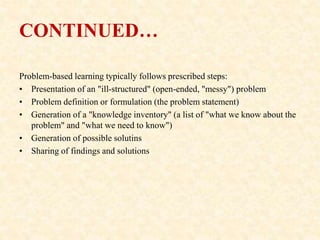
Problem-based learning typically follows prescribed steps:
• Presentation of an "ill-structured" (open-ended, "messy") problem
• Problem definition or formulation (the problem statement)
• Generation of a "knowledge inventory" (a list of "what we know about the
problem" and "what we need to know")
• Generation of possible solutins
• Sharing of findings and solutions
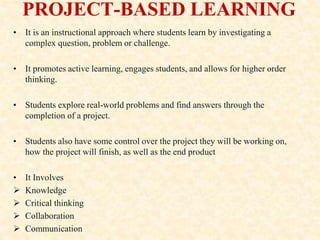
PROJECT-BASED LEARNING
• It is an instructional approach where students learn by investigating a
complex question, problem or challenge.
• It promotes active learning, engages students, and allows for higher order
thinking.
• Students explore real-world problems and find answers through the
completion of a project.
• Students also have some control over the project they will be working on,
how the project will finish, as well as the end product
• It Involves
 Knowledge
 Critical thinking
 Collaboration
 Communication
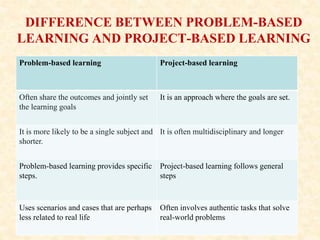
DIFFERENCE BETWEEN PROBLEM-BASED
LEARNING AND PROJECT-BASED LEARNING
Problem-based learning Project-based learning
Often share the outcomes and jointly set
the learning goals
It is an approach where the goals are set.
It is more likely to be a single subject and
shorter.
It is often multidisciplinary and longer
Problem-based learning provides specific
steps.
Project-based learning follows general
steps
Uses scenarios and cases that are perhaps
less related to real life
Often involves authentic tasks that solve
real-world problems
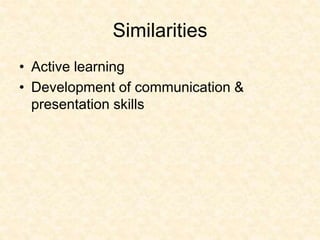
Similarities
• Active learning
• Development of communication &
presentation skills
MODULAR DESIGN
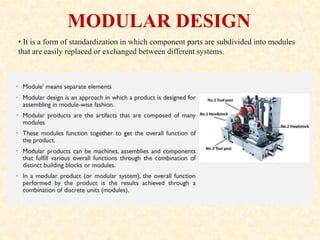
• It is a form of standardization in which component parts are subdivided into modules
that are easily replaced or exchanged between different systems.
CONTINUED…
• It allows:
 easier diagnosis and remedy of failures
 easier repair and replacement
 simplification of manufacturing and assembly
CONTINUED…
• It can be characterized by functional partitioning into discrete scalable and
reusable modules, rigorous use of well-defined modular interfaces, and
making use of industry standards for interfaces.
• In this context modularity is at the component level, and has a single
dimension, component slottability.
• A modular system with this limited modularity is generally known as a
platform system that uses modular components.
• Examples are car platforms or the USB port in computer engineering
platforms
• Modularity offers benefits such as
 Reduction in cost
 Interoperability
 Shorter learning time
 Flexibility in design
 Non-generationally constrained augmentation or updating (adding new
solution by merely plugging in a new module)
LIFE-CYCLE DESIGN
• The environmentally sound design of products based on the whole lifecycle.
• Starting from exploitation and processing of raw materials, preproduction,
production, distribution, to use and returning materials back into the
industrial cycles.
• PRODUCT LIFE CYCLE
• STAGES OF A PRODUCT
 Design
 Production
 Distribution
 Consumption
 Retirement: end-of-life
CONTINUED…
• Design: standards, design time, customer need, cost, profit, future
upgrading, deciding when to launch, energy efficiency
• Production: manufacturing cost, energy use, materials use, production time,
quality, environmental issues
• Distribution: transportation cost, transportation time, inventory, sales
network
• Consumption: customer training, repair & maintenance, upgrades, lifetime,
energy use
• Retirement: lifetime, upgrade plan, end of customer support, reuse,
recycling, disposal
OVER FULL LIFE CYCLE
• Design to minimize power consumption during use and manufacturing
• Design for disassembly, reuse, recycling
• Minimizing or eliminating use of CFC (ozone destroyers) in manufacturing
process.
• Minimizing or eliminating use of heavy metals in products -- like lead
solders
• Selection of battery type, plastics used, etc., in products
• Minimizing or recycling solvents, acids, etc., in manufacturing process
DESIGN RESPONSIBILITY
• Product designer should understand the environmental and energy use impact of his
or her design.
• ENVIRONMENTALLY RESPONSIBLE DESIGN
• Reduce, Reuse, Recycle (3Rs) (Apply these principles in product design)
• Reduce or eliminate use of greenhouse gases, toxic chemicals, lead solders, etc.
• Reduce energy consumption -- during manufacturing and use
• Recycling considerations -- take-back laws, how much of it needs to be recycled,
toxic chemicals in waste product, etc
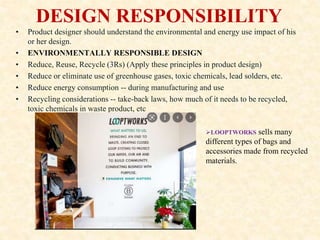
LOOPTWORKS sells many
different types of bags and
accessories made from recycled
materials.
APPLICATION OF BIOMIMICRY
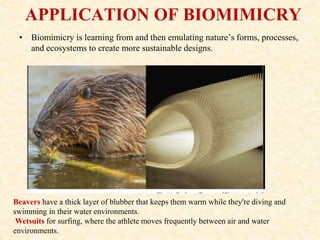
• Biomimicry is learning from and then emulating nature’s forms, processes,
and ecosystems to create more sustainable designs.
Beavers have a thick layer of blubber that keeps them warm while they're diving and
swimming in their water environments.
Wetsuits for surfing, where the athlete moves frequently between air and water
environments.
ERGONOMICS IN DESIGN
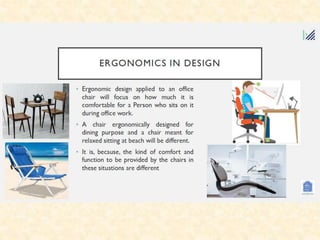
• Ergonomics is basically the science of analyzing work and then designing
items(tools,equipment,products) and methods to most appropriately fit the
capabilities of the user.
• Ergonomics design approach focuses on human comfort and decreased
fatigue through product design.
• During the design phase of a product, all the aspects of the product that can
cause discomfort while using that product are identified.
• Then, analyzes the causes of the discomfort and appropriate solutions will
be incorporated in the product design.
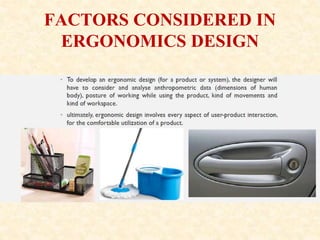
FACTORS CONSIDERED IN
ERGONOMICS DESIGN
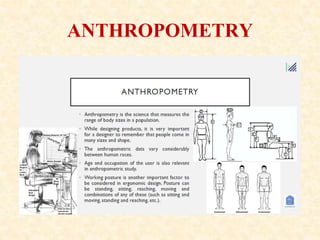
ANTHROPOMETRY
ADVANTAGES OF ERGONOMICS
DESIGN
AESTHETICS IN DESIGN
• The word‘ aesthetics‘ is derived from the Greek word‘ aesthetikos‘
meaning sensory perception.
• Aesthetics is the feel that a human being perceives.
• When a person perceives a sense of pleasure through any of the senses
while using a product, then we can say that the product is aesthetically
appealing.
• Example: good food, nice perfume
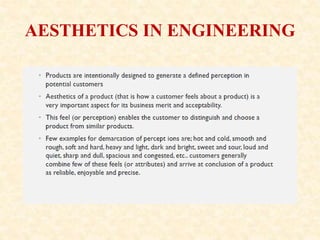
AESTHETICS IN ENGINEERING
CONCURRENT ENGINEERING
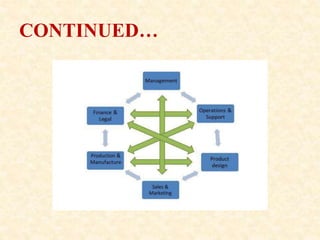
• It is an approach in product design process in which people from various
functional areas works together simultaneously to develop a product.
• Since people from various fields are working simultaneously for the
development, this kind of engineering is also known as Simultaneous
Engineering or Parallel Engineering.
• This approach is adopted to improve the efficiency of product design and
reduce the product development cycle time.
CONTINUED…
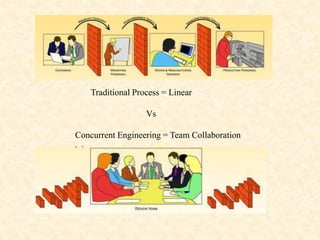
Traditional Process = Linear
Vs
Concurrent Engineering = Team Collaboration
ADVANTAGES
• Reduce design time
• Reduce cost for design changes
• Ensure correct data and information transfer between various sections
• Companies must keep pace with changing markets
• Decisions made sooner rather than later
• Reduces/eliminates repetition of tasks
• Reduces waste and reworking of design
• Product quicker to market
• Maximises company profit
• Company operates more efficiently
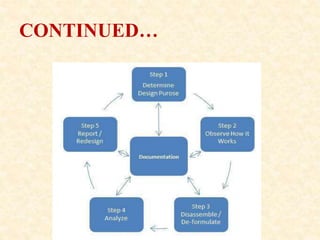
REVERSE ENGINEERING
• Reverse engineering, also called backward engineering is the process by
which an artificial object is deconstructed to reveal its designs, architecture,
code or to extract knowledge from the object.
• In reverse engineering, a product is dissected or disassembled to find out in
detail how a part works an why is it used. This information obtained by this
process can then be applied to solve own design problem or develop a new
product.
CONTINUED…
NEED FOR REVERSE ENGINEERING
• Legacy products – products that are no longer manufactured and do not have
drawings to reproduce them
• Obsolete products – Original Equipment Manufacturer (OEM) products that are no
longer supported or manufactured by the OEM
• Design analysis and development – analyzing a product to make design
improvements
• Competitive analysis research or investigation of competitor’s products for possible
patent infringement
• Servicing or repair of products when documentation is unavailable
• Crime prevention (e.g. reverse engineering of malware)
• Failure analysis
THANK YOU

module 4 (1).ppt

  • 1.
  • 2.
    MODULE 4 • DesignEngineering Concepts:-Project- based Learning and Problem-based Learning in Design. • Modular Design and Life Cycle Design Approaches. • Application of Biomimicry, Aesthetics and Ergonomics in Design. • Value Engineering, Concurrent Engineering, and Reverse Engineering in Design
  • 3.
    PROBLEM-BASED LEARNING • Itis a teaching pedagogy that is student-centred. • Students learn about a topic through the solving of problems and generally work in groups to solve the problem . • It empowers learners to conduct research, integrate theory and practice, and apply knowledge and skills to develop a viable solution to a defined problem
  • 4.
    CONTINUED… Problem-based learning typicallyfollows prescribed steps: • Presentation of an "ill-structured" (open-ended, "messy") problem • Problem definition or formulation (the problem statement) • Generation of a "knowledge inventory" (a list of "what we know about the problem" and "what we need to know") • Generation of possible solutins • Sharing of findings and solutions
  • 5.
    PROJECT-BASED LEARNING • Itis an instructional approach where students learn by investigating a complex question, problem or challenge. • It promotes active learning, engages students, and allows for higher order thinking. • Students explore real-world problems and find answers through the completion of a project. • Students also have some control over the project they will be working on, how the project will finish, as well as the end product • It Involves  Knowledge  Critical thinking  Collaboration  Communication
  • 6.
    DIFFERENCE BETWEEN PROBLEM-BASED LEARNINGAND PROJECT-BASED LEARNING Problem-based learning Project-based learning Often share the outcomes and jointly set the learning goals It is an approach where the goals are set. It is more likely to be a single subject and shorter. It is often multidisciplinary and longer Problem-based learning provides specific steps. Project-based learning follows general steps Uses scenarios and cases that are perhaps less related to real life Often involves authentic tasks that solve real-world problems
  • 7.
    Similarities • Active learning •Development of communication & presentation skills
  • 8.
    MODULAR DESIGN • Itis a form of standardization in which component parts are subdivided into modules that are easily replaced or exchanged between different systems.
  • 9.
    CONTINUED… • It allows: easier diagnosis and remedy of failures  easier repair and replacement  simplification of manufacturing and assembly
  • 10.
    CONTINUED… • It canbe characterized by functional partitioning into discrete scalable and reusable modules, rigorous use of well-defined modular interfaces, and making use of industry standards for interfaces. • In this context modularity is at the component level, and has a single dimension, component slottability. • A modular system with this limited modularity is generally known as a platform system that uses modular components. • Examples are car platforms or the USB port in computer engineering platforms
  • 11.
    • Modularity offersbenefits such as  Reduction in cost  Interoperability  Shorter learning time  Flexibility in design  Non-generationally constrained augmentation or updating (adding new solution by merely plugging in a new module)
  • 12.
    LIFE-CYCLE DESIGN • Theenvironmentally sound design of products based on the whole lifecycle. • Starting from exploitation and processing of raw materials, preproduction, production, distribution, to use and returning materials back into the industrial cycles. • PRODUCT LIFE CYCLE • STAGES OF A PRODUCT  Design  Production  Distribution  Consumption  Retirement: end-of-life
  • 13.
    CONTINUED… • Design: standards,design time, customer need, cost, profit, future upgrading, deciding when to launch, energy efficiency • Production: manufacturing cost, energy use, materials use, production time, quality, environmental issues • Distribution: transportation cost, transportation time, inventory, sales network • Consumption: customer training, repair & maintenance, upgrades, lifetime, energy use • Retirement: lifetime, upgrade plan, end of customer support, reuse, recycling, disposal
  • 14.
    OVER FULL LIFECYCLE • Design to minimize power consumption during use and manufacturing • Design for disassembly, reuse, recycling • Minimizing or eliminating use of CFC (ozone destroyers) in manufacturing process. • Minimizing or eliminating use of heavy metals in products -- like lead solders • Selection of battery type, plastics used, etc., in products • Minimizing or recycling solvents, acids, etc., in manufacturing process
  • 15.
    DESIGN RESPONSIBILITY • Productdesigner should understand the environmental and energy use impact of his or her design. • ENVIRONMENTALLY RESPONSIBLE DESIGN • Reduce, Reuse, Recycle (3Rs) (Apply these principles in product design) • Reduce or eliminate use of greenhouse gases, toxic chemicals, lead solders, etc. • Reduce energy consumption -- during manufacturing and use • Recycling considerations -- take-back laws, how much of it needs to be recycled, toxic chemicals in waste product, etc LOOPTWORKS sells many different types of bags and accessories made from recycled materials.
  • 16.
    APPLICATION OF BIOMIMICRY •Biomimicry is learning from and then emulating nature’s forms, processes, and ecosystems to create more sustainable designs. Beavers have a thick layer of blubber that keeps them warm while they're diving and swimming in their water environments. Wetsuits for surfing, where the athlete moves frequently between air and water environments.
  • 17.
    ERGONOMICS IN DESIGN •Ergonomics is basically the science of analyzing work and then designing items(tools,equipment,products) and methods to most appropriately fit the capabilities of the user. • Ergonomics design approach focuses on human comfort and decreased fatigue through product design. • During the design phase of a product, all the aspects of the product that can cause discomfort while using that product are identified. • Then, analyzes the causes of the discomfort and appropriate solutions will be incorporated in the product design.
  • 19.
  • 20.
  • 21.
  • 22.
    AESTHETICS IN DESIGN •The word‘ aesthetics‘ is derived from the Greek word‘ aesthetikos‘ meaning sensory perception. • Aesthetics is the feel that a human being perceives. • When a person perceives a sense of pleasure through any of the senses while using a product, then we can say that the product is aesthetically appealing. • Example: good food, nice perfume
  • 23.
  • 24.
    CONCURRENT ENGINEERING • Itis an approach in product design process in which people from various functional areas works together simultaneously to develop a product. • Since people from various fields are working simultaneously for the development, this kind of engineering is also known as Simultaneous Engineering or Parallel Engineering. • This approach is adopted to improve the efficiency of product design and reduce the product development cycle time.
  • 25.
  • 26.
    Traditional Process =Linear Vs Concurrent Engineering = Team Collaboration
  • 27.
    ADVANTAGES • Reduce designtime • Reduce cost for design changes • Ensure correct data and information transfer between various sections • Companies must keep pace with changing markets • Decisions made sooner rather than later • Reduces/eliminates repetition of tasks • Reduces waste and reworking of design • Product quicker to market • Maximises company profit • Company operates more efficiently
  • 28.
    REVERSE ENGINEERING • Reverseengineering, also called backward engineering is the process by which an artificial object is deconstructed to reveal its designs, architecture, code or to extract knowledge from the object. • In reverse engineering, a product is dissected or disassembled to find out in detail how a part works an why is it used. This information obtained by this process can then be applied to solve own design problem or develop a new product.
  • 29.
  • 30.
    NEED FOR REVERSEENGINEERING • Legacy products – products that are no longer manufactured and do not have drawings to reproduce them • Obsolete products – Original Equipment Manufacturer (OEM) products that are no longer supported or manufactured by the OEM • Design analysis and development – analyzing a product to make design improvements • Competitive analysis research or investigation of competitor’s products for possible patent infringement • Servicing or repair of products when documentation is unavailable • Crime prevention (e.g. reverse engineering of malware) • Failure analysis
  • 32.