BACHELOR OF TECHNOLOGY IN
MANUFACTURING TECHNOLOGY
Level 8 RQF, Rwanda Polytechnic
2
Module: MATID801 INDUSTRIAL DESIGN FOR MANUFACTURING
PROCESS
BTech: manufacturing Technology
Competence: Apply INDUSTRIAL DESIGN FOR
MANUFACTURING PROCESS
Module: MATID801 INDUSTRIAL DESIGN FOR MANUFACTURING
PROCESS
BTech: manufacturing Technology
Module Description
5
Elements of
competence
Performance criteria
1. Develop
design ideas
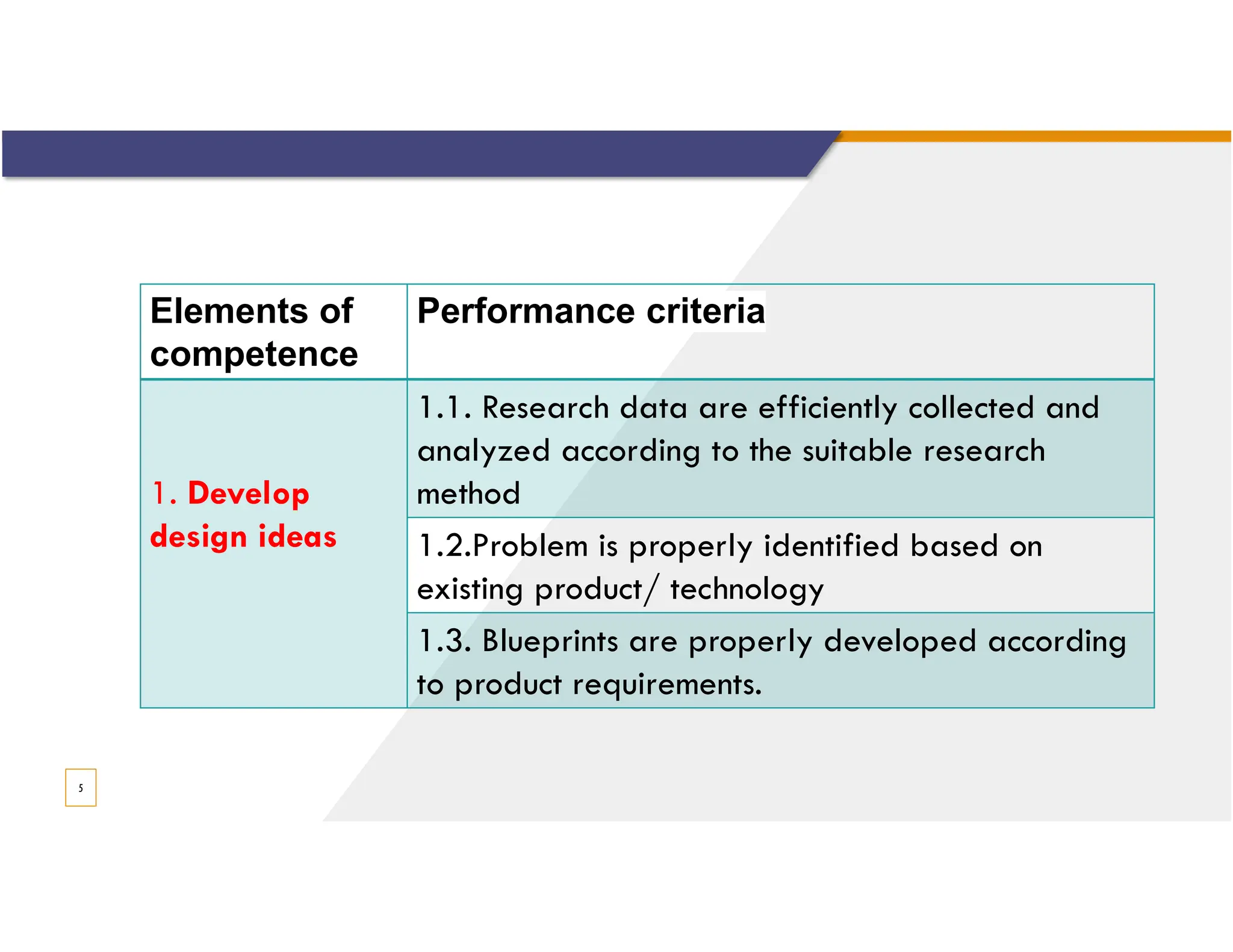
1.1. Research data are efficiently collected and
analyzed according to the suitable research
method
1.2.Problem is properly identified based on
existing product/ technology
1.3. Blueprints are properly developed according
to product requirements.
6
Elements of
competence
Performance criteria
2. Generate
design concept
2.1. Design tools are properly selected based on
product requirements
2.2.Design concept is accurately elaborated in
consideration of product requirements.
2.3. Mock-ups are efficiently constructed
according to material optimization
7
Elements of
competence
Performance criteria
3. Make
product model
simulation
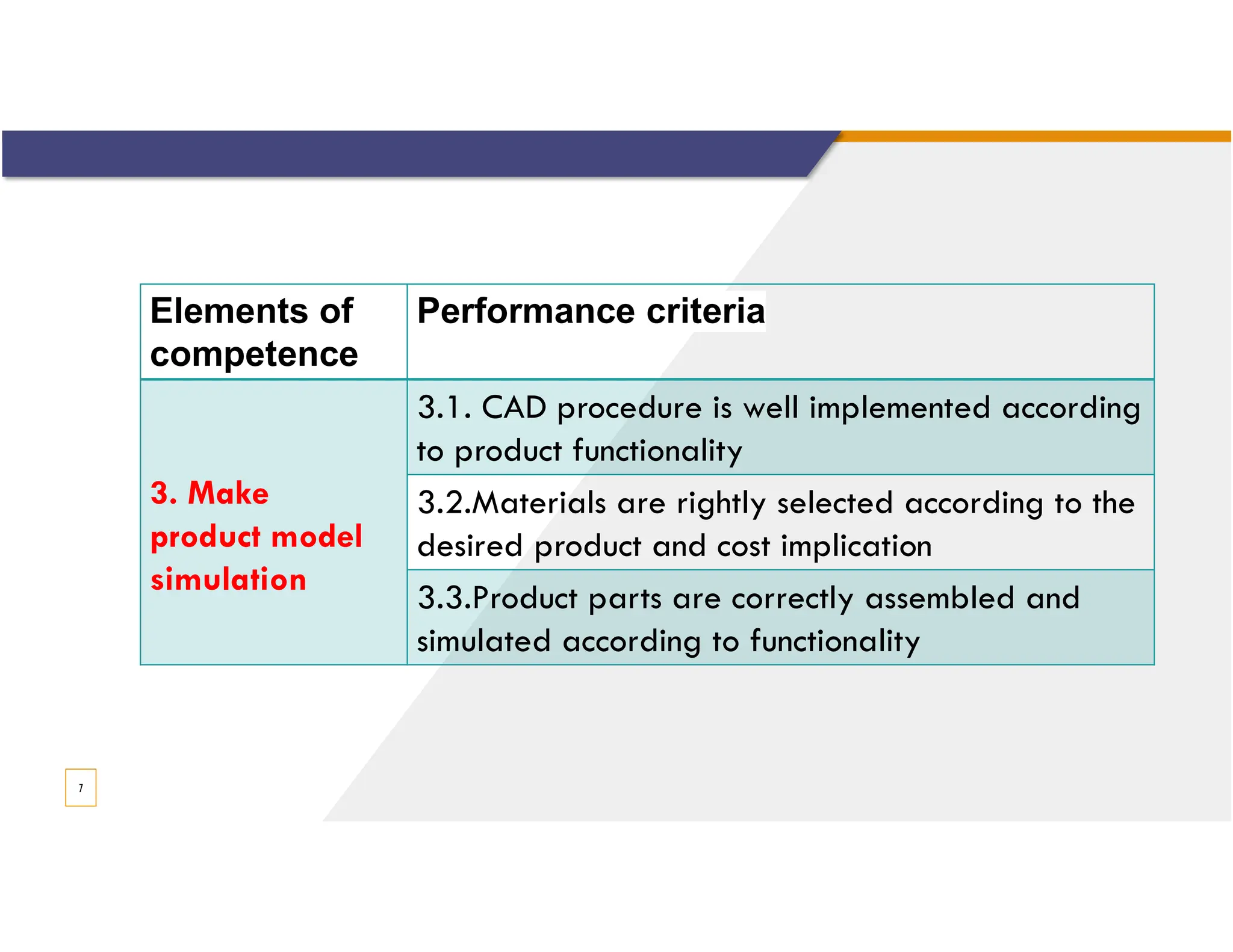
3.1. CAD procedure is well implemented according
to product functionality
3.2.Materials are rightly selected according to the
desired product and cost implication
3.3.Product parts are correctly assembled and
simulated according to functionality
8
Elements of
competence
Performance criteria
4. Supervise
prototype
manufacturing
activities
4.1.Operational tests are correctly executed
according to the desired output
4.2.Product compliances are properly set
according to the desired output
4.3.SOPs are correctly monitored according to
national/international standards
9
Elements of
competence
Performance criteria
5. Develop
industrial
documentation
5.1.Assemble Catalogues for machine parts are
correctly elaborated according to the assembling
procedures.
5.2.Operational/User/instruction guide is correctly
elaborated according to the working principles.
5.3.Maintenance manual is properly elaborated
according to working standards.
5.4.Product manual is neatly elaborated according
to the quality standard.
Module: MATID801 INDUSTRIAL DESIGN FOR MANUFACTURING
PROCESS
i. Develop design ideas
ii. Generate design concept
iii. Make product model simulation
iv. Supervise prototype manufacturing activities
v. Develop industrial documentation
Module content
Module: MATID801 INDUSTRIAL DESIGN FOR MANUFACTURING
PROCESS
I. Develop
design ideas
Develop design ideas
12
Develop design
ideas
13
Introduction to Industrial
Design
14
Developing design ideas for the manufacturing process is a vital phase in
industrial design that transforms creative concepts into practical, producible
products.
This process begins with brainstorming and creative exploration to generate
innovative ideas, followed by refining these ideas into detailed design concepts
that consider functionality, user experience, and cost-effectiveness.
Industrial design is the process of creating and developing concepts and
specifications for products that are visually appealing, ergonomic,
functional, and user-friendly.
15
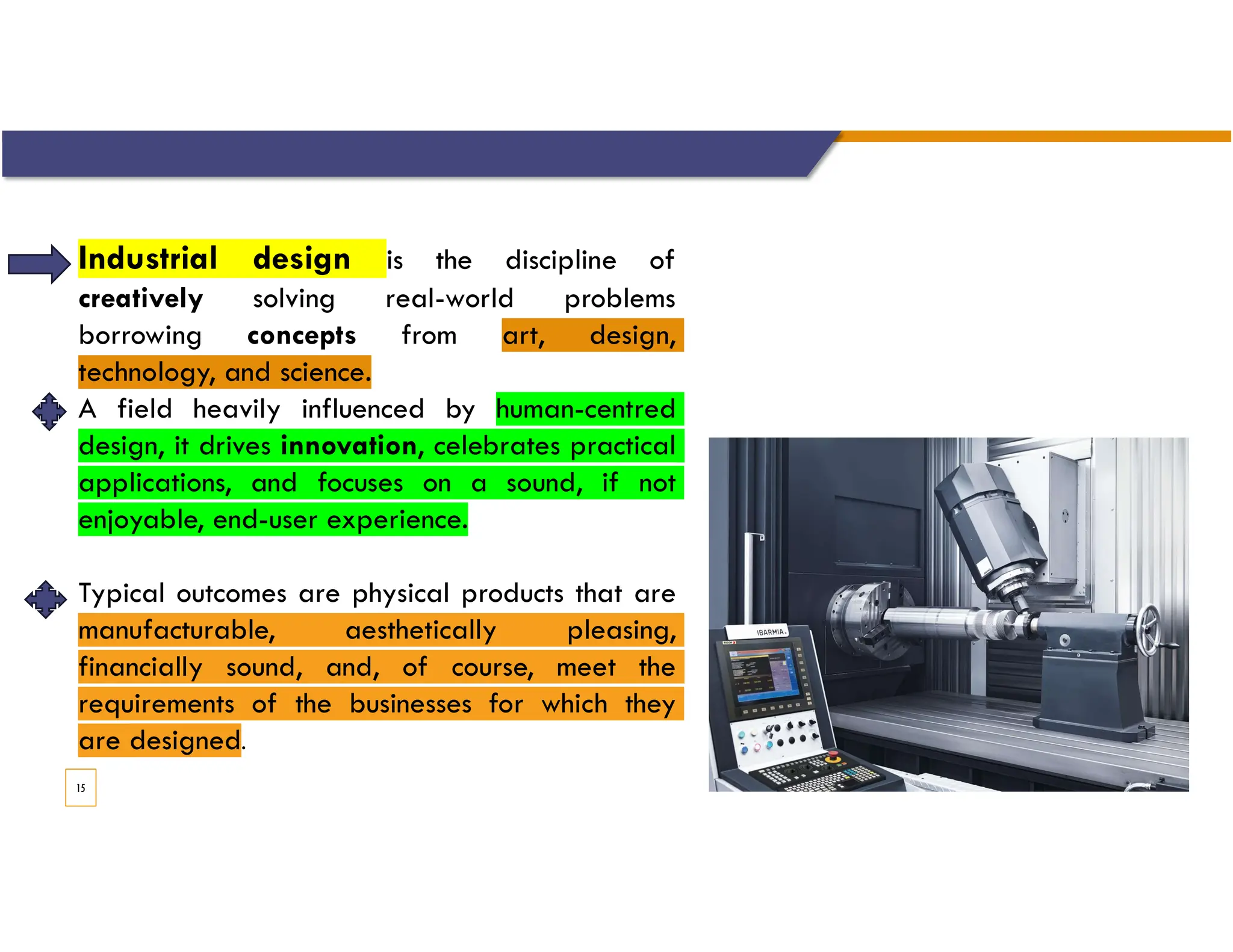
Industrial design is the discipline of
creatively solving real-world problems
borrowing concepts from art, design,
technology, and science.
A field heavily influenced by human-centred
design, it drives innovation, celebrates practical
applications, and focuses on a sound, if not
enjoyable, end-user experience.
Typical outcomes are physical products that are
manufacturable, aesthetically pleasing,
financially sound, and, of course, meet the
requirements of the businesses for which they
are designed.
TERMS ASS
16
17
1. Engineering design (sometimes called
technological design) is an iterative, systematic process
for solving problems that involve creativity, experience,
and accumulated disciplinary knowledge.
2. Technical Development means any technical and
Manufacturing-related activities, including test method
development and stability testing, assay development, process
development, formulation development, quality assurance and
quality control development, validation and other testing,
packaging development, as well as record-keeping, data and
database development, management, storage, and retention
activities relating to any of the foregoing.
Technical Development is any invention and
product innovation that enables a new good to be
produced, and a process innovation or method that
enables an existing good to be produced at a lower
cost as a result of the increase in the efficiency of the
factors used in its production.
3. Creative Art in Manufacturing In the
manufacturing industry, creative art refers to the
application of artistic principles and techniques
to the design and production of products. This
can involve using art forms such as painting,
sculpture, and graphic design to create
aesthetically pleasing and functional products
Position of Product Design (by Horvăth 2004)
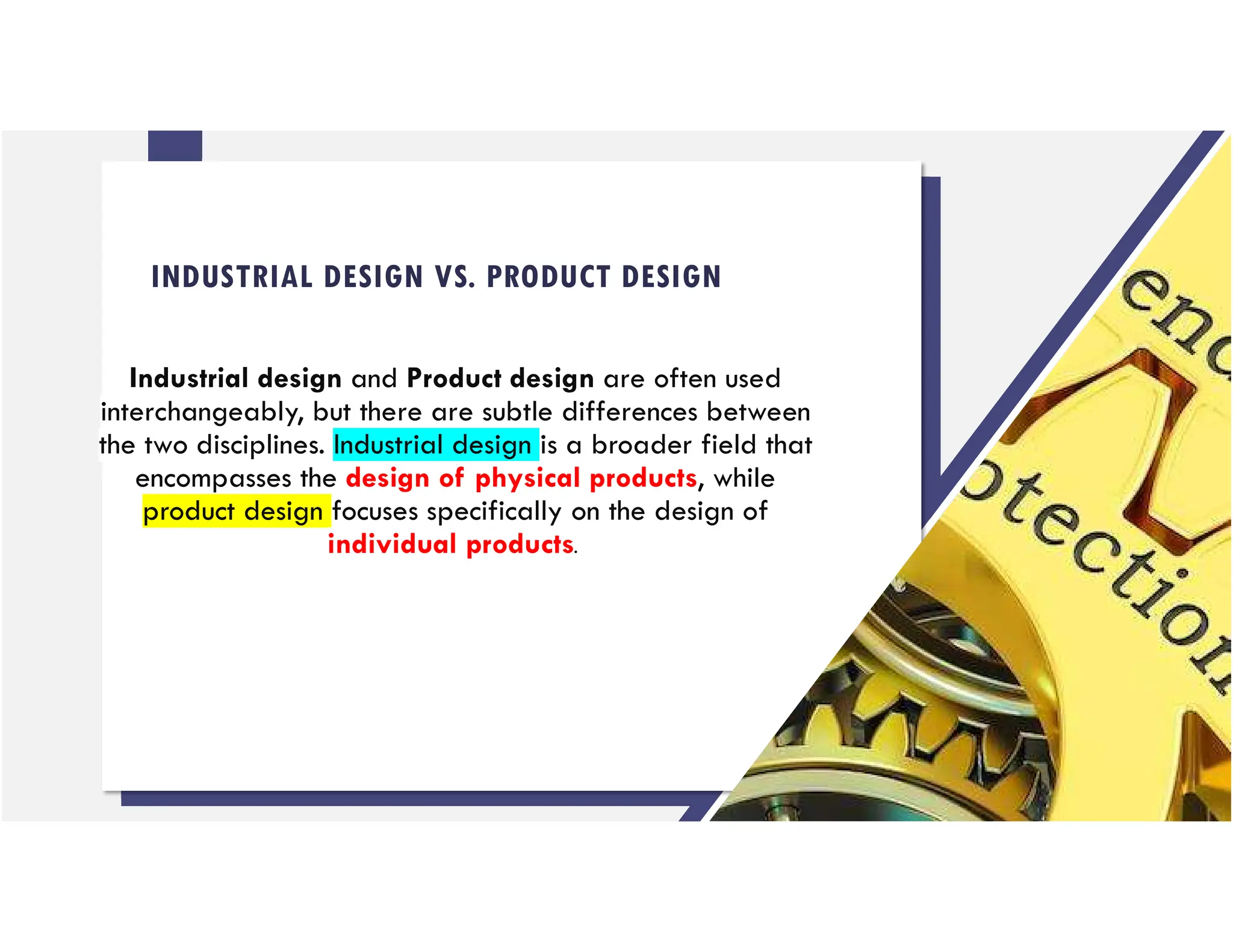
INDUSTRIAL DESIGN VS. PRODUCT DESIGN
Industrial design and Product design are often used
interchangeably, but there are subtle differences between
the two disciplines. Industrial design is a broader field that
encompasses the design of physical products, while
product design focuses specifically on the design of
individual products.
INDUSTRIAL DESIGN VS. PRODUCT DESIGN
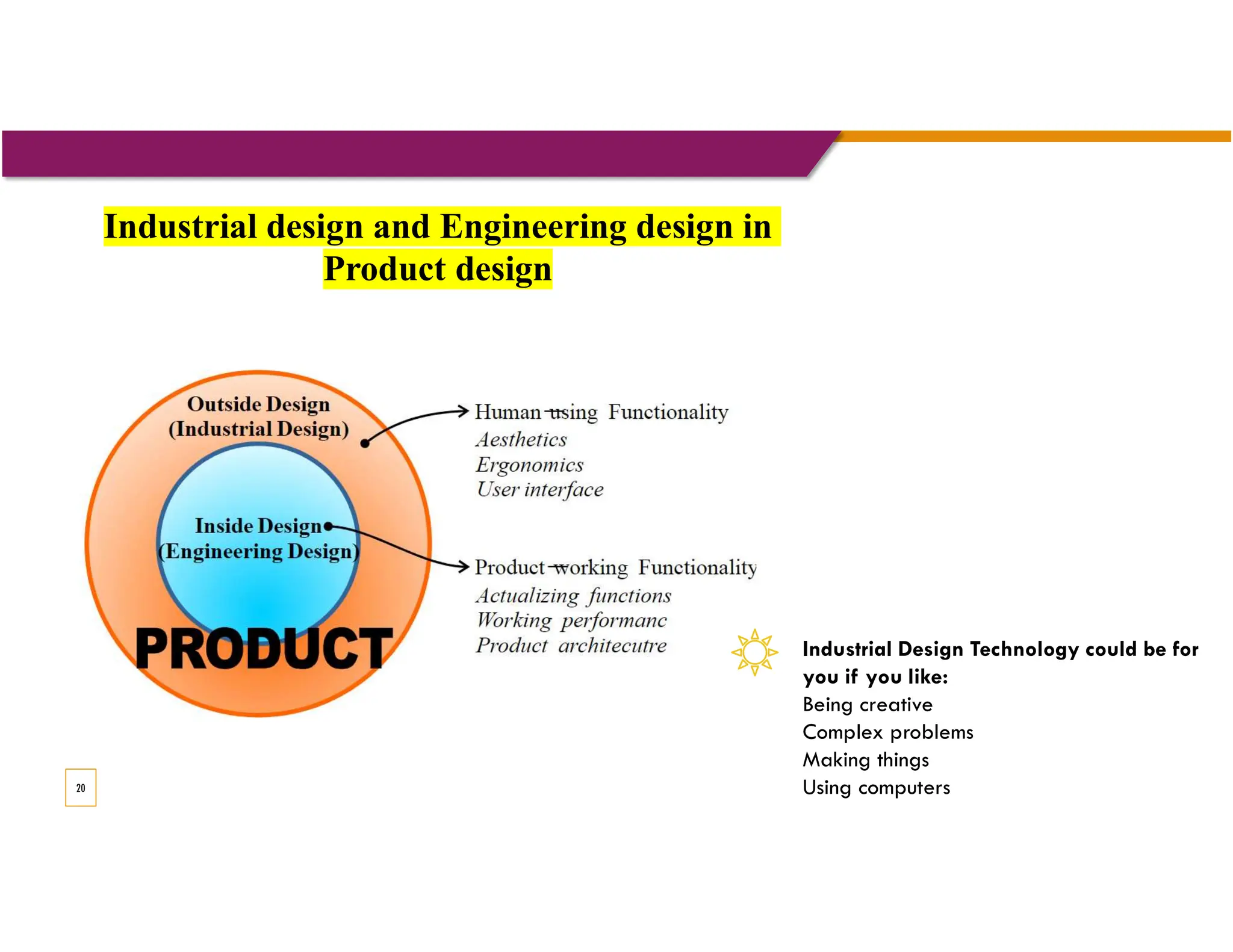
Two major parts in product design
19
20
Industrial Design Technology could be for
you if you like:
Being creative
Complex problems
Making things
Using computers
Industrial design and Engineering design in
Product design
INDUSTRY & DESIGN
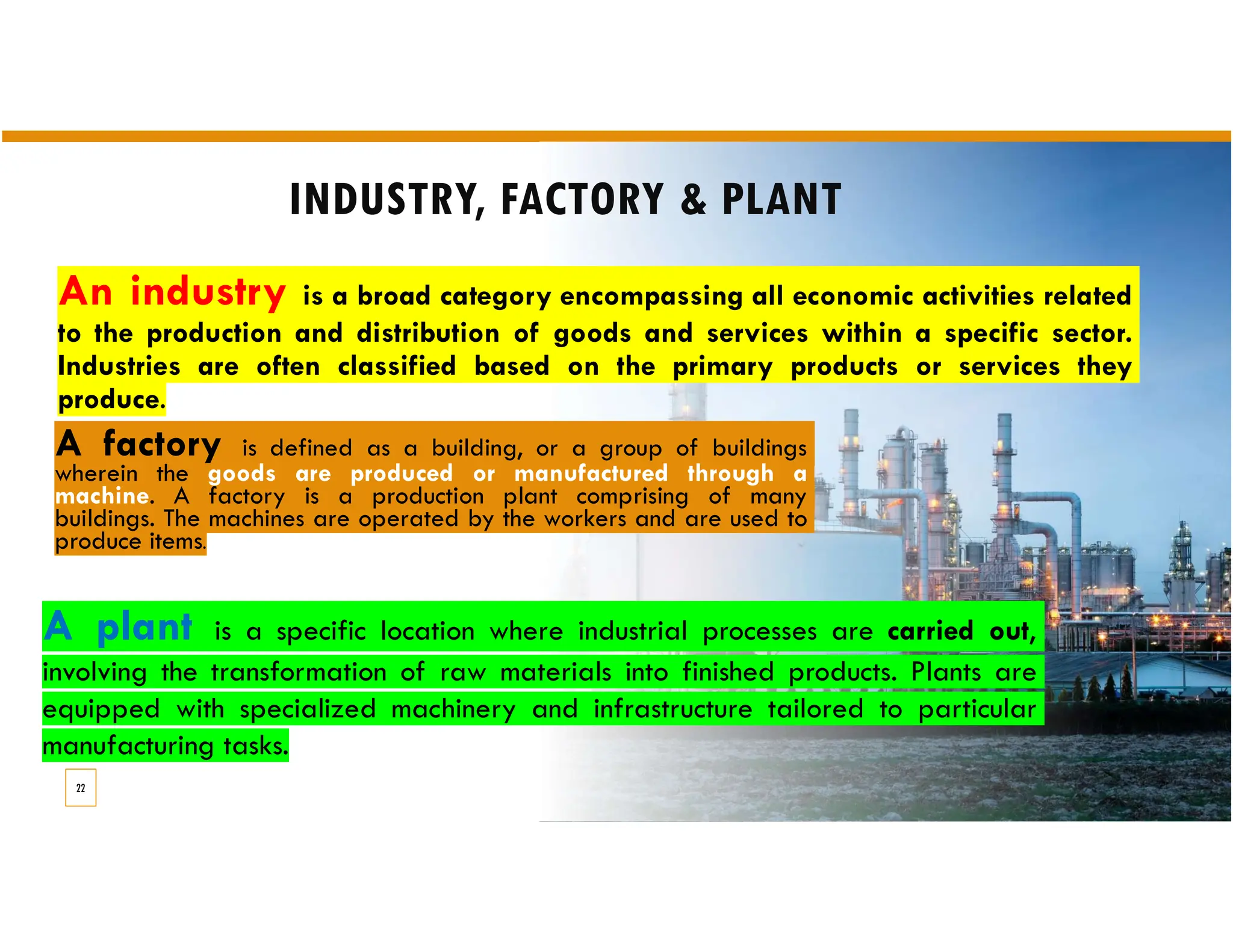
INDUSTRY, FACTORY & PLANT
A factory is defined as a building, or a group of buildings
wherein the goods are produced or manufactured through a
machine. A factory is a production plant comprising of many
buildings. The machines are operated by the workers and are used to
produce items.
An industry is a broad category encompassing all economic activities related
to the production and distribution of goods and services within a specific sector.
Industries are often classified based on the primary products or services they
produce.
22
A plant is a specific location where industrial processes are carried out,
involving the transformation of raw materials into finished products. Plants are
equipped with specialized machinery and infrastructure tailored to particular
manufacturing tasks.
Design
Design
24
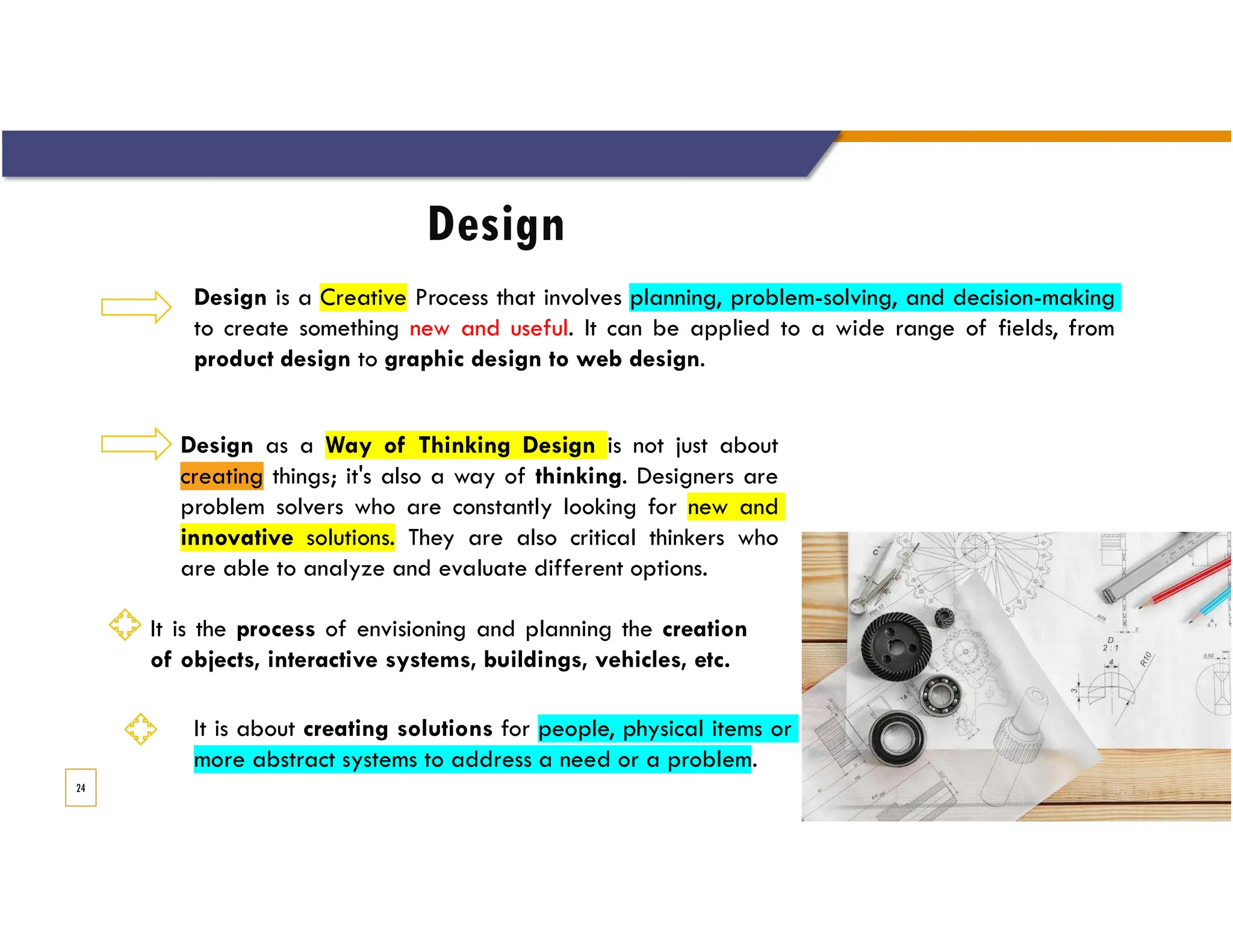
Design is a Creative Process that involves planning, problem-solving, and decision-making
to create something new and useful. It can be applied to a wide range of fields, from
product design to graphic design to web design.
Design as a Way of Thinking Design is not just about
creating things; it's also a way of thinking. Designers are
problem solvers who are constantly looking for new and
innovative solutions. They are also critical thinkers who
are able to analyze and evaluate different options.
It is the process of envisioning and planning the creation
of objects, interactive systems, buildings, vehicles, etc.
It is about creating solutions for people, physical items or
more abstract systems to address a need or a problem.
DESIGN THINKING
.
25
https://ln.run/MCTgT
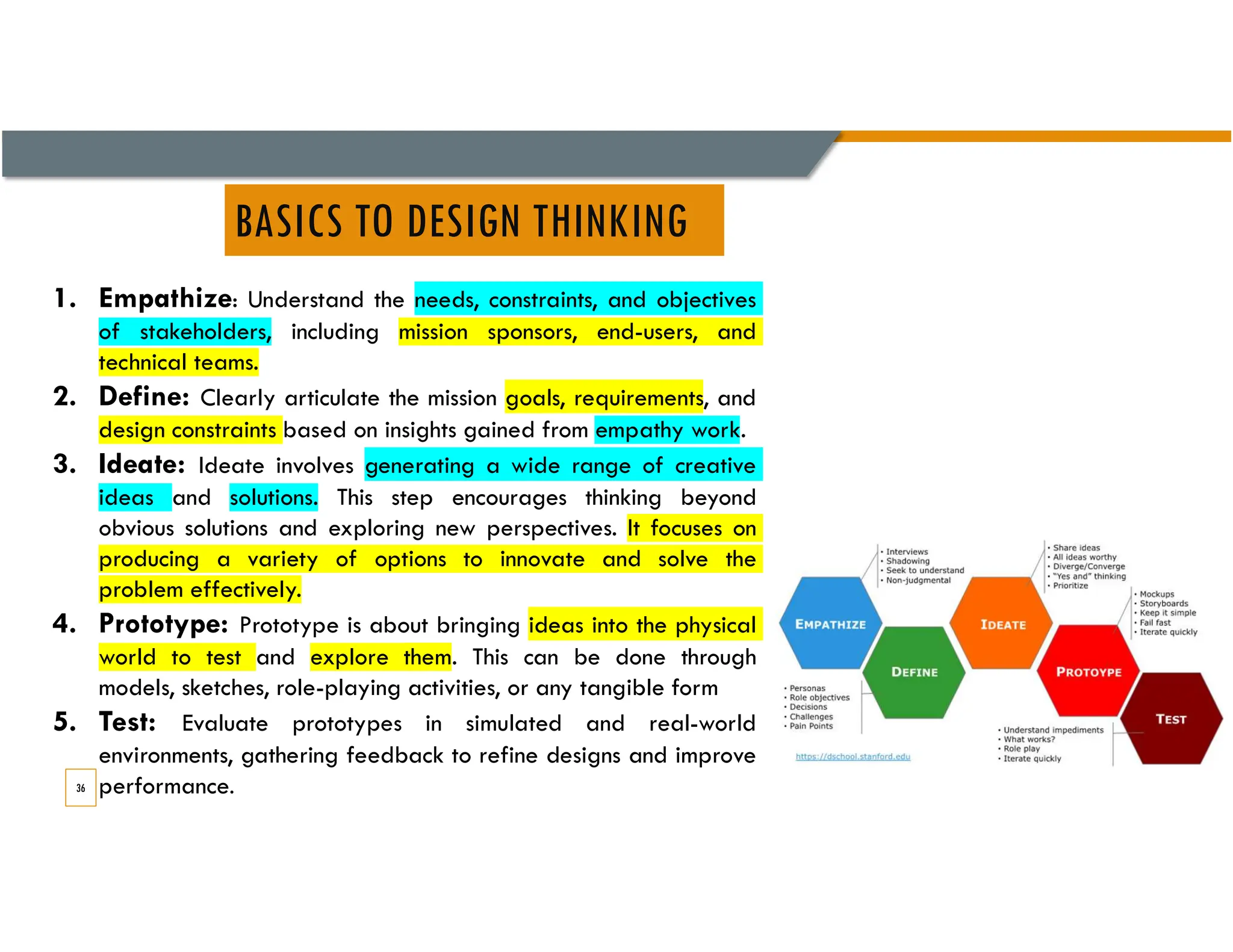
Design thinking is an iterative, non-linear
process which focuses on a collaboration
between designers and users.
Design thinking is a non-linear, iterative process that
teams use to understand users, challenge assumptions,
redefine problems and create innovative solutions
to prototype and test. It is most useful to tackle ill-
defined or unknown problems and involves five
phases: Empathize, Define, Ideate, Prototype and
Test.
DEFINITIONS
Innovation: Combining existing ideas in a new and useful
way.
Creativity: Application of imagination to a problem
Design thinking: is the process of creating solutions using
creative problem-solving techniques.
“Is not a way of thinking but a way of doing "By Professor Steven D. Eppinger
DESIGN THINKING:
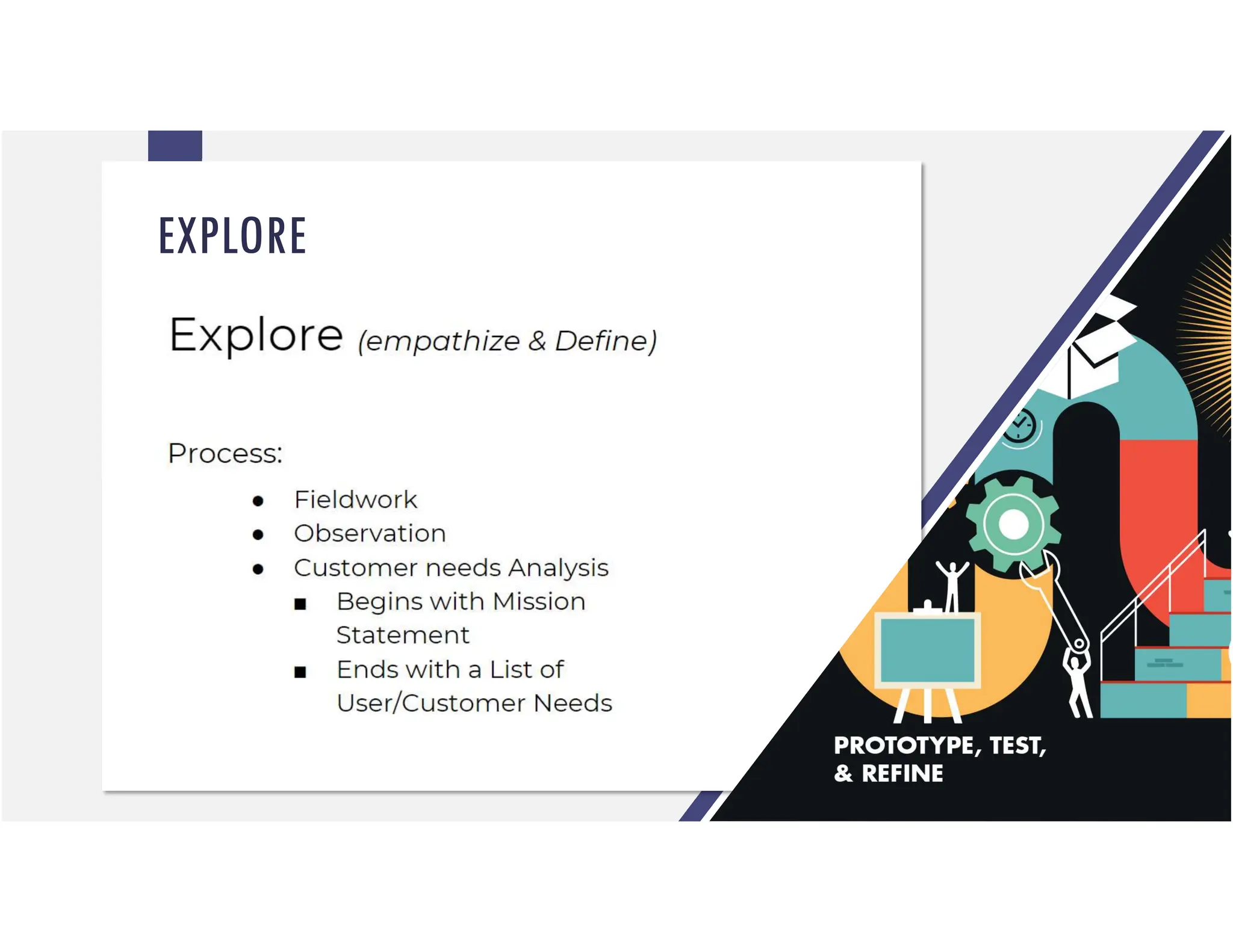
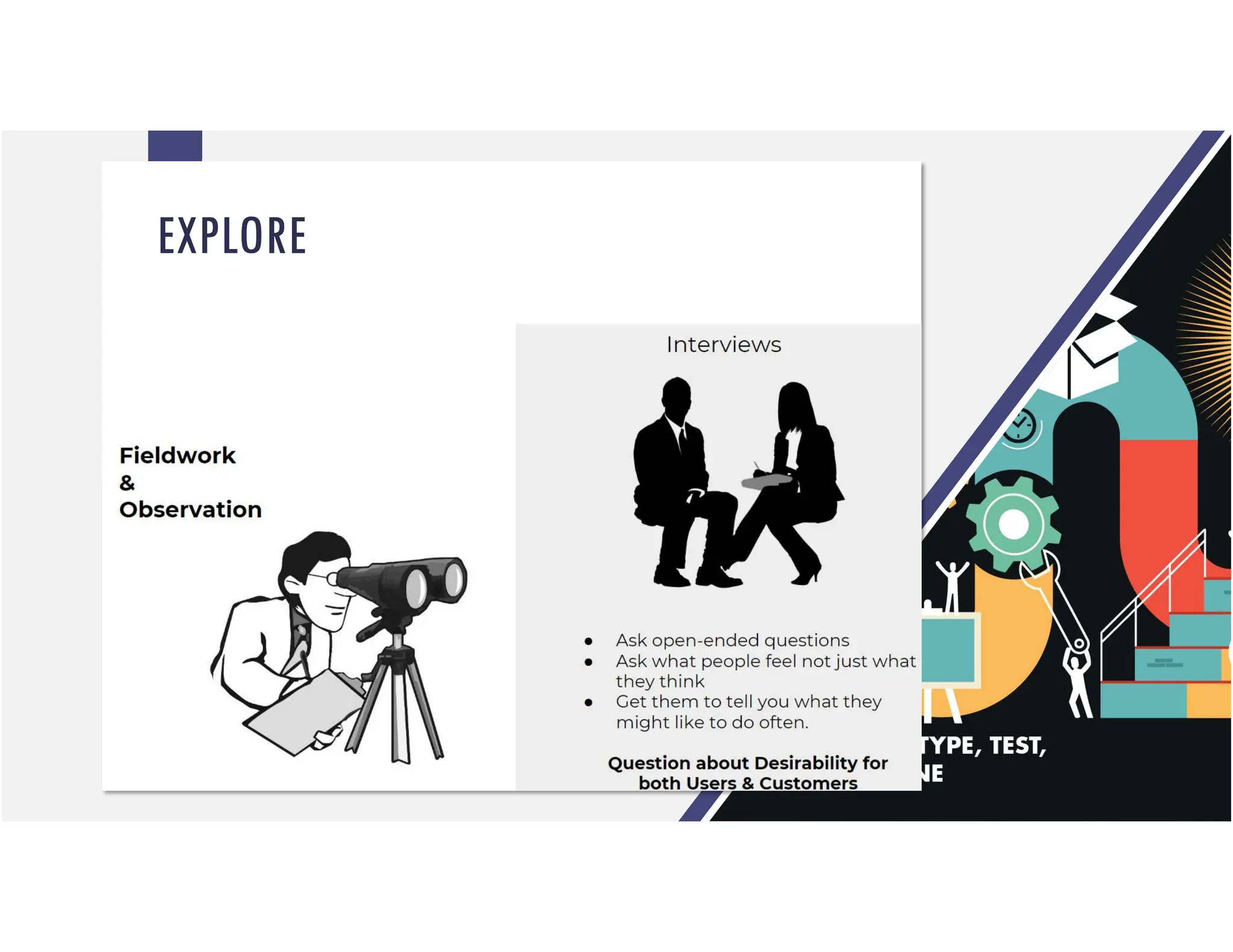
EXPLORE
EXPLORE
CREATE (consider the entire solution space)
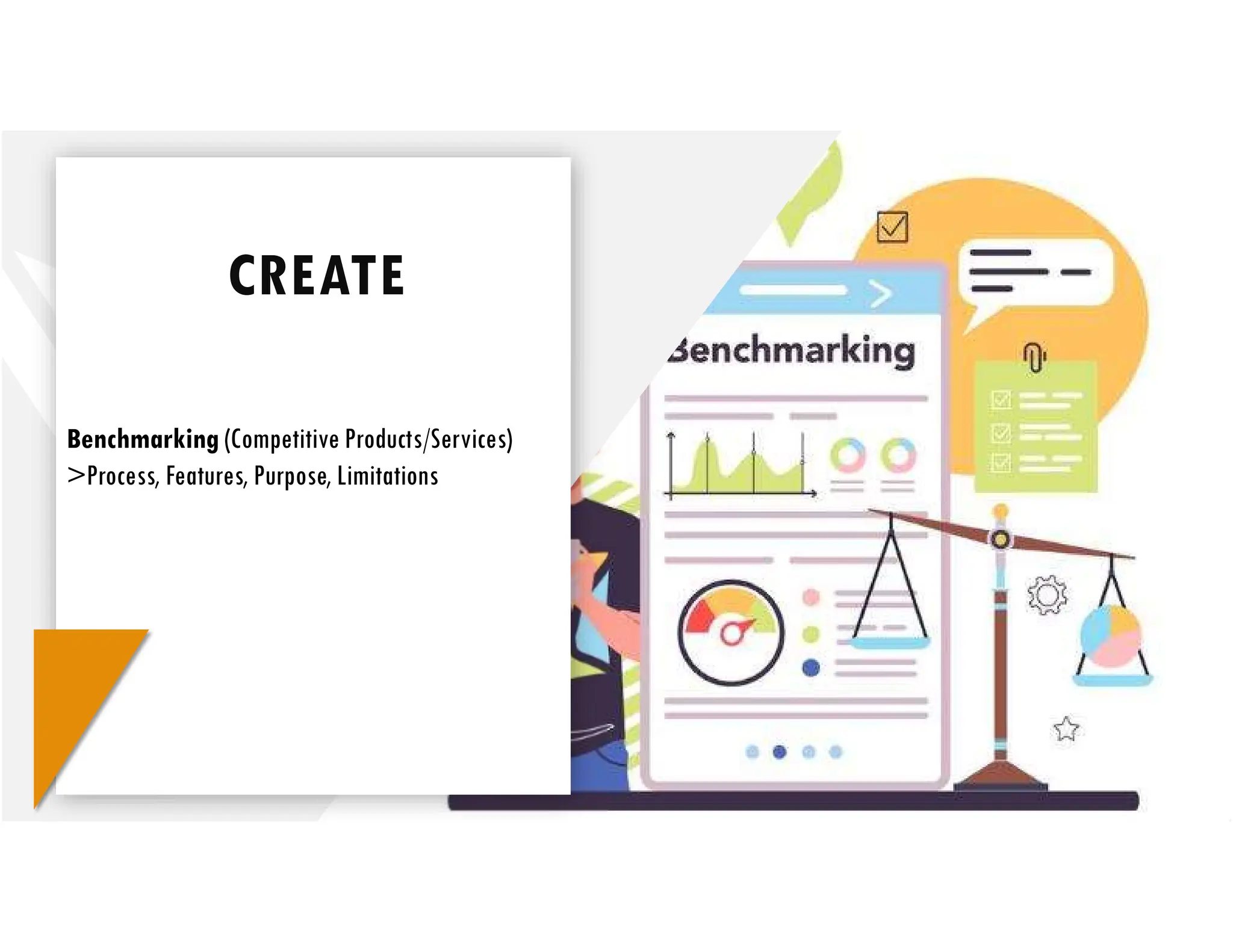
CREATE
Benchmarking (Competitive Products/Services)
>Process, Features, Purpose, Limitations
32
Rules for Brainstorming
1. Defer Judgement of Ideas
2. Build on the ideas of others
3. Encourage wild ideas
4. Express Ideas Visually
5. Stay focused on the topic
6. One conversation at a time
7. Use stimuli related &
Unrelated to the topic
Brainstorming
possible Solutions
Quotes
“To have a great Idea have a lot of them”. Thomas Edison
“Creativity is just having enough dots to connect”. Steve
Jobs
PROTOTYPE
1. Make a detailed design
2. Never fall in love with your
prototype
3. Test, Lean & Test Again
33
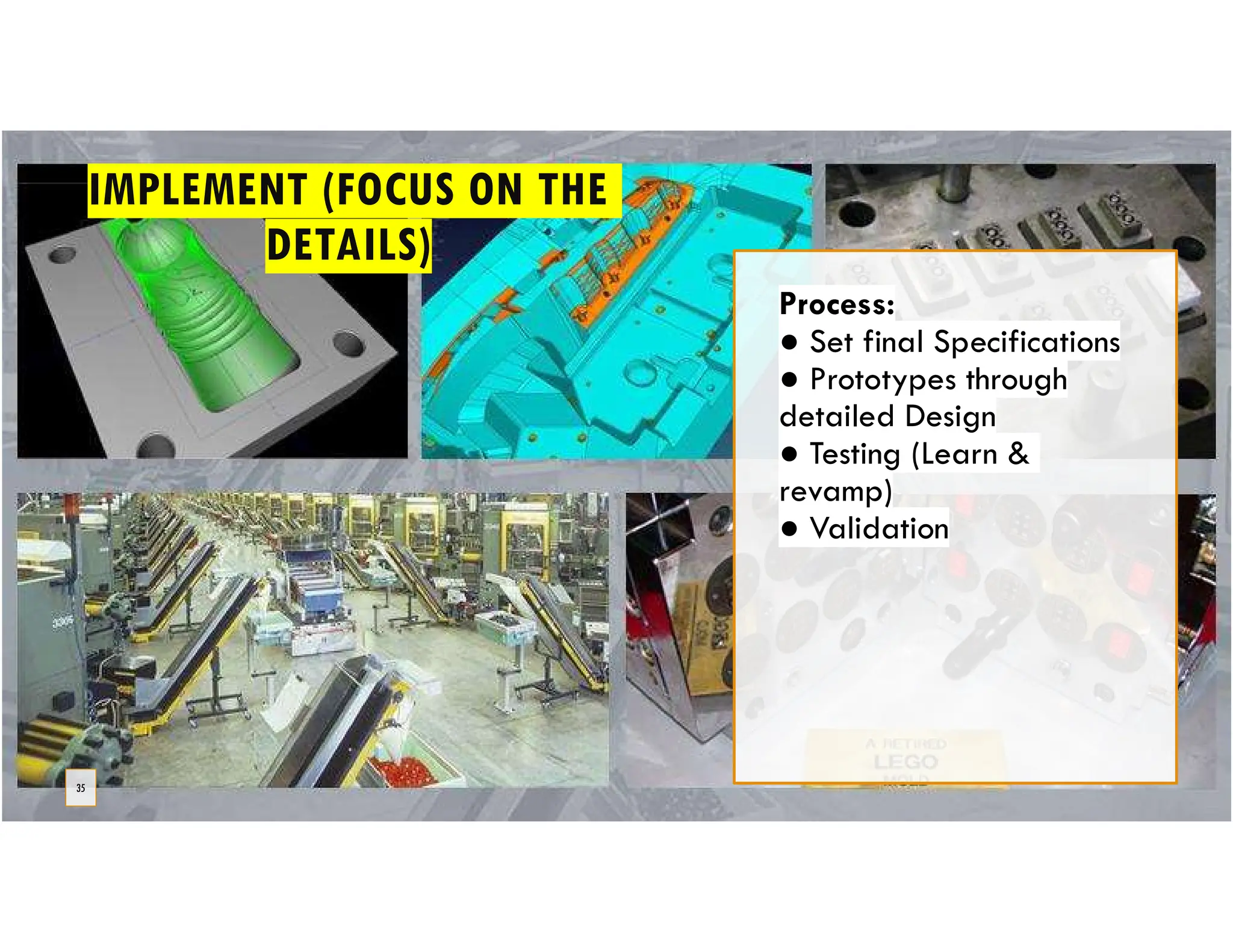
IMPLEMENT (FOCUS ON THE DETAILS)
Design Process:
● Set final Specifications
● Prototypes through
detailed Design
● Testing (Learn & revamp)
● Validation
Process:
● Set final Specifications
● Prototypes through
detailed Design
● Testing (Learn &
revamp)
● Validation
35
IMPLEMENT (FOCUS ON THE
DETAILS)
BASICS TO DESIGN THINKING
36
1. Empathize: Understand the needs, constraints, and objectives
of stakeholders, including mission sponsors, end-users, and
technical teams.
2. Define: Clearly articulate the mission goals, requirements, and
design constraints based on insights gained from empathy work.
3. Ideate: Ideate involves generating a wide range of creative
ideas and solutions. This step encourages thinking beyond
obvious solutions and exploring new perspectives. It focuses on
producing a variety of options to innovate and solve the
problem effectively.
4. Prototype: Prototype is about bringing ideas into the physical
world to test and explore them. This can be done through
models, sketches, role-playing activities, or any tangible form
5. Test: Evaluate prototypes in simulated and real-world
environments, gathering feedback to refine designs and improve
performance.
MANUFACTURING
Manufacturing is the creation or
production of goods with the help of
equipment, labour, machines, tools,
and chemical or biological
processing or formulation.
38
MANUFACTURING PROCESS
Is the method through which raw materials are transformed into a final product
Manufacturing process
39
DESIGN FOR MANUFACTURING
(DFM)
40
Design for manufacturing is the
combination of two major sources of product
implementation, design and the production
process. In which both the design of a product
should be simple and easy while in
manufacturing, production cost should be less
with a better quality product.
Fundamental step for design for manufacturing (DFM)
41
Before a product goes into manufacturing there is some fundamental procedure we must consider for
economical production.
https://tinyurl.com/3td8fvhw
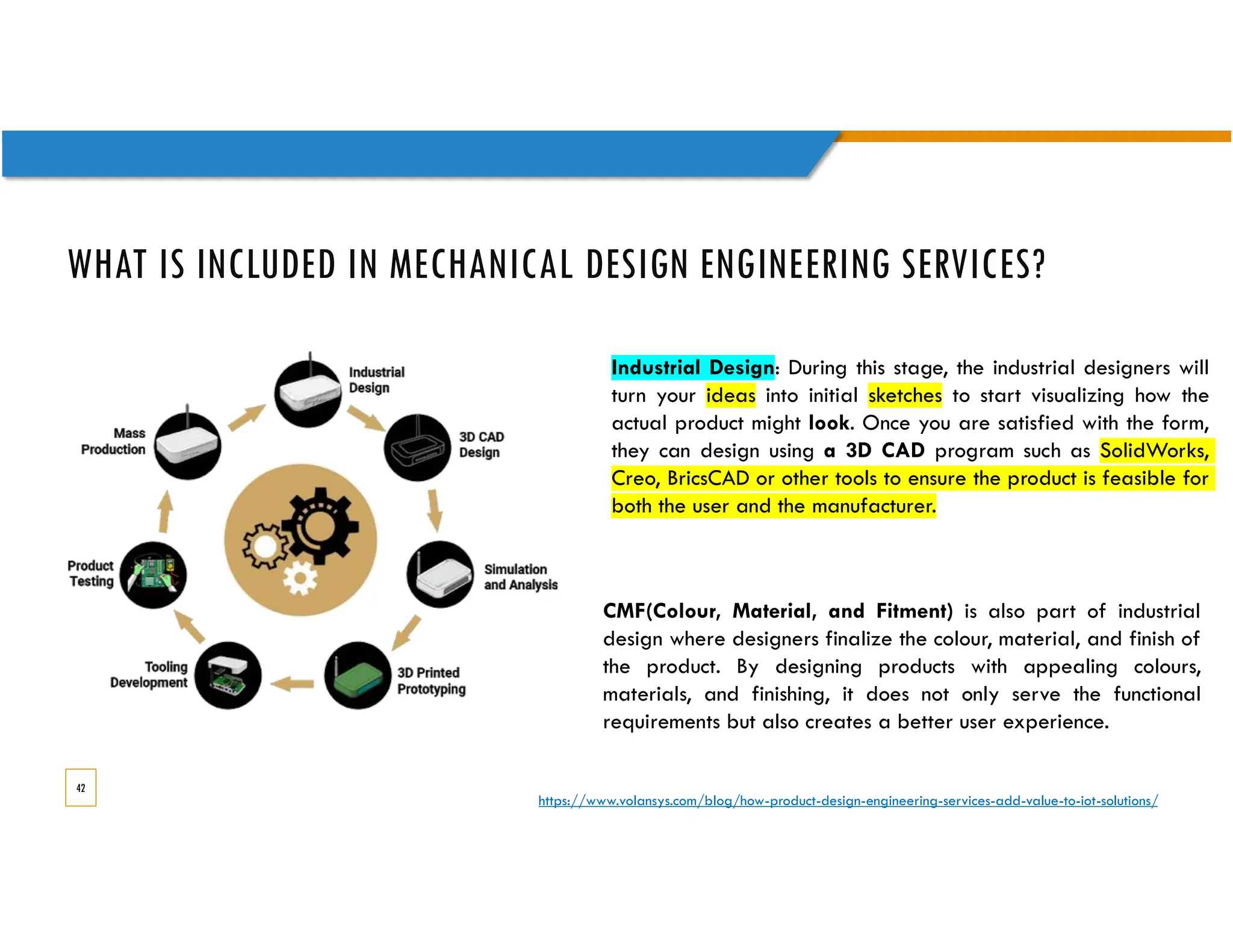
WHAT IS INCLUDED IN MECHANICAL DESIGN ENGINEERING SERVICES?
42
Industrial Design: During this stage, the industrial designers will
turn your ideas into initial sketches to start visualizing how the
actual product might look. Once you are satisfied with the form,
they can design using a 3D CAD program such as SolidWorks,
Creo, BricsCAD or other tools to ensure the product is feasible for
both the user and the manufacturer.
CMF(Colour, Material, and Fitment) is also part of industrial
design where designers finalize the colour, material, and finish of
the product. By designing products with appealing colours,
materials, and finishing, it does not only serve the functional
requirements but also creates a better user experience.
https://www.volansys.com/blog/how-product-design-engineering-services-add-value-to-iot-solutions/
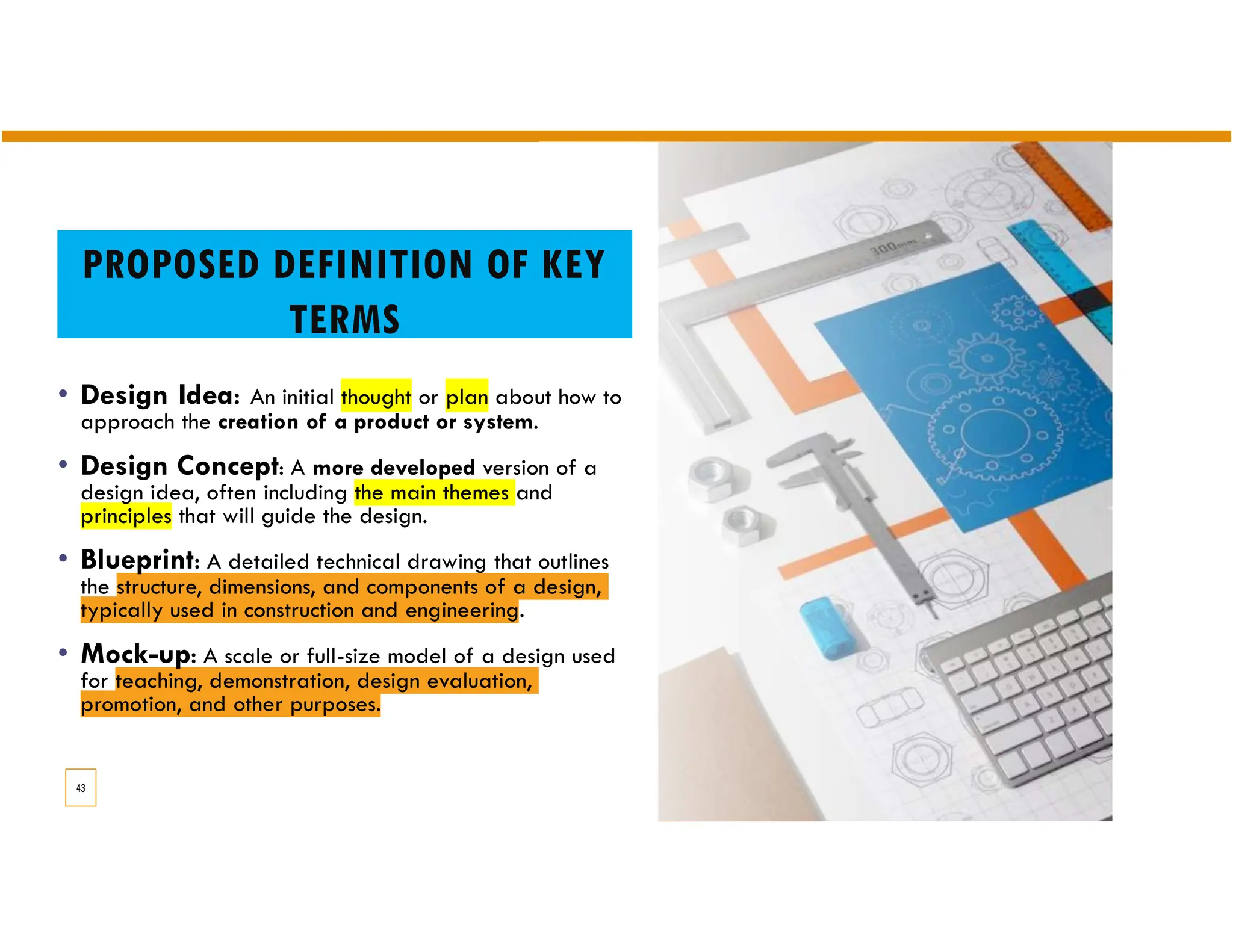
PROPOSED DEFINITION OF KEY
TERMS
• Design Idea: An initial thought or plan about how to
approach the creation of a product or system.
• Design Concept: A more developed version of a
design idea, often including the main themes and
principles that will guide the design.
• Blueprint: A detailed technical drawing that outlines
the structure, dimensions, and components of a design,
typically used in construction and engineering.
• Mock-up: A scale or full-size model of a design used
for teaching, demonstration, design evaluation,
promotion, and other purposes.
43
INDUSTRIAL DESIGN DATA COLLECTION
Importance:
Data-driven design allows designers to
make informed decisions based on user
behavior and preferences.
Industrial design data collection involves
gathering information related to product
design, manufacturing, and user preferences. It
encompasses both qualitative and quantitative
data.
44
Techniques for data collection: User research,
A/B testing, data analytics, and feedback loops.
https://dragonflyai.co/resources/blog/what-is-data-driven-design-definition-guide-examples
TYPE OF CUSTOMER NEEDS
45
Understanding customer needs is crucial for
successful product design.
Different types of customer
needs include
1. Functional Needs: These relate to the core purpose of the product
(e.g., a phone’s ability to make calls).
2. Emotional Needs: These address how a product makes users feel
(e.g., aesthetics, brand perception).
3. Social Needs: Considerations related to social context and
interactions (e.g., sharing experiences).
4. Economic Needs: Cost-effectiveness and value for money.
5. Cultural Needs: Reflecting cultural preferences and norms.
DESIGN RESEARCH PROTOCOLS
46
1. These are systematic approaches to
conducting design research. Protocols guide
the research process, ensuring consistency
and reliability.
2. Examples: User interviews, surveys,
ethnographic studies, and usability testing.
CONCEPT DESIGN
47
1. The initial phase of design where ideas are explored and
conceptualized.
2. Focuses on creating a vision for the product, considering
form, function, and user experience.
CAD MODELS AND RENDERINGS
48
1. Computer-Aided Design (CAD) models
represent the product in a digital format.
2. Renderings provide visual representations of
the design, often used for presentations and
marketing.
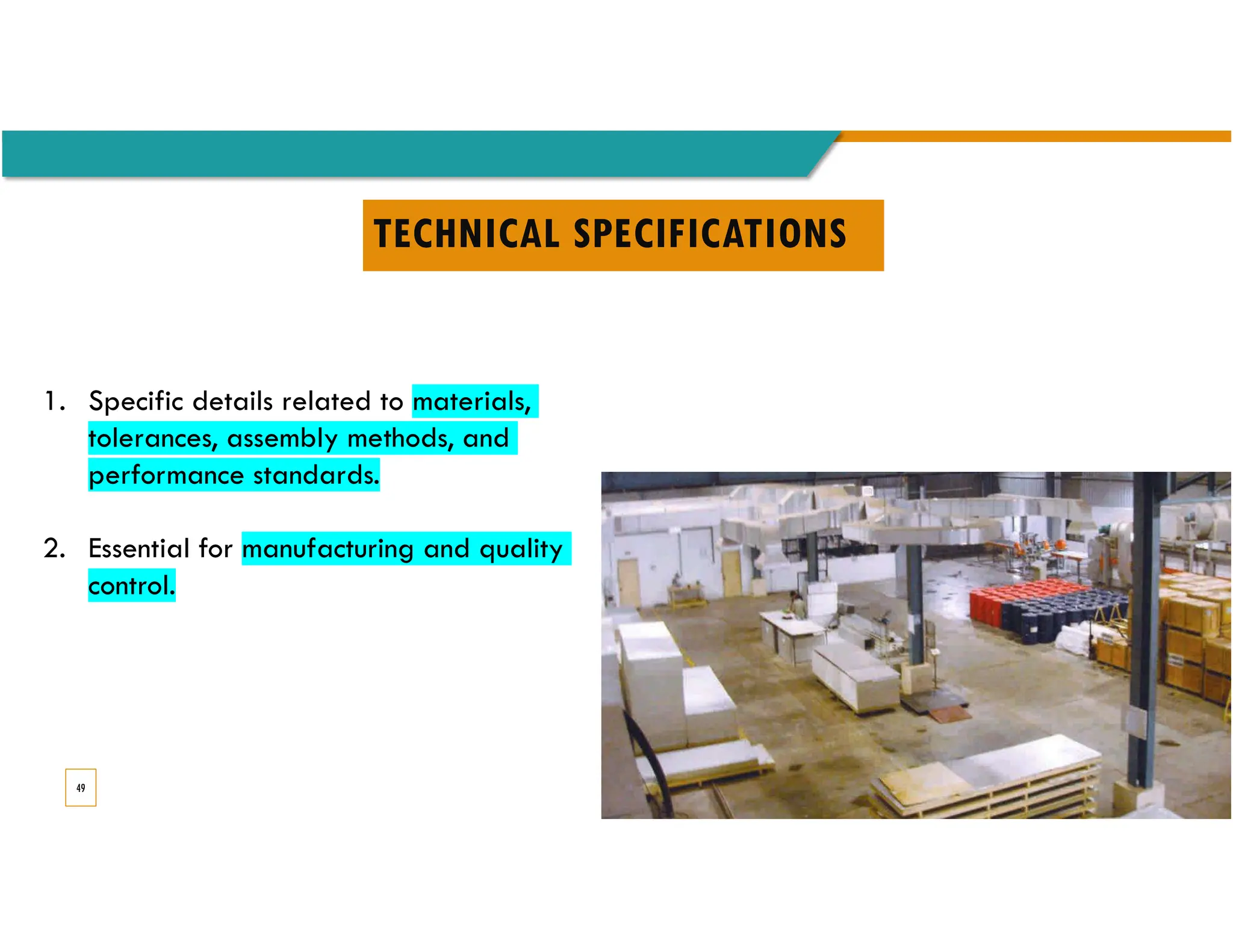
TECHNICAL SPECIFICATIONS
49
1. Specific details related to materials,
tolerances, assembly methods, and
performance standards.
2. Essential for manufacturing and quality
control.
PRODUCT MANUFACTURING DATA:
50
Refers to all the information and attributes associated with a specific product. This
includes not only physical characteristics but also details like marketing descriptions,
brand, product name, visuals, pricing, logistical information, and more.
1. Manufacturing Processes and Techniques:
i. These are methods used to transform raw materials into finished products.
ii. Examples include machining, casting, forming, welding, and additive
manufacturing.
2. Bill of Materials (BOM):
i. A comprehensive list of all components, sub-assemblies, and raw materials
required to manufacture a product.
ii. It specifies quantities and relationships between parts.
PRODUCT MANUFACTURING DATA
51
3. Bill of Quantity (BoQ):
i. Typically used in construction and engineering projects, the BoQ is a detailed list of
materials, labour, and other resources needed for a specific project.
ii. It helps estimate costs and plan resource allocation.
4. Tooling and Production Equipment Requirements:
i. Refers to the machinery, tools, and equipment necessary for manufacturing processes.
ii. Proper tooling ensures efficient production and high-quality output.
5. Cost and Budgeting:
i. Involves estimating and managing expenses related to production.
ii. Accurate cost analysis helps optimize resource allocation and maintain profitability.
Details of Lecturer • Course Lecturer: Eng.
Alphonse Blaise B
• Room Number:
• Email:
batariblaise@gmail.com
• Linkedin:
https://bit.ly/3yC6qLj
• Tel. No. : +250787797443
+250722716405
• Office Hours:

develop design ideas for manufacturing.pdf

  • 1.
    BACHELOR OF TECHNOLOGYIN MANUFACTURING TECHNOLOGY Level 8 RQF, Rwanda Polytechnic
  • 2.
  • 3.
    Module: MATID801 INDUSTRIALDESIGN FOR MANUFACTURING PROCESS BTech: manufacturing Technology Competence: Apply INDUSTRIAL DESIGN FOR MANUFACTURING PROCESS
  • 4.
    Module: MATID801 INDUSTRIALDESIGN FOR MANUFACTURING PROCESS BTech: manufacturing Technology Module Description
  • 5.
    5 Elements of competence Performance criteria 1.Develop design ideas 1.1. Research data are efficiently collected and analyzed according to the suitable research method 1.2.Problem is properly identified based on existing product/ technology 1.3. Blueprints are properly developed according to product requirements.
  • 6.
    6 Elements of competence Performance criteria 2.Generate design concept 2.1. Design tools are properly selected based on product requirements 2.2.Design concept is accurately elaborated in consideration of product requirements. 2.3. Mock-ups are efficiently constructed according to material optimization
  • 7.
    7 Elements of competence Performance criteria 3.Make product model simulation 3.1. CAD procedure is well implemented according to product functionality 3.2.Materials are rightly selected according to the desired product and cost implication 3.3.Product parts are correctly assembled and simulated according to functionality
  • 8.
    8 Elements of competence Performance criteria 4.Supervise prototype manufacturing activities 4.1.Operational tests are correctly executed according to the desired output 4.2.Product compliances are properly set according to the desired output 4.3.SOPs are correctly monitored according to national/international standards
  • 9.
    9 Elements of competence Performance criteria 5.Develop industrial documentation 5.1.Assemble Catalogues for machine parts are correctly elaborated according to the assembling procedures. 5.2.Operational/User/instruction guide is correctly elaborated according to the working principles. 5.3.Maintenance manual is properly elaborated according to working standards. 5.4.Product manual is neatly elaborated according to the quality standard.
  • 10.
    Module: MATID801 INDUSTRIALDESIGN FOR MANUFACTURING PROCESS i. Develop design ideas ii. Generate design concept iii. Make product model simulation iv. Supervise prototype manufacturing activities v. Develop industrial documentation Module content
  • 11.
    Module: MATID801 INDUSTRIALDESIGN FOR MANUFACTURING PROCESS I. Develop design ideas
  • 12.
  • 13.
  • 14.
    Introduction to Industrial Design 14 Developingdesign ideas for the manufacturing process is a vital phase in industrial design that transforms creative concepts into practical, producible products. This process begins with brainstorming and creative exploration to generate innovative ideas, followed by refining these ideas into detailed design concepts that consider functionality, user experience, and cost-effectiveness. Industrial design is the process of creating and developing concepts and specifications for products that are visually appealing, ergonomic, functional, and user-friendly.
  • 15.
    15 Industrial design isthe discipline of creatively solving real-world problems borrowing concepts from art, design, technology, and science. A field heavily influenced by human-centred design, it drives innovation, celebrates practical applications, and focuses on a sound, if not enjoyable, end-user experience. Typical outcomes are physical products that are manufacturable, aesthetically pleasing, financially sound, and, of course, meet the requirements of the businesses for which they are designed.
  • 16.
  • 17.
    17 1. Engineering design(sometimes called technological design) is an iterative, systematic process for solving problems that involve creativity, experience, and accumulated disciplinary knowledge. 2. Technical Development means any technical and Manufacturing-related activities, including test method development and stability testing, assay development, process development, formulation development, quality assurance and quality control development, validation and other testing, packaging development, as well as record-keeping, data and database development, management, storage, and retention activities relating to any of the foregoing. Technical Development is any invention and product innovation that enables a new good to be produced, and a process innovation or method that enables an existing good to be produced at a lower cost as a result of the increase in the efficiency of the factors used in its production. 3. Creative Art in Manufacturing In the manufacturing industry, creative art refers to the application of artistic principles and techniques to the design and production of products. This can involve using art forms such as painting, sculpture, and graphic design to create aesthetically pleasing and functional products Position of Product Design (by Horvăth 2004)
  • 18.
    INDUSTRIAL DESIGN VS.PRODUCT DESIGN Industrial design and Product design are often used interchangeably, but there are subtle differences between the two disciplines. Industrial design is a broader field that encompasses the design of physical products, while product design focuses specifically on the design of individual products.
  • 19.
    INDUSTRIAL DESIGN VS.PRODUCT DESIGN Two major parts in product design 19
  • 20.
    20 Industrial Design Technologycould be for you if you like: Being creative Complex problems Making things Using computers Industrial design and Engineering design in Product design
  • 21.
  • 22.
    INDUSTRY, FACTORY &PLANT A factory is defined as a building, or a group of buildings wherein the goods are produced or manufactured through a machine. A factory is a production plant comprising of many buildings. The machines are operated by the workers and are used to produce items. An industry is a broad category encompassing all economic activities related to the production and distribution of goods and services within a specific sector. Industries are often classified based on the primary products or services they produce. 22 A plant is a specific location where industrial processes are carried out, involving the transformation of raw materials into finished products. Plants are equipped with specialized machinery and infrastructure tailored to particular manufacturing tasks.
  • 23.
  • 24.
    Design 24 Design is aCreative Process that involves planning, problem-solving, and decision-making to create something new and useful. It can be applied to a wide range of fields, from product design to graphic design to web design. Design as a Way of Thinking Design is not just about creating things; it's also a way of thinking. Designers are problem solvers who are constantly looking for new and innovative solutions. They are also critical thinkers who are able to analyze and evaluate different options. It is the process of envisioning and planning the creation of objects, interactive systems, buildings, vehicles, etc. It is about creating solutions for people, physical items or more abstract systems to address a need or a problem.
  • 25.
    DESIGN THINKING . 25 https://ln.run/MCTgT Design thinkingis an iterative, non-linear process which focuses on a collaboration between designers and users. Design thinking is a non-linear, iterative process that teams use to understand users, challenge assumptions, redefine problems and create innovative solutions to prototype and test. It is most useful to tackle ill- defined or unknown problems and involves five phases: Empathize, Define, Ideate, Prototype and Test.
  • 26.
    DEFINITIONS Innovation: Combining existingideas in a new and useful way. Creativity: Application of imagination to a problem Design thinking: is the process of creating solutions using creative problem-solving techniques. “Is not a way of thinking but a way of doing "By Professor Steven D. Eppinger
  • 27.
  • 28.
  • 29.
  • 30.
    CREATE (consider theentire solution space)
  • 31.
  • 32.
    32 Rules for Brainstorming 1.Defer Judgement of Ideas 2. Build on the ideas of others 3. Encourage wild ideas 4. Express Ideas Visually 5. Stay focused on the topic 6. One conversation at a time 7. Use stimuli related & Unrelated to the topic Brainstorming possible Solutions Quotes “To have a great Idea have a lot of them”. Thomas Edison “Creativity is just having enough dots to connect”. Steve Jobs
  • 33.
    PROTOTYPE 1. Make adetailed design 2. Never fall in love with your prototype 3. Test, Lean & Test Again 33
  • 34.
    IMPLEMENT (FOCUS ONTHE DETAILS) Design Process: ● Set final Specifications ● Prototypes through detailed Design ● Testing (Learn & revamp) ● Validation
  • 35.
    Process: ● Set finalSpecifications ● Prototypes through detailed Design ● Testing (Learn & revamp) ● Validation 35 IMPLEMENT (FOCUS ON THE DETAILS)
  • 36.
    BASICS TO DESIGNTHINKING 36 1. Empathize: Understand the needs, constraints, and objectives of stakeholders, including mission sponsors, end-users, and technical teams. 2. Define: Clearly articulate the mission goals, requirements, and design constraints based on insights gained from empathy work. 3. Ideate: Ideate involves generating a wide range of creative ideas and solutions. This step encourages thinking beyond obvious solutions and exploring new perspectives. It focuses on producing a variety of options to innovate and solve the problem effectively. 4. Prototype: Prototype is about bringing ideas into the physical world to test and explore them. This can be done through models, sketches, role-playing activities, or any tangible form 5. Test: Evaluate prototypes in simulated and real-world environments, gathering feedback to refine designs and improve performance.
  • 37.
    MANUFACTURING Manufacturing is thecreation or production of goods with the help of equipment, labour, machines, tools, and chemical or biological processing or formulation.
  • 38.
    38 MANUFACTURING PROCESS Is themethod through which raw materials are transformed into a final product Manufacturing process
  • 39.
  • 40.
    DESIGN FOR MANUFACTURING (DFM) 40 Designfor manufacturing is the combination of two major sources of product implementation, design and the production process. In which both the design of a product should be simple and easy while in manufacturing, production cost should be less with a better quality product.
  • 41.
    Fundamental step fordesign for manufacturing (DFM) 41 Before a product goes into manufacturing there is some fundamental procedure we must consider for economical production. https://tinyurl.com/3td8fvhw
  • 42.
    WHAT IS INCLUDEDIN MECHANICAL DESIGN ENGINEERING SERVICES? 42 Industrial Design: During this stage, the industrial designers will turn your ideas into initial sketches to start visualizing how the actual product might look. Once you are satisfied with the form, they can design using a 3D CAD program such as SolidWorks, Creo, BricsCAD or other tools to ensure the product is feasible for both the user and the manufacturer. CMF(Colour, Material, and Fitment) is also part of industrial design where designers finalize the colour, material, and finish of the product. By designing products with appealing colours, materials, and finishing, it does not only serve the functional requirements but also creates a better user experience. https://www.volansys.com/blog/how-product-design-engineering-services-add-value-to-iot-solutions/
  • 43.
    PROPOSED DEFINITION OFKEY TERMS • Design Idea: An initial thought or plan about how to approach the creation of a product or system. • Design Concept: A more developed version of a design idea, often including the main themes and principles that will guide the design. • Blueprint: A detailed technical drawing that outlines the structure, dimensions, and components of a design, typically used in construction and engineering. • Mock-up: A scale or full-size model of a design used for teaching, demonstration, design evaluation, promotion, and other purposes. 43
  • 44.
    INDUSTRIAL DESIGN DATACOLLECTION Importance: Data-driven design allows designers to make informed decisions based on user behavior and preferences. Industrial design data collection involves gathering information related to product design, manufacturing, and user preferences. It encompasses both qualitative and quantitative data. 44 Techniques for data collection: User research, A/B testing, data analytics, and feedback loops. https://dragonflyai.co/resources/blog/what-is-data-driven-design-definition-guide-examples
  • 45.
    TYPE OF CUSTOMERNEEDS 45 Understanding customer needs is crucial for successful product design. Different types of customer needs include 1. Functional Needs: These relate to the core purpose of the product (e.g., a phone’s ability to make calls). 2. Emotional Needs: These address how a product makes users feel (e.g., aesthetics, brand perception). 3. Social Needs: Considerations related to social context and interactions (e.g., sharing experiences). 4. Economic Needs: Cost-effectiveness and value for money. 5. Cultural Needs: Reflecting cultural preferences and norms.
  • 46.
    DESIGN RESEARCH PROTOCOLS 46 1.These are systematic approaches to conducting design research. Protocols guide the research process, ensuring consistency and reliability. 2. Examples: User interviews, surveys, ethnographic studies, and usability testing.
  • 47.
    CONCEPT DESIGN 47 1. Theinitial phase of design where ideas are explored and conceptualized. 2. Focuses on creating a vision for the product, considering form, function, and user experience.
  • 48.
    CAD MODELS ANDRENDERINGS 48 1. Computer-Aided Design (CAD) models represent the product in a digital format. 2. Renderings provide visual representations of the design, often used for presentations and marketing.
  • 49.
    TECHNICAL SPECIFICATIONS 49 1. Specificdetails related to materials, tolerances, assembly methods, and performance standards. 2. Essential for manufacturing and quality control.
  • 50.
    PRODUCT MANUFACTURING DATA: 50 Refersto all the information and attributes associated with a specific product. This includes not only physical characteristics but also details like marketing descriptions, brand, product name, visuals, pricing, logistical information, and more. 1. Manufacturing Processes and Techniques: i. These are methods used to transform raw materials into finished products. ii. Examples include machining, casting, forming, welding, and additive manufacturing. 2. Bill of Materials (BOM): i. A comprehensive list of all components, sub-assemblies, and raw materials required to manufacture a product. ii. It specifies quantities and relationships between parts.
  • 51.
    PRODUCT MANUFACTURING DATA 51 3.Bill of Quantity (BoQ): i. Typically used in construction and engineering projects, the BoQ is a detailed list of materials, labour, and other resources needed for a specific project. ii. It helps estimate costs and plan resource allocation. 4. Tooling and Production Equipment Requirements: i. Refers to the machinery, tools, and equipment necessary for manufacturing processes. ii. Proper tooling ensures efficient production and high-quality output. 5. Cost and Budgeting: i. Involves estimating and managing expenses related to production. ii. Accurate cost analysis helps optimize resource allocation and maintain profitability.
  • 52.
    Details of Lecturer• Course Lecturer: Eng. Alphonse Blaise B • Room Number: • Email: batariblaise@gmail.com • Linkedin: https://bit.ly/3yC6qLj • Tel. No. : +250787797443 +250722716405 • Office Hours: