POWER GENERATOR BY
WIND TURBINE
SUBMITTED TO:
MS. KHAN
SUBMITTED BY:
JAM ABDULSATTAR
What is wind turbine/wind mill
 Wind turbine is a device that converts kinetic energy into
mechanical energy
 If the mechanical energy is used to produce electricity, the
device may be called a wind turbine
 If the mechanical energy is used to drive machinery, such as
for grinding grain the device is called a
wind mill.
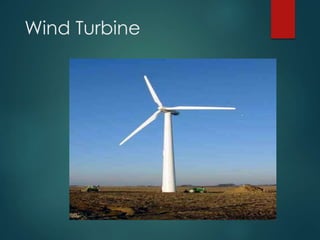
Wind Turbine
Why Did we take this project
of wind turbine?
 IT’S VERY CHEAP.
 WIND POWER CONSUMES NO FUEL. SO IT IS VERY RELIABLE.
MORE EFFICIENT.
 SUITABLE FOR KARACHI CLIMATE.
 COMPARED TO THE ENVIRONMENTAL IMPACT OF
TRADITIONAL ENERGY SOURCES, THE ENVIRONMENTAL
IMPACT OF WIND POWER IS RELATIVELY MINOR IN TERMS OF
POLLUTION.
 WIND TURBINES CAN CARRY ON GENERATING ELECTRICITY
FOR 20-25 YEARS. OVER THEIR LIFETIME THEY WILL BE
RUNNING CONTINUOUSLY FOR AS MUCH AS 120,000 HOURS
Wind turbine contains:
 DC MOTOR
 BLADES
 TOWER OR STRUCTURE
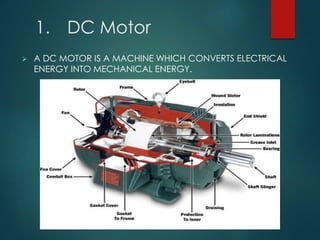
1. DC Motor
 A DC MOTOR IS A MACHINE WHICH CONVERTS ELECTRICAL
ENERGY INTO MECHANICAL ENERGY.
Construction of DC motor
DC MOTOR CONSISTS OF THE FOUR IMPORTANT PARTS.
 ARMATURE: A RECTANGULAR COIL WHICH IS MADE OF
INSULATED COPPER WIRE WHICH IS WOUND ON THE SOFT IRON
CORE THIS IS ARMATURE.
 FIELD WINDING: THE FIELD WINDINGS ARE ATTACHED TO
INSIDE OF THE YOKE AND TO FORM TWO POLES FITTING
CLOSELY TO THE ARMATURE.
 COMMUTATER AND BRUSHES: COMMOTATOR IS USED TO
REVERSE THE DIRECTION OF CURRENT. PRESS SLIGHTLY AGAINST
THE TWO SPLIT RINGS AND THE SPLIT RING ROTATE BETWEEN THE
BRUSHES. THE CARBON BRUSHES CONNECTED TO THE DC
SUPPLY.
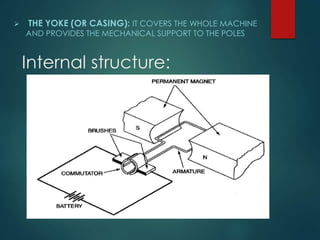
Internal structure:
 THE YOKE (OR CASING): IT COVERS THE WHOLE MACHINE
AND PROVIDES THE MECHANICAL SUPPORT TO THE POLES
WORKING PRINCIPLE OF DC MOTOR
when A current coil conductor is placed inside of the
magnet field .when the current is passed through the
conductor a field is produced around it. And the
direction of this magnetic field can be determined by
the right hand rule .because of the current flows
through the segments of the loop is in different
direction it means that that are opposite to each
other as shown in the figure .The segment on one side
pushes the upward while the segment on the other
side pushes the down word. it mean that both sides of
the armature experience the force which is in equal in
magnitude but in opposite in direction and its known
as couples forces these combined forces create the
twisting action or torque.
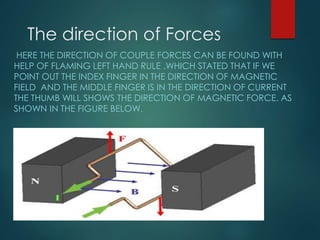
The direction of Forces
HERE THE DIRECTION OF COUPLE FORCES CAN BE FOUND WITH
HELP OF FLAMING LEFT HAND RULE .WHICH STATED THAT IF WE
POINT OUT THE INDEX FINGER IN THE DIRECTION OF MAGNETIC
FIELD AND THE MIDDLE FINGER IS IN THE DIRECTION OF CURRENT
THE THUMB WILL SHOWS THE DIRECTION OF MAGNETIC FORCE. AS
SHOWN IN THE FIGURE BELOW.
Why we use Dc motor not
AC motor?
Due to below reasons we use DC motor:
 High starting torque.
 Speed control over a wide range, both below and
above normal speed
 Quick starting, stopping
Blades:
 ON THE BASIS OF BLADES THERE ARE TWO TYPES OF
WIND TURBINES.
 VERTICAL AXIS WIND TURBINE (VAWT)
 HORIZONTAL AXIS WIND TURBINE (HAWT)
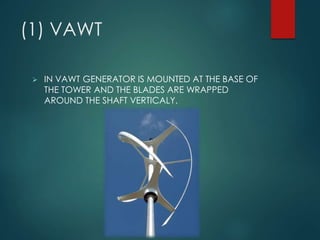
(1) VAWT
 IN VAWT GENERATOR IS MOUNTED AT THE BASE OF
THE TOWER AND THE BLADES ARE WRAPPED
AROUND THE SHAFT VERTICALY.
(2)HAWT
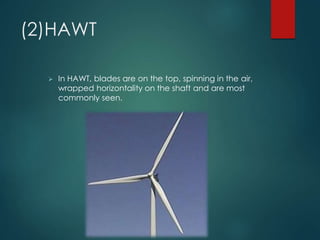
 In HAWT, blades are on the top, spinning in the air,
wrapped horizontality on the shaft and are most
commonly seen.
Calculation of Wind Power
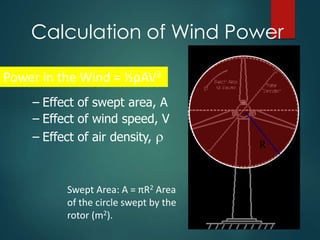
•Power in the wind
– Effect of swept area, A
– Effect of wind speed, V
– Effect of air density,  R
Swept Area: A = πR2 Area
of the circle swept by the
rotor (m2).
Power in the Wind = ½ρAV3
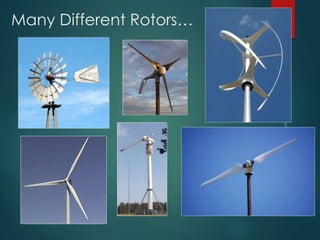
Many Different Rotors…
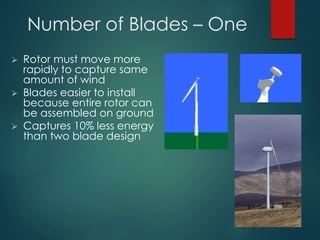
Number of Blades – One
 Rotor must move more
rapidly to capture same
amount of wind
 Blades easier to install
because entire rotor can
be assembled on ground
 Captures 10% less energy
than two blade design
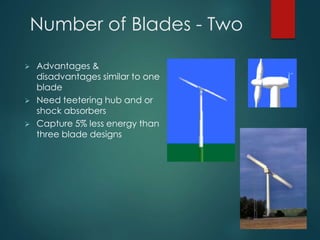
Number of Blades - Two
 Advantages &
disadvantages similar to one
blade
 Need teetering hub and or
shock absorbers
 Capture 5% less energy than
three blade designs
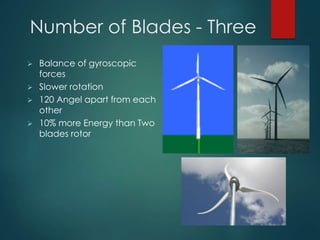
Number of Blades - Three
 Balance of gyroscopic
forces
 Slower rotation
 120 Angel apart from each
other
 10% more Energy than Two
blades rotor
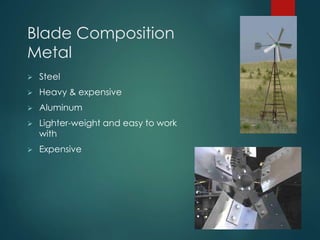
Blade Composition
Metal
 Steel
 Heavy & expensive
 Aluminum
 Lighter-weight and easy to work
with
 Expensive
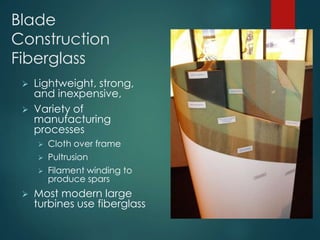
Blade
Construction
Fiberglass
 Lightweight, strong,
and inexpensive,
 Variety of
manufacturing
processes
 Cloth over frame
 Pultrusion
 Filament winding to
produce spars
 Most modern large
turbines use fiberglass
Tip-Speed Ratio
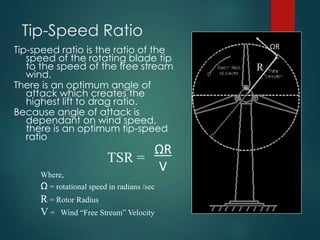
Tip-speed ratio is the ratio of the
speed of the rotating blade tip
to the speed of the free stream
wind.
There is an optimum angle of
attack which creates the
highest lift to drag ratio.
Because angle of attack is
dependant on wind speed,
there is an optimum tip-speed
ratio
ΩR
V
TSR =
Where,
Ω = rotational speed in radians /sec
R = Rotor Radius
V = Wind “Free Stream” Velocity
ΩR
R
TOWER
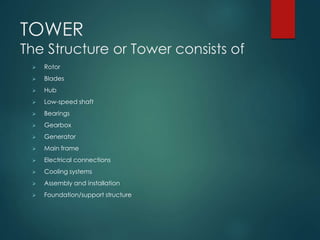
The Structure or Tower consists of
 Rotor
 Blades
 Hub
 Low-speed shaft
 Bearings
 Gearbox
 Generator
 Main frame
 Electrical connections
 Cooling systems
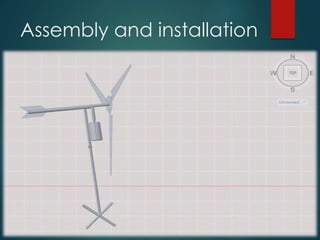
 Assembly and installation
 Foundation/support structure
DRAWINGS IN AUTOCAD
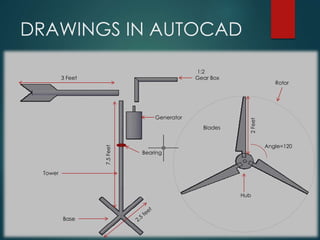
3 Feet
7.5Feet
2Feet
Blades
Gear Box
Base
Generator
Rotor
Hub
Angle=120
Bearing
Tower
1:2
Measurements
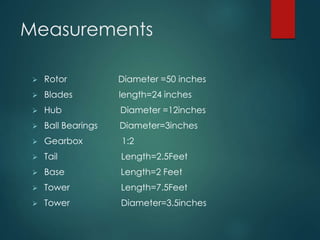
 Rotor Diameter =50 inches
 Blades length=24 inches
 Hub Diameter =12inches
 Ball Bearings Diameter=3inches
 Gearbox 1:2
 Tail Length=2.5Feet
 Base Length=2 Feet
 Tower Length=7.5Feet
 Tower Diameter=3.5inches
Assembly and installation
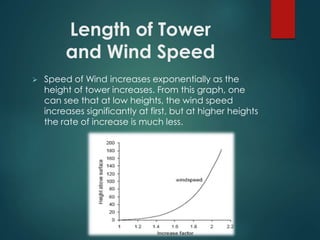
Length of Tower
and Wind Speed
 Speed of Wind increases exponentially as the
height of tower increases. From this graph, one
can see that at low heights, the wind speed
increases significantly at first, but at higher heights
the rate of increase is much less.
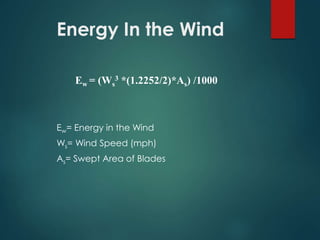
Energy In the Wind
Ew = (Ws
3 *(1.2252/2)*As) /1000
Ew= Energy in the Wind
Ws= Wind Speed (mph)
As= Swept Area of Blades
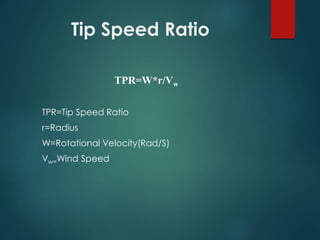
Tip Speed Ratio
TPR=W*r/Vw
TPR=Tip Speed Ratio
r=Radius
W=Rotational Velocity(Rad/S)
Vw=Wind Speed
APPLICATIONS:
 IT CAN BE USED TO PROVIDE ELECTRICITY TO
SECURITY AND CCTV CAMERAS
 ALSO TO POWER STREETLIGHTS AND TRAFFIC
MANAGEMENT SYSTEMS
 IT IS USED TO DRIVE SAILBOATS
 IT IS USED TO LIGHTING UP THE SMALL VILLAGES
AND URBAN AREAS HOME
 IT IS USED IN INDUSTRIES DUE TO ITS LOW COSTS
 BY USING IT WE CAN AVOID CONVERTING POWER
FROM AC TO DC OR DC TO AC. EVERY TIME THE
POWER IS CONVERTED, YOU WILL LOSE 25% TO 30%
OF THE POWER
ANY
Q?
THANK YOU!

Wind turbine

  • 1.
    POWER GENERATOR BY WINDTURBINE SUBMITTED TO: MS. KHAN SUBMITTED BY: JAM ABDULSATTAR
  • 2.
    What is windturbine/wind mill  Wind turbine is a device that converts kinetic energy into mechanical energy  If the mechanical energy is used to produce electricity, the device may be called a wind turbine  If the mechanical energy is used to drive machinery, such as for grinding grain the device is called a wind mill.
  • 3.
  • 4.
    Why Did wetake this project of wind turbine?  IT’S VERY CHEAP.  WIND POWER CONSUMES NO FUEL. SO IT IS VERY RELIABLE. MORE EFFICIENT.  SUITABLE FOR KARACHI CLIMATE.  COMPARED TO THE ENVIRONMENTAL IMPACT OF TRADITIONAL ENERGY SOURCES, THE ENVIRONMENTAL IMPACT OF WIND POWER IS RELATIVELY MINOR IN TERMS OF POLLUTION.  WIND TURBINES CAN CARRY ON GENERATING ELECTRICITY FOR 20-25 YEARS. OVER THEIR LIFETIME THEY WILL BE RUNNING CONTINUOUSLY FOR AS MUCH AS 120,000 HOURS
  • 5.
    Wind turbine contains: DC MOTOR  BLADES  TOWER OR STRUCTURE
  • 6.
    1. DC Motor A DC MOTOR IS A MACHINE WHICH CONVERTS ELECTRICAL ENERGY INTO MECHANICAL ENERGY.
  • 7.
    Construction of DCmotor DC MOTOR CONSISTS OF THE FOUR IMPORTANT PARTS.  ARMATURE: A RECTANGULAR COIL WHICH IS MADE OF INSULATED COPPER WIRE WHICH IS WOUND ON THE SOFT IRON CORE THIS IS ARMATURE.  FIELD WINDING: THE FIELD WINDINGS ARE ATTACHED TO INSIDE OF THE YOKE AND TO FORM TWO POLES FITTING CLOSELY TO THE ARMATURE.  COMMUTATER AND BRUSHES: COMMOTATOR IS USED TO REVERSE THE DIRECTION OF CURRENT. PRESS SLIGHTLY AGAINST THE TWO SPLIT RINGS AND THE SPLIT RING ROTATE BETWEEN THE BRUSHES. THE CARBON BRUSHES CONNECTED TO THE DC SUPPLY.
  • 8.
    Internal structure:  THEYOKE (OR CASING): IT COVERS THE WHOLE MACHINE AND PROVIDES THE MECHANICAL SUPPORT TO THE POLES
  • 9.
    WORKING PRINCIPLE OFDC MOTOR when A current coil conductor is placed inside of the magnet field .when the current is passed through the conductor a field is produced around it. And the direction of this magnetic field can be determined by the right hand rule .because of the current flows through the segments of the loop is in different direction it means that that are opposite to each other as shown in the figure .The segment on one side pushes the upward while the segment on the other side pushes the down word. it mean that both sides of the armature experience the force which is in equal in magnitude but in opposite in direction and its known as couples forces these combined forces create the twisting action or torque.
  • 10.
    The direction ofForces HERE THE DIRECTION OF COUPLE FORCES CAN BE FOUND WITH HELP OF FLAMING LEFT HAND RULE .WHICH STATED THAT IF WE POINT OUT THE INDEX FINGER IN THE DIRECTION OF MAGNETIC FIELD AND THE MIDDLE FINGER IS IN THE DIRECTION OF CURRENT THE THUMB WILL SHOWS THE DIRECTION OF MAGNETIC FORCE. AS SHOWN IN THE FIGURE BELOW.
  • 11.
    Why we useDc motor not AC motor? Due to below reasons we use DC motor:  High starting torque.  Speed control over a wide range, both below and above normal speed  Quick starting, stopping
  • 12.
    Blades:  ON THEBASIS OF BLADES THERE ARE TWO TYPES OF WIND TURBINES.  VERTICAL AXIS WIND TURBINE (VAWT)  HORIZONTAL AXIS WIND TURBINE (HAWT)
  • 13.
    (1) VAWT  INVAWT GENERATOR IS MOUNTED AT THE BASE OF THE TOWER AND THE BLADES ARE WRAPPED AROUND THE SHAFT VERTICALY.
  • 14.
    (2)HAWT  In HAWT,blades are on the top, spinning in the air, wrapped horizontality on the shaft and are most commonly seen.
  • 15.
    Calculation of WindPower •Power in the wind – Effect of swept area, A – Effect of wind speed, V – Effect of air density,  R Swept Area: A = πR2 Area of the circle swept by the rotor (m2). Power in the Wind = ½ρAV3
  • 16.
  • 17.
    Number of Blades– One  Rotor must move more rapidly to capture same amount of wind  Blades easier to install because entire rotor can be assembled on ground  Captures 10% less energy than two blade design
  • 18.
    Number of Blades- Two  Advantages & disadvantages similar to one blade  Need teetering hub and or shock absorbers  Capture 5% less energy than three blade designs
  • 19.
    Number of Blades- Three  Balance of gyroscopic forces  Slower rotation  120 Angel apart from each other  10% more Energy than Two blades rotor
  • 20.
    Blade Composition Metal  Steel Heavy & expensive  Aluminum  Lighter-weight and easy to work with  Expensive
  • 21.
    Blade Construction Fiberglass  Lightweight, strong, andinexpensive,  Variety of manufacturing processes  Cloth over frame  Pultrusion  Filament winding to produce spars  Most modern large turbines use fiberglass
  • 22.
    Tip-Speed Ratio Tip-speed ratiois the ratio of the speed of the rotating blade tip to the speed of the free stream wind. There is an optimum angle of attack which creates the highest lift to drag ratio. Because angle of attack is dependant on wind speed, there is an optimum tip-speed ratio ΩR V TSR = Where, Ω = rotational speed in radians /sec R = Rotor Radius V = Wind “Free Stream” Velocity ΩR R
  • 23.
    TOWER The Structure orTower consists of  Rotor  Blades  Hub  Low-speed shaft  Bearings  Gearbox  Generator  Main frame  Electrical connections  Cooling systems  Assembly and installation  Foundation/support structure
  • 24.
    DRAWINGS IN AUTOCAD 3Feet 7.5Feet 2Feet Blades Gear Box Base Generator Rotor Hub Angle=120 Bearing Tower 1:2
  • 25.
    Measurements  Rotor Diameter=50 inches  Blades length=24 inches  Hub Diameter =12inches  Ball Bearings Diameter=3inches  Gearbox 1:2  Tail Length=2.5Feet  Base Length=2 Feet  Tower Length=7.5Feet  Tower Diameter=3.5inches
  • 26.
  • 27.
    Length of Tower andWind Speed  Speed of Wind increases exponentially as the height of tower increases. From this graph, one can see that at low heights, the wind speed increases significantly at first, but at higher heights the rate of increase is much less.
  • 28.
    Energy In theWind Ew = (Ws 3 *(1.2252/2)*As) /1000 Ew= Energy in the Wind Ws= Wind Speed (mph) As= Swept Area of Blades
  • 29.
    Tip Speed Ratio TPR=W*r/Vw TPR=TipSpeed Ratio r=Radius W=Rotational Velocity(Rad/S) Vw=Wind Speed
  • 30.
    APPLICATIONS:  IT CANBE USED TO PROVIDE ELECTRICITY TO SECURITY AND CCTV CAMERAS  ALSO TO POWER STREETLIGHTS AND TRAFFIC MANAGEMENT SYSTEMS  IT IS USED TO DRIVE SAILBOATS  IT IS USED TO LIGHTING UP THE SMALL VILLAGES AND URBAN AREAS HOME  IT IS USED IN INDUSTRIES DUE TO ITS LOW COSTS  BY USING IT WE CAN AVOID CONVERTING POWER FROM AC TO DC OR DC TO AC. EVERY TIME THE POWER IS CONVERTED, YOU WILL LOSE 25% TO 30% OF THE POWER
  • 31.
  • 32.