Descriptive
Statistics with
   2012-10-12 @HSPH
  Kazuki Yoshida, M.D.
    MPH-CLE student


                         FREEDOM
                         TO	
  KNOW
Group Website is at:
http://rpubs.com/kaz_yos/useR_at_HSPH
Previously in this group
n   Introduction to R

n   Reading Data into R (1)

n   Reading Data into R (2)


                  Group Website: http://rpubs.com/kaz_yos/useR_at_HSPH
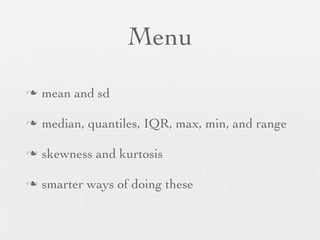
Menu
n   mean and sd

n   median, quantiles, IQR, max, min, and range

n   skewness and kurtosis

n   smarter ways of doing these
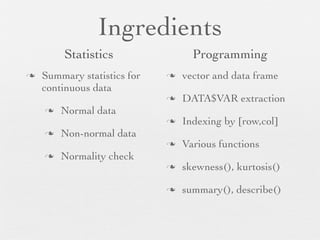
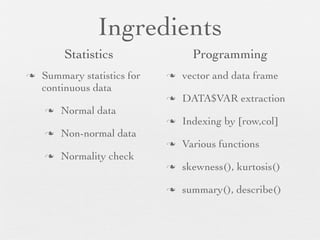
Ingredients
          Statistics                 Programming
n   Summary statistics for   n   vector and data frame
     continuous data
                              n   DATA$VAR extraction
     n   Normal data
                              n   Indexing by [row,col]
     n   Non-normal data
                              n   Various functions
     n   Normality check
                              n   skewness(), kurtosis()

                              n   summary()

                              n   describe(), describeBy()
Data loaded
What’s next?
 http://echrblog.blogspot.com/2011/04/statistics-on-states-with-systemic-or.html
Descriptive
 Statistics
 http://www.ehow.com/info_8650637_descriptive-statistical-methods.html
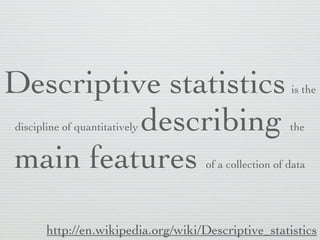
Descriptive statistics                                  is the


          describing
discipline of quantitatively                            the


main features                        of a collection of data


       http://en.wikipedia.org/wiki/Descriptive_statistics
Open
R Studio
Download comma-separated and Excel


 Put them in folder
BONEDEN.DAT.txt

        http://www.cengage.com/cgi-wadsworth/course_products_wp.pl?
                 fid=M20bI&product_isbn_issn=9780538733496
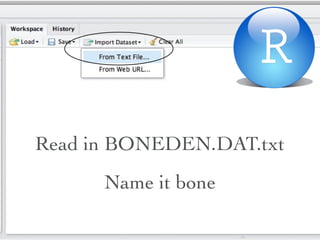
Read in BONEDEN.DAT.txt
      Name it bone
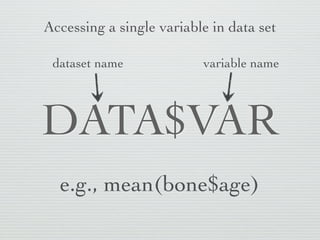
Accessing a single variable in data set

 dataset name             variable name


DATA$VAR
  e.g., mean(bone$age)
vector
?
http://healthy-india.org/enviromentalhealth/
            direct_indirect2.html
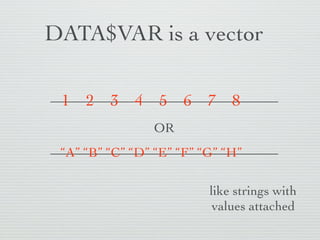
DATA$VAR is a vector

 1 2     3   4   5    6   7   8
                 OR
 “A” “B” “C” “D” “E” “F” “G” “H”

                          like strings with
                           values attached
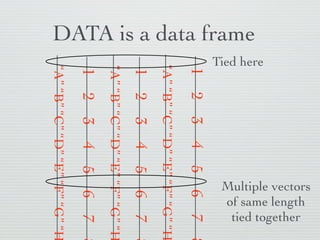
Multiple vectors
                                                   of same length
                                                    tied together
                       Tied here
DATA is a data frame


                               1   2   3   4   5      6        7      8
                             “A” “B” “C” “D” “E” “F” “G” “H
                               1   2   3   4   5       6       7      8
                             “A” “B” “C” “D” “E” “F” “G” “H
                               1   2   3   4   5       6       7      8
                             “A” “B” “C” “D” “E” “F” “G” “H
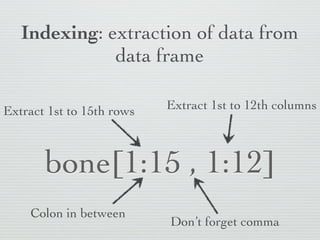
Indexing: extraction of data from
              data frame

Extract 1st to 15th rows   Extract 1st to 12th columns


       bone[1:15 , 1:12]
    Colon in between
                           Don’t forget comma
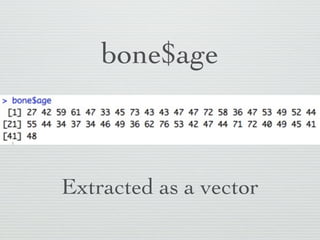
age vector within bone data frame
bone$age


Extracted as a vector
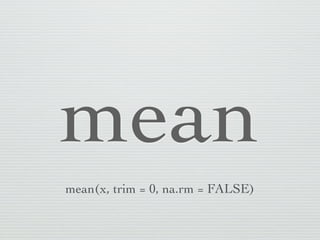
mean
mean(x, trim = 0, na.rm = FALSE)
Your turn      adopted from Hadley Wickham


n   What is the mean of age?
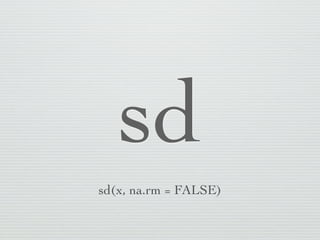
sd
sd(x, na.rm = FALSE)
Your turn   adopted from Hadley Wickham


n   What is the sd of age?
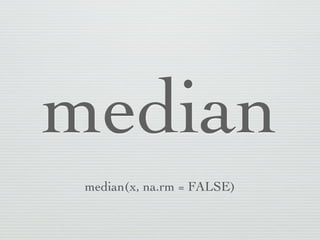
median
 median(x, na.rm = FALSE)
Your turn    adopted from Hadley Wickham


n   What is the median of age?
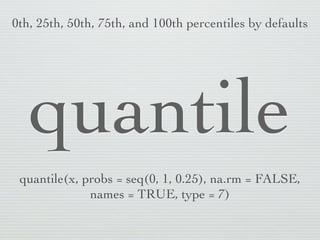
0th, 25th, 50th, 75th, and 100th percentiles by defaults


   quantile
 quantile(x, probs = seq(0, 1, 0.25), na.rm = FALSE,
              names = TRUE, type = 7)
Your turn    adopted from Hadley Wickham


n   What is the 25th and 75th percentiles of age?
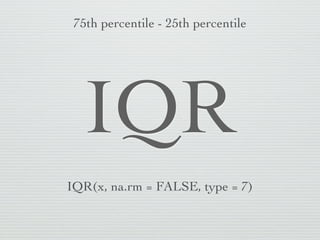
75th percentile - 25th percentile


   IQR
IQR(x, na.rm = FALSE, type = 7)
Your turn     adopted from Hadley Wickham


n   What is the IQR of age?
max
max(..., na.rm = FALSE)
min


min(..., na.rm = FALSE)
Your turn   adopted from Hadley Wickham


n   What are the minimum and maximum of age?
range
range(..., na.rm = FALSE)
Your turn    adopted from Hadley Wickham


n   What the range of age?
We now
resort to
external
packages
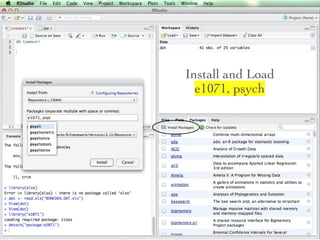
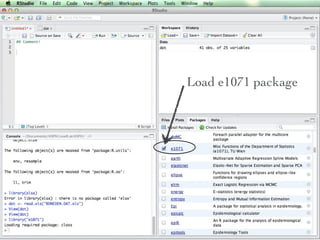
Install and Load
  e1071, psych
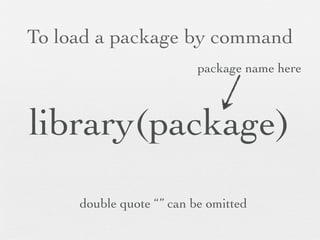
To load a package by command
                          package name here


library(package)
     double quote “” can be omitted
Assessment of
  normality
Load e1071 package
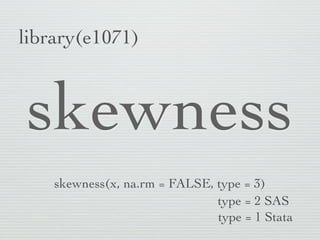
library(e1071)


skewness
    skewness(x, na.rm = FALSE, type = 3)
                               type = 2 SAS
                               type = 1 Stata
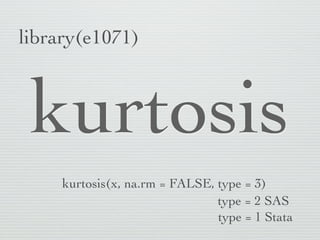
library(e1071)


 kurtosis
     kurtosis(x, na.rm = FALSE, type = 3)
                                type = 2 SAS
                                type = 1 Stata
Your turn     adopted from Hadley Wickham


n   What are the skewness and kurtosis of age by the
     Stata-method?
Multiple
variables
 at once
summary
  summary(object, ...)
Your turn    adopted from Hadley Wickham


n   Try summary on the dataset (data frame).
Various summary
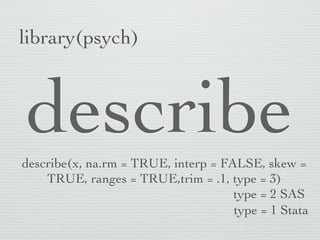
    measures                   library(psych)


  describe
 describe(x, na.rm = TRUE, interp = FALSE, skew =
     TRUE, ranges = TRUE,trim = .1, type = 3)
                                      type = 2 SAS
                                      type = 1 Stata
Your turn    adopted from Hadley Wickham


n   describe(bone[,-1], type = 2)
Groupwise
 summary                    library(psych)


 describeBy
describeBy(x, group=NULL,mat=FALSE,type=3,...)
                                  type = 2 SAS
                                  type = 1 Stata
Your turn    adopted from Hadley Wickham


 bone data frame
without 1st columns           zyg vector for grouping


 n   describeBy(bone[ , c(-1)] , bone$zyg , type = 2)


                                       SAS method for
                                    skewness and kurtosis
Ingredients
          Statistics                 Programming
n   Summary statistics for   n   vector and data frame
     continuous data
                              n   DATA$VAR extraction
     n   Normal data
                              n   Indexing by [row,col]
     n   Non-normal data
                              n   Various functions
     n   Normality check
                              n   skewness(), kurtosis()

                              n   summary()

                              n   describe(), describeBy()
Descriptive Statistics with R

Descriptive Statistics with R