
Mul$ple	Imputa$on	
Octavious	Talbot	&	Kazuki	Yoshida	
Dec	16,	2015	
BIO235	Final	Project	
This	document	was	created	by	students	to	fulfill	a	course	requirement.	Be	aware	of	
poten$al	errors,	and	check	with	the	original	papers.	There	is	a	corresponding	report	
document	at	hPps://github.com/kaz-yos/misc/blob/master/MI_Project.Rnw.pdf
Outline	
•  Background	
•  Mul$ple	Imputa$on	
– Joint	Distribu$on	
– Condi$onal	Distribu$on	
•  Compare/Contrast	
•  Conclusion
Background	
•  Missing	data	is	an	omnipresent	problem	that	
affects	almost	all	real	datasets.	
•  MI	has	become	one	of	the	most	popular	
methods	to	address	missing	data.	
•  We	review	major	MI	algorithms,	including	
their	rela$ve	strengths	and	weaknesses	and	
implica$ons	for	high-dimensional	data.
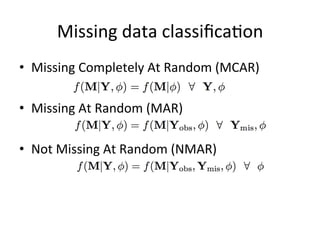
Missing	data	classifica$on	
•  Missing	Completely	At	Random	(MCAR)	
•  Missing	At	Random	(MAR)	
•  Not	Missing	At	Random	(NMAR)
Approaches	
•  Insufficient	
– Complete	cases,	indicator,	single	imputa$on
Approaches	
•  Insufficient	
– Complete	cases,	indicator,	single	imputa$on	
•  BePer	
– Mul$ple	imputa$on
Approaches	
•  Insufficient	
– Complete	cases,	indicator,	single	imputa$on	
•  BePer	
– Mul$ple	imputa$on	
– Likelihood-based	
– Weigh$ng
Approaches	
•  Insufficient	
– Complete	cases,	indicator,	single	imputa$on	
•  BePer	
– Mul$ple	imputa$on	
– Likelihood-based	
– Weigh$ng	
•  Best
Approaches	
•  Insufficient	
– Complete	cases,	indicator,	single	imputa$on	
•  BePer	
– Mul$ple	imputa$on	
– Likelihood-based	
– Weigh$ng	
•  Best	
– Preven$on
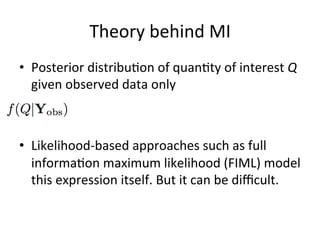
Theory	behind	MI	
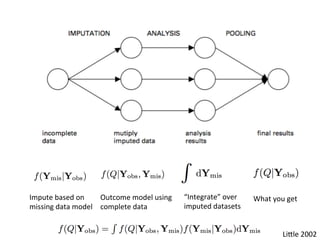
•  Posterior	distribu$on	of	quan$ty	of	interest	Q	
given	observed	data	only	
•  Likelihood-based	approaches	such	as	full	
informa$on	maximum	likelihood	(FIML)	model	
this	expression	itself.	But	it	can	be	difficult.
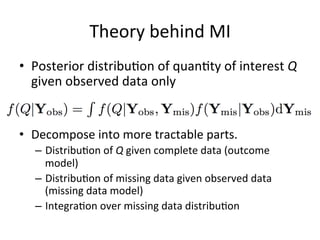
Theory	behind	MI	
•  Posterior	distribu$on	of	quan$ty	of	interest	Q	
given	observed	data	only	
•  Decompose	into	more	tractable	parts.	
–  Distribu$on	of	Q	given	complete	data	(outcome	
model)	
–  Distribu$on	of	missing	data	given	observed	data	
(missing	data	model)	
–  Integra$on	over	missing	data	distribu$on
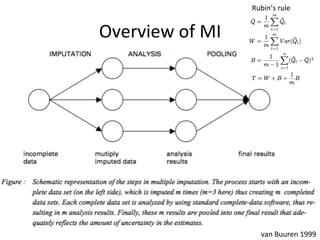
Overview	of	MI	
van	Buuren	1999	
Rubin’s	rule
Overview	of	MI	
Impute	based	on	
missing	data	model	
Outcome	model	using	
complete	data	
“Integrate”	over	
imputed	datasets	
What	you	get	
LiPle	2002
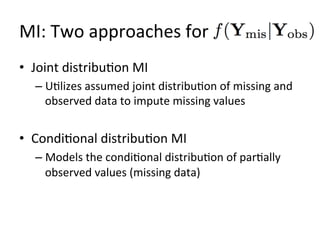
MI:	Two	approaches	for	
•  Joint	distribu$on	MI	
– U$lizes	assumed	joint	distribu$on	of	missing	and	
observed	data	to	impute	missing	values	
•  Condi$onal	distribu$on	MI	
– Models	the	condi$onal	distribu$on	of	par$ally	
observed	values	(missing	data)
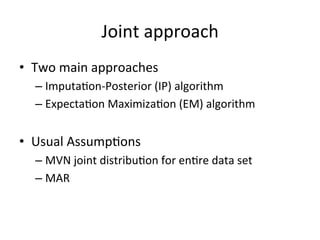
Joint	approach	
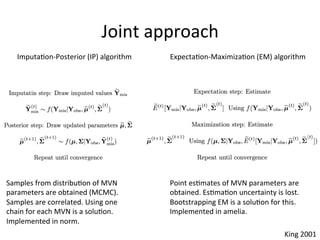
•  Two	main	approaches	
– Imputa$on-Posterior	(IP)	algorithm	
– Expecta$on	Maximiza$on	(EM)	algorithm	
•  Usual	Assump$ons	
– MVN	joint	distribu$on	for	en$re	data	set	
– MAR
Joint	approach	
Samples	from	distribu$on	of	MVN	
parameters	are	obtained	(MCMC).	
Samples	are	correlated.	Using	one	
chain	for	each	MVN	is	a	solu$on.	
Implemented	in	norm.	
Point	es$mates	of	MVN	parameters	are	
obtained.	Es$ma$on	uncertainty	is	lost.	
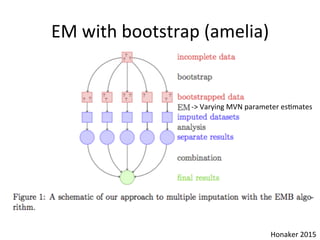
Bootstrapping	EM	is	a	solu$on	for	this.	
Implemented	in	amelia.	
Imputa$on-Posterior	(IP)	algorithm	 Expecta$on-Maximiza$on	(EM)	algorithm	
King	2001
EM	with	bootstrap	(amelia)	
Honaker	2015	
->	Varying	MVN	parameter	es$mates
Condi$onal	approach	
•  Models	the	missing-ness	within	dis$nct	
variables	sepeartely	and	does	not	assume	
joint	distribu$on.	MAR	s$ll	holds.
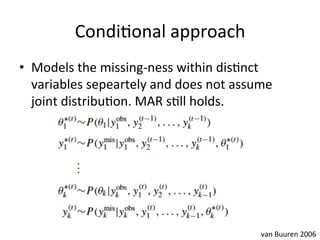
Condi$onal	approach	
•  Models	the	missing-ness	within	dis$nct	
variables	sepeartely	and	does	not	assume	
joint	distribu$on.	MAR	s$ll	holds.		
van	Buuren	2006
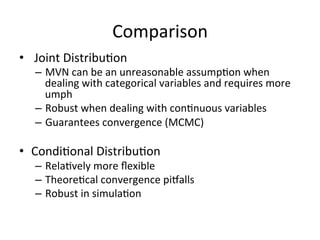
Comparison	
•  	Joint	Distribu$on	
–  MVN	can	be	an	unreasonable	assump$on	when	
dealing	with	categorical	variables	and	requires	more	
umph		
–  Robust	when	dealing	with	con$nuous	variables	
–  Guarantees	convergence	(MCMC)	
•  Condi$onal	Distribu$on		
–  Rela$vely	more	flexible	
–  Theore$cal	convergence	pimalls		
–  Robust	in	simula$on
High-dimensional	data	
•  The	joint	MI	has	an	issue	with	a	huge	
covariance	matrix	many	parameters,	whereas	
the	condi$onal	MI	has	an	overfinng	issue	for	
each	regression	model.	
•  Introducing	structures	for	the	covariance	
matrix	(joint	MI)[1]	and	using	regulariza$on	
(condi$onal	MI)[2]	have	been	examined.	
•  Widely	available	soqware	implementa$ons	
are	lacking.	
[1]	He	2014;	[2]	Zhao	2013
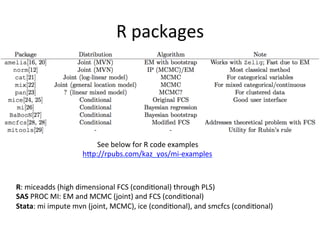
R	packages	
See	below	for	R	code	examples	
hPp://rpubs.com/kaz_yos/mi-examples	
R:	miceadds	(high	dimensional	FCS	(condi$onal)	through	PLS)	
SAS	PROC	MI:	EM	and	MCMC	(joint)	and	FCS	(condi$onal)	
Stata:	mi	impute	mvn	(joint,	MCMC),	ice	(condi$onal),	and	smcfcs	(condi$onal)
Conclusion	
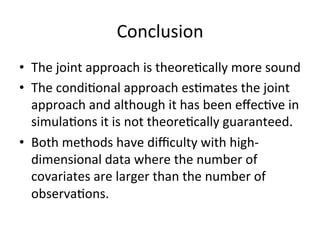
•  The	joint	approach	is	theore$cally	more	sound	
•  The	condi$onal	approach	es$mates	the	joint	
approach	and	although	it	has	been	effec$ve	in	
simula$ons	it	is	not	theore$cally	guaranteed.		
•  Both	methods	have	difficulty	with	high-
dimensional	data	where	the	number	of	
covariates	are	larger	than	the	number	of	
observa$ons.

Multiple Imputation: Joint and Conditional Modeling of Missing Data