Data Analytics Course
Logistic regression(Version-1)
Venkat Reddy
Data Analysis Course
•   Data analysis design document
•   Introduction to statistical data analysis
•   Descriptive statistics
•   Data exploration, validation & sanitization
•   Probability distributions examples and applications


                                                                Venkat Reddy
                                                          Data Analysis Course
•   Simple correlation and regression analysis
•   Multiple liner regression analysis

• Logistic regression analysis
•   Testing of hypothesis
•   Clustering and decision trees
•   Time series analysis and forecasting
•   Credit Risk Model building-1                                 2
•   Credit Risk Model building-2
Note
• This presentation is just class notes. The course notes for Data
  Analysis Training is by written by me, as an aid for myself.
• The best way to treat this is as a high-level summary; the
  actual session went more in depth and contained other


                                                                           Venkat Reddy
                                                                     Data Analysis Course
  information.
• Most of this material was written as informal notes, not
  intended for publication
• Please send questions/comments/corrections to
  venkat@trenwiseanalytics.com or 21.venkat@gmail.com
• Please check my website for latest version of this document
                                         -Venkat Reddy                      3
Contents
•   Need of logistic regression?
•   The logistic regression model
•   Meaning of beta
•   Goodness of fit


                                           Venkat Reddy
                                    Data Analytics Course
•   Multicollinearity
•   Prediction
•   Stepwise regression


                                            4
What is the need of logistic regression?
• Remember the burger example? Number of burgers sold vs
  number of visitors?
• What if we are trying to find whether a person is going to buy
  a burger or not, based on person’s age.
• Download the data from here & fit a linear regression line.


                                                                          Venkat Reddy
                                                                   Data Analytics Course
• What is R squared
• If age increases, what happens to burger sales?
• 25 years old person, does he buy a burger?
• Can we fit a liner regression line to this data?


                                                                           5
Real-life Challenges
•   Gaming - Win vs Loss
•   Sales - Buying vs Not buying
•   Marketing – Response vs No Response
•   Credit card & Loans – Default vs Non Default


                                                          Venkat Reddy
                                                   Data Analytics Course
•   Operations – Attrition vs Retention
•   Websites – Click vs No click
•   Fraud identification –Fraud vs Non Frau
•   Healthcare –Cure vs No Cure


                                                           6
Bought burger?


                                            No


           Yes
      0
      10
      20
                                                 Why not liner ?


      30

Age
      40
      50
      60
      70
      80


                    Data Analytics Course
7


                           Venkat Reddy
Any better line?
                        1.2


                  No     1


                        0.8


                                                                                       Venkat Reddy
                                                                                Data Analytics Course
 Bought burger?


                        0.6


                        0.4


                        0.2


                  Yes    0
                              0   10   20   30         40   50   60   70   80

                                                 Age                                    8
Logistic function
• We want a model that predicts probabilities between 0 and 1, that
  is, S-shaped.
• There are lots of S-shaped curves. We use the logistic model:
• Probability = 1/[1 + exp(0+ 1X) ] or loge[P/(1-P)] = 0+ 1X
• The function on left, loge[P/(1-P)], is called the logistic function.


                                                                                 Venkat Reddy
                                                                          Data Analytics Course
        1.0
                           e  x
              P( y x ) 
        0.8              1  e  x

        0.6


        0.4


        0.2                                                                       9

        0.0
                                       x
Logistic regression function
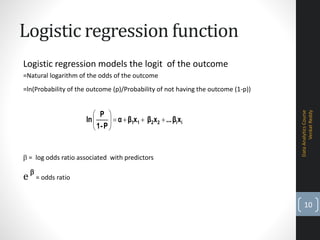
Logistic regression models the logit of the outcome
=Natural logarithm of the odds of the outcome
=ln(Probability of the outcome (p)/Probability of not having the outcome (1-p))


                           P 


                                                                                         Venkat Reddy
                                                                                  Data Analytics Course
                       ln         α  β1x1  β2x2  ... βixi
                           1- P 


 = log odds ratio associated with predictors

    
e       = odds ratio


                                                                                      10
Curve fitting using MLE
• Remember OLS for linear models?
• Maximum Likelihood Estimator:
  • starts with arbitrary values of the regression coefficients and
    constructs an initial model for predicting the observed data.
  • Then evaluates errors in such prediction and changes the


                                                                               Venkat Reddy
                                                                        Data Analytics Course
    regression coefficients so as make the likelihood of the observed
    data greater under the new model.
  • Repeats until the model converges, meaning the differences
    between the newest model and the previous model are trivial.
• The idea is that you “find and report as statistics” the
  parameters that are most likely to have produced your data.

                                                                            11
Meaning of beta
• The betas themselves are log-odds ratios. Negative values
  indicate a negative relationship between the probability of
  "success" and the independent variable; positive values
  indicate a positive relationship.
• Increase in log-odds for a one unit increase in xi with all the


                                                                           Venkat Reddy
                                                                    Data Analytics Course
  other xi s constant
• Measures association between xi and log-odds adjusted for all
  other xi


                  P 
              ln         α  β1x1  β2x2  ... βixi
                  1- P 
                                                                        12
Goodness of fit for a logistic regression
Chi-Square
• The Chi-Square statistic and associated p-value (Sig.) tests whether
  the model coefficients as a group equal zero.
• Larger Chi-squares and smaller p-values indicate greater confidence
  in rejected the null hypothesis of no impact


                                                                                 Venkat Reddy
                                                                          Data Analytics Course
Percent Correct Predictions
• The "Percent Correct Predictions" statistic assumes that if the
  estimated p is greater than or equal to .5 then the event is expected
  to occur and not occur otherwise.
• By assigning these probabilities 0s and 1s and comparing these to
  the actual 0s and 1s, the % correct Yes, % correct No, and overall %
  correct scores are calculated.
• Note: subgroups for the % correctly predicted is also important,            13
  especially if most of the data are 0s or 1s
Goodness of fit for a logistic regression
• Hosmer and Lemeshow Goodness-of-Fit Test
  • Chisquare test for Observed and expected bad by diving the variable
    into groups
  • The test assesses whether or not the observed event rates match
    expected event rates in subgroups of the model population.
  • The Hosmer–Lemeshow test specifically identifies subgroups as the


                                                                                   Venkat Reddy
                                                                            Data Analytics Course
    deciles of fitted risk values. Models for which expected and observed
    event rates in subgroups are similar are called well calibrated.
• Other methods
  •   ROC curves – How to interpret ROC curve?
  •   Somers' D
  •   Gamma
  •   Tau-a
  •   C
                                                                                14
  •   More than a dozen “R2”-type summaries
Lab-Logistic Regression
• Fit a logistic regression line for burger example
• If age increases, what happens to burger sales?
• 25 years old person, does he buy a burger? What is the
  probability (or what are the odds of him buying the burger)


                                                                         Venkat Reddy
                                                                  Data Analytics Course
• How good is the regression line for burger example
• If age difference is 20 years, what is the difference in odds
• Write the below code to see
Proc logistic data=burger2
PLOTS(ONLY)=(ROC(ID=prob) EFFECT) descending;
model buy=Age / lackfit;
run;
                                                                      15
Lab: Logistic regression
• Build a logistic regression line on credit card
  data(cred.training)
• Problem with monthly income, number of open cred limits,
  number of dependents? Drop them & build for the rest of
  variables


                                                                         Venkat Reddy
                                                                  Data Analytics Course
• How good is the fit?
• What is the impact of each variable
• Is there any interdependency between variables
• Remove 60 plus delinquency & 90 plus delinquency variables
  & build the model again
• How to identify & use the variables with data related issues?
  Data validation & cleaning                                          16
Venkat Reddy Konasani
Manager at Trendwise Analytics
venkat@TrendwiseAnalytics.com
21.venkat@gmail.com


                                          Venkat Reddy
                                    Data Analysis Course
www.TrendwiseAnalytics.com/venkat
+91 9886 768879


                                        17

Logistic regression

  • 1.
    Data Analytics Course Logisticregression(Version-1) Venkat Reddy
  • 2.
    Data Analysis Course • Data analysis design document • Introduction to statistical data analysis • Descriptive statistics • Data exploration, validation & sanitization • Probability distributions examples and applications Venkat Reddy Data Analysis Course • Simple correlation and regression analysis • Multiple liner regression analysis • Logistic regression analysis • Testing of hypothesis • Clustering and decision trees • Time series analysis and forecasting • Credit Risk Model building-1 2 • Credit Risk Model building-2
  • 3.
    Note • This presentationis just class notes. The course notes for Data Analysis Training is by written by me, as an aid for myself. • The best way to treat this is as a high-level summary; the actual session went more in depth and contained other Venkat Reddy Data Analysis Course information. • Most of this material was written as informal notes, not intended for publication • Please send questions/comments/corrections to venkat@trenwiseanalytics.com or 21.venkat@gmail.com • Please check my website for latest version of this document -Venkat Reddy 3
  • 4.
    Contents • Need of logistic regression? • The logistic regression model • Meaning of beta • Goodness of fit Venkat Reddy Data Analytics Course • Multicollinearity • Prediction • Stepwise regression 4
  • 5.
    What is theneed of logistic regression? • Remember the burger example? Number of burgers sold vs number of visitors? • What if we are trying to find whether a person is going to buy a burger or not, based on person’s age. • Download the data from here & fit a linear regression line. Venkat Reddy Data Analytics Course • What is R squared • If age increases, what happens to burger sales? • 25 years old person, does he buy a burger? • Can we fit a liner regression line to this data? 5
  • 6.
    Real-life Challenges • Gaming - Win vs Loss • Sales - Buying vs Not buying • Marketing – Response vs No Response • Credit card & Loans – Default vs Non Default Venkat Reddy Data Analytics Course • Operations – Attrition vs Retention • Websites – Click vs No click • Fraud identification –Fraud vs Non Frau • Healthcare –Cure vs No Cure 6
  • 7.
    Bought burger? No Yes 0 10 20 Why not liner ? 30 Age 40 50 60 70 80 Data Analytics Course 7 Venkat Reddy
  • 8.
    Any better line? 1.2 No 1 0.8 Venkat Reddy Data Analytics Course Bought burger? 0.6 0.4 0.2 Yes 0 0 10 20 30 40 50 60 70 80 Age 8
  • 9.
    Logistic function • Wewant a model that predicts probabilities between 0 and 1, that is, S-shaped. • There are lots of S-shaped curves. We use the logistic model: • Probability = 1/[1 + exp(0+ 1X) ] or loge[P/(1-P)] = 0+ 1X • The function on left, loge[P/(1-P)], is called the logistic function. Venkat Reddy Data Analytics Course 1.0 e  x P( y x )  0.8 1  e  x 0.6 0.4 0.2 9 0.0 x
  • 10.
    Logistic regression function Logisticregression models the logit of the outcome =Natural logarithm of the odds of the outcome =ln(Probability of the outcome (p)/Probability of not having the outcome (1-p))  P  Venkat Reddy Data Analytics Course ln    α  β1x1  β2x2  ... βixi  1- P   = log odds ratio associated with predictors  e = odds ratio 10
  • 11.
    Curve fitting usingMLE • Remember OLS for linear models? • Maximum Likelihood Estimator: • starts with arbitrary values of the regression coefficients and constructs an initial model for predicting the observed data. • Then evaluates errors in such prediction and changes the Venkat Reddy Data Analytics Course regression coefficients so as make the likelihood of the observed data greater under the new model. • Repeats until the model converges, meaning the differences between the newest model and the previous model are trivial. • The idea is that you “find and report as statistics” the parameters that are most likely to have produced your data. 11
  • 12.
    Meaning of beta •The betas themselves are log-odds ratios. Negative values indicate a negative relationship between the probability of "success" and the independent variable; positive values indicate a positive relationship. • Increase in log-odds for a one unit increase in xi with all the Venkat Reddy Data Analytics Course other xi s constant • Measures association between xi and log-odds adjusted for all other xi  P  ln    α  β1x1  β2x2  ... βixi  1- P  12
  • 13.
    Goodness of fitfor a logistic regression Chi-Square • The Chi-Square statistic and associated p-value (Sig.) tests whether the model coefficients as a group equal zero. • Larger Chi-squares and smaller p-values indicate greater confidence in rejected the null hypothesis of no impact Venkat Reddy Data Analytics Course Percent Correct Predictions • The "Percent Correct Predictions" statistic assumes that if the estimated p is greater than or equal to .5 then the event is expected to occur and not occur otherwise. • By assigning these probabilities 0s and 1s and comparing these to the actual 0s and 1s, the % correct Yes, % correct No, and overall % correct scores are calculated. • Note: subgroups for the % correctly predicted is also important, 13 especially if most of the data are 0s or 1s
  • 14.
    Goodness of fitfor a logistic regression • Hosmer and Lemeshow Goodness-of-Fit Test • Chisquare test for Observed and expected bad by diving the variable into groups • The test assesses whether or not the observed event rates match expected event rates in subgroups of the model population. • The Hosmer–Lemeshow test specifically identifies subgroups as the Venkat Reddy Data Analytics Course deciles of fitted risk values. Models for which expected and observed event rates in subgroups are similar are called well calibrated. • Other methods • ROC curves – How to interpret ROC curve? • Somers' D • Gamma • Tau-a • C 14 • More than a dozen “R2”-type summaries
  • 15.
    Lab-Logistic Regression • Fita logistic regression line for burger example • If age increases, what happens to burger sales? • 25 years old person, does he buy a burger? What is the probability (or what are the odds of him buying the burger) Venkat Reddy Data Analytics Course • How good is the regression line for burger example • If age difference is 20 years, what is the difference in odds • Write the below code to see Proc logistic data=burger2 PLOTS(ONLY)=(ROC(ID=prob) EFFECT) descending; model buy=Age / lackfit; run; 15
  • 16.
    Lab: Logistic regression •Build a logistic regression line on credit card data(cred.training) • Problem with monthly income, number of open cred limits, number of dependents? Drop them & build for the rest of variables Venkat Reddy Data Analytics Course • How good is the fit? • What is the impact of each variable • Is there any interdependency between variables • Remove 60 plus delinquency & 90 plus delinquency variables & build the model again • How to identify & use the variables with data related issues? Data validation & cleaning 16
  • 17.
    Venkat Reddy Konasani Managerat Trendwise Analytics venkat@TrendwiseAnalytics.com 21.venkat@gmail.com Venkat Reddy Data Analysis Course www.TrendwiseAnalytics.com/venkat +91 9886 768879 17