Prepared By:
Neeraj Kumar Rai
M.Sc., P.G.D.B.M., Black belt in Lean Six
Sigma
Certified Lead Auditor
ISO9001:2015(QMS)
Data Integrity in Pharmaceutical
Industry
What is Data?
 Data is the name given to basic facts and entities
such as names and numbers. The main examples
of data are weights, prices, costs, numbers of
items sold, employee names, product names
etc.
 Factual information (such as measurements or
statistics) used as a basis for reasoning,
discussion, or calculation
What is Integrity?
The state of
being whole,
entire or
undiminished
So what is Data Integrity?
 Data integrity is the maintenance of, and the
assurance of, data accuracy and consistency
over its entire life-cycle and is a critical aspect to
the design, implementation, and usage of any
system that stores, processes, or retrieves data.
Data Integrity
 Data integrity (DI) ensures that the data
generated during business operations and
drug manufacturing is accurate, complete and
reliable. It is a fundamental pillar in the
pharmaceutical industry, ensuring that medicines
are of the required quality and safe to the
patients.
Regulatory requirement
 The U.S. Food and Drug Administration has
created draft guidance on data integrity for the
pharmaceutical manufacturers required to adhere
to U.S. Code of Federal Regulations 21 CFR
Parts 210–212.
Why Data Integrity required??
 To ensure the patient safety.
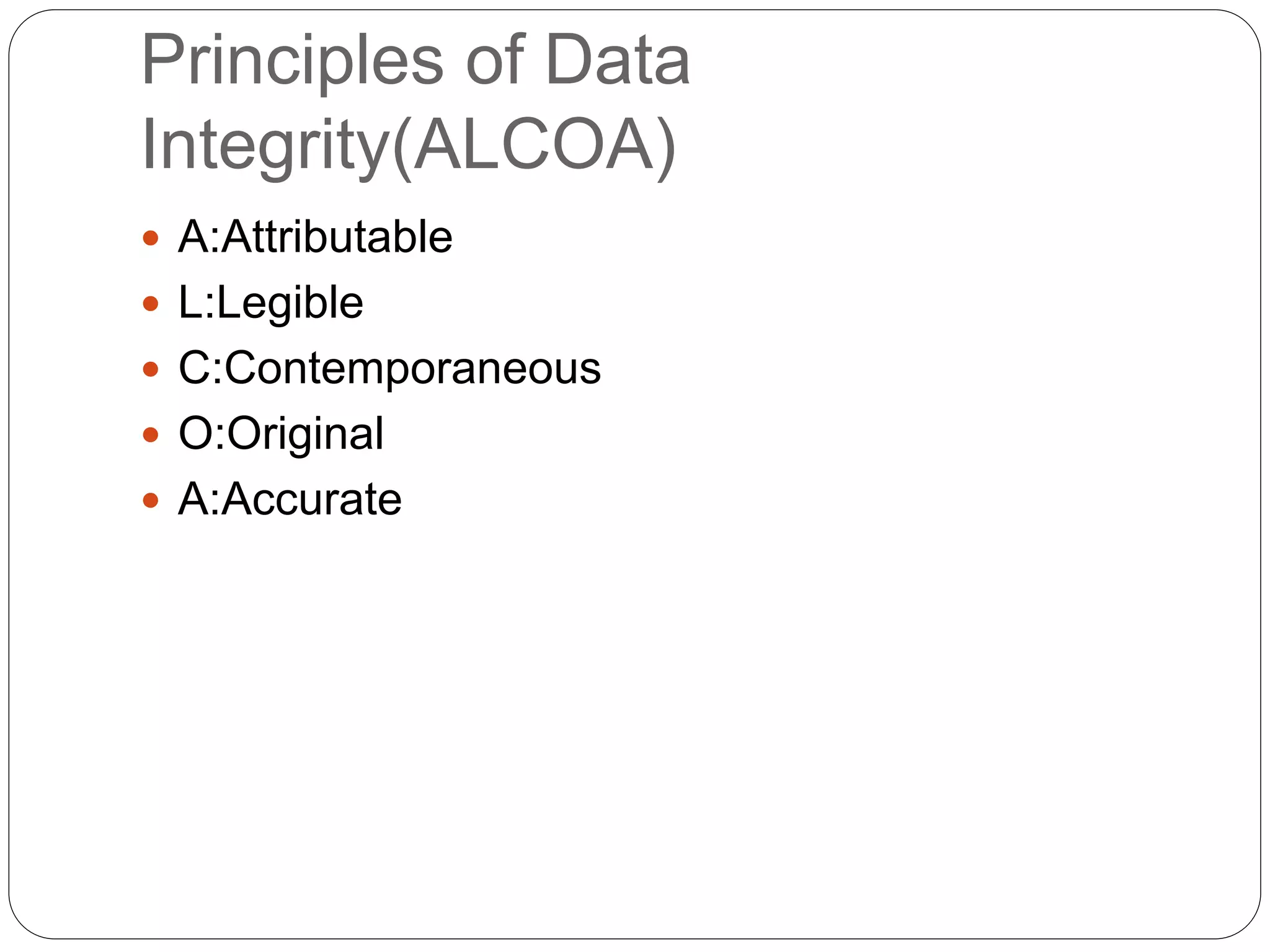
Principles of Data
Integrity(ALCOA)
 A:Attributable
 L:Legible
 C:Contemporaneous
 O:Original
 A:Accurate
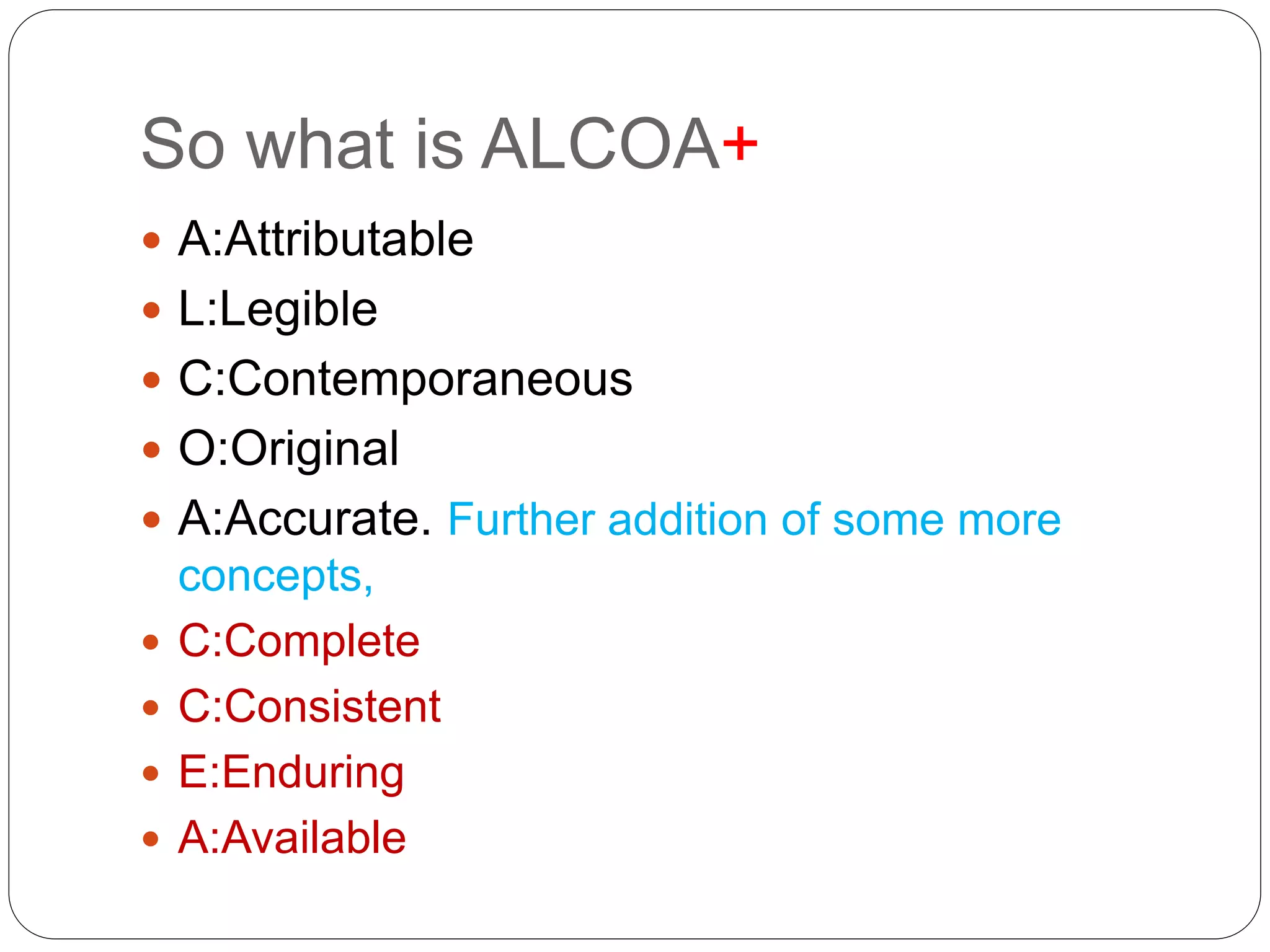
So what is ALCOA+
 A:Attributable
 L:Legible
 C:Contemporaneous
 O:Original
 A:Accurate. Further addition of some more
concepts,
 C:Complete
 C:Consistent
 E:Enduring
 A:Available
Principles of Data Integrity:
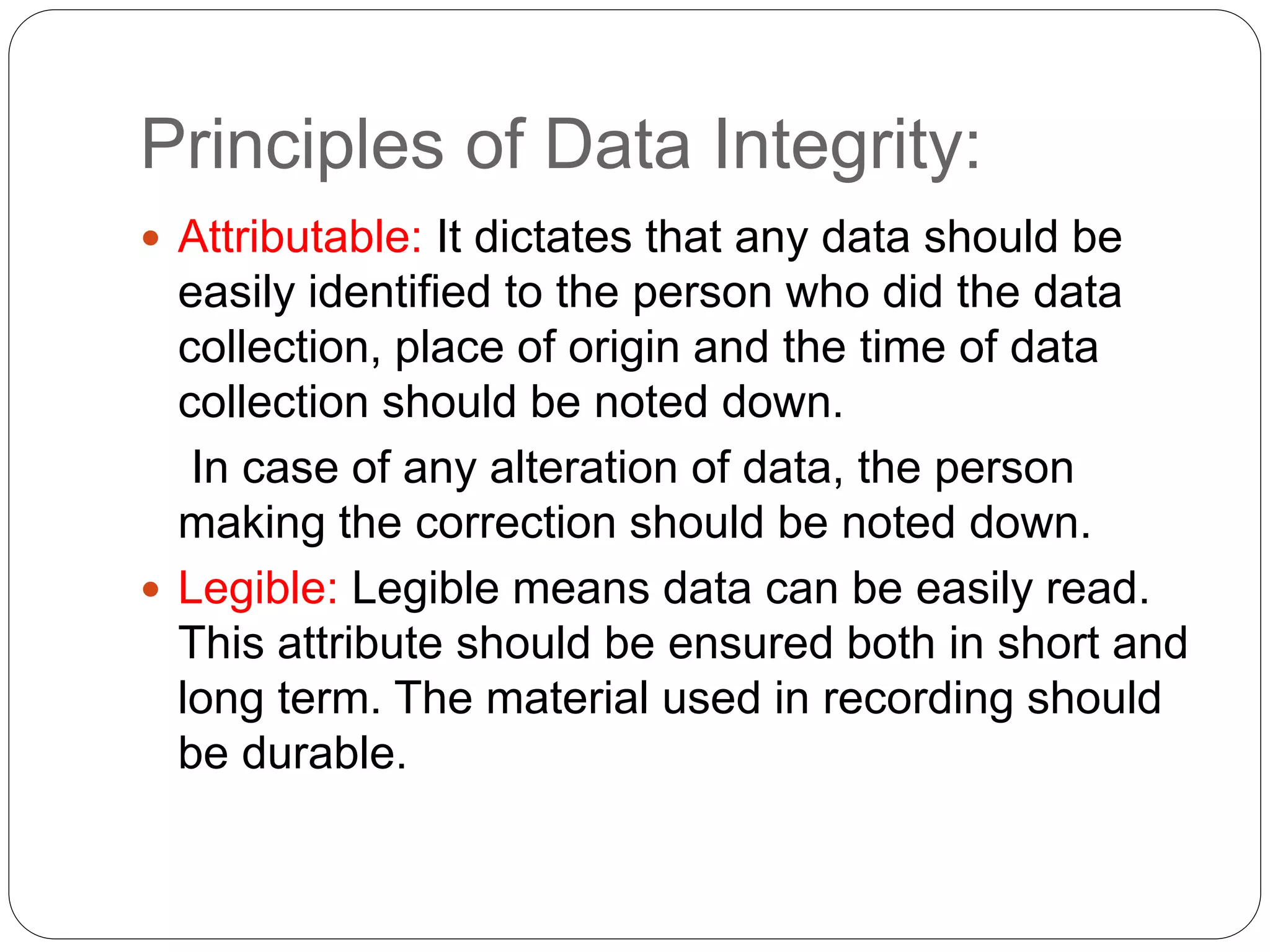
 Attributable: It dictates that any data should be
easily identified to the person who did the data
collection, place of origin and the time of data
collection should be noted down.
In case of any alteration of data, the person
making the correction should be noted down.
 Legible: Legible means data can be easily read.
This attribute should be ensured both in short and
long term. The material used in recording should
be durable.
Principles of Data Integrity:
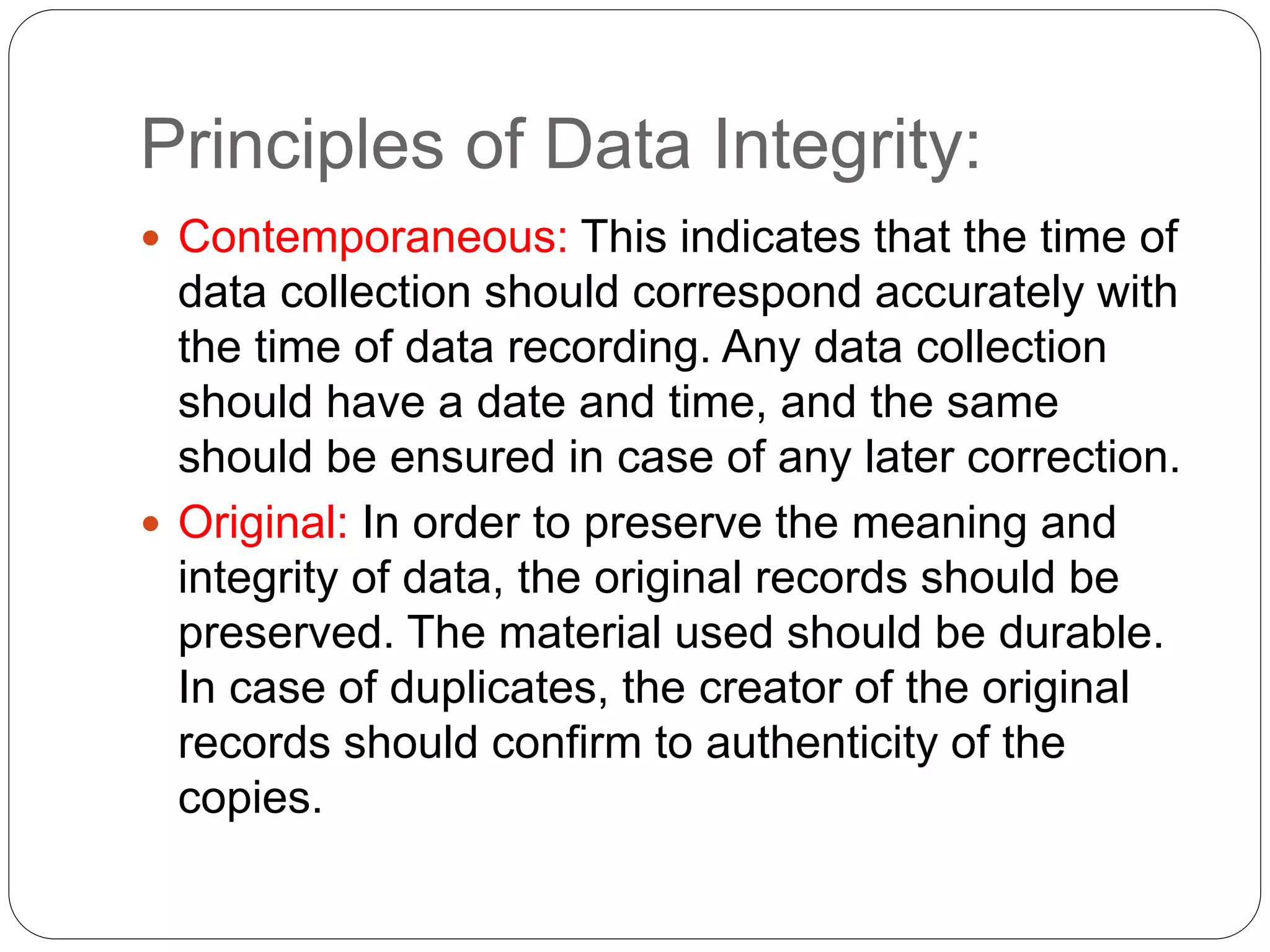
 Contemporaneous: This indicates that the time of
data collection should correspond accurately with
the time of data recording. Any data collection
should have a date and time, and the same
should be ensured in case of any later correction.
 Original: In order to preserve the meaning and
integrity of data, the original records should be
preserved. The material used should be durable.
In case of duplicates, the creator of the original
records should confirm to authenticity of the
copies.
Principles of Data Integrity:
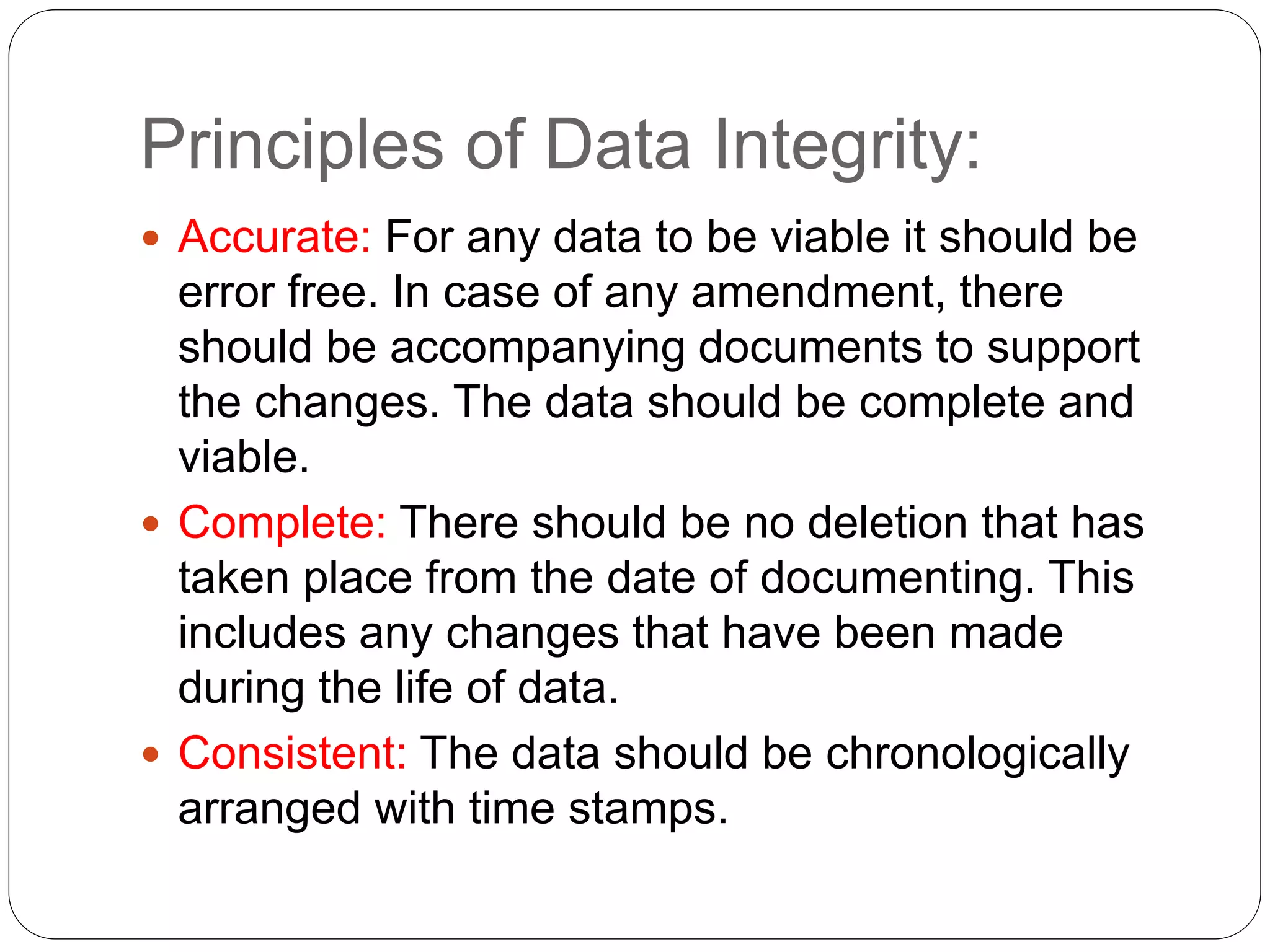
 Accurate: For any data to be viable it should be
error free. In case of any amendment, there
should be accompanying documents to support
the changes. The data should be complete and
viable.
 Complete: There should be no deletion that has
taken place from the date of documenting. This
includes any changes that have been made
during the life of data.
 Consistent: The data should be chronologically
arranged with time stamps.
Principles of Data Integrity:
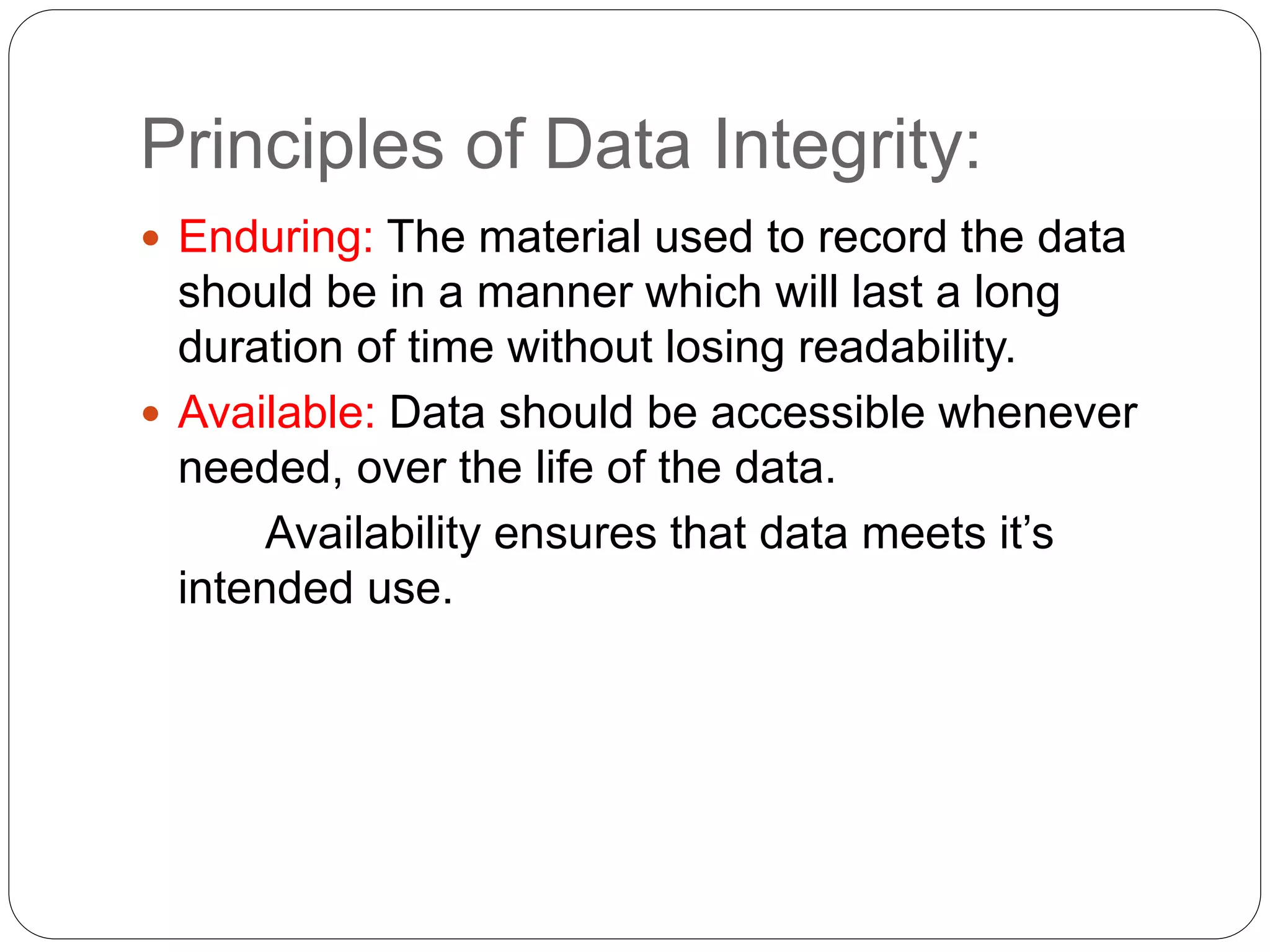
 Enduring: The material used to record the data
should be in a manner which will last a long
duration of time without losing readability.
 Available: Data should be accessible whenever
needed, over the life of the data.
Availability ensures that data meets it’s
intended use.
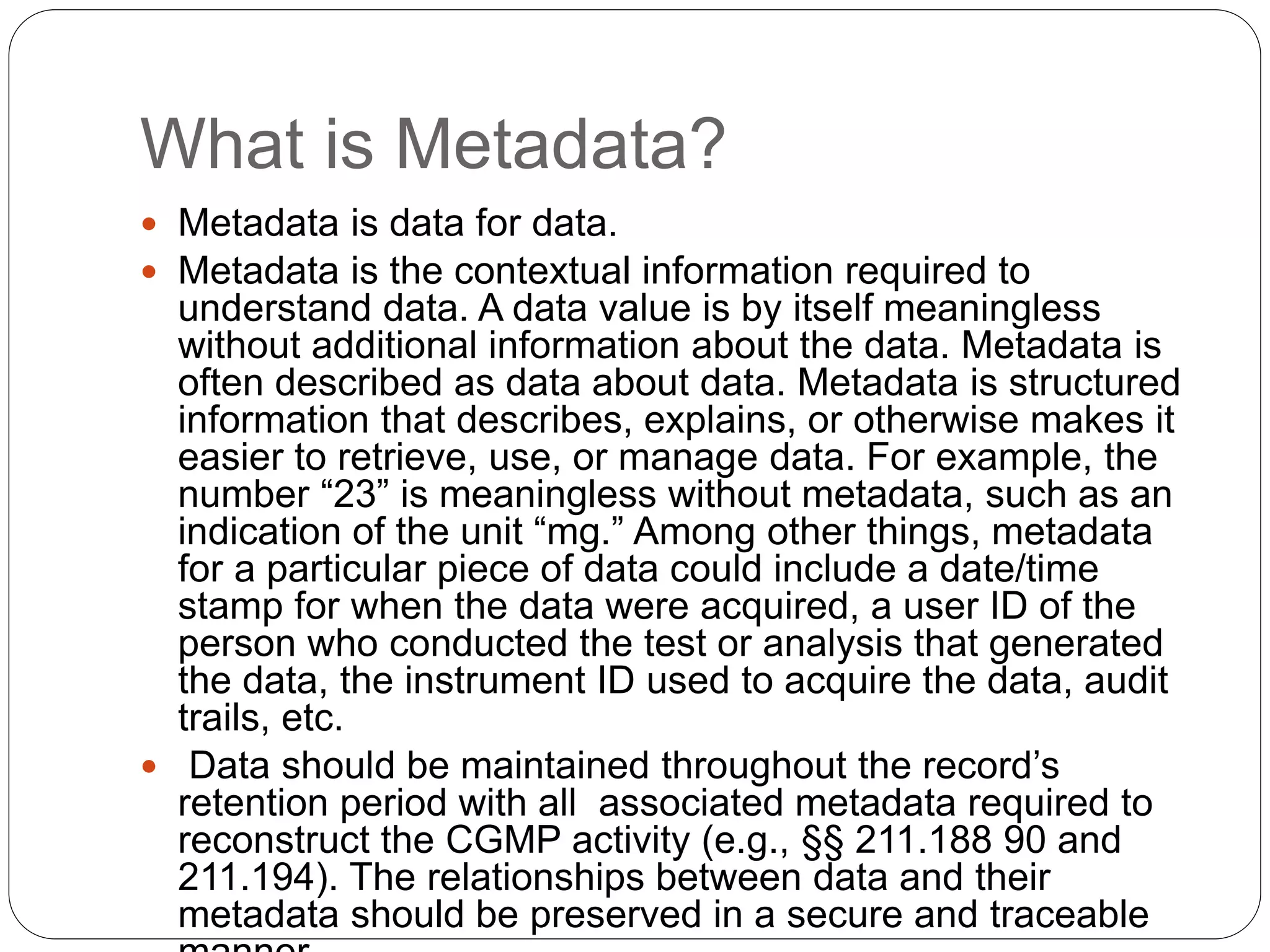
What is Metadata?
 Metadata is data for data.
 Metadata is the contextual information required to
understand data. A data value is by itself meaningless
without additional information about the data. Metadata is
often described as data about data. Metadata is structured
information that describes, explains, or otherwise makes it
easier to retrieve, use, or manage data. For example, the
number “23” is meaningless without metadata, such as an
indication of the unit “mg.” Among other things, metadata
for a particular piece of data could include a date/time
stamp for when the data were acquired, a user ID of the
person who conducted the test or analysis that generated
the data, the instrument ID used to acquire the data, audit
trails, etc.
 Data should be maintained throughout the record’s
retention period with all associated metadata required to
reconstruct the CGMP activity (e.g., §§ 211.188 90 and
211.194). The relationships between data and their
metadata should be preserved in a secure and traceable
Data Integrity.pptx
Data Integrity.pptx

Data Integrity.pptx

  • 1.
    Prepared By: Neeraj KumarRai M.Sc., P.G.D.B.M., Black belt in Lean Six Sigma Certified Lead Auditor ISO9001:2015(QMS) Data Integrity in Pharmaceutical Industry
  • 2.
    What is Data? Data is the name given to basic facts and entities such as names and numbers. The main examples of data are weights, prices, costs, numbers of items sold, employee names, product names etc.  Factual information (such as measurements or statistics) used as a basis for reasoning, discussion, or calculation
  • 3.
    What is Integrity? Thestate of being whole, entire or undiminished
  • 4.
    So what isData Integrity?  Data integrity is the maintenance of, and the assurance of, data accuracy and consistency over its entire life-cycle and is a critical aspect to the design, implementation, and usage of any system that stores, processes, or retrieves data.
  • 5.
    Data Integrity  Dataintegrity (DI) ensures that the data generated during business operations and drug manufacturing is accurate, complete and reliable. It is a fundamental pillar in the pharmaceutical industry, ensuring that medicines are of the required quality and safe to the patients.
  • 6.
    Regulatory requirement  TheU.S. Food and Drug Administration has created draft guidance on data integrity for the pharmaceutical manufacturers required to adhere to U.S. Code of Federal Regulations 21 CFR Parts 210–212.
  • 7.
    Why Data Integrityrequired??  To ensure the patient safety.
  • 8.
    Principles of Data Integrity(ALCOA) A:Attributable  L:Legible  C:Contemporaneous  O:Original  A:Accurate
  • 9.
    So what isALCOA+  A:Attributable  L:Legible  C:Contemporaneous  O:Original  A:Accurate. Further addition of some more concepts,  C:Complete  C:Consistent  E:Enduring  A:Available
  • 10.
    Principles of DataIntegrity:  Attributable: It dictates that any data should be easily identified to the person who did the data collection, place of origin and the time of data collection should be noted down. In case of any alteration of data, the person making the correction should be noted down.  Legible: Legible means data can be easily read. This attribute should be ensured both in short and long term. The material used in recording should be durable.
  • 11.
    Principles of DataIntegrity:  Contemporaneous: This indicates that the time of data collection should correspond accurately with the time of data recording. Any data collection should have a date and time, and the same should be ensured in case of any later correction.  Original: In order to preserve the meaning and integrity of data, the original records should be preserved. The material used should be durable. In case of duplicates, the creator of the original records should confirm to authenticity of the copies.
  • 12.
    Principles of DataIntegrity:  Accurate: For any data to be viable it should be error free. In case of any amendment, there should be accompanying documents to support the changes. The data should be complete and viable.  Complete: There should be no deletion that has taken place from the date of documenting. This includes any changes that have been made during the life of data.  Consistent: The data should be chronologically arranged with time stamps.
  • 13.
    Principles of DataIntegrity:  Enduring: The material used to record the data should be in a manner which will last a long duration of time without losing readability.  Available: Data should be accessible whenever needed, over the life of the data. Availability ensures that data meets it’s intended use.
  • 14.
    What is Metadata? Metadata is data for data.  Metadata is the contextual information required to understand data. A data value is by itself meaningless without additional information about the data. Metadata is often described as data about data. Metadata is structured information that describes, explains, or otherwise makes it easier to retrieve, use, or manage data. For example, the number “23” is meaningless without metadata, such as an indication of the unit “mg.” Among other things, metadata for a particular piece of data could include a date/time stamp for when the data were acquired, a user ID of the person who conducted the test or analysis that generated the data, the instrument ID used to acquire the data, audit trails, etc.  Data should be maintained throughout the record’s retention period with all associated metadata required to reconstruct the CGMP activity (e.g., §§ 211.188 90 and 211.194). The relationships between data and their metadata should be preserved in a secure and traceable