Data Integrity Training
Dr. A. Amsavel, M.Sc., B.Ed., Ph.D.
Dec 2019
Presentation Overview
 Objective of Data Integrity
 What is Data Integrity?
 Regulatory Requirement
 Data Integrity Principles
 ALCOA, + Principles
 Basic Data Integrity Expectations
 Data Integrity examples and WL
 Implementation
 Conclusions
What is Integrity ?What is Integrity ?
What is mean by Integrity ?
Integrity: Direct meaning
Cambridge Dictionary:
Integrity noun [U] (HONESTY) ... the quality
of being honest and having strong moral
principles that you refuse to change
Integrity :
The Quality of being honest and
Quality & Integrity
The Quality of being honest and
having strong moral principles
Definition -MHRA
Data:
Information derived or obtained from raw data, (MHRA, 2015)
Facts, figures and statistics collected together for reference or
analysis. (MHRA, 2018)
1. Data can be ‘electronic’ or ‘paper based’ or ‘Hybrid’
2. From initial data generation and recording through processing (including
transformation or migration), use, retention, archiving, retrieval and destruction
3. Electronic information includes everything, such as emails, adverse events
reports, complaints, batch records, and quality control records—everything
that’s stored electronically.
Definition -MHRA
Data Integrity:
Data integrity is the degree to which data are complete,
consistent, accurate, trustworthy, reliable and that these
characteristics of the data are maintained throughout the datacharacteristics of the data are maintained throughout the data
life cycle.
The data should be collected and maintained in a secure manner,
so that they are attributable, legible, contemporaneously
recorded, original (or a true copy) and accurate.
Definition
 Raw Data Original records and documentation, retained
in the format in which they were originally generated (i.e.
paper or electronic), or as a ‘true copy’. (MHRA, 2015)paper or electronic), or as a ‘true copy’. (MHRA, 2015)
 Meta Data are data used to describe other data. It can be
used to describe information such as file type, format,
author, user rights, etc. and is usually attached to files,
but invisible to the user. (ISPE, GAMP 5)
Definition -MHRA
 Data Governance
The arrangements to ensure that data, irrespective of
the format in which they are generated, are
recorded, processed, retained and used to ensure
the record throughout the data lifecycle.the record throughout the data lifecycle.
 Data Lifecycle
All phases in the life of the data from generation and
recording through processing (including analysis,
transformation or migration), use, data retention,
archive/retrieval and destruction.
Definition
Audit Trail
 Secure, computer-generated, time-stamped electronic record that allows for
reconstruction of events relating to the creation, modification, or deletion of an
electronic record
 Who, what, when, and sometimes why of a record
 Example: audit trail for an HPLC run could include user name, date/time of Example: audit trail for an HPLC run could include user name, date/time of
run, integration parameters used, details of a reprocessing.
 Audit trails shall capture: overwriting, aborting runs, “testing into compliance,”
deleting, backdating, altering data
 Audit trials subject to regular review should include changes to:
 history of unfinished product test results
 sample run sequences
 sample identification
 critical process parameters
Objective of Data Integrity
to ensure patient safety and Quality
 …..the protection of the patient by managing the
risk to quality is considered as importance.risk to quality is considered as importance.
 Ultimately Pharmaceutical quality is to Assure
every dose is safe and effective, free of
contamination and defects.
Regulators view
Data Integrity breach Break the trust between
Industry and Regulatory Agencies .
Time period between the inspections, we trust
you to do the right thing when the regulatoryyou to do the right thing when the regulatory
agency are not watching.
If they find compliance gaps, regaining trust
can be costly, and time consuming Task.
Karen Takahashi
Senior Policy Adviser to USFDA
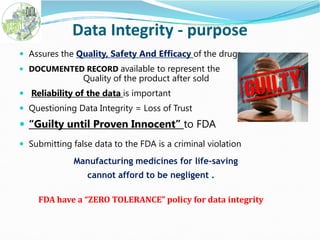
Data Integrity - purpose
 Assures the Quality, Safety And Efficacy of the drugs
 DOCUMENTED RECORD available to represent the
Quality of the product after sold
 Reliability of the data is important
 Questioning Data Integrity = Loss of Trust
 “Guilty until Proven Innocent” to FDA “Guilty until Proven Innocent” to FDA
 Submitting false data to the FDA is a criminal violation
Manufacturing medicines for life-saving
cannot afford to be negligent .
FDA have a “ZERO TOLERANCE” policy for data integrity
Bad practices
Zero colony
What are Poor or Bad practices ?
What is misconduct ?What is misconduct ?
What is Data falsification or fabrication?
Poor/Bad practices and Falsification
Innocent
Ignorance
Carelessness/
Negligence
Intentional/
Malicious
Act is unintentional;
Non-Compliance is
Act may or may not be
intentional;
Act is intentional;
Non-compliance isNon-Compliance is
unintentional
intentional;
Non-compliance is
unintentional
Non-compliance is
intentional
Discarding source
documents after
accurate transcription;
Deleting e-files after
printing
Inaction, inattention to
detail, inadequate staff,
lack of supervision
Data manipulation, data
falsification,
mis-representation, with
holding critical
information
Data Integrity
Are all misconducts are DI??
What are called Data Integrity breach ?
 Falsification / fabrication
 Dishonest / malicious
 Hiding
 Bad practice: historical practice, Shortcuts, etc
Data Integrity
Know the difference between Poor/Bad practices and Falsification
 Human errors data entered by mistake
 Ignorance (not aware of regulatory requirements or poor training)
 Errors during transmission from one computer to another
 Changes due to software bugs or malware of which the user is unaware
 Use of non-validated software applications/Spreadsheets Use of non-validated software applications/Spreadsheets
 Discarding source documents after accurate transcription;
 Hardware malfunctions
 Wilfully falsification of data or fraudulent data (with the intent to
deceive)
 Selection of good or passing results ( exclusion of poor or failing results)
 Unauthorised changes of post acquisition data - overwriting, change
the name / data
FDA findings Related Data integrity
 Backdating/Postdating/missing /mismating Signatures
 Data manipulation/ data falsification,
 Copying existing data as new data
 Not saving the actual electronic or deleting electronic data
after Printing- Chromatogramsafter Printing- Chromatograms
 Disposing the original hard copies
 Not reporting of failures and deviations
 Releasing the failing product
 Hiding/obscuring /withholding critical information etc
 Mismatch between reported data and actual data
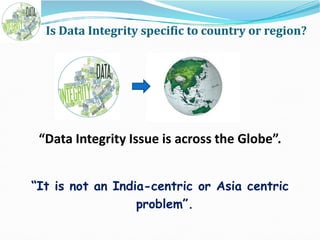
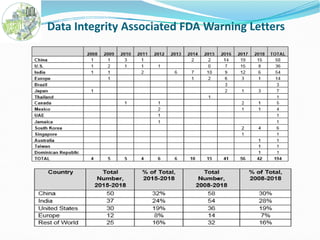
Is Data Integrity specific to country or region?
“Data Integrity Issue is across the Globe”.
“It is not an India-centric or Asia centric
problem”.
Warning Letters in India
2018- 16% , but 2019 47% ( until Nov)
Year 2019- upto 11/2019 (17 out of 36) Year 2018 ( 9 out of 57 from India)
1 Mylan Laboratories Limited - Unit 8 1 Skylark CMC Pvt. Ltd.
2 Coral Pharmaceuticals LTD 2 Apotex Research Private Limited
3 Torrent Pharmaceuticals Limited 3 JT Cosmetics & Chemicals Pvt. Ltd.
4 Glenmark Pharmaceuticals Limited 4 Claris Injectables Limited
5 Lupin Limited 5 Reine Lifescience
6 Lantech Pharmaceuticals Limited 6 Goran Pharma Private Limited
Emcure Pharmaceuticals Limited Keshava Organics Pvt. Ltd.7 Emcure Pharmaceuticals Limited 7 Keshava Organics Pvt. Ltd.
8 CTX Lifesciences Private Ltd. 8 Malladi Drugs & Pharmaceuticals Limited
9 Indoco Remedies Limited 9 Alchymars ICM SM Private Limited
10 Strides Pharma Limited
11 Aurobindo Pharma Limited
12 Centurion Laboratories Private Limited
13 B. Jain Pharmaceuticals Private Limited
14 Jubilant Life Sciences
15 Hospira Healthcare India Pvt. Ltd
16 Anicare Pharmaceuticals Pvt. Ltd.
17 Vipor Chemicals Private Ltd.
Warning Letters Related to DI - India
10
12
10
9
12
No. of Warning Letters related to DI from India
80
90
100
100
70
67
% Warnig Letters related to DI from India to ROW
0
2
4
6
8
2013 2014 2015 2016 2017 2018
6
7
6
0
10
20
30
40
50
60
70
80
2013 2014 2015 2016 2017 2018
70
67
22
26
14
Year
Year
Data Integrity Associated FDA Warning Letters
EDQM : Critical / Major Deficiencies
India Manufacturers 2013 – 2016
2018
2
Data integrity.
Sterility & Contamination
Training
Facility
& Prdn
22
715
11
5
Training
QA & QC
Equip. Qual.& Process validation
CAPA
Facility & Production Operation
Supplier & material
QA&QC
What are the consequences of DI?
 The cost of remediation, investigation, CAPA to meet regulatory
compliance will be huge when compared to prevention of DI.
 It will destroy the image of the company
 loose the credibility from customers,
 demoralize the employees,
 reduces time to gain the market
 Affects the future plan of the company……
Spending Rupees for prevention is better than
spending in millions for remediation
Does any management wanted to have DI in
their Organization?
Is top management aware all the problems?Is top management aware all the problems?
How it is happening?
Why it is not identified and corrected?
Where is DI starts ……..
 Organization culture
 Employee awareness,
 Taught by seniors
 Motivation of wrong doing
Where is DI starts & continues.. ?
Motivation of wrong doing
 Lack of Quality System
 Lack of Infrastructure
 Inadequate process / technology
• Wrong understanding
• Bad practices…..
How organization is missing to know
or
Possibility of ignorantPossibility of ignorant
…Which may lead to DI
Iceberg of Ignorance
4% Problem known to Top Executives
Gap:Knownbymgt
9% Problem known to Managers
74% Problem known to Shift in-charges
100% Problem known to staffs
Gap:Knownbymgt-Unknown96%
Gapis91%
Data Integrity – Regulatory requirement
 FDA September 1991: Application Integrity Policy – Fraud, Untrue
Statements of Material Facts, Bribery, and Illegal Gratuities
 FDA Guidance for Industry April 2016: Data Integrity and Compliance With
CGMP
 MHRA Guidance March 2018: GXP Data Integrity Guidance and Definitions MHRA Guidance March 2018: GXP Data Integrity Guidance and Definitions
 WHO Guidance September 2015: Good Data and Record Management
Practices
 PIC/S Guidance Good Practices For Data Management And Integrity In
Regulated GMP/GDP Environments - November 2018
 EMA Questions & Answers August 2016
MHRA -Data Integrity Definitions and
Guidance
 Data Integrity is the extent to which all data are
complete, consistent and accurate throughout the data lifecycle.
 Handwritten entries should be made in a clear, legible, indelible
way.
Records should be made or completed at the time each action is Records should be made or completed at the time each action is
taken and in such a way that all significant activities concerning
the manufacture of medicinal products are traceable.
 Any alteration made to the entry on a document should be signed
and dated; the alteration should permit the reading of the original
information. Where appropriate, the reason for the alteration
should be recorded.
Data Integrity as per USFDA
Data integrity is critical to regulatory compliance, and the
fundamental reason for 21 CFR Part 11.
A - Attributable
L – Legible
C – Contemporaneous
DATA
C – Contemporaneous
O – Original
A - Accurate
+ Complete
+ Consistent
+ Enduring
+ Available
DATA
ALCOA principle
ALCOA is an acronym representing the following data integrity
elements:
 Attributable – Who performed and when?
 Legible – Can it be read? Permanent Record Legible – Can it be read? Permanent Record
 Contemporaneous – Recorded at the time the activity
was performed
 Original – Original record or certified true copy
 Accurate – Error free
ALCOA Description
ALCOA Description/Explanation Comments
A Attributable Who performed an action and when?
If a record is changed, who did it and why?
Link to the source data.
Who did it?
Source data
L Legible Data must be recorded permanently in a
durable medium and be readable.
Can you read it?
Is it permanent
L durable medium and be readable. Is it permanent
record
C Contemporan
eous
The data should be recorded at the time the
work is performed and date/time stamps
should follow in order.
Was it done in
“Real Time”?
O Original Is the information the original record or a
certified true copy?
Is it original or
true copy?
A Accurate No errors or editing performed without
documented amendments.
Is it accurate?
ALCOA + (2 CEA)
ALCOA + Description/Explanation Comments
+1 Complete All data including repeat or
reanalysis performed on the sample.
21 CFR
211.194
+2 Consistent Consistent application of data time
stamps in the expected sequence
Date time
stamps
+3 Enduring & Recorded on controlled worksheets,
laboratory notebooks, orelectronic
media.
Medium -to
record data
+4 Available Available/accessible for
review/audit for the lifetime of the
record.
For the
lifetime of the
record
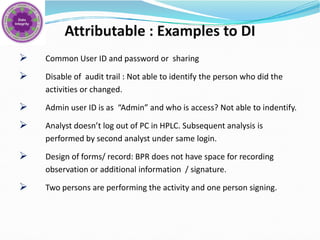
 Common User ID and password or sharing
 Disable of audit trail : Not able to identify the person who did the
activities or changed.
 Admin user ID is as “Admin” and who is access? Not able to indentify.
 Analyst doesn’t log out of PC in HPLC. Subsequent analysis is
Attributable : Examples to DI
 Analyst doesn’t log out of PC in HPLC. Subsequent analysis is
performed by second analyst under same login.
 Design of forms/ record: BPR does not have space for recording
observation or additional information / signature.
 Two persons are performing the activity and one person signing.
Legible
 Hand writing should be readable by others.
If Chemists hand writing is not readable like prescription, it will
be assumption.
 Any correction shall be done as per Good Documentation Practices
 Data can not be obscured with a data annotation tool. Data can not be obscured with a data annotation tool.
 Data printouts shall be readable. No smudged letters / fade ink
cartridge / store the printed in thermal paper
X Write over's - usage of correction fluids / Eraser or pencil .
X Correct number of significant digits is not shown on the printout
(Machine or Excel printout).
41
Contemporaneous
 Data entered in the record at the time of activities performed
X Second person /witness ( eg weight) enter the data by observer at the
actual time; but second person only signing at end of the shift.
X Electronic version of the excel output saved on personal drive and printed in
a later time.
X Time clock is not available/ accessible where the activity is performed. Eg.X Time clock is not available/ accessible where the activity is performed. Eg.
maintenance activity at near by /away
X Unavailability of form, raw data sheet and log books right place.
X Recording data in white paper /scrap papers / post it and entered the data in
actual record later
X Non compliance with Good documentation practices (back date /forward
date).
42
Original
X Modify / deleting the original data.
X Operator writes down data onto scratch paper and then
transcribes it onto the batch record.
X Results written on to a new worksheet because originalX Results written on to a new worksheet because original
worksheet got smudged/ torn. Old sheet discarded.
X Supporting data /raw data is discarded
X Data printout is retained as raw data , original electronic
record which contains meaningful metadata is discarded.
43
Accurate
X Operator records a passing value for IPC result, even though they
never performed the test, as they know this attribute never fails.
X Actual result is failing , so data is discarded; the system adjusted to
get passing results to avoid an OOS.
X Flow meter readings are recorded with the “typical” value, ratherX Flow meter readings are recorded with the “typical” value, rather
than the ( start and end) actual value.
X Data is recorded on paper, however during transcription the numbers
are accidentally reversed.
X Data from passing run is re-named, and used for a different sample
to ensure a result within specification.
44
+ Complete
X Deleting selective data (deviation/OOS) and retaining
desired data.
X Worksheets/ notebooks not reconciled or controlled.
X Data printout without instrument ID, analyst
name, method name, or date, or time …. analysis.name, method name, or date, or time …. analysis.
X Three technicians work on a complex calibration, but only
one person’s name is on the record.
X Data printout is retained as raw data, original meaningful
metadata is discarded.
45
+ Consistent
X Batch record steps are filled inconstantly- based on the
operators time.
X Recorded info may found ambiguity in the process or
data, which may be due to inadequate design of worksheet /
format. Eg parallel activity / sequential activity…format. Eg parallel activity / sequential activity…
X System flashes the results and the results disappears before
operator can record the data. Eg rpm of reactor/cfg
X System allows you to preview data prior to naming or saving
the record.
46
+ Enduring
X Thermal paper is used for equipment printouts, but
copies are not made available.
X New software upgraded for the system, but existing data
could not be retrieved due to old version of software
X Poor quality of printed report/ BPRs
X Record the data in temporary manner and forget . Eg QC
chemists writes in butter papers, post-it notes, etc.,
X Not storing the data from the system / not taking backup
47
+ Available
 OOS results are hideout in separate folder and
frequently deleted.
 Files are not backed up, and data is deleted from the
system periodically .
 Records are not archived until its complete retention
period.
 Validated spreadsheet is not backed-up.
48
Data Integrity :
Computer Systems
49
Computer System - Access Control
 Prevent unauthorized access to systems and altering any data
 Do not use common id & password
 Do not share user ID & password
 Password Polices
 Job /role specific access
 Lowest access level possible to perform the job to highest level to control overall
by IT or QA
 Do not use common system administrator account
 Must ensure that any changes to records be made only by authorized personnel
 System administrator should be different from those with substantive
responsibility
50
Data Up & Recovery
 Procedure for data back up
 Electronic records should be available until retention
period
Back-up, archival and recovery
Primary & secondary back up
Preferably auto back up
Disaster recovery / Business continuity planning
 Evidence for Back-up and recovery.
 Validation and verification at defined frequency 51
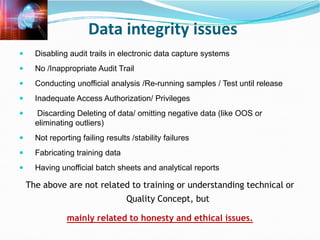
Data integrity issues
 Disabling audit trails in electronic data capture systems
 No /Inappropriate Audit Trail
 Conducting unofficial analysis /Re-running samples / Test until release
 Inadequate Access Authorization/ Privileges
 Discarding Deleting of data/ omitting negative data (like OOS or
eliminating outliers)eliminating outliers)
 Not reporting failing results /stability failures
 Fabricating training data
 Having unofficial batch sheets and analytical reports
The above are not related to training or understanding technical or
Quality Concept, but
mainly related to honesty and ethical issues.
Typical content in WL
 Firm did not identify, report, or investigate the out-of-
specification (OOS) results.
 Firm did not retain any raw data related to sample weights and
sample solution preparations for the HPLC assays and
repeated the analysis next day using a new set of samplerepeated the analysis next day using a new set of sample
solutions, and reported the retest results in COA
 Firm deleted /disregarded OOS data without
investigations, and selectively reported only passing results.
 During inspection, QC Chemist admitted that, under the direction
of a senior colleague, he had recorded false data in the logbooks
for reserve samples
Typical content in WL
 The documentation is first done on loose sheets of paper and
recorded in batch record.
 “QC analyst label sample “trial” injections as standard rather than by
the actual sample batch numbers”
 Company deleted multiple HPLC data files acquired
 The FDA found an operator performing in process weight checks The FDA found an operator performing in process weight checks
memorizing two " weights" , going to the next room where the batch
records are kept and documenting the same
 Creating acceptable test results without performing the test
 Access control is not implemented in GC, FTIR and HPLC to prevent
unauthorized access and control
 Backdating stability test results to meet the required commitments
Typical content in WL
Firm repeatedly delayed, denied, limited an inspection or refused to
permit the FDA inspection:
 Torn raw data records in the waste area ,asked to QA Officer to show these
for inspector’s review. QA Officer removed 20 paper records
 Inspector asked three times if there were any more records and the QA
Officer responded to each question, "no, this is all of the records”.Officer responded to each question, "no, this is all of the records”.
 Inspector then re-visited the waste area and found that the raw data records
had been removed and placed in a different holding bag.
 These records included raw data testing worksheets, MB report BPR
calibration records, and stability protocol records.
 All area will be accessed or copying of records for the FDA inspection.
Recent WL on DI
1. Failure to have laboratory control records that include complete
data derived from all laboratory tests conducted to ensure your
API complies with established specifications and standards.
 Our investigator found that your firm was falsifying laboratory data.
For example, the number of colony-forming units (CFU) found onFor example, the number of colony-forming units (CFU) found on
(b)(4) plates for (b)(4) water point-of-use tests differed substantially
from the number recorded on your (b)(4) water report. For multiple
points of use, your analyst reported far fewer CFU than observed on
the plate by our investigator. In addition, while you reported
absence of growth on a selective media plate used to detect
objectionable microorganisms, our investigator observed growth on
this plate.
Recent WL on DI
 Your firm failed to establish an adequate quality control unit with the responsibility
and authority to approve or reject all components, drug product
containers, closures, in-process materials, packaging materials, labeling, and drug
products (21 CFR 211.22(a)).
 Your quality unit (QU) lacks appropriate responsibility and control over your drug
manufacturing operations.
 During the inspection, our investigator observed discarded CGMP documents and
evidence of uncontrolled shredding of documents. For example, multiple bags of
uncontrolled CGMP documents with color coding indicating they were from drug
production, quality, and laboratory operations were awaiting shredding. Our
investigator also found a blue binder containing CGMP records, including batch
records for U.S. drug products, discarded with other records in a 55-gallon drum in
your scrap yard. CGMP documents in the binder were dated as recently as January
21, 2019: seven days before our inspection. Your QU did not review or check these
documents prior to disposal.
Observations in vendor audit
 pH written in BMR 7.00 by checking using pH paper
 Temperature recording as 78. 0°C in analog indicator
 Record of 20.03kg in the balance has 0.05kg least count
 Tare weight of poly bags 0.250kg in all the bags
 Vacuum 750mm throughout the operation including breaking for Vacuum 750mm throughout the operation including breaking for
sampling
 Testing time is prior to the sampling time
 >20 reading in the same order /same alignment (as like home work)
 Record the weight /yield without fractional value 20.000 /210.000
 Mismatch of activity between records eg maintenance work, power
trip, BPR Vs maintenance records
Opportunity Vs Motivation Vs Control
Under
control
UNACCEPTABLE
RISK IS HIGH
Motivators
• Pressure to succeed
• Lack of training /
• Multiple reviews (next reviewer will find the mistake)
• Operational inefficiencies
• Frequent failure / unstable process
• processes not well understood
Control Failures
• Unclear or inadequate procedures
• Lack of control over forms and / or samples
• Controls not forcing accountability
• Disjointed electronic systems
• Too many transcription steps
Copy from QORM LLC
Motivation and Control
 If the motivation is high enough, no level of control will be sufficient
 Too many controls, different level may be drivers for higher motivation for
untoward data manipulation
 Too many review, initiator may believe that reviewer will find mistake
Many review cycles may slow down work and increase work pressure Many review cycles may slow down work and increase work pressure
 If processes is well understood , issues will be less including DI
 Understand risks in the processes
 Do not live with issue
 Understand and correct them
Implementation
Strategy: Develop strategy, identify and get support from
management
Culture Build into organizational culture & to change the
mindset and behavior
Training Provide appropriate training. Involve teams and
bring initiatives
Detection Identify thro strong Internal audit, IPQA , audit
trail . Identify regulatory expectations
Prevention Incorporate / build into the system,
Risk Assessment / internal audit on DI
Data Integrity - Implementation
Prevention – better than cure!!!
 QMS modernisation
 Computer System Validation
 Data review policy
 Quality Risk Management Processes Quality Risk Management Processes
 Control of documents/ records
 Strengthen internal Audit
 Identifying risk factors
 Technical/QA Training/Education
 Promoting and supporting Quality Culture
 Effective CAPAs –Systemic Assessment all the area
 Quality Management Performance Review Meetings etc
Tips for Data Integrity - Implementation
 Establish a “Data Integrity policy” .
 Describe the DI and consequences of DI breach /falsification of data
 Training on the DI policy or procedure .
 Establish a GDP so that even the most innocent recording issues
cannot be perceived as fraudulentcannot be perceived as fraudulent
 Design systems to prevent DI
 Keep the BPRs / Log books / at work place to assess and record
 Control over templates/ formats/ blank papers
 Setting proper access to users/ audit trail
 Connect recorder / printouts /
 Access to Clock for recording time
Design the system to prevent DI
Systems should be designed to assure data integrity.
Examples not limited to ;
 Access to clocks for recording timed events
 Access to sampling points / displays/ measuring devices
 Access to raw data for staff for review
Accessibility of batch records at locations where activities take place so Accessibility of batch records at locations where activities take place so
that adhoc data recording and later transcription to official records is not
necessary
 Control over blank paper/ templates for data recording
 User access rights which prevent (or audit trail) data amendments
 Automated data capture or printers attached to equipment such as
balances
 Proximity of printers to relevant activities
Data Integrity – What you have to do?
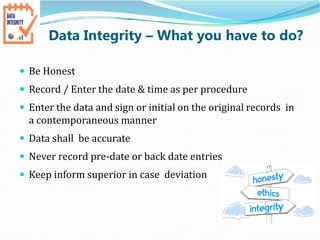
 Be Honest
 Record / Enter the date & time as per procedure
 Enter the data and sign or initial on the original records in
a contemporaneous mannera contemporaneous manner
 Data shall be accurate
 Never record pre-date or back date entries
 Keep inform superior in case deviation
Area to focus
People
•Technical/QA Training/Education Rate –All employees with direct impact on
product/data
•Effectiveness of Training/Education
•Management Accountability for Cultural development; promoting and supporting
quality
PlacesPlaces
•Investment spent in new and existing facilities, equipment, utilities
Performance
•Frequency of Quality Management Performance Review Meetings
•Level of proactive actions and assessing trends
Prevention
•Quality Risk Management Processes
•Internal Audit Programs
•Effective CAPAs –Systemic Assessment all the area
Let us Question ourselves
 Are we compliant with the ALCOA Principles in our daily work?
 Do we meet the requirements of regulatory Guidelines?
 Where do we have problems or deviations regarding data Where do we have problems or deviations regarding data
integrity?
 Which employees have difficulties with implementation?
 Do we live by the principles of a comprehensive quality culture?
 Is quality a critical factor for the company’s decision processes?
Ref documents
 PIC/S Guidance Good Practices For Data Management And Integrity
In Regulated GMP/GDP Environments - November 2018
 MHRA‘GXP’ Data Integrity Guidance and Definitions March 2018
 FDA : Data Integrity and Compliance With CGMP Guidance for
Industry April 2016
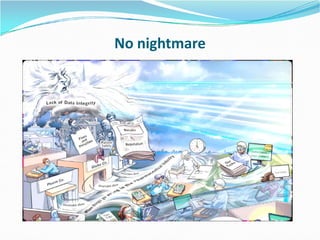
No nightmare
Thank you
Q&A

Data Integrity Training by Dr. A. Amsavel

  • 1.
    Data Integrity Training Dr.A. Amsavel, M.Sc., B.Ed., Ph.D. Dec 2019
  • 2.
    Presentation Overview  Objectiveof Data Integrity  What is Data Integrity?  Regulatory Requirement  Data Integrity Principles  ALCOA, + Principles  Basic Data Integrity Expectations  Data Integrity examples and WL  Implementation  Conclusions
  • 3.
    What is Integrity?What is Integrity ?
  • 4.
    What is meanby Integrity ?
  • 5.
    Integrity: Direct meaning CambridgeDictionary: Integrity noun [U] (HONESTY) ... the quality of being honest and having strong moral principles that you refuse to change
  • 6.
    Integrity : The Qualityof being honest and Quality & Integrity The Quality of being honest and having strong moral principles
  • 7.
    Definition -MHRA Data: Information derivedor obtained from raw data, (MHRA, 2015) Facts, figures and statistics collected together for reference or analysis. (MHRA, 2018) 1. Data can be ‘electronic’ or ‘paper based’ or ‘Hybrid’ 2. From initial data generation and recording through processing (including transformation or migration), use, retention, archiving, retrieval and destruction 3. Electronic information includes everything, such as emails, adverse events reports, complaints, batch records, and quality control records—everything that’s stored electronically.
  • 8.
    Definition -MHRA Data Integrity: Dataintegrity is the degree to which data are complete, consistent, accurate, trustworthy, reliable and that these characteristics of the data are maintained throughout the datacharacteristics of the data are maintained throughout the data life cycle. The data should be collected and maintained in a secure manner, so that they are attributable, legible, contemporaneously recorded, original (or a true copy) and accurate.
  • 9.
    Definition  Raw DataOriginal records and documentation, retained in the format in which they were originally generated (i.e. paper or electronic), or as a ‘true copy’. (MHRA, 2015)paper or electronic), or as a ‘true copy’. (MHRA, 2015)  Meta Data are data used to describe other data. It can be used to describe information such as file type, format, author, user rights, etc. and is usually attached to files, but invisible to the user. (ISPE, GAMP 5)
  • 10.
    Definition -MHRA  DataGovernance The arrangements to ensure that data, irrespective of the format in which they are generated, are recorded, processed, retained and used to ensure the record throughout the data lifecycle.the record throughout the data lifecycle.  Data Lifecycle All phases in the life of the data from generation and recording through processing (including analysis, transformation or migration), use, data retention, archive/retrieval and destruction.
  • 11.
    Definition Audit Trail  Secure,computer-generated, time-stamped electronic record that allows for reconstruction of events relating to the creation, modification, or deletion of an electronic record  Who, what, when, and sometimes why of a record  Example: audit trail for an HPLC run could include user name, date/time of Example: audit trail for an HPLC run could include user name, date/time of run, integration parameters used, details of a reprocessing.  Audit trails shall capture: overwriting, aborting runs, “testing into compliance,” deleting, backdating, altering data  Audit trials subject to regular review should include changes to:  history of unfinished product test results  sample run sequences  sample identification  critical process parameters
  • 12.
    Objective of DataIntegrity to ensure patient safety and Quality  …..the protection of the patient by managing the risk to quality is considered as importance.risk to quality is considered as importance.  Ultimately Pharmaceutical quality is to Assure every dose is safe and effective, free of contamination and defects.
  • 13.
    Regulators view Data Integritybreach Break the trust between Industry and Regulatory Agencies . Time period between the inspections, we trust you to do the right thing when the regulatoryyou to do the right thing when the regulatory agency are not watching. If they find compliance gaps, regaining trust can be costly, and time consuming Task. Karen Takahashi Senior Policy Adviser to USFDA
  • 14.
    Data Integrity -purpose  Assures the Quality, Safety And Efficacy of the drugs  DOCUMENTED RECORD available to represent the Quality of the product after sold  Reliability of the data is important  Questioning Data Integrity = Loss of Trust  “Guilty until Proven Innocent” to FDA “Guilty until Proven Innocent” to FDA  Submitting false data to the FDA is a criminal violation Manufacturing medicines for life-saving cannot afford to be negligent . FDA have a “ZERO TOLERANCE” policy for data integrity
  • 15.
  • 16.
    What are Pooror Bad practices ? What is misconduct ?What is misconduct ? What is Data falsification or fabrication?
  • 17.
    Poor/Bad practices andFalsification Innocent Ignorance Carelessness/ Negligence Intentional/ Malicious Act is unintentional; Non-Compliance is Act may or may not be intentional; Act is intentional; Non-compliance isNon-Compliance is unintentional intentional; Non-compliance is unintentional Non-compliance is intentional Discarding source documents after accurate transcription; Deleting e-files after printing Inaction, inattention to detail, inadequate staff, lack of supervision Data manipulation, data falsification, mis-representation, with holding critical information
  • 18.
    Data Integrity Are allmisconducts are DI?? What are called Data Integrity breach ?  Falsification / fabrication  Dishonest / malicious  Hiding  Bad practice: historical practice, Shortcuts, etc
  • 19.
    Data Integrity Know thedifference between Poor/Bad practices and Falsification  Human errors data entered by mistake  Ignorance (not aware of regulatory requirements or poor training)  Errors during transmission from one computer to another  Changes due to software bugs or malware of which the user is unaware  Use of non-validated software applications/Spreadsheets Use of non-validated software applications/Spreadsheets  Discarding source documents after accurate transcription;  Hardware malfunctions  Wilfully falsification of data or fraudulent data (with the intent to deceive)  Selection of good or passing results ( exclusion of poor or failing results)  Unauthorised changes of post acquisition data - overwriting, change the name / data
  • 20.
    FDA findings RelatedData integrity  Backdating/Postdating/missing /mismating Signatures  Data manipulation/ data falsification,  Copying existing data as new data  Not saving the actual electronic or deleting electronic data after Printing- Chromatogramsafter Printing- Chromatograms  Disposing the original hard copies  Not reporting of failures and deviations  Releasing the failing product  Hiding/obscuring /withholding critical information etc  Mismatch between reported data and actual data
  • 21.
    Is Data Integrityspecific to country or region? “Data Integrity Issue is across the Globe”. “It is not an India-centric or Asia centric problem”.
  • 22.
    Warning Letters inIndia 2018- 16% , but 2019 47% ( until Nov) Year 2019- upto 11/2019 (17 out of 36) Year 2018 ( 9 out of 57 from India) 1 Mylan Laboratories Limited - Unit 8 1 Skylark CMC Pvt. Ltd. 2 Coral Pharmaceuticals LTD 2 Apotex Research Private Limited 3 Torrent Pharmaceuticals Limited 3 JT Cosmetics & Chemicals Pvt. Ltd. 4 Glenmark Pharmaceuticals Limited 4 Claris Injectables Limited 5 Lupin Limited 5 Reine Lifescience 6 Lantech Pharmaceuticals Limited 6 Goran Pharma Private Limited Emcure Pharmaceuticals Limited Keshava Organics Pvt. Ltd.7 Emcure Pharmaceuticals Limited 7 Keshava Organics Pvt. Ltd. 8 CTX Lifesciences Private Ltd. 8 Malladi Drugs & Pharmaceuticals Limited 9 Indoco Remedies Limited 9 Alchymars ICM SM Private Limited 10 Strides Pharma Limited 11 Aurobindo Pharma Limited 12 Centurion Laboratories Private Limited 13 B. Jain Pharmaceuticals Private Limited 14 Jubilant Life Sciences 15 Hospira Healthcare India Pvt. Ltd 16 Anicare Pharmaceuticals Pvt. Ltd. 17 Vipor Chemicals Private Ltd.
  • 23.
    Warning Letters Relatedto DI - India 10 12 10 9 12 No. of Warning Letters related to DI from India 80 90 100 100 70 67 % Warnig Letters related to DI from India to ROW 0 2 4 6 8 2013 2014 2015 2016 2017 2018 6 7 6 0 10 20 30 40 50 60 70 80 2013 2014 2015 2016 2017 2018 70 67 22 26 14 Year Year
  • 24.
    Data Integrity AssociatedFDA Warning Letters
  • 28.
    EDQM : Critical/ Major Deficiencies India Manufacturers 2013 – 2016 2018 2 Data integrity. Sterility & Contamination Training Facility & Prdn 22 715 11 5 Training QA & QC Equip. Qual.& Process validation CAPA Facility & Production Operation Supplier & material QA&QC
  • 29.
    What are theconsequences of DI?  The cost of remediation, investigation, CAPA to meet regulatory compliance will be huge when compared to prevention of DI.  It will destroy the image of the company  loose the credibility from customers,  demoralize the employees,  reduces time to gain the market  Affects the future plan of the company…… Spending Rupees for prevention is better than spending in millions for remediation
  • 30.
    Does any managementwanted to have DI in their Organization? Is top management aware all the problems?Is top management aware all the problems? How it is happening? Why it is not identified and corrected? Where is DI starts ……..
  • 31.
     Organization culture Employee awareness,  Taught by seniors  Motivation of wrong doing Where is DI starts & continues.. ? Motivation of wrong doing  Lack of Quality System  Lack of Infrastructure  Inadequate process / technology • Wrong understanding • Bad practices…..
  • 32.
    How organization ismissing to know or Possibility of ignorantPossibility of ignorant …Which may lead to DI
  • 33.
    Iceberg of Ignorance 4%Problem known to Top Executives Gap:Knownbymgt 9% Problem known to Managers 74% Problem known to Shift in-charges 100% Problem known to staffs Gap:Knownbymgt-Unknown96% Gapis91%
  • 34.
    Data Integrity –Regulatory requirement  FDA September 1991: Application Integrity Policy – Fraud, Untrue Statements of Material Facts, Bribery, and Illegal Gratuities  FDA Guidance for Industry April 2016: Data Integrity and Compliance With CGMP  MHRA Guidance March 2018: GXP Data Integrity Guidance and Definitions MHRA Guidance March 2018: GXP Data Integrity Guidance and Definitions  WHO Guidance September 2015: Good Data and Record Management Practices  PIC/S Guidance Good Practices For Data Management And Integrity In Regulated GMP/GDP Environments - November 2018  EMA Questions & Answers August 2016
  • 35.
    MHRA -Data IntegrityDefinitions and Guidance  Data Integrity is the extent to which all data are complete, consistent and accurate throughout the data lifecycle.  Handwritten entries should be made in a clear, legible, indelible way. Records should be made or completed at the time each action is Records should be made or completed at the time each action is taken and in such a way that all significant activities concerning the manufacture of medicinal products are traceable.  Any alteration made to the entry on a document should be signed and dated; the alteration should permit the reading of the original information. Where appropriate, the reason for the alteration should be recorded.
  • 36.
    Data Integrity asper USFDA Data integrity is critical to regulatory compliance, and the fundamental reason for 21 CFR Part 11. A - Attributable L – Legible C – Contemporaneous DATA C – Contemporaneous O – Original A - Accurate + Complete + Consistent + Enduring + Available DATA
  • 37.
    ALCOA principle ALCOA isan acronym representing the following data integrity elements:  Attributable – Who performed and when?  Legible – Can it be read? Permanent Record Legible – Can it be read? Permanent Record  Contemporaneous – Recorded at the time the activity was performed  Original – Original record or certified true copy  Accurate – Error free
  • 38.
    ALCOA Description ALCOA Description/ExplanationComments A Attributable Who performed an action and when? If a record is changed, who did it and why? Link to the source data. Who did it? Source data L Legible Data must be recorded permanently in a durable medium and be readable. Can you read it? Is it permanent L durable medium and be readable. Is it permanent record C Contemporan eous The data should be recorded at the time the work is performed and date/time stamps should follow in order. Was it done in “Real Time”? O Original Is the information the original record or a certified true copy? Is it original or true copy? A Accurate No errors or editing performed without documented amendments. Is it accurate?
  • 39.
    ALCOA + (2CEA) ALCOA + Description/Explanation Comments +1 Complete All data including repeat or reanalysis performed on the sample. 21 CFR 211.194 +2 Consistent Consistent application of data time stamps in the expected sequence Date time stamps +3 Enduring & Recorded on controlled worksheets, laboratory notebooks, orelectronic media. Medium -to record data +4 Available Available/accessible for review/audit for the lifetime of the record. For the lifetime of the record
  • 40.
     Common UserID and password or sharing  Disable of audit trail : Not able to identify the person who did the activities or changed.  Admin user ID is as “Admin” and who is access? Not able to indentify.  Analyst doesn’t log out of PC in HPLC. Subsequent analysis is Attributable : Examples to DI  Analyst doesn’t log out of PC in HPLC. Subsequent analysis is performed by second analyst under same login.  Design of forms/ record: BPR does not have space for recording observation or additional information / signature.  Two persons are performing the activity and one person signing.
  • 41.
    Legible  Hand writingshould be readable by others. If Chemists hand writing is not readable like prescription, it will be assumption.  Any correction shall be done as per Good Documentation Practices  Data can not be obscured with a data annotation tool. Data can not be obscured with a data annotation tool.  Data printouts shall be readable. No smudged letters / fade ink cartridge / store the printed in thermal paper X Write over's - usage of correction fluids / Eraser or pencil . X Correct number of significant digits is not shown on the printout (Machine or Excel printout). 41
  • 42.
    Contemporaneous  Data enteredin the record at the time of activities performed X Second person /witness ( eg weight) enter the data by observer at the actual time; but second person only signing at end of the shift. X Electronic version of the excel output saved on personal drive and printed in a later time. X Time clock is not available/ accessible where the activity is performed. Eg.X Time clock is not available/ accessible where the activity is performed. Eg. maintenance activity at near by /away X Unavailability of form, raw data sheet and log books right place. X Recording data in white paper /scrap papers / post it and entered the data in actual record later X Non compliance with Good documentation practices (back date /forward date). 42
  • 43.
    Original X Modify /deleting the original data. X Operator writes down data onto scratch paper and then transcribes it onto the batch record. X Results written on to a new worksheet because originalX Results written on to a new worksheet because original worksheet got smudged/ torn. Old sheet discarded. X Supporting data /raw data is discarded X Data printout is retained as raw data , original electronic record which contains meaningful metadata is discarded. 43
  • 44.
    Accurate X Operator recordsa passing value for IPC result, even though they never performed the test, as they know this attribute never fails. X Actual result is failing , so data is discarded; the system adjusted to get passing results to avoid an OOS. X Flow meter readings are recorded with the “typical” value, ratherX Flow meter readings are recorded with the “typical” value, rather than the ( start and end) actual value. X Data is recorded on paper, however during transcription the numbers are accidentally reversed. X Data from passing run is re-named, and used for a different sample to ensure a result within specification. 44
  • 45.
    + Complete X Deletingselective data (deviation/OOS) and retaining desired data. X Worksheets/ notebooks not reconciled or controlled. X Data printout without instrument ID, analyst name, method name, or date, or time …. analysis.name, method name, or date, or time …. analysis. X Three technicians work on a complex calibration, but only one person’s name is on the record. X Data printout is retained as raw data, original meaningful metadata is discarded. 45
  • 46.
    + Consistent X Batchrecord steps are filled inconstantly- based on the operators time. X Recorded info may found ambiguity in the process or data, which may be due to inadequate design of worksheet / format. Eg parallel activity / sequential activity…format. Eg parallel activity / sequential activity… X System flashes the results and the results disappears before operator can record the data. Eg rpm of reactor/cfg X System allows you to preview data prior to naming or saving the record. 46
  • 47.
    + Enduring X Thermalpaper is used for equipment printouts, but copies are not made available. X New software upgraded for the system, but existing data could not be retrieved due to old version of software X Poor quality of printed report/ BPRs X Record the data in temporary manner and forget . Eg QC chemists writes in butter papers, post-it notes, etc., X Not storing the data from the system / not taking backup 47
  • 48.
    + Available  OOSresults are hideout in separate folder and frequently deleted.  Files are not backed up, and data is deleted from the system periodically .  Records are not archived until its complete retention period.  Validated spreadsheet is not backed-up. 48
  • 49.
  • 50.
    Computer System -Access Control  Prevent unauthorized access to systems and altering any data  Do not use common id & password  Do not share user ID & password  Password Polices  Job /role specific access  Lowest access level possible to perform the job to highest level to control overall by IT or QA  Do not use common system administrator account  Must ensure that any changes to records be made only by authorized personnel  System administrator should be different from those with substantive responsibility 50
  • 51.
    Data Up &Recovery  Procedure for data back up  Electronic records should be available until retention period Back-up, archival and recovery Primary & secondary back up Preferably auto back up Disaster recovery / Business continuity planning  Evidence for Back-up and recovery.  Validation and verification at defined frequency 51
  • 52.
    Data integrity issues Disabling audit trails in electronic data capture systems  No /Inappropriate Audit Trail  Conducting unofficial analysis /Re-running samples / Test until release  Inadequate Access Authorization/ Privileges  Discarding Deleting of data/ omitting negative data (like OOS or eliminating outliers)eliminating outliers)  Not reporting failing results /stability failures  Fabricating training data  Having unofficial batch sheets and analytical reports The above are not related to training or understanding technical or Quality Concept, but mainly related to honesty and ethical issues.
  • 53.
    Typical content inWL  Firm did not identify, report, or investigate the out-of- specification (OOS) results.  Firm did not retain any raw data related to sample weights and sample solution preparations for the HPLC assays and repeated the analysis next day using a new set of samplerepeated the analysis next day using a new set of sample solutions, and reported the retest results in COA  Firm deleted /disregarded OOS data without investigations, and selectively reported only passing results.  During inspection, QC Chemist admitted that, under the direction of a senior colleague, he had recorded false data in the logbooks for reserve samples
  • 54.
    Typical content inWL  The documentation is first done on loose sheets of paper and recorded in batch record.  “QC analyst label sample “trial” injections as standard rather than by the actual sample batch numbers”  Company deleted multiple HPLC data files acquired  The FDA found an operator performing in process weight checks The FDA found an operator performing in process weight checks memorizing two " weights" , going to the next room where the batch records are kept and documenting the same  Creating acceptable test results without performing the test  Access control is not implemented in GC, FTIR and HPLC to prevent unauthorized access and control  Backdating stability test results to meet the required commitments
  • 55.
    Typical content inWL Firm repeatedly delayed, denied, limited an inspection or refused to permit the FDA inspection:  Torn raw data records in the waste area ,asked to QA Officer to show these for inspector’s review. QA Officer removed 20 paper records  Inspector asked three times if there were any more records and the QA Officer responded to each question, "no, this is all of the records”.Officer responded to each question, "no, this is all of the records”.  Inspector then re-visited the waste area and found that the raw data records had been removed and placed in a different holding bag.  These records included raw data testing worksheets, MB report BPR calibration records, and stability protocol records.  All area will be accessed or copying of records for the FDA inspection.
  • 56.
    Recent WL onDI 1. Failure to have laboratory control records that include complete data derived from all laboratory tests conducted to ensure your API complies with established specifications and standards.  Our investigator found that your firm was falsifying laboratory data. For example, the number of colony-forming units (CFU) found onFor example, the number of colony-forming units (CFU) found on (b)(4) plates for (b)(4) water point-of-use tests differed substantially from the number recorded on your (b)(4) water report. For multiple points of use, your analyst reported far fewer CFU than observed on the plate by our investigator. In addition, while you reported absence of growth on a selective media plate used to detect objectionable microorganisms, our investigator observed growth on this plate.
  • 57.
    Recent WL onDI  Your firm failed to establish an adequate quality control unit with the responsibility and authority to approve or reject all components, drug product containers, closures, in-process materials, packaging materials, labeling, and drug products (21 CFR 211.22(a)).  Your quality unit (QU) lacks appropriate responsibility and control over your drug manufacturing operations.  During the inspection, our investigator observed discarded CGMP documents and evidence of uncontrolled shredding of documents. For example, multiple bags of uncontrolled CGMP documents with color coding indicating they were from drug production, quality, and laboratory operations were awaiting shredding. Our investigator also found a blue binder containing CGMP records, including batch records for U.S. drug products, discarded with other records in a 55-gallon drum in your scrap yard. CGMP documents in the binder were dated as recently as January 21, 2019: seven days before our inspection. Your QU did not review or check these documents prior to disposal.
  • 58.
    Observations in vendoraudit  pH written in BMR 7.00 by checking using pH paper  Temperature recording as 78. 0°C in analog indicator  Record of 20.03kg in the balance has 0.05kg least count  Tare weight of poly bags 0.250kg in all the bags  Vacuum 750mm throughout the operation including breaking for Vacuum 750mm throughout the operation including breaking for sampling  Testing time is prior to the sampling time  >20 reading in the same order /same alignment (as like home work)  Record the weight /yield without fractional value 20.000 /210.000  Mismatch of activity between records eg maintenance work, power trip, BPR Vs maintenance records
  • 59.
    Opportunity Vs MotivationVs Control Under control UNACCEPTABLE RISK IS HIGH Motivators • Pressure to succeed • Lack of training / • Multiple reviews (next reviewer will find the mistake) • Operational inefficiencies • Frequent failure / unstable process • processes not well understood Control Failures • Unclear or inadequate procedures • Lack of control over forms and / or samples • Controls not forcing accountability • Disjointed electronic systems • Too many transcription steps Copy from QORM LLC
  • 60.
    Motivation and Control If the motivation is high enough, no level of control will be sufficient  Too many controls, different level may be drivers for higher motivation for untoward data manipulation  Too many review, initiator may believe that reviewer will find mistake Many review cycles may slow down work and increase work pressure Many review cycles may slow down work and increase work pressure  If processes is well understood , issues will be less including DI  Understand risks in the processes  Do not live with issue  Understand and correct them
  • 61.
    Implementation Strategy: Develop strategy,identify and get support from management Culture Build into organizational culture & to change the mindset and behavior Training Provide appropriate training. Involve teams and bring initiatives Detection Identify thro strong Internal audit, IPQA , audit trail . Identify regulatory expectations Prevention Incorporate / build into the system, Risk Assessment / internal audit on DI
  • 62.
    Data Integrity -Implementation Prevention – better than cure!!!  QMS modernisation  Computer System Validation  Data review policy  Quality Risk Management Processes Quality Risk Management Processes  Control of documents/ records  Strengthen internal Audit  Identifying risk factors  Technical/QA Training/Education  Promoting and supporting Quality Culture  Effective CAPAs –Systemic Assessment all the area  Quality Management Performance Review Meetings etc
  • 63.
    Tips for DataIntegrity - Implementation  Establish a “Data Integrity policy” .  Describe the DI and consequences of DI breach /falsification of data  Training on the DI policy or procedure .  Establish a GDP so that even the most innocent recording issues cannot be perceived as fraudulentcannot be perceived as fraudulent  Design systems to prevent DI  Keep the BPRs / Log books / at work place to assess and record  Control over templates/ formats/ blank papers  Setting proper access to users/ audit trail  Connect recorder / printouts /  Access to Clock for recording time
  • 64.
    Design the systemto prevent DI Systems should be designed to assure data integrity. Examples not limited to ;  Access to clocks for recording timed events  Access to sampling points / displays/ measuring devices  Access to raw data for staff for review Accessibility of batch records at locations where activities take place so Accessibility of batch records at locations where activities take place so that adhoc data recording and later transcription to official records is not necessary  Control over blank paper/ templates for data recording  User access rights which prevent (or audit trail) data amendments  Automated data capture or printers attached to equipment such as balances  Proximity of printers to relevant activities
  • 65.
    Data Integrity –What you have to do?  Be Honest  Record / Enter the date & time as per procedure  Enter the data and sign or initial on the original records in a contemporaneous mannera contemporaneous manner  Data shall be accurate  Never record pre-date or back date entries  Keep inform superior in case deviation
  • 66.
    Area to focus People •Technical/QATraining/Education Rate –All employees with direct impact on product/data •Effectiveness of Training/Education •Management Accountability for Cultural development; promoting and supporting quality PlacesPlaces •Investment spent in new and existing facilities, equipment, utilities Performance •Frequency of Quality Management Performance Review Meetings •Level of proactive actions and assessing trends Prevention •Quality Risk Management Processes •Internal Audit Programs •Effective CAPAs –Systemic Assessment all the area
  • 67.
    Let us Questionourselves  Are we compliant with the ALCOA Principles in our daily work?  Do we meet the requirements of regulatory Guidelines?  Where do we have problems or deviations regarding data Where do we have problems or deviations regarding data integrity?  Which employees have difficulties with implementation?  Do we live by the principles of a comprehensive quality culture?  Is quality a critical factor for the company’s decision processes?
  • 68.
    Ref documents  PIC/SGuidance Good Practices For Data Management And Integrity In Regulated GMP/GDP Environments - November 2018  MHRA‘GXP’ Data Integrity Guidance and Definitions March 2018  FDA : Data Integrity and Compliance With CGMP Guidance for Industry April 2016
  • 69.
  • 70.