DATA INTEGRITY
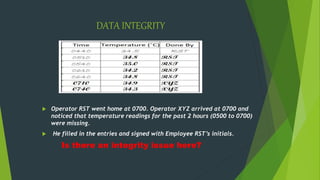
Is there an integrity issue here?
 Operator RST went home at 0700. Operator XYZ arrived at 0700 and
noticed that temperature readings for the past 2 hours (0500 to 0700)
were missing.
 He filled in the entries and signed with Employee RST’s initials.
DATA INTEGRITY
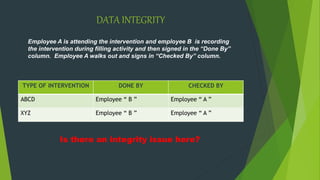
TYPE OF INTERVENTION DONE BY CHECKED BY
ABCD Employee “ B ” Employee “ A ”
XYZ Employee “ B ” Employee “ A ”
Employee A is attending the intervention and employee B is recording
the intervention during filling activity and then signed in the “Done By”
column. Employee A walks out and signs in “Checked By” column.
Is there an integrity issue here?
DATA INTEGRITY
 WHAT IS INTEGRITY
 WHAT IS DATA INTEGRITY
 IMPORTANCE OF DATA INTEGRITY
 WHERE IS THE DATA INTEGRITY RELATED ISSUES USUALLY HAPPENS
 CONSEQUENCES IF DATA INTEGRITY FAILS
 CONCLUSION
DATA INTEGRITY
 WHAT IS INTEGIRY
 Is what you are doing,saying,Recording is REAL!!
[in-teg-ri-tee]
1.Adherence to moral and ethical principles;soundness of moral character;
honesty.
2. The state of being whole, entire, or undiminished:
To preserve the integrity of the empire.
3. A sound,unimpaired,or perfect condition:
The integrity of a ship's hull.
DATA INTEGRITY
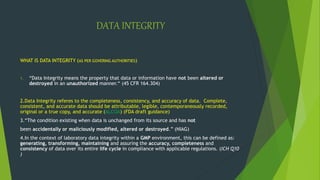
WHAT IS DATA INTEGRITY (AS PER GOVERING AUTHORITIES)
1. “Data Integrity means the property that data or information have not been altered or
destroyed in an unauthorized manner.“ (45 CFR 164.304)
2.Data Integrity referes to the completeness, consistency, and accuracy of data. Complete,
consistent, and accurate data should be attributable, legible, contemporaneously recorded,
original or a true copy, and accurate (ALCOA) (FDA draft guidance)
3.“The condition existing when data is unchanged from its source and has not
been accidentally or maliciously modified, altered or destroyed.” (NIAG)
4.In the context of laboratory data integrity within a GMP environment, this can be defined as:
generating, transforming, maintaining and assuring the accuracy, completeness and
consistency of data over its entire life cycle in compliance with applicable regulations. (ICH Q10
)
DATA INTEGRITY
 5. Unauthorized manner. "Data integrity refers to maintaining and assuring
the accuracy and consistency of data over its entire life-cycle.
[Wikipedia]
 6.Data Integrity is the assurance that data is consistent, accurate, reliable
and accessible
DATA INTEGRITY
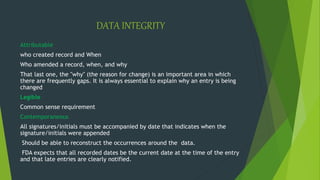
Attributable
who created record and When
Who amended a record, when, and why
That last one, the "why" (the reason for change) is an important area in which
there are frequently gaps. It is always essential to explain why an entry is being
changed
Legible
Common sense requirement
Contemporaneous
All signatures/initials must be accompanied by date that indicates when the
signature/initials were appended
Should be able to reconstruct the occurrences around the data.
FDA expects that all recorded dates be the current date at the time of the entry
and that late entries are clearly notified.
DATA INTEGRITY
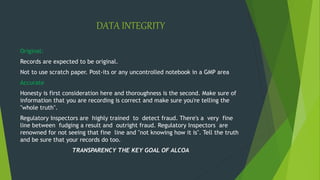
Original:
Records are expected to be original.
Not to use scratch paper. Post-its or any uncontrolled notebook in a GMP area
Accurate
Honesty is first consideration here and thoroughness is the second. Make sure of
information that you are recording is correct and make sure you're telling the
"whole truth".
Regulatory Inspectors are highly trained to detect fraud. There's a very fine
line between fudging a result and outright fraud. Regulatory Inspectors are
renowned for not seeing that fine line and "not knowing how it is". Tell the truth
and be sure that your records do too.
TRANSPARENCY THE KEY GOAL OF ALCOA
DATA INTEGRITY
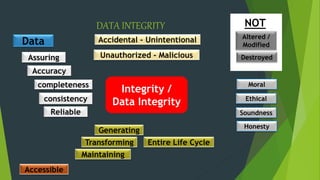
Integrity /
Data Integrity
Data
Assuring
Accuracy
completeness
consistency
Reliable
Accidental - Unintentional
Unauthorized - Malicious
Generating
Transforming Entire Life Cycle
Maintaining
Accessible
Altered /
Modified
Destroyed
NOT
Moral
Ethical
Soundness
Honesty
DATA INTEGRITY
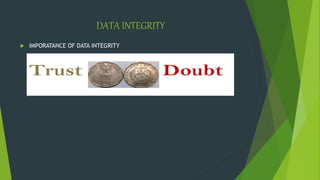
 IMPORATANCE OF DATA INTEGRITY
DATA INTEGRITY
Trust
Customers
DATA INTEGRITY
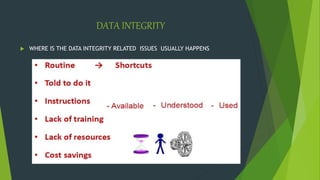
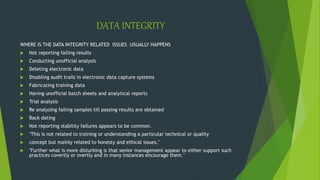
 WHERE IS THE DATA INTEGRITY RELATED ISSUES USUALLY HAPPENS
DATA INTEGRITY
WHERE IS THE DATA INTEGRITY RELATED ISSUES USUALLY HAPPENS
 Not reporting failing results
 Conducting unofficial analysis
 Deleting electronic data
 Disabling audit trails in electronic data capture systems
 Fabricating training data
 Having unofficial batch sheets and analytical reports
 Trial analysis
 Re analyzing failing samples till passing results are obtained
 Back dating
 Not reporting stability failures appears to be common.
 "This is not related to training or understanding a particular technical or quality
 concept but mainly related to honesty and ethical issues."
 "Further what is more disturbing is that senior management appear to either support such
practices covertly or overtly and in many instances encourage them."
DATA INTEGRITY
Data integrity issues FDA with Indian Companies
• Backdating/Postdating/Missing Signatures
• Fabricating/faking data
• Copying existing data as new data
• Re-running samples
• Discarding data/ omitting negative data (like OOS or eliminating outliers)
• Releasing failing product
• Test until release
• Hiding/obscuring SOP or protocol deviations
• Not saving electronic or hard copy data
• Poor Document Control & retention/Version Management
• No /Inappropriate Audit Trail
• Inadequate Access Authorization/ Privileges
• Inadequate reporting of failure and deviation management
• Use of un validated software applications/Spreadsheets
• Mismatch between reported data and actual data
DATA INTEGRITY
Electronic SECURITY
Administrator
 Qualified
 Does not report to user
 No dual role
ACCESS CONTROL TO
 File deletion
 Folder creation
 Internet
 Software installation
 User privileges
 Regional settings
DATA INTEGRITY
Electronic SECURITY
USERS OF ELECTRONIC SYSTEMS
 Maintain list of active users
 Review periodically
 Infrequent/temporary user policy
Passwords
 Unique user names & passwords
 Password never shared with anyone
 Minimum character size and type
 Periodic password change required
 No visible passwords / Log in info on screens, post-its, etc.,
DATA INTEGRITY
Electronic Systems
Chromatograms
 Signed immediately after printing
 None disregarded or invalidated without investigation
 Version controlled, protected, consistent
 No calculations done on chromatograms
DATA INTEGRITY
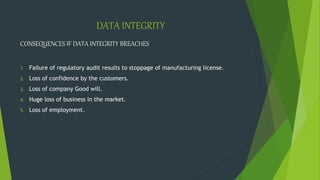
CONSEQUENCES IF DATA INTEGRITY BREACHES
1. Failure of regulatory audit results to stoppage of manufacturing license.
2. Loss of confidence by the customers.
3. Loss of company Good will.
4. Huge loss of business in the market.
5. Loss of employment.
DATA INTEGRITY
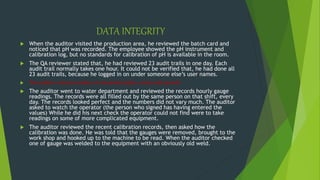
 When the auditor visited the production area, he reviewed the batch card and
noticed that pH was recorded. The employee showed the pH instrument and
calibration log, but no standards for calibration of pH is available in the room.
 The QA reviewer stated that, he had reviewed 23 audit trails in one day. Each
audit trail normally takes one hour. It could not be verified that, he had done all
23 audit trails, because he logged in on under someone else’s user names.
 The auditor noticed number of unmarked plates, some with growth
 The auditor went to water department and reviewed the records hourly gauge
readings. The records were all filled out by the same person on that shift, every
day. The records looked perfect and the numbers did not vary much. The auditor
asked to watch the operator (the person who signed has having entered the
values) While he did his next check the operator could not find were to take
readings on some of more complicated equipment.
 The auditor reviewed the recent calibration records, then asked how the
calibration was done. He was told that the gauges were removed, brought to the
work shop and hooked up to the machine to be read. When the auditor checked
one of gauge was welded to the equipment with an obviously old weld.
DATA INTEGRITY
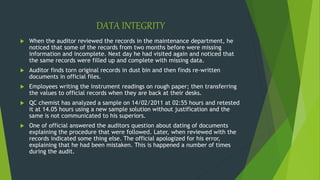
 When the auditor reviewed the records in the maintenance department, he
noticed that some of the records from two months before were missing
information and incomplete. Next day he had visited again and noticed that
the same records were filled up and complete with missing data.
 Auditor finds torn original records in dust bin and then finds re-written
documents in official files.
 Employees writing the instrument readings on rough paper; then transferring
the values to official records when they are back at their desks.
 QC chemist has analyzed a sample on 14/02/2011 at 02:55 hours and retested
it at 14.05 hours using a new sample solution without justification and the
same is not communicated to his superiors.
 One of official answered the auditors question about dating of documents
explaining the procedure that were followed. Later, when reviewed with the
records indicated some thing else. The official apologized for his error,
explaining that he had been mistaken. This is happened a number of times
during the audit.
DATA INTEGRITY
 Conclusion
 What, where, why and how the integrity issues can be identified.
 Digging the root cause and solving the problem.
 Consequences
 Expectations from Regulatory bodies
A - Attributable
L - Legible
C - Contemporaneous
O - Original
A - Accurate
DATA INTEGRITY

Data Integrity.pptx

  • 1.
    DATA INTEGRITY Is therean integrity issue here?  Operator RST went home at 0700. Operator XYZ arrived at 0700 and noticed that temperature readings for the past 2 hours (0500 to 0700) were missing.  He filled in the entries and signed with Employee RST’s initials.
  • 2.
    DATA INTEGRITY TYPE OFINTERVENTION DONE BY CHECKED BY ABCD Employee “ B ” Employee “ A ” XYZ Employee “ B ” Employee “ A ” Employee A is attending the intervention and employee B is recording the intervention during filling activity and then signed in the “Done By” column. Employee A walks out and signs in “Checked By” column. Is there an integrity issue here?
  • 3.
    DATA INTEGRITY  WHATIS INTEGRITY  WHAT IS DATA INTEGRITY  IMPORTANCE OF DATA INTEGRITY  WHERE IS THE DATA INTEGRITY RELATED ISSUES USUALLY HAPPENS  CONSEQUENCES IF DATA INTEGRITY FAILS  CONCLUSION
  • 4.
    DATA INTEGRITY  WHATIS INTEGIRY  Is what you are doing,saying,Recording is REAL!! [in-teg-ri-tee] 1.Adherence to moral and ethical principles;soundness of moral character; honesty. 2. The state of being whole, entire, or undiminished: To preserve the integrity of the empire. 3. A sound,unimpaired,or perfect condition: The integrity of a ship's hull.
  • 5.
    DATA INTEGRITY WHAT ISDATA INTEGRITY (AS PER GOVERING AUTHORITIES) 1. “Data Integrity means the property that data or information have not been altered or destroyed in an unauthorized manner.“ (45 CFR 164.304) 2.Data Integrity referes to the completeness, consistency, and accuracy of data. Complete, consistent, and accurate data should be attributable, legible, contemporaneously recorded, original or a true copy, and accurate (ALCOA) (FDA draft guidance) 3.“The condition existing when data is unchanged from its source and has not been accidentally or maliciously modified, altered or destroyed.” (NIAG) 4.In the context of laboratory data integrity within a GMP environment, this can be defined as: generating, transforming, maintaining and assuring the accuracy, completeness and consistency of data over its entire life cycle in compliance with applicable regulations. (ICH Q10 )
  • 6.
    DATA INTEGRITY  5.Unauthorized manner. "Data integrity refers to maintaining and assuring the accuracy and consistency of data over its entire life-cycle. [Wikipedia]  6.Data Integrity is the assurance that data is consistent, accurate, reliable and accessible
  • 7.
    DATA INTEGRITY Attributable who createdrecord and When Who amended a record, when, and why That last one, the "why" (the reason for change) is an important area in which there are frequently gaps. It is always essential to explain why an entry is being changed Legible Common sense requirement Contemporaneous All signatures/initials must be accompanied by date that indicates when the signature/initials were appended Should be able to reconstruct the occurrences around the data. FDA expects that all recorded dates be the current date at the time of the entry and that late entries are clearly notified.
  • 8.
    DATA INTEGRITY Original: Records areexpected to be original. Not to use scratch paper. Post-its or any uncontrolled notebook in a GMP area Accurate Honesty is first consideration here and thoroughness is the second. Make sure of information that you are recording is correct and make sure you're telling the "whole truth". Regulatory Inspectors are highly trained to detect fraud. There's a very fine line between fudging a result and outright fraud. Regulatory Inspectors are renowned for not seeing that fine line and "not knowing how it is". Tell the truth and be sure that your records do too. TRANSPARENCY THE KEY GOAL OF ALCOA
  • 9.
    DATA INTEGRITY Integrity / DataIntegrity Data Assuring Accuracy completeness consistency Reliable Accidental - Unintentional Unauthorized - Malicious Generating Transforming Entire Life Cycle Maintaining Accessible Altered / Modified Destroyed NOT Moral Ethical Soundness Honesty
  • 10.
  • 11.
  • 12.
    DATA INTEGRITY  WHEREIS THE DATA INTEGRITY RELATED ISSUES USUALLY HAPPENS
  • 13.
    DATA INTEGRITY WHERE ISTHE DATA INTEGRITY RELATED ISSUES USUALLY HAPPENS  Not reporting failing results  Conducting unofficial analysis  Deleting electronic data  Disabling audit trails in electronic data capture systems  Fabricating training data  Having unofficial batch sheets and analytical reports  Trial analysis  Re analyzing failing samples till passing results are obtained  Back dating  Not reporting stability failures appears to be common.  "This is not related to training or understanding a particular technical or quality  concept but mainly related to honesty and ethical issues."  "Further what is more disturbing is that senior management appear to either support such practices covertly or overtly and in many instances encourage them."
  • 14.
    DATA INTEGRITY Data integrityissues FDA with Indian Companies • Backdating/Postdating/Missing Signatures • Fabricating/faking data • Copying existing data as new data • Re-running samples • Discarding data/ omitting negative data (like OOS or eliminating outliers) • Releasing failing product • Test until release • Hiding/obscuring SOP or protocol deviations • Not saving electronic or hard copy data • Poor Document Control & retention/Version Management • No /Inappropriate Audit Trail • Inadequate Access Authorization/ Privileges • Inadequate reporting of failure and deviation management • Use of un validated software applications/Spreadsheets • Mismatch between reported data and actual data
  • 15.
    DATA INTEGRITY Electronic SECURITY Administrator Qualified  Does not report to user  No dual role ACCESS CONTROL TO  File deletion  Folder creation  Internet  Software installation  User privileges  Regional settings
  • 16.
    DATA INTEGRITY Electronic SECURITY USERSOF ELECTRONIC SYSTEMS  Maintain list of active users  Review periodically  Infrequent/temporary user policy Passwords  Unique user names & passwords  Password never shared with anyone  Minimum character size and type  Periodic password change required  No visible passwords / Log in info on screens, post-its, etc.,
  • 17.
    DATA INTEGRITY Electronic Systems Chromatograms Signed immediately after printing  None disregarded or invalidated without investigation  Version controlled, protected, consistent  No calculations done on chromatograms
  • 18.
    DATA INTEGRITY CONSEQUENCES IFDATA INTEGRITY BREACHES 1. Failure of regulatory audit results to stoppage of manufacturing license. 2. Loss of confidence by the customers. 3. Loss of company Good will. 4. Huge loss of business in the market. 5. Loss of employment.
  • 19.
    DATA INTEGRITY  Whenthe auditor visited the production area, he reviewed the batch card and noticed that pH was recorded. The employee showed the pH instrument and calibration log, but no standards for calibration of pH is available in the room.  The QA reviewer stated that, he had reviewed 23 audit trails in one day. Each audit trail normally takes one hour. It could not be verified that, he had done all 23 audit trails, because he logged in on under someone else’s user names.  The auditor noticed number of unmarked plates, some with growth  The auditor went to water department and reviewed the records hourly gauge readings. The records were all filled out by the same person on that shift, every day. The records looked perfect and the numbers did not vary much. The auditor asked to watch the operator (the person who signed has having entered the values) While he did his next check the operator could not find were to take readings on some of more complicated equipment.  The auditor reviewed the recent calibration records, then asked how the calibration was done. He was told that the gauges were removed, brought to the work shop and hooked up to the machine to be read. When the auditor checked one of gauge was welded to the equipment with an obviously old weld.
  • 20.
    DATA INTEGRITY  Whenthe auditor reviewed the records in the maintenance department, he noticed that some of the records from two months before were missing information and incomplete. Next day he had visited again and noticed that the same records were filled up and complete with missing data.  Auditor finds torn original records in dust bin and then finds re-written documents in official files.  Employees writing the instrument readings on rough paper; then transferring the values to official records when they are back at their desks.  QC chemist has analyzed a sample on 14/02/2011 at 02:55 hours and retested it at 14.05 hours using a new sample solution without justification and the same is not communicated to his superiors.  One of official answered the auditors question about dating of documents explaining the procedure that were followed. Later, when reviewed with the records indicated some thing else. The official apologized for his error, explaining that he had been mistaken. This is happened a number of times during the audit.
  • 21.
    DATA INTEGRITY  Conclusion What, where, why and how the integrity issues can be identified.  Digging the root cause and solving the problem.  Consequences  Expectations from Regulatory bodies A - Attributable L - Legible C - Contemporaneous O - Original A - Accurate
  • 22.