In Pharmaceutical
Quality Control
What is data integrity
Data: Facts and statistics collected together for reference or
analysis.
Integrity: The qualityof being honest and having strong moral
principles.
Data Integrityin the context of Pharmaceutical Industry within a
GMP environment: Generating, transforming, maintaining and
assuringthe completeness and consistency of data over it’s entire
life cycle in compliance with applicable regulations.
Importance of data integrity
Undermines the safety and efficacy and assurance of quality of
the drugs that consumers will take.
Importance of data integrity
Any data integrity issues highlighted usually break trust.
Importance of data integrity
The regulators trust the companies to do the right thingwhen no
one is seeing.
What can be considered as data
integrity concern
Not recording activitiesonline
Backdating
Fabricatingdata
Copyingexistingdata as new
Re-processing without justification
Discardingdata
Releasinga failing product/material
Passing a failingproduct/material
Not saving dataeither electronically or in hardcopy format
Criteria for integrity of data
FDA warningletters and announcements of MHRAhave
highlightedthe increasing focus on data integrityin pharma
Industry.
Data integrity is a subject that many pharma industries currently
have significant concerns about.
To add to those concerns, even the term“dataintegrity” can have
widely differing meanings or interpretation, and there are
currently few definitive reference sources availableon the subject.
Criteria for integrity of data
The acronymALCOAhas been widely associatedwithdata
integrity by FDA and was first used by Stan Woollen when he
worked for the agency to help himremembercompliance terms
relevant to data quality.
Criteria for integrity of data
The goodautomatedmanufacturingpractice (GAMP) guide “A
Risk-BasedApproach to GxP Complaint Laboratory
Computerized Systems” includes an appendix 3 on data integrity.
The terms used in the appendix are sometimes referredto as
“ALCOA+” because they incorporate additional terms basedon
the European Medicines Agency’s concept paper on electronic
data in clinical trials. The terms associated withALCOA+ are
described as:
Attributable, Legible, Contemporaneous, Original, Accurate, com
plete, consistent, enduring, and available.
Criteria for integrity of data
ALCOA+
Who performed an action and when?
If a record is changed, whodid it any why?
What is the link to the source data
Criteria for integrity of data
ALCOA+
Data must be preserved /recorded permanently in a durable
mediumand shouldbe readable
Criteria for integrity of data
ALCOA+
The data should be recorded at the time when the work is
performed and data/time stamps shouldfollowin order
Criteria for integrity of data
ALCOA+
The information provided in the data shall be either original
record or certified true copy
Criteria for integrity of data
ALCOA+
A: Accurate
No errors or editing shall be performed without approved
documented amendments
Criteria for integrity of data
ALCOA+
Complete: All data includingreprocessing performedon the
product shall be available
Consistent: Consistent application of data time stamps shall be
available in expected sequence
Enduring: All data shall be recorded on batch documents directly
Available: All data shall be available / accessible for review/ audit
for the life time of therecord.
Common data integrity issues
Common Passwords
Where peopleshare passwords, it is not possible to identify who
creates or changes records.
Common data integrity issues
User privileges
The systemconfiguration for the software does not adequately define
or segregate user levels and users have accessto inappropriate
software privileges such as modification of data
Common data integrity issues
Computer systemcontrol
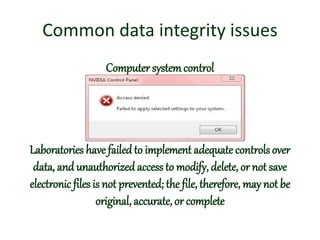
Laboratories have failed to implement adequate controls over
data, and unauthorized access to modify, delete, or not save
electronic files is not prevented; the file, therefore, may not be
original, accurate, or complete
Common data integrity issues
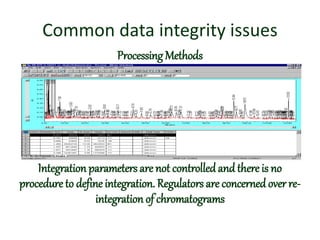
Processing Methods
Integration parameters are not controlled and there is no
procedure to define integration. Regulators are concerned over re-
integration of chromatograms
Common data integrity issues
Incomplete data
The recordis not complete in this case. The definition of complete
data is open to interpretation
Common data integrity issues
Audit trails
The Laboratories turn off the audit-trail functionalitywithin the
system. It is, therefore, not clear who has modifieda fileor why
GMP regulatory requirements for data
integrity
Derived fromthe data integrity definition and the applicable 21
CFR 211 GMP regulations there are some of the following points:
Equipment must be qualifiedand fit for purpose [§211.160(b),
§211.63]
GMP regulatory requirements for data
integrity
Software must be validated [§211.63]
GMP regulatory requirements for data
integrity
Any calculations used must be verified [§211.68(b)]
GMP regulatory requirements for data
integrity
Data generatedduring analysis must be backed up [§211.68(b)]
GMP regulatory requirements for data
integrity
Reagents and reference solutions are prepared correctly with
appropriaterecords [§211.194(c)]
GMP regulatory requirements for data
integrity
Methods used must be documented and approved [§211.160(a)]
Methods must be verified under actual conditions of use
[§211.194(a)(2)]
GMP regulatory requirements for data
integrity
Data generatedand transformed must meet the criterion of
scientific soundness [§211.160(a)]
GMP regulatory requirements for data
integrity
Test data must be accurate, complete and procedures should
be followed [§211.194(a)]
GMP regulatory requirements for data
integrity
Data and the reportable value must be checkedby a second
individual to ensure accuracy, completeness and conformance
with procedures [§211.194(a)(8)]
Q & A

Lab data integrity

  • 1.
  • 2.
    What is dataintegrity
  • 3.
    Data: Facts andstatistics collected together for reference or analysis. Integrity: The qualityof being honest and having strong moral principles. Data Integrityin the context of Pharmaceutical Industry within a GMP environment: Generating, transforming, maintaining and assuringthe completeness and consistency of data over it’s entire life cycle in compliance with applicable regulations.
  • 4.
    Importance of dataintegrity Undermines the safety and efficacy and assurance of quality of the drugs that consumers will take.
  • 5.
    Importance of dataintegrity Any data integrity issues highlighted usually break trust.
  • 6.
    Importance of dataintegrity The regulators trust the companies to do the right thingwhen no one is seeing.
  • 7.
    What can beconsidered as data integrity concern Not recording activitiesonline Backdating Fabricatingdata Copyingexistingdata as new Re-processing without justification Discardingdata Releasinga failing product/material Passing a failingproduct/material Not saving dataeither electronically or in hardcopy format
  • 8.
    Criteria for integrityof data FDA warningletters and announcements of MHRAhave highlightedthe increasing focus on data integrityin pharma Industry. Data integrity is a subject that many pharma industries currently have significant concerns about. To add to those concerns, even the term“dataintegrity” can have widely differing meanings or interpretation, and there are currently few definitive reference sources availableon the subject.
  • 9.
    Criteria for integrityof data The acronymALCOAhas been widely associatedwithdata integrity by FDA and was first used by Stan Woollen when he worked for the agency to help himremembercompliance terms relevant to data quality.
  • 10.
    Criteria for integrityof data The goodautomatedmanufacturingpractice (GAMP) guide “A Risk-BasedApproach to GxP Complaint Laboratory Computerized Systems” includes an appendix 3 on data integrity. The terms used in the appendix are sometimes referredto as “ALCOA+” because they incorporate additional terms basedon the European Medicines Agency’s concept paper on electronic data in clinical trials. The terms associated withALCOA+ are described as: Attributable, Legible, Contemporaneous, Original, Accurate, com plete, consistent, enduring, and available.
  • 11.
    Criteria for integrityof data ALCOA+ Who performed an action and when? If a record is changed, whodid it any why? What is the link to the source data
  • 12.
    Criteria for integrityof data ALCOA+ Data must be preserved /recorded permanently in a durable mediumand shouldbe readable
  • 13.
    Criteria for integrityof data ALCOA+ The data should be recorded at the time when the work is performed and data/time stamps shouldfollowin order
  • 14.
    Criteria for integrityof data ALCOA+ The information provided in the data shall be either original record or certified true copy
  • 15.
    Criteria for integrityof data ALCOA+ A: Accurate No errors or editing shall be performed without approved documented amendments
  • 16.
    Criteria for integrityof data ALCOA+ Complete: All data includingreprocessing performedon the product shall be available Consistent: Consistent application of data time stamps shall be available in expected sequence Enduring: All data shall be recorded on batch documents directly Available: All data shall be available / accessible for review/ audit for the life time of therecord.
  • 17.
    Common data integrityissues Common Passwords Where peopleshare passwords, it is not possible to identify who creates or changes records.
  • 18.
    Common data integrityissues User privileges The systemconfiguration for the software does not adequately define or segregate user levels and users have accessto inappropriate software privileges such as modification of data
  • 19.
    Common data integrityissues Computer systemcontrol Laboratories have failed to implement adequate controls over data, and unauthorized access to modify, delete, or not save electronic files is not prevented; the file, therefore, may not be original, accurate, or complete
  • 20.
    Common data integrityissues Processing Methods Integration parameters are not controlled and there is no procedure to define integration. Regulators are concerned over re- integration of chromatograms
  • 21.
    Common data integrityissues Incomplete data The recordis not complete in this case. The definition of complete data is open to interpretation
  • 22.
    Common data integrityissues Audit trails The Laboratories turn off the audit-trail functionalitywithin the system. It is, therefore, not clear who has modifieda fileor why
  • 23.
    GMP regulatory requirementsfor data integrity Derived fromthe data integrity definition and the applicable 21 CFR 211 GMP regulations there are some of the following points: Equipment must be qualifiedand fit for purpose [§211.160(b), §211.63]
  • 24.
    GMP regulatory requirementsfor data integrity Software must be validated [§211.63]
  • 25.
    GMP regulatory requirementsfor data integrity Any calculations used must be verified [§211.68(b)]
  • 26.
    GMP regulatory requirementsfor data integrity Data generatedduring analysis must be backed up [§211.68(b)]
  • 27.
    GMP regulatory requirementsfor data integrity Reagents and reference solutions are prepared correctly with appropriaterecords [§211.194(c)]
  • 28.
    GMP regulatory requirementsfor data integrity Methods used must be documented and approved [§211.160(a)] Methods must be verified under actual conditions of use [§211.194(a)(2)]
  • 29.
    GMP regulatory requirementsfor data integrity Data generatedand transformed must meet the criterion of scientific soundness [§211.160(a)]
  • 30.
    GMP regulatory requirementsfor data integrity Test data must be accurate, complete and procedures should be followed [§211.194(a)]
  • 31.
    GMP regulatory requirementsfor data integrity Data and the reportable value must be checkedby a second individual to ensure accuracy, completeness and conformance with procedures [§211.194(a)(8)]
  • 32.