Data Integrity
Dr. A. Amsavel
Presentation Overview
 What is Data Integrity?
 Regulatory Environments
 Data Integrity Principles
 ALCOA Principles
 Basic Data Integrity Expectations
 Data Integrity examples and WL
 Implementation
Definition -MHRA
Data:
Information derived or obtained from raw data, for example
a reported analytical result (MHRA, 2015)
Data Integrity:
The extent to which all data are complete, consistent and
accurate throughout the data lifecycle.
Note:
1. Data can be ‘electronic’ or ‘paper based’ or ‘Hybrid’
2. Data lifecycle :From initial data generation and recording through processing
(including transformation or migration), use, retention, archiving, retrieval and
destruction
Why Data Integrity
• Assures the quality, safety and efficacy of the drugs
• The documented data is the only record of the
activity presenting the quality of the product
• Reliability of the data presented
• Questioning Data Integrity = Loss of Trust
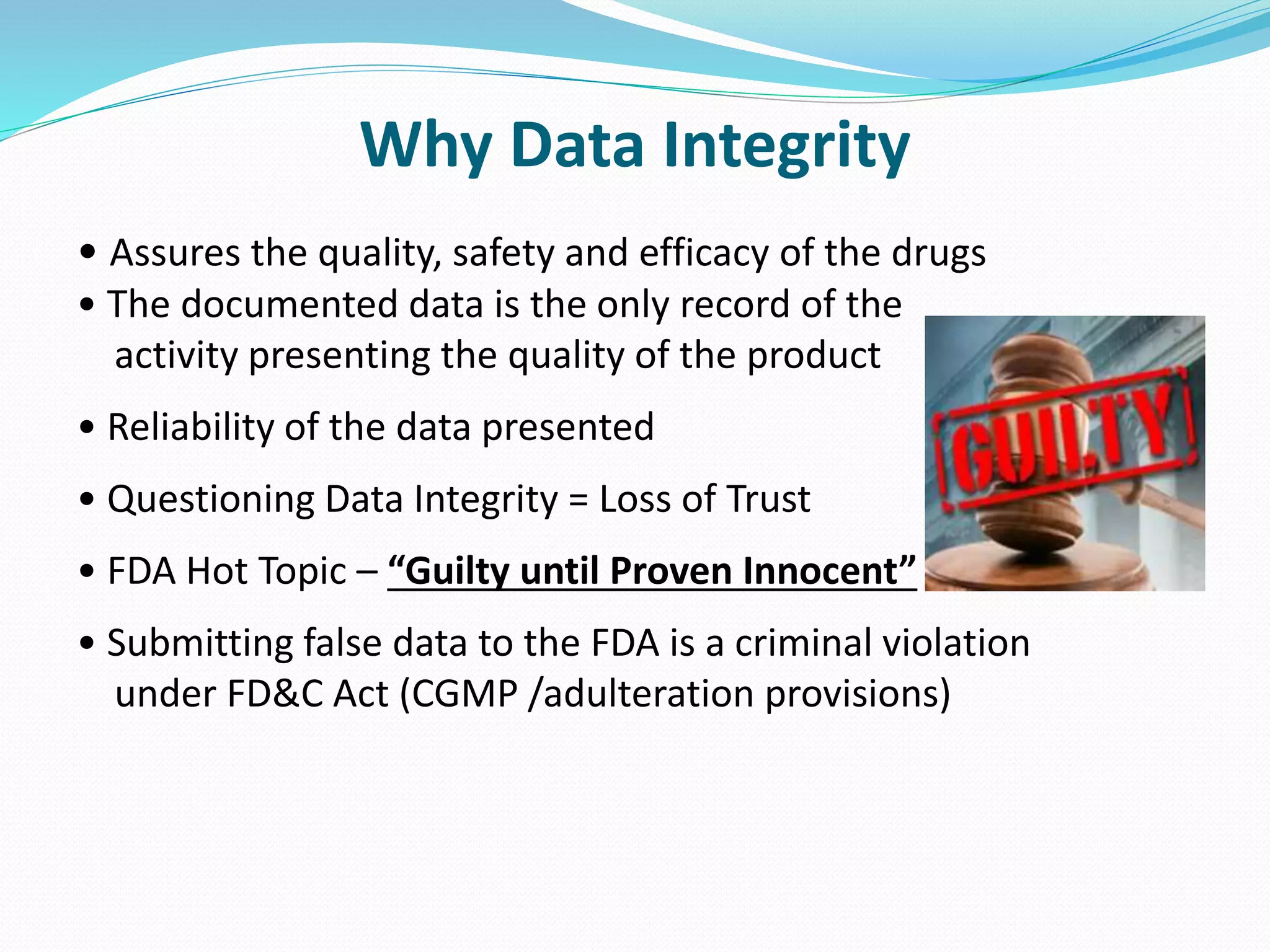
• FDA Hot Topic – “Guilty until Proven Innocent”
• Submitting false data to the FDA is a criminal violation
under FD&C Act (CGMP /adulteration provisions)
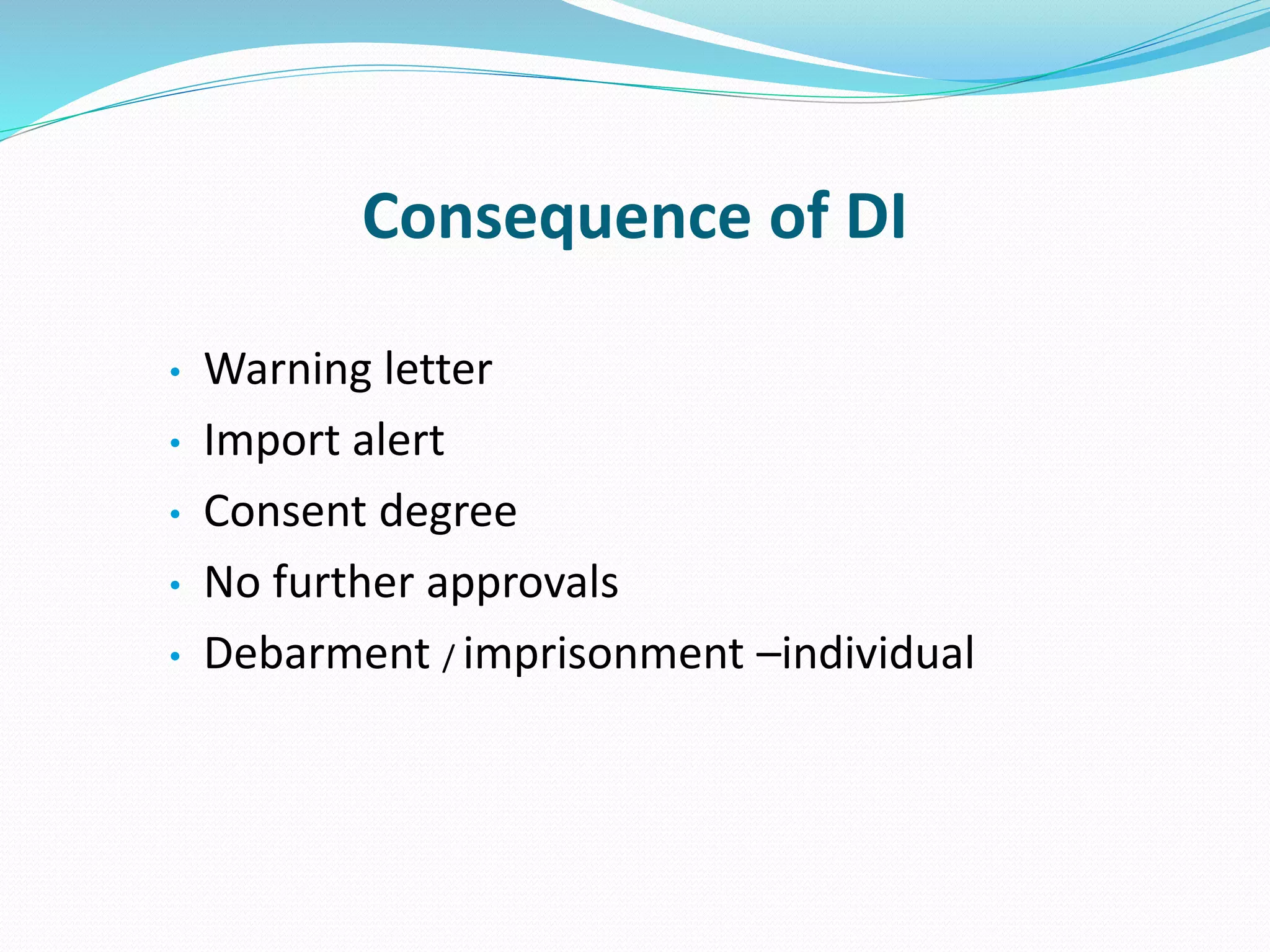
Consequence of DI
• Warning letter
• Import alert
• Consent degree
• No further approvals
• Debarment / imprisonment –individual
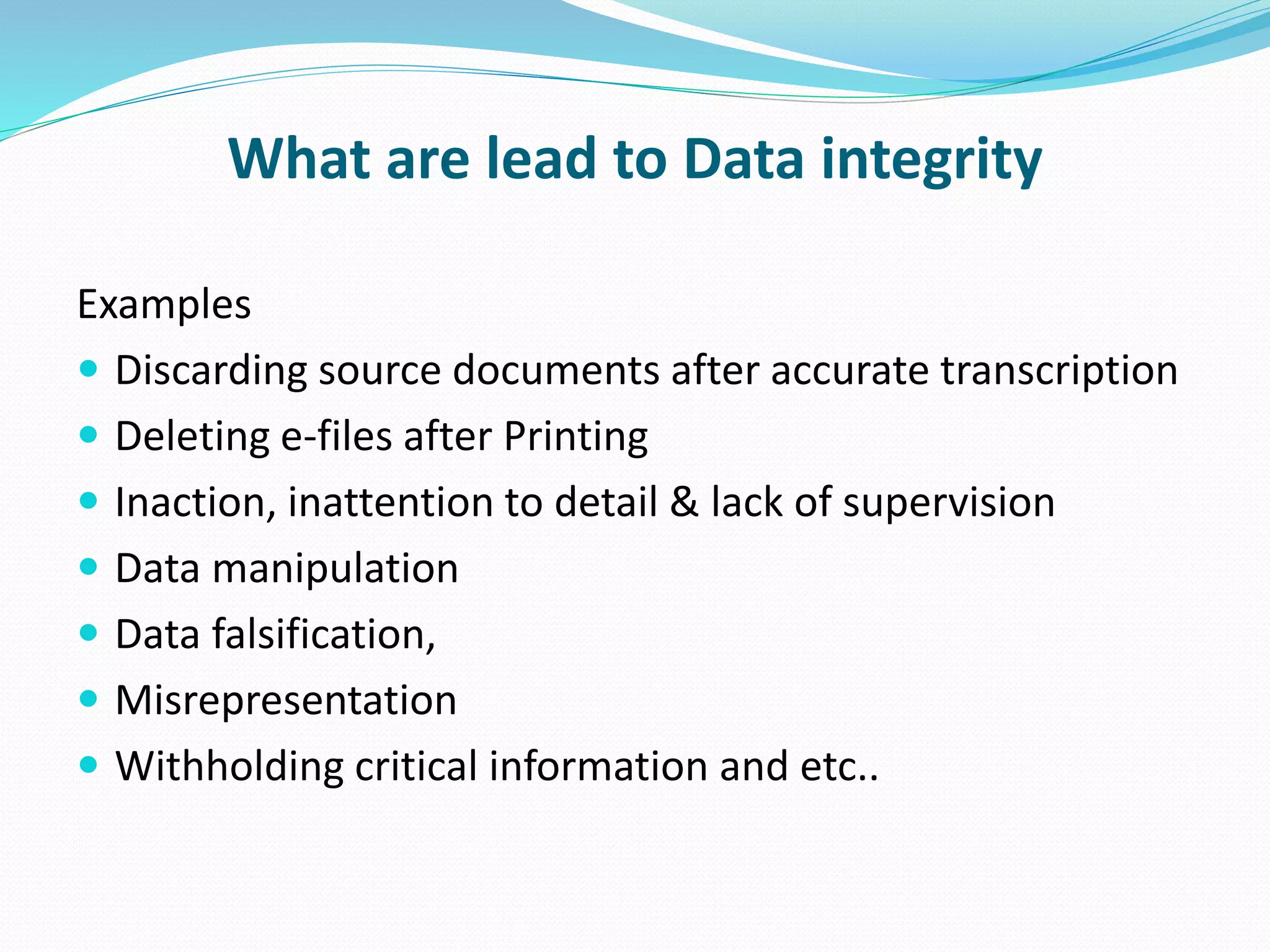
What are lead to Data integrity
Examples
 Discarding source documents after accurate transcription
 Deleting e-files after Printing
 Inaction, inattention to detail & lack of supervision
 Data manipulation
 Data falsification,
 Misrepresentation
 Withholding critical information and etc..
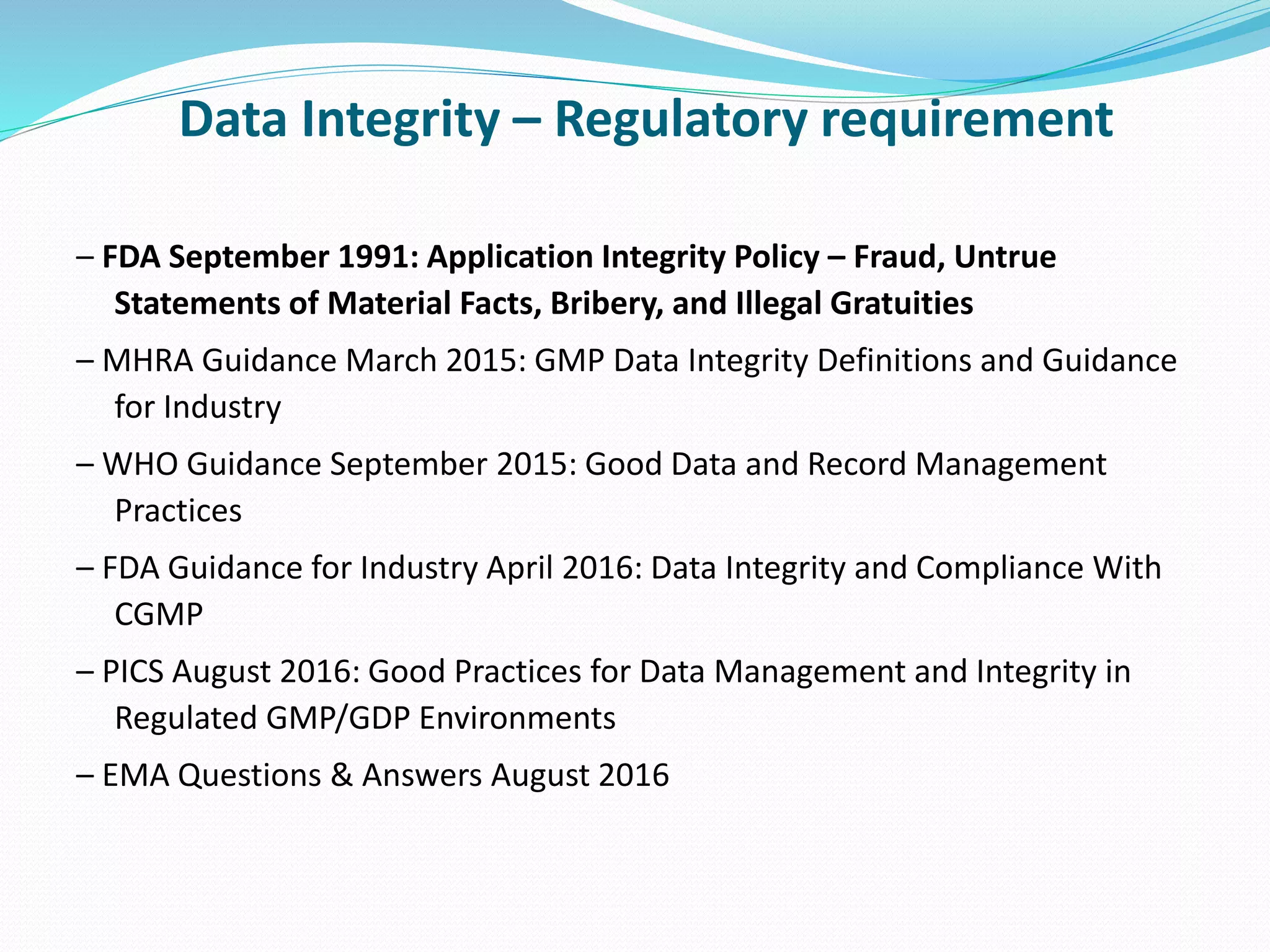
Data Integrity – Regulatory requirement
– FDA September 1991: Application Integrity Policy – Fraud, Untrue
Statements of Material Facts, Bribery, and Illegal Gratuities
– MHRA Guidance March 2015: GMP Data Integrity Definitions and Guidance
for Industry
– WHO Guidance September 2015: Good Data and Record Management
Practices
– FDA Guidance for Industry April 2016: Data Integrity and Compliance With
CGMP
– PICS August 2016: Good Practices for Data Management and Integrity in
Regulated GMP/GDP Environments
– EMA Questions & Answers August 2016
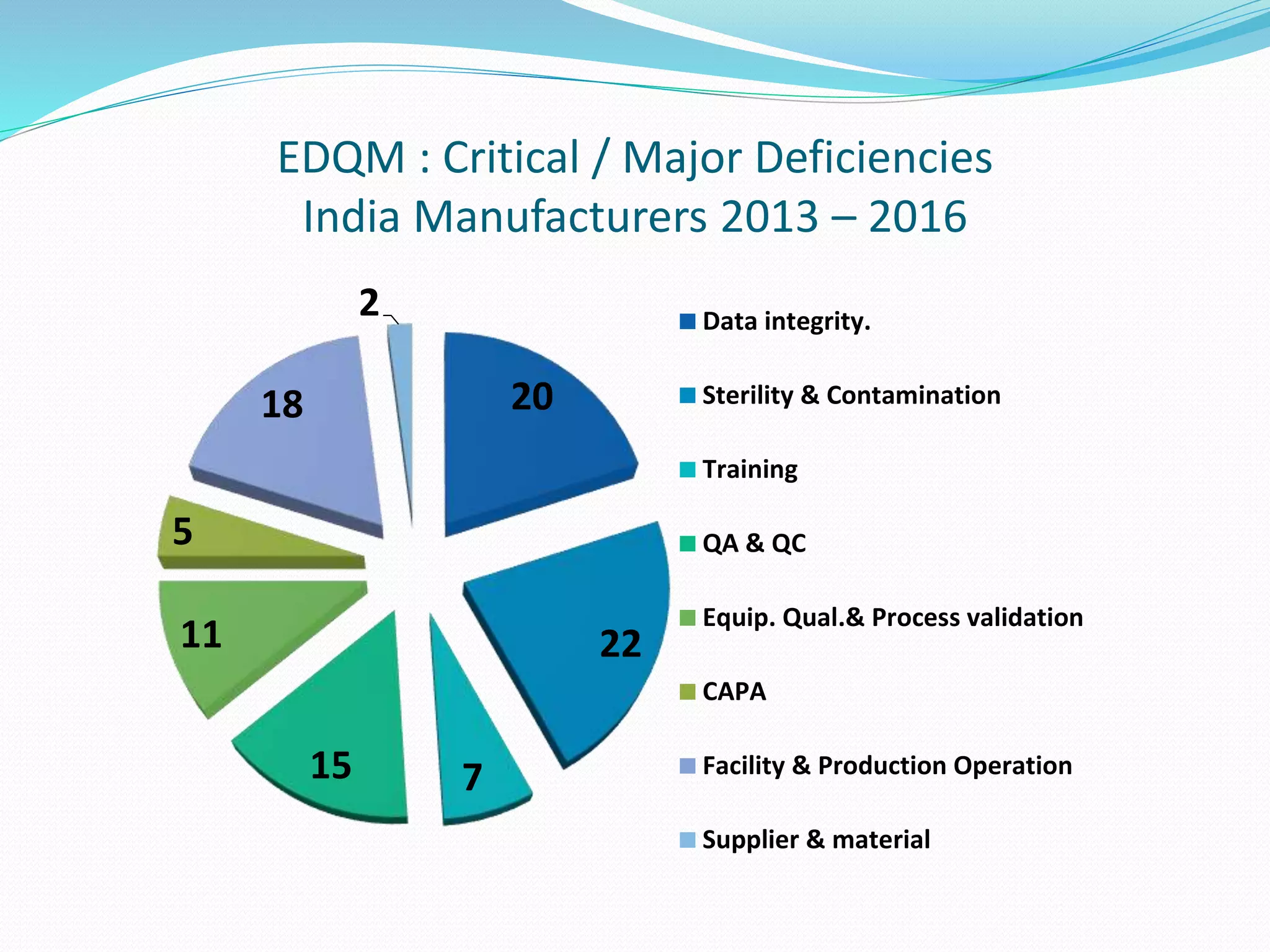
EDQM : Critical / Major Deficiencies
India Manufacturers 2013 – 2016
20
22
715
11
5
18
2 Data integrity.
Sterility & Contamination
Training
QA & QC
Equip. Qual.& Process validation
CAPA
Facility & Production Operation
Supplier & material
MHRA -Data Integrity Definitions and
Guidance
 Data Integrity is the extent to which all data are complete,
consistent and accurate throughout the data lifecycle.
 4.7 Handwritten entries should be made in a clear, legible, indelible
way.
 4.8 Records should be made or completed at the time each action is
taken and in such a way that all significant activities concerning
the manufacture of medicinal products are traceable.
 4.9 Any alteration made to the entry on a document should be
signed and dated; the alteration should permit the reading of the
original information. Where appropriate, the reason for the
alteration should be recorded.
MHRA -Data Integrity Definitions and
Guidance
 “The effort and resource assigned to data governance
should be commensurate with the risk to product quality,
 Also be balanced with other quality assurance resource
demands.
 Manufacturers and analytical laboratories are not
expected to implement a forensic approach to data
checking on a routine basis, but instead design and
operate a system which provides an acceptable state of
control based on the data integrity risk, and which is fully
documented with supporting rationale.”
How to Design a system to ensure data Integrity
Systems should be designed to assure data integrity.
Examples not limited to ;
• Access to clocks for recording timed events
• Accessibility of batch records at locations where activities take place so
that adhoc data recording and later transcription to official records is not
necessary
• Control over blank paper/ templates for data recording
• User access rights which prevent (or audit trail) data amendments
• Automated data capture or printers attached to equipment such as
balances
• Proximity of printers to relevant activities
• Access to sampling points / displays/ measuring devices
• Access to raw data for staff for review
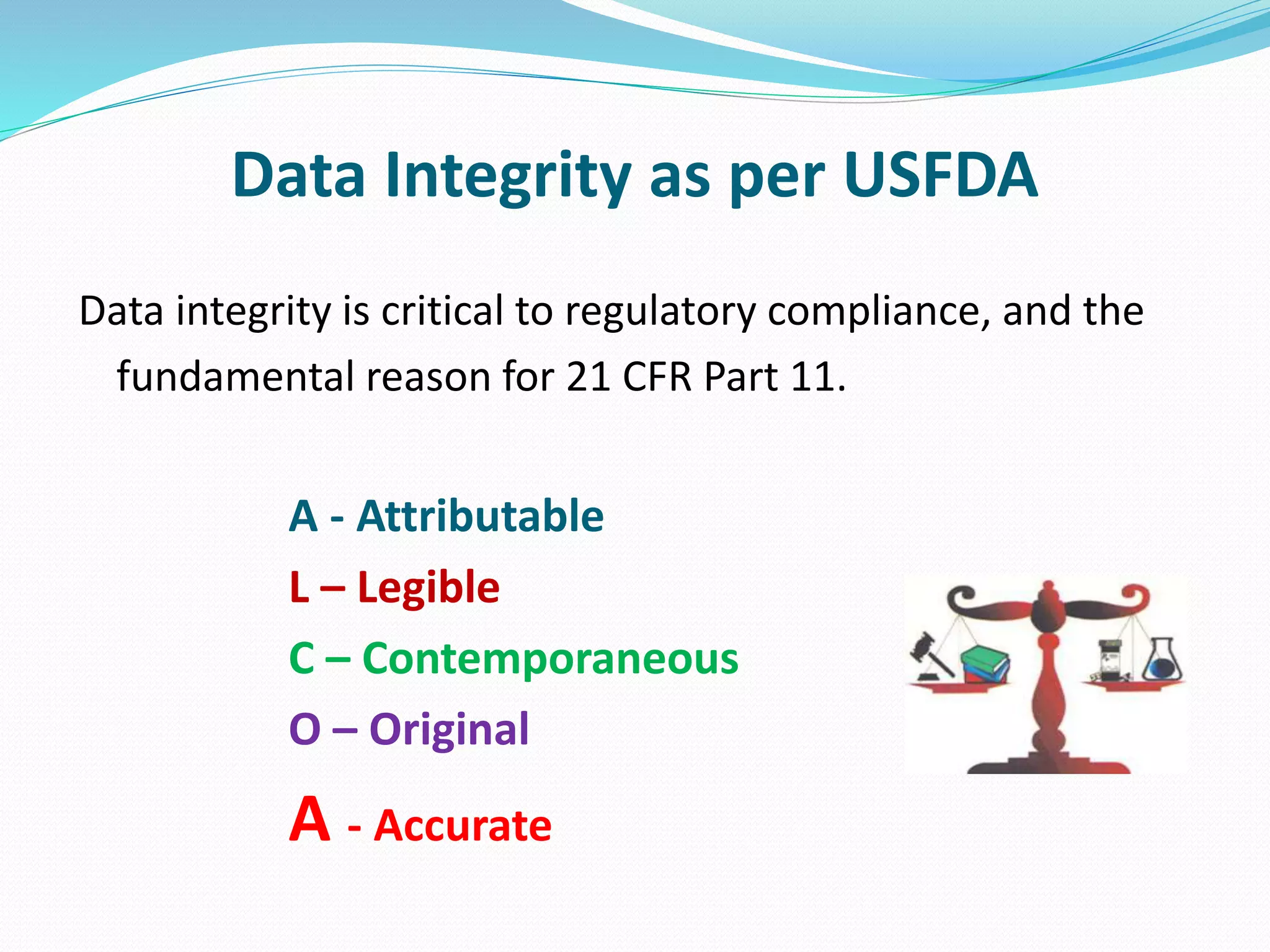
Data Integrity as per USFDA
Data integrity is critical to regulatory compliance, and the
fundamental reason for 21 CFR Part 11.
A - Attributable
L – Legible
C – Contemporaneous
O – Original
A - Accurate
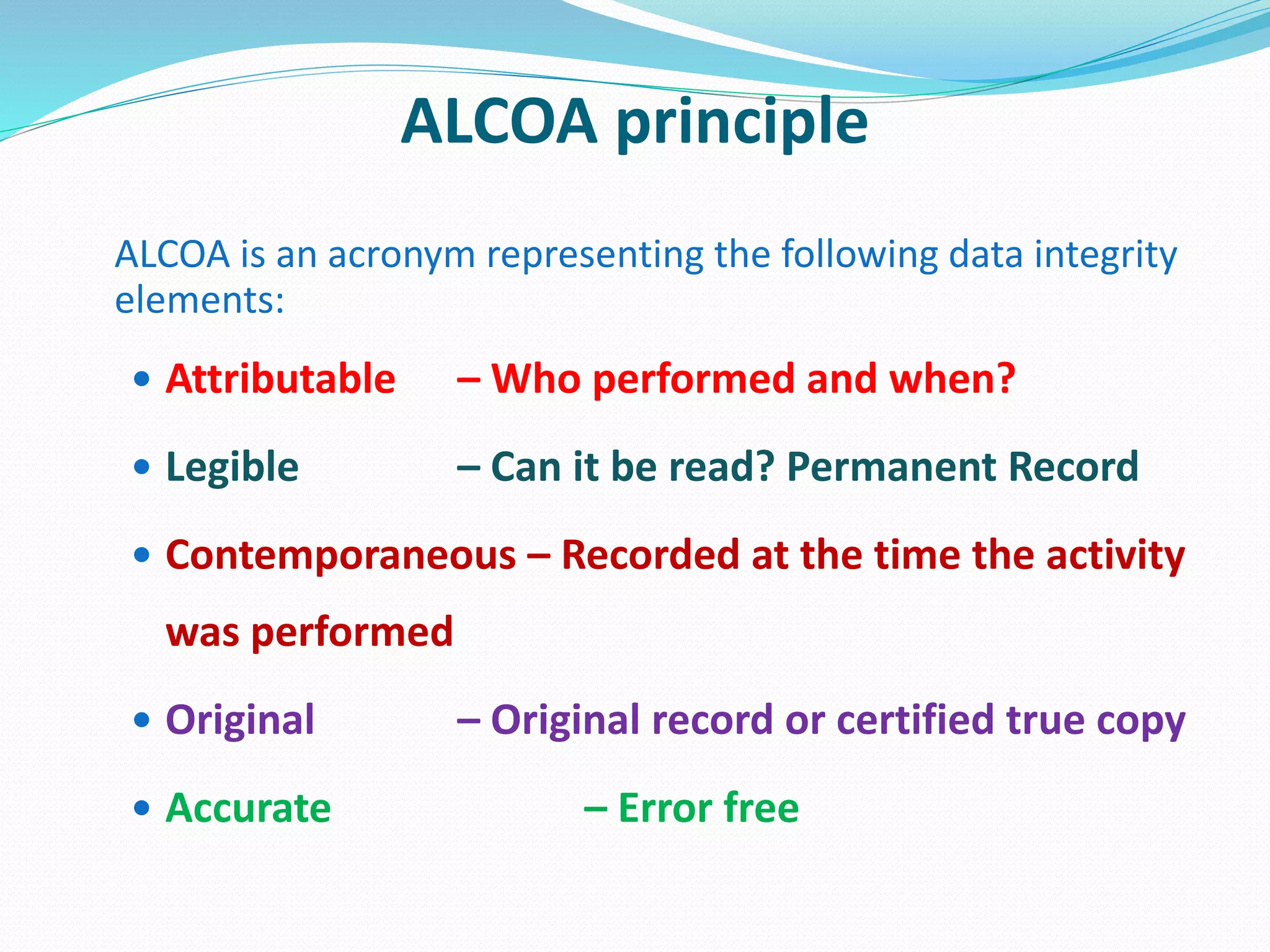
ALCOA principle
ALCOA is an acronym representing the following data integrity
elements:
 Attributable – Who performed and when?
 Legible – Can it be read? Permanent Record
 Contemporaneous – Recorded at the time the activity
was performed
 Original – Original record or certified true copy
 Accurate – Error free
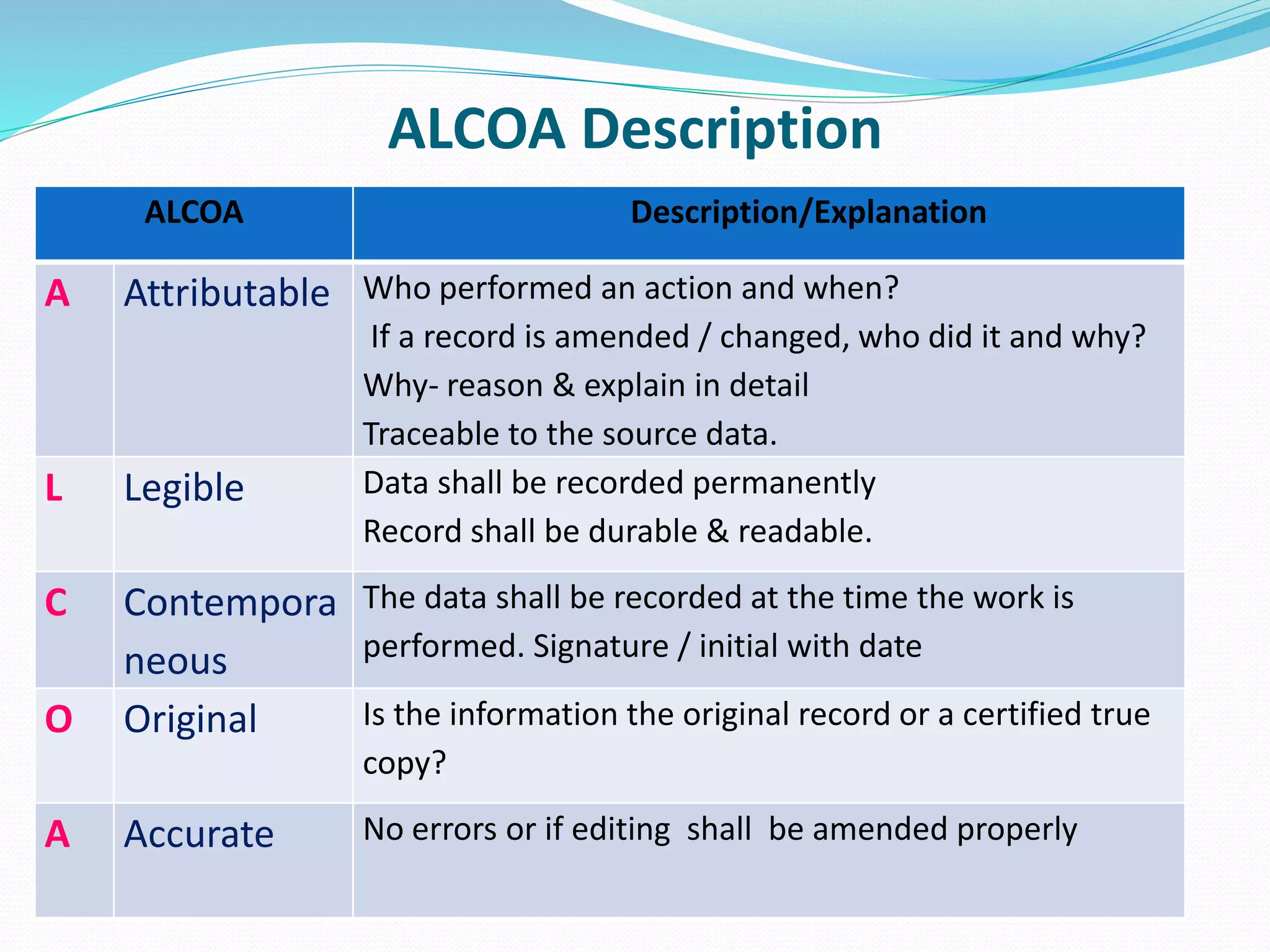
ALCOA Description
ALCOA Description/Explanation
A Attributable Who performed an action and when?
If a record is amended / changed, who did it and why?
Why- reason & explain in detail
Traceable to the source data.
L Legible Data shall be recorded permanently
Record shall be durable & readable.
C Contempora
neous
The data shall be recorded at the time the work is
performed. Signature / initial with date
O Original Is the information the original record or a certified true
copy?
A Accurate No errors or if editing shall be amended properly
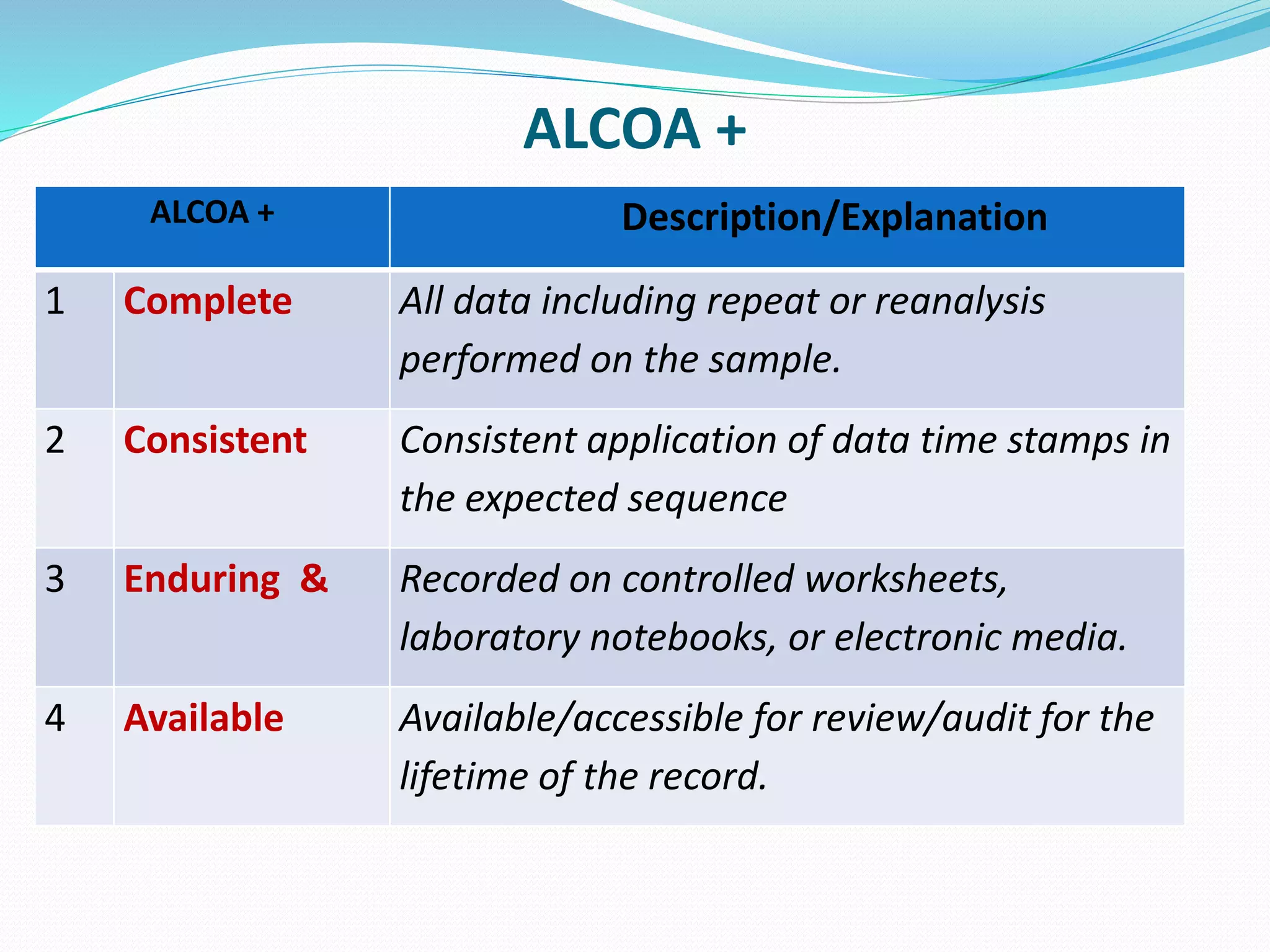
ALCOA +
ALCOA + Description/Explanation
1 Complete All data including repeat or reanalysis
performed on the sample.
2 Consistent Consistent application of data time stamps in
the expected sequence
3 Enduring & Recorded on controlled worksheets,
laboratory notebooks, or electronic media.
4 Available Available/accessible for review/audit for the
lifetime of the record.
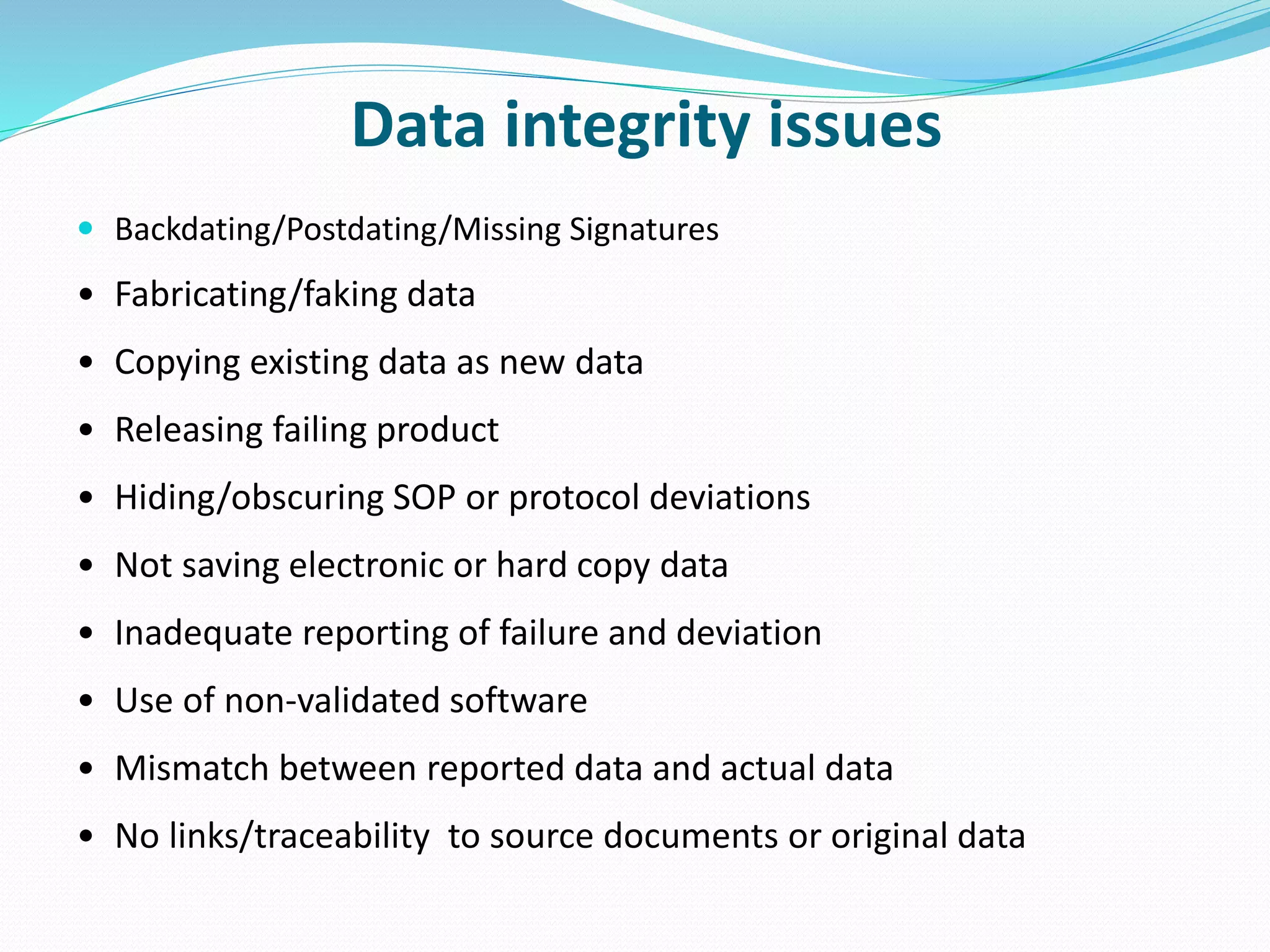
Data integrity issues
 Backdating/Postdating/Missing Signatures
• Fabricating/faking data
• Copying existing data as new data
• Releasing failing product
• Hiding/obscuring SOP or protocol deviations
• Not saving electronic or hard copy data
• Inadequate reporting of failure and deviation
• Use of non-validated software
• Mismatch between reported data and actual data
• No links/traceability to source documents or original data
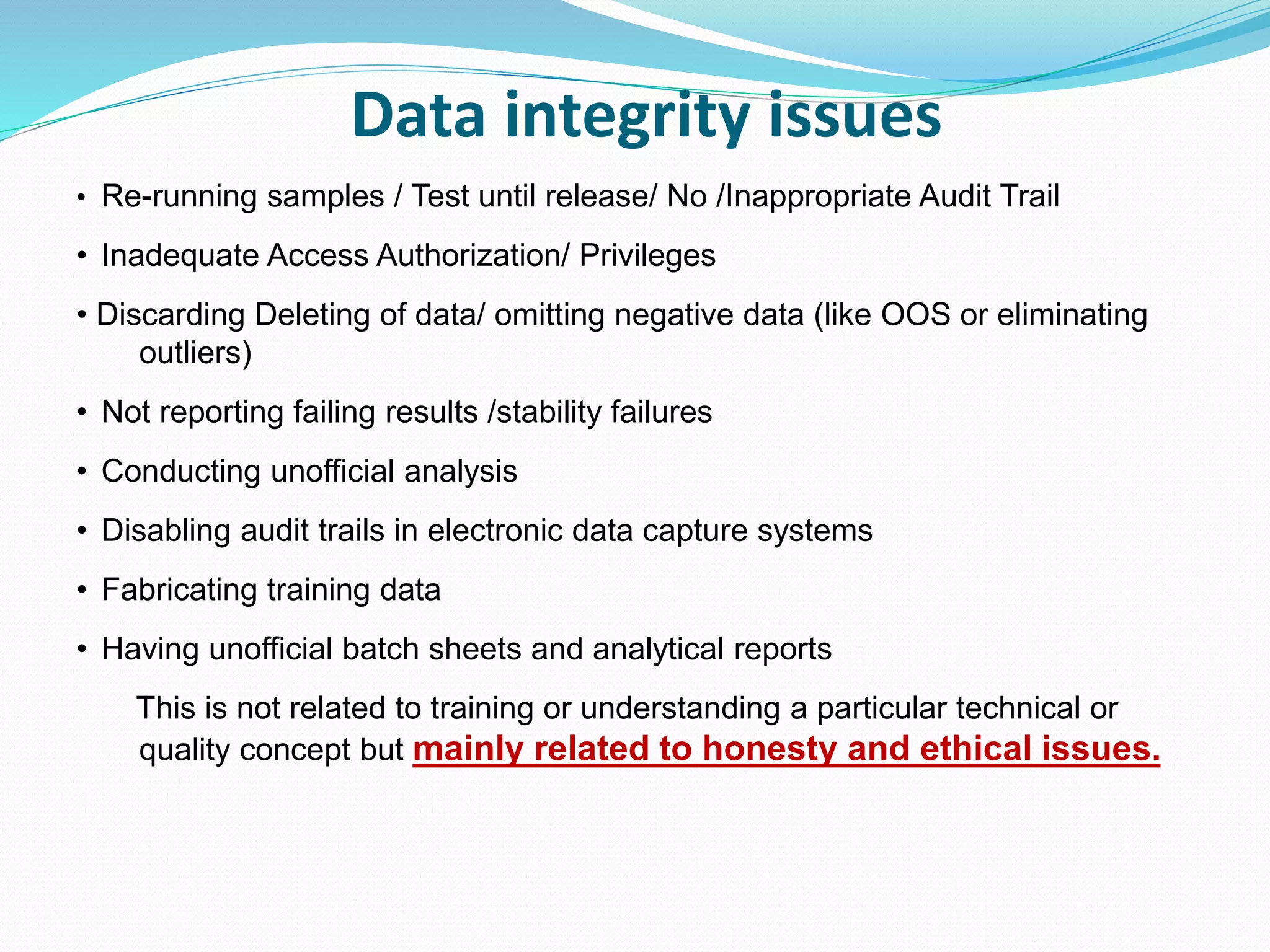
Data integrity issues
• Re-running samples / Test until release/ No /Inappropriate Audit Trail
• Inadequate Access Authorization/ Privileges
• Discarding Deleting of data/ omitting negative data (like OOS or eliminating
outliers)
• Not reporting failing results /stability failures
• Conducting unofficial analysis
• Disabling audit trails in electronic data capture systems
• Fabricating training data
• Having unofficial batch sheets and analytical reports
This is not related to training or understanding a particular technical or
quality concept but mainly related to honesty and ethical issues.
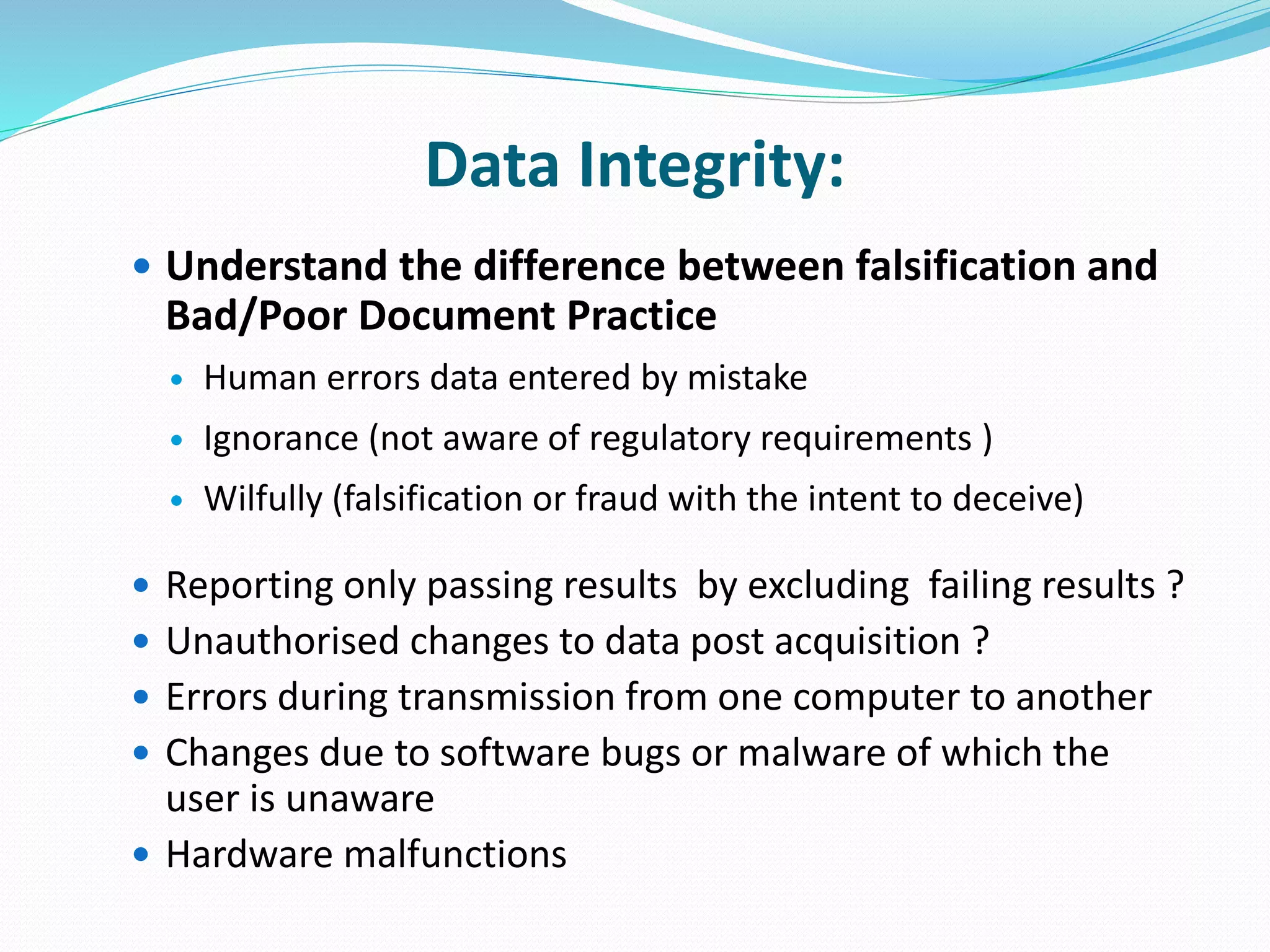
Data Integrity:
 Understand the difference between falsification and
Bad/Poor Document Practice
 Human errors data entered by mistake
 Ignorance (not aware of regulatory requirements )
 Wilfully (falsification or fraud with the intent to deceive)
 Reporting only passing results by excluding failing results ?
 Unauthorised changes to data post acquisition ?
 Errors during transmission from one computer to another
 Changes due to software bugs or malware of which the
user is unaware
 Hardware malfunctions
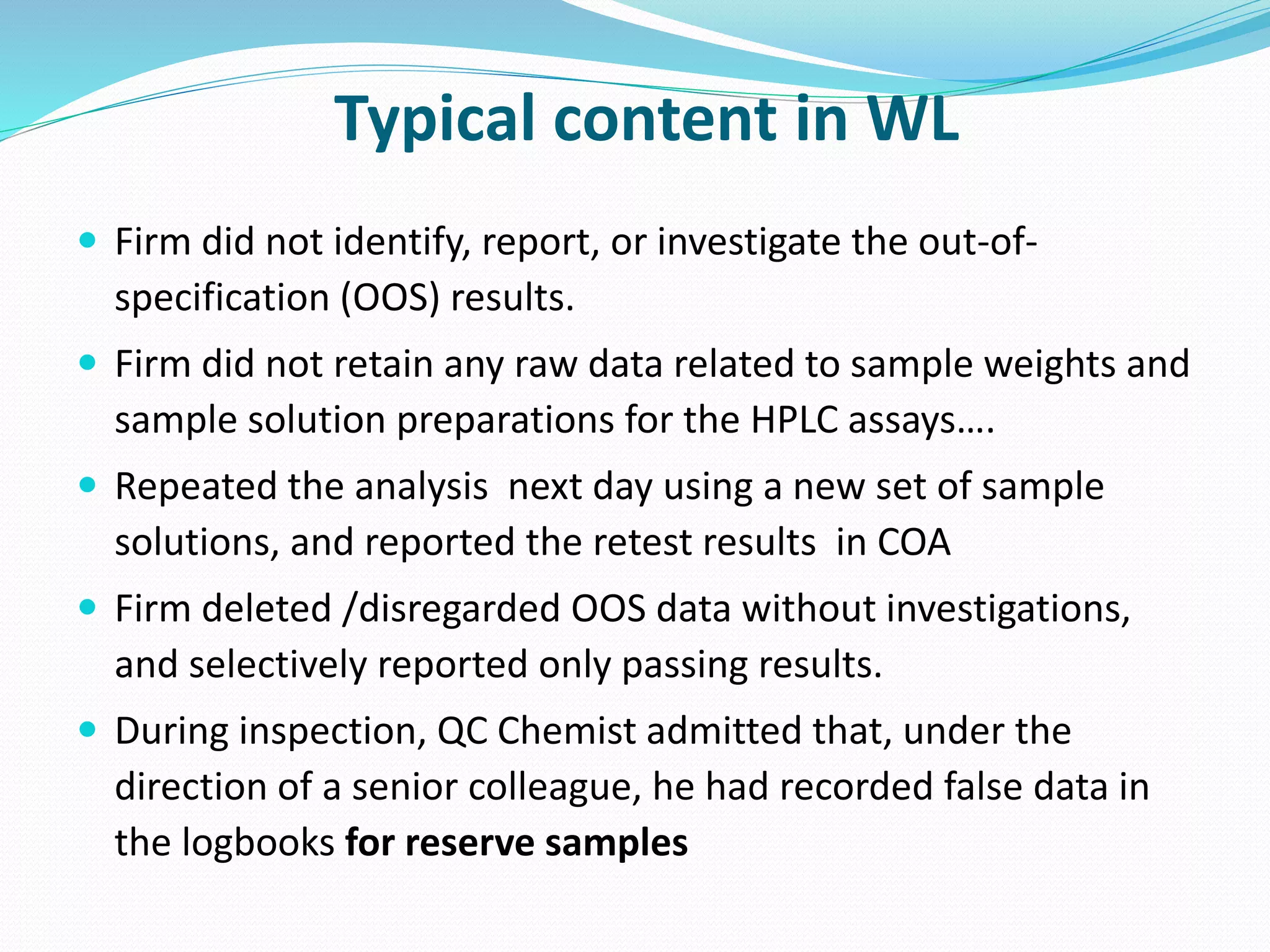
Typical content in WL
 Firm did not identify, report, or investigate the out-of-
specification (OOS) results.
 Firm did not retain any raw data related to sample weights and
sample solution preparations for the HPLC assays….
 Repeated the analysis next day using a new set of sample
solutions, and reported the retest results in COA
 Firm deleted /disregarded OOS data without investigations,
and selectively reported only passing results.
 During inspection, QC Chemist admitted that, under the
direction of a senior colleague, he had recorded false data in
the logbooks for reserve samples
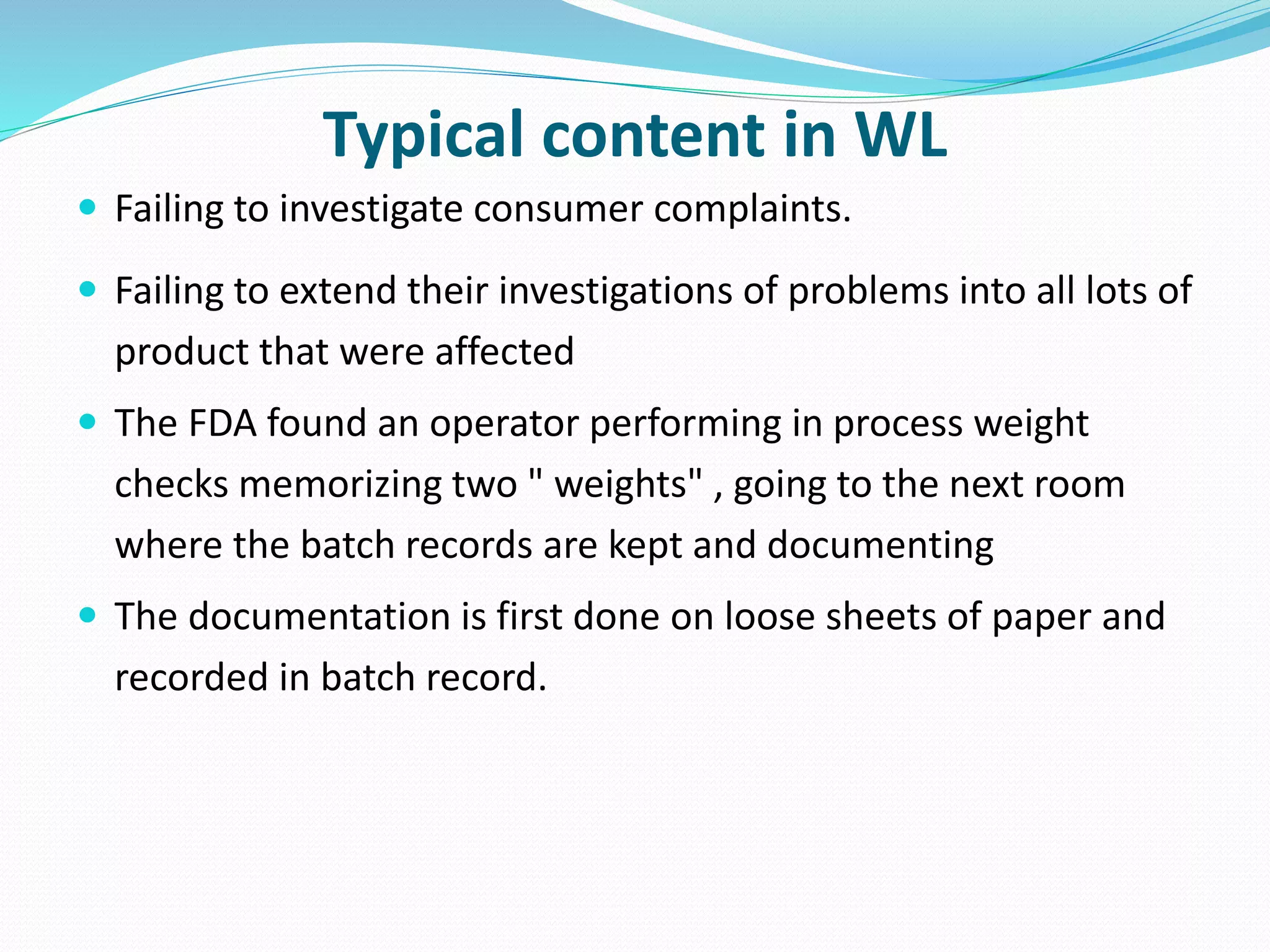
Typical content in WL
 Failing to investigate consumer complaints.
 Failing to extend their investigations of problems into all lots of
product that were affected
 The FDA found an operator performing in process weight
checks memorizing two " weights" , going to the next room
where the batch records are kept and documenting
 The documentation is first done on loose sheets of paper and
recorded in batch record.
Typical content in WL
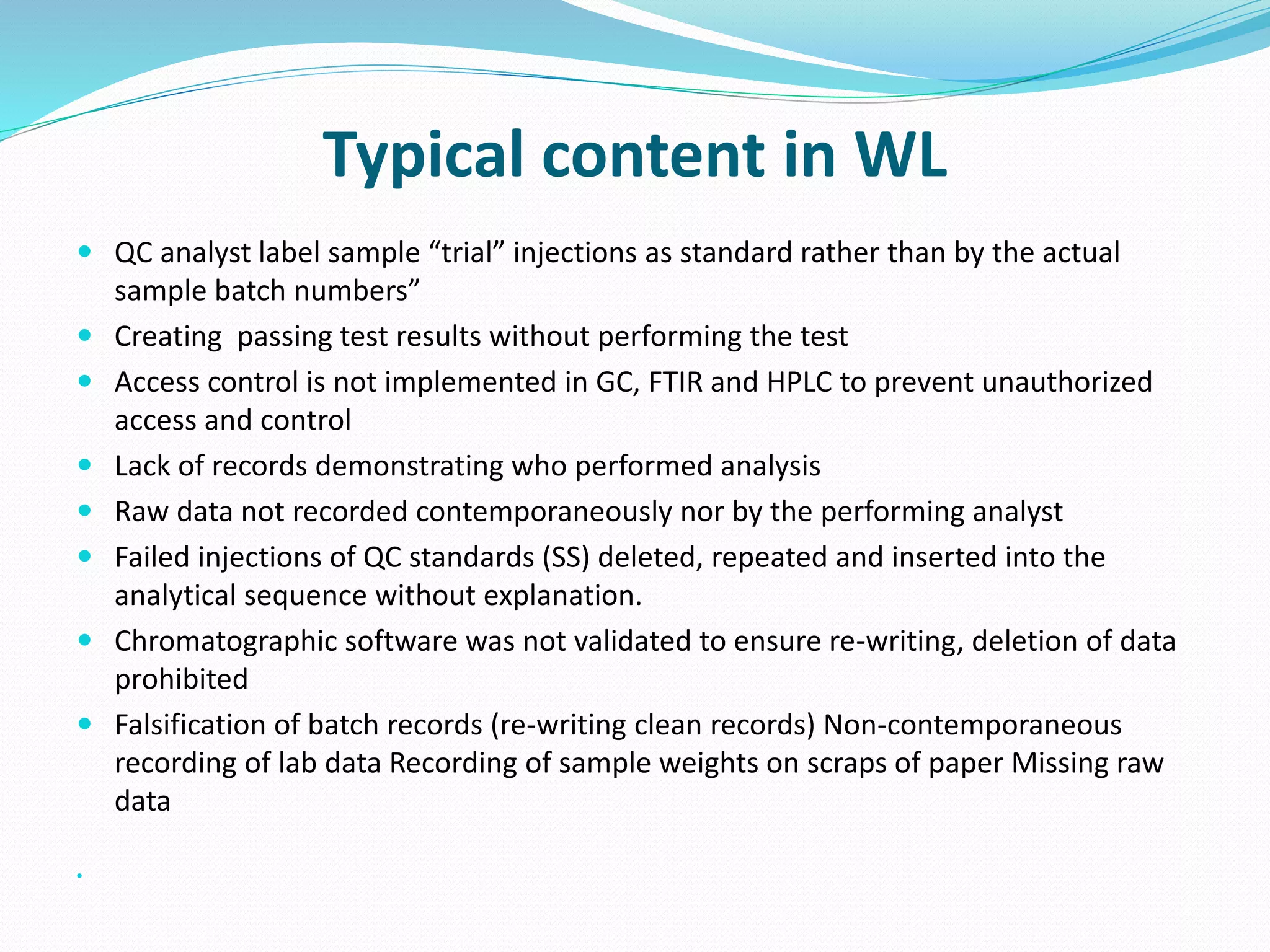
 QC analyst label sample “trial” injections as standard rather than by the actual
sample batch numbers”
 Creating passing test results without performing the test
 Access control is not implemented in GC, FTIR and HPLC to prevent unauthorized
access and control
 Lack of records demonstrating who performed analysis
 Raw data not recorded contemporaneously nor by the performing analyst
 Failed injections of QC standards (SS) deleted, repeated and inserted into the
analytical sequence without explanation.
 Chromatographic software was not validated to ensure re-writing, deletion of data
prohibited
 Falsification of batch records (re-writing clean records) Non-contemporaneous
recording of lab data Recording of sample weights on scraps of paper Missing raw
data

Typical content in WL
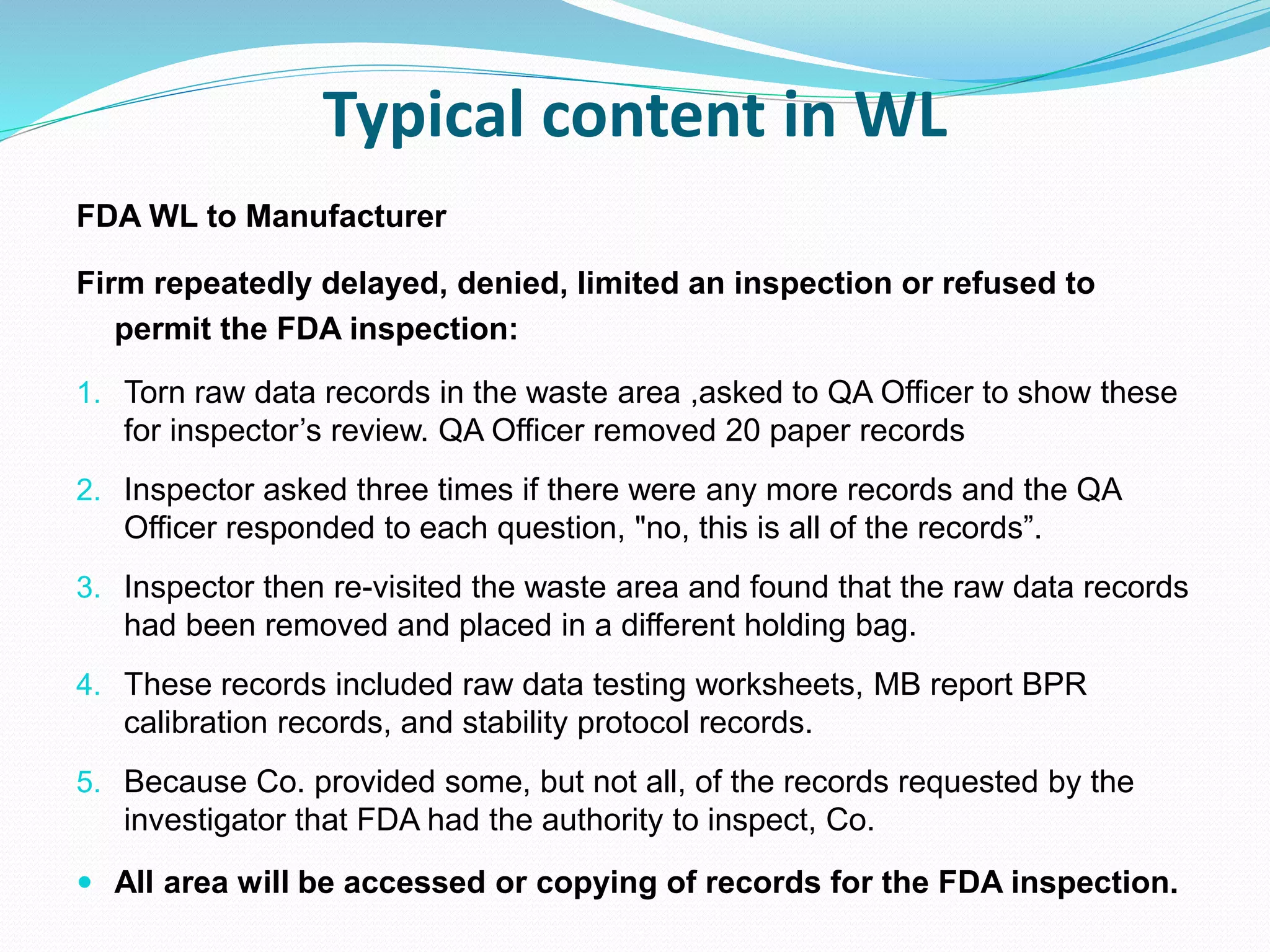
FDA WL to Manufacturer
Firm repeatedly delayed, denied, limited an inspection or refused to
permit the FDA inspection:
1. Torn raw data records in the waste area ,asked to QA Officer to show these
for inspector’s review. QA Officer removed 20 paper records
2. Inspector asked three times if there were any more records and the QA
Officer responded to each question, "no, this is all of the records”.
3. Inspector then re-visited the waste area and found that the raw data records
had been removed and placed in a different holding bag.
4. These records included raw data testing worksheets, MB report BPR
calibration records, and stability protocol records.
5. Because Co. provided some, but not all, of the records requested by the
investigator that FDA had the authority to inspect, Co.
 All area will be accessed or copying of records for the FDA inspection.
Data Integrity - Implementation
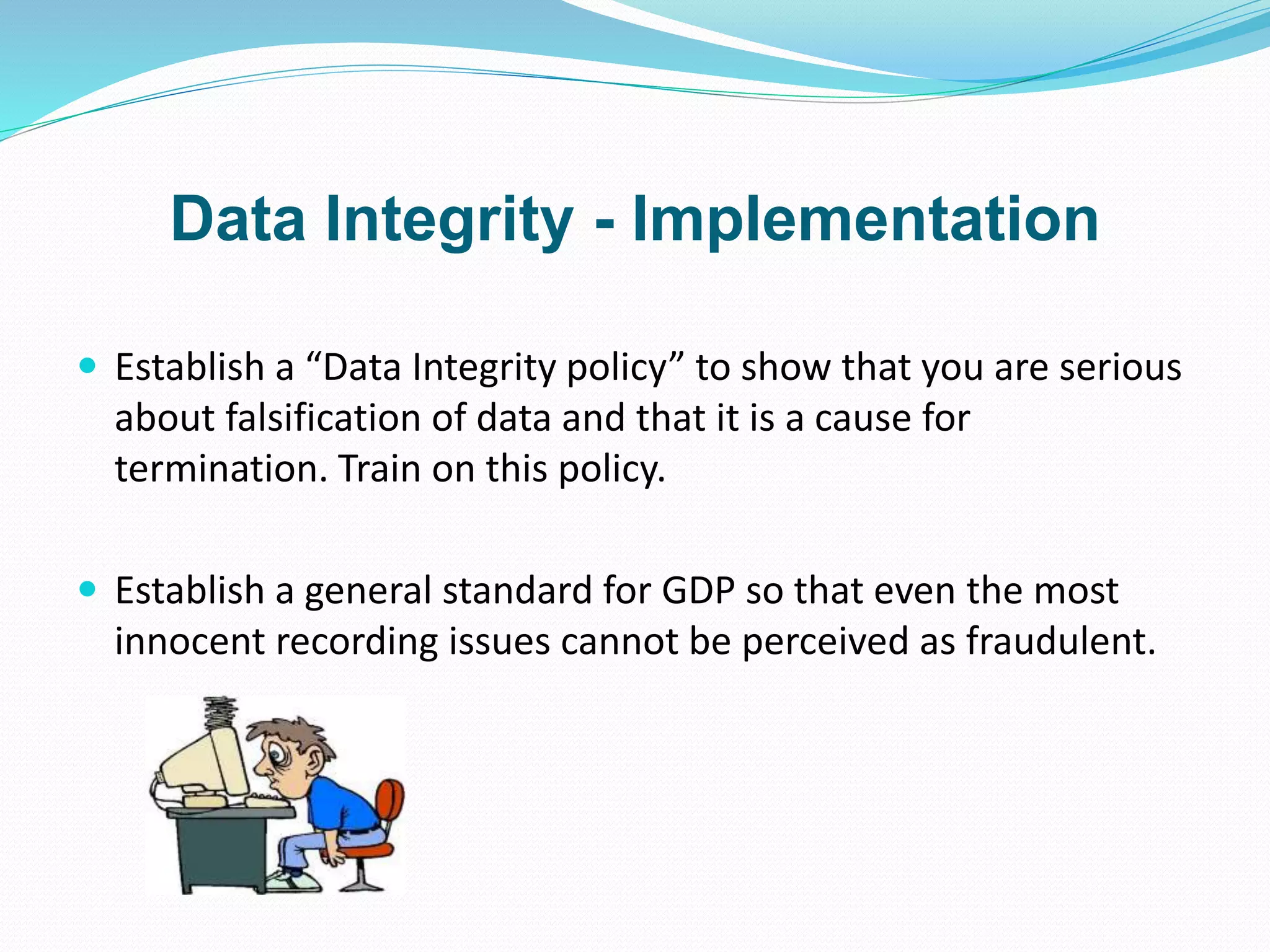
 Establish a “Data Integrity policy” to show that you are serious
about falsification of data and that it is a cause for
termination. Train on this policy.
 Establish a general standard for GDP so that even the most
innocent recording issues cannot be perceived as fraudulent.
Data Integrity - Implementation
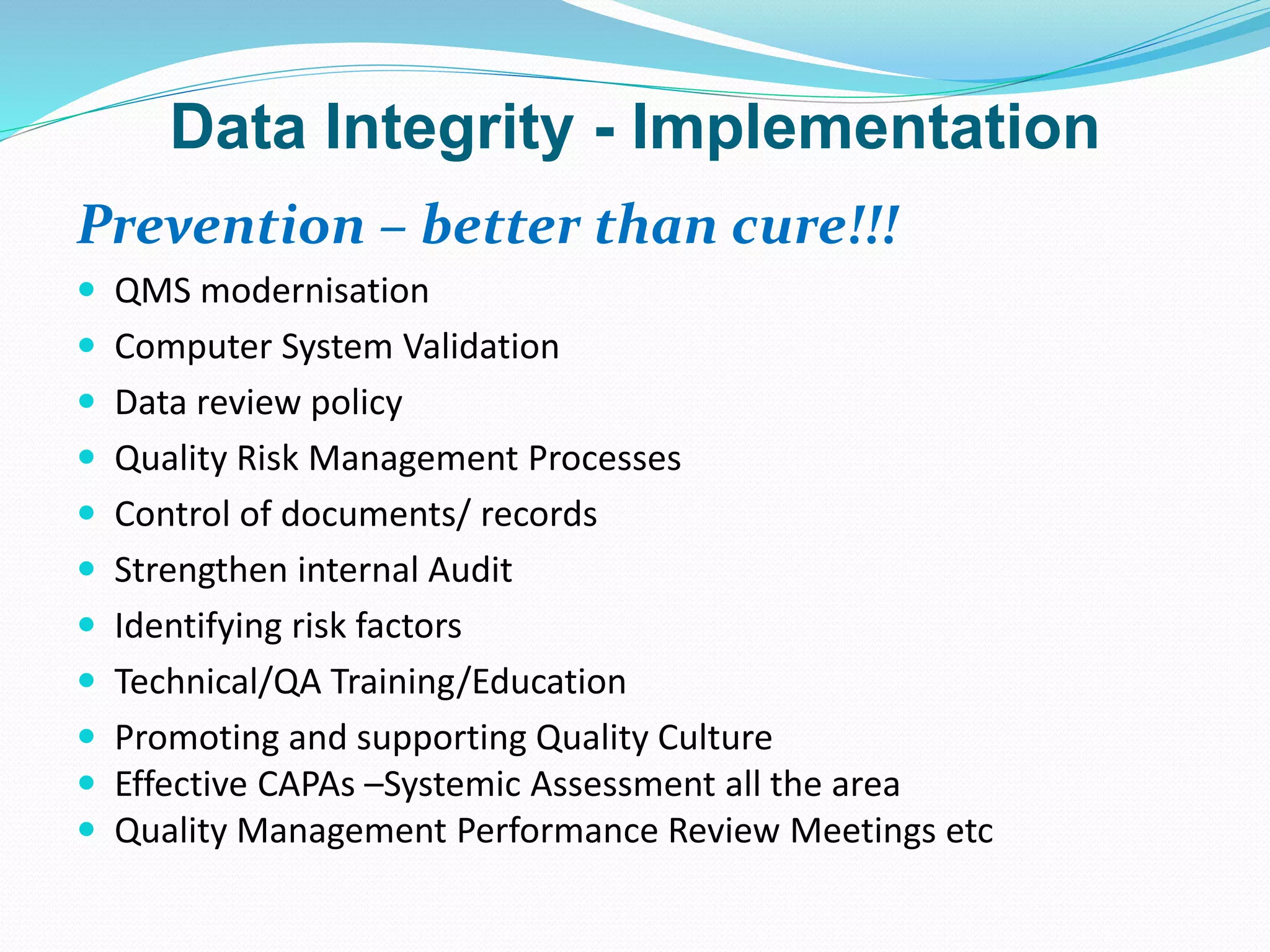
Prevention – better than cure!!!
 QMS modernisation
 Computer System Validation
 Data review policy
 Quality Risk Management Processes
 Control of documents/ records
 Strengthen internal Audit
 Identifying risk factors
 Technical/QA Training/Education
 Promoting and supporting Quality Culture
 Effective CAPAs –Systemic Assessment all the area
 Quality Management Performance Review Meetings etc
Data Integrity - Implementation
 Be Honest
 Record all the data in a contemporaneous manner and sign
 Enter the date & time as per procedure
 Any error shall be corrected as per GDP
 Any changes should be noted, with reason and non repudiated
 Data shall accurately reflect who performed or witnessed the
activity or who entered results or verified the accuracy of entries.
Never record the signature or initials of another person
 Never pre-date or back date entries on any record
 Computer system shall be trustworthy, validated, ensure access
control & audit trail
Let us Question ourselves
 Are we compliant with the ALCOA Principles in our daily work?
 Do we meet the requirements of regulatory Guidelines?
 Where do we have problems or deviations regarding data integrity?
 Which employees have difficulties with implementation?
 Do we live by the principles of a comprehensive quality culture?
 Is quality a critical factor for the company’s decision processes?
Questions?

Data Integrity

  • 1.
  • 2.
    Presentation Overview  Whatis Data Integrity?  Regulatory Environments  Data Integrity Principles  ALCOA Principles  Basic Data Integrity Expectations  Data Integrity examples and WL  Implementation
  • 3.
    Definition -MHRA Data: Information derivedor obtained from raw data, for example a reported analytical result (MHRA, 2015) Data Integrity: The extent to which all data are complete, consistent and accurate throughout the data lifecycle. Note: 1. Data can be ‘electronic’ or ‘paper based’ or ‘Hybrid’ 2. Data lifecycle :From initial data generation and recording through processing (including transformation or migration), use, retention, archiving, retrieval and destruction
  • 5.
    Why Data Integrity •Assures the quality, safety and efficacy of the drugs • The documented data is the only record of the activity presenting the quality of the product • Reliability of the data presented • Questioning Data Integrity = Loss of Trust • FDA Hot Topic – “Guilty until Proven Innocent” • Submitting false data to the FDA is a criminal violation under FD&C Act (CGMP /adulteration provisions)
  • 6.
    Consequence of DI •Warning letter • Import alert • Consent degree • No further approvals • Debarment / imprisonment –individual
  • 7.
    What are leadto Data integrity Examples  Discarding source documents after accurate transcription  Deleting e-files after Printing  Inaction, inattention to detail & lack of supervision  Data manipulation  Data falsification,  Misrepresentation  Withholding critical information and etc..
  • 8.
    Data Integrity –Regulatory requirement – FDA September 1991: Application Integrity Policy – Fraud, Untrue Statements of Material Facts, Bribery, and Illegal Gratuities – MHRA Guidance March 2015: GMP Data Integrity Definitions and Guidance for Industry – WHO Guidance September 2015: Good Data and Record Management Practices – FDA Guidance for Industry April 2016: Data Integrity and Compliance With CGMP – PICS August 2016: Good Practices for Data Management and Integrity in Regulated GMP/GDP Environments – EMA Questions & Answers August 2016
  • 9.
    EDQM : Critical/ Major Deficiencies India Manufacturers 2013 – 2016 20 22 715 11 5 18 2 Data integrity. Sterility & Contamination Training QA & QC Equip. Qual.& Process validation CAPA Facility & Production Operation Supplier & material
  • 11.
    MHRA -Data IntegrityDefinitions and Guidance  Data Integrity is the extent to which all data are complete, consistent and accurate throughout the data lifecycle.  4.7 Handwritten entries should be made in a clear, legible, indelible way.  4.8 Records should be made or completed at the time each action is taken and in such a way that all significant activities concerning the manufacture of medicinal products are traceable.  4.9 Any alteration made to the entry on a document should be signed and dated; the alteration should permit the reading of the original information. Where appropriate, the reason for the alteration should be recorded.
  • 12.
    MHRA -Data IntegrityDefinitions and Guidance  “The effort and resource assigned to data governance should be commensurate with the risk to product quality,  Also be balanced with other quality assurance resource demands.  Manufacturers and analytical laboratories are not expected to implement a forensic approach to data checking on a routine basis, but instead design and operate a system which provides an acceptable state of control based on the data integrity risk, and which is fully documented with supporting rationale.”
  • 13.
    How to Designa system to ensure data Integrity Systems should be designed to assure data integrity. Examples not limited to ; • Access to clocks for recording timed events • Accessibility of batch records at locations where activities take place so that adhoc data recording and later transcription to official records is not necessary • Control over blank paper/ templates for data recording • User access rights which prevent (or audit trail) data amendments • Automated data capture or printers attached to equipment such as balances • Proximity of printers to relevant activities • Access to sampling points / displays/ measuring devices • Access to raw data for staff for review
  • 14.
    Data Integrity asper USFDA Data integrity is critical to regulatory compliance, and the fundamental reason for 21 CFR Part 11. A - Attributable L – Legible C – Contemporaneous O – Original A - Accurate
  • 15.
    ALCOA principle ALCOA isan acronym representing the following data integrity elements:  Attributable – Who performed and when?  Legible – Can it be read? Permanent Record  Contemporaneous – Recorded at the time the activity was performed  Original – Original record or certified true copy  Accurate – Error free
  • 16.
    ALCOA Description ALCOA Description/Explanation AAttributable Who performed an action and when? If a record is amended / changed, who did it and why? Why- reason & explain in detail Traceable to the source data. L Legible Data shall be recorded permanently Record shall be durable & readable. C Contempora neous The data shall be recorded at the time the work is performed. Signature / initial with date O Original Is the information the original record or a certified true copy? A Accurate No errors or if editing shall be amended properly
  • 17.
    ALCOA + ALCOA +Description/Explanation 1 Complete All data including repeat or reanalysis performed on the sample. 2 Consistent Consistent application of data time stamps in the expected sequence 3 Enduring & Recorded on controlled worksheets, laboratory notebooks, or electronic media. 4 Available Available/accessible for review/audit for the lifetime of the record.
  • 18.
    Data integrity issues Backdating/Postdating/Missing Signatures • Fabricating/faking data • Copying existing data as new data • Releasing failing product • Hiding/obscuring SOP or protocol deviations • Not saving electronic or hard copy data • Inadequate reporting of failure and deviation • Use of non-validated software • Mismatch between reported data and actual data • No links/traceability to source documents or original data
  • 19.
    Data integrity issues •Re-running samples / Test until release/ No /Inappropriate Audit Trail • Inadequate Access Authorization/ Privileges • Discarding Deleting of data/ omitting negative data (like OOS or eliminating outliers) • Not reporting failing results /stability failures • Conducting unofficial analysis • Disabling audit trails in electronic data capture systems • Fabricating training data • Having unofficial batch sheets and analytical reports This is not related to training or understanding a particular technical or quality concept but mainly related to honesty and ethical issues.
  • 20.
    Data Integrity:  Understandthe difference between falsification and Bad/Poor Document Practice  Human errors data entered by mistake  Ignorance (not aware of regulatory requirements )  Wilfully (falsification or fraud with the intent to deceive)  Reporting only passing results by excluding failing results ?  Unauthorised changes to data post acquisition ?  Errors during transmission from one computer to another  Changes due to software bugs or malware of which the user is unaware  Hardware malfunctions
  • 21.
    Typical content inWL  Firm did not identify, report, or investigate the out-of- specification (OOS) results.  Firm did not retain any raw data related to sample weights and sample solution preparations for the HPLC assays….  Repeated the analysis next day using a new set of sample solutions, and reported the retest results in COA  Firm deleted /disregarded OOS data without investigations, and selectively reported only passing results.  During inspection, QC Chemist admitted that, under the direction of a senior colleague, he had recorded false data in the logbooks for reserve samples
  • 22.
    Typical content inWL  Failing to investigate consumer complaints.  Failing to extend their investigations of problems into all lots of product that were affected  The FDA found an operator performing in process weight checks memorizing two " weights" , going to the next room where the batch records are kept and documenting  The documentation is first done on loose sheets of paper and recorded in batch record.
  • 23.
    Typical content inWL  QC analyst label sample “trial” injections as standard rather than by the actual sample batch numbers”  Creating passing test results without performing the test  Access control is not implemented in GC, FTIR and HPLC to prevent unauthorized access and control  Lack of records demonstrating who performed analysis  Raw data not recorded contemporaneously nor by the performing analyst  Failed injections of QC standards (SS) deleted, repeated and inserted into the analytical sequence without explanation.  Chromatographic software was not validated to ensure re-writing, deletion of data prohibited  Falsification of batch records (re-writing clean records) Non-contemporaneous recording of lab data Recording of sample weights on scraps of paper Missing raw data 
  • 24.
    Typical content inWL FDA WL to Manufacturer Firm repeatedly delayed, denied, limited an inspection or refused to permit the FDA inspection: 1. Torn raw data records in the waste area ,asked to QA Officer to show these for inspector’s review. QA Officer removed 20 paper records 2. Inspector asked three times if there were any more records and the QA Officer responded to each question, "no, this is all of the records”. 3. Inspector then re-visited the waste area and found that the raw data records had been removed and placed in a different holding bag. 4. These records included raw data testing worksheets, MB report BPR calibration records, and stability protocol records. 5. Because Co. provided some, but not all, of the records requested by the investigator that FDA had the authority to inspect, Co.  All area will be accessed or copying of records for the FDA inspection.
  • 25.
    Data Integrity -Implementation  Establish a “Data Integrity policy” to show that you are serious about falsification of data and that it is a cause for termination. Train on this policy.  Establish a general standard for GDP so that even the most innocent recording issues cannot be perceived as fraudulent.
  • 26.
    Data Integrity -Implementation Prevention – better than cure!!!  QMS modernisation  Computer System Validation  Data review policy  Quality Risk Management Processes  Control of documents/ records  Strengthen internal Audit  Identifying risk factors  Technical/QA Training/Education  Promoting and supporting Quality Culture  Effective CAPAs –Systemic Assessment all the area  Quality Management Performance Review Meetings etc
  • 27.
    Data Integrity -Implementation  Be Honest  Record all the data in a contemporaneous manner and sign  Enter the date & time as per procedure  Any error shall be corrected as per GDP  Any changes should be noted, with reason and non repudiated  Data shall accurately reflect who performed or witnessed the activity or who entered results or verified the accuracy of entries. Never record the signature or initials of another person  Never pre-date or back date entries on any record  Computer system shall be trustworthy, validated, ensure access control & audit trail
  • 28.
    Let us Questionourselves  Are we compliant with the ALCOA Principles in our daily work?  Do we meet the requirements of regulatory Guidelines?  Where do we have problems or deviations regarding data integrity?  Which employees have difficulties with implementation?  Do we live by the principles of a comprehensive quality culture?  Is quality a critical factor for the company’s decision processes?
  • 30.