Data Integrity Concepts
Agenda
• Introduction to data, types and its lifecycle
• Data Integrity – definition, objectives and types
• ALCOA+ principle
• Data Governance
• Data Integrity vs Data Quality
• Ensuring Data Integrity
• Key Steps to ensure Data Integrity
• Advantages of Data Integrity
• Data Integrity Violations
• Causes of Data Integrity Violations
• Prevention Factors
• Consequences of Data Integrity Breach
• Warning Letters
• Responding to DI breaches
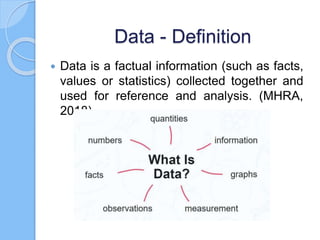
Data - Definition
 Data is a factual information (such as facts,
values or statistics) collected together and
used for reference and analysis. (MHRA,
2018)
Types of Data
Raw Data
Source Data
Meta Data
Raw Data
 Raw data is the data originally
generated by a system, device or
operation, that can be captured either
electronically or recorded on paper
manually. (MHRA, 2015)
 Example: Laboratory worksheets,
records, memoranda, notes, or exact
copies of original observations
Source Data
 Source data is also raw data that is
captured/recorded and has not been
processed/converted into a
meaningful information.
 Example: Manually written values
such as air temperature
measurements that are needed to
converted into an excel file.
Meta Data
 Meta data can be used to describe
information such as file type, format,
author, user rights, etc. and is
usually attached to files, but invisible
to the user. (ISPE, GAMP 5)
 Examples: Author name, date
created, date modified, and file size.
Data Lifecycle
Understanding about Data
Integrity
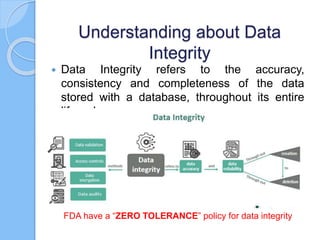
 Data Integrity refers to the accuracy,
consistency and completeness of the data
stored with a database, throughout its entire
lifecycle.
FDA have a “ZERO TOLERANCE” policy for data integrity
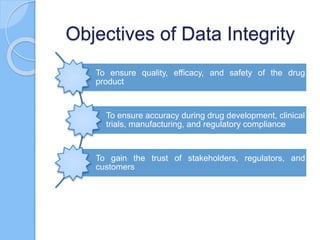
Objectives of Data Integrity
To ensure quality, efficacy, and safety of the drug
product
To ensure accuracy during drug development, clinical
trials, manufacturing, and regulatory compliance
To gain the trust of stakeholders, regulators, and
customers
Types of Data Integrity
Domain Integrity
• Domain integrity requires that each set of data
values/columns falls within a specific permissible
defined range.
Entity Integrity
• Entity integrity is concerned with non-duplication of
records and that each row in a table is uniquely
identified.
Referential integrity
• Referential integrity is concerned with maintaining
the relationships between tables.
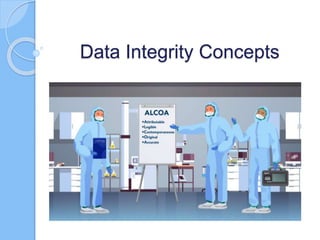
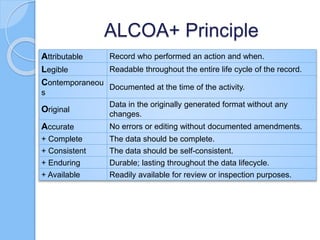
ALCOA+ Principle
Attributable Record who performed an action and when.
Legible Readable throughout the entire life cycle of the record.
Contemporaneou
s
Documented at the time of the activity.
Original
Data in the originally generated format without any
changes.
Accurate No errors or editing without documented amendments.
+ Complete The data should be complete.
+ Consistent The data should be self-consistent.
+ Enduring Durable; lasting throughout the data lifecycle.
+ Available Readily available for review or inspection purposes.
Data Governance
 Data governance is the practice of
creating, updating and consistently
enforcing the processes, rules and
standards that prevent errors, data
loss, data corruption, mishandling of
sensitive or regulated data, and data
breaches.
Data Integrity vs Data Quality
Ensuring Data Integrity
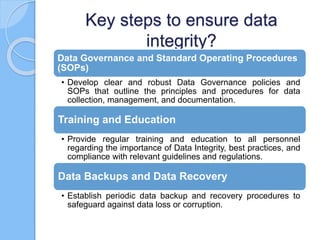
Key steps to ensure data
integrity?
Data Governance and Standard Operating Procedures
(SOPs)
• Develop clear and robust Data Governance policies and
SOPs that outline the principles and procedures for data
collection, management, and documentation.
Training and Education
• Provide regular training and education to all personnel
regarding the importance of Data Integrity, best practices, and
compliance with relevant guidelines and regulations.
Data Backups and Data Recovery
• Establish periodic data backup and recovery procedures to
safeguard against data loss or corruption.
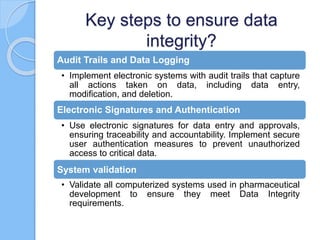
Key steps to ensure data
integrity?
Audit Trails and Data Logging
• Implement electronic systems with audit trails that capture
all actions taken on data, including data entry,
modification, and deletion.
Electronic Signatures and Authentication
• Use electronic signatures for data entry and approvals,
ensuring traceability and accountability. Implement secure
user authentication measures to prevent unauthorized
access to critical data.
System validation
• Validate all computerized systems used in pharmaceutical
development to ensure they meet Data Integrity
requirements.
Key steps to ensure data
integrity?
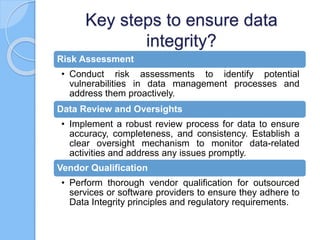
Risk Assessment
• Conduct risk assessments to identify potential
vulnerabilities in data management processes and
address them proactively.
Data Review and Oversights
• Implement a robust review process for data to ensure
accuracy, completeness, and consistency. Establish a
clear oversight mechanism to monitor data-related
activities and address any issues promptly.
Vendor Qualification
• Perform thorough vendor qualification for outsourced
services or software providers to ensure they adhere to
Data Integrity principles and regulatory requirements.
Key steps to ensure data
integrity?
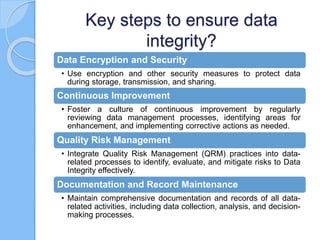
Data Encryption and Security
• Use encryption and other security measures to protect data
during storage, transmission, and sharing.
Continuous Improvement
• Foster a culture of continuous improvement by regularly
reviewing data management processes, identifying areas for
enhancement, and implementing corrective actions as needed.
Quality Risk Management
• Integrate Quality Risk Management (QRM) practices into data-
related processes to identify, evaluate, and mitigate risks to Data
Integrity effectively.
Documentation and Record Maintenance
• Maintain comprehensive documentation and records of all data-
related activities, including data collection, analysis, and decision-
making processes.
Advantages of Data Integrity
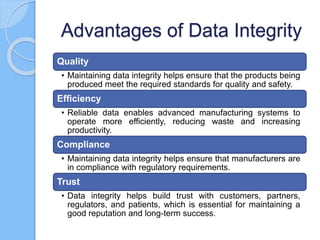
Quality
• Maintaining data integrity helps ensure that the products being
produced meet the required standards for quality and safety.
Efficiency
• Reliable data enables advanced manufacturing systems to
operate more efficiently, reducing waste and increasing
productivity.
Compliance
• Maintaining data integrity helps ensure that manufacturers are
in compliance with regulatory requirements.
Trust
• Data integrity helps build trust with customers, partners,
regulators, and patients, which is essential for maintaining a
good reputation and long-term success.
Data Integrity Violations
 Improper data access and security
control
 Legacy systems and outdated
procedures
 Incomplete/Inaccurate data recording
 Erroneous, false and edited data/reports
 Record deletion
 Human Errors
 Lack of audit trails and their review
 Orphan and unreported data
 Inadequate third-party management
 Improper environmental monitoring
measures
Causes of Data Integrity
Violations
 Lack of employee technical knowledge
 Reliance on legacy systems and outdated
procedures
 Poor quality culture, organizational or
individual behaviour, leadership, processes,
or technology
 Internal pressure to achieve key performance
indicators (KPIs)
 Shortcuts through an overly bureaucratic
process
 Confusion in a fragmented system
 Professional ignorance
 Lack of awareness of SOPs and compliance-
related requirements
Prevention Factors
Prevent
Employee Training
Validation
Access control
Data quality checks
Periodic audit and review
Vendor qualification
Consequences of Data Integrity
Breach
 Productivity and revenue loss
 Warning Letters from regulatory bodies
 Prosecution (including indictments and temporary or permanent
debarment)
 Post-marketing issues
 Frequent product recalls
 Seizure
 Consent decree of permanent injunction
 Civil money penalties
 Import alerts
 Withheld product approvals
 Cancellation of government contracts
 Loss of brand reputation in the market
 Loss of customer’s trust
 Suspension or revocation of licenses
 Closing or take-over company
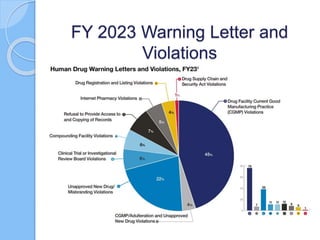
FY 2023 FDA DI Warning Letter
Statistics
FY 2023 Warning Letter and
Violations
2024 FDA Warning Letters
 In a letter issued to China-based Sichuan Deebio
Pharmaceutical Co. Ltd on 5 February, FDA stated
the company failed to ensure the integrity of data
generated by the QC microbiology laboratory.
 A separate letter issued to Amman Pharmaceutical
Industries of Jordan on 14 February detailed issues
with environmental monitoring at their facility.
 The FDA also wrote to S & J International
Enterprises Public Company Limited in January,
stating that the company’s quality system “does not
adequately ensure the accuracy and integrity of
data to support the safety, effectiveness, and
quality of the drugs.
Sun Pharma – FDA Warning
 In 2014, Sun Pharma faced scrutiny and
legal issues related to quality control and
compliance with regulatory standards at its
manufacturing facilities.
 The United States Food and Drug
Administration (FDA) had issued warning
letters to Sun Pharma for violations of good
manufacturing practices (GMP) at its
facilities in Gujarat, India.
 These violations included issues related to
data integrity, quality control procedures, and
manufacturing practices.
Wockhardt – FDA Warning
 In 2013, Wockhardt faced similar
challenges when the FDA issued warning
letters to its manufacturing facilities in
Waluj and Chikalthana, Maharashtra,
India.
 The warning letters cited violations of
GMP regulations, including inadequate
control over manufacturing processes,
quality assurance systems, and
documentation practices.
Responding to DI breaches
 Develop Data Integrity Policy and
Procedures to address data ownership
throughout the lifecycle
 Consider the design, operation and
monitoring of processes / including control
over intentional and unintentional changes to
information
 Investigate, correct & prevent deviations and
abnormalities
 If warranted, conduct an in-depth
documented investigation of any alleged
instance of falsification, fabrication, or other
misconduct involving data integrity issues
Data Integrity Concepts - Without Logo.pptx

Data Integrity Concepts - Without Logo.pptx

  • 1.
  • 2.
    Agenda • Introduction todata, types and its lifecycle • Data Integrity – definition, objectives and types • ALCOA+ principle • Data Governance • Data Integrity vs Data Quality • Ensuring Data Integrity • Key Steps to ensure Data Integrity • Advantages of Data Integrity • Data Integrity Violations • Causes of Data Integrity Violations • Prevention Factors • Consequences of Data Integrity Breach • Warning Letters • Responding to DI breaches
  • 3.
    Data - Definition Data is a factual information (such as facts, values or statistics) collected together and used for reference and analysis. (MHRA, 2018)
  • 4.
    Types of Data RawData Source Data Meta Data
  • 5.
    Raw Data  Rawdata is the data originally generated by a system, device or operation, that can be captured either electronically or recorded on paper manually. (MHRA, 2015)  Example: Laboratory worksheets, records, memoranda, notes, or exact copies of original observations
  • 6.
    Source Data  Sourcedata is also raw data that is captured/recorded and has not been processed/converted into a meaningful information.  Example: Manually written values such as air temperature measurements that are needed to converted into an excel file.
  • 7.
    Meta Data  Metadata can be used to describe information such as file type, format, author, user rights, etc. and is usually attached to files, but invisible to the user. (ISPE, GAMP 5)  Examples: Author name, date created, date modified, and file size.
  • 8.
  • 9.
    Understanding about Data Integrity Data Integrity refers to the accuracy, consistency and completeness of the data stored with a database, throughout its entire lifecycle. FDA have a “ZERO TOLERANCE” policy for data integrity
  • 10.
    Objectives of DataIntegrity To ensure quality, efficacy, and safety of the drug product To ensure accuracy during drug development, clinical trials, manufacturing, and regulatory compliance To gain the trust of stakeholders, regulators, and customers
  • 11.
    Types of DataIntegrity Domain Integrity • Domain integrity requires that each set of data values/columns falls within a specific permissible defined range. Entity Integrity • Entity integrity is concerned with non-duplication of records and that each row in a table is uniquely identified. Referential integrity • Referential integrity is concerned with maintaining the relationships between tables.
  • 12.
    ALCOA+ Principle Attributable Recordwho performed an action and when. Legible Readable throughout the entire life cycle of the record. Contemporaneou s Documented at the time of the activity. Original Data in the originally generated format without any changes. Accurate No errors or editing without documented amendments. + Complete The data should be complete. + Consistent The data should be self-consistent. + Enduring Durable; lasting throughout the data lifecycle. + Available Readily available for review or inspection purposes.
  • 13.
    Data Governance  Datagovernance is the practice of creating, updating and consistently enforcing the processes, rules and standards that prevent errors, data loss, data corruption, mishandling of sensitive or regulated data, and data breaches.
  • 14.
    Data Integrity vsData Quality
  • 15.
  • 16.
    Key steps toensure data integrity? Data Governance and Standard Operating Procedures (SOPs) • Develop clear and robust Data Governance policies and SOPs that outline the principles and procedures for data collection, management, and documentation. Training and Education • Provide regular training and education to all personnel regarding the importance of Data Integrity, best practices, and compliance with relevant guidelines and regulations. Data Backups and Data Recovery • Establish periodic data backup and recovery procedures to safeguard against data loss or corruption.
  • 17.
    Key steps toensure data integrity? Audit Trails and Data Logging • Implement electronic systems with audit trails that capture all actions taken on data, including data entry, modification, and deletion. Electronic Signatures and Authentication • Use electronic signatures for data entry and approvals, ensuring traceability and accountability. Implement secure user authentication measures to prevent unauthorized access to critical data. System validation • Validate all computerized systems used in pharmaceutical development to ensure they meet Data Integrity requirements.
  • 18.
    Key steps toensure data integrity? Risk Assessment • Conduct risk assessments to identify potential vulnerabilities in data management processes and address them proactively. Data Review and Oversights • Implement a robust review process for data to ensure accuracy, completeness, and consistency. Establish a clear oversight mechanism to monitor data-related activities and address any issues promptly. Vendor Qualification • Perform thorough vendor qualification for outsourced services or software providers to ensure they adhere to Data Integrity principles and regulatory requirements.
  • 19.
    Key steps toensure data integrity? Data Encryption and Security • Use encryption and other security measures to protect data during storage, transmission, and sharing. Continuous Improvement • Foster a culture of continuous improvement by regularly reviewing data management processes, identifying areas for enhancement, and implementing corrective actions as needed. Quality Risk Management • Integrate Quality Risk Management (QRM) practices into data- related processes to identify, evaluate, and mitigate risks to Data Integrity effectively. Documentation and Record Maintenance • Maintain comprehensive documentation and records of all data- related activities, including data collection, analysis, and decision- making processes.
  • 20.
    Advantages of DataIntegrity Quality • Maintaining data integrity helps ensure that the products being produced meet the required standards for quality and safety. Efficiency • Reliable data enables advanced manufacturing systems to operate more efficiently, reducing waste and increasing productivity. Compliance • Maintaining data integrity helps ensure that manufacturers are in compliance with regulatory requirements. Trust • Data integrity helps build trust with customers, partners, regulators, and patients, which is essential for maintaining a good reputation and long-term success.
  • 21.
    Data Integrity Violations Improper data access and security control  Legacy systems and outdated procedures  Incomplete/Inaccurate data recording  Erroneous, false and edited data/reports  Record deletion  Human Errors  Lack of audit trails and their review  Orphan and unreported data  Inadequate third-party management  Improper environmental monitoring measures
  • 22.
    Causes of DataIntegrity Violations  Lack of employee technical knowledge  Reliance on legacy systems and outdated procedures  Poor quality culture, organizational or individual behaviour, leadership, processes, or technology  Internal pressure to achieve key performance indicators (KPIs)  Shortcuts through an overly bureaucratic process  Confusion in a fragmented system  Professional ignorance  Lack of awareness of SOPs and compliance- related requirements
  • 23.
    Prevention Factors Prevent Employee Training Validation Accesscontrol Data quality checks Periodic audit and review Vendor qualification
  • 24.
    Consequences of DataIntegrity Breach  Productivity and revenue loss  Warning Letters from regulatory bodies  Prosecution (including indictments and temporary or permanent debarment)  Post-marketing issues  Frequent product recalls  Seizure  Consent decree of permanent injunction  Civil money penalties  Import alerts  Withheld product approvals  Cancellation of government contracts  Loss of brand reputation in the market  Loss of customer’s trust  Suspension or revocation of licenses  Closing or take-over company
  • 25.
    FY 2023 FDADI Warning Letter Statistics
  • 26.
    FY 2023 WarningLetter and Violations
  • 27.
    2024 FDA WarningLetters  In a letter issued to China-based Sichuan Deebio Pharmaceutical Co. Ltd on 5 February, FDA stated the company failed to ensure the integrity of data generated by the QC microbiology laboratory.  A separate letter issued to Amman Pharmaceutical Industries of Jordan on 14 February detailed issues with environmental monitoring at their facility.  The FDA also wrote to S & J International Enterprises Public Company Limited in January, stating that the company’s quality system “does not adequately ensure the accuracy and integrity of data to support the safety, effectiveness, and quality of the drugs.
  • 28.
    Sun Pharma –FDA Warning  In 2014, Sun Pharma faced scrutiny and legal issues related to quality control and compliance with regulatory standards at its manufacturing facilities.  The United States Food and Drug Administration (FDA) had issued warning letters to Sun Pharma for violations of good manufacturing practices (GMP) at its facilities in Gujarat, India.  These violations included issues related to data integrity, quality control procedures, and manufacturing practices.
  • 29.
    Wockhardt – FDAWarning  In 2013, Wockhardt faced similar challenges when the FDA issued warning letters to its manufacturing facilities in Waluj and Chikalthana, Maharashtra, India.  The warning letters cited violations of GMP regulations, including inadequate control over manufacturing processes, quality assurance systems, and documentation practices.
  • 30.
    Responding to DIbreaches  Develop Data Integrity Policy and Procedures to address data ownership throughout the lifecycle  Consider the design, operation and monitoring of processes / including control over intentional and unintentional changes to information  Investigate, correct & prevent deviations and abnormalities  If warranted, conduct an in-depth documented investigation of any alleged instance of falsification, fabrication, or other misconduct involving data integrity issues