www.ngsmips.nitte.edu.in
CGMP
Current Good Manufacturing Practices
Department of Regulatory Affairs
NGSMIPS, Nitte University
Mangalore
- Swapnil Dylan Fernandes
1
What is CGMP ?
• Current Good Manufacturing Practice regulations enforced by the US Food and
Drug Administration (FDA).
• Provides for systems that assure proper design, monitoring, and control of
manufacturing processes and facilities.
• Assures the identity, strength, quality, and purity of drug products.
• The "C" in CGMP stands for "current," requiring companies to use technologies
and systems that are up-to-date in order to comply with the regulations.
2
Importance of CGMP
• To assure that quality is built into the design and
manufacturing process at every step.
3
21 CFR Part 210
CURRENT GOOD MANUFACTURING PRACTICE IN
MANUFACTURING, PROCESSING, PACKING, OR HOLDING
OF DRUGS
• § 210.1 - Status of current good manufacturing practice regulations.
• § 210.2 - Applicability of current good manufacturing practice
regulations.
• § 210.3 - Definitions.
4
21 CFR Part 210
210.1 Status of the regulations
• Regulations set forth are “minimum” requirements!!!!
• Covers manufacturing, facilities and controls for Manufacturing,
processing, packaging or holding of a drug product
• Failure to comply will render the drug to be adulterated
• The person who is responsible for the failure to comply shall be
subject to regulatory action
5
21 CFR Part 210
210.2 Applicability of current good manufacturing practice
regulations.
• Applies to drug products for human use.
• If a person engages in only some operations subject to the
regulations in this part, and not in others, that person need only
comply with those regulations applicable to the operations in which
he or she is engaged.
6
21 CFR Part 210
210.3 Definitions
Act
-means the Federal Food, Drug, and Cosmetic Act.
Batch
-A specific quantity of drug/material intended to have uniform character and
quality produced under a single manufacturing order form during the same
cycle of manufacture.
Component
-Any ingredient intended for use INCLUDING those that may not appear in
such drug product.
Drug Product
- Finished dosage form
Fiber
- Any particulate with a length at least 3 times to its width
7
• Nonfibre releasing filter, will not release fibres into the component or
drug product that is being filtered.
• Active ingredient, Any component intended to furnish pharmacological
activity
• Drug is defined by the Act as any compound that has effect in the diagnosis,
cure, mitigation, treatment or prevention of disease or to affect the structure
or function of the body of man or animals
• In-process material, Any material fabricated, compounded, blended or
derived for use in the drug product.
• Lot means a batch, or a specific identified portion of a batch, having uniform
character and quality within specified limits
• Lot number, control number, or batch number means any
distinctive, from which the complete history of drug product or other material
can be determined.
8
• Acceptance criteria
• Representative sample
• Strength
• Gang-printed labelling means labelling derived from a sheet of
material on which more than one item of labelling is printed.
9
21 CFR Part 211
CURRENT GOOD MANUFACTURING PRACTICE FOR FINISHED
PHARMACEUTICALS
There are 11 subchapters
Identified by letters from A through K
Covers all sections of operations
Designed to be all encompassing (general) – DON’T
expect too many specific.
10
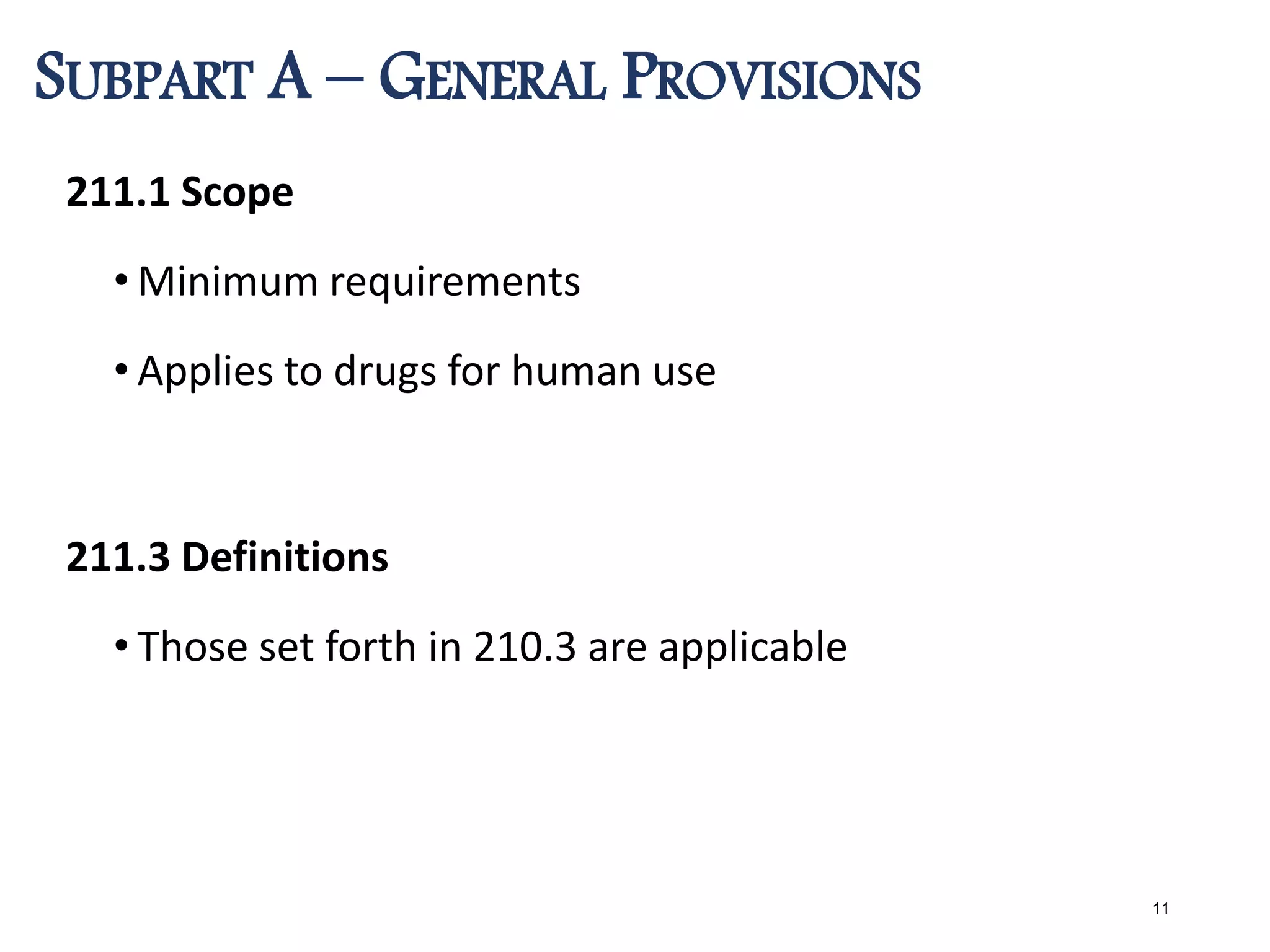
211.1 Scope
• Minimum requirements
• Applies to drugs for human use
211.3 Definitions
• Those set forth in 210.3 are applicable
SUBPART A – GENERAL PROVISIONS
11
SUBPART B – ORGANISATION & PERSONNEL
 211.22 - Responsibilities of quality control unit
211.25 - Personnel qualifications
 211.28 - Personnel responsibilities
 211.34 - Consultants.
12
SUBPART C – BUILDINGS AND FACILITIES
 211.42 - Design and construction features
 211.44 - Lighting
 211.46 - Ventilation, air filtration, air heating and cooling
 211.48 - Plumbing
 211.50 - Sewage and refuse
 211.52 - Washing and toilet facilities
 211.56 - Sanitation
 211.58 - Maintenance
13
SUBPART D – EQUIPMENT
 211.63 - Equipment design, size, and
location
 211.65 - Equipment construction
 211.67 - Equipment cleaning and
maintenance
 211.68 - Automatic, mechanical, and
electronic equipment
 211.72 - Filters
14
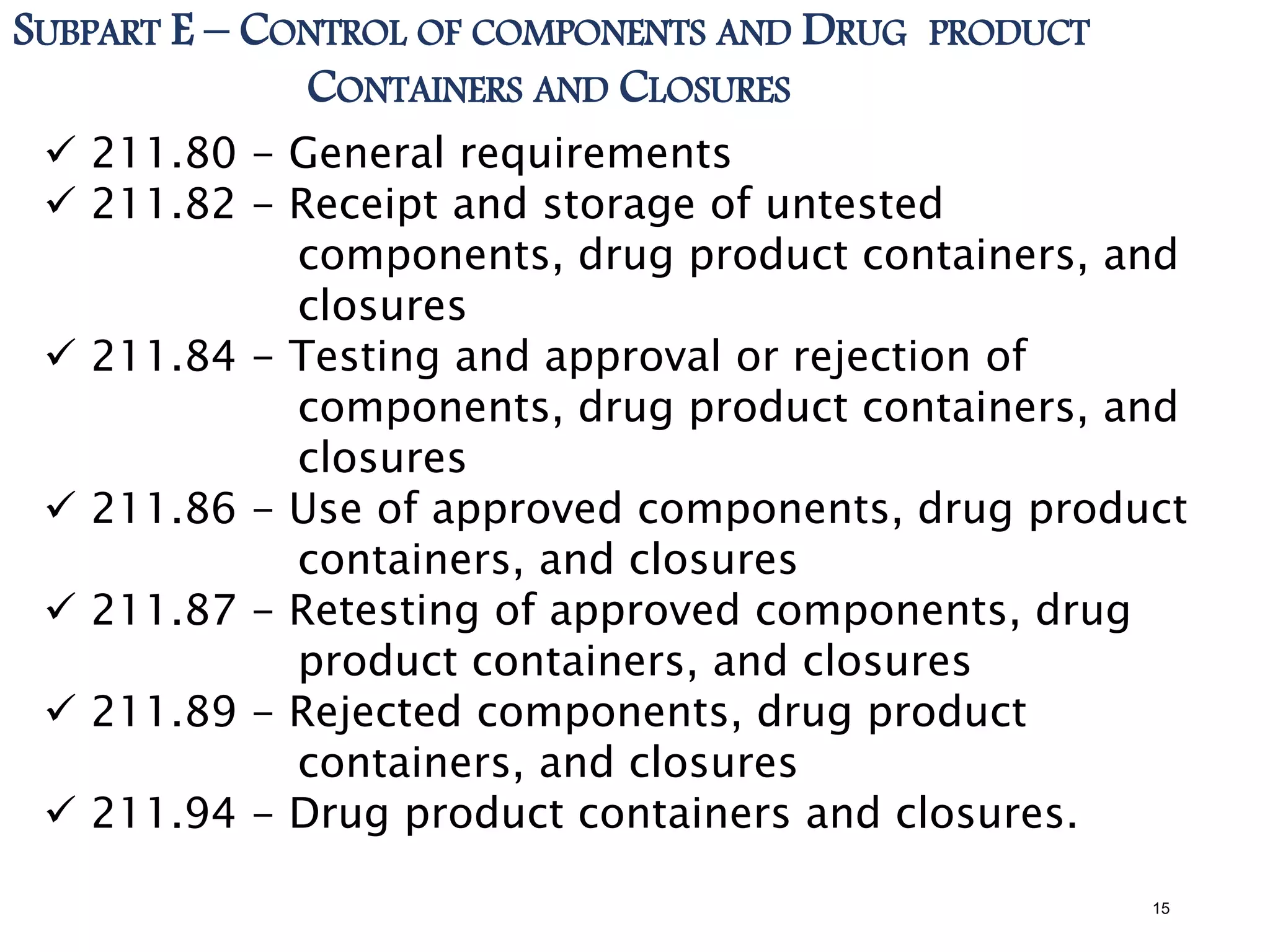
SUBPART E – CONTROL OF COMPONENTS AND DRUG PRODUCT
CONTAINERS AND CLOSURES
 211.80 - General requirements
 211.82 - Receipt and storage of untested
components, drug product containers, and
closures
 211.84 - Testing and approval or rejection of
components, drug product containers, and
closures
 211.86 - Use of approved components, drug product
containers, and closures
 211.87 - Retesting of approved components, drug
product containers, and closures
 211.89 - Rejected components, drug product
containers, and closures
 211.94 - Drug product containers and closures.
15
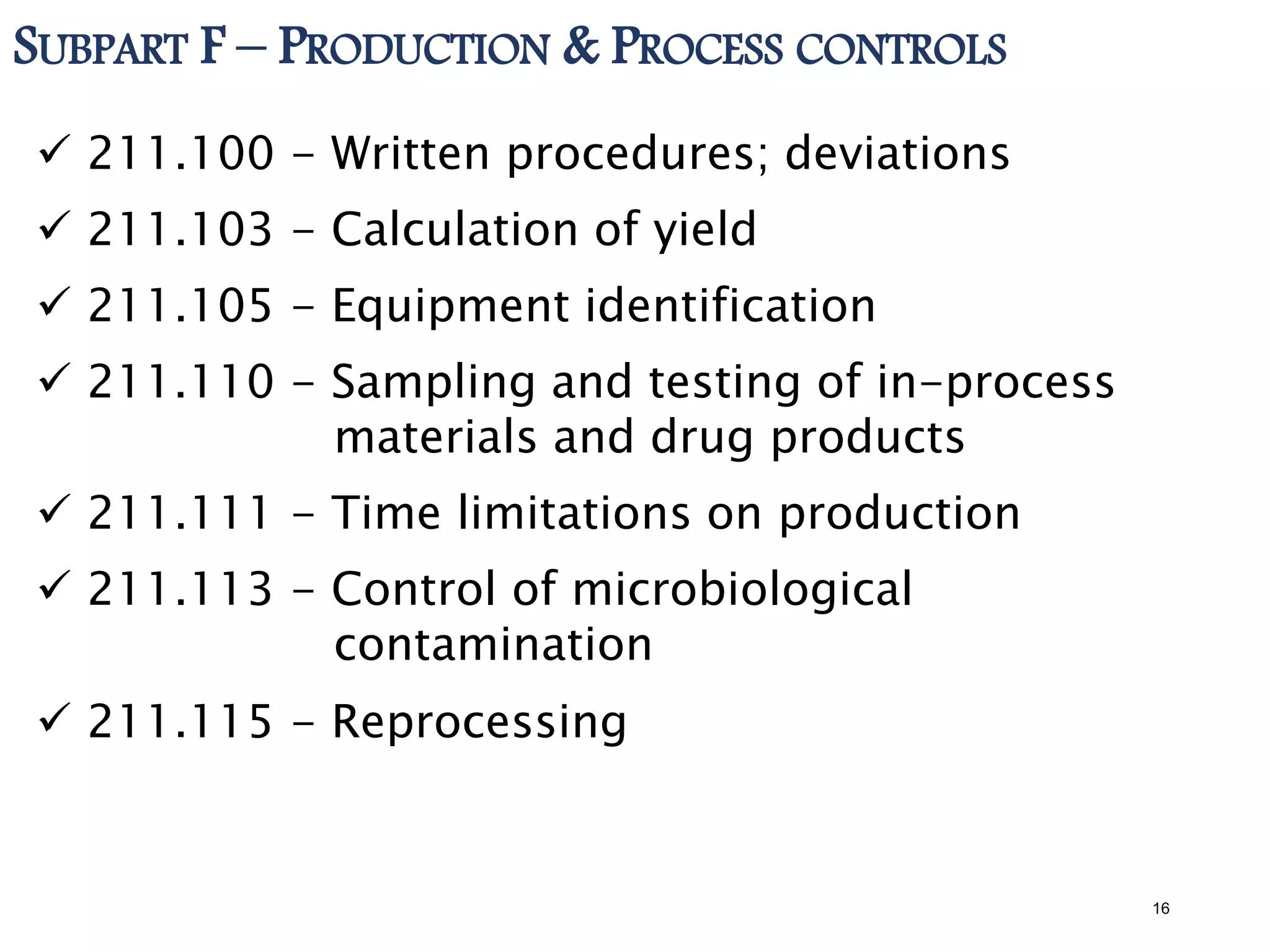
SUBPART F – PRODUCTION & PROCESS CONTROLS
 211.100 - Written procedures; deviations
 211.103 - Calculation of yield
 211.105 - Equipment identification
 211.110 - Sampling and testing of in-process
materials and drug products
 211.111 - Time limitations on production
 211.113 - Control of microbiological
contamination
 211.115 - Reprocessing
16
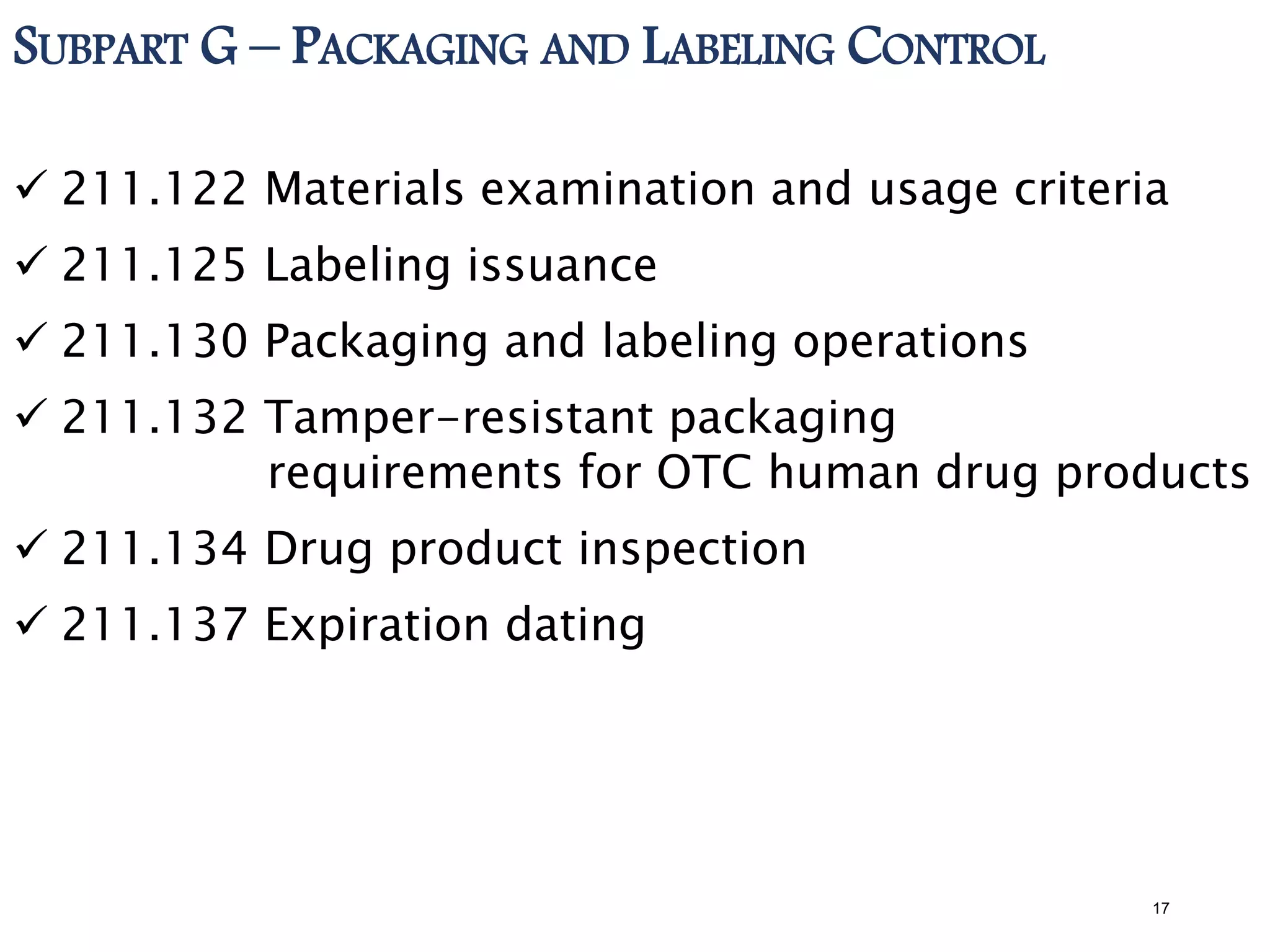
SUBPART G – PACKAGING AND LABELING CONTROL
 211.122 Materials examination and usage criteria
 211.125 Labeling issuance
 211.130 Packaging and labeling operations
 211.132 Tamper-resistant packaging
requirements for OTC human drug products
 211.134 Drug product inspection
 211.137 Expiration dating
17
SUBPART H – HOLDING AND DISTRIBUTION
 211.142 - Warehousing procedures
 211.150 - Distribution procedures
18
SUBPART I – LABORATORY CONTROLS
 211.160 - General requirements
 211.165 - Testing and release for distribution
 211.166 - Stability testing
 211.167 - Special testing requirements
 211.170 - Reserve samples
 211.173 - Laboratory animals
 211.176 - Penicillin contamination.
19
SUBPART J – RECORDS AND REPORTS
 211.180 - General requirements
 211.182 - Equipment cleaning and use log
 211.184 - Component, drug product container,
closure, and labeling records
 211.186 - Master production and control
records
 211.188 - Batch production and control records
 211.192 - Production record review
 211.194 - Laboratory records
 211.196 - Distribution records
 211.198 - Complaint files
20
 211.204 - Returned drug products
 211.208 - Drug product salvaging
SUBPART K – RETURNED AND SALVAGED DRUG PRODUCTS
21
CONCLUSION
CGMP compliance is not an option.
Quality should be built into the product right from the initial stage.
GMP's are very similar and are really Good Common Sense.
Good Practices cover all aspects of manufacturing activities prior to
supply.
The role and involvement of senior management is crucial.
The goal is to tell you
WHAT TO DO, NOT HOW TO DO it!
22
References
• https://www.fda.gov/drugs/developmentapprovalprocess/manufactu
ring/ucm090016.html, Current Good Manufacturing Practice
(CGMP) Regulations (Accessed on 13th September 2017)
• https://www.accessdata.fda.gov/scripts/cdrh/cfdocs/cfcfr/CFRSearch.
cfm?CFRPart=210 , 21 CFR Part 210 Guidelines (Accessed on 13th
September 2017)
• https://www.accessdata.fda.gov/scripts/cdrh/cfdocs/cfcfr/CFRSearch.
cfm?CFRPart=211 , 21 CFR Part 211 Guidelines (Accessed on 13th
September 2017)
• P.P. Sharma, How to Practice GMPs, 7th ed, New Delhi, Vallabh
Publishers; 2015
23
24

Current Good Manufacturing Practices

  • 1.
    www.ngsmips.nitte.edu.in CGMP Current Good ManufacturingPractices Department of Regulatory Affairs NGSMIPS, Nitte University Mangalore - Swapnil Dylan Fernandes 1
  • 2.
    What is CGMP? • Current Good Manufacturing Practice regulations enforced by the US Food and Drug Administration (FDA). • Provides for systems that assure proper design, monitoring, and control of manufacturing processes and facilities. • Assures the identity, strength, quality, and purity of drug products. • The "C" in CGMP stands for "current," requiring companies to use technologies and systems that are up-to-date in order to comply with the regulations. 2
  • 3.
    Importance of CGMP •To assure that quality is built into the design and manufacturing process at every step. 3
  • 4.
    21 CFR Part210 CURRENT GOOD MANUFACTURING PRACTICE IN MANUFACTURING, PROCESSING, PACKING, OR HOLDING OF DRUGS • § 210.1 - Status of current good manufacturing practice regulations. • § 210.2 - Applicability of current good manufacturing practice regulations. • § 210.3 - Definitions. 4
  • 5.
    21 CFR Part210 210.1 Status of the regulations • Regulations set forth are “minimum” requirements!!!! • Covers manufacturing, facilities and controls for Manufacturing, processing, packaging or holding of a drug product • Failure to comply will render the drug to be adulterated • The person who is responsible for the failure to comply shall be subject to regulatory action 5
  • 6.
    21 CFR Part210 210.2 Applicability of current good manufacturing practice regulations. • Applies to drug products for human use. • If a person engages in only some operations subject to the regulations in this part, and not in others, that person need only comply with those regulations applicable to the operations in which he or she is engaged. 6
  • 7.
    21 CFR Part210 210.3 Definitions Act -means the Federal Food, Drug, and Cosmetic Act. Batch -A specific quantity of drug/material intended to have uniform character and quality produced under a single manufacturing order form during the same cycle of manufacture. Component -Any ingredient intended for use INCLUDING those that may not appear in such drug product. Drug Product - Finished dosage form Fiber - Any particulate with a length at least 3 times to its width 7
  • 8.
    • Nonfibre releasingfilter, will not release fibres into the component or drug product that is being filtered. • Active ingredient, Any component intended to furnish pharmacological activity • Drug is defined by the Act as any compound that has effect in the diagnosis, cure, mitigation, treatment or prevention of disease or to affect the structure or function of the body of man or animals • In-process material, Any material fabricated, compounded, blended or derived for use in the drug product. • Lot means a batch, or a specific identified portion of a batch, having uniform character and quality within specified limits • Lot number, control number, or batch number means any distinctive, from which the complete history of drug product or other material can be determined. 8
  • 9.
    • Acceptance criteria •Representative sample • Strength • Gang-printed labelling means labelling derived from a sheet of material on which more than one item of labelling is printed. 9
  • 10.
    21 CFR Part211 CURRENT GOOD MANUFACTURING PRACTICE FOR FINISHED PHARMACEUTICALS There are 11 subchapters Identified by letters from A through K Covers all sections of operations Designed to be all encompassing (general) – DON’T expect too many specific. 10
  • 11.
    211.1 Scope • Minimumrequirements • Applies to drugs for human use 211.3 Definitions • Those set forth in 210.3 are applicable SUBPART A – GENERAL PROVISIONS 11
  • 12.
    SUBPART B –ORGANISATION & PERSONNEL  211.22 - Responsibilities of quality control unit 211.25 - Personnel qualifications  211.28 - Personnel responsibilities  211.34 - Consultants. 12
  • 13.
    SUBPART C –BUILDINGS AND FACILITIES  211.42 - Design and construction features  211.44 - Lighting  211.46 - Ventilation, air filtration, air heating and cooling  211.48 - Plumbing  211.50 - Sewage and refuse  211.52 - Washing and toilet facilities  211.56 - Sanitation  211.58 - Maintenance 13
  • 14.
    SUBPART D –EQUIPMENT  211.63 - Equipment design, size, and location  211.65 - Equipment construction  211.67 - Equipment cleaning and maintenance  211.68 - Automatic, mechanical, and electronic equipment  211.72 - Filters 14
  • 15.
    SUBPART E –CONTROL OF COMPONENTS AND DRUG PRODUCT CONTAINERS AND CLOSURES  211.80 - General requirements  211.82 - Receipt and storage of untested components, drug product containers, and closures  211.84 - Testing and approval or rejection of components, drug product containers, and closures  211.86 - Use of approved components, drug product containers, and closures  211.87 - Retesting of approved components, drug product containers, and closures  211.89 - Rejected components, drug product containers, and closures  211.94 - Drug product containers and closures. 15
  • 16.
    SUBPART F –PRODUCTION & PROCESS CONTROLS  211.100 - Written procedures; deviations  211.103 - Calculation of yield  211.105 - Equipment identification  211.110 - Sampling and testing of in-process materials and drug products  211.111 - Time limitations on production  211.113 - Control of microbiological contamination  211.115 - Reprocessing 16
  • 17.
    SUBPART G –PACKAGING AND LABELING CONTROL  211.122 Materials examination and usage criteria  211.125 Labeling issuance  211.130 Packaging and labeling operations  211.132 Tamper-resistant packaging requirements for OTC human drug products  211.134 Drug product inspection  211.137 Expiration dating 17
  • 18.
    SUBPART H –HOLDING AND DISTRIBUTION  211.142 - Warehousing procedures  211.150 - Distribution procedures 18
  • 19.
    SUBPART I –LABORATORY CONTROLS  211.160 - General requirements  211.165 - Testing and release for distribution  211.166 - Stability testing  211.167 - Special testing requirements  211.170 - Reserve samples  211.173 - Laboratory animals  211.176 - Penicillin contamination. 19
  • 20.
    SUBPART J –RECORDS AND REPORTS  211.180 - General requirements  211.182 - Equipment cleaning and use log  211.184 - Component, drug product container, closure, and labeling records  211.186 - Master production and control records  211.188 - Batch production and control records  211.192 - Production record review  211.194 - Laboratory records  211.196 - Distribution records  211.198 - Complaint files 20
  • 21.
     211.204 -Returned drug products  211.208 - Drug product salvaging SUBPART K – RETURNED AND SALVAGED DRUG PRODUCTS 21
  • 22.
    CONCLUSION CGMP compliance isnot an option. Quality should be built into the product right from the initial stage. GMP's are very similar and are really Good Common Sense. Good Practices cover all aspects of manufacturing activities prior to supply. The role and involvement of senior management is crucial. The goal is to tell you WHAT TO DO, NOT HOW TO DO it! 22
  • 23.
    References • https://www.fda.gov/drugs/developmentapprovalprocess/manufactu ring/ucm090016.html, CurrentGood Manufacturing Practice (CGMP) Regulations (Accessed on 13th September 2017) • https://www.accessdata.fda.gov/scripts/cdrh/cfdocs/cfcfr/CFRSearch. cfm?CFRPart=210 , 21 CFR Part 210 Guidelines (Accessed on 13th September 2017) • https://www.accessdata.fda.gov/scripts/cdrh/cfdocs/cfcfr/CFRSearch. cfm?CFRPart=211 , 21 CFR Part 211 Guidelines (Accessed on 13th September 2017) • P.P. Sharma, How to Practice GMPs, 7th ed, New Delhi, Vallabh Publishers; 2015 23
  • 24.