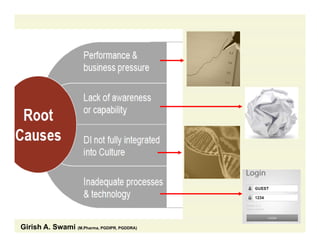


““DATA INTEGRITYDATA INTEGRITY””DATA INTEGRITYDATA INTEGRITY
RECENT APPROACH BY REGULATORY
AGENCIES
By:
Girish A. Swami (M.Pharma, PGDIPR, PGDDRA)( , , )
Cell :+91-9881492626
E-Mail: pr.girish@gmail.com
““DATA INTEGRITYDATA INTEGRITY””
Key to GMP ComplianceKey to GMP Compliance
Girish A. Swami (M.Pharma, PGDIPR, PGDDRA)
Presentation OverviewPresentation Overview
• What is data Integrity ?What is data Integrity ?
• USFDA/WHO/ Global Environment
D t I t it G l E l• Data Integrity General Examples
• Basic data Integrity Expectations
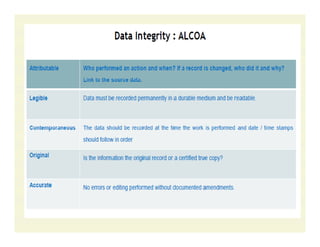
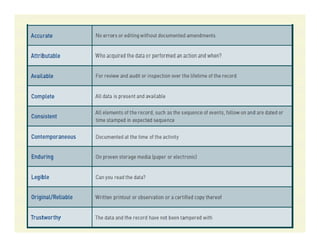
• ALCOA Principles
• Manufacturers ExpectationsManufacturers Expectations
• Conclusion
Girish A. Swami (M.Pharma, PGDIPR, PGDDRA)
“DATA INTEGRITY”
“Data integrity refers to the accuracy and
consistency of data generated during GxP”
“Data integrity is a prerequisite for the regulated
healthcare industry as decisions andy
assumptions on Product quality and Compliance
ith th li bl l t i twith the applicable regulatory requirements are
made based on data”
Girish A. Swami (M.Pharma, PGDIPR, PGDDRA)
What is data IntegrityWhat is data Integrity
• The Extent to which all data are complete,p ,
consistent and accurate throughout the data
lifecycle
• From initial data generation and recording
through processing (including transformation orthrough processing (including transformation or
migration), use, retention, archiving, retrieval
and destruction.
Girish A. Swami (M.Pharma, PGDIPR, PGDDRA)
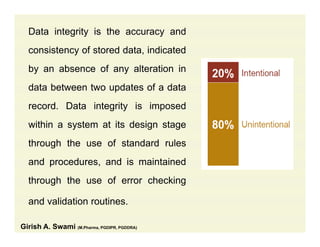
Data integrity is the accuracy and
consistency of stored data, indicated
by an absence of any alteration in
data between two updates of a data
record Data integrity is imposedrecord. Data integrity is imposed
within a system at its design stage
through the use of standard rules
and procedures, and is maintained
through the use of error checking
and validation routinesand validation routines.
Girish A. Swami (M.Pharma, PGDIPR, PGDDRA)
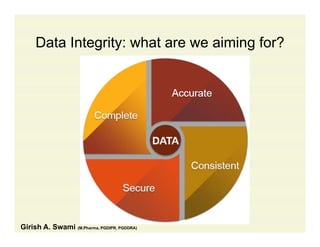
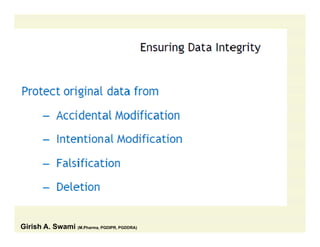
Data Integrity: what are we aiming for?Data Integrity: what are we aiming for?
Girish A. Swami (M.Pharma, PGDIPR, PGDDRA)
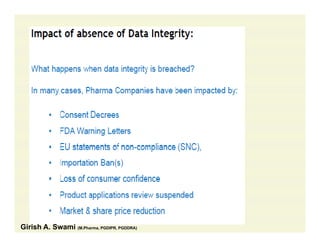
Data integrity – Why a hot topics now ?
• Agencies expects that pharmaceutical companies should
retain complete and accurate records and all raw dataretain complete and accurate records and all raw data
and to make that available to inspectors
• The integrity of data generated by a regulated
pharmaceutical companies and laboratories matters
most, because properly recorded information is the basis
for manufacturers to assure product identity strengthfor manufacturers to assure product identity, strength,
purity, and safety and non-compliances found in the
integrity of data leads warning letters and a regulatoryg y g g y
action from the agencies
Girish A. Swami (M.Pharma, PGDIPR, PGDDRA)
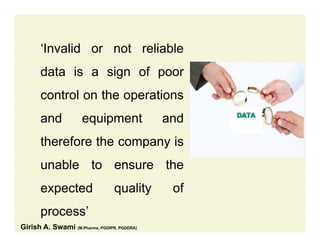
‘I lid t li bl‘Invalid or not reliable
data is a sign of poorg p
control on the operations
and equipment and
therefore the compan istherefore the company is
unable to ensure the
expected quality of
process’
Girish A. Swami (M.Pharma, PGDIPR, PGDDRA)
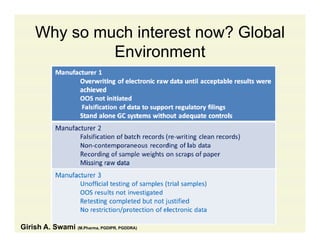
Why so much interest now? Global
E iEnvironment
Girish A. Swami (M.Pharma, PGDIPR, PGDDRA)
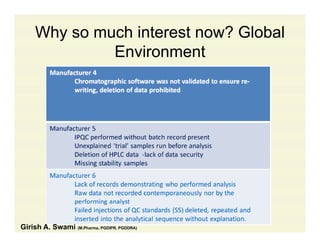
Why so much interest now? Global
E iEnvironment
Girish A. Swami (M.Pharma, PGDIPR, PGDDRA)
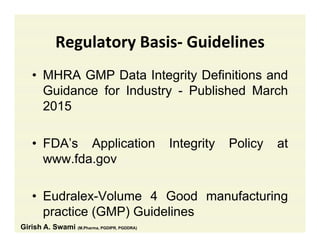
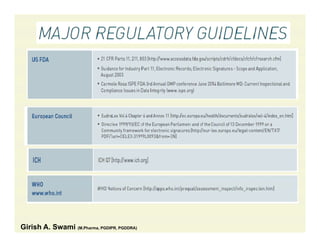
Regulatory Basis‐ GuidelinesRegulatory Basis Guidelines 
• MHRA GMP Data Integrity Definitions andMHRA GMP Data Integrity Definitions and
Guidance for Industry - Published March
20152015
FDA’ A li ti I t it P li t• FDA’s Application Integrity Policy at
www.fda.gov
• Eudralex-Volume 4 Good manufacturingg
practice (GMP) Guidelines
Girish A. Swami (M.Pharma, PGDIPR, PGDDRA)
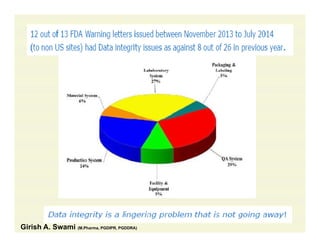
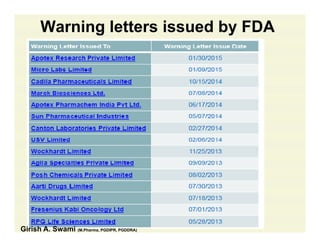
Warning letters issued by FDA
Girish A. Swami (M.Pharma, PGDIPR, PGDDRA)
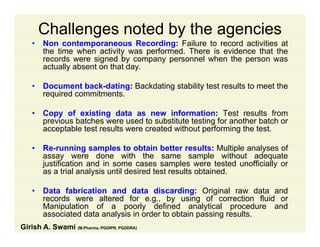
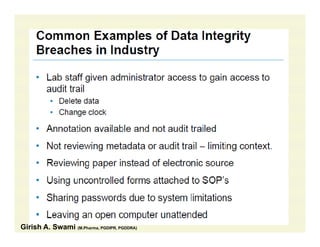
Challenges noted by the agencies
• Non contemporaneous Recording: Failure to record activities atNon contemporaneous Recording: Failure to record activities at
the time when activity was performed. There is evidence that the
records were signed by company personnel when the person was
actually absent on that day.
• Document back-dating: Backdating stability test results to meet the
required commitments.
• Copy of existing data as new information: Test results from
previous batches were used to substitute testing for another batch or
acceptable test results were created without performing the test.
• Re-running samples to obtain better results: Multiple analyses of
assay were done with the same sample without adequate
justification and in some cases samples were tested unofficially or
as a trial analysis until desired test results obtainedas a trial analysis until desired test results obtained.
• Data fabrication and data discarding: Original raw data and
records were altered for e.g., by using of correction fluid org , y g
Manipulation of a poorly defined analytical procedure and
associated data analysis in order to obtain passing results.
Girish A. Swami (M.Pharma, PGDIPR, PGDDRA)
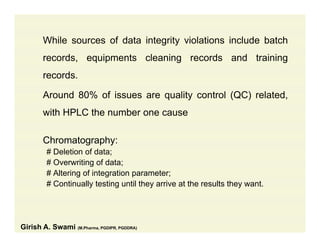
While sources of data integrity violations include batch
records, equipments cleaning records and training
recordsrecords.
Around 80% of issues are quality control (QC) related,
with HPLC the number one cause
Chromatography:Chromatography:
# Deletion of data;
# Overwriting of data;
# Alt i f i t ti t# Altering of integration parameter;
# Continually testing until they arrive at the results they want.
Girish A. Swami (M.Pharma, PGDIPR, PGDDRA)
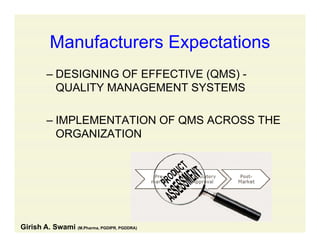
Manufacturers ExpectationsManufacturers Expectations
– DESIGNING OF EFFECTIVE (QMS) -DESIGNING OF EFFECTIVE (QMS)
QUALITY MANAGEMENT SYSTEMS
– IMPLEMENTATION OF QMS ACROSS THE
ORGANIZATION
Girish A. Swami (M.Pharma, PGDIPR, PGDDRA)
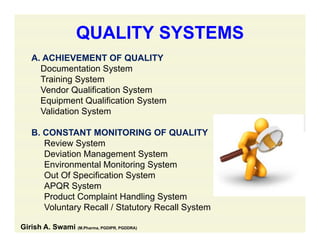
QUALITY SYSTEMS
A. ACHIEVEMENT OF QUALITY
Documentation System
T i i S tTraining System
Vendor Qualification System
Equipment Qualification System
V lid i SValidation System
B. CONSTANT MONITORING OF QUALITY
Review System
Deviation Management System
Environmental Monitoring System
Out Of Specification System
APQR System
Product Complaint Handling Systemg y
Voluntary Recall / Statutory Recall System
Girish A. Swami (M.Pharma, PGDIPR, PGDDRA)
QUALITY SYSTEMS
C. MAINTENANCE AND IMPROVEMENT OF QUALITY
Self Inspection System
CAPA System
Change Control System
Root cause analysis systemy y
Quality Risk Management
Regular Management Review of Key Quality Parametersg g y y
Girish A. Swami (M.Pharma, PGDIPR, PGDDRA)
REVIEW SYSTEM
• BMR BPR CDR are issued & filled documents are• BMR, BPR, CDR are issued & filled documents are
reviewed and managed by QA.
• All batch specific deviations are assessed and closed
before release of a batch.
• All the batches are released by QA, after verification of
batch specific BMR, QC results.
Girish A. Swami (M.Pharma, PGDIPR, PGDDRA)
OUT OF SPECIFICATION SYSTEM (OOS)( )
Th d t lit t i t i l t dThe product quality at various stages is evaluated
against approved specifications.
The test results that do not meet established
specification are investigated through Out Ofp g g
Specification system to determine root cause and
remedial actions are implemented through CAPA
tsystem.
Girish A. Swami (M.Pharma, PGDIPR, PGDDRA)
ANNUAL PRODUCT QUALITY REVIEW (APQR) SYSTEM:
APQR is performed to monitor the consistency in
manufacturing process and product quality. Trends of
QC test results and critical process parameters are
reviewed periodically.p y
This product specific review also includes outcome of
various quality systems such as deviations, change
control, internal audit, OOS, OOT, review of control
samples and stability data.samples and stability data.
Outcome of APQR is used for further enhancement of
the process and product quality.
Girish A. Swami (M.Pharma, PGDIPR, PGDDRA)
QUALITY RISK MANAGEMENT
• Risk assessment ensures identification of hazards , analysis
and evaluation of associated risks.
• This procedure assesses the severity of impact, occurrence
and detection of a particular risk and assigns a risk priority
scorescore.
These are defined as follows:
• Severity of impact- A measure of the possible consequences
of a hazard
• Occurrence- The likelihood of hazard occurring
• Detection- The ability to determine the existence of hazard
Girish A. Swami (M.Pharma, PGDIPR, PGDDRA)
QUALITY RISK ASSESSMENT
Steps followed for initiation of Risk Assessment:Steps followed for initiation of Risk Assessment:
• Identifying the risk areas
• Empowering a suitable team for risk assessment
• Review of risk assessment document for correctnessReview of risk assessment document for correctness
and completeness
Miti ti f th d i k• Mitigation of the assessed risk.
• Reassessment of the risk.
Girish A. Swami (M.Pharma, PGDIPR, PGDDRA)
REGULATORY GUIDELINES
• Food and Drug Administration –FDAg
• Centre for Drug Evaluation and Research – CDER
• European Agency for the Evaluation of Medicinal
Products – EMEA
• PIC/S
• WHO
• Schedule - MSchedule M
Girish A. Swami (M.Pharma, PGDIPR, PGDDRA)
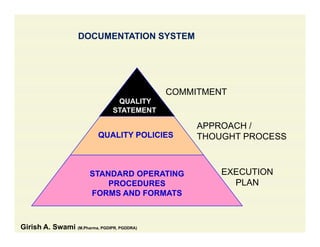
DOCUMENTATION SYSTEM
QUALITY
STATEMENT
COMMITMENT
STATEMENT
QUALITY POLICIES
APPROACH /
THOUGHT PROCESSTHOUGHT PROCESS
EXECUTIONSTANDARD OPERATING
PROCEDURES
FORMS AND FORMATS
EXECUTION
PLAN
Girish A. Swami (M.Pharma, PGDIPR, PGDDRA)
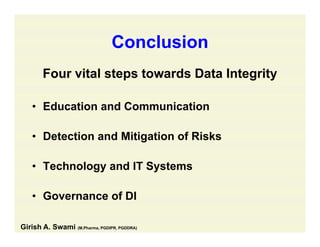
ConclusionConclusion
Four vital steps towards Data IntegrityFour vital steps towards Data Integrity
• Education and CommunicationEducation and Communication
• Detection and Mitigation of RisksDetection and Mitigation of Risks
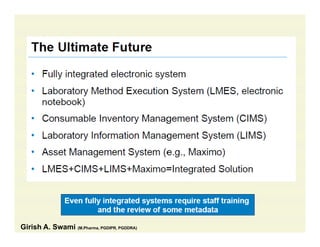
• Technology and IT Systemsgy y
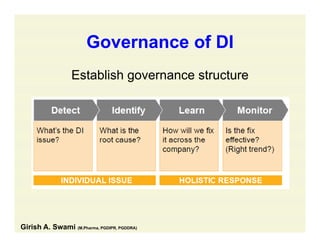
• Governance of DI
Girish A. Swami (M.Pharma, PGDIPR, PGDDRA)
Education and CommunicationEducation and Communication
Culture and education is the foundation for a strong Data IntegrityCulture and education is the foundation for a strong Data Integrity
mindset
Education and consistent communication ensure:
•A common understanding
•Awareness of impact
•Ownership
•Leadership support
Girish A. Swami (M.Pharma, PGDIPR, PGDDRA)
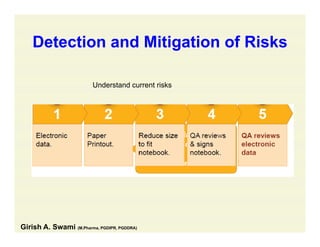
Detection and Mitigation of RisksDetection and Mitigation of Risks
Understand current risks
Girish A. Swami (M.Pharma, PGDIPR, PGDDRA)
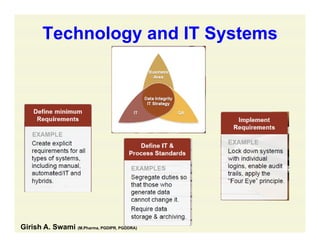
Technology and IT Systems
Girish A. Swami (M.Pharma, PGDIPR, PGDDRA)
Governance of DIGovernance of DI
Establish governance structureEstablish governance structure
Girish A. Swami (M.Pharma, PGDIPR, PGDDRA)
Thank YouThank You
Girish A. Swami
(M.Pharma, PGDIPR, PGDDRA)
Cell :+91-9881492626Cell :+91 9881492626
E-Mail: pr.girish@gmail.com

Pharma data integrity

  • 1.
    ““DATA INTEGRITYDATA INTEGRITY””DATAINTEGRITYDATA INTEGRITY RECENT APPROACH BY REGULATORY AGENCIES By: Girish A. Swami (M.Pharma, PGDIPR, PGDDRA)( , , ) Cell :+91-9881492626 E-Mail: pr.girish@gmail.com
  • 2.
    ““DATA INTEGRITYDATA INTEGRITY”” Keyto GMP ComplianceKey to GMP Compliance Girish A. Swami (M.Pharma, PGDIPR, PGDDRA)
  • 3.
    Presentation OverviewPresentation Overview •What is data Integrity ?What is data Integrity ? • USFDA/WHO/ Global Environment D t I t it G l E l• Data Integrity General Examples • Basic data Integrity Expectations • ALCOA Principles • Manufacturers ExpectationsManufacturers Expectations • Conclusion Girish A. Swami (M.Pharma, PGDIPR, PGDDRA)
  • 4.
    “DATA INTEGRITY” “Data integrityrefers to the accuracy and consistency of data generated during GxP” “Data integrity is a prerequisite for the regulated healthcare industry as decisions andy assumptions on Product quality and Compliance ith th li bl l t i twith the applicable regulatory requirements are made based on data” Girish A. Swami (M.Pharma, PGDIPR, PGDDRA)
  • 5.
    What is dataIntegrityWhat is data Integrity • The Extent to which all data are complete,p , consistent and accurate throughout the data lifecycle • From initial data generation and recording through processing (including transformation orthrough processing (including transformation or migration), use, retention, archiving, retrieval and destruction. Girish A. Swami (M.Pharma, PGDIPR, PGDDRA)
  • 6.
    Data integrity isthe accuracy and consistency of stored data, indicated by an absence of any alteration in data between two updates of a data record Data integrity is imposedrecord. Data integrity is imposed within a system at its design stage through the use of standard rules and procedures, and is maintained through the use of error checking and validation routinesand validation routines. Girish A. Swami (M.Pharma, PGDIPR, PGDDRA)
  • 7.
    Data Integrity: whatare we aiming for?Data Integrity: what are we aiming for? Girish A. Swami (M.Pharma, PGDIPR, PGDDRA)
  • 8.
    Data integrity –Why a hot topics now ? • Agencies expects that pharmaceutical companies should retain complete and accurate records and all raw dataretain complete and accurate records and all raw data and to make that available to inspectors • The integrity of data generated by a regulated pharmaceutical companies and laboratories matters most, because properly recorded information is the basis for manufacturers to assure product identity strengthfor manufacturers to assure product identity, strength, purity, and safety and non-compliances found in the integrity of data leads warning letters and a regulatoryg y g g y action from the agencies Girish A. Swami (M.Pharma, PGDIPR, PGDDRA)
  • 9.
    ‘I lid tli bl‘Invalid or not reliable data is a sign of poorg p control on the operations and equipment and therefore the compan istherefore the company is unable to ensure the expected quality of process’ Girish A. Swami (M.Pharma, PGDIPR, PGDDRA)
  • 10.
    Girish A. Swami(M.Pharma, PGDIPR, PGDDRA)
  • 11.
    Why so muchinterest now? Global E iEnvironment Girish A. Swami (M.Pharma, PGDIPR, PGDDRA)
  • 12.
    Why so muchinterest now? Global E iEnvironment Girish A. Swami (M.Pharma, PGDIPR, PGDDRA)
  • 15.
    Regulatory Basis‐ GuidelinesRegulatory BasisGuidelines  • MHRA GMP Data Integrity Definitions andMHRA GMP Data Integrity Definitions and Guidance for Industry - Published March 20152015 FDA’ A li ti I t it P li t• FDA’s Application Integrity Policy at www.fda.gov • Eudralex-Volume 4 Good manufacturingg practice (GMP) Guidelines Girish A. Swami (M.Pharma, PGDIPR, PGDDRA)
  • 16.
    Girish A. Swami(M.Pharma, PGDIPR, PGDDRA)
  • 17.
    Warning letters issuedby FDA Girish A. Swami (M.Pharma, PGDIPR, PGDDRA)
  • 18.
    Girish A. Swami(M.Pharma, PGDIPR, PGDDRA)
  • 19.
    Challenges noted bythe agencies • Non contemporaneous Recording: Failure to record activities atNon contemporaneous Recording: Failure to record activities at the time when activity was performed. There is evidence that the records were signed by company personnel when the person was actually absent on that day. • Document back-dating: Backdating stability test results to meet the required commitments. • Copy of existing data as new information: Test results from previous batches were used to substitute testing for another batch or acceptable test results were created without performing the test. • Re-running samples to obtain better results: Multiple analyses of assay were done with the same sample without adequate justification and in some cases samples were tested unofficially or as a trial analysis until desired test results obtainedas a trial analysis until desired test results obtained. • Data fabrication and data discarding: Original raw data and records were altered for e.g., by using of correction fluid org , y g Manipulation of a poorly defined analytical procedure and associated data analysis in order to obtain passing results. Girish A. Swami (M.Pharma, PGDIPR, PGDDRA)
  • 20.
    While sources ofdata integrity violations include batch records, equipments cleaning records and training recordsrecords. Around 80% of issues are quality control (QC) related, with HPLC the number one cause Chromatography:Chromatography: # Deletion of data; # Overwriting of data; # Alt i f i t ti t# Altering of integration parameter; # Continually testing until they arrive at the results they want. Girish A. Swami (M.Pharma, PGDIPR, PGDDRA)
  • 21.
    Girish A. Swami(M.Pharma, PGDIPR, PGDDRA)
  • 22.
    Girish A. Swami(M.Pharma, PGDIPR, PGDDRA)
  • 23.
    Girish A. Swami(M.Pharma, PGDIPR, PGDDRA)
  • 24.
    Manufacturers ExpectationsManufacturers Expectations –DESIGNING OF EFFECTIVE (QMS) -DESIGNING OF EFFECTIVE (QMS) QUALITY MANAGEMENT SYSTEMS – IMPLEMENTATION OF QMS ACROSS THE ORGANIZATION Girish A. Swami (M.Pharma, PGDIPR, PGDDRA)
  • 25.
    QUALITY SYSTEMS A. ACHIEVEMENTOF QUALITY Documentation System T i i S tTraining System Vendor Qualification System Equipment Qualification System V lid i SValidation System B. CONSTANT MONITORING OF QUALITY Review System Deviation Management System Environmental Monitoring System Out Of Specification System APQR System Product Complaint Handling Systemg y Voluntary Recall / Statutory Recall System Girish A. Swami (M.Pharma, PGDIPR, PGDDRA)
  • 26.
    QUALITY SYSTEMS C. MAINTENANCEAND IMPROVEMENT OF QUALITY Self Inspection System CAPA System Change Control System Root cause analysis systemy y Quality Risk Management Regular Management Review of Key Quality Parametersg g y y Girish A. Swami (M.Pharma, PGDIPR, PGDDRA)
  • 27.
    REVIEW SYSTEM • BMRBPR CDR are issued & filled documents are• BMR, BPR, CDR are issued & filled documents are reviewed and managed by QA. • All batch specific deviations are assessed and closed before release of a batch. • All the batches are released by QA, after verification of batch specific BMR, QC results. Girish A. Swami (M.Pharma, PGDIPR, PGDDRA)
  • 28.
    OUT OF SPECIFICATIONSYSTEM (OOS)( ) Th d t lit t i t i l t dThe product quality at various stages is evaluated against approved specifications. The test results that do not meet established specification are investigated through Out Ofp g g Specification system to determine root cause and remedial actions are implemented through CAPA tsystem. Girish A. Swami (M.Pharma, PGDIPR, PGDDRA)
  • 29.
    ANNUAL PRODUCT QUALITYREVIEW (APQR) SYSTEM: APQR is performed to monitor the consistency in manufacturing process and product quality. Trends of QC test results and critical process parameters are reviewed periodically.p y This product specific review also includes outcome of various quality systems such as deviations, change control, internal audit, OOS, OOT, review of control samples and stability data.samples and stability data. Outcome of APQR is used for further enhancement of the process and product quality. Girish A. Swami (M.Pharma, PGDIPR, PGDDRA)
  • 30.
    QUALITY RISK MANAGEMENT •Risk assessment ensures identification of hazards , analysis and evaluation of associated risks. • This procedure assesses the severity of impact, occurrence and detection of a particular risk and assigns a risk priority scorescore. These are defined as follows: • Severity of impact- A measure of the possible consequences of a hazard • Occurrence- The likelihood of hazard occurring • Detection- The ability to determine the existence of hazard Girish A. Swami (M.Pharma, PGDIPR, PGDDRA)
  • 31.
    QUALITY RISK ASSESSMENT Stepsfollowed for initiation of Risk Assessment:Steps followed for initiation of Risk Assessment: • Identifying the risk areas • Empowering a suitable team for risk assessment • Review of risk assessment document for correctnessReview of risk assessment document for correctness and completeness Miti ti f th d i k• Mitigation of the assessed risk. • Reassessment of the risk. Girish A. Swami (M.Pharma, PGDIPR, PGDDRA)
  • 32.
    REGULATORY GUIDELINES • Foodand Drug Administration –FDAg • Centre for Drug Evaluation and Research – CDER • European Agency for the Evaluation of Medicinal Products – EMEA • PIC/S • WHO • Schedule - MSchedule M Girish A. Swami (M.Pharma, PGDIPR, PGDDRA)
  • 33.
    DOCUMENTATION SYSTEM QUALITY STATEMENT COMMITMENT STATEMENT QUALITY POLICIES APPROACH/ THOUGHT PROCESSTHOUGHT PROCESS EXECUTIONSTANDARD OPERATING PROCEDURES FORMS AND FORMATS EXECUTION PLAN Girish A. Swami (M.Pharma, PGDIPR, PGDDRA)
  • 34.
    Girish A. Swami(M.Pharma, PGDIPR, PGDDRA)
  • 35.
    ConclusionConclusion Four vital stepstowards Data IntegrityFour vital steps towards Data Integrity • Education and CommunicationEducation and Communication • Detection and Mitigation of RisksDetection and Mitigation of Risks • Technology and IT Systemsgy y • Governance of DI Girish A. Swami (M.Pharma, PGDIPR, PGDDRA)
  • 36.
    Education and CommunicationEducationand Communication Culture and education is the foundation for a strong Data IntegrityCulture and education is the foundation for a strong Data Integrity mindset Education and consistent communication ensure: •A common understanding •Awareness of impact •Ownership •Leadership support Girish A. Swami (M.Pharma, PGDIPR, PGDDRA)
  • 37.
    Detection and Mitigationof RisksDetection and Mitigation of Risks Understand current risks Girish A. Swami (M.Pharma, PGDIPR, PGDDRA)
  • 38.
    Technology and ITSystems Girish A. Swami (M.Pharma, PGDIPR, PGDDRA)
  • 39.
    Governance of DIGovernanceof DI Establish governance structureEstablish governance structure Girish A. Swami (M.Pharma, PGDIPR, PGDDRA)
  • 40.
    Girish A. Swami(M.Pharma, PGDIPR, PGDDRA)
  • 41.
    Girish A. Swami(M.Pharma, PGDIPR, PGDDRA)
  • 42.
    Thank YouThank You GirishA. Swami (M.Pharma, PGDIPR, PGDDRA) Cell :+91-9881492626Cell :+91 9881492626 E-Mail: pr.girish@gmail.com