DATA INTEGRITY
Page 1
Monday, April 27, 2015
"This presentation is compiled from resources available on the world wide web.
“Drug Regulations” is a non profit organization which provides free online resource
to the Pharmaceutical Professional. Visit http://www.drugregulations.org for latest
information from the world of Pharmaceuticals.”
DATA INTEGRITY
Page 2
 Data Integrity is assuming greater
importance in cGMP’s.
 Quality of raw materials, in process
materials and finished goods can not be
assured with out data integrity.
 Data integrity issues are 21 CFR Part 11 and
severe CGMP violations.
DATA INTEGRITY
Page 3
 If the integrity of laboratory data is
compromised.
o Products may not comply with regulatory
authorization terms.
o Products can not be released for sale.
 In recent past FDA has Increased its focus on
data integrity and reliability.
 Similarly MHRA and Other regulatory bodies
have increased focus on data integrity.
DATA INTEGRITY
Page 4
 Inspectors are examining data based on
multiple regulations and standards.
o CGMP
o Good Laboratory Practices (GLP),
o Good Clinical Practices (GCP) and
o The Application Integrity Policy.
DATA INTEGRITY
Page 5
 “Guilty until proven innocent” approach.
 Historical approaches based on technical
justification and scientific rationale not
adequate.
 Emphasis on providing evidence that the
analytical results are not fraudulent.
What is DATA INTEGRITY?
Page 6
Data integrity is the assurance that data
records are accurate, complete, intact and
maintained within their original context,
including their relationship to other data
records.
This definition applies to data recorded in
electronic and paper formats or a hybrid of
both.
Ensuring DATA INTEGRITY:
Page 7
 Protecting original data from
 Accidental modification
 Intentional Modification
 Falsification
 Deletion
DATA INTEGRITY:
Page 8
 Data Integrity key to
 Reliable and trust worthy records
 Record that will withstand scrutiny during
regulatory inspections.
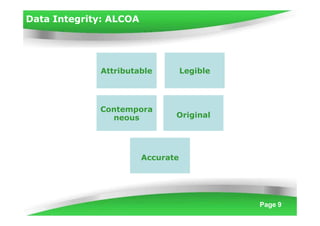
 According to FDA, which uses the acronym
ALCOA, data need to be “attributable,
legible, contemporaneous, original, and
accurate.”
Data Integrity: ALCOA
Attributable Legible
Contempora
neous Original
Accurate
Page 9
Revealing list of DATA INTEGRITY observation in
FDA Audits:
Page 10
 “…..trial injections…..”
 “results failing specifications are retested
until acceptable results are obtained….”
 “…..over-writing electronic raw data…..”
 “…….OOS not investigates per XYZ SOP….”
 “……appropriate controls not established…..”
“……records are not completed
contemporaneously…”
 “….observed back-date entry in logbooks.”
INTEGRITY issue 1:
A) This is an Integrity issue
Page 11
INTEGRITY issue 2:
Page 12
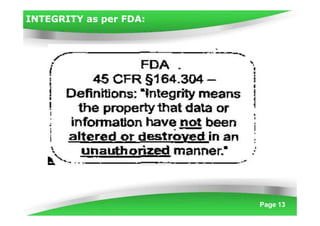
INTEGRITY as per FDA:
Page 13
DATA INTEGRITY:
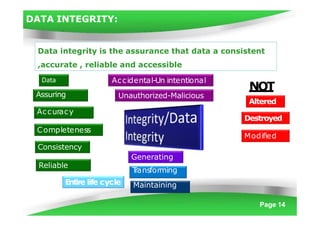
Data integrity is the assurance that data a consistent
,accurate , reliable and accessible
Data
Assuring
Accuracy
Completeness
Consistency
Accidental-Un intentional
Unauthorized-Malicious
Generating
T
ransforming
Maintaining
Reliable
Entire life cycle
NOT
Altered
Destroyed
Modified
Page 14
Reasons:
Page 15
Reasons:
Page 16
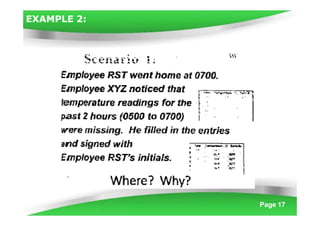
EXAMPLE 2:
Page 17
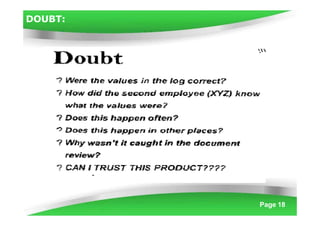
DOUBT:
Page 18
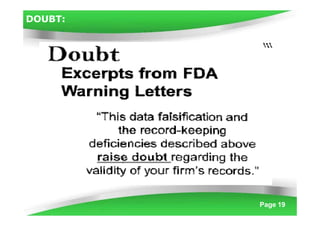
DOUBT:
Page 19
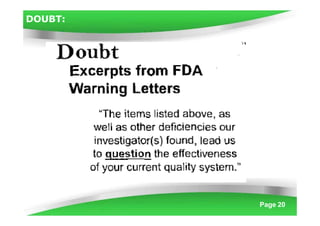
DOUBT:
Page 20
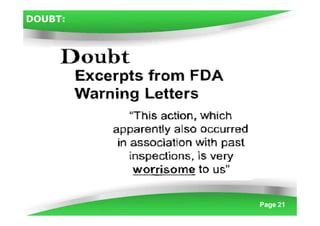
DOUBT:
Page 21
Data Integrity Regulations:
Page 22
 FDA inspects for electronic data integrity
during the pre- and post market product
approval process.
 21 CFR Part 11 commonly referred to as
the “data integrity regulation.” Four goals
listed by FDA.
 Assess the industry’s comprehension or
continuing misinterpretations of Part
11.
 Determine how firms are ensuring the
integrity of electronic records.
 Extend scrutiny of data, quality-related
and computerized system validation-
related Form 483 inspectional
observations since 2007.
Electronic & Paper Data:
Page 23
 Comparisons between secure electronic data
and data in paper format
 For software compliant to 21 CFR Part
11 (9) & with appropriate technical
controls.
 Electronic data are more secure, more
difficult to manipulate or change, and
any changes are easier to detect.
 Changes to paper data, such as a
printed chromatogram, are simpler to
make, but much harder to detect.
Electronic & Paper Data:
Page 24
 Comparisons between secure electronic data
and data in paper format.
 Defining paper records as “raw data”
(the so-called typewriter rule) does not
satisfy the predicate rules.
 Printed paper copy of the
chromatogram will not be considered a
true copy.
 Although this comment was made
about chromatographic data, the
principles have much wider
implications.
Thank you very much your valuable time!
Page 25

DI-GCP.pptx

  • 1.
    DATA INTEGRITY Page 1 Monday,April 27, 2015 "This presentation is compiled from resources available on the world wide web. “Drug Regulations” is a non profit organization which provides free online resource to the Pharmaceutical Professional. Visit http://www.drugregulations.org for latest information from the world of Pharmaceuticals.”
  • 2.
    DATA INTEGRITY Page 2 Data Integrity is assuming greater importance in cGMP’s.  Quality of raw materials, in process materials and finished goods can not be assured with out data integrity.  Data integrity issues are 21 CFR Part 11 and severe CGMP violations.
  • 3.
    DATA INTEGRITY Page 3 If the integrity of laboratory data is compromised. o Products may not comply with regulatory authorization terms. o Products can not be released for sale.  In recent past FDA has Increased its focus on data integrity and reliability.  Similarly MHRA and Other regulatory bodies have increased focus on data integrity.
  • 4.
    DATA INTEGRITY Page 4 Inspectors are examining data based on multiple regulations and standards. o CGMP o Good Laboratory Practices (GLP), o Good Clinical Practices (GCP) and o The Application Integrity Policy.
  • 5.
    DATA INTEGRITY Page 5 “Guilty until proven innocent” approach.  Historical approaches based on technical justification and scientific rationale not adequate.  Emphasis on providing evidence that the analytical results are not fraudulent.
  • 6.
    What is DATAINTEGRITY? Page 6 Data integrity is the assurance that data records are accurate, complete, intact and maintained within their original context, including their relationship to other data records. This definition applies to data recorded in electronic and paper formats or a hybrid of both.
  • 7.
    Ensuring DATA INTEGRITY: Page7  Protecting original data from  Accidental modification  Intentional Modification  Falsification  Deletion
  • 8.
    DATA INTEGRITY: Page 8 Data Integrity key to  Reliable and trust worthy records  Record that will withstand scrutiny during regulatory inspections.  According to FDA, which uses the acronym ALCOA, data need to be “attributable, legible, contemporaneous, original, and accurate.”
  • 9.
    Data Integrity: ALCOA AttributableLegible Contempora neous Original Accurate Page 9
  • 10.
    Revealing list ofDATA INTEGRITY observation in FDA Audits: Page 10  “…..trial injections…..”  “results failing specifications are retested until acceptable results are obtained….”  “…..over-writing electronic raw data…..”  “…….OOS not investigates per XYZ SOP….”  “……appropriate controls not established…..” “……records are not completed contemporaneously…”  “….observed back-date entry in logbooks.”
  • 11.
    INTEGRITY issue 1: A)This is an Integrity issue Page 11
  • 12.
  • 13.
    INTEGRITY as perFDA: Page 13
  • 14.
    DATA INTEGRITY: Data integrityis the assurance that data a consistent ,accurate , reliable and accessible Data Assuring Accuracy Completeness Consistency Accidental-Un intentional Unauthorized-Malicious Generating T ransforming Maintaining Reliable Entire life cycle NOT Altered Destroyed Modified Page 14
  • 15.
  • 16.
  • 17.
  • 18.
  • 19.
  • 20.
  • 21.
  • 22.
    Data Integrity Regulations: Page22  FDA inspects for electronic data integrity during the pre- and post market product approval process.  21 CFR Part 11 commonly referred to as the “data integrity regulation.” Four goals listed by FDA.  Assess the industry’s comprehension or continuing misinterpretations of Part 11.  Determine how firms are ensuring the integrity of electronic records.  Extend scrutiny of data, quality-related and computerized system validation- related Form 483 inspectional observations since 2007.
  • 23.
    Electronic & PaperData: Page 23  Comparisons between secure electronic data and data in paper format  For software compliant to 21 CFR Part 11 (9) & with appropriate technical controls.  Electronic data are more secure, more difficult to manipulate or change, and any changes are easier to detect.  Changes to paper data, such as a printed chromatogram, are simpler to make, but much harder to detect.
  • 24.
    Electronic & PaperData: Page 24  Comparisons between secure electronic data and data in paper format.  Defining paper records as “raw data” (the so-called typewriter rule) does not satisfy the predicate rules.  Printed paper copy of the chromatogram will not be considered a true copy.  Although this comment was made about chromatographic data, the principles have much wider implications.
  • 25.
    Thank you verymuch your valuable time! Page 25