www.ngsmips.nitte.edu.in
GOOD AUTOMATED
LABORATORY PRACTICES
Good Regulatory Practices
Department of Regulatory Affairs
NGSMIPS, Nitte University
Mangalore
- Swapnil Dylan Fernandes
1
www.ngsmips.nitte.edu.in
Contents
 Standard Operating Procedures.
 Documentation in GALP.
 Logs and Related Forms.
 Training
 Conclusion
 References
2
www.ngsmips.nitte.edu.in
STANDARD OPERATING PROCEDURES
3
Definition
Aim of SOP’s
SOP’s Concerned with GALP.
www.ngsmips.nitte.edu.in
GALP SOP’s
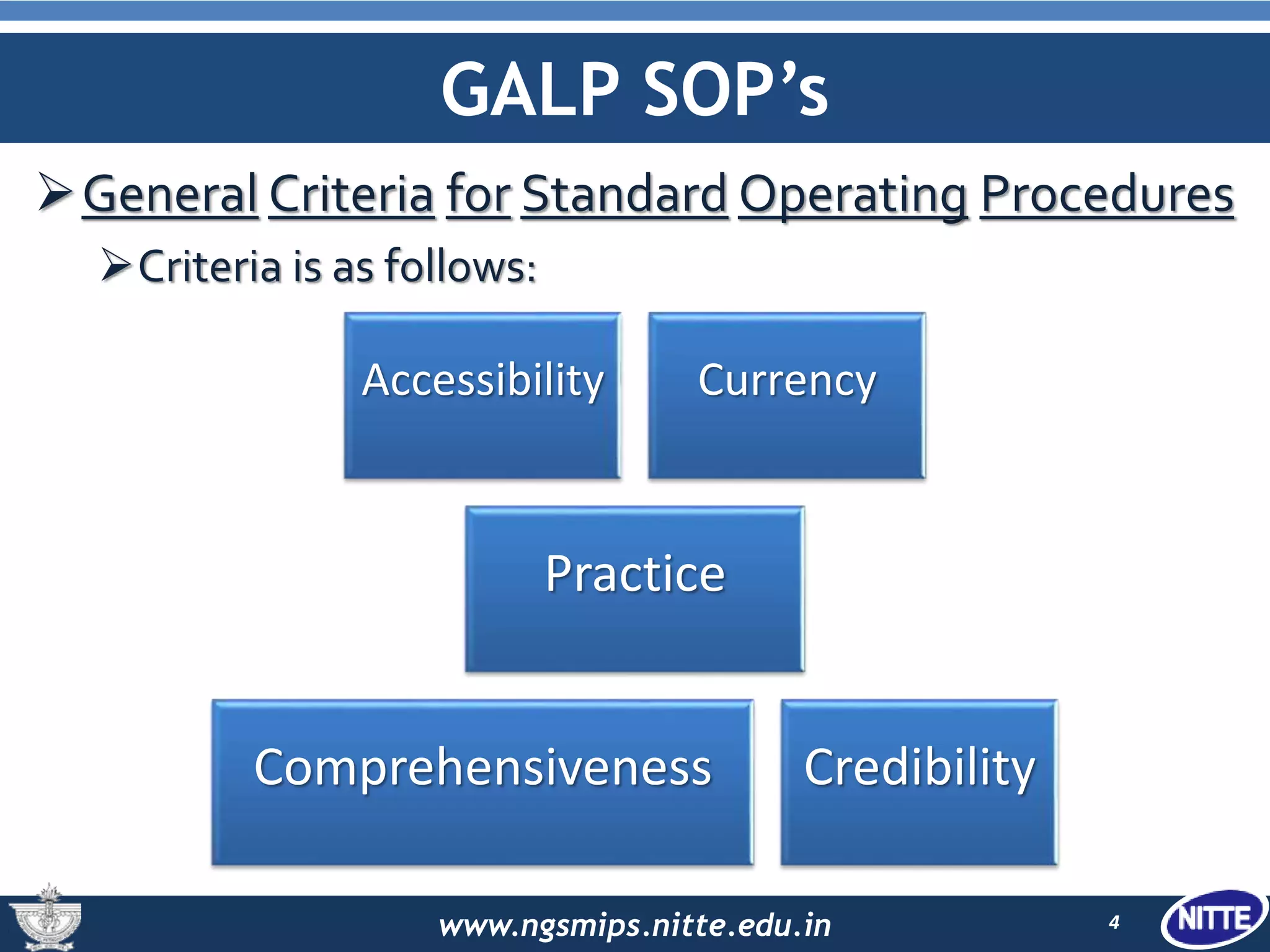
General Criteria for Standard Operating Procedures
Criteria is as follows:
4
Accessibility Currency
Practice
Comprehensiveness Credibility
www.ngsmips.nitte.edu.in
GALP SOP’s
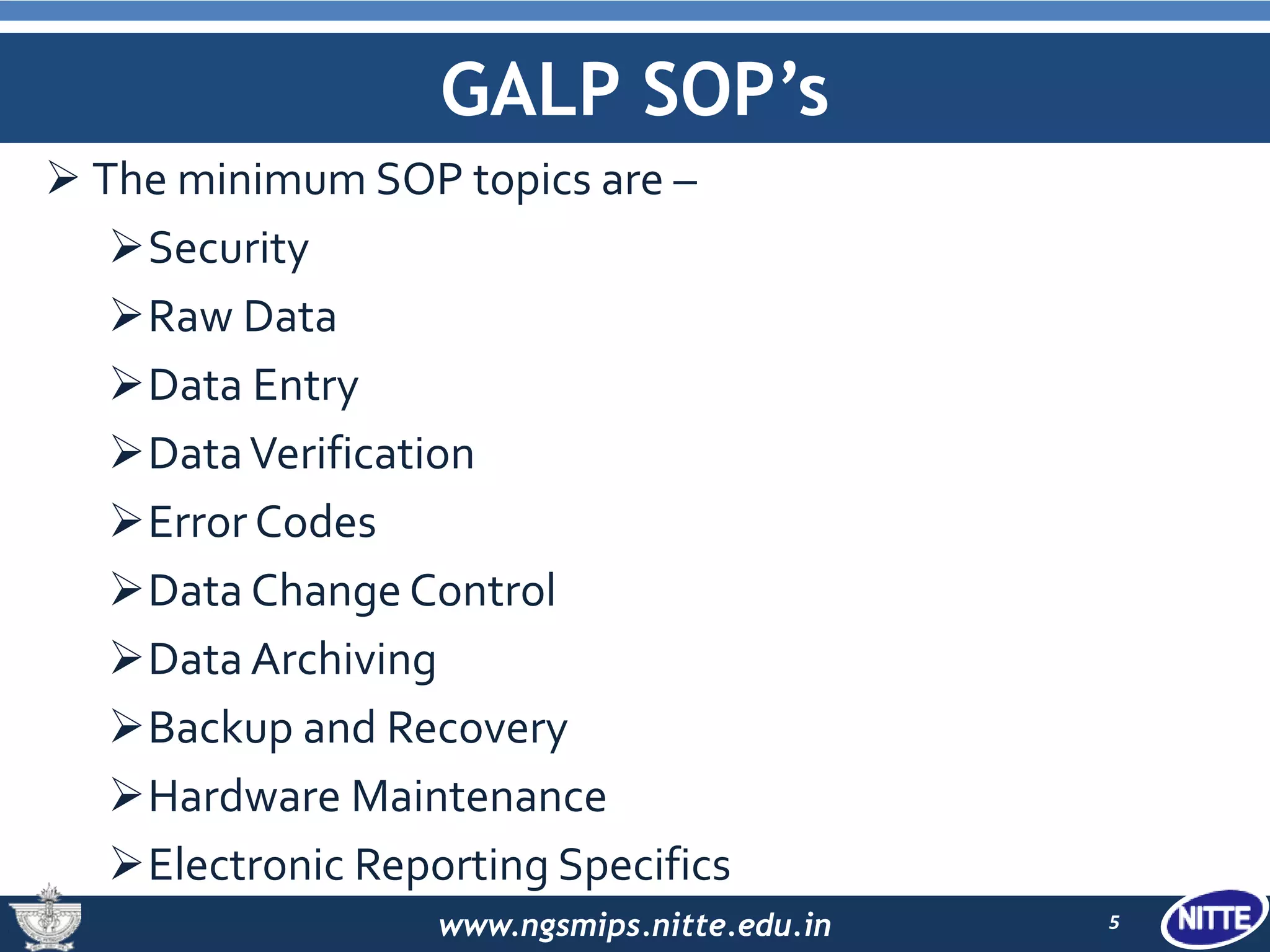
 The minimum SOP topics are –
Security
Raw Data
Data Entry
DataVerification
Error Codes
Data Change Control
Data Archiving
Backup and Recovery
Hardware Maintenance
Electronic Reporting Specifics
5
www.ngsmips.nitte.edu.in
 Security –
– 2 types : System access security and Physical Security
– Focus:
• Primarily on the computer room.
• Any related workstations.
– Physical Security
– System Access Security
 Raw Data –
– Raw data is also known as primary data.
– Working definition used within the laboratory.
6
www.ngsmips.nitte.edu.in
 Data Entry –
– Procedures related to data entry is the identification of
the person/personnel entering the system.
 DataVerification –
– Verification of the Input Data.
7
www.ngsmips.nitte.edu.in
 Error Codes –
– Interpretation of any error messages.
 Data Change Control –
– Include –
• Documentation of how the authorised changes are
carried out.
• Proof that the changes do not represent changes that
could lead to the loss or corruption of data.
• Cost, scheduling and impact statements.
8
www.ngsmips.nitte.edu.in
 Data Archiving –
– Define the procedures to ensure that the data is
stored in a clear, logical, repeatable manner.
 Backup and Recovery –
– Primary aim is to ensure the integrity and
availability of the stored data in the event of
serious breach of security or a system wide
failure.
9
www.ngsmips.nitte.edu.in
 Hardware Maintenance –
– SOP’s pertaining to efficient functioning of
Hardware.
 Electronic Reporting Specifics –
– Standards, protocols and the procedures used in
the collection of data and analysis.
 Additional Standard Operating Procedures
Requirements
10
www.ngsmips.nitte.edu.in
DOCUMENTATION IN GALP
 The purpose of GALP is to
provide a vehicle for
demonstrating system
control. Documentation is an
important cog in the wheel
when it comes to GALP.
 In general, six categories of
documents are specified and
required for compliance with
GALP guidelines.They are as
follows –
11
www.ngsmips.nitte.edu.in
 Personnel:
– Personnel records help support the competence of
various employees assigned to the system
responsibilities.
 Equipment:
– A hardware description log records
– A record of acceptance testing
12
www.ngsmips.nitte.edu.in
 Operations:
– A security risk document identifies the likely and
possible risks to the security of computer-
resident data.
 Facilities:
– A written environmental specifications guard
against data loss or corruption from various
environmental threats.
13
www.ngsmips.nitte.edu.in
 Software:
– Documents for ensuring the continual functioning
of the software.
 Operational Logs:
– Backup and recovery logs and drills help guard
against data loss or corruption.
14
www.ngsmips.nitte.edu.in
LOGS AND RELATED FORMS
 Logs are used to document regular,
incremental or complete backups or changes
or performance data of the systems as well as
other elements in the laboratory.
 To safeguard existing data against the risk of
future loss of data in the event of system
failure or application failure.
15
www.ngsmips.nitte.edu.in
 Types of Logs –
– System Backup Log –
• Documents, regularly, complete or incremental system
backups.
– Routine SoftwareTesting Log –
• Records the changes made to the system software.
– User Problem Log-
• Records user related problems with the systems or
related softwares.
16
www.ngsmips.nitte.edu.in
– System maintenance Log –
• Records the preventative maintenance completed on particular
hardware.
– Training Log –
• Documents all the user training related information.
– Security Log –
• Used to track and identify visitors, consultants, contractors and
other nonemployees who are currently in the premises.
– Data Change Log-
• Used to record all changes made to the data in the system.
17
www.ngsmips.nitte.edu.in
TRAINING
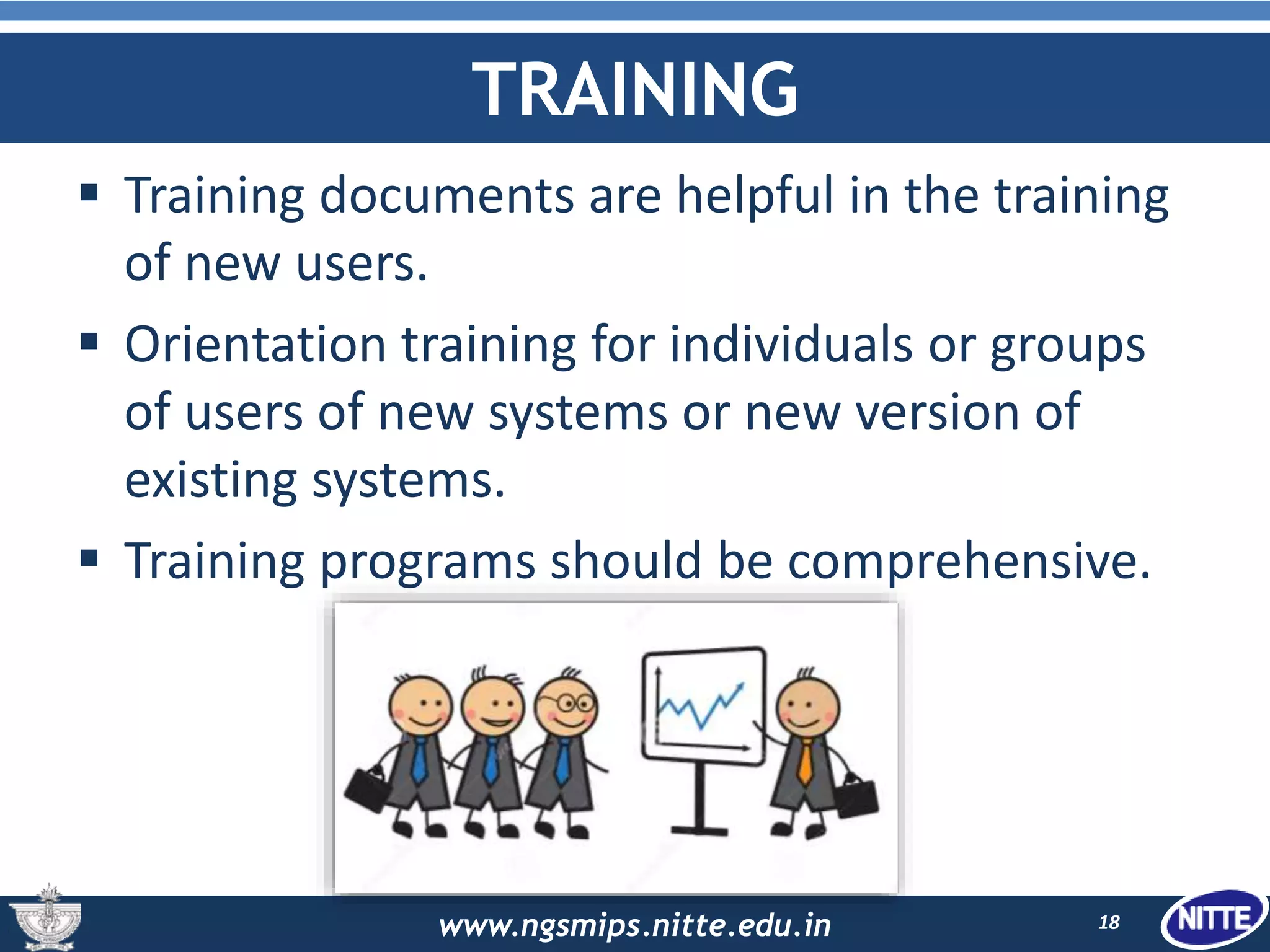
 Training documents are helpful in the training
of new users.
 Orientation training for individuals or groups
of users of new systems or new version of
existing systems.
 Training programs should be comprehensive.
18
www.ngsmips.nitte.edu.in
CONCLUSION
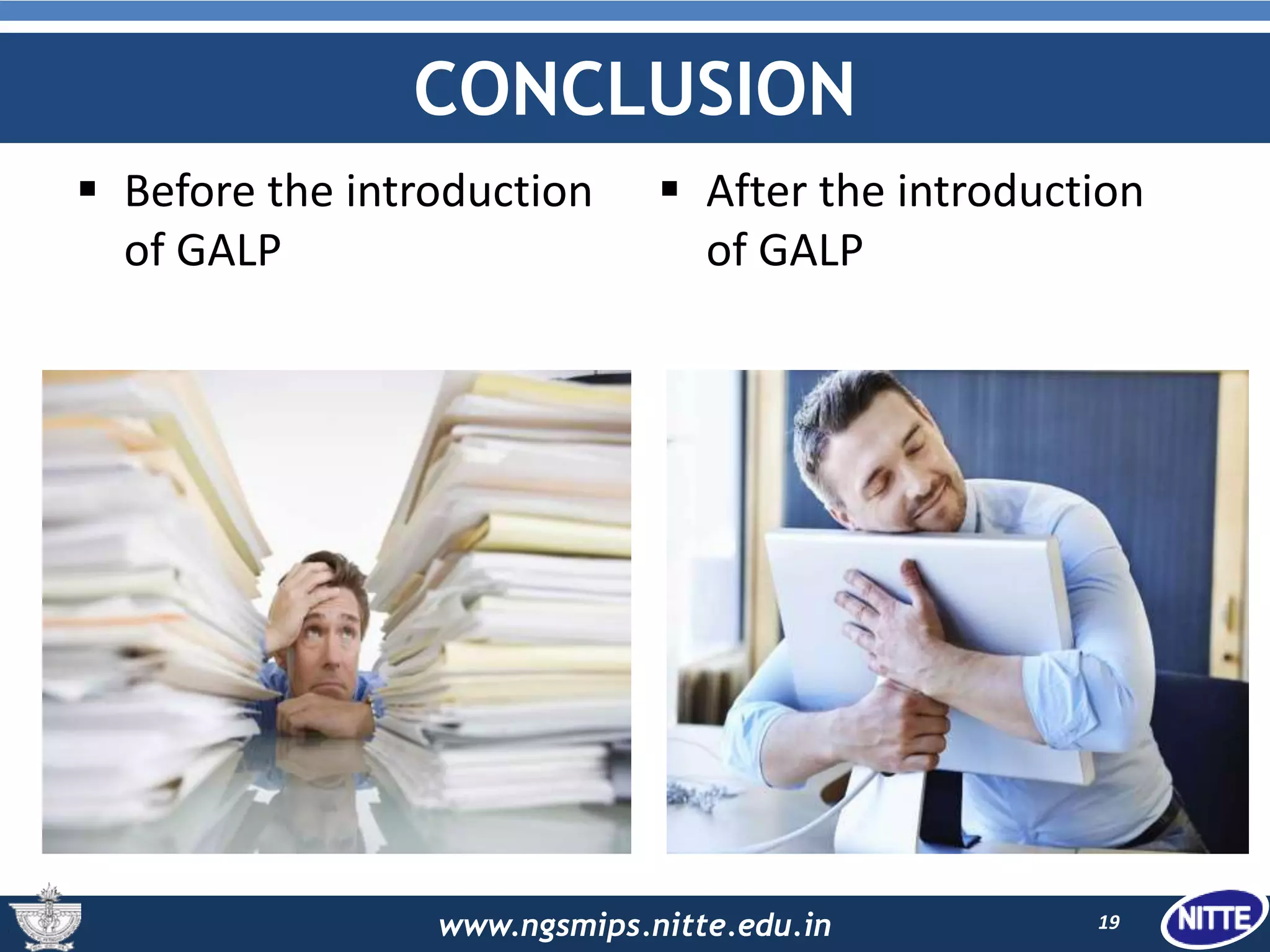
 Before the introduction
of GALP
19
 After the introduction
of GALP
www.ngsmips.nitte.edu.in
CONCLUSION
 GALP provides important guidance for the
management of automated regulated laboratory.
 GALP’s serve as important interpretive material in
applying the content and principles of the GLP’s to the
realities of the modern laboratory.
 GALP’s have provided the much needed impetus to
the modernisation of laboratory work and have
ensured that work can be carried out in an efficient
manner within relatively shorter time.
 Streamlining of processes to has been one of the
major successes of the GALP’s.
20
www.ngsmips.nitte.edu.in
REFERENCES
 Sandy Weinberg, Good Laboratory Practice Regulations,
Informa Healthcare, 52 Vanderbilt Avenue New York, P.No
131-150
 2185 good Automated Laboratory Practices Principles And
Guidance to Regulations for Ensuring Data Integrity in
Automated Laboratory Operations with Implementation
Guidance 1995 Edition.
url:https://nepis.epa.gov/Exe/ZyPDF.cgi/2000AOGI.PDF?Dockey=
2000AOGLPDF (accessed on 25 October 2017)
 GALP Regulatory Handbook, Sandy Weinberg, Lewis
Publishers e-book
url:https://books.google.co.in/books?id=RfzlISKm581EC&printse
c=frontcover&source=gbs_ge_summary_r&cad=0#v=onepage&q
&f=false (Accessed on 25th October 2017)
21

Good Automated Laboratory Practices

  • 1.
    www.ngsmips.nitte.edu.in GOOD AUTOMATED LABORATORY PRACTICES GoodRegulatory Practices Department of Regulatory Affairs NGSMIPS, Nitte University Mangalore - Swapnil Dylan Fernandes 1
  • 2.
    www.ngsmips.nitte.edu.in Contents  Standard OperatingProcedures.  Documentation in GALP.  Logs and Related Forms.  Training  Conclusion  References 2
  • 3.
  • 4.
    www.ngsmips.nitte.edu.in GALP SOP’s General Criteriafor Standard Operating Procedures Criteria is as follows: 4 Accessibility Currency Practice Comprehensiveness Credibility
  • 5.
    www.ngsmips.nitte.edu.in GALP SOP’s  Theminimum SOP topics are – Security Raw Data Data Entry DataVerification Error Codes Data Change Control Data Archiving Backup and Recovery Hardware Maintenance Electronic Reporting Specifics 5
  • 6.
    www.ngsmips.nitte.edu.in  Security – –2 types : System access security and Physical Security – Focus: • Primarily on the computer room. • Any related workstations. – Physical Security – System Access Security  Raw Data – – Raw data is also known as primary data. – Working definition used within the laboratory. 6
  • 7.
    www.ngsmips.nitte.edu.in  Data Entry– – Procedures related to data entry is the identification of the person/personnel entering the system.  DataVerification – – Verification of the Input Data. 7
  • 8.
    www.ngsmips.nitte.edu.in  Error Codes– – Interpretation of any error messages.  Data Change Control – – Include – • Documentation of how the authorised changes are carried out. • Proof that the changes do not represent changes that could lead to the loss or corruption of data. • Cost, scheduling and impact statements. 8
  • 9.
    www.ngsmips.nitte.edu.in  Data Archiving– – Define the procedures to ensure that the data is stored in a clear, logical, repeatable manner.  Backup and Recovery – – Primary aim is to ensure the integrity and availability of the stored data in the event of serious breach of security or a system wide failure. 9
  • 10.
    www.ngsmips.nitte.edu.in  Hardware Maintenance– – SOP’s pertaining to efficient functioning of Hardware.  Electronic Reporting Specifics – – Standards, protocols and the procedures used in the collection of data and analysis.  Additional Standard Operating Procedures Requirements 10
  • 11.
    www.ngsmips.nitte.edu.in DOCUMENTATION IN GALP The purpose of GALP is to provide a vehicle for demonstrating system control. Documentation is an important cog in the wheel when it comes to GALP.  In general, six categories of documents are specified and required for compliance with GALP guidelines.They are as follows – 11
  • 12.
    www.ngsmips.nitte.edu.in  Personnel: – Personnelrecords help support the competence of various employees assigned to the system responsibilities.  Equipment: – A hardware description log records – A record of acceptance testing 12
  • 13.
    www.ngsmips.nitte.edu.in  Operations: – Asecurity risk document identifies the likely and possible risks to the security of computer- resident data.  Facilities: – A written environmental specifications guard against data loss or corruption from various environmental threats. 13
  • 14.
    www.ngsmips.nitte.edu.in  Software: – Documentsfor ensuring the continual functioning of the software.  Operational Logs: – Backup and recovery logs and drills help guard against data loss or corruption. 14
  • 15.
    www.ngsmips.nitte.edu.in LOGS AND RELATEDFORMS  Logs are used to document regular, incremental or complete backups or changes or performance data of the systems as well as other elements in the laboratory.  To safeguard existing data against the risk of future loss of data in the event of system failure or application failure. 15
  • 16.
    www.ngsmips.nitte.edu.in  Types ofLogs – – System Backup Log – • Documents, regularly, complete or incremental system backups. – Routine SoftwareTesting Log – • Records the changes made to the system software. – User Problem Log- • Records user related problems with the systems or related softwares. 16
  • 17.
    www.ngsmips.nitte.edu.in – System maintenanceLog – • Records the preventative maintenance completed on particular hardware. – Training Log – • Documents all the user training related information. – Security Log – • Used to track and identify visitors, consultants, contractors and other nonemployees who are currently in the premises. – Data Change Log- • Used to record all changes made to the data in the system. 17
  • 18.
    www.ngsmips.nitte.edu.in TRAINING  Training documentsare helpful in the training of new users.  Orientation training for individuals or groups of users of new systems or new version of existing systems.  Training programs should be comprehensive. 18
  • 19.
    www.ngsmips.nitte.edu.in CONCLUSION  Before theintroduction of GALP 19  After the introduction of GALP
  • 20.
    www.ngsmips.nitte.edu.in CONCLUSION  GALP providesimportant guidance for the management of automated regulated laboratory.  GALP’s serve as important interpretive material in applying the content and principles of the GLP’s to the realities of the modern laboratory.  GALP’s have provided the much needed impetus to the modernisation of laboratory work and have ensured that work can be carried out in an efficient manner within relatively shorter time.  Streamlining of processes to has been one of the major successes of the GALP’s. 20
  • 21.
    www.ngsmips.nitte.edu.in REFERENCES  Sandy Weinberg,Good Laboratory Practice Regulations, Informa Healthcare, 52 Vanderbilt Avenue New York, P.No 131-150  2185 good Automated Laboratory Practices Principles And Guidance to Regulations for Ensuring Data Integrity in Automated Laboratory Operations with Implementation Guidance 1995 Edition. url:https://nepis.epa.gov/Exe/ZyPDF.cgi/2000AOGI.PDF?Dockey= 2000AOGLPDF (accessed on 25 October 2017)  GALP Regulatory Handbook, Sandy Weinberg, Lewis Publishers e-book url:https://books.google.co.in/books?id=RfzlISKm581EC&printse c=frontcover&source=gbs_ge_summary_r&cad=0#v=onepage&q &f=false (Accessed on 25th October 2017) 21