Presented by:
Nikita Bajarang Amane.
M. Pharmacy
1st year
(Quality Assurance)
Rajarambapu college of Pharmacy Kasegaon
1
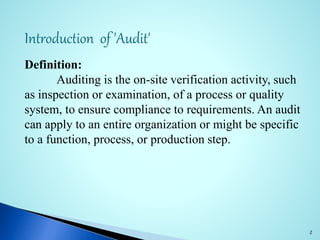
Introduction of 'Audit'
Definition:
Auditing is the on-site verification activity, such
as inspection or examination, of a process or quality
system, to ensure compliance to requirements. An audit
can apply to an entire organization or might be specific
to a function, process, or production step.
2
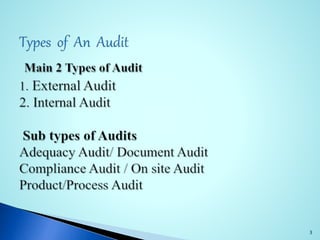
3
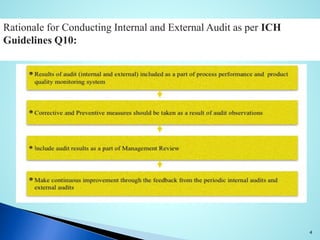
Rationale for Conducting Internal and External Audit as per ICH
Guidelines Q10:
4
Objective
5
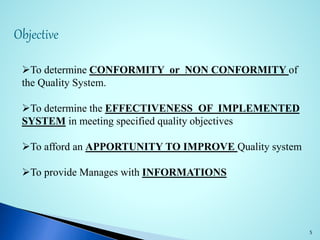
To determine CONFORMITY or NON CONFORMITY of
the Quality System.
To determine the EFFECTIVENESS OF IMPLEMENTED
SYSTEM in meeting specified quality objectives
To afford an APPORTUNITY TO IMPROVE Quality system
To provide Manages with INFORMATIONS
6
7
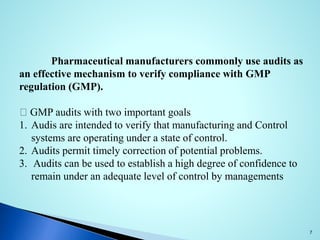
Pharmaceutical manufacturers commonly use audits as
an effective mechanism to verify compliance with GMP
regulation (GMP).
GMP audits with two important goals
1. Audis are intended to verify that manufacturing and Control
systems are operating under a state of control.
2. Audits permit timely correction of potential problems.
3. Audits can be used to establish a high degree of confidence to
remain under an adequate level of control by managements
Management
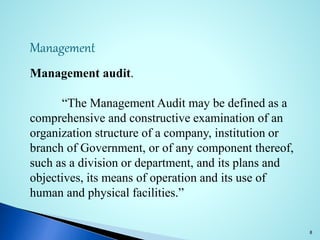
Management audit.
“The Management Audit may be defined as a
comprehensive and constructive examination of an
organization structure of a company, institution or
branch of Government, or of any component thereof,
such as a division or department, and its plans and
objectives, its means of operation and its use of
human and physical facilities.”
8
9
Management of Audits Involve
1.First Party Audit
2.Second Party Audit
3.Third Party Audit
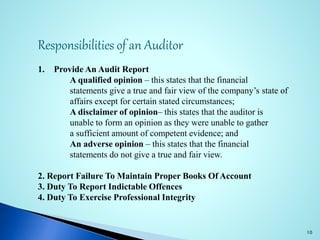
Responsibilities of an Auditor
1. Provide An Audit Report
A qualified opinion – this states that the financial
statements give a true and fair view of the company’s state of
affairs except for certain stated circumstances;
A disclaimer of opinion– this states that the auditor is
unable to form an opinion as they were unable to gather
a sufficient amount of competent evidence; and
An adverse opinion – this states that the financial
statements do not give a true and fair view.
2. Report Failure To Maintain Proper Books Of Account
3. Duty To Report Indictable Offences
4. Duty To Exercise Professional Integrity
10
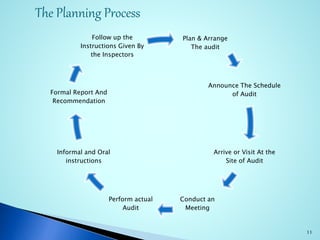
The Planning Process
11
Plan & Arrange
The audit
Announce The Schedule
of Audit
Arrive or Visit At the
Site of Audit
Conduct an
Meeting
Perform actual
Audit
Informal and Oral
instructions
Formal Report And
Recommendation
Follow up the
Instructions Given By
the Inspectors
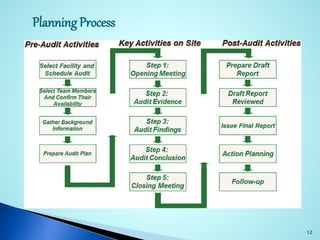
Planning Process
12
References
ISO 9001-2008 Audit
www.accountingnotes.net/auditing/management-
audit/management-audit-definition-meaning-and-fundamental-
concepts/5049
 www.corplaw.ie/blog/bid/337442/The-Responsibility-Of-Auditors
 smallbusiness.chron.com/planning-process-audit-10354
 smallbusiness.chron.com/sixstep-audit-process-17816
This Compliance Audit Handbook has been produced by the
Compliance and Assurance Section of the Department of
Environment and Conservation NSW (DEC).
Responsibilities and Functions of the Independent Auditor Source:
SAS No. 1, section 110; SAS No. 78; SAS No. 82.
13
14

Audits in pharma industries

  • 1.
    Presented by: Nikita BajarangAmane. M. Pharmacy 1st year (Quality Assurance) Rajarambapu college of Pharmacy Kasegaon 1
  • 2.
    Introduction of 'Audit' Definition: Auditingis the on-site verification activity, such as inspection or examination, of a process or quality system, to ensure compliance to requirements. An audit can apply to an entire organization or might be specific to a function, process, or production step. 2
  • 3.
  • 4.
    Rationale for ConductingInternal and External Audit as per ICH Guidelines Q10: 4
  • 5.
    Objective 5 To determine CONFORMITYor NON CONFORMITY of the Quality System. To determine the EFFECTIVENESS OF IMPLEMENTED SYSTEM in meeting specified quality objectives To afford an APPORTUNITY TO IMPROVE Quality system To provide Manages with INFORMATIONS
  • 6.
  • 7.
    7 Pharmaceutical manufacturers commonlyuse audits as an effective mechanism to verify compliance with GMP regulation (GMP). GMP audits with two important goals 1. Audis are intended to verify that manufacturing and Control systems are operating under a state of control. 2. Audits permit timely correction of potential problems. 3. Audits can be used to establish a high degree of confidence to remain under an adequate level of control by managements
  • 8.
    Management Management audit. “The ManagementAudit may be defined as a comprehensive and constructive examination of an organization structure of a company, institution or branch of Government, or of any component thereof, such as a division or department, and its plans and objectives, its means of operation and its use of human and physical facilities.” 8
  • 9.
    9 Management of AuditsInvolve 1.First Party Audit 2.Second Party Audit 3.Third Party Audit
  • 10.
    Responsibilities of anAuditor 1. Provide An Audit Report A qualified opinion – this states that the financial statements give a true and fair view of the company’s state of affairs except for certain stated circumstances; A disclaimer of opinion– this states that the auditor is unable to form an opinion as they were unable to gather a sufficient amount of competent evidence; and An adverse opinion – this states that the financial statements do not give a true and fair view. 2. Report Failure To Maintain Proper Books Of Account 3. Duty To Report Indictable Offences 4. Duty To Exercise Professional Integrity 10
  • 11.
    The Planning Process 11 Plan& Arrange The audit Announce The Schedule of Audit Arrive or Visit At the Site of Audit Conduct an Meeting Perform actual Audit Informal and Oral instructions Formal Report And Recommendation Follow up the Instructions Given By the Inspectors
  • 12.
  • 13.
    References ISO 9001-2008 Audit www.accountingnotes.net/auditing/management- audit/management-audit-definition-meaning-and-fundamental- concepts/5049 www.corplaw.ie/blog/bid/337442/The-Responsibility-Of-Auditors  smallbusiness.chron.com/planning-process-audit-10354  smallbusiness.chron.com/sixstep-audit-process-17816 This Compliance Audit Handbook has been produced by the Compliance and Assurance Section of the Department of Environment and Conservation NSW (DEC). Responsibilities and Functions of the Independent Auditor Source: SAS No. 1, section 110; SAS No. 78; SAS No. 82. 13
  • 14.