
Data Analysis
BY: ROMMEL LUIS C. ISRAEL III
Data Analysis
is a process of
evaluating data using
analytical and logical
reasoning to examine
each component of
the data provided.
BY: ROMMEL LUIS C. ISRAEL III 2
Purpose of
Data Analysis
to answer the
research questions
and to help determine
the trends and
relationships among
the variables.
BY: ROMMEL LUIS C. ISRAEL III 3
Two Types of
Data
1. Qualitative Data –
comprises information that
isn’t collected in the form of
numbers, and is suited to
influencing subjective
perception of a thing.
2. Quantitative Data –
comprises information that
is collected in the form of
numbers, and is suited to
influencing occurence of an
objective outcome.
BY: ROMMEL LUIS C. ISRAEL III 4
Steps in Data
Analysis
Before data collection, the
researcher should accomplish
the ff:
 Determine the method of
Data Analysis
 Determine how to process
the data
 Consult a statistician
Prepare dummy tables.
BY: ROMMEL LUIS C. ISRAEL III 5
Steps in Data
Analysis
After data collection :
 Process data
 Prepares tables and
graphs
 Analyze and interpret
findings
 Consult again a statistician
 Prepares editing
 Prepares presentation
BY: ROMMEL LUIS C. ISRAEL III 6
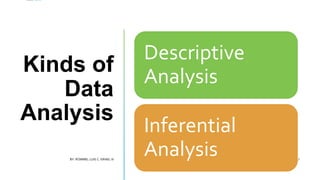
Kinds of
Data
Analysis
Descriptive
Analysis
Inferential
Analysis
BY: ROMMEL LUIS C. ISRAEL III 7
Descriptive
Analysis
- refers to the description
of the data from a particular
sample.
- hence, the conclusion must refer
only to the sample.
- In other words, these summarize
the data and describe sample
characteristics.
BY: ROMMEL LUIS C. ISRAEL III 8
Classification of Descriptive
Analysis
A. Frequency Distribution – a systematic arrangement of numeric
values from the lowest to the highest or highest to the lowest.
Formula : Ef = N
where :
E = sum of
f = frequency
N = sample size
BY: ROMMEL LUIS C. ISRAEL III 9
Classification of
Descriptive
Analysis
B. Measure of Central Tendency – a
statistical index that describes the
average of the set values.
Kinds of Averages
• Mode – a numeric value in a
distribution that occurs most
frequently.
• Median – an index of average position
in distribution of numbers.
• Mean – the point on the score scale
that is equal to the sum of the scores
divided by the total number of scores.
BY: ROMMEL LUIS C. ISRAEL III 10
Classification of Descriptive Analysis
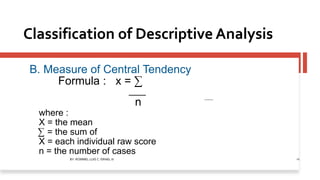
B. Measure of Central Tendency
Formula : x = ∑
___
n
where :
X = the mean
∑ = the sum of
X = each individual raw score
n = the number of cases
BY: ROMMEL LUIS C. ISRAEL III 11
Classification
of Descriptive
Analysis
BY: ROMMEL LUIS C. ISRAEL III 12
Commonly
used
measures of
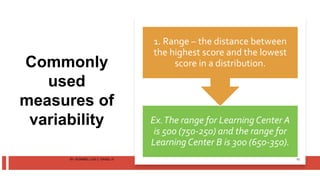
variability Ex.The range for Learning Center A
is 500 (750-250) and the range for
Learning Center B is 300 (650-350).
1. Range – the distance between
the highest score and the lowest
score in a distribution.
BY: ROMMEL LUIS C. ISRAEL III 13
Commonly
used
measures
of
variability
2. Standard Deviation –
the most commonly
used measures of
variability that |
indicates the average
to which the scores
deviate from the mean.
BY: ROMMEL LUIS C. ISRAEL III 14
Classification
of Descriptive
Analysis
D. Bivariate
Descriptive
Statistics
– derived from the
simultaneous analysis of
two variables to examine
the relationship between
the variables.
BY: ROMMEL LUIS C. ISRAEL III 15
Commonly used bivariate descriptive analysis
1. ContingencyTable – is
essentially a two-
dimensioned frequency
distribution in which the
frequencies of two variables
are cross-tabulated.
2. Correlation – the most
common method of
describing the relationship
between two measures.
BY: ROMMEL LUIS C. ISRAEL III 16
Inferential
Analysis
- the use of
statistical tests,
either to test for
significant
relationships
among variable or
to find statistical
support for the
hypothesis.
BY: ROMMEL LUIS C. ISRAEL III 17
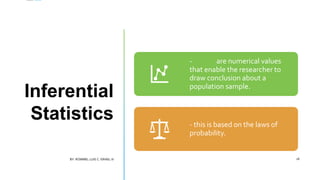
Inferential
Statistics
- are numerical values
that enable the researcher to
draw conclusion about a
population sample.
- this is based on the laws of
probability.
BY: ROMMEL LUIS C. ISRAEL III 18
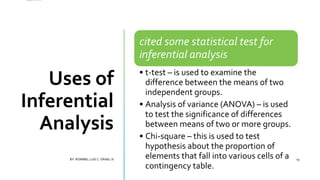
Uses of
Inferential
Analysis
cited some statistical test for
inferential analysis
• t-test – is used to examine the
difference between the means of two
independent groups.
• Analysis of variance (ANOVA) – is used
to test the significance of differences
between means of two or more groups.
• Chi-square – this is used to test
hypothesis about the proportion of
elements that fall into various cells of a
contingency table.
BY: ROMMEL LUIS C. ISRAEL III 19
Hypothesis
–Testing
Procedure
•
BY: ROMMEL LUIS C. ISRAEL III 20
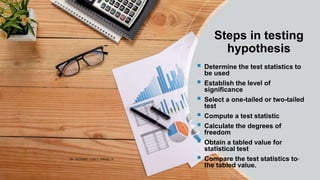
Steps in testing
hypothesis
 Determine the test statistics to
be used
 Establish the level of
significance
 Select a one-tailed or two-tailed
test
 Compute a test statistic
 Calculate the degrees of
freedom
 Obtain a tabled value for
statistical test
 Compare the test statistics to
the tabled value.
BY: ROMMEL LUIS C. ISRAEL III 21
Other Importance
of Data Analysis
It helps in structuring the
findings from different
sources of data collection
Acts like a filter when it
comes to acquiring
meaningful insights out of
huge data-set.
Provides meaningful base
to critical decision.
It helps in keeping human
bias away from research
conclusion with the help of
proper statistical treatment.
BY: ROMMEL LUIS C. ISRAEL III 22

DATA ANALYSIS

  • 1.
    Data Analysis BY: ROMMELLUIS C. ISRAEL III
  • 2.
    Data Analysis is aprocess of evaluating data using analytical and logical reasoning to examine each component of the data provided. BY: ROMMEL LUIS C. ISRAEL III 2
  • 3.
    Purpose of Data Analysis toanswer the research questions and to help determine the trends and relationships among the variables. BY: ROMMEL LUIS C. ISRAEL III 3
  • 4.
    Two Types of Data 1.Qualitative Data – comprises information that isn’t collected in the form of numbers, and is suited to influencing subjective perception of a thing. 2. Quantitative Data – comprises information that is collected in the form of numbers, and is suited to influencing occurence of an objective outcome. BY: ROMMEL LUIS C. ISRAEL III 4
  • 5.
    Steps in Data Analysis Beforedata collection, the researcher should accomplish the ff:  Determine the method of Data Analysis  Determine how to process the data  Consult a statistician Prepare dummy tables. BY: ROMMEL LUIS C. ISRAEL III 5
  • 6.
    Steps in Data Analysis Afterdata collection :  Process data  Prepares tables and graphs  Analyze and interpret findings  Consult again a statistician  Prepares editing  Prepares presentation BY: ROMMEL LUIS C. ISRAEL III 6
  • 7.
  • 8.
    Descriptive Analysis - refers tothe description of the data from a particular sample. - hence, the conclusion must refer only to the sample. - In other words, these summarize the data and describe sample characteristics. BY: ROMMEL LUIS C. ISRAEL III 8
  • 9.
    Classification of Descriptive Analysis A.Frequency Distribution – a systematic arrangement of numeric values from the lowest to the highest or highest to the lowest. Formula : Ef = N where : E = sum of f = frequency N = sample size BY: ROMMEL LUIS C. ISRAEL III 9
  • 10.
    Classification of Descriptive Analysis B. Measureof Central Tendency – a statistical index that describes the average of the set values. Kinds of Averages • Mode – a numeric value in a distribution that occurs most frequently. • Median – an index of average position in distribution of numbers. • Mean – the point on the score scale that is equal to the sum of the scores divided by the total number of scores. BY: ROMMEL LUIS C. ISRAEL III 10
  • 11.
    Classification of DescriptiveAnalysis B. Measure of Central Tendency Formula : x = ∑ ___ n where : X = the mean ∑ = the sum of X = each individual raw score n = the number of cases BY: ROMMEL LUIS C. ISRAEL III 11
  • 12.
  • 13.
    Commonly used measures of variability Ex.Therange for Learning Center A is 500 (750-250) and the range for Learning Center B is 300 (650-350). 1. Range – the distance between the highest score and the lowest score in a distribution. BY: ROMMEL LUIS C. ISRAEL III 13
  • 14.
    Commonly used measures of variability 2. Standard Deviation– the most commonly used measures of variability that | indicates the average to which the scores deviate from the mean. BY: ROMMEL LUIS C. ISRAEL III 14
  • 15.
    Classification of Descriptive Analysis D. Bivariate Descriptive Statistics –derived from the simultaneous analysis of two variables to examine the relationship between the variables. BY: ROMMEL LUIS C. ISRAEL III 15
  • 16.
    Commonly used bivariatedescriptive analysis 1. ContingencyTable – is essentially a two- dimensioned frequency distribution in which the frequencies of two variables are cross-tabulated. 2. Correlation – the most common method of describing the relationship between two measures. BY: ROMMEL LUIS C. ISRAEL III 16
  • 17.
    Inferential Analysis - the useof statistical tests, either to test for significant relationships among variable or to find statistical support for the hypothesis. BY: ROMMEL LUIS C. ISRAEL III 17
  • 18.
    Inferential Statistics - are numericalvalues that enable the researcher to draw conclusion about a population sample. - this is based on the laws of probability. BY: ROMMEL LUIS C. ISRAEL III 18
  • 19.
    Uses of Inferential Analysis cited somestatistical test for inferential analysis • t-test – is used to examine the difference between the means of two independent groups. • Analysis of variance (ANOVA) – is used to test the significance of differences between means of two or more groups. • Chi-square – this is used to test hypothesis about the proportion of elements that fall into various cells of a contingency table. BY: ROMMEL LUIS C. ISRAEL III 19
  • 20.
  • 21.
    Steps in testing hypothesis Determine the test statistics to be used  Establish the level of significance  Select a one-tailed or two-tailed test  Compute a test statistic  Calculate the degrees of freedom  Obtain a tabled value for statistical test  Compare the test statistics to the tabled value. BY: ROMMEL LUIS C. ISRAEL III 21
  • 22.
    Other Importance of DataAnalysis It helps in structuring the findings from different sources of data collection Acts like a filter when it comes to acquiring meaningful insights out of huge data-set. Provides meaningful base to critical decision. It helps in keeping human bias away from research conclusion with the help of proper statistical treatment. BY: ROMMEL LUIS C. ISRAEL III 22