Clinical Research
Dr Naveen Phuyal
MBBS. MD
History
Medical research as an organized scientific
discipline has just surfaced in last few decades.
The practice of this art however can be traced
to almost 400 years back when Hippocrates
related human disease to the environment on
his treatise “ Airs, Waters and Places”.
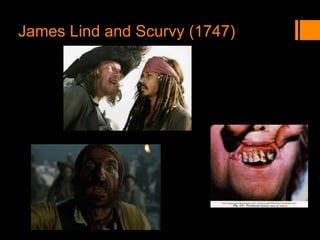
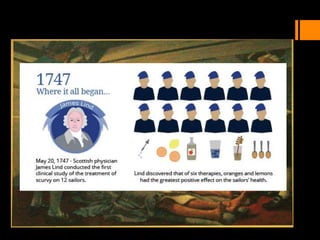
James Lind and Scurvy (1747)
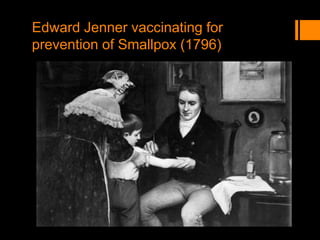
Edward Jenner vaccinating for
prevention of Smallpox (1796)
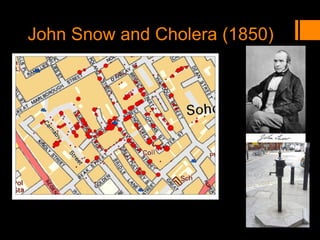
John Snow and Cholera (1850)
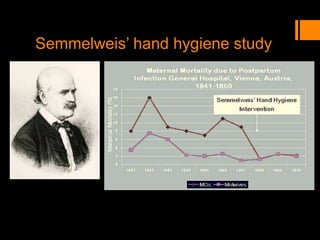
Semmelweis’ hand hygiene study
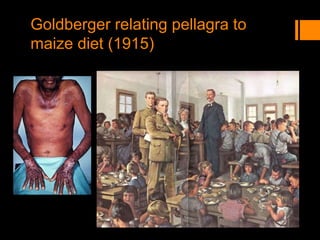
Goldberger relating pellagra to
maize diet (1915)
History
Fletcher relating beriberi to polished rice (1905)
They all were practicing epidemiology
Strong methodologies were developed later on in
1940s and 1950s
Community trials of fluoridation of water supplies
Cigarette smoking and lung cancer by Doll and Hill
Why research at all ?
To submit thesis/ dissertation
Publish or Perish syndrome
Medicine is still practiced and so many things yet
to be known
Medicine is expanding we need more knowledge
As qualified doctor we have obligation to art and
science of medicine and we also have to
contribute to this advancement.
Why should a doctor be trained to do
medical research?
Clinical epidemiology is nothing but an extension of wise
clinician’s intuitively explorative faculties.
However such extension of this faculty does not occur with
learning and practicing medicine.
History of medicine is replete with instances in where the
results based on unscientifically conducted research have
been applied to the patients eg. Blood letting, Gastric
freezing.
Why should a doctor be trained to
do medical research?
Doctors are consumers of research done by others,
applying their research to treat their own patients.
Our own research will be used by our colleagues
who read our publications, in their clinical practice.
7 reasons
These 7 reasons act in sequence and make a working
knowledge of ‘ medical research’ necessary for every
doctors:
1. Variability
2. Generalisability/ Loss of external variablity
3. Precision/ Sampling error
4. Internal validity/ Bias/ Measurement Errors
5. Indirect Associations/ Confounding
6. Statistical significance / Clinical significance
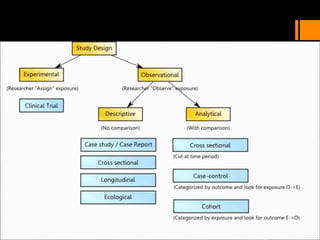
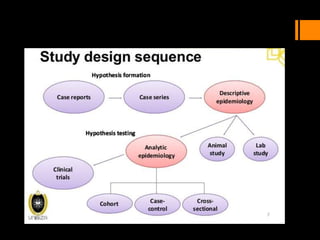
7. Selecting the correct research “Design”
8. Reading and asking questions
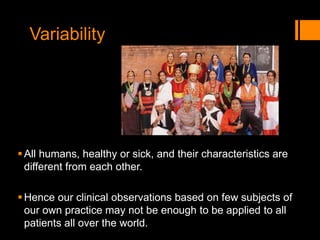
Variability
All humans, healthy or sick, and their characteristics are
different from each other.
Hence our clinical observations based on few subjects of
our own practice may not be enough to be applied to all
patients all over the world.
Generalisability
We cannot study the whole lot of subjects , we have
to study samples.
Samples should be representative: if not results can
not be generalized to the total population.
This is called as loss of external validity or loss of
generalisability.
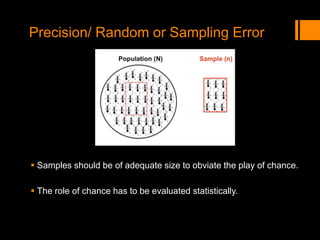
Precision/ Random or Sampling Error
 Samples should be of adequate size to obviate the play of chance.
 The role of chance has to be evaluated statistically.
Internal validity/Bias/Measurement
Errors
Entire research is based on making correct
measurements.
We should be able to accurately measure what we
really intend to measure.
We need to be aware of places where such
‘measurement errors’ may come up.
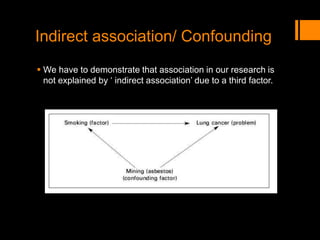
Indirect association/ Confounding
 We have to demonstrate that association in our research is
not explained by ‘ indirect association’ due to a third factor.
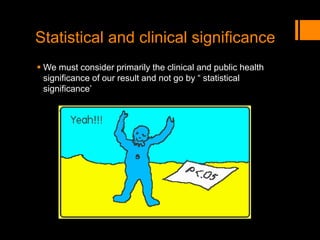
Statistical and clinical significance
 We must consider primarily the clinical and public health
significance of our result and not go by “ statistical
significance’
Design of the study
The design of our research work should be
such that it is appropriate to answer the
clinical/ public health question at hand.
Reading and asking
Research does not stop after our particular
study has been done.
Every research opens up many more question,
which need to be further answered.
Thank You

Medical research and study design

  • 1.
  • 2.
    History Medical research asan organized scientific discipline has just surfaced in last few decades. The practice of this art however can be traced to almost 400 years back when Hippocrates related human disease to the environment on his treatise “ Airs, Waters and Places”.
  • 4.
    James Lind andScurvy (1747)
  • 6.
    Edward Jenner vaccinatingfor prevention of Smallpox (1796)
  • 7.
    John Snow andCholera (1850)
  • 8.
  • 9.
    Goldberger relating pellagrato maize diet (1915)
  • 10.
    History Fletcher relating beriberito polished rice (1905) They all were practicing epidemiology Strong methodologies were developed later on in 1940s and 1950s Community trials of fluoridation of water supplies Cigarette smoking and lung cancer by Doll and Hill
  • 11.
    Why research atall ? To submit thesis/ dissertation Publish or Perish syndrome Medicine is still practiced and so many things yet to be known Medicine is expanding we need more knowledge As qualified doctor we have obligation to art and science of medicine and we also have to contribute to this advancement.
  • 12.
    Why should adoctor be trained to do medical research? Clinical epidemiology is nothing but an extension of wise clinician’s intuitively explorative faculties. However such extension of this faculty does not occur with learning and practicing medicine. History of medicine is replete with instances in where the results based on unscientifically conducted research have been applied to the patients eg. Blood letting, Gastric freezing.
  • 13.
    Why should adoctor be trained to do medical research? Doctors are consumers of research done by others, applying their research to treat their own patients. Our own research will be used by our colleagues who read our publications, in their clinical practice.
  • 14.
    7 reasons These 7reasons act in sequence and make a working knowledge of ‘ medical research’ necessary for every doctors: 1. Variability 2. Generalisability/ Loss of external variablity 3. Precision/ Sampling error 4. Internal validity/ Bias/ Measurement Errors 5. Indirect Associations/ Confounding 6. Statistical significance / Clinical significance 7. Selecting the correct research “Design” 8. Reading and asking questions
  • 15.
    Variability All humans, healthyor sick, and their characteristics are different from each other. Hence our clinical observations based on few subjects of our own practice may not be enough to be applied to all patients all over the world.
  • 16.
    Generalisability We cannot studythe whole lot of subjects , we have to study samples. Samples should be representative: if not results can not be generalized to the total population. This is called as loss of external validity or loss of generalisability.
  • 17.
    Precision/ Random orSampling Error  Samples should be of adequate size to obviate the play of chance.  The role of chance has to be evaluated statistically.
  • 18.
    Internal validity/Bias/Measurement Errors Entire researchis based on making correct measurements. We should be able to accurately measure what we really intend to measure. We need to be aware of places where such ‘measurement errors’ may come up.
  • 19.
    Indirect association/ Confounding We have to demonstrate that association in our research is not explained by ‘ indirect association’ due to a third factor.
  • 20.
    Statistical and clinicalsignificance  We must consider primarily the clinical and public health significance of our result and not go by “ statistical significance’
  • 21.
    Design of thestudy The design of our research work should be such that it is appropriate to answer the clinical/ public health question at hand.
  • 22.
    Reading and asking Researchdoes not stop after our particular study has been done. Every research opens up many more question, which need to be further answered.
  • 25.