DOH PROGRAMS RELATED TO
FAMILY PLANNING
BY: ROMMEL LUIS C. ISRAEL III
• The DOH – Family Health Office is tasked to operate health
programs geared towards the health of the family. It is responsible for
the creation, implementation and evaluation of health family
programs.
• The summary of its objective is to improve the survival, health and
well being of each members of the family as well as the reduction of
morbidity and mortality rates in the family and community.
BY: ROMMEL LUIS C. ISRAEL III
2
FAMILY HEALTH PROGRAMS
1. National Safe Motherhood Program
2. Family Planning Program
3. Child Health Program
a. Adolescent Health and Development
b.Integrated Management Of Childhood Illness (IMCI)
4. Expanded Program Of Immunization
5. Nutrition Program
6. Oral Health Program
7. Other Health Program
BY: ROMMEL LUIS C. ISRAEL III
3
NATIONAL SAFE MOTHERHOOD PROGRAM
BY: ROMMEL LUIS C. ISRAEL III
4
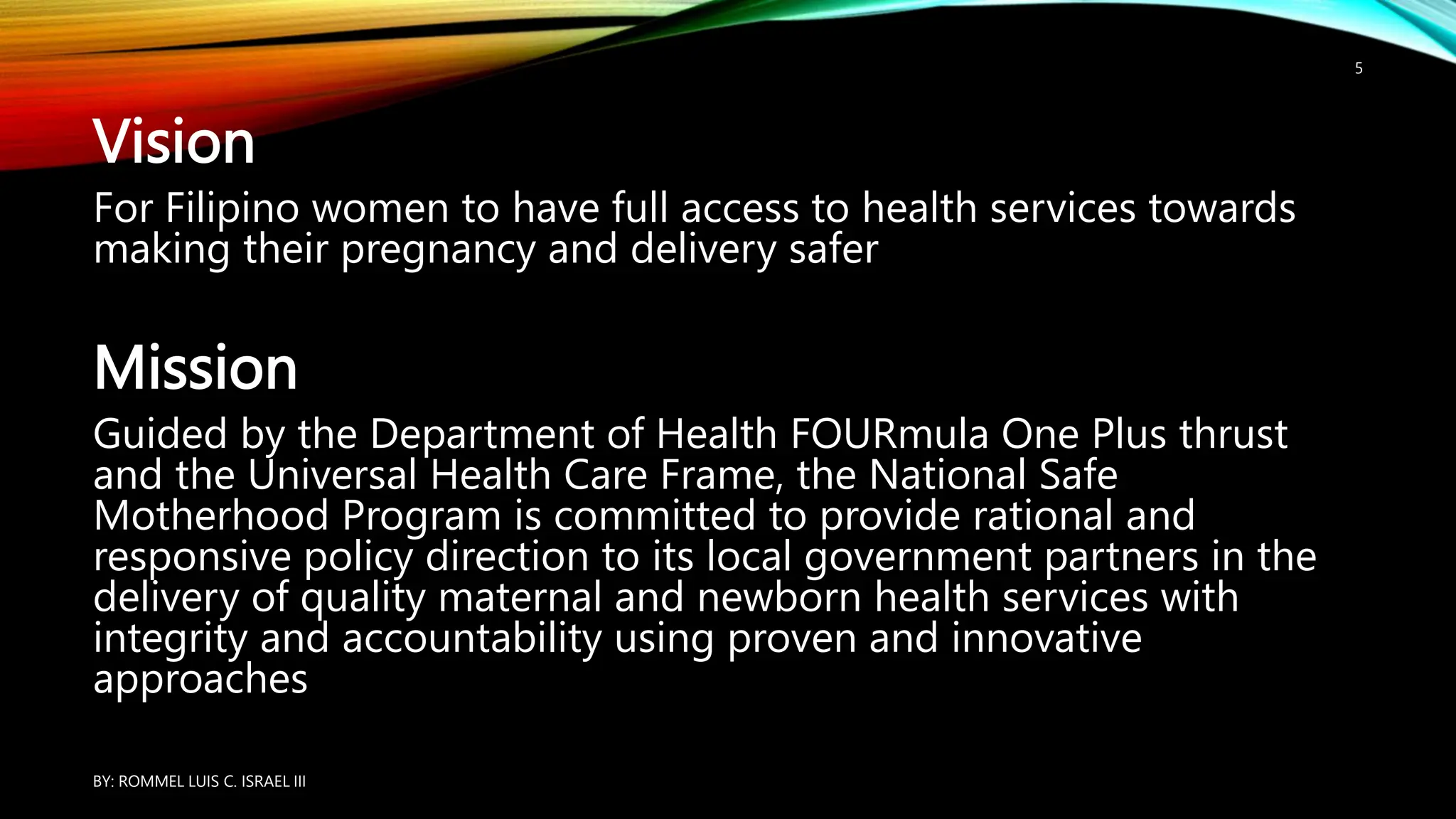
Vision
For Filipino women to have full access to health services towards
making their pregnancy and delivery safer
Mission
Guided by the Department of Health FOURmula One Plus thrust
and the Universal Health Care Frame, the National Safe
Motherhood Program is committed to provide rational and
responsive policy direction to its local government partners in the
delivery of quality maternal and newborn health services with
integrity and accountability using proven and innovative
approaches
BY: ROMMEL LUIS C. ISRAEL III
5
Objectives
The Program contributes to the national goal of improving women’s
health and well-being by:
1. Collaborating with Local Government Units in establishing
sustainable, cost-effective approach of delivering health services that
ensure access of disadvantaged women to acceptable and high
quality maternal and newborn health services and enable them to
safely give birth in health facilities near their homes
2. Establishing core knowledge base and support systems that facilitate
the delivery of quality maternal and newborn health services in the
country.
BY: ROMMEL LUIS C. ISRAEL III
6
PROGRAM COMPONENTS
BY: ROMMEL LUIS C. ISRAEL III
7
COMPONENT A: LOCAL DELIVERY OF THE
MATERNAL–NEWBORN SERVICE PACKAGE
This component supports LGUs in establishing and mobilizing the service delivery network of public and private providers to
enable them to deliver the integrated maternal-newborn service package. In each province and city, the following shall
continue to be undertaken:
1. Establishment of critical capacities to provide quality maternal-newborn services through the
organization and operation of a network of Service Delivery Teams consisting of:
a. Barangay Health Workers
b. BEmONC Teams composed of Doctors, Nurses and Midwives
2. In collaboration with the Centers for health Development and relevant national offices: Establishment of
Reliable Sustainable Support Systems for Maternal-Newborn Service Delivery through such initiatives as:
a. Establishment of Safe Blood Supply Network with support from the National Voluntary Blood Program
b. Behavior Change Interventions in collaboration with the Health Promotion and Communication Service
c. Sustainable financing of maternal - newborn services and commodities through locally initiated revenue
generation and retention activities including PhilHealth accreditation and enrolment.
BY: ROMMEL LUIS C. ISRAEL III
8
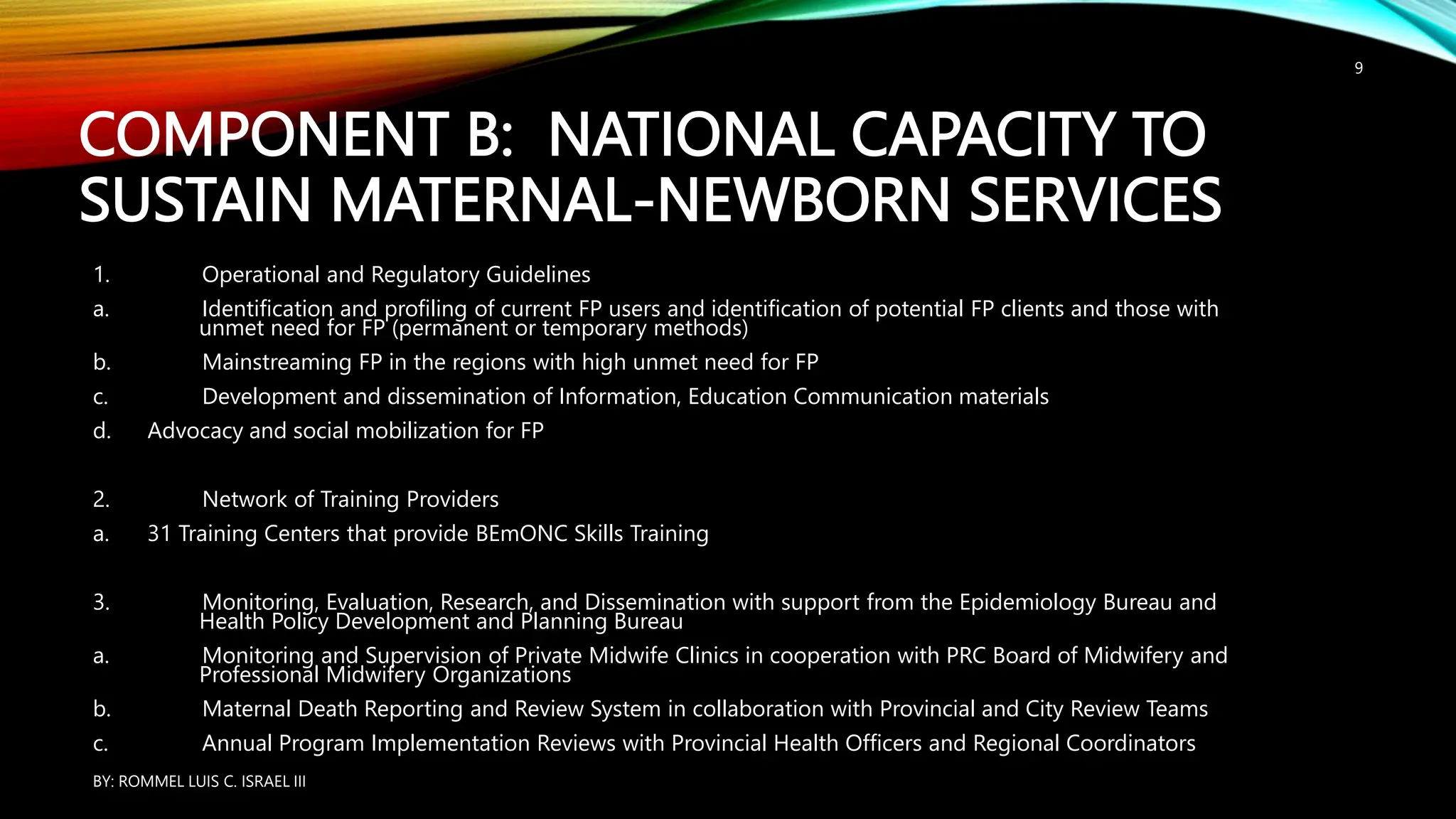
COMPONENT B: NATIONAL CAPACITY TO
SUSTAIN MATERNAL-NEWBORN SERVICES
1. Operational and Regulatory Guidelines
a. Identification and profiling of current FP users and identification of potential FP clients and those with
unmet need for FP (permanent or temporary methods)
b. Mainstreaming FP in the regions with high unmet need for FP
c. Development and dissemination of Information, Education Communication materials
d. Advocacy and social mobilization for FP
2. Network of Training Providers
a. 31 Training Centers that provide BEmONC Skills Training
3. Monitoring, Evaluation, Research, and Dissemination with support from the Epidemiology Bureau and
Health Policy Development and Planning Bureau
a. Monitoring and Supervision of Private Midwife Clinics in cooperation with PRC Board of Midwifery and
Professional Midwifery Organizations
b. Maternal Death Reporting and Review System in collaboration with Provincial and City Review Teams
c. Annual Program Implementation Reviews with Provincial Health Officers and Regional Coordinators
BY: ROMMEL LUIS C. ISRAEL III
9
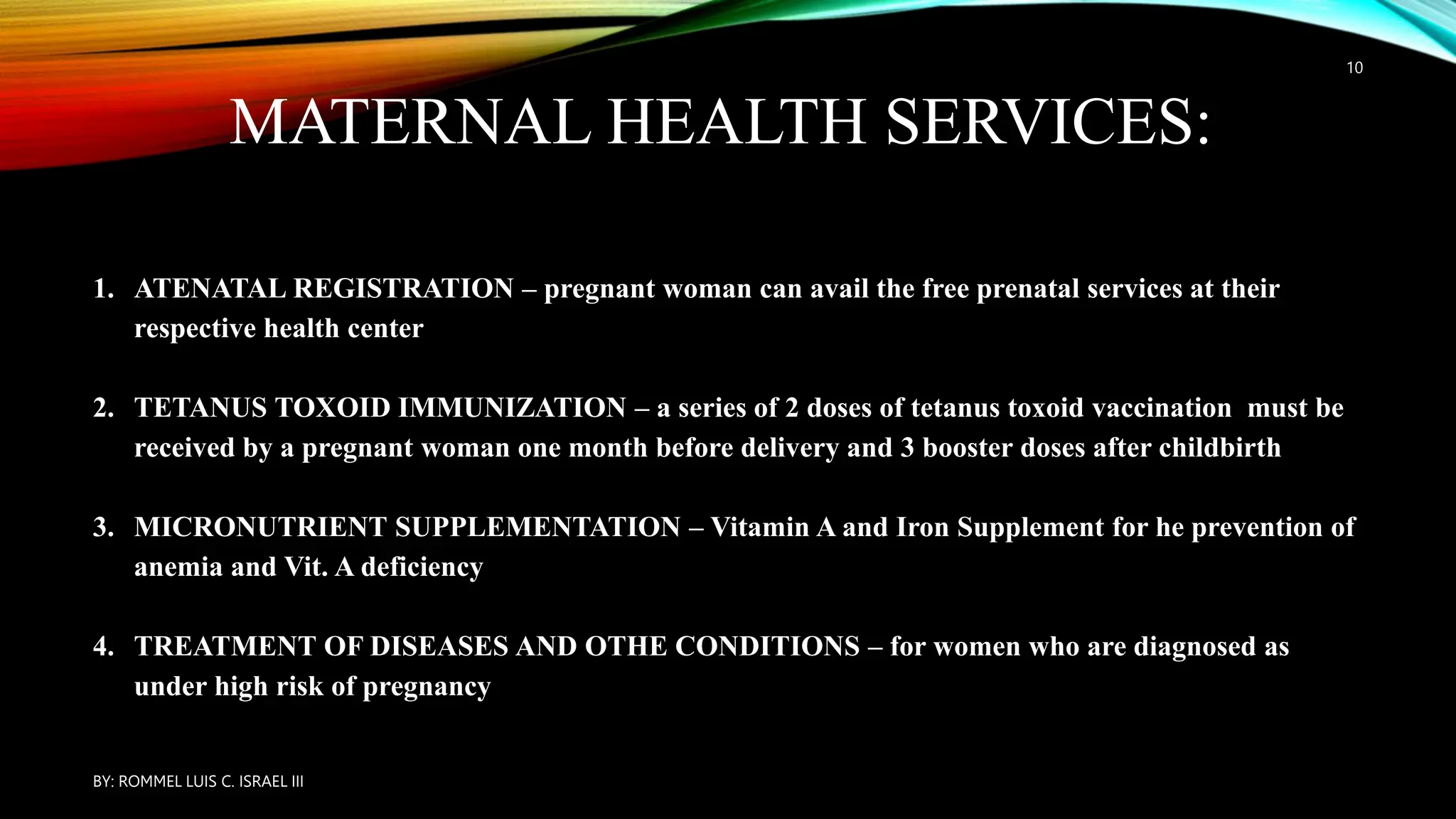
MATERNAL HEALTH SERVICES:
1. ATENATAL REGISTRATION – pregnant woman can avail the free prenatal services at their
respective health center
2. TETANUS TOXOID IMMUNIZATION – a series of 2 doses of tetanus toxoid vaccination must be
received by a pregnant woman one month before delivery and 3 booster doses after childbirth
3. MICRONUTRIENT SUPPLEMENTATION – Vitamin A and Iron Supplement for he prevention of
anemia and Vit. A deficiency
4. TREATMENT OF DISEASES AND OTHE CONDITIONS – for women who are diagnosed as
under high risk of pregnancy
BY: ROMMEL LUIS C. ISRAEL III
10
IDEAL FREQUENCY OF PRENATAL VISITS DURING
THE DURATION OF PREGNANCY:
PRENATAL VISITS PERIOD OF PREGNANCY
First visit As early as possible before 4
months or during 1st trimester
Second visit During the second trimester
Third visit During the third trimester
Every 2 weeks After 8 months
BY: ROMMEL LUIS C. ISRAEL III
11
NATIONAL FAMILY PLANNING PROGRAM
BY: ROMMEL LUIS C. ISRAEL III
12
DESCRIPTION:
A national mandated priority public health program to attain
the country's national health development: a health
intervention program and an important tool for the
improvement of the health and welfare of mothers, children
and other members of the family.
It also provides information and services for the couples of
reproductive age to plan their family according to their beliefs
and circumstances through legally and medically acceptable
family planning methods.
BY: ROMMEL LUIS C. ISRAEL III
13
THE PROGRAM IS ANCHORED ON THE
FOLLOWING BASIC PRINCIPLES:
• Responsible Parenthood which means that each family has the right and duty to determine the
desired number of children they might have and when they might have them. And beyond responsible
parenthood is Responsible Parenting which is the proper ubringing and education of chidren so that they grow
up to be upright, productive and civic-minded citizens.
• Respect for Life. The 1987 Constitution states that the government protects the sanctity of life.
Abortion is NOT a FP method:
• Birth Spacing refers to interval between pregnancies (which is ideally 3 years). It enables women to
recover their health improves women's potential to be more productive and to realize their personal aspirations
and allows more time to care for children and spouse/husband, and;
• Informed Choice that is upholding and ensuring the rights of couples to determin the number and
spacing of their children according to their life's aspirations and reminding couples that planning size of their
families have a direct bearing on the quality of their children's and their own lives.
BY: ROMMEL LUIS C. ISRAEL III
14
Vision
For Filipino women and men achieve their desired family size and fulfill
the reproductive health and rights for all through universal access to
quality family planning information and services.
Mission
In line with the Department of Health FOURmula One Plus strategy and
Universal Health Care framework, the National Family Planning Program
is committed to provide responsive policy direction and ensure access of
Filipinos to medically safe, legal, non-abortifacient, effective, and
culturally acceptable modern family planning (FP) methods.
BY: ROMMEL LUIS C. ISRAEL III
15
Objectives
1. To increase modern Contraceptive Prevalence Rate
(mCPR) among all women from 24.9% in 2017 to 30% by
2022
2. To reduce the unmet need for modern family
planning from 10.8% in 2017 to 8% by 2022
BY: ROMMEL LUIS C. ISRAEL III
16
PROGRAM COMPONENTS
BY: ROMMEL LUIS C. ISRAEL III
17
Component A: Provision of free FP Commodities that are
medically safe, legal, non-abortifacient, effective and
culturally acceptable to all in need of the FP service:
o Forecasting of FP commodity requirements for the
country
o Procurement of FP commodities and its ancillary
supplies
o Strengthening of the supply chain management in
FP and ensuring of adequate FP supply at the
service delivery points
BY: ROMMEL LUIS C. ISRAEL III
18
Component B: Demand Generation through Community-
based Management Information System:
o Identification and profiling of current FP users and
identification of potential FP clients and those with unmet
need for FP (permanent or temporary methods)
o Mainstreaming FP in the regions with high unmet need for FP
o Development and dissemination of Information, Education
Communication materials
o Advocacy and social mobilization for FP
BY: ROMMEL LUIS C. ISRAEL III
19
Component C: Family Planning in Hospitals and other Health Facilities
o Establishment of FP service package in hospitals
o Organization of FP Itinerant team for outreach missions
o Delivery of FP services by hospitals to the poor communities especially
Geographically Isolated and Disadvantaged Areas (GIDAs):
o Provision of budget support to operations by the itinerant teams including logistics
and medical supplies needed for voluntary surgical sterilization services
o FP services as part of medical and surgical missions of the hospital
o Partnership with LGU hospitals for the FP outreach missions
BY: ROMMEL LUIS C. ISRAEL III
20
Component D: Financial Security in FP
o Strengthening PhilHealth benefit packages for F
o Expansion of PhilHealth coverage to include health centers providing
No Scalpel Vasectomy and FP Itinerant Teams
o Expansion of Philhealth benefit package to include pills, injectables and
IUD
o Social Marketing of contraceptives and FP services by the partner
NGOs
o National Funding/Subsidy
BY: ROMMEL LUIS C. ISRAEL III
21
Strategies, Action Points and Timeline
Apart from the routine means of FP service delivery, the National Family Planning
Program also employs the following main strategies to ensure universal access to FP:
o FP Outreach Mission – this maximizes opportunities where clients are
and FP services are delivered down to the community level.
o FP in hospitals – this address missed opportunities where women
especially those who recently gave birth are offered with appropriate
FP services.
o Intensive Demand generation through house-to-house visits by the
community health volunteers, Family Development Sessions, Usapan
sessions, among others
BY: ROMMEL LUIS C. ISRAEL III
22
TYPES OF FAMILY PLANNING
NATURAL ARTIFICIAL PERMANENT
- Standard days method
- Lactational Amenorrhea
method
- Basal Body Temperature
- Billings ovulation/Cervical
Mucus method
- Symptothermal
- Condoms
- Injectables
- Oral contraceptive pills
- Intrauterine device
- Vasectomy
- Bilateral Tubal Ligation
BY: ROMMEL LUIS C. ISRAEL III
23
NATURAL FAMILY PLANNING
BY: ROMMEL LUIS C. ISRAEL III
24
NATURAL FAMILY PLANNING
You can only use the Standard Days Method if:
o Your menstrual cycle is really regular (your periods always come at the same time).
o Your cycle is never shorter than 26 days.
o Your cycle is never longer than 32 days.
o You’re okay with either not having vaginal sex or using birth control from day 8
through day 19 of each cycle.
BY: ROMMEL LUIS C. ISRAEL III
25
•To use the Standard Days method, you simply don’t
have vaginal sex or use another method of birth control
on days 8-19 of your cycle.
•Most people using the Standard Days method use an app
or have a special string of beads, called CycleBeads, that
helps them keep track of their cycles. CycleBeads have
33 colored beads and a black rubber ring that moves from
bead to bead.
BY: ROMMEL LUIS C. ISRAEL III
26
• Lactational Amenorrhea Method is a temporary postpartum
method of postponing pregnancy based on the physiological
infertility experienced by breastfeeding mothers. Mothers may
ovulate but not menstruate while breastfeeding.
• Basal Body Temperature is used to identify the fertile and
infertile period of a woman’s cycle by daily taking and recording
the rise and fall in body temperature during and after ovulation.
Woman’s BBT falls about half a degree before day of ovulation
and BBT rises a full degree at time of ovulation.
BY: ROMMEL LUIS C. ISRAEL III
27
•The Billings ovulation method is a method in which
women use their vaginal mucous to determine their
fertility. It does not rely on the presence of ovulation,
rather it identifies patterns of potential fertility and
obvious infertility within the cycle, whatever its length.
Effectiveness, however, is not very clear.
•Symptothermal is a combination of BBT and Billings
method.
BY: ROMMEL LUIS C. ISRAEL III
28
ARTIFICIAL FAMILY PLANNING
BY: ROMMEL LUIS C. ISRAEL III
29
• Condom is a thin sheath of latex rubber made to fit on a man’s
erected penis, it prevents the passage of sperm into the internal
vagina.
• Injectables contain synthetic hormone, progestin which
suppresses ovulation; thickens cervical mucus thus making it
difficult for sperm to pass through
BY: ROMMEL LUIS C. ISRAEL III
30
• Oral Contraceptive Pills contain hormones: estrogen and progesterone,
taken daily to prevent conception. It also reduces gynaecological
symptoms like painful menstruation and reduce the risk of ovarian and
endometrial cancers
• Intrauterine Device is a long term birth control that is a small, T-shaped
plastic device that is wrapped in coppe or contains hormones. A plastic
string is ties of the IUD hangs down through cervix into vagina. It can last
up to 10 years.
BY: ROMMEL LUIS C. ISRAEL III
31
PERMANENT FAMILY PLANNING
BY: ROMMEL LUIS C. ISRAEL III
32
• Vasectomy prevents passage of sperm because the vas deferens
is blocked or cut
• Bilateral Tubal Ligation involves cutting or blocking of the 2
fallopian tubes.
BY: ROMMEL LUIS C. ISRAEL III
33
ADOLESCENT HEALTH AND
DEVELOPMENT PROGRAM
BY: ROMMEL LUIS C. ISRAEL III
34
DESCRIPTION:
In April 2000, DOH issued the Administrative Order 34- A s 2000, the
Adolescent and Youth Health (AYH) Policy, creating the Adolescent Youth
Health Sub-program under the Children’s Health Cluster of Family Health
Office. In 2006, the department created the Technical Committee for
Adolescent and Youth Health Program, composed of both government
and non-government organizations dedicated to uplifting the welfare of
adolescents and tasked to revitalize the program. Due to an increasing
health risky behaviour among our Filipino adolescents
BY: ROMMEL LUIS C. ISRAEL III
35
• DOH embarked on revising the policy and to focus on the
emerging issues of the adolescents which are the 10 – 19
years old.
• In March 21, 2013, DOH with the support of the United
Nations Population Fund (UNFPA) Philippines, revised the
policy and served the Administrative Order 0013 - 2013
National Health Policy and Strategic Framework on
Adolescent Health and Development (AHDP). The
Strategic Framework 2013 is designed in accordance with
this goal.
BY: ROMMEL LUIS C. ISRAEL III
36
In 2015, DOH AHDP Program revived the National External Technical
Working Group (TWG) on AHDP. This is composed of different
stakeholders from the government, non-government, academe, and
youth – led organizations. In 2016, DOH recognized the need for
harmonization of programs within the department that caters 10 – 19
years old. The AHDP Program convened the first DOH – Internal
Technical Working Group. This aims to ensure that all programs are
working together for the betterment of the adolescents in the country. It
is also an avenue to discuss indicators, policies, strategies, and service
delivery at the national and local implementation levels. The External
and Internal TWGs on AHDP are multi -sectoral, collaborative
approaches to fulfil the goal, vision, and mission of the program. In 2017,
both TWGs revised the strategic framework, and developed a logical
framework, and monitoring and evaluation framework of the program.
BY: ROMMEL LUIS C. ISRAEL III
37
Vision
The AHDP envisions a country with well informed,
empowered, responsible and healthy adolescents who are
leaders in the society
Mission
Its mission is to ensure that all adolescents have access to
comprehensive health care and services in an adolescent-
friendly environment.
BY: ROMMEL LUIS C. ISRAEL III
38
Objectives
Improve the health status of adolescents and enable them
to fully enjoy their rights to health.
BY: ROMMEL LUIS C. ISRAEL III
39
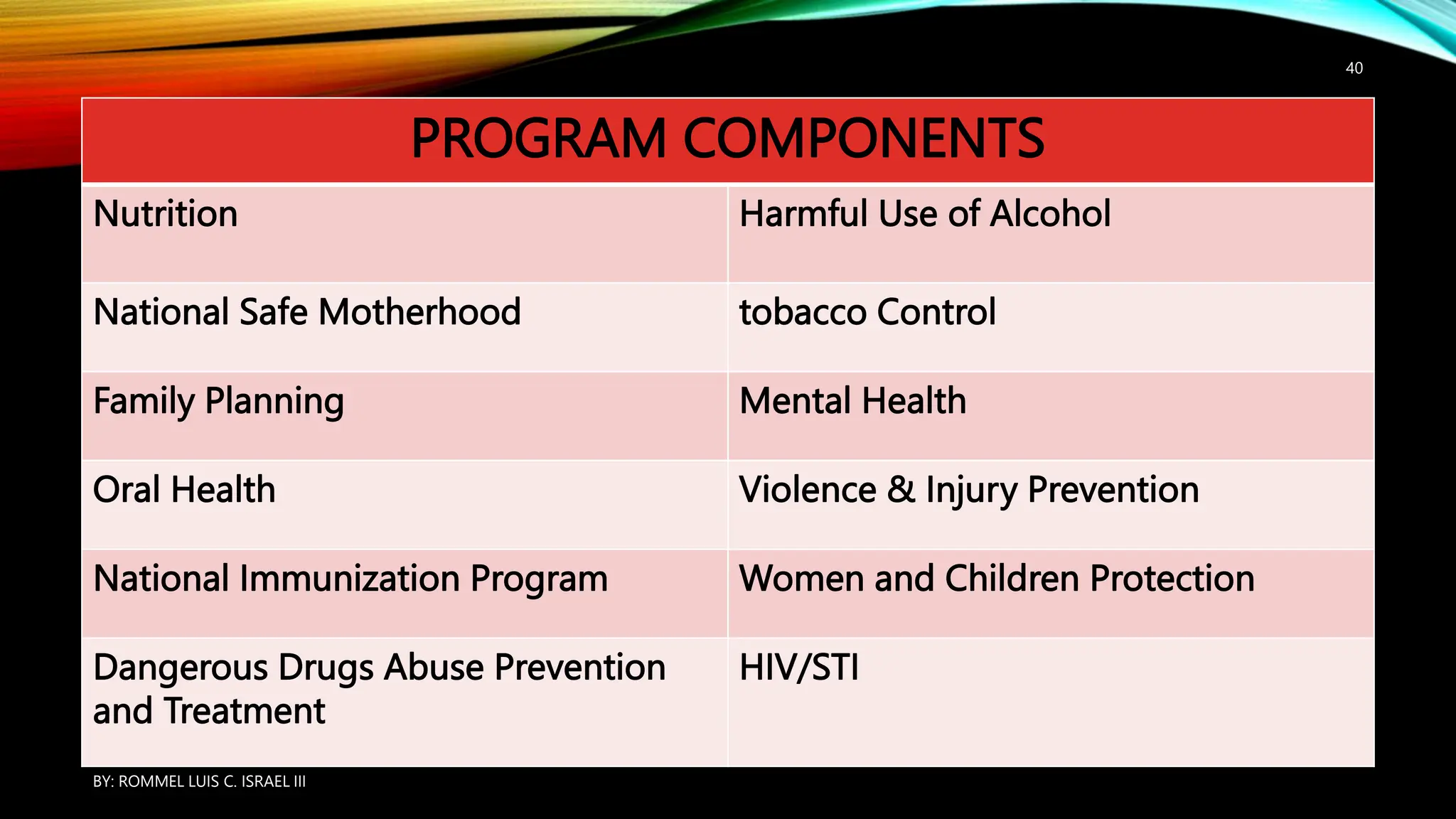
PROGRAM COMPONENTS
Nutrition Harmful Use of Alcohol
National Safe Motherhood tobacco Control
Family Planning Mental Health
Oral Health Violence & Injury Prevention
National Immunization Program Women and Children Protection
Dangerous Drugs Abuse Prevention
and Treatment
HIV/STI
BY: ROMMEL LUIS C. ISRAEL III
40
Strategies, action Points and Timeline
• Health promotion and behavior change for adolescents
• Adolescent participation in governance and policy decisions
• Developing/transforming health care centers to become adolescent-
friendly facilities
• Expanding health insurance to young people
• Enhancing skills of service providers, families and adolescents
• Strengthening partnerships among adolescent groups, government
agencies, private sectors, Civil Society organizations, families and
communities
• Resource mobilization
• Regular assessment and evaluation
BY: ROMMEL LUIS C. ISRAEL III
41
PROGRAM ACCOMPLISHMENTS/ STATUS
Health Education and Promotion
o Advocacy and awareness raising activities such as
Adolescent Health TV segment and Healthy Young Ones
BY: ROMMEL LUIS C. ISRAEL III
42
PROGRAM ACCOMPLISHMENTS/ STATUS
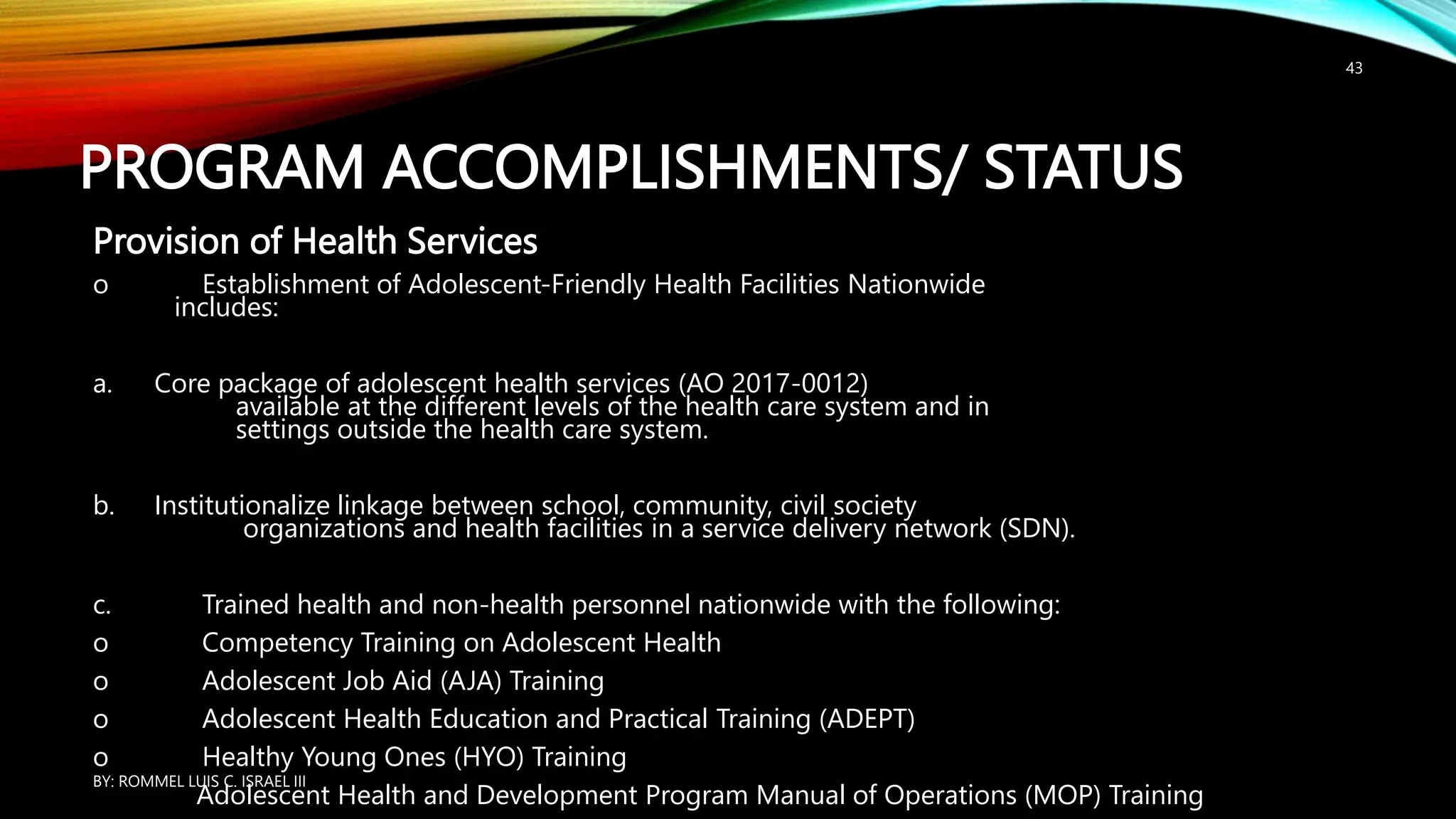
Provision of Health Services
o Establishment of Adolescent-Friendly Health Facilities Nationwide
includes:
a. Core package of adolescent health services (AO 2017-0012)
available at the different levels of the health care system and in
settings outside the health care system.
b. Institutionalize linkage between school, community, civil society
organizations and health facilities in a service delivery network (SDN).
c. Trained health and non-health personnel nationwide with the following:
o Competency Training on Adolescent Health
o Adolescent Job Aid (AJA) Training
o Adolescent Health Education and Practical Training (ADEPT)
o Healthy Young Ones (HYO) Training
Adolescent Health and Development Program Manual of Operations (MOP) Training
BY: ROMMEL LUIS C. ISRAEL III
43
INTEGRATED MANAGEMENT OF
CHILDHOOD ILLNESS (IMCI)
BY: ROMMEL LUIS C. ISRAEL III
44
One million children under five years old die each year in
less developed countries. Just five diseases (pneumonia,
diarrhea, malaria, measles and dengue hemorrhagic fever)
account for nearly half of these deaths and malnutrition is
often the underlying condition. Effective and affordable
interventions to address these common conditions exist
but they do not yet reach the populations most in need,
the young and impoverish.
BY: ROMMEL LUIS C. ISRAEL III
45
The Integrated Management of Childhood Illness strategy has
been introduced in an increasing number of countries in the
region since 1995. IMCI is a major strategy for child survival,
healthy growth and development and is based on the
combined delivery of essential interventions at community,
health facility and health systems levels. IMCI includes
elements of prevention as well as curative and addresses the
most common conditions that affect young children. The
strategy was developed by the World Health Organization
(WHO) and United Nations Children’s Fund (UNICEF).
BY: ROMMEL LUIS C. ISRAEL III
46
In the Philippines, IMCI was started on a pilot basis
in 1996, thereafter more health workers and hospital
staff were capacitated to implement the strategy at
the frontline level.
BY: ROMMEL LUIS C. ISRAEL III
47
Objectives of IMCI
• Reduce death and frequency and severity of
illness and disability, and
• Contribute to improved growth and
development
BY: ROMMEL LUIS C. ISRAEL III
48
Components of IMCI
• Improving case management skills of health workers
11-day Basic Course for RHMs, PHNs and MOHs
5 - day Facilitators course
5 – day Follow-up course for IMCI Supervisors
• Improving over-all health systems
• Improving family and community health practices
BY: ROMMEL LUIS C. ISRAEL III
49
RATIONALE FOR AN INTEGRATED APPROACH IN
THE MANAGEMENT OF SICK CHILDREN
Majority of these deaths are caused by 5 preventable and
treatable conditions namely: pneumonia, diarrhea, malaria,
measles and malnutrition. Three (3) out of four (4) episodes
of childhood illness are caused by these five conditions
Most children have more than one illness at one time. This
overlap means that a single diagnosis may not be possible
or appropriate.
BY: ROMMEL LUIS C. ISRAEL III
50
WHO ARE THE CHILDREN COVERED BY THE
IMCI PROTOCOL?
• Sick children birth up to 2 months (Sick
Young Infant)
• Sick children 2 months up to 5 years old
(Sick child)
BY: ROMMEL LUIS C. ISRAEL III
51
STRATEGIES/PRINCIPLES OF IMCI
• All sick children aged 2 months up to 5 years are examined for
GENERAL DANGER signs and all Sick Young Infants Birth up to 2 months
are examined for VERY SEVERE DISEASE AND LOCAL BACTERIAL
INFECTION. These signs indicate immediate referral or admission to
hospital
• The children and infants are then assessed for main symptoms. For sick
children, the main symptoms include: cough or difficulty breathing,
diarrhea, fever and ear infection. For sick young infants, local bacterial
infection, diarrhea and jaundice. All sick children are routinely assessed
for nutritional, immunization and deworming status and for other
problems
BY: ROMMEL LUIS C. ISRAEL III
52
STRATEGIES/PRINCIPLES OF IMCI
• Only a limited number of clinical signs are used
• A combination of individual signs leads to a child’s classification within
one or more symptom groups rather than a diagnosis.
• IMCI management procedures use limited number of essential drugs
and encourage active participation of caretakers in the treatment of
children
• Counseling of caretakers on home care, correct feeding and giving of
fluids, and when to return to clinic is an essential component of IMCI
BY: ROMMEL LUIS C. ISRAEL III
53
BASIS FOR CLASSIFYING THE CHILD’S ILLNESS (PLEASE SEE ENCLOSED
PORTION OF THE IMCI CHARTBOOKLET) THE CHILD’S ILLNESS IS CLASSIFIED
BASED ON A COLOR-CODED TRIAGE SYSTEM:
PINK- indicates urgent hospital referral or admission
YELLOW- indicates initiation of specific Outpatient Treatment
GREEN – indicates supportive home care
BY: ROMMEL LUIS C. ISRAEL III
54
EXPANDED PROGRAM OF HEALTH
IMMUNIZATION
BY: ROMMEL LUIS C. ISRAEL III
55
The EPI was launched in July 1976 by the DOH
in cooperation with WHO and UNICEF, it is to
ensure that infants/children and mothers have
access to routinely recommended
infant/childhood vaccines.
BY: ROMMEL LUIS C. ISRAEL III
56
Six vaccine-preventable diseases were
included in the EPI:
1. tuberculosis,
2. poliomyelitis,
3. diphtheria,
4. tetanus,
5. pertussis and
6. measles.
BY: ROMMEL LUIS C. ISRAEL III
57
In 1986, 21.3% “fully immunized” children
less than fourteen months of age based on
the EPI Comprehensive Program review
BY: ROMMEL LUIS C. ISRAEL III
58
OBJECTIVE OF EXPANDED PROGRAM OF
HEALTH IMMUNIZATION
• Reduce the morbidity and mortality among
infants and children caused by the seven childhood
diseases.
BY: ROMMEL LUIS C. ISRAEL III
59
•Every Wednesday is designated as
immunization day in all parts of the
country.
BY: ROMMEL LUIS C. ISRAEL III
60
A fully immunized child: receives one dose of BCG, 3 doses of OPV,
DPT, HB and one dose of measle vaccine before the child’s first
birthday
Republic Act No. 10152 “Mandatory Infants and Children Health
Immunization Act of 2011 signed by President Benigno Aquino III in
July 26, 2010.
The mandatory includes basic immunization for children under 5
including other types that will be determined by the Secretary of
Health.
BY: ROMMEL LUIS C. ISRAEL III
61
OVER-ALL GOAL:
• To reduce the morbidity and mortality among children against
the most common vaccine-preventable diseases.
BY: ROMMEL LUIS C. ISRAEL III
62
SPECIFIC GOAL
1. To immunize all infants/children against the most common vaccine-preventable diseases.
2. To sustain the polio-free status of the Philippines.
3. To eliminate measles infection.
4. To eliminate maternal and neonatal tetanus
5. To control diphtheria, pertussis, hepatitis b and German measles.
6. To prevent extra pulmonary tuberculosis among children.
BY: ROMMEL LUIS C. ISRAEL III
63
FOUR MAJOR STRATEGIES
 Sustaining high routine FIC coverage of atleast 90%
 Sustaining polio free country for global certification
 Eliminating measles by 2008
 Eliminating neonatal tetanus by 2008
BY: ROMMEL LUIS C. ISRAEL III
64
Immunization is the process by which vaccines
are introduced into the body before injection
sets in.
Vaccines are administered to induce immunity
thereby causing the recipient’s immune system
BY: ROMMEL LUIS C. ISRAEL III
65
EPI GUIDELINES:
 It is safe and immunologically effective to administer all EPI vaccines on the same day at different sites of the
body.
 Moderate fever, malnutrition, mild respiratory infection, cough, diarrhea and vomiting are not contraindicated to
vaccination.
 DPT2 and DPT3 are contraindicated to a child who has had convulsion or shock within 3 days the previous
dose.
 Live vaccines like BCG must not be given to individuals who are immunosuppressed due to malignant disease,
therapy with immunosuppressive agents or irradiation.
 It is safe and effective with mild side effects after vaccination. (Ex: Local reaction, fever)
 Repeat BCG vaccination if the child does not develop a scar after the first injection.
 BCG immunization shall be given to all school entrants both in private and public schools regardless of the
presence or absence of BCG scar.
BY: ROMMEL LUIS C. ISRAEL III
66
NUTRITION PROGRAM
BY: ROMMEL LUIS C. ISRAEL III
67
 Malnutrition continues to be a public health concerns in the
country.
 The common nutritional deficiencies are Vitamin A, Iron and
Iodine.
 Programs and projects are: Micronutrient supplementation, food
fortification, nutrition information, communication and education,
home, school and community food production and food assistance.
BY: ROMMEL LUIS C. ISRAEL III
68
GOAL:
To improve quality of life of Filipinos through better
nutrition, improved health and increased productivity
BY: ROMMEL LUIS C. ISRAEL III
69
General Objective:
•The overall objective is to improve the survival of
infants and young children by improving their nutritional
status, growth and development through optimal feeding.
BY: ROMMEL LUIS C. ISRAEL III
70
Specific Objectives:
• To raise awareness of the main problems affecting infant and young child
feeding, identify approaches to their solution, and provide a framework of
essential interventions;
• To create an environment that will enable mothers, families and other
caregivers in all circumstances to make and implement informed choices about
optimal feeding practices for infants and young children.
• To increase commitment of the local chief executives and other partners.
BY: ROMMEL LUIS C. ISRAEL III
71
PROGRAM COMPONENTS OF
NUTRITION PROGRAM
BY: ROMMEL LUIS C. ISRAEL III
72
A. BREASTFEEDING PRACTICES (IYCF)
• Exclusive Breastfeeding for the first six months – Infants shall be exclusively
breastfeed for the first six months of life to achieve optimum growth and
development. Only breast-milk should be given and no other food or drinks, not
even water. Vitamins and medicines are permitted by physicians.
• Extended breastfeeding up to three years – Although volume of breast-milk
consumed declines as complementary foods are added, breast-milk contribute
significantly as it provides one third to two thirds of average total energy intake
towards the end of first year.
BY: ROMMEL LUIS C. ISRAEL III
73
B. COMPLEMENTARY FEEDING PRACTICES (IYCF)
• Appropriate complementary feeding
• Infants shall be given appropriate complementary foods at age six months in order to meet their
evolving nutritional requirements. This means that it should be given: timely, adequate, safe, and
properly fed.
• Ensure access to appropriate complementary foods – through diversified approaches and use of
home-and community based technologies.
• Use of locally available and culturally acceptable foods
• Low-cost complementary foods
BY: ROMMEL LUIS C. ISRAEL III
74
C. MICRONUTRIENT SUPPLEMENTATION
Based on the updated Guidelines on Micronutrient Supplementation, the following are the
priority targets for micronutrient supplementation:
• Universal Vitamin A supplementationshall continue to be provided to
infants and children 6-59 months of age. Vitamin A supplementation shall be given to children
at risk, particularly those with measles, persistent diarrhoea, severe pneumonia and severely
malnourished children to help re-establish body reserves of vitamin A and protect against
severity of infections and prevent complications. Postpartum women shall be given vitamin A
capsule within one month after delivery to increase vitamin A concentration of her breast-milk
as well as vitamin A status of their breastfed children. Children with signs of xeropthalmia
shall be treated with vitamin A. Children during emergencies shall be given priority for
vitamin A supplementation following schedule for high risk children.
BY: ROMMEL LUIS C. ISRAEL III
75
C. MICRONUTRIENT SUPPLEMENTATION
•Iron Supplementation shall be provided to
pregnant and lactating women and low birth weight
babies and children 6-11 months of age. In addition,
anaemic and underweight children 1-5 years of age shall
be provided with iron supplements including adolescent
girls enrolled in Grades 7-10.
BY: ROMMEL LUIS C. ISRAEL III
76
C. MICRONUTRIENT SUPPLEMENTATION
•Iodine supplementation shall be provided to
women of reproductive age group, school age children in
areas when the Urinary iodine Excretion of less than 50
ug/L in more than 20% of the ppulation. Priority will be
given to all pregnant women who do not have access to
iodized salt.
BY: ROMMEL LUIS C. ISRAEL III
77
C. MICRONUTRIENT SUPPLEMENTATION
•Calcium Supplementation for Pregnant Women
shall be provided to reduce the risk of developing gestational
hypertensive disorders and associated health problems thereby
improving maternal and new born health and nutrition outcomes
through provision of daily calcium supplementation.
BY: ROMMEL LUIS C. ISRAEL III
78
D. UNIVERSAL SALT IODIZATION
•Families shall be encourage and educated on the use of
iodized salt in the preparation of foods for older infants
and young children and even adults to prevent iodine
deficiency disorders.
BY: ROMMEL LUIS C. ISRAEL III
79
E. FOOD FORTIFICATION
•Food fortification of staple foods like oils and flour and
salt to include processed foods was undertaken to ensure
that older infants and young children receive adequate
amounts of micronutrients.
BY: ROMMEL LUIS C. ISRAEL III
80
F. MOTHER BABY FRIENDLY HEALTH
INITIATIVE (MBFHI)
•To promote and support and protect breastfeeding and
Infant and Young Child Feeding Practices in all health
facilities, and the need to transform these facilities
(government and private-hospitals and Lying-in)
rendering maternal and new born care services into
Mother Baby Friendly Health Institution.
BY: ROMMEL LUIS C. ISRAEL III
81
G. PHILIPPINE INTEGRATED MANAGEMENT
OF ACUTE MALNUTRITION (PIMAM)
•This aims to support the implementation and expansion
of quality treatment for children suffering from the most
severe and acute form, of under nutrition which is
severe acute malnutrition (SAM). These children with
SAM are at most risk of dying as a result of their under
nutrition.
BY: ROMMEL LUIS C. ISRAEL III
82
DENTAL HEALTH
BY: ROMMEL LUIS C. ISRAEL III
83
 Oral disease continues to be a serious public health problem in
the Philippines. The prevalence of dental caries on permanent
teeth has generally remained above 90% throughout the years.
About 92.4% of Filipinos have tooth decay (dental caries) and
78% have gum diseases (periodontal diseases)
 Although preventable, these diseases affect almost every
Filipino at one point or another in his or her lifetime.
BY: ROMMEL LUIS C. ISRAEL III
84
GOAL:
Attainment of improved quality of life through
promotion of oral health and quality
BY: ROMMEL LUIS C. ISRAEL III
85
OBJECTIVES:
 The prevalence of dental caries is reduce.
 The prevalence of periodontal disease is reduced.
 Dental caries experience is reduced.
 The proportion of Orally Fit Children (OFC) 12-71
months old is increased.
BY: ROMMEL LUIS C. ISRAEL III
86
TYPES OF SERVICE
(BASIC ORAL HEATH CARE PACKAGE)
THROUGH THE LIFE CYCLE
BY: ROMMEL LUIS C. ISRAEL III
87
MOTHER/PREGNANT WOMEN
ORAL EXAMINATION
ORAL PROPHYLAXIS
PERMANENT FILLINGS
GUM TREATMENT
HEALTH INSTRUCTION
BY: ROMMEL LUIS C. ISRAEL III
88
NEONATAL AND INFANTS UNDER 1 YEAR OLD
 DENTAL CHECK UP AS SOON AS THE FIRST TOOTH
ERUPTS
 HEALTH INSTRUCTIONS ON INFANT ORAL HEALTH
CARE AND ADVISE ON EXCLUSIVE BREASTFEEDING
BY: ROMMEL LUIS C. ISRAEL III
89
CHILDREN 12-71 MONTHS OLD
 DENTAL CHECK UP AS SOON AS THE FIRST TOOTH APPEARS AND
EVERY 6 MONTHS THEREAFTER
 SUPERVISED TOOTH BRUSHING DRILLS
 ORAL URGENT TREATMENT
-REMOVAL OF UNSAVEABLE TEETH
- REFERRAL OF COMPLICATED CASES
-TREATMENT OF POST EXTRACTION COMPLICATIONS
- DRAINAGE OF LOCALIZED ORAL ABSCESS
 APPLICATION OF ATRAUMATIC RESTORATIVE TREATMENT (ART)
BY: ROMMEL LUIS C. ISRAEL III
90
SCHOOL CHILDREN (6-12 YRS OLD)
 ORAL EXAMINATION
 SUPERVISING TOOTH BRUSHING DRILLS
 TOPICAL FLOURIDE THERAPY
 PITS AND FISSURE SEALANT APPLICATION
 ORAL PROPHYLAXIS
 PERMANENT FILLINGS
BY: ROMMEL LUIS C. ISRAEL III
91
ADOLESCENT YOUTH (10-24 YRS OLD)
 ORAL EXAMINATION
 HEALTH PROMOTION AND EDUCATION
ON ORAL HYGIENE AND ADVERSE EFFECT
ON CONSUMPTION OF SWEETS AND
SUGARY BEVERAGES, TOBACCO AND
ALCOHOL
BY: ROMMEL LUIS C. ISRAEL III
92
OTHER ADULTS (25-59 YRS OLD)
 ORAL EXAMINATION
 EMERGENCY DENTAL TREATMENT
 HEALTH INSTRUCTION AND ADVICE
 REFERRALS
BY: ROMMEL LUIS C. ISRAEL III
93
OLDER PERSON (60 YRS OLD AND ABOVE)
 ORAL EXAMINATION
 EXTRACTION OF UNSAVABLE TOOTH
 GUM TREATMENT
 RELIEF OF PAIN
 HEALTH INSTRUCTION AND ADVICE
BY: ROMMEL LUIS C. ISRAEL III
94
STRATEGIES AND ACTION POINTS:
1. Formulate policy and regulations to ensure the full implementation of OHP
A. Establishment of effective networking system (Deped, DSWD, LGU,
Academe and others)
B. Development of policies, standards, guidelines and clinical protocols
-flouride use
- toothbrushing
-other preventive measures
BY: ROMMEL LUIS C. ISRAEL III
95
STRATEGIES AND ACTION POINTS:
2. Ensure financial access to essential public and personal oral
health services
A. Develop an outpatient benefit package for oral health
B. Develop financing schemes for oral health applicable to other
levels of care
C. Restoration of oral health budget line
BY: ROMMEL LUIS C. ISRAEL III
96
STRATEGIES AND ACTION POINTS:
3. Provide relevant, timely and accurate information
management system for oral health
A. Improve existing information system/ data collection
B. Conduct Regular Epidemiological Dental Surveys- every 5 years
4. Ensure access and delivery of quality oral health care services
A. Upgrading of facilities, equipment, instruments, supplies
B. Develop package of essential care/ services for different age
groups
C. Design and implement grant assistance mechanism for high
performing LGU’s
BY: ROMMEL LUIS C. ISRAEL III
97
STRATEGIES AND ACTION POINTS:
5. Build up highly motivated health professionals and
trained auxilliaries to manage and provide quality oral
health care
A. Provide of adequate dental personnel
B. Capacity enhancement programs for dental personnel
and non- dental personnel
BY: ROMMEL LUIS C. ISRAEL III
98
NEWBORN SCREENING PROGRAM
BY: ROMMEL LUIS C. ISRAEL III
99
• The Comprehensive Newborn Screening (NBS) Program was
integrated as part of the country’s public health delivery
system with the enactment of the Republic Act no. 9288
otherwise known as Newborn Screening Act of 2004.
• The Department of Health (DOH) acts as the lead agency in
the implementation of the law and collaborates with other
National Government Agencies (NGA) and key stakeholders
to ensure early detection and management of several
congenital metabolic disorders, which if left untreated, may
lead to mental retardation and/or death.
BY: ROMMEL LUIS C. ISRAEL III
100
• Early diagnosis and initiation of treatment, along with
appropriate long-term care help ensure normal growth and
development of the affected individual.
• It has been an integral part of routine newborn care in most
developed countries for five decades, either as a health
directive or mandated by law.
• It is also a service that has been available in the Philippines
since 1996. Under the DOH, NBS is part of the Child
Development and Disability Prevention Program at the
Disease Prevention and Control Bureau.
BY: ROMMEL LUIS C. ISRAEL III
101
VISION:
The National Comprehensive Newborn Screening System
envisions all Filipino children will be born healthy and well,
with an inherent right to life, endowed with human dignity; and
Reaching their full potential with the right opportunities and
accessible resources
BY: ROMMEL LUIS C. ISRAEL III
102
MISSION:
To ensure that all Filipino children will have access
to and avail of total quality care for the optimal
growth and development of their full potential.
BY: ROMMEL LUIS C. ISRAEL III
103
GOAL:
To reduce preventable deaths of all Filipino newborns due
to more common and rare congenital disorders through
timely screening and proper management.
BY: ROMMEL LUIS C. ISRAEL III
104
PROGRAM OBJECTIVES
• By 2030, all Filipino newborns are screened; Strengthen Quality of
service and intensify monitoring and evaluation of NBS implementation;
Sustainable financial scheme; Strengthen patient management
BY: ROMMEL LUIS C. ISRAEL III
105
PROGRAM COMPONENTS
1. Operations / Systems and Network
2. Efficient data management
3. Service Delivery
4. Monitoring and Evaluation
5. Strengthen health promotion
6. Financing Scheme Alliance building for ENBS
BY: ROMMEL LUIS C. ISRAEL III
106
TARGET POPULATION:
Filipino newborns
AREA OF COVERAGE:
Nationwide
BY: ROMMEL LUIS C. ISRAEL III
107
STRATEGIES ACTION POINTS AND
HIGHLIGHTS
o Ensuring Efficient Operations, Systems and Networks Management
o Expanding Package of Services and Delivery Network
o Enhancing Health Promotion and Advocacy
o Optimizing Health Information Management Systems for Expanded
Newborn Screening
o Strengthen Monitoring and Evaluation
o Establishing Sustainable Financing Scheme
BY: ROMMEL LUIS C. ISRAEL III
108
REFERENCES:
• https://www.doh.gov.ph/health-programs
• https://www.doh.gov.ph/family-planning
• https://www.doh.gov.ph/Adolescent-Health-and-Development-Program
• https://www.doh.gov.ph/integrated-management-of-childhood-illness
• https://www.plannedparenthood.org/learn/birth-control/fertility-awareness/whats-
standard-days-method
• https://www.slideshare.net/lopao1024/health-care-
programs?fbclid=IwAR0gdBW6RvwtPnF0XLSPCy-x1-pWg135sl4X-
L6SRee4UpqBIOxHH8oG1ns
BY: ROMMEL LUIS C. ISRAEL III
109

DOH PROGRAMS RELATED TO FAMILY PLANNING.pptx

  • 1.
    DOH PROGRAMS RELATEDTO FAMILY PLANNING BY: ROMMEL LUIS C. ISRAEL III
  • 2.
    • The DOH– Family Health Office is tasked to operate health programs geared towards the health of the family. It is responsible for the creation, implementation and evaluation of health family programs. • The summary of its objective is to improve the survival, health and well being of each members of the family as well as the reduction of morbidity and mortality rates in the family and community. BY: ROMMEL LUIS C. ISRAEL III 2
  • 3.
    FAMILY HEALTH PROGRAMS 1.National Safe Motherhood Program 2. Family Planning Program 3. Child Health Program a. Adolescent Health and Development b.Integrated Management Of Childhood Illness (IMCI) 4. Expanded Program Of Immunization 5. Nutrition Program 6. Oral Health Program 7. Other Health Program BY: ROMMEL LUIS C. ISRAEL III 3
  • 4.
    NATIONAL SAFE MOTHERHOODPROGRAM BY: ROMMEL LUIS C. ISRAEL III 4
  • 5.
    Vision For Filipino womento have full access to health services towards making their pregnancy and delivery safer Mission Guided by the Department of Health FOURmula One Plus thrust and the Universal Health Care Frame, the National Safe Motherhood Program is committed to provide rational and responsive policy direction to its local government partners in the delivery of quality maternal and newborn health services with integrity and accountability using proven and innovative approaches BY: ROMMEL LUIS C. ISRAEL III 5
  • 6.
    Objectives The Program contributesto the national goal of improving women’s health and well-being by: 1. Collaborating with Local Government Units in establishing sustainable, cost-effective approach of delivering health services that ensure access of disadvantaged women to acceptable and high quality maternal and newborn health services and enable them to safely give birth in health facilities near their homes 2. Establishing core knowledge base and support systems that facilitate the delivery of quality maternal and newborn health services in the country. BY: ROMMEL LUIS C. ISRAEL III 6
  • 7.
    PROGRAM COMPONENTS BY: ROMMELLUIS C. ISRAEL III 7
  • 8.
    COMPONENT A: LOCALDELIVERY OF THE MATERNAL–NEWBORN SERVICE PACKAGE This component supports LGUs in establishing and mobilizing the service delivery network of public and private providers to enable them to deliver the integrated maternal-newborn service package. In each province and city, the following shall continue to be undertaken: 1. Establishment of critical capacities to provide quality maternal-newborn services through the organization and operation of a network of Service Delivery Teams consisting of: a. Barangay Health Workers b. BEmONC Teams composed of Doctors, Nurses and Midwives 2. In collaboration with the Centers for health Development and relevant national offices: Establishment of Reliable Sustainable Support Systems for Maternal-Newborn Service Delivery through such initiatives as: a. Establishment of Safe Blood Supply Network with support from the National Voluntary Blood Program b. Behavior Change Interventions in collaboration with the Health Promotion and Communication Service c. Sustainable financing of maternal - newborn services and commodities through locally initiated revenue generation and retention activities including PhilHealth accreditation and enrolment. BY: ROMMEL LUIS C. ISRAEL III 8
  • 9.
    COMPONENT B: NATIONALCAPACITY TO SUSTAIN MATERNAL-NEWBORN SERVICES 1. Operational and Regulatory Guidelines a. Identification and profiling of current FP users and identification of potential FP clients and those with unmet need for FP (permanent or temporary methods) b. Mainstreaming FP in the regions with high unmet need for FP c. Development and dissemination of Information, Education Communication materials d. Advocacy and social mobilization for FP 2. Network of Training Providers a. 31 Training Centers that provide BEmONC Skills Training 3. Monitoring, Evaluation, Research, and Dissemination with support from the Epidemiology Bureau and Health Policy Development and Planning Bureau a. Monitoring and Supervision of Private Midwife Clinics in cooperation with PRC Board of Midwifery and Professional Midwifery Organizations b. Maternal Death Reporting and Review System in collaboration with Provincial and City Review Teams c. Annual Program Implementation Reviews with Provincial Health Officers and Regional Coordinators BY: ROMMEL LUIS C. ISRAEL III 9
  • 10.
    MATERNAL HEALTH SERVICES: 1.ATENATAL REGISTRATION – pregnant woman can avail the free prenatal services at their respective health center 2. TETANUS TOXOID IMMUNIZATION – a series of 2 doses of tetanus toxoid vaccination must be received by a pregnant woman one month before delivery and 3 booster doses after childbirth 3. MICRONUTRIENT SUPPLEMENTATION – Vitamin A and Iron Supplement for he prevention of anemia and Vit. A deficiency 4. TREATMENT OF DISEASES AND OTHE CONDITIONS – for women who are diagnosed as under high risk of pregnancy BY: ROMMEL LUIS C. ISRAEL III 10
  • 11.
    IDEAL FREQUENCY OFPRENATAL VISITS DURING THE DURATION OF PREGNANCY: PRENATAL VISITS PERIOD OF PREGNANCY First visit As early as possible before 4 months or during 1st trimester Second visit During the second trimester Third visit During the third trimester Every 2 weeks After 8 months BY: ROMMEL LUIS C. ISRAEL III 11
  • 12.
    NATIONAL FAMILY PLANNINGPROGRAM BY: ROMMEL LUIS C. ISRAEL III 12
  • 13.
    DESCRIPTION: A national mandatedpriority public health program to attain the country's national health development: a health intervention program and an important tool for the improvement of the health and welfare of mothers, children and other members of the family. It also provides information and services for the couples of reproductive age to plan their family according to their beliefs and circumstances through legally and medically acceptable family planning methods. BY: ROMMEL LUIS C. ISRAEL III 13
  • 14.
    THE PROGRAM ISANCHORED ON THE FOLLOWING BASIC PRINCIPLES: • Responsible Parenthood which means that each family has the right and duty to determine the desired number of children they might have and when they might have them. And beyond responsible parenthood is Responsible Parenting which is the proper ubringing and education of chidren so that they grow up to be upright, productive and civic-minded citizens. • Respect for Life. The 1987 Constitution states that the government protects the sanctity of life. Abortion is NOT a FP method: • Birth Spacing refers to interval between pregnancies (which is ideally 3 years). It enables women to recover their health improves women's potential to be more productive and to realize their personal aspirations and allows more time to care for children and spouse/husband, and; • Informed Choice that is upholding and ensuring the rights of couples to determin the number and spacing of their children according to their life's aspirations and reminding couples that planning size of their families have a direct bearing on the quality of their children's and their own lives. BY: ROMMEL LUIS C. ISRAEL III 14
  • 15.
    Vision For Filipino womenand men achieve their desired family size and fulfill the reproductive health and rights for all through universal access to quality family planning information and services. Mission In line with the Department of Health FOURmula One Plus strategy and Universal Health Care framework, the National Family Planning Program is committed to provide responsive policy direction and ensure access of Filipinos to medically safe, legal, non-abortifacient, effective, and culturally acceptable modern family planning (FP) methods. BY: ROMMEL LUIS C. ISRAEL III 15
  • 16.
    Objectives 1. To increasemodern Contraceptive Prevalence Rate (mCPR) among all women from 24.9% in 2017 to 30% by 2022 2. To reduce the unmet need for modern family planning from 10.8% in 2017 to 8% by 2022 BY: ROMMEL LUIS C. ISRAEL III 16
  • 17.
    PROGRAM COMPONENTS BY: ROMMELLUIS C. ISRAEL III 17
  • 18.
    Component A: Provisionof free FP Commodities that are medically safe, legal, non-abortifacient, effective and culturally acceptable to all in need of the FP service: o Forecasting of FP commodity requirements for the country o Procurement of FP commodities and its ancillary supplies o Strengthening of the supply chain management in FP and ensuring of adequate FP supply at the service delivery points BY: ROMMEL LUIS C. ISRAEL III 18
  • 19.
    Component B: DemandGeneration through Community- based Management Information System: o Identification and profiling of current FP users and identification of potential FP clients and those with unmet need for FP (permanent or temporary methods) o Mainstreaming FP in the regions with high unmet need for FP o Development and dissemination of Information, Education Communication materials o Advocacy and social mobilization for FP BY: ROMMEL LUIS C. ISRAEL III 19
  • 20.
    Component C: FamilyPlanning in Hospitals and other Health Facilities o Establishment of FP service package in hospitals o Organization of FP Itinerant team for outreach missions o Delivery of FP services by hospitals to the poor communities especially Geographically Isolated and Disadvantaged Areas (GIDAs): o Provision of budget support to operations by the itinerant teams including logistics and medical supplies needed for voluntary surgical sterilization services o FP services as part of medical and surgical missions of the hospital o Partnership with LGU hospitals for the FP outreach missions BY: ROMMEL LUIS C. ISRAEL III 20
  • 21.
    Component D: FinancialSecurity in FP o Strengthening PhilHealth benefit packages for F o Expansion of PhilHealth coverage to include health centers providing No Scalpel Vasectomy and FP Itinerant Teams o Expansion of Philhealth benefit package to include pills, injectables and IUD o Social Marketing of contraceptives and FP services by the partner NGOs o National Funding/Subsidy BY: ROMMEL LUIS C. ISRAEL III 21
  • 22.
    Strategies, Action Pointsand Timeline Apart from the routine means of FP service delivery, the National Family Planning Program also employs the following main strategies to ensure universal access to FP: o FP Outreach Mission – this maximizes opportunities where clients are and FP services are delivered down to the community level. o FP in hospitals – this address missed opportunities where women especially those who recently gave birth are offered with appropriate FP services. o Intensive Demand generation through house-to-house visits by the community health volunteers, Family Development Sessions, Usapan sessions, among others BY: ROMMEL LUIS C. ISRAEL III 22
  • 23.
    TYPES OF FAMILYPLANNING NATURAL ARTIFICIAL PERMANENT - Standard days method - Lactational Amenorrhea method - Basal Body Temperature - Billings ovulation/Cervical Mucus method - Symptothermal - Condoms - Injectables - Oral contraceptive pills - Intrauterine device - Vasectomy - Bilateral Tubal Ligation BY: ROMMEL LUIS C. ISRAEL III 23
  • 24.
    NATURAL FAMILY PLANNING BY:ROMMEL LUIS C. ISRAEL III 24
  • 25.
    NATURAL FAMILY PLANNING Youcan only use the Standard Days Method if: o Your menstrual cycle is really regular (your periods always come at the same time). o Your cycle is never shorter than 26 days. o Your cycle is never longer than 32 days. o You’re okay with either not having vaginal sex or using birth control from day 8 through day 19 of each cycle. BY: ROMMEL LUIS C. ISRAEL III 25
  • 26.
    •To use theStandard Days method, you simply don’t have vaginal sex or use another method of birth control on days 8-19 of your cycle. •Most people using the Standard Days method use an app or have a special string of beads, called CycleBeads, that helps them keep track of their cycles. CycleBeads have 33 colored beads and a black rubber ring that moves from bead to bead. BY: ROMMEL LUIS C. ISRAEL III 26
  • 27.
    • Lactational AmenorrheaMethod is a temporary postpartum method of postponing pregnancy based on the physiological infertility experienced by breastfeeding mothers. Mothers may ovulate but not menstruate while breastfeeding. • Basal Body Temperature is used to identify the fertile and infertile period of a woman’s cycle by daily taking and recording the rise and fall in body temperature during and after ovulation. Woman’s BBT falls about half a degree before day of ovulation and BBT rises a full degree at time of ovulation. BY: ROMMEL LUIS C. ISRAEL III 27
  • 28.
    •The Billings ovulationmethod is a method in which women use their vaginal mucous to determine their fertility. It does not rely on the presence of ovulation, rather it identifies patterns of potential fertility and obvious infertility within the cycle, whatever its length. Effectiveness, however, is not very clear. •Symptothermal is a combination of BBT and Billings method. BY: ROMMEL LUIS C. ISRAEL III 28
  • 29.
    ARTIFICIAL FAMILY PLANNING BY:ROMMEL LUIS C. ISRAEL III 29
  • 30.
    • Condom isa thin sheath of latex rubber made to fit on a man’s erected penis, it prevents the passage of sperm into the internal vagina. • Injectables contain synthetic hormone, progestin which suppresses ovulation; thickens cervical mucus thus making it difficult for sperm to pass through BY: ROMMEL LUIS C. ISRAEL III 30
  • 31.
    • Oral ContraceptivePills contain hormones: estrogen and progesterone, taken daily to prevent conception. It also reduces gynaecological symptoms like painful menstruation and reduce the risk of ovarian and endometrial cancers • Intrauterine Device is a long term birth control that is a small, T-shaped plastic device that is wrapped in coppe or contains hormones. A plastic string is ties of the IUD hangs down through cervix into vagina. It can last up to 10 years. BY: ROMMEL LUIS C. ISRAEL III 31
  • 32.
    PERMANENT FAMILY PLANNING BY:ROMMEL LUIS C. ISRAEL III 32
  • 33.
    • Vasectomy preventspassage of sperm because the vas deferens is blocked or cut • Bilateral Tubal Ligation involves cutting or blocking of the 2 fallopian tubes. BY: ROMMEL LUIS C. ISRAEL III 33
  • 34.
    ADOLESCENT HEALTH AND DEVELOPMENTPROGRAM BY: ROMMEL LUIS C. ISRAEL III 34
  • 35.
    DESCRIPTION: In April 2000,DOH issued the Administrative Order 34- A s 2000, the Adolescent and Youth Health (AYH) Policy, creating the Adolescent Youth Health Sub-program under the Children’s Health Cluster of Family Health Office. In 2006, the department created the Technical Committee for Adolescent and Youth Health Program, composed of both government and non-government organizations dedicated to uplifting the welfare of adolescents and tasked to revitalize the program. Due to an increasing health risky behaviour among our Filipino adolescents BY: ROMMEL LUIS C. ISRAEL III 35
  • 36.
    • DOH embarkedon revising the policy and to focus on the emerging issues of the adolescents which are the 10 – 19 years old. • In March 21, 2013, DOH with the support of the United Nations Population Fund (UNFPA) Philippines, revised the policy and served the Administrative Order 0013 - 2013 National Health Policy and Strategic Framework on Adolescent Health and Development (AHDP). The Strategic Framework 2013 is designed in accordance with this goal. BY: ROMMEL LUIS C. ISRAEL III 36
  • 37.
    In 2015, DOHAHDP Program revived the National External Technical Working Group (TWG) on AHDP. This is composed of different stakeholders from the government, non-government, academe, and youth – led organizations. In 2016, DOH recognized the need for harmonization of programs within the department that caters 10 – 19 years old. The AHDP Program convened the first DOH – Internal Technical Working Group. This aims to ensure that all programs are working together for the betterment of the adolescents in the country. It is also an avenue to discuss indicators, policies, strategies, and service delivery at the national and local implementation levels. The External and Internal TWGs on AHDP are multi -sectoral, collaborative approaches to fulfil the goal, vision, and mission of the program. In 2017, both TWGs revised the strategic framework, and developed a logical framework, and monitoring and evaluation framework of the program. BY: ROMMEL LUIS C. ISRAEL III 37
  • 38.
    Vision The AHDP envisionsa country with well informed, empowered, responsible and healthy adolescents who are leaders in the society Mission Its mission is to ensure that all adolescents have access to comprehensive health care and services in an adolescent- friendly environment. BY: ROMMEL LUIS C. ISRAEL III 38
  • 39.
    Objectives Improve the healthstatus of adolescents and enable them to fully enjoy their rights to health. BY: ROMMEL LUIS C. ISRAEL III 39
  • 40.
    PROGRAM COMPONENTS Nutrition HarmfulUse of Alcohol National Safe Motherhood tobacco Control Family Planning Mental Health Oral Health Violence & Injury Prevention National Immunization Program Women and Children Protection Dangerous Drugs Abuse Prevention and Treatment HIV/STI BY: ROMMEL LUIS C. ISRAEL III 40
  • 41.
    Strategies, action Pointsand Timeline • Health promotion and behavior change for adolescents • Adolescent participation in governance and policy decisions • Developing/transforming health care centers to become adolescent- friendly facilities • Expanding health insurance to young people • Enhancing skills of service providers, families and adolescents • Strengthening partnerships among adolescent groups, government agencies, private sectors, Civil Society organizations, families and communities • Resource mobilization • Regular assessment and evaluation BY: ROMMEL LUIS C. ISRAEL III 41
  • 42.
    PROGRAM ACCOMPLISHMENTS/ STATUS HealthEducation and Promotion o Advocacy and awareness raising activities such as Adolescent Health TV segment and Healthy Young Ones BY: ROMMEL LUIS C. ISRAEL III 42
  • 43.
    PROGRAM ACCOMPLISHMENTS/ STATUS Provisionof Health Services o Establishment of Adolescent-Friendly Health Facilities Nationwide includes: a. Core package of adolescent health services (AO 2017-0012) available at the different levels of the health care system and in settings outside the health care system. b. Institutionalize linkage between school, community, civil society organizations and health facilities in a service delivery network (SDN). c. Trained health and non-health personnel nationwide with the following: o Competency Training on Adolescent Health o Adolescent Job Aid (AJA) Training o Adolescent Health Education and Practical Training (ADEPT) o Healthy Young Ones (HYO) Training Adolescent Health and Development Program Manual of Operations (MOP) Training BY: ROMMEL LUIS C. ISRAEL III 43
  • 44.
    INTEGRATED MANAGEMENT OF CHILDHOODILLNESS (IMCI) BY: ROMMEL LUIS C. ISRAEL III 44
  • 45.
    One million childrenunder five years old die each year in less developed countries. Just five diseases (pneumonia, diarrhea, malaria, measles and dengue hemorrhagic fever) account for nearly half of these deaths and malnutrition is often the underlying condition. Effective and affordable interventions to address these common conditions exist but they do not yet reach the populations most in need, the young and impoverish. BY: ROMMEL LUIS C. ISRAEL III 45
  • 46.
    The Integrated Managementof Childhood Illness strategy has been introduced in an increasing number of countries in the region since 1995. IMCI is a major strategy for child survival, healthy growth and development and is based on the combined delivery of essential interventions at community, health facility and health systems levels. IMCI includes elements of prevention as well as curative and addresses the most common conditions that affect young children. The strategy was developed by the World Health Organization (WHO) and United Nations Children’s Fund (UNICEF). BY: ROMMEL LUIS C. ISRAEL III 46
  • 47.
    In the Philippines,IMCI was started on a pilot basis in 1996, thereafter more health workers and hospital staff were capacitated to implement the strategy at the frontline level. BY: ROMMEL LUIS C. ISRAEL III 47
  • 48.
    Objectives of IMCI •Reduce death and frequency and severity of illness and disability, and • Contribute to improved growth and development BY: ROMMEL LUIS C. ISRAEL III 48
  • 49.
    Components of IMCI •Improving case management skills of health workers 11-day Basic Course for RHMs, PHNs and MOHs 5 - day Facilitators course 5 – day Follow-up course for IMCI Supervisors • Improving over-all health systems • Improving family and community health practices BY: ROMMEL LUIS C. ISRAEL III 49
  • 50.
    RATIONALE FOR ANINTEGRATED APPROACH IN THE MANAGEMENT OF SICK CHILDREN Majority of these deaths are caused by 5 preventable and treatable conditions namely: pneumonia, diarrhea, malaria, measles and malnutrition. Three (3) out of four (4) episodes of childhood illness are caused by these five conditions Most children have more than one illness at one time. This overlap means that a single diagnosis may not be possible or appropriate. BY: ROMMEL LUIS C. ISRAEL III 50
  • 51.
    WHO ARE THECHILDREN COVERED BY THE IMCI PROTOCOL? • Sick children birth up to 2 months (Sick Young Infant) • Sick children 2 months up to 5 years old (Sick child) BY: ROMMEL LUIS C. ISRAEL III 51
  • 52.
    STRATEGIES/PRINCIPLES OF IMCI •All sick children aged 2 months up to 5 years are examined for GENERAL DANGER signs and all Sick Young Infants Birth up to 2 months are examined for VERY SEVERE DISEASE AND LOCAL BACTERIAL INFECTION. These signs indicate immediate referral or admission to hospital • The children and infants are then assessed for main symptoms. For sick children, the main symptoms include: cough or difficulty breathing, diarrhea, fever and ear infection. For sick young infants, local bacterial infection, diarrhea and jaundice. All sick children are routinely assessed for nutritional, immunization and deworming status and for other problems BY: ROMMEL LUIS C. ISRAEL III 52
  • 53.
    STRATEGIES/PRINCIPLES OF IMCI •Only a limited number of clinical signs are used • A combination of individual signs leads to a child’s classification within one or more symptom groups rather than a diagnosis. • IMCI management procedures use limited number of essential drugs and encourage active participation of caretakers in the treatment of children • Counseling of caretakers on home care, correct feeding and giving of fluids, and when to return to clinic is an essential component of IMCI BY: ROMMEL LUIS C. ISRAEL III 53
  • 54.
    BASIS FOR CLASSIFYINGTHE CHILD’S ILLNESS (PLEASE SEE ENCLOSED PORTION OF THE IMCI CHARTBOOKLET) THE CHILD’S ILLNESS IS CLASSIFIED BASED ON A COLOR-CODED TRIAGE SYSTEM: PINK- indicates urgent hospital referral or admission YELLOW- indicates initiation of specific Outpatient Treatment GREEN – indicates supportive home care BY: ROMMEL LUIS C. ISRAEL III 54
  • 55.
    EXPANDED PROGRAM OFHEALTH IMMUNIZATION BY: ROMMEL LUIS C. ISRAEL III 55
  • 56.
    The EPI waslaunched in July 1976 by the DOH in cooperation with WHO and UNICEF, it is to ensure that infants/children and mothers have access to routinely recommended infant/childhood vaccines. BY: ROMMEL LUIS C. ISRAEL III 56
  • 57.
    Six vaccine-preventable diseaseswere included in the EPI: 1. tuberculosis, 2. poliomyelitis, 3. diphtheria, 4. tetanus, 5. pertussis and 6. measles. BY: ROMMEL LUIS C. ISRAEL III 57
  • 58.
    In 1986, 21.3%“fully immunized” children less than fourteen months of age based on the EPI Comprehensive Program review BY: ROMMEL LUIS C. ISRAEL III 58
  • 59.
    OBJECTIVE OF EXPANDEDPROGRAM OF HEALTH IMMUNIZATION • Reduce the morbidity and mortality among infants and children caused by the seven childhood diseases. BY: ROMMEL LUIS C. ISRAEL III 59
  • 60.
    •Every Wednesday isdesignated as immunization day in all parts of the country. BY: ROMMEL LUIS C. ISRAEL III 60
  • 61.
    A fully immunizedchild: receives one dose of BCG, 3 doses of OPV, DPT, HB and one dose of measle vaccine before the child’s first birthday Republic Act No. 10152 “Mandatory Infants and Children Health Immunization Act of 2011 signed by President Benigno Aquino III in July 26, 2010. The mandatory includes basic immunization for children under 5 including other types that will be determined by the Secretary of Health. BY: ROMMEL LUIS C. ISRAEL III 61
  • 62.
    OVER-ALL GOAL: • Toreduce the morbidity and mortality among children against the most common vaccine-preventable diseases. BY: ROMMEL LUIS C. ISRAEL III 62
  • 63.
    SPECIFIC GOAL 1. Toimmunize all infants/children against the most common vaccine-preventable diseases. 2. To sustain the polio-free status of the Philippines. 3. To eliminate measles infection. 4. To eliminate maternal and neonatal tetanus 5. To control diphtheria, pertussis, hepatitis b and German measles. 6. To prevent extra pulmonary tuberculosis among children. BY: ROMMEL LUIS C. ISRAEL III 63
  • 64.
    FOUR MAJOR STRATEGIES Sustaining high routine FIC coverage of atleast 90%  Sustaining polio free country for global certification  Eliminating measles by 2008  Eliminating neonatal tetanus by 2008 BY: ROMMEL LUIS C. ISRAEL III 64
  • 65.
    Immunization is theprocess by which vaccines are introduced into the body before injection sets in. Vaccines are administered to induce immunity thereby causing the recipient’s immune system BY: ROMMEL LUIS C. ISRAEL III 65
  • 66.
    EPI GUIDELINES:  Itis safe and immunologically effective to administer all EPI vaccines on the same day at different sites of the body.  Moderate fever, malnutrition, mild respiratory infection, cough, diarrhea and vomiting are not contraindicated to vaccination.  DPT2 and DPT3 are contraindicated to a child who has had convulsion or shock within 3 days the previous dose.  Live vaccines like BCG must not be given to individuals who are immunosuppressed due to malignant disease, therapy with immunosuppressive agents or irradiation.  It is safe and effective with mild side effects after vaccination. (Ex: Local reaction, fever)  Repeat BCG vaccination if the child does not develop a scar after the first injection.  BCG immunization shall be given to all school entrants both in private and public schools regardless of the presence or absence of BCG scar. BY: ROMMEL LUIS C. ISRAEL III 66
  • 67.
    NUTRITION PROGRAM BY: ROMMELLUIS C. ISRAEL III 67
  • 68.
     Malnutrition continuesto be a public health concerns in the country.  The common nutritional deficiencies are Vitamin A, Iron and Iodine.  Programs and projects are: Micronutrient supplementation, food fortification, nutrition information, communication and education, home, school and community food production and food assistance. BY: ROMMEL LUIS C. ISRAEL III 68
  • 69.
    GOAL: To improve qualityof life of Filipinos through better nutrition, improved health and increased productivity BY: ROMMEL LUIS C. ISRAEL III 69
  • 70.
    General Objective: •The overallobjective is to improve the survival of infants and young children by improving their nutritional status, growth and development through optimal feeding. BY: ROMMEL LUIS C. ISRAEL III 70
  • 71.
    Specific Objectives: • Toraise awareness of the main problems affecting infant and young child feeding, identify approaches to their solution, and provide a framework of essential interventions; • To create an environment that will enable mothers, families and other caregivers in all circumstances to make and implement informed choices about optimal feeding practices for infants and young children. • To increase commitment of the local chief executives and other partners. BY: ROMMEL LUIS C. ISRAEL III 71
  • 72.
    PROGRAM COMPONENTS OF NUTRITIONPROGRAM BY: ROMMEL LUIS C. ISRAEL III 72
  • 73.
    A. BREASTFEEDING PRACTICES(IYCF) • Exclusive Breastfeeding for the first six months – Infants shall be exclusively breastfeed for the first six months of life to achieve optimum growth and development. Only breast-milk should be given and no other food or drinks, not even water. Vitamins and medicines are permitted by physicians. • Extended breastfeeding up to three years – Although volume of breast-milk consumed declines as complementary foods are added, breast-milk contribute significantly as it provides one third to two thirds of average total energy intake towards the end of first year. BY: ROMMEL LUIS C. ISRAEL III 73
  • 74.
    B. COMPLEMENTARY FEEDINGPRACTICES (IYCF) • Appropriate complementary feeding • Infants shall be given appropriate complementary foods at age six months in order to meet their evolving nutritional requirements. This means that it should be given: timely, adequate, safe, and properly fed. • Ensure access to appropriate complementary foods – through diversified approaches and use of home-and community based technologies. • Use of locally available and culturally acceptable foods • Low-cost complementary foods BY: ROMMEL LUIS C. ISRAEL III 74
  • 75.
    C. MICRONUTRIENT SUPPLEMENTATION Basedon the updated Guidelines on Micronutrient Supplementation, the following are the priority targets for micronutrient supplementation: • Universal Vitamin A supplementationshall continue to be provided to infants and children 6-59 months of age. Vitamin A supplementation shall be given to children at risk, particularly those with measles, persistent diarrhoea, severe pneumonia and severely malnourished children to help re-establish body reserves of vitamin A and protect against severity of infections and prevent complications. Postpartum women shall be given vitamin A capsule within one month after delivery to increase vitamin A concentration of her breast-milk as well as vitamin A status of their breastfed children. Children with signs of xeropthalmia shall be treated with vitamin A. Children during emergencies shall be given priority for vitamin A supplementation following schedule for high risk children. BY: ROMMEL LUIS C. ISRAEL III 75
  • 76.
    C. MICRONUTRIENT SUPPLEMENTATION •IronSupplementation shall be provided to pregnant and lactating women and low birth weight babies and children 6-11 months of age. In addition, anaemic and underweight children 1-5 years of age shall be provided with iron supplements including adolescent girls enrolled in Grades 7-10. BY: ROMMEL LUIS C. ISRAEL III 76
  • 77.
    C. MICRONUTRIENT SUPPLEMENTATION •Iodinesupplementation shall be provided to women of reproductive age group, school age children in areas when the Urinary iodine Excretion of less than 50 ug/L in more than 20% of the ppulation. Priority will be given to all pregnant women who do not have access to iodized salt. BY: ROMMEL LUIS C. ISRAEL III 77
  • 78.
    C. MICRONUTRIENT SUPPLEMENTATION •CalciumSupplementation for Pregnant Women shall be provided to reduce the risk of developing gestational hypertensive disorders and associated health problems thereby improving maternal and new born health and nutrition outcomes through provision of daily calcium supplementation. BY: ROMMEL LUIS C. ISRAEL III 78
  • 79.
    D. UNIVERSAL SALTIODIZATION •Families shall be encourage and educated on the use of iodized salt in the preparation of foods for older infants and young children and even adults to prevent iodine deficiency disorders. BY: ROMMEL LUIS C. ISRAEL III 79
  • 80.
    E. FOOD FORTIFICATION •Foodfortification of staple foods like oils and flour and salt to include processed foods was undertaken to ensure that older infants and young children receive adequate amounts of micronutrients. BY: ROMMEL LUIS C. ISRAEL III 80
  • 81.
    F. MOTHER BABYFRIENDLY HEALTH INITIATIVE (MBFHI) •To promote and support and protect breastfeeding and Infant and Young Child Feeding Practices in all health facilities, and the need to transform these facilities (government and private-hospitals and Lying-in) rendering maternal and new born care services into Mother Baby Friendly Health Institution. BY: ROMMEL LUIS C. ISRAEL III 81
  • 82.
    G. PHILIPPINE INTEGRATEDMANAGEMENT OF ACUTE MALNUTRITION (PIMAM) •This aims to support the implementation and expansion of quality treatment for children suffering from the most severe and acute form, of under nutrition which is severe acute malnutrition (SAM). These children with SAM are at most risk of dying as a result of their under nutrition. BY: ROMMEL LUIS C. ISRAEL III 82
  • 83.
    DENTAL HEALTH BY: ROMMELLUIS C. ISRAEL III 83
  • 84.
     Oral diseasecontinues to be a serious public health problem in the Philippines. The prevalence of dental caries on permanent teeth has generally remained above 90% throughout the years. About 92.4% of Filipinos have tooth decay (dental caries) and 78% have gum diseases (periodontal diseases)  Although preventable, these diseases affect almost every Filipino at one point or another in his or her lifetime. BY: ROMMEL LUIS C. ISRAEL III 84
  • 85.
    GOAL: Attainment of improvedquality of life through promotion of oral health and quality BY: ROMMEL LUIS C. ISRAEL III 85
  • 86.
    OBJECTIVES:  The prevalenceof dental caries is reduce.  The prevalence of periodontal disease is reduced.  Dental caries experience is reduced.  The proportion of Orally Fit Children (OFC) 12-71 months old is increased. BY: ROMMEL LUIS C. ISRAEL III 86
  • 87.
    TYPES OF SERVICE (BASICORAL HEATH CARE PACKAGE) THROUGH THE LIFE CYCLE BY: ROMMEL LUIS C. ISRAEL III 87
  • 88.
    MOTHER/PREGNANT WOMEN ORAL EXAMINATION ORALPROPHYLAXIS PERMANENT FILLINGS GUM TREATMENT HEALTH INSTRUCTION BY: ROMMEL LUIS C. ISRAEL III 88
  • 89.
    NEONATAL AND INFANTSUNDER 1 YEAR OLD  DENTAL CHECK UP AS SOON AS THE FIRST TOOTH ERUPTS  HEALTH INSTRUCTIONS ON INFANT ORAL HEALTH CARE AND ADVISE ON EXCLUSIVE BREASTFEEDING BY: ROMMEL LUIS C. ISRAEL III 89
  • 90.
    CHILDREN 12-71 MONTHSOLD  DENTAL CHECK UP AS SOON AS THE FIRST TOOTH APPEARS AND EVERY 6 MONTHS THEREAFTER  SUPERVISED TOOTH BRUSHING DRILLS  ORAL URGENT TREATMENT -REMOVAL OF UNSAVEABLE TEETH - REFERRAL OF COMPLICATED CASES -TREATMENT OF POST EXTRACTION COMPLICATIONS - DRAINAGE OF LOCALIZED ORAL ABSCESS  APPLICATION OF ATRAUMATIC RESTORATIVE TREATMENT (ART) BY: ROMMEL LUIS C. ISRAEL III 90
  • 91.
    SCHOOL CHILDREN (6-12YRS OLD)  ORAL EXAMINATION  SUPERVISING TOOTH BRUSHING DRILLS  TOPICAL FLOURIDE THERAPY  PITS AND FISSURE SEALANT APPLICATION  ORAL PROPHYLAXIS  PERMANENT FILLINGS BY: ROMMEL LUIS C. ISRAEL III 91
  • 92.
    ADOLESCENT YOUTH (10-24YRS OLD)  ORAL EXAMINATION  HEALTH PROMOTION AND EDUCATION ON ORAL HYGIENE AND ADVERSE EFFECT ON CONSUMPTION OF SWEETS AND SUGARY BEVERAGES, TOBACCO AND ALCOHOL BY: ROMMEL LUIS C. ISRAEL III 92
  • 93.
    OTHER ADULTS (25-59YRS OLD)  ORAL EXAMINATION  EMERGENCY DENTAL TREATMENT  HEALTH INSTRUCTION AND ADVICE  REFERRALS BY: ROMMEL LUIS C. ISRAEL III 93
  • 94.
    OLDER PERSON (60YRS OLD AND ABOVE)  ORAL EXAMINATION  EXTRACTION OF UNSAVABLE TOOTH  GUM TREATMENT  RELIEF OF PAIN  HEALTH INSTRUCTION AND ADVICE BY: ROMMEL LUIS C. ISRAEL III 94
  • 95.
    STRATEGIES AND ACTIONPOINTS: 1. Formulate policy and regulations to ensure the full implementation of OHP A. Establishment of effective networking system (Deped, DSWD, LGU, Academe and others) B. Development of policies, standards, guidelines and clinical protocols -flouride use - toothbrushing -other preventive measures BY: ROMMEL LUIS C. ISRAEL III 95
  • 96.
    STRATEGIES AND ACTIONPOINTS: 2. Ensure financial access to essential public and personal oral health services A. Develop an outpatient benefit package for oral health B. Develop financing schemes for oral health applicable to other levels of care C. Restoration of oral health budget line BY: ROMMEL LUIS C. ISRAEL III 96
  • 97.
    STRATEGIES AND ACTIONPOINTS: 3. Provide relevant, timely and accurate information management system for oral health A. Improve existing information system/ data collection B. Conduct Regular Epidemiological Dental Surveys- every 5 years 4. Ensure access and delivery of quality oral health care services A. Upgrading of facilities, equipment, instruments, supplies B. Develop package of essential care/ services for different age groups C. Design and implement grant assistance mechanism for high performing LGU’s BY: ROMMEL LUIS C. ISRAEL III 97
  • 98.
    STRATEGIES AND ACTIONPOINTS: 5. Build up highly motivated health professionals and trained auxilliaries to manage and provide quality oral health care A. Provide of adequate dental personnel B. Capacity enhancement programs for dental personnel and non- dental personnel BY: ROMMEL LUIS C. ISRAEL III 98
  • 99.
    NEWBORN SCREENING PROGRAM BY:ROMMEL LUIS C. ISRAEL III 99
  • 100.
    • The ComprehensiveNewborn Screening (NBS) Program was integrated as part of the country’s public health delivery system with the enactment of the Republic Act no. 9288 otherwise known as Newborn Screening Act of 2004. • The Department of Health (DOH) acts as the lead agency in the implementation of the law and collaborates with other National Government Agencies (NGA) and key stakeholders to ensure early detection and management of several congenital metabolic disorders, which if left untreated, may lead to mental retardation and/or death. BY: ROMMEL LUIS C. ISRAEL III 100
  • 101.
    • Early diagnosisand initiation of treatment, along with appropriate long-term care help ensure normal growth and development of the affected individual. • It has been an integral part of routine newborn care in most developed countries for five decades, either as a health directive or mandated by law. • It is also a service that has been available in the Philippines since 1996. Under the DOH, NBS is part of the Child Development and Disability Prevention Program at the Disease Prevention and Control Bureau. BY: ROMMEL LUIS C. ISRAEL III 101
  • 102.
    VISION: The National ComprehensiveNewborn Screening System envisions all Filipino children will be born healthy and well, with an inherent right to life, endowed with human dignity; and Reaching their full potential with the right opportunities and accessible resources BY: ROMMEL LUIS C. ISRAEL III 102
  • 103.
    MISSION: To ensure thatall Filipino children will have access to and avail of total quality care for the optimal growth and development of their full potential. BY: ROMMEL LUIS C. ISRAEL III 103
  • 104.
    GOAL: To reduce preventabledeaths of all Filipino newborns due to more common and rare congenital disorders through timely screening and proper management. BY: ROMMEL LUIS C. ISRAEL III 104
  • 105.
    PROGRAM OBJECTIVES • By2030, all Filipino newborns are screened; Strengthen Quality of service and intensify monitoring and evaluation of NBS implementation; Sustainable financial scheme; Strengthen patient management BY: ROMMEL LUIS C. ISRAEL III 105
  • 106.
    PROGRAM COMPONENTS 1. Operations/ Systems and Network 2. Efficient data management 3. Service Delivery 4. Monitoring and Evaluation 5. Strengthen health promotion 6. Financing Scheme Alliance building for ENBS BY: ROMMEL LUIS C. ISRAEL III 106
  • 107.
    TARGET POPULATION: Filipino newborns AREAOF COVERAGE: Nationwide BY: ROMMEL LUIS C. ISRAEL III 107
  • 108.
    STRATEGIES ACTION POINTSAND HIGHLIGHTS o Ensuring Efficient Operations, Systems and Networks Management o Expanding Package of Services and Delivery Network o Enhancing Health Promotion and Advocacy o Optimizing Health Information Management Systems for Expanded Newborn Screening o Strengthen Monitoring and Evaluation o Establishing Sustainable Financing Scheme BY: ROMMEL LUIS C. ISRAEL III 108
  • 109.
    REFERENCES: • https://www.doh.gov.ph/health-programs • https://www.doh.gov.ph/family-planning •https://www.doh.gov.ph/Adolescent-Health-and-Development-Program • https://www.doh.gov.ph/integrated-management-of-childhood-illness • https://www.plannedparenthood.org/learn/birth-control/fertility-awareness/whats- standard-days-method • https://www.slideshare.net/lopao1024/health-care- programs?fbclid=IwAR0gdBW6RvwtPnF0XLSPCy-x1-pWg135sl4X- L6SRee4UpqBIOxHH8oG1ns BY: ROMMEL LUIS C. ISRAEL III 109