Multivariate Data 
Analysis 
SETIA PRAMANA
Course Outline 
Introduction 
◦ Overview of Multivariate data analysis 
◦ The applications 
Matrix Algebra And Random Vectors 
Sample Geometry 
Multivariate Normal Distribution 
Inference About A Mean Vector 
Comparison Several Mean Vectors 
Setia Pramana SURVIVAL DATA ANALYSIS 2
Course Outline 
Principal Component Analysis 
Factor Analysis 
Cluster Analysis 
Discriminant Analysis 
Canonical Correlations 
Setia Pramana SURVIVAL DATA ANALYSIS 3
Course Workload 
40% Theory, 60% practice 
Group Project (4 students) 
Group Presentation in ENGLISH every week 
Software used is mainly R, others are allowed 
R code would be provided 
Slides can be seen at : http://www.slideshare.net/hafidztio/ 
Setia Pramana SURVIVAL DATA ANALYSIS 4
Reference Books 
Setia Pramana SURVIVAL DATA ANALYSIS 5
Intermezzo 
http://www.youtube.com/watch?v=zRsMEl6PHhM&list=PLFE776F2C513A744E 
http://tylervigen.com/
Data Types
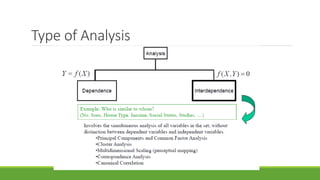
Type of Analysis
Type of Analysis
What is Multivariate? 
 Univariate Analysis? 
 Some describe it as: any statistical technique used to analyze data 
that arises from more than one variable 
 Multivariable vs. Multivariate Analysis 
 http://www.youtube.com/watch?v=KhA_PCMPZZo
Example of MV Data
Other Examples?
What is Multivariate Data Analysis? 
 The statistical analysis of the data collected on more than one 
(response) variable. 
 We want to analyze them simultaneously 
 The variables may be correlated with each other 
 The dependence is taken into account 
 More complex univariate analysis 
 In the real world, most data are multivariate data 
 Basic Statistical Analysis for Data Mining
Types of MVA 
 Exploratory Data Analysis (EDA): Sometimes called data mining this area is useful for gaining 
deeper insights into large, complex data sets. 
Regression analysis: Develops models to predict new and future events. Is useful for predictive 
analytics applications. 
Classification for identifying new or existing classes: This area is useful in research, 
development, market analysis, etc.
MVD objectives 
1. Data reduction or structural simplification. To simplify without 
loosing any valuable information and make interpretation easier. 
2. Sorting and grouping. Similar objects or variables are grouped, 
based upon the characteristics. Define rules for classifying objects 
into well-defined groups. 
3. Investigation of the dependence among variables. The nature of 
the relationships among variables is of interest. Are all the 
variables mutually dependent/ independent?
MVD objectives 
4. Prediction. Relationships between variables must be 
determined for the purpose of predicting the values of one or 
more variables on the basis of observations on the other 
variables. 
5. Hypothesis construction and testing. Specific statistical 
hypotheses, formulated are tested.
Examples of Multivariate Data 
http://www.youtube.com/watch?v=eEpxN0htRKI
Software 
1. SAS 
2. R 
3. SPSS 
4. Herodes 
5. etc….
Applications 
 Petrochemical and refining operations, including early fault detection and 
gasoline blending and optimisation 
 Food and beverage applications, particularly for consumer segmentation and 
new product development 
 Agricultural analysis, including real-time analysis of protein and moisture in 
wheat, barley and other crops 
 Business Intelligence and marketing for predicting changes in dynamic markets 
or better product placement 
 Oil and gas and mining, including analysis of machinery performance and 
locating new sources of commodities
Applications 
Data reduction or simplification 
Using data on several variables related to cancer patient responses to 
radiotherapy, a simple measure of patient response to radiotherapy was 
constructed. 
Multispectral image data collected by a high-altitude scanner were reduced to a 
form that could be viewed as images (pictures) of a shoreline in two dimensions. 
Data on several variables relating to yield and protein content were used to 
create an index to select parents of subsequent generations of improved bean 
plants.
Applications 
Sorting and grouping 
• Data on several variables related to computer use were employed to create 
clusters of categories of computer jobs that allow a better determination of 
existing (or planned) computer utilization. 
• Measurements of several physiological variables were used to develop a 
screening procedure that discriminates alcoholics from nonalcoholics. 
• Data related to responses to visual stimuli were used to develop a rule for 
separating people suffering from a multiple-sclerosis-caused visual pathology 
from those not suffering from the disease.
Applications 
Investigation of the dependence among variables 
• Data on several variables were used to identify factors that were responsible 
for client success in hiring external consultants. 
• Measurements of variables related to innovation, and variables related to the 
business environment and business organization, on the other hand, were used 
to discover why some firms are product innovators and some firms are not. 
• Measurements of pulp fiber characteristics and subsequent measurements of 
characteristics of the paper made from them are used to examine the relations 
between pulp fiber properties and the resulting paper properties. The goal is to 
determine those fibers that lead to higher quality paper.
Applications 
Prediction 
• The associations between test scores, and several high school performance variables, 
and several college performance variables were used to develop predictors of success in 
college. 
• Data on several variables related to the size distribution of sediments were used to 
develop rules for predicting different depositional environments. 
• Measurements on several accounting and financial variables were used to develop a 
method for identifying potentially insolvent property-liability insurers. 
• cDNA microarray experiments (gene expression data) are increasingly used to study 
the molecular variations among cancer tumors. A reliable classification of tumors is 
essential for successful diagnosis and treatment of cancer.
Applications 
Hypotheses testing 
• Several pollution-related variables were measured to determine whether 
levels for a large metropolitan area were roughly constant throughout the week, 
or whether there was a noticeable difference between weekdays and weekends. 
• Experimental data on several variables were used to see whether the nature of 
the instructions makes any difference in perceived risks, as quantified by test 
scores. 
• Data on many variables were used to investigate the differences in structure of 
American occupations to determine the support for one of two competing 
sociological theories.
Other Applications? 
In Group, discuss multivariate data on: 
1. Biomedical 
2. Economic 
3. Government Policy 
4. Health 
5. Social 
6. Demography 
7. Business 
8. Telecommunication 
9. Education 
10. Psychology
Data Structure
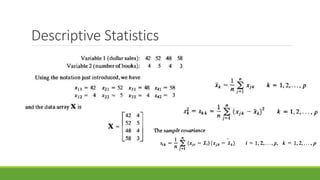
Descriptive Statistics
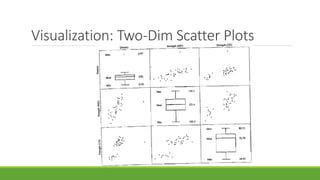
Visualization: Two-Dim Scatter Plots
Visualization: Growth Curves
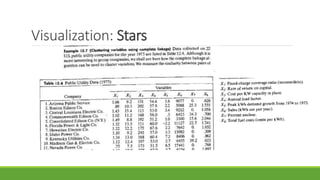
Visualization: Stars
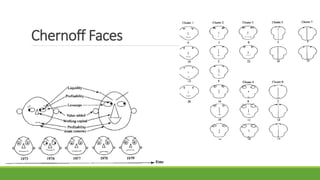
Visualization: Chernoff Faces
Chernoff Faces
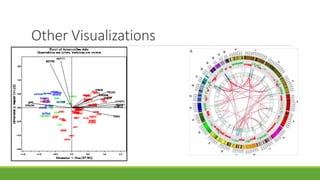
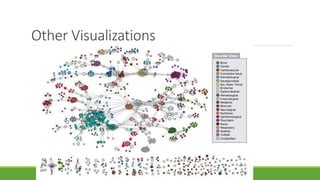
Visualizations
Other Visualizations
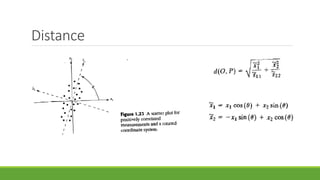
Distance
Distance
Next Week: Matrix Algebra
Multivariate data analysis

Multivariate data analysis

  • 1.
  • 2.
    Course Outline Introduction ◦ Overview of Multivariate data analysis ◦ The applications Matrix Algebra And Random Vectors Sample Geometry Multivariate Normal Distribution Inference About A Mean Vector Comparison Several Mean Vectors Setia Pramana SURVIVAL DATA ANALYSIS 2
  • 3.
    Course Outline PrincipalComponent Analysis Factor Analysis Cluster Analysis Discriminant Analysis Canonical Correlations Setia Pramana SURVIVAL DATA ANALYSIS 3
  • 4.
    Course Workload 40%Theory, 60% practice Group Project (4 students) Group Presentation in ENGLISH every week Software used is mainly R, others are allowed R code would be provided Slides can be seen at : http://www.slideshare.net/hafidztio/ Setia Pramana SURVIVAL DATA ANALYSIS 4
  • 5.
    Reference Books SetiaPramana SURVIVAL DATA ANALYSIS 5
  • 6.
  • 7.
  • 8.
  • 9.
  • 10.
    What is Multivariate?  Univariate Analysis?  Some describe it as: any statistical technique used to analyze data that arises from more than one variable  Multivariable vs. Multivariate Analysis  http://www.youtube.com/watch?v=KhA_PCMPZZo
  • 11.
  • 12.
  • 13.
    What is MultivariateData Analysis?  The statistical analysis of the data collected on more than one (response) variable.  We want to analyze them simultaneously  The variables may be correlated with each other  The dependence is taken into account  More complex univariate analysis  In the real world, most data are multivariate data  Basic Statistical Analysis for Data Mining
  • 14.
    Types of MVA  Exploratory Data Analysis (EDA): Sometimes called data mining this area is useful for gaining deeper insights into large, complex data sets. Regression analysis: Develops models to predict new and future events. Is useful for predictive analytics applications. Classification for identifying new or existing classes: This area is useful in research, development, market analysis, etc.
  • 15.
    MVD objectives 1.Data reduction or structural simplification. To simplify without loosing any valuable information and make interpretation easier. 2. Sorting and grouping. Similar objects or variables are grouped, based upon the characteristics. Define rules for classifying objects into well-defined groups. 3. Investigation of the dependence among variables. The nature of the relationships among variables is of interest. Are all the variables mutually dependent/ independent?
  • 16.
    MVD objectives 4.Prediction. Relationships between variables must be determined for the purpose of predicting the values of one or more variables on the basis of observations on the other variables. 5. Hypothesis construction and testing. Specific statistical hypotheses, formulated are tested.
  • 17.
    Examples of MultivariateData http://www.youtube.com/watch?v=eEpxN0htRKI
  • 18.
    Software 1. SAS 2. R 3. SPSS 4. Herodes 5. etc….
  • 19.
    Applications  Petrochemicaland refining operations, including early fault detection and gasoline blending and optimisation  Food and beverage applications, particularly for consumer segmentation and new product development  Agricultural analysis, including real-time analysis of protein and moisture in wheat, barley and other crops  Business Intelligence and marketing for predicting changes in dynamic markets or better product placement  Oil and gas and mining, including analysis of machinery performance and locating new sources of commodities
  • 20.
    Applications Data reductionor simplification Using data on several variables related to cancer patient responses to radiotherapy, a simple measure of patient response to radiotherapy was constructed. Multispectral image data collected by a high-altitude scanner were reduced to a form that could be viewed as images (pictures) of a shoreline in two dimensions. Data on several variables relating to yield and protein content were used to create an index to select parents of subsequent generations of improved bean plants.
  • 21.
    Applications Sorting andgrouping • Data on several variables related to computer use were employed to create clusters of categories of computer jobs that allow a better determination of existing (or planned) computer utilization. • Measurements of several physiological variables were used to develop a screening procedure that discriminates alcoholics from nonalcoholics. • Data related to responses to visual stimuli were used to develop a rule for separating people suffering from a multiple-sclerosis-caused visual pathology from those not suffering from the disease.
  • 22.
    Applications Investigation ofthe dependence among variables • Data on several variables were used to identify factors that were responsible for client success in hiring external consultants. • Measurements of variables related to innovation, and variables related to the business environment and business organization, on the other hand, were used to discover why some firms are product innovators and some firms are not. • Measurements of pulp fiber characteristics and subsequent measurements of characteristics of the paper made from them are used to examine the relations between pulp fiber properties and the resulting paper properties. The goal is to determine those fibers that lead to higher quality paper.
  • 23.
    Applications Prediction •The associations between test scores, and several high school performance variables, and several college performance variables were used to develop predictors of success in college. • Data on several variables related to the size distribution of sediments were used to develop rules for predicting different depositional environments. • Measurements on several accounting and financial variables were used to develop a method for identifying potentially insolvent property-liability insurers. • cDNA microarray experiments (gene expression data) are increasingly used to study the molecular variations among cancer tumors. A reliable classification of tumors is essential for successful diagnosis and treatment of cancer.
  • 24.
    Applications Hypotheses testing • Several pollution-related variables were measured to determine whether levels for a large metropolitan area were roughly constant throughout the week, or whether there was a noticeable difference between weekdays and weekends. • Experimental data on several variables were used to see whether the nature of the instructions makes any difference in perceived risks, as quantified by test scores. • Data on many variables were used to investigate the differences in structure of American occupations to determine the support for one of two competing sociological theories.
  • 25.
    Other Applications? InGroup, discuss multivariate data on: 1. Biomedical 2. Economic 3. Government Policy 4. Health 5. Social 6. Demography 7. Business 8. Telecommunication 9. Education 10. Psychology
  • 26.
  • 27.
  • 28.
  • 29.
  • 30.
  • 31.
  • 32.
  • 33.
  • 34.
  • 35.
  • 36.
  • 37.
  • 38.
  • 39.
  • 40.
  • 41.
  • 42.
  • 43.
  • 44.
  • 45.