TOPIC - INTERPRETATION OF DATA
AND ITS ANALYSIS
RESEARCH METHODOLOGY
PRESENTATION
ON
TRIPTI SINGH
Department of Bioscience
Enrolment No- 2001316
DATA INTERPRETATION
• Interpretation refers to the task of drawing inferences from
the collected facts after an analytical and/or experimental
study. In fact, it is a search for broader meaning of research
findings.
• In one sense, Interpretation is concerned with relationship
within the collected data, partially overlapping analysis.
• Interpretation also extends beyond the data of the study to
include the results of other research, theory and
hypotheses.
TECHNIQUE OF INTERPRETATION
• Researcher must give reasonable explanations of the relations which he
has found and he must interpret the lines of relationship in terms of
underlying processes and must try to find out the thread of uniformity
that lies under the surface layer of his diversified research finding. In fact,
this is the technique of how generalization should be done and concepts
be formulated.
• Extraneous information, if collected during study, must be considered
while interpreting the final results of research study, for it may prove to be
a key factor in understanding the problem under consideration.
• Researcher must accomplish the task of interpretation only after
considering all relevant factors affecting the problem to avoid false
generalization.
IMPORTANCE OF DATA INTERPRETATION
• It helps to make informed decisions and not just through guessing or
predictions.
• Interpretation is essential for the simple reason that the usefulness and
utility of research finding lie in proper interpretation.
• Interpretation leads to the establishment of explanatory concepts that can
serve as a guide for future studies.
• Researcher can better appreciate only through interpretation why is
finding are what they are and can make others to understand the real
significance of his research findings.
DATA ANALYSIS
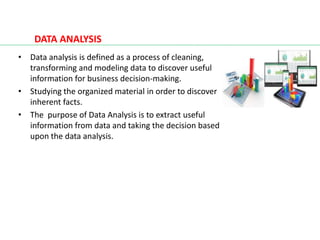
• Data analysis is defined as a process of cleaning,
transforming and modeling data to discover useful
information for business decision-making.
• Studying the organized material in order to discover
inherent facts.
• The purpose of Data Analysis is to extract useful
information from data and taking the decision based
upon the data analysis.
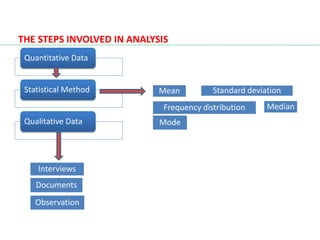
Quantitative Data
Statistical Method
Qualitative Data
Mean Standard deviation
Frequency distribution Median
Mode
Interviews
Documents
Observation
THE STEPS INVOLVED IN ANALYSIS
QUANTITATIVE DATA
• This method is also known as Numeric data. Quantitative data contains
numbers and its therefore analyzed with the use of numbers and not
texts. Some of statistical methods used in analyzing numeric data.
• Mean- this is simply the mathematical average of a range of numbers.
• Median- this is the midpoint in a range of numbers when the numbers are
arranged in numerical order. If the data set makes up an odd number, then
the median is the number right in the middle of the set. If the data set
makes up an even number, then the median is the midpoint between the
two middle numbers.
• Mode- this is simply the most commonly occurring number in the data
set.
• Standard Deviation- this metric indicates how dispersed a range of
numbers is. In other words, how close all the numbers are to mean.
• This technique is used to assess the demography of the respondent or the
number of times a particular response appears in research. It is extremely
keep on determining the degree of intersection between data points.
• QUALITATIVE DATA- this method is also known as narrative data. This
method uses texts, rather than numbers or patterns to describe data. The
following steps included are-
• Interviews- read and organize the data from each question separately.
This approach permits focusing on one question at a time.
• Documents- Code content and characteristics of documents into various
categories (e.g.. Training manual- policies and procedure, communication,
responsibilities).
• Observation- code content from the focus of the observation (e.g.
behavioral patterns- amount of time engaged/ not engaged in activity,
type of engagement, communication, interpersonal skills).
Frequency distribution
CONCLUSION
• Data interpretation and analysis is an important of working with data sets
in any field or research and statistics. They both go hand in hand, as the
process of data interpretation involves the analysis of data. Data
interpretation is very important, as it helps to acquire useful information
from a pool of irrelevant ones while making informed decision. It is found
useful for individuals, business, and researchers.
THANK YOU

Topic interpretation of data and its analysis

  • 1.
    TOPIC - INTERPRETATIONOF DATA AND ITS ANALYSIS RESEARCH METHODOLOGY PRESENTATION ON TRIPTI SINGH Department of Bioscience Enrolment No- 2001316
  • 2.
    DATA INTERPRETATION • Interpretationrefers to the task of drawing inferences from the collected facts after an analytical and/or experimental study. In fact, it is a search for broader meaning of research findings. • In one sense, Interpretation is concerned with relationship within the collected data, partially overlapping analysis. • Interpretation also extends beyond the data of the study to include the results of other research, theory and hypotheses.
  • 3.
    TECHNIQUE OF INTERPRETATION •Researcher must give reasonable explanations of the relations which he has found and he must interpret the lines of relationship in terms of underlying processes and must try to find out the thread of uniformity that lies under the surface layer of his diversified research finding. In fact, this is the technique of how generalization should be done and concepts be formulated. • Extraneous information, if collected during study, must be considered while interpreting the final results of research study, for it may prove to be a key factor in understanding the problem under consideration. • Researcher must accomplish the task of interpretation only after considering all relevant factors affecting the problem to avoid false generalization.
  • 4.
    IMPORTANCE OF DATAINTERPRETATION • It helps to make informed decisions and not just through guessing or predictions. • Interpretation is essential for the simple reason that the usefulness and utility of research finding lie in proper interpretation. • Interpretation leads to the establishment of explanatory concepts that can serve as a guide for future studies. • Researcher can better appreciate only through interpretation why is finding are what they are and can make others to understand the real significance of his research findings.
  • 5.
    DATA ANALYSIS • Dataanalysis is defined as a process of cleaning, transforming and modeling data to discover useful information for business decision-making. • Studying the organized material in order to discover inherent facts. • The purpose of Data Analysis is to extract useful information from data and taking the decision based upon the data analysis.
  • 6.
    Quantitative Data Statistical Method QualitativeData Mean Standard deviation Frequency distribution Median Mode Interviews Documents Observation THE STEPS INVOLVED IN ANALYSIS
  • 7.
    QUANTITATIVE DATA • Thismethod is also known as Numeric data. Quantitative data contains numbers and its therefore analyzed with the use of numbers and not texts. Some of statistical methods used in analyzing numeric data. • Mean- this is simply the mathematical average of a range of numbers. • Median- this is the midpoint in a range of numbers when the numbers are arranged in numerical order. If the data set makes up an odd number, then the median is the number right in the middle of the set. If the data set makes up an even number, then the median is the midpoint between the two middle numbers. • Mode- this is simply the most commonly occurring number in the data set. • Standard Deviation- this metric indicates how dispersed a range of numbers is. In other words, how close all the numbers are to mean.
  • 8.
    • This techniqueis used to assess the demography of the respondent or the number of times a particular response appears in research. It is extremely keep on determining the degree of intersection between data points. • QUALITATIVE DATA- this method is also known as narrative data. This method uses texts, rather than numbers or patterns to describe data. The following steps included are- • Interviews- read and organize the data from each question separately. This approach permits focusing on one question at a time. • Documents- Code content and characteristics of documents into various categories (e.g.. Training manual- policies and procedure, communication, responsibilities). • Observation- code content from the focus of the observation (e.g. behavioral patterns- amount of time engaged/ not engaged in activity, type of engagement, communication, interpersonal skills). Frequency distribution
  • 9.
    CONCLUSION • Data interpretationand analysis is an important of working with data sets in any field or research and statistics. They both go hand in hand, as the process of data interpretation involves the analysis of data. Data interpretation is very important, as it helps to acquire useful information from a pool of irrelevant ones while making informed decision. It is found useful for individuals, business, and researchers.
  • 10.