A vne
 da cd
Ifr t nT e r i
nomai h oyn
     o
C P “ aN t e”
 VRi n us l
          hl
                                      CP
                                       VR
  T ti
   u rl
    oa                              J n 1 -82 1
                                     u e 31 0 0
                                    S nFa c c ,A
                                     a rn i oC
                                           s
Shape Matching with I-divergences

Anand Rangarajan
Shape Matching with I-Divergences


Groupwise Point-set Pattern Registration
Given N point-sets, which are denoted by {X p , p ∈ {1, ..., N}}, the
task of multiple point pattern matching or point-set registration is to
recover the spatial transformations which yield the best alignment of
all shapes.


                                                                          2/29
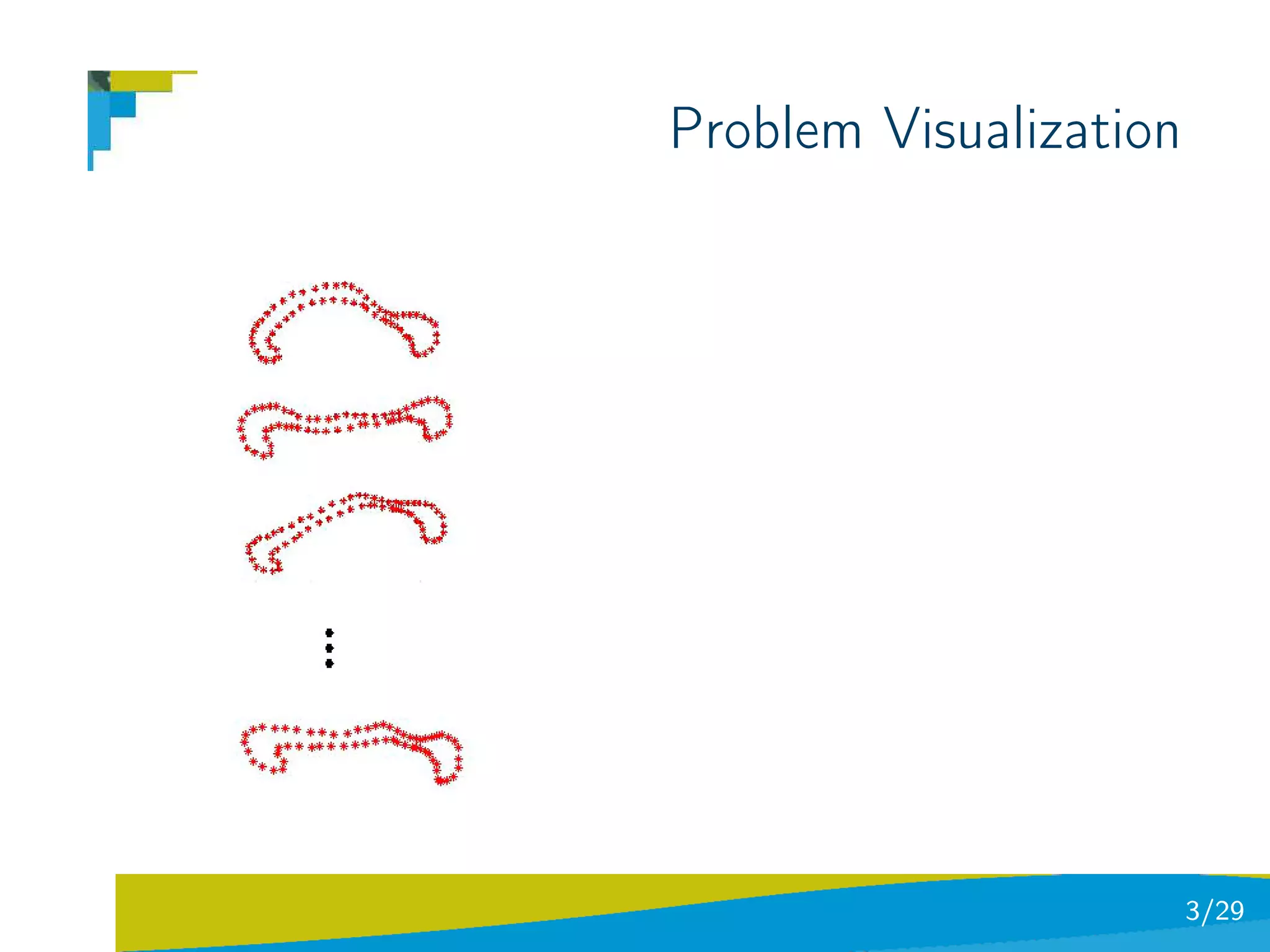
Problem Visualization


                        3/29
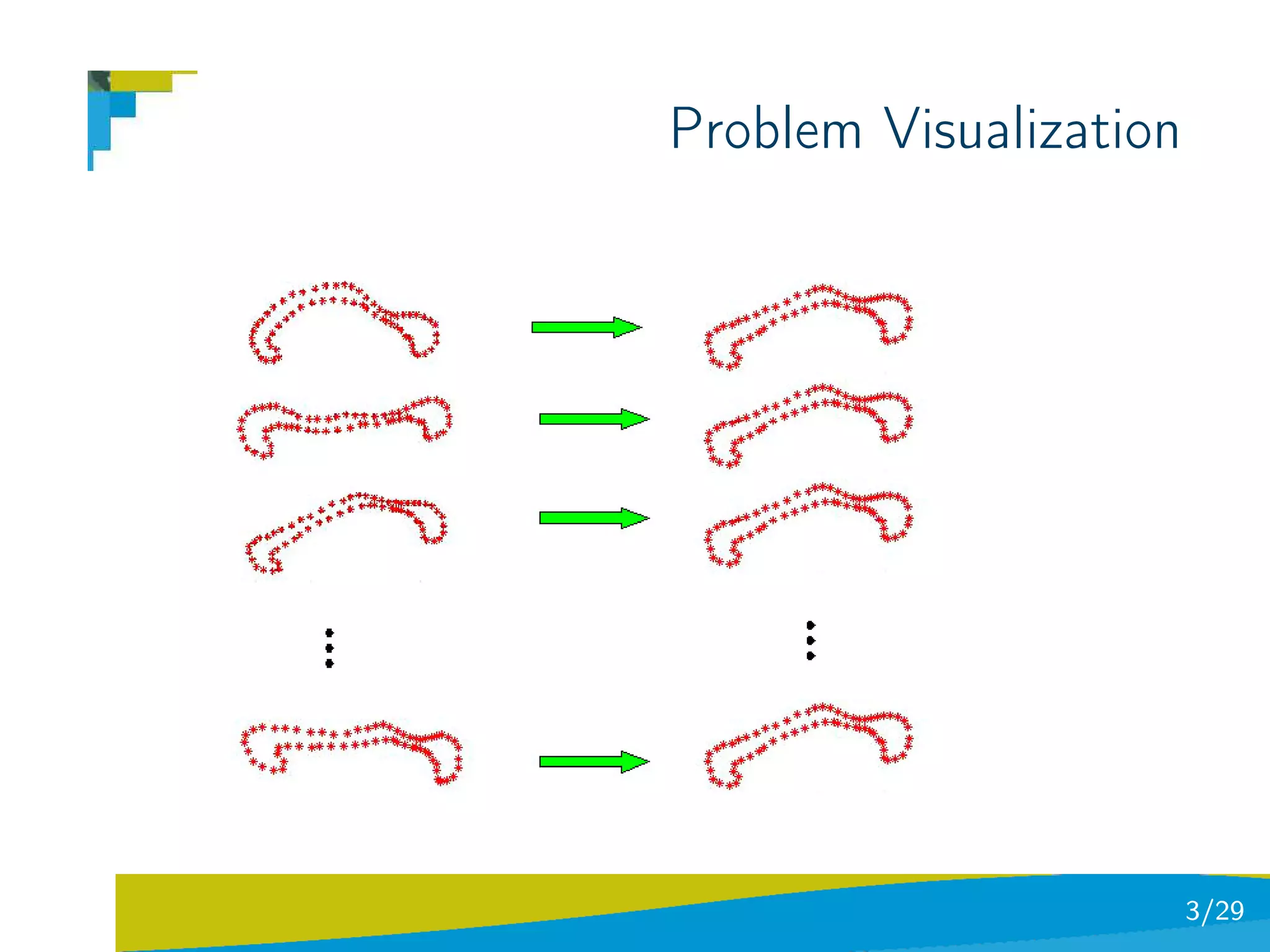
Problem Visualization


                        3/29
Group-wise Point-set Registration


Principal Technical Challenges
    Solving for nonrigid deformations between point-sets with
    unknown correspondence is a difficult problem.

    How do we align all the point-sets in a symmetric manner so
    that there is no bias toward any particular point-set?


                                                                  4/29
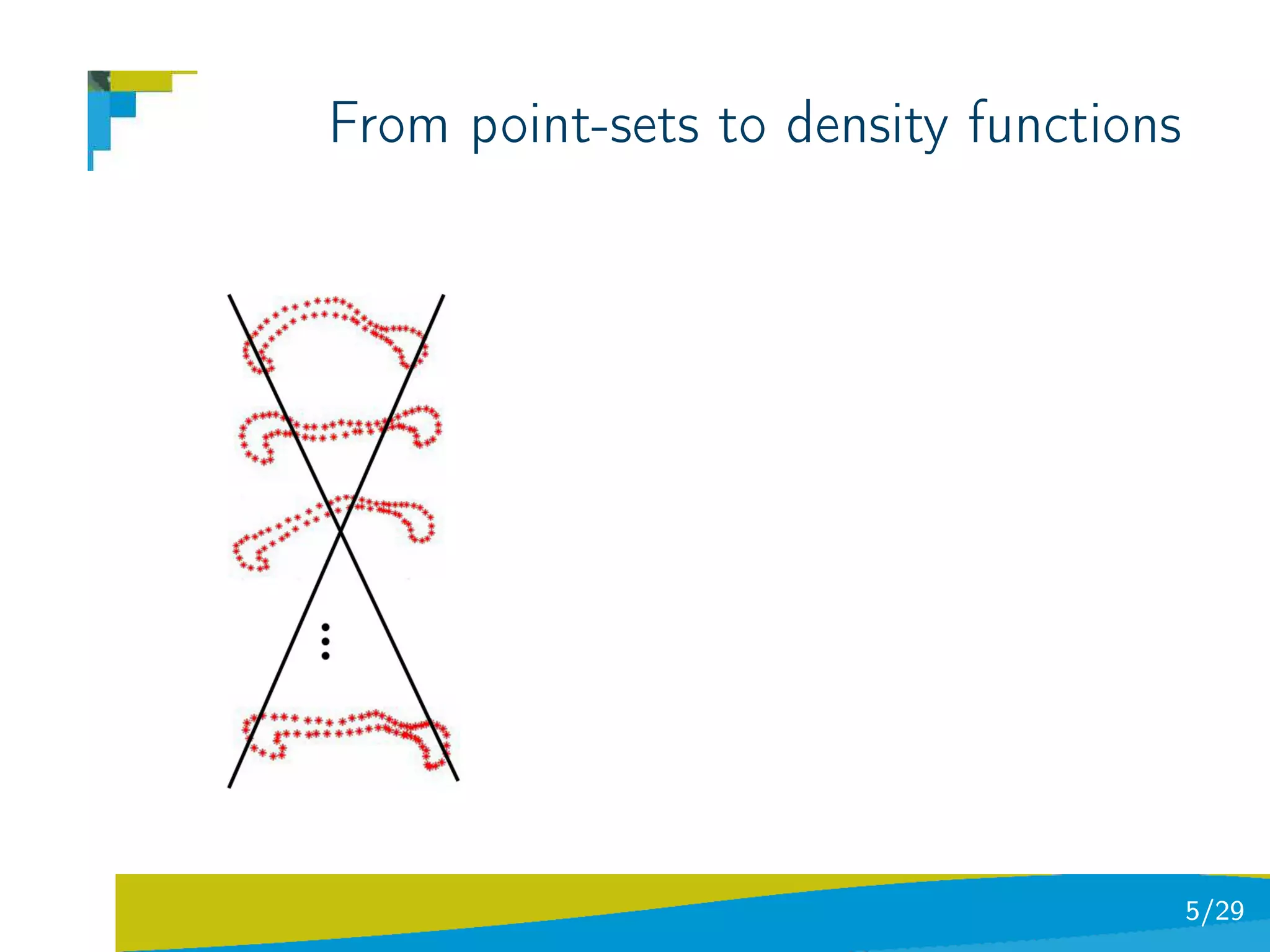
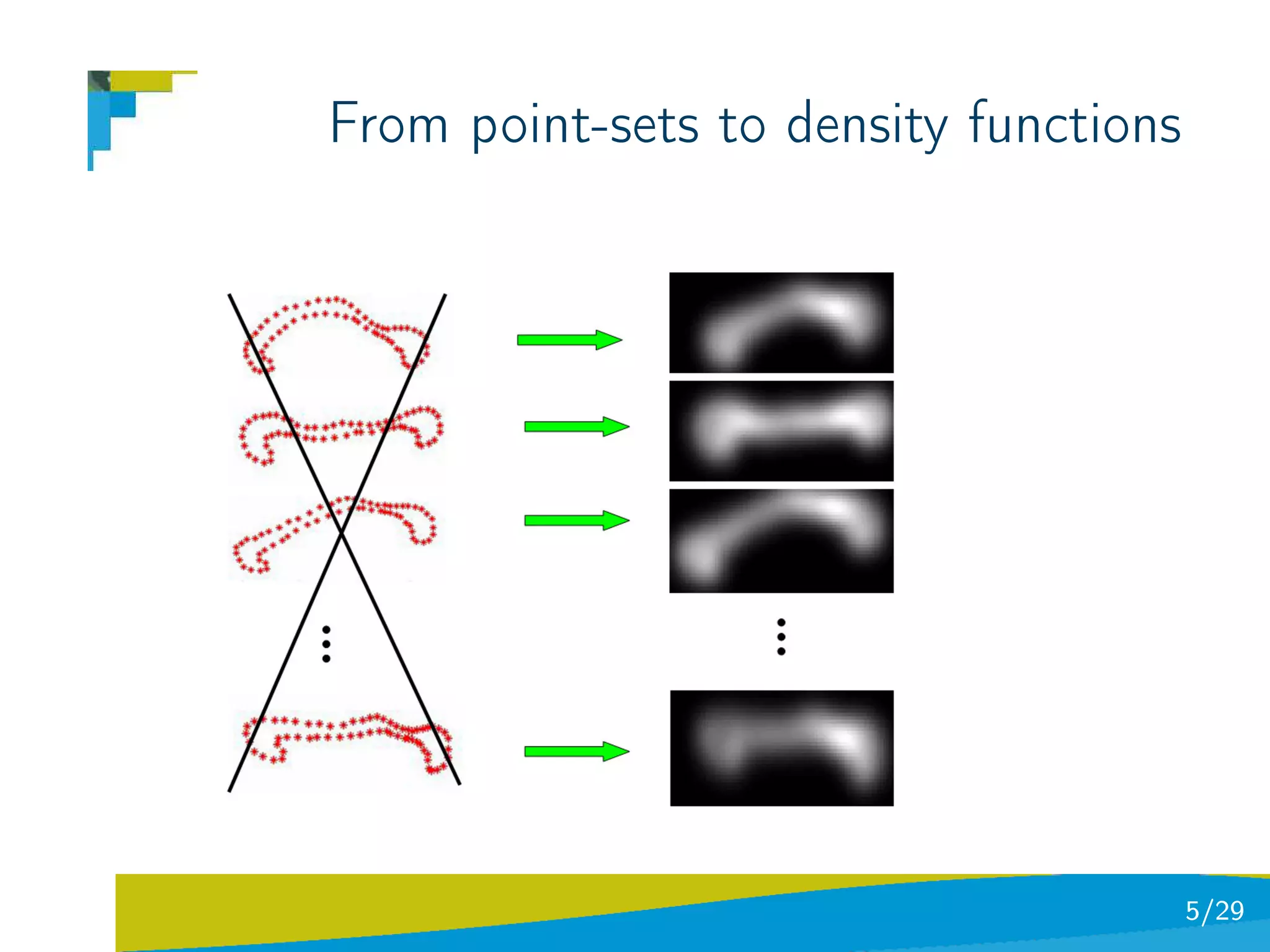
From point-sets to density functions


                                       5/29
From point-sets to density functions


                                       5/29
Group-wise Point-set Registration


From point-sets to density functions
    Point sets are represented by probability density functions.
    Intuitively, if these point sets are aligned properly, the
    corresponding density functions should be similar.


                                                                   6/29
Group-wise Point-set Registration


From point-sets to density functions
    Point sets are represented by probability density functions.
    Intuitively, if these point sets are aligned properly, the
    corresponding density functions should be similar.
Question: How do we measure the similarity between multiple
density functions?


                                                                   6/29
Divergence Measures


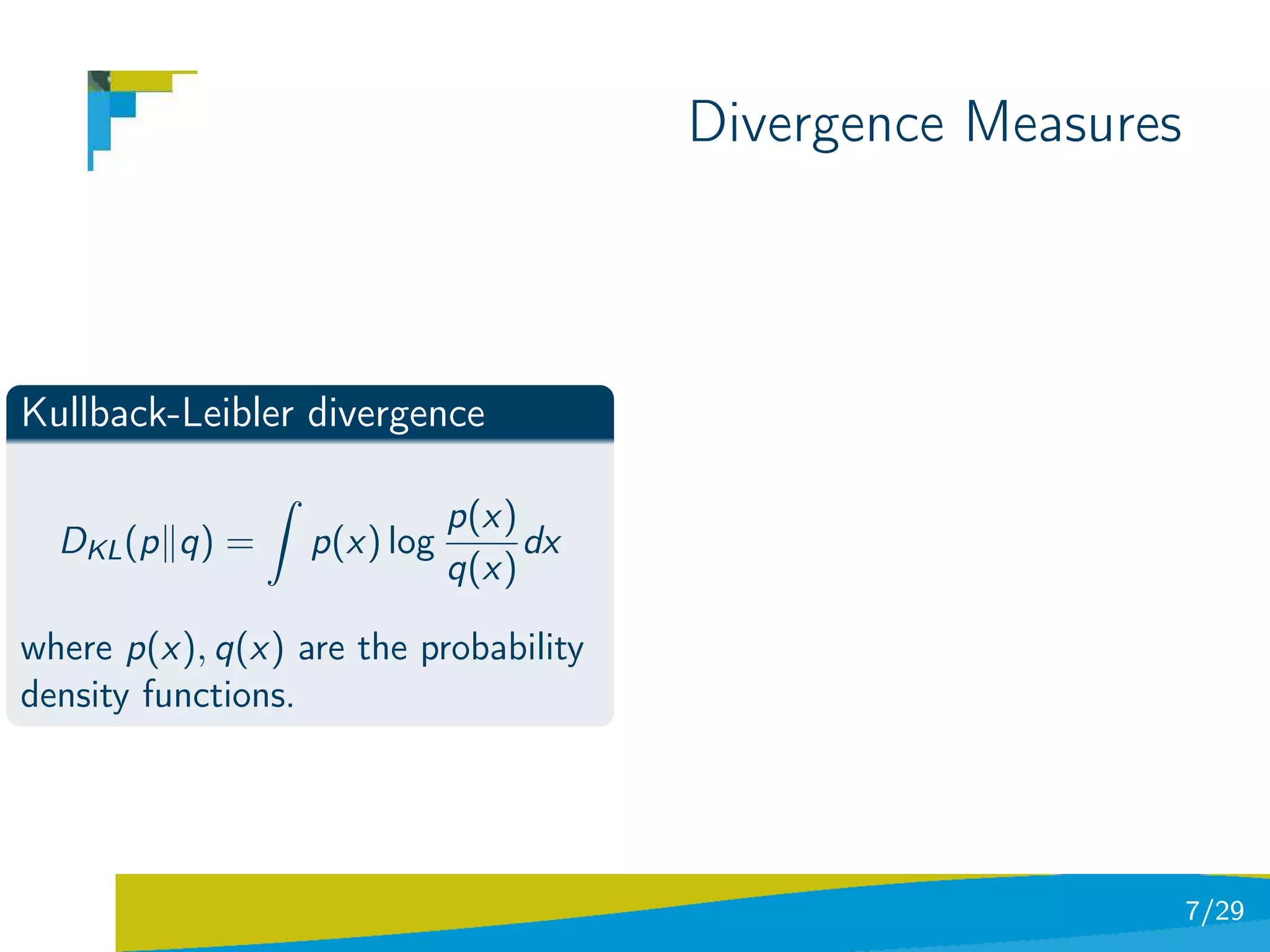
Kullback-Leibler divergence
                ˆ
                               p(x)
  DKL (p q) =       p(x) log        dx
                               q(x)

where p(x), q(x) are the probability
density functions.


                                                               7/29
Divergence Measures


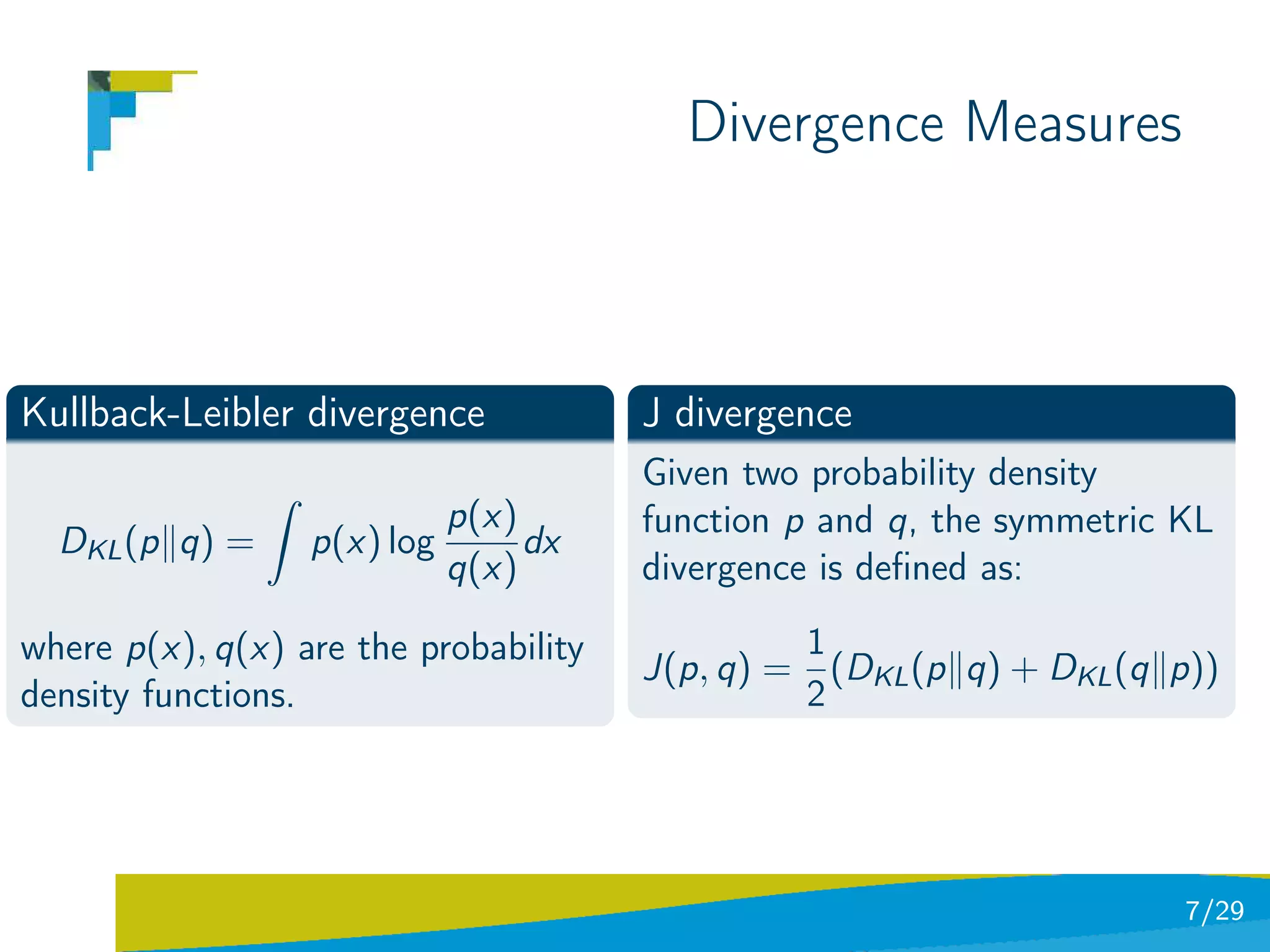
Kullback-Leibler divergence            J divergence
                ˆ                      Given two probability density
                             p(x)      function p and q, the symmetric KL
  DKL (p q) =       p(x) log      dx
                             q(x)      divergence is defined as:

where p(x), q(x) are the probability            1
                                       J(p, q) = (DKL (p q) + DKL (q p))
density functions.                              2


                                                                       7/29
Motivating the JS divergence

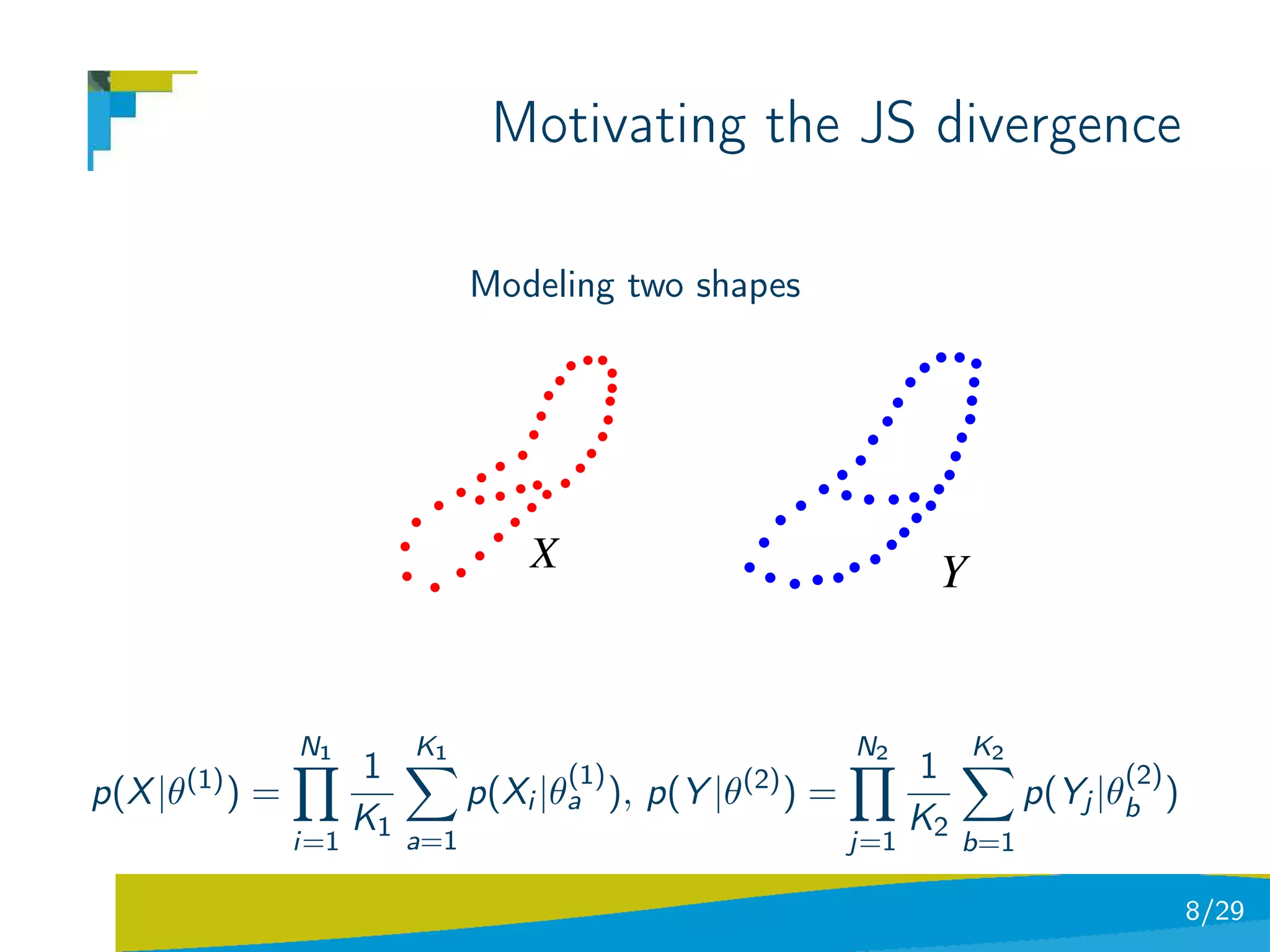
                                     Modeling two shapes


                                         X                                    Y


                    N1         K1                                      N2         K2
         (1)              1                 (1)             (2)              1                (2)
p(X |θ         )=                    p(Xi |θa ),   p(Y |θ         )=                    p(Yj |θb )
                          K1                                                 K2
                    i=1        a=1                                     j=1        b=1

                                                                                                     8/29
Motivating the JS divergence


Modeling the overlay of two shapes with identity of origin


                                 X Y


        p(X ∪ Y |θ(1) , θ(2) ) = p(X |θ(1) )p(Y |θ(2) )


                                                             8/29
Motivating the JS divergence


Modeling the overlay of two shapes without identity of origin


                                       Z

                           N1                    N2
  p(Z |θ(1) , θ(2) ) =           p(Z |θ(1) ) +         p(Z |θ(2) )
                         N1 + N2               N1 + N2


                                                                     8/29
Likelihood Ratio

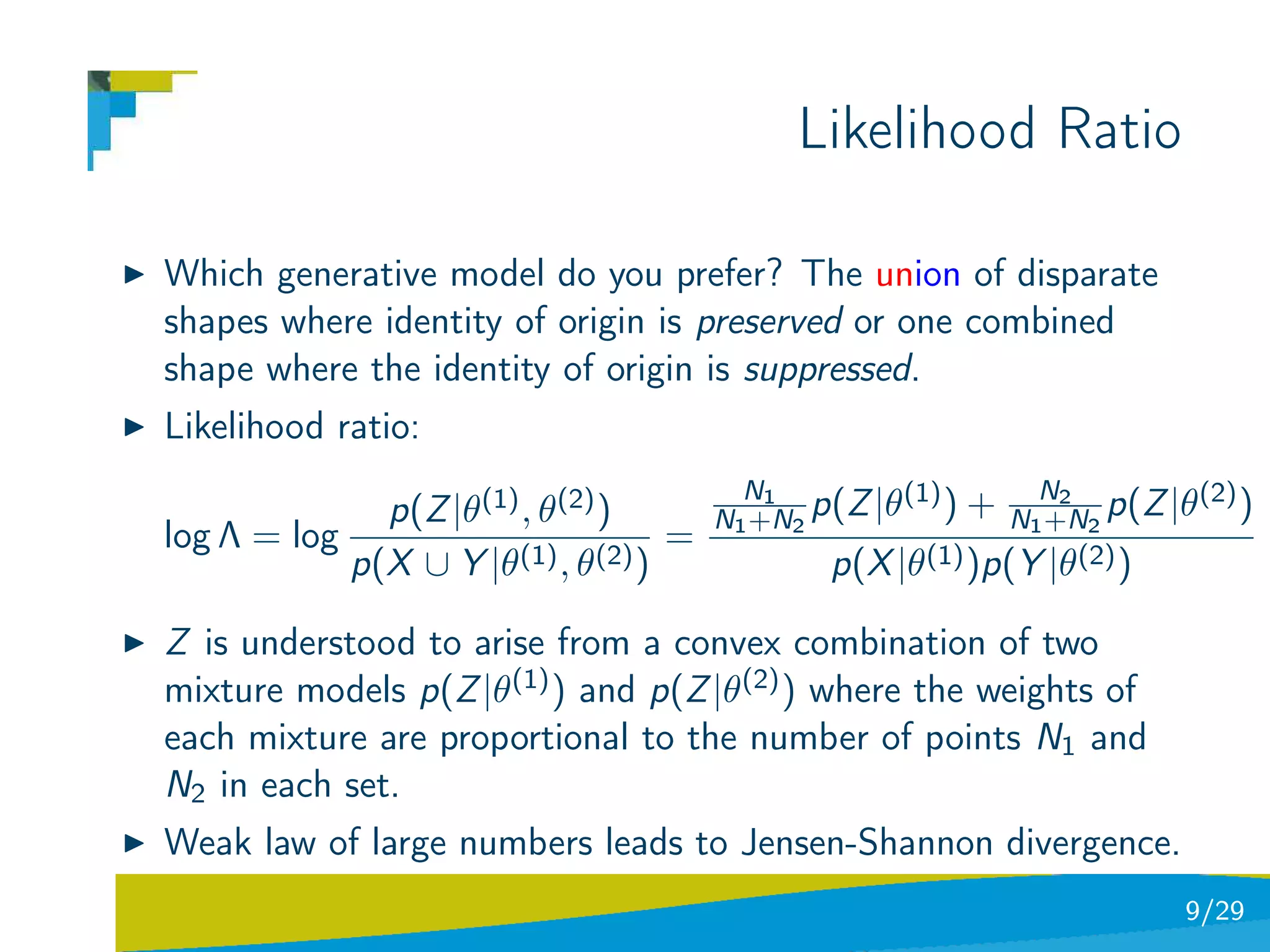
Which generative model do you prefer? The union of disparate
shapes where identity of origin is preserved or one combined
shape where the identity of origin is suppressed.
Likelihood ratio:
                                         N1         (1)      N2       (2)
              p(Z |θ(1) , θ(2) )       N1 +N2 p(Z |θ ) + N1 +N2 p(Z |θ )
log Λ = log                        =
            p(X ∪ Y |θ(1) , θ(2) )             p(X |θ(1) )p(Y |θ(2) )

Z is understood to arise from a convex combination of two
mixture models p(Z |θ(1) ) and p(Z |θ(2) ) where the weights of
each mixture are proportional to the number of points N1 and
N2 in each set.
Weak law of large numbers leads to Jensen-Shannon divergence.
                                                                    9/29
JS Divergence for multiple shapes


JS-divergence of shape densities
          JSπ (P1 , P2 , ..., Pn ) = H(    π i Pi ) −   πi H(Pi )      (1)
where π = {π1 , π2 , ..., πn |πi > 0, πi = 1} are the weights of the
probability densities Pi and H(Pi ) is the Shannon entropy.


                                                                         10/29
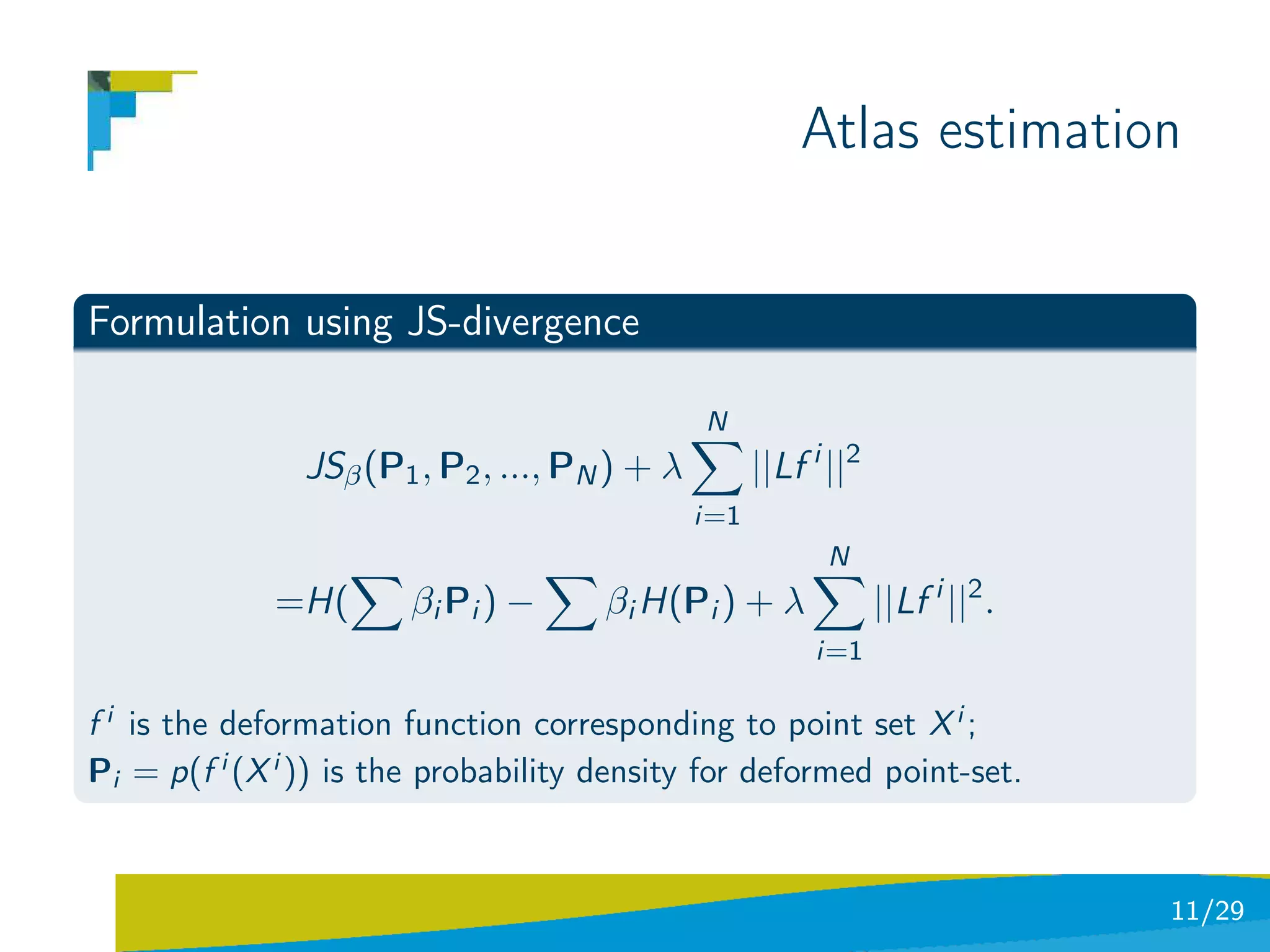
Atlas estimation


Formulation using JS-divergence

                                               N
                JSβ (P1 , P2 , ..., PN ) + λ         ||Lf i ||2
                                               i=1
                                                           N
             =H(       β i Pi ) −     βi H(Pi ) + λ               ||Lf i ||2 .
                                                          i=1

f i is the deformation function corresponding to point set X i ;
Pi = p(f i (X i )) is the probability density for deformed point-set.


                                                                                 11/29
Multiple shapes: JS divergence

JS divergence in a hypothesis testing framework:
    Construct a likelihood ratio between i.i.d. samples drawn from a
    mixture ( a πa Pa ) and i.i.d. samples drawn from a
    heterogeneous collection of densities (P1 , P2 , ..., PN ).

    The likelihood ratio is then
                              M      N
                              k=1    a=1 πa Pa (xk )
                      Λ=       N     Na
                                                     .
                                                a
                               a=1   ka =1 Pa (xka )

    Weak law of large numbers gives us the JS-divergence.

                                                                   12/29
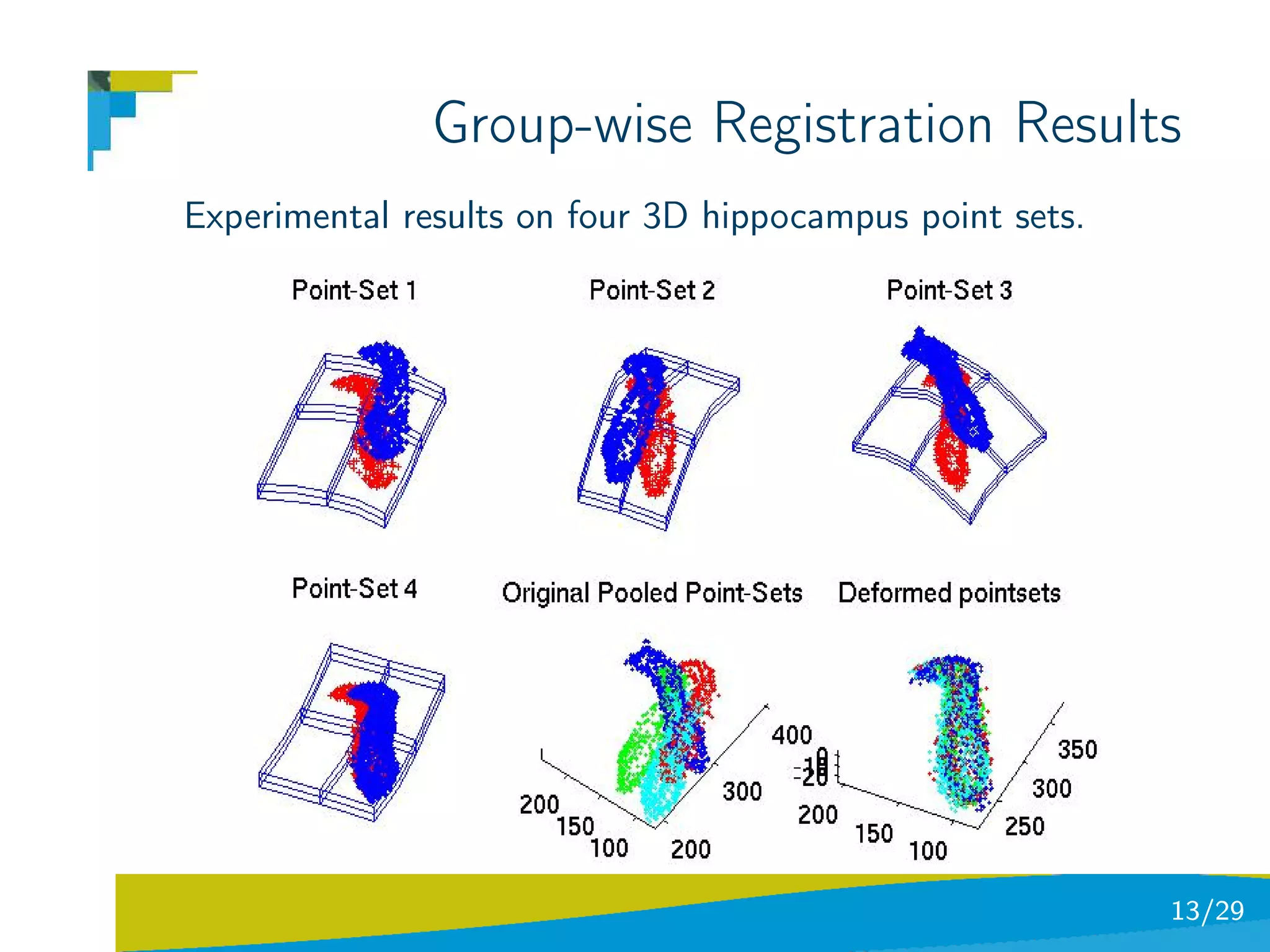
Group-wise Registration Results
Experimental results on four 3D hippocampus point sets.


                                                          13/29
Shape matching via CDF I-divergences


Model each point-set by a cumulative distribution function
(CDF)
Quantify the distance among cdfs via an information-theoretic
measure [typically the cumulative residual entropy (CRE)]
Minimize the dis-similarity measure over the space of
coordinate transformation parameters


                                                                14/29
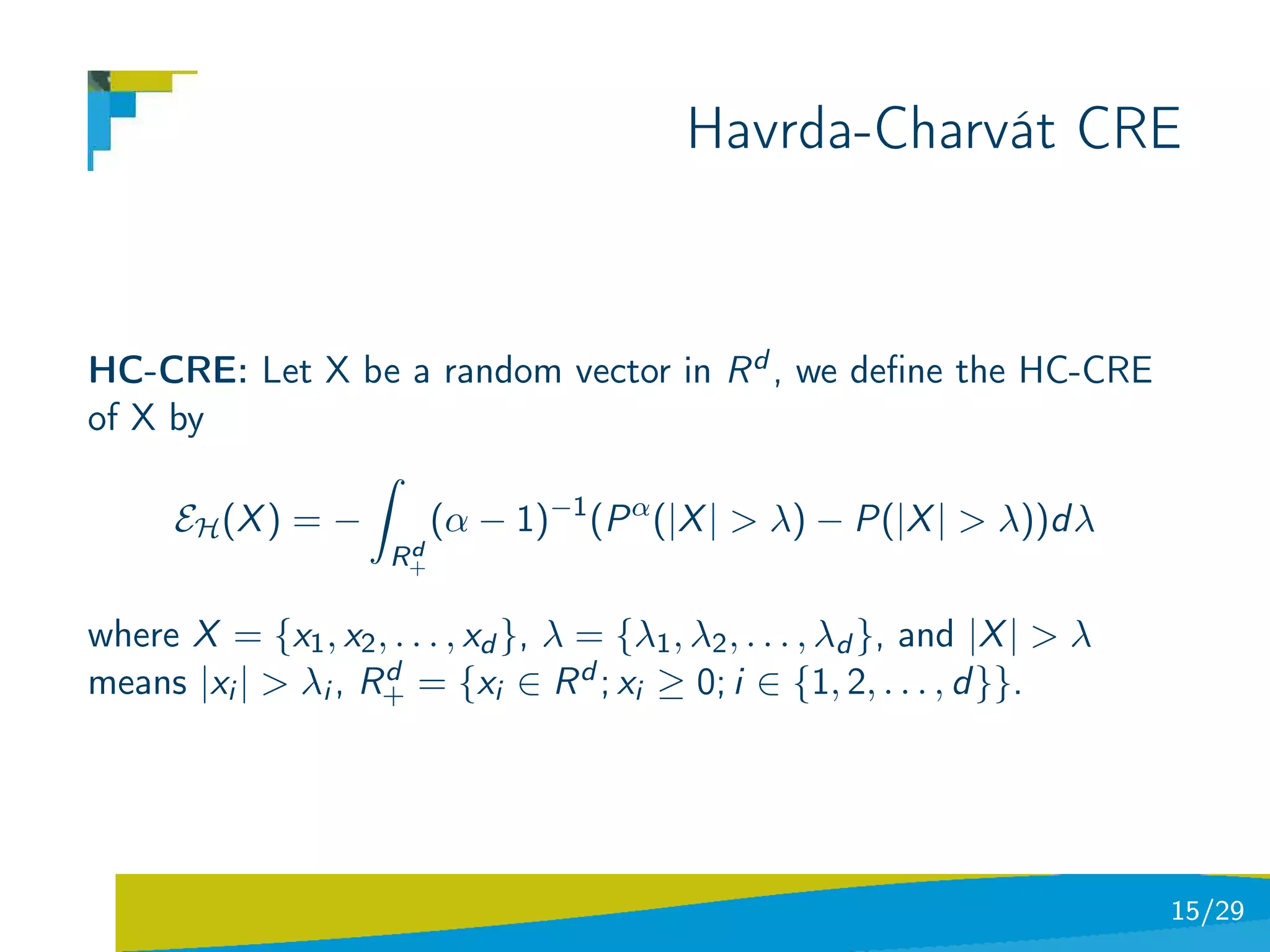
Havrda-Charvát CRE


HC-CRE: Let X be a random vector in R d , we define the HC-CRE
of X by
                 ˆ
     EH (X ) = −   (α − 1)−1 (P α (|X | > λ) − P(|X | > λ))d λ
                       d
                      R+

where X = {x1 , x2 , . . . , xd }, λ = {λ1 , λ2 , . . . , λd }, and |X | > λ
means |xi | > λi , R+ = {xi ∈ R d ; xi ≥ 0; i ∈ {1, 2, . . . , d }}.
                    d


                                                                               15/29
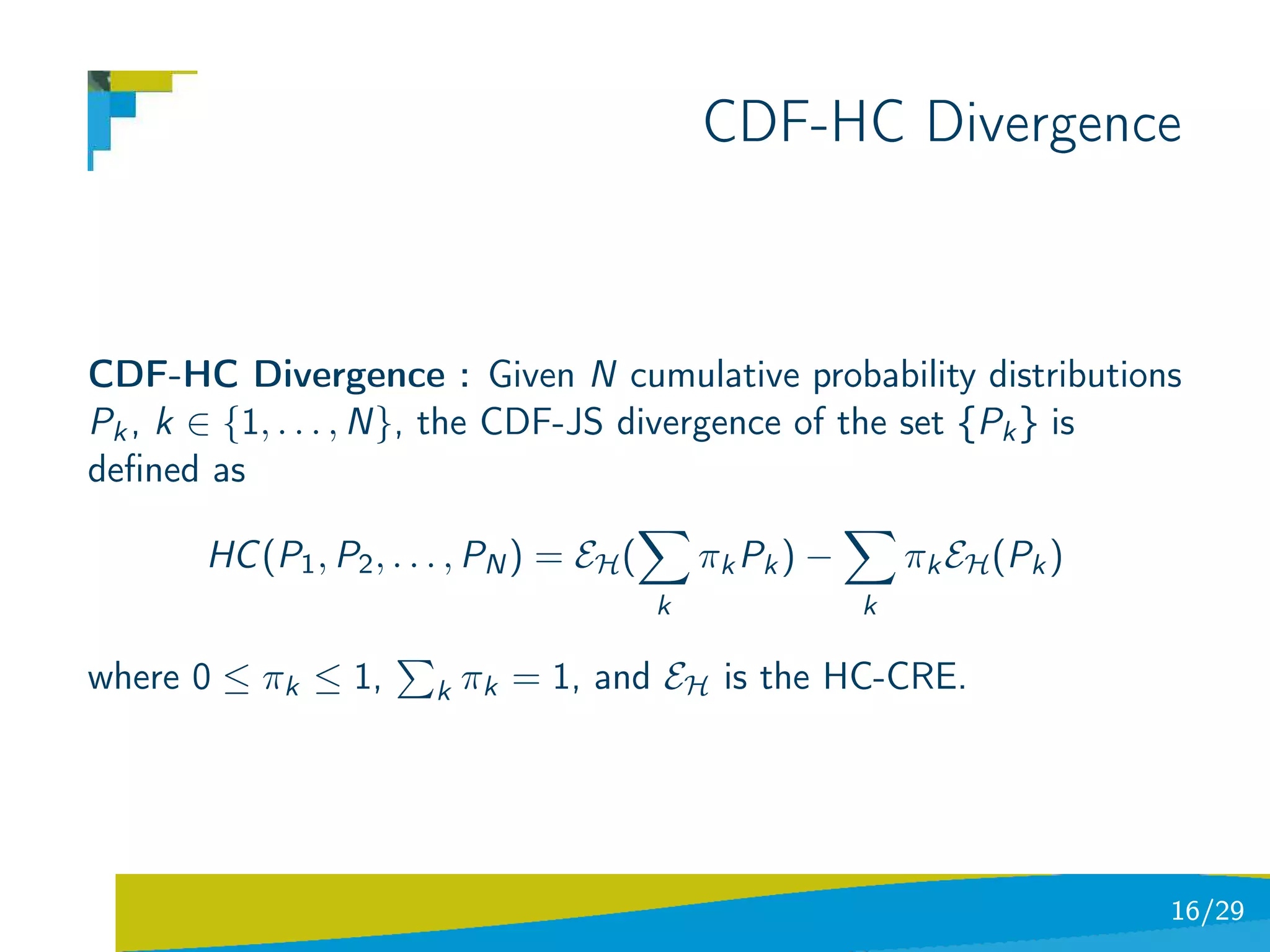
CDF-HC Divergence


CDF-HC Divergence : Given N cumulative probability distributions
Pk , k ∈ {1, . . . , N}, the CDF-JS divergence of the set {Pk } is
defined as

       HC (P1 , P2 , . . . , PN ) = EH (       πk Pk ) −       πk EH (Pk )
                                           k               k

where 0 ≤ πk ≤ 1,       k   πk = 1, and EH is the HC-CRE.


                                                                             16/29
CDF-HC Divergence


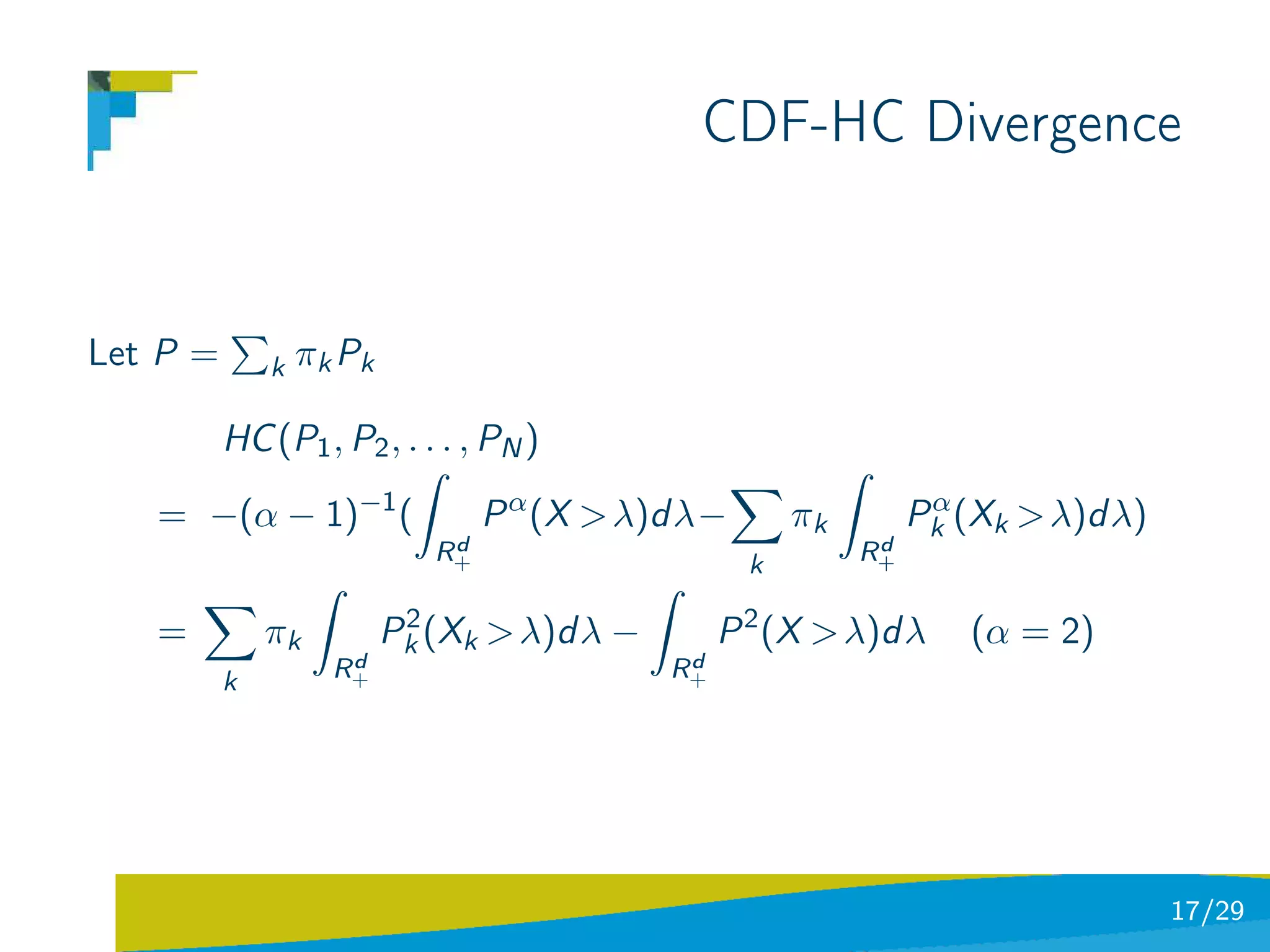
Let P =       k   πk Pk

     HC (P1 , P2 , . . . , PN )
                    ˆ                                        ˆ
              −1
   = −(α − 1) (            P α (X > λ)d λ−              πk         α
                                                                  Pk (Xk > λ)d λ)
                              d
                             R+                               d
                                                             R+
                                                    k
                   ˆ                         ˆ
                           2
   =          πk          Pk (Xk > λ)d λ −        P 2 (X > λ)d λ      (α = 2)
                     d
                    R+                        d
                                             R+
          k


                                                                                    17/29
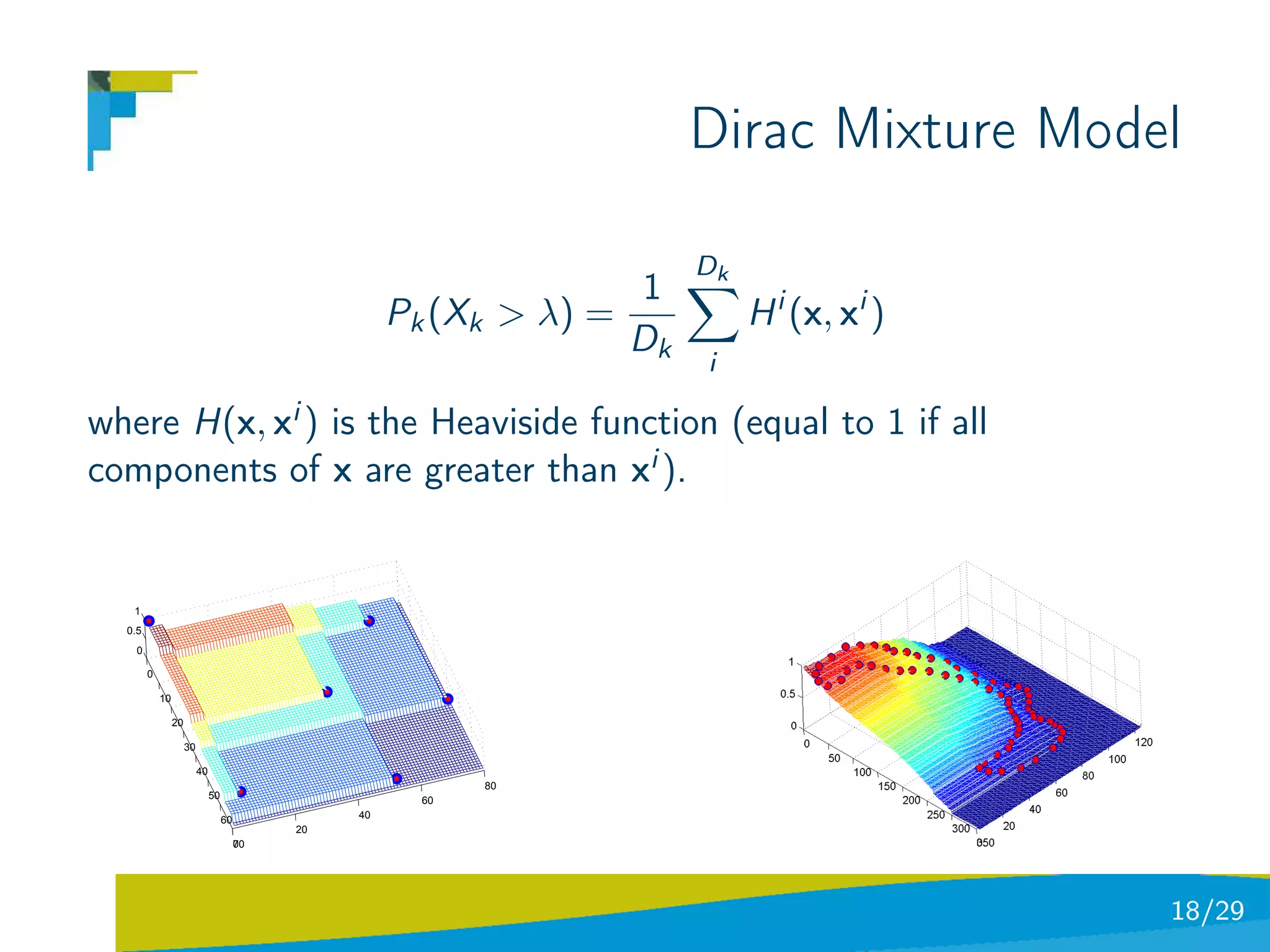
Dirac Mixture Model

                                                                            Dk
                                                                       1
                                                         Pk (Xk > λ) =           H i (x, xi )
                                                                       Dk
                                                                            i

where H(x, xi ) is the Heaviside function (equal to 1 if all
components of x are greater than xi ).


   1
  0.5
    0

        0

            10

                 20

                      30

                           40
                                                                80
                                50                         60
                                     60             40
                                               20
                                          0
                                          70


                                                                                                18/29
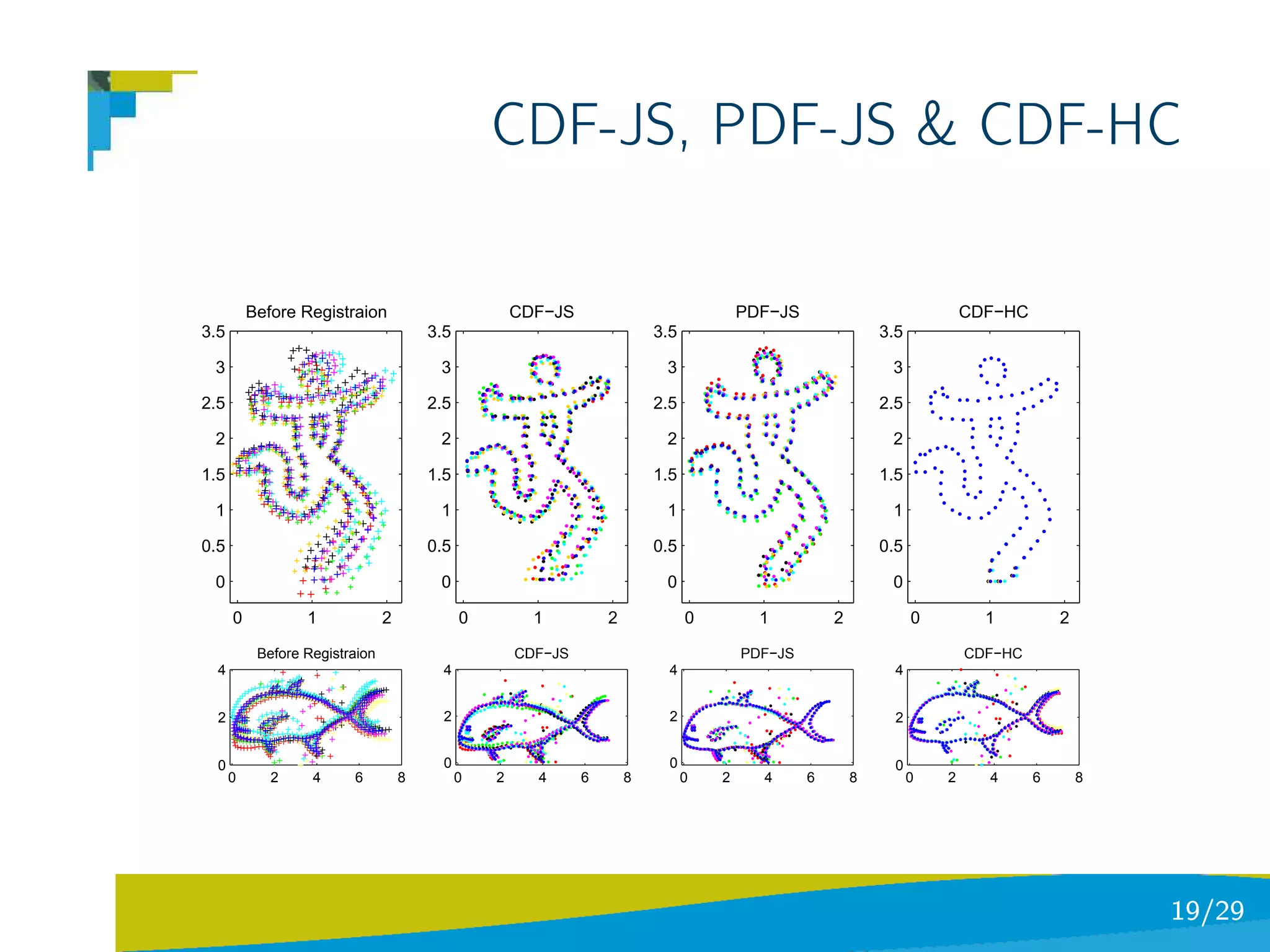
CDF-JS, PDF-JS & CDF-HC

          Before Registraion                          CDF−JS                             PDF−JS                             CDF−HC
3.5                                     3.5                                3.5                                3.5

 3                                       3                                  3                                  3

2.5                                     2.5                                2.5                                2.5

 2                                       2                                  2                                  2

1.5                                     1.5                                1.5                                1.5

 1                                       1                                  1                                  1

0.5                                     0.5                                0.5                                0.5

 0                                       0                                  0                                  0

      0           1             2             0         1          2             0         1          2             0         1          2

           Before Registraion                         CDF−JS                             PDF−JS                             CDF−HC
  4                                       4                                  4                                  4


  2                                       2                                  2                                  2


  0                                       0                                  0                                  0
      0      2     4     6          8         0   2     4      6       8         0   2     4      6       8         0   2     4      6       8


                                                                                                                                                 19/29
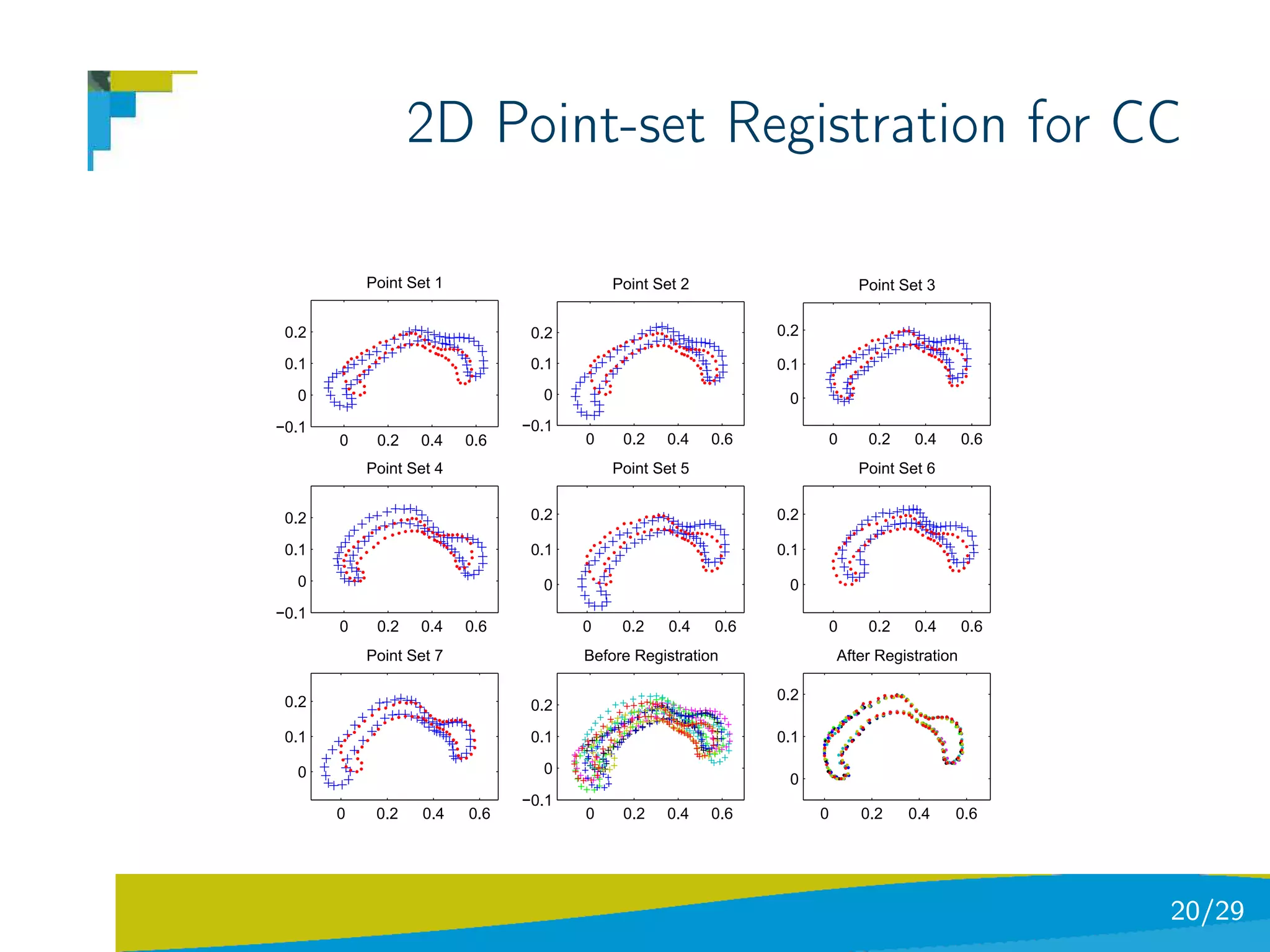
2D Point-set Registration for CC

           Point Set 1                    Point Set 2                       Point Set 3


 0.2                            0.2                           0.2

 0.1                            0.1                           0.1
  0                              0                             0
−0.1                           −0.1
       0    0.2   0.4    0.6          0    0.2   0.4    0.6             0    0.2    0.4      0.6
           Point Set 4                    Point Set 5                       Point Set 6


 0.2                            0.2                           0.2

 0.1                            0.1                           0.1

  0                              0                             0
−0.1
       0    0.2   0.4    0.6          0    0.2    0.4   0.6             0    0.2    0.4      0.6
           Point Set 7                Before Registration               After Registration

 0.2                                                          0.2
                                0.2

 0.1                            0.1                           0.1

  0                              0
                                                               0
                               −0.1
       0    0.2    0.4   0.6          0    0.2   0.4    0.6         0       0.2    0.4    0.6


                                                                                                   20/29
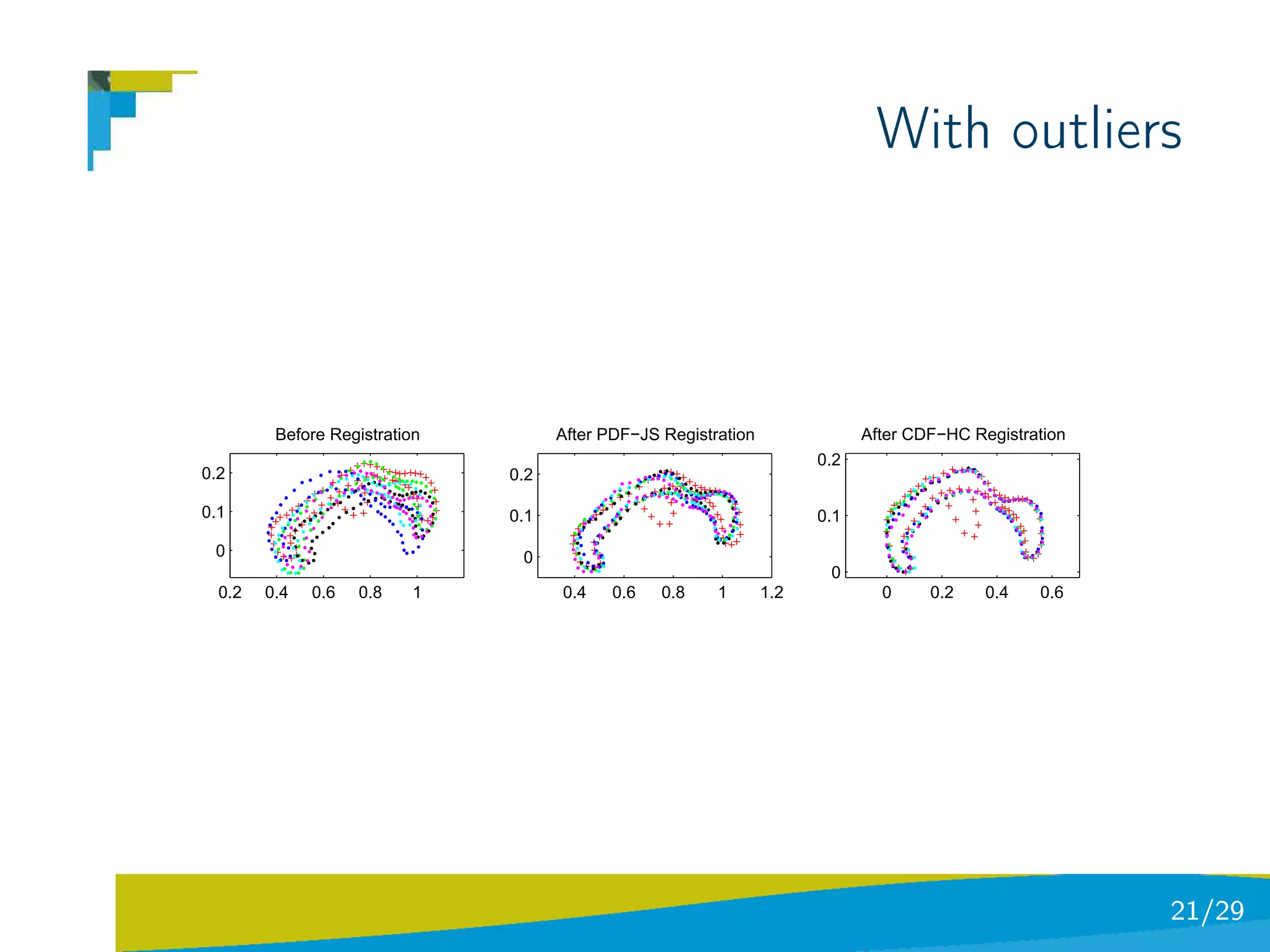
With outliers


         Before Registration         After PDF−JS Registration               After CDF−HC Registration
                                                                       0.2
0.2                            0.2

0.1                            0.1                                     0.1

 0                              0
                                                                        0
  0.2   0.4   0.6   0.8   1          0.4    0.6   0.8    1       1.2           0     0.2    0.4   0.6


                                                                                                         21/29
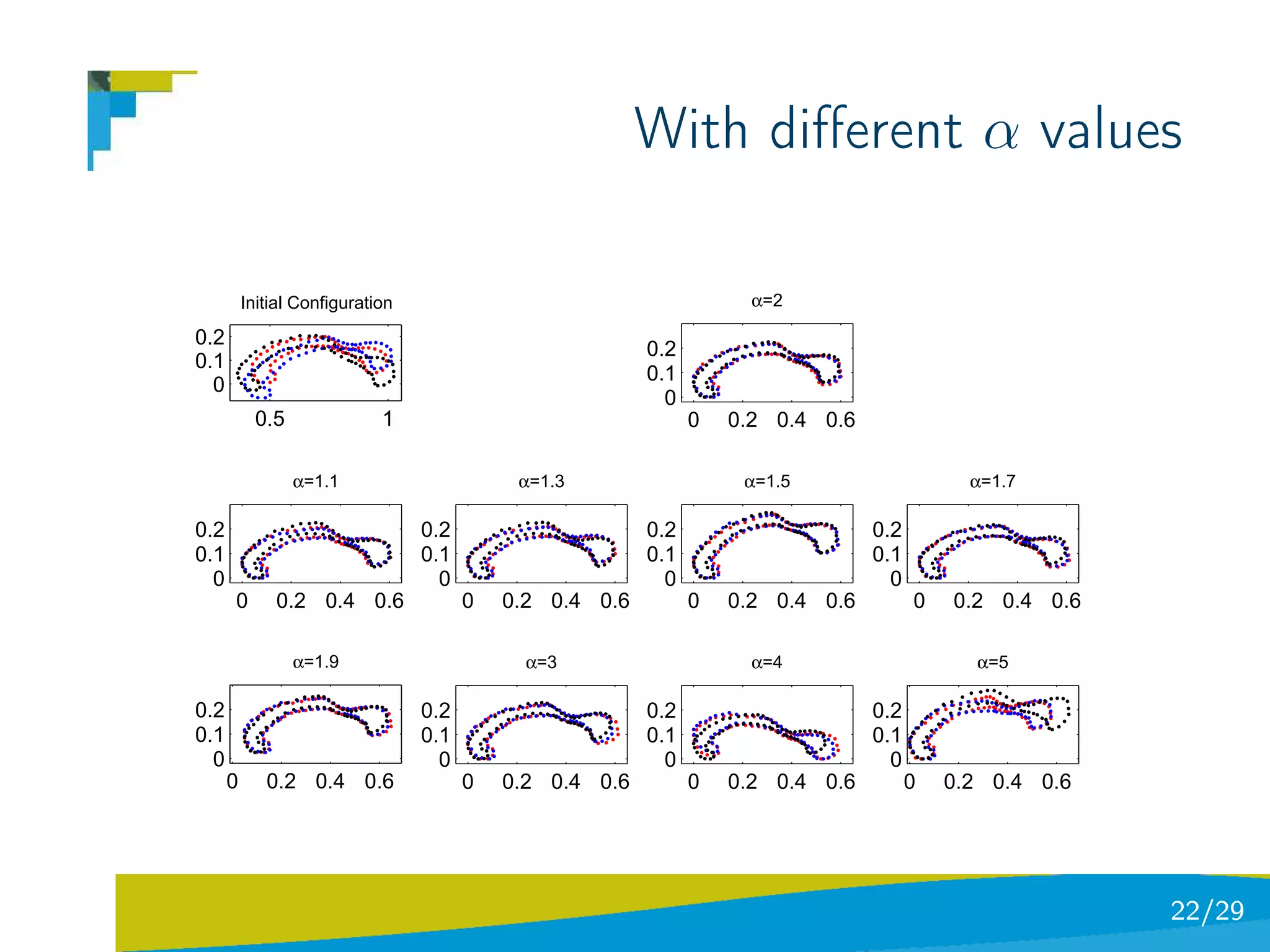
With different α values

          Initial Configuration                                       α=2

0.2
                                                          0.2
0.1
                                                          0.1
  0
                                                            0
            0.5              1                                  0   0.2 0.4 0.6

                  α=1.1                      α=1.3                   α=1.5                    α=1.7

0.2                               0.2                     0.2                     0.2
0.1                               0.1                     0.1                     0.1
  0                                 0                       0                       0
      0       0.2 0.4 0.6               0   0.2 0.4 0.6         0   0.2 0.4 0.6         0   0.2 0.4 0.6

                  α=1.9                       α=3                     α=4                     α=5

0.2                               0.2                     0.2                     0.2
0.1                               0.1                     0.1                     0.1
  0                                 0                       0                       0
      0      0.2 0.4 0.6                0   0.2 0.4 0.6         0   0.2 0.4 0.6         0   0.2 0.4 0.6


                                                                                                          22/29
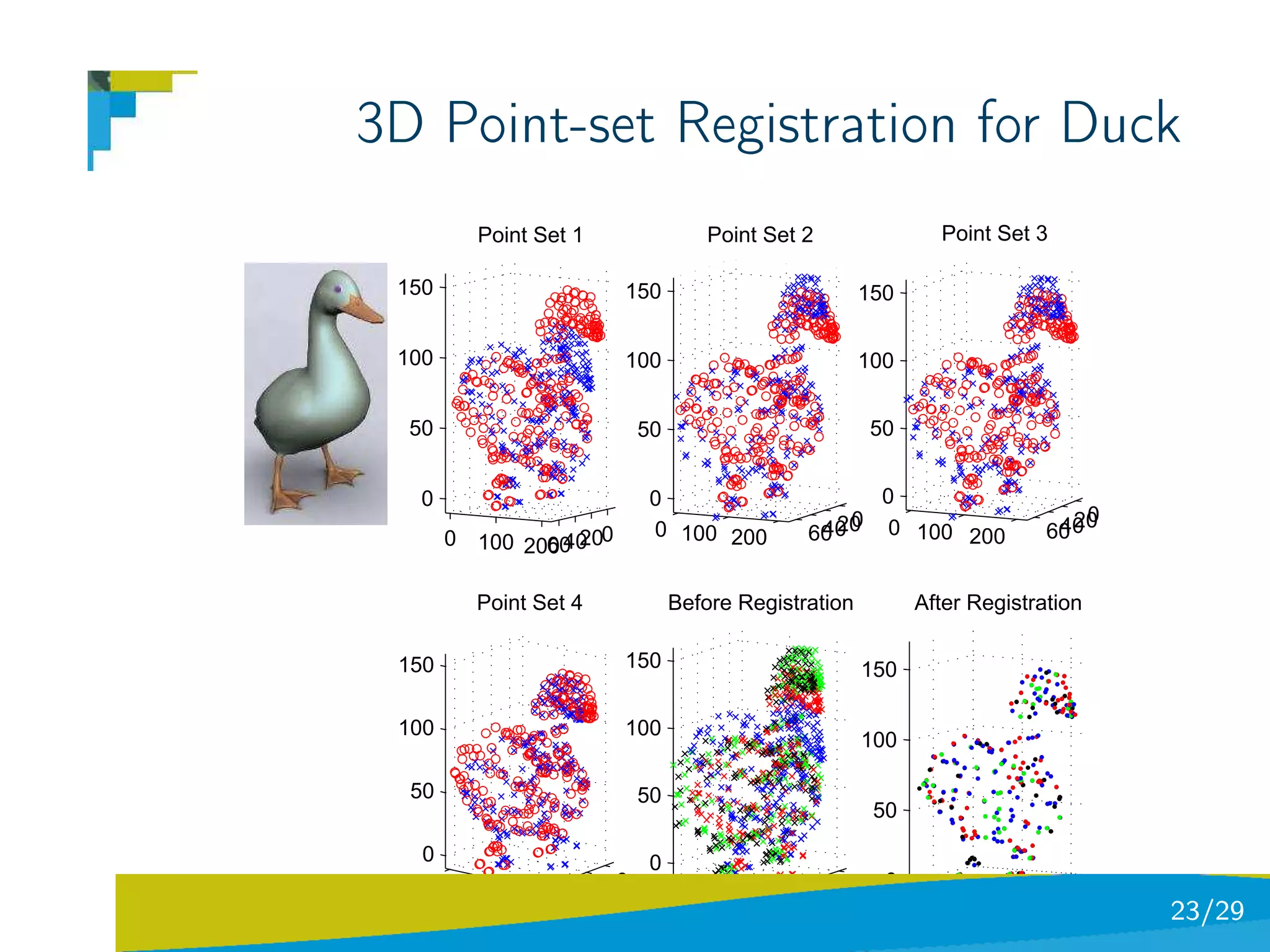
3D Point-set Registration for Duck
         Point Set 1                Point Set 2                 Point Set 3

 150                    150                           150

 100                    100                           100


  50                       50                          50


   0                        0                           0
                                                                              0
       0 100 200 40 0       0 100 200          40 0
                                              60 20      0 100 200         40
                                                                          60
                                                                             20
               60 20

         Point Set 4            Before Registration         After Registration

 150                    150                           150

 100                    100
                                                      100

  50                       50
                                                       50

   0                        0
                       0                                0
   0 100
           200   604020     0 100 200         40 0
                                             60 20          0                 0
                                                                100 200 50        23/29
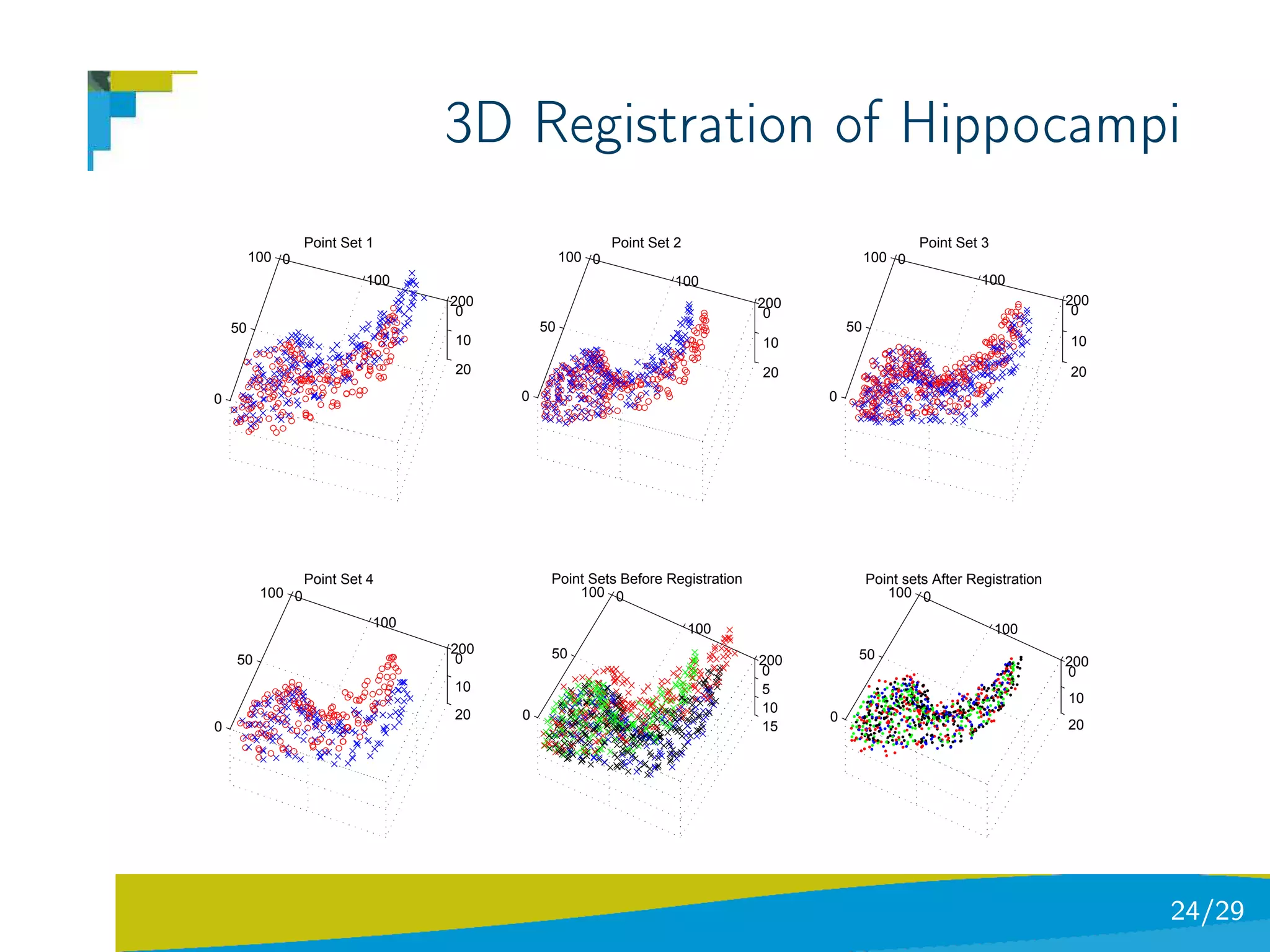
3D Registration of Hippocampi
                  Point Set 1                            Point Set 2                                 Point Set 3
         100 0                                   100 0                                       100 0
                           100                                     100                                          100
                                  200                                         200                                            200
                                   0                                           0                                              0
    50                                      50                                          50
                                  10                                          10                                             10
                                  20                                          20                                             20
0                                       0                                           0


                  Point Set 4                Point Sets Before Registration                  Point sets After Registration
          100 0                                  100 0                                          100 0

                            100                                        100                                         100
                                  200        50                                          50
    50                             0                                          200                                            200
                                                                              0                                              0
                                  10                                          5
                                                                                                                             10
                                  20    0                                     10
                                                                                    0
0                                                                             15                                             20


                                                                                                                                   24/29
Group-Wise Registration Assessment

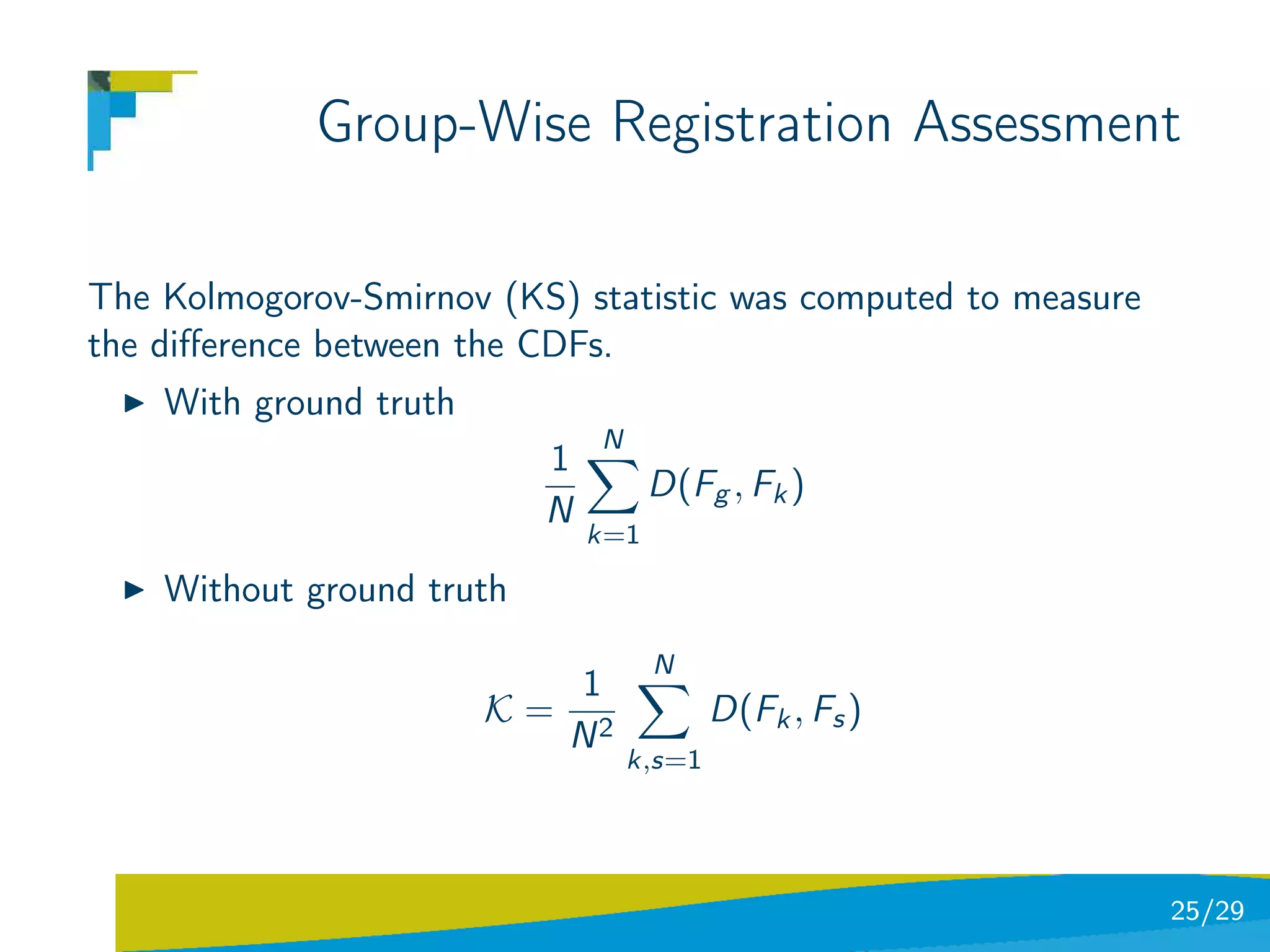
The Kolmogorov-Smirnov (KS) statistic was computed to measure
the difference between the CDFs.
    With ground truth
                               N
                           1
                                     D(Fg , Fk )
                           N
                               k=1

    Without ground truth
                                     N
                             1
                        K=                 D(Fk , Fs )
                             N2
                                   k,s=1


                                                                25/29
KS statistic for comparison


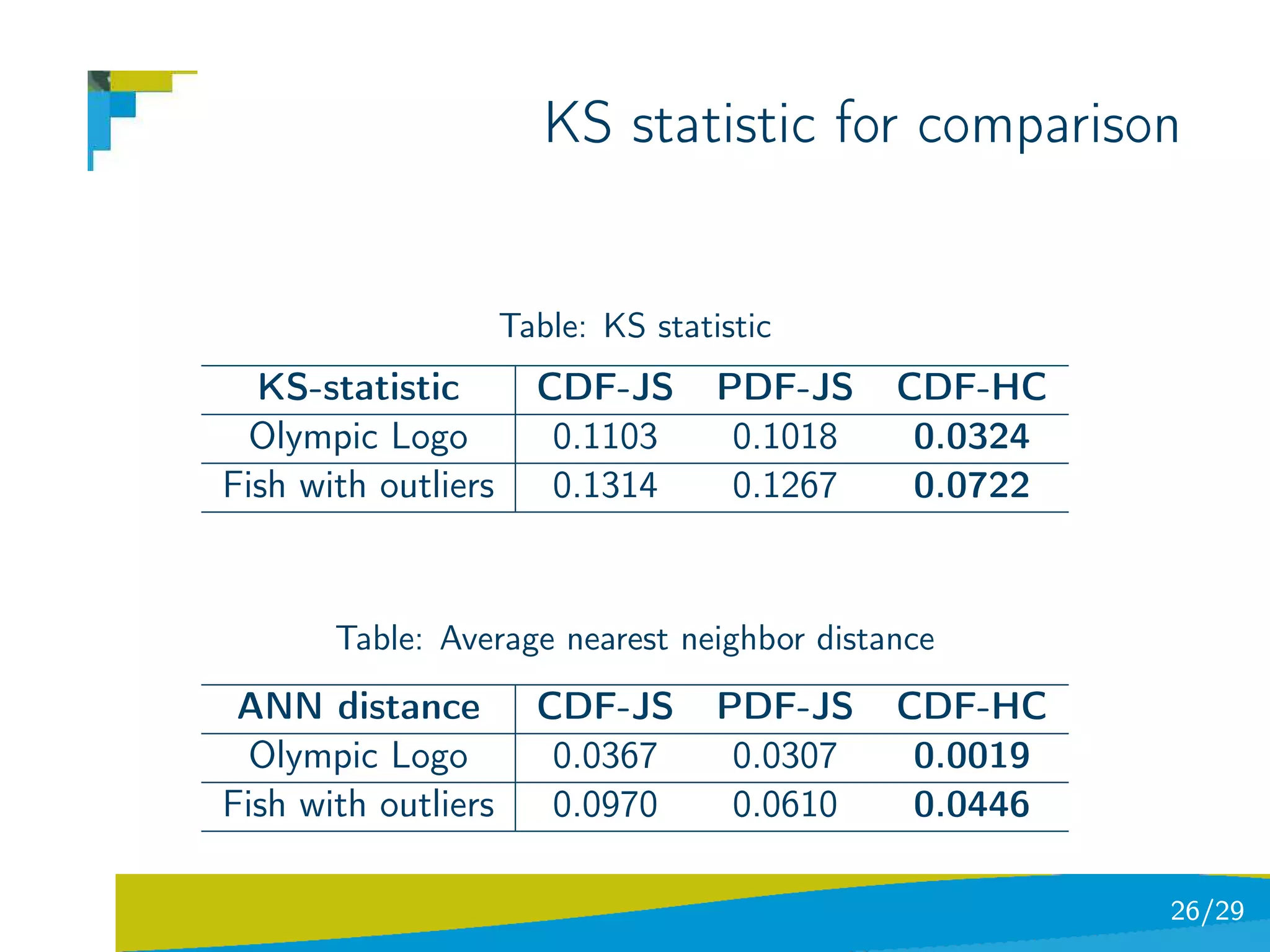
                     Table: KS statistic
  KS-statistic         CDF-JS       PDF-JS    CDF-HC
  Olympic Logo          0.1103       0.1018    0.0324
Fish with outliers      0.1314       0.1267    0.0722


       Table: Average nearest neighbor distance
 ANN distance          CDF-JS       PDF-JS    CDF-HC
  Olympic Logo          0.0367       0.0307    0.0019
Fish with outliers      0.0970       0.0610    0.0446

                                                        26/29
KS statistic for comparison (contd.)


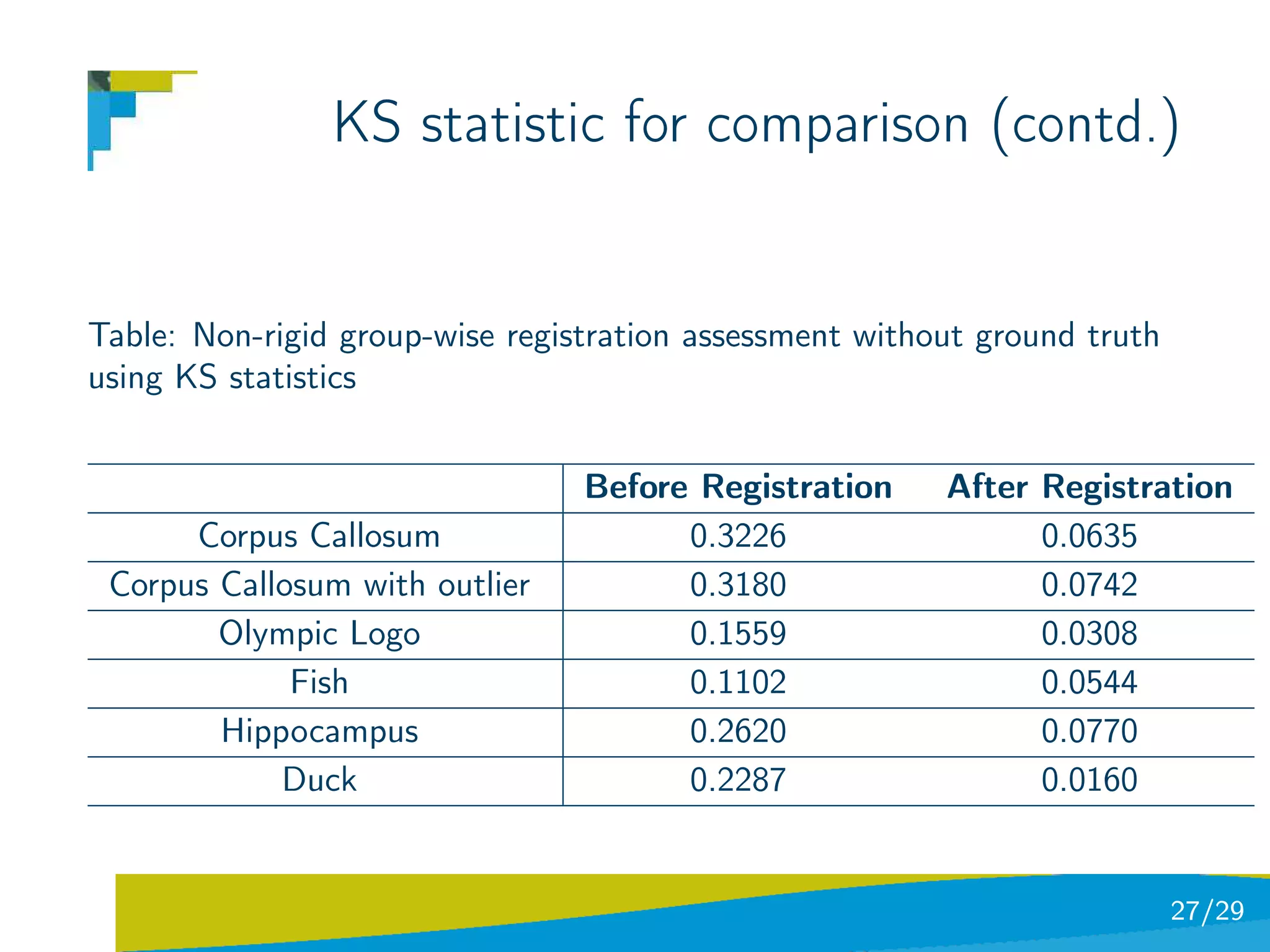
Table: Non-rigid group-wise registration assessment without ground truth
using KS statistics


                                 Before Registration     After Registration
      Corpus Callosum                  0.3226                  0.0635
 Corpus Callosum with outlier          0.3180                  0.0742
        Olympic Logo                   0.1559                  0.0308
             Fish                      0.1102                  0.0544
        Hippocampus                    0.2620                  0.0770
            Duck                       0.2287                  0.0160


                                                                           27/29
KS statistic for comparison (contd.)


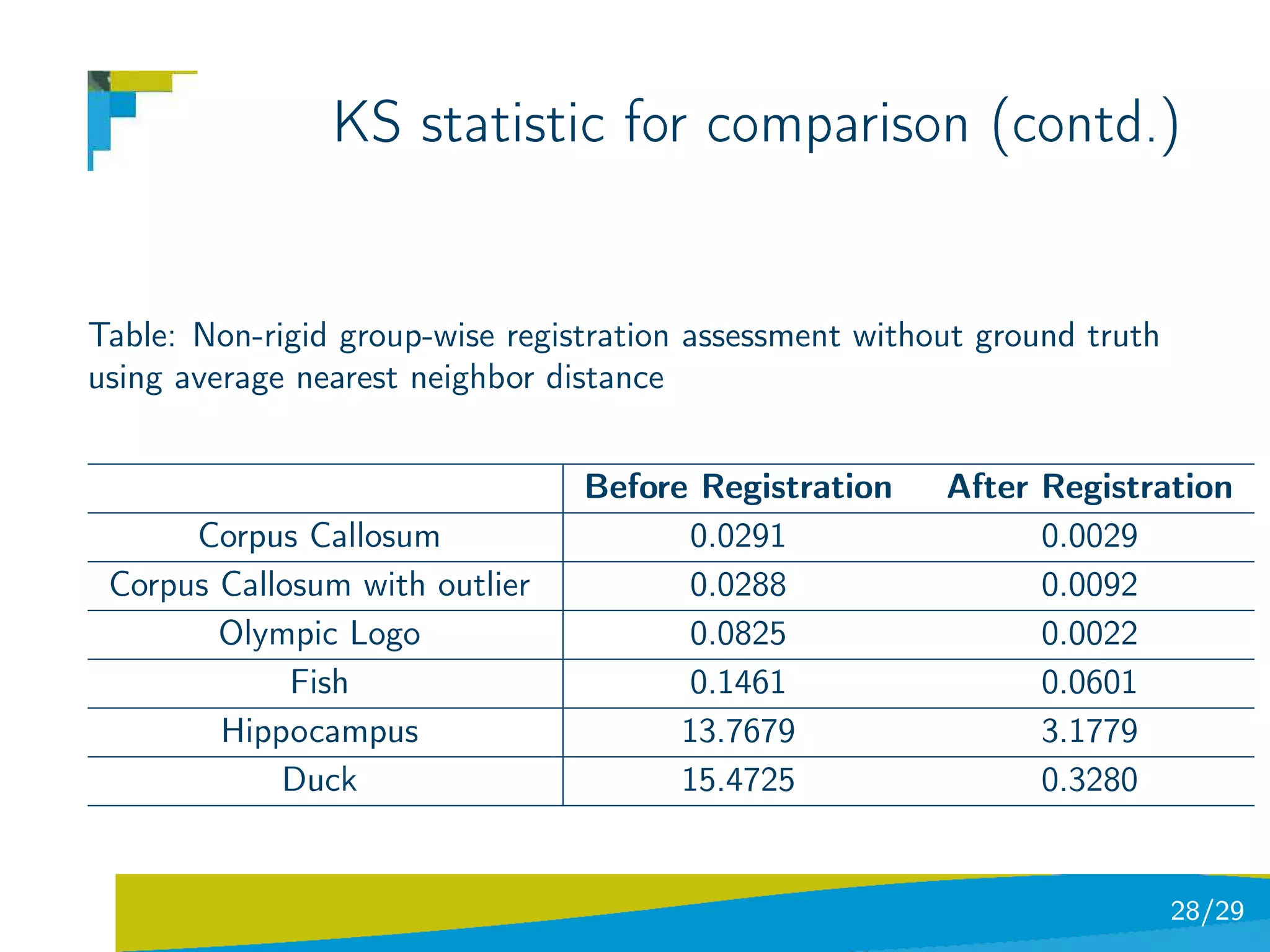
Table: Non-rigid group-wise registration assessment without ground truth
using average nearest neighbor distance


                                 Before Registration     After Registration
      Corpus Callosum                  0.0291                  0.0029
 Corpus Callosum with outlier          0.0288                  0.0092
        Olympic Logo                   0.0825                  0.0022
             Fish                      0.1461                  0.0601
        Hippocampus                    13.7679                 3.1779
            Duck                       15.4725                 0.3280


                                                                           28/29
Discussion


I-divergences for shape matching avoid correspondence problem
Symmetric, unbiased registration and atlas estimation
Shape densities modeled as Gaussian mixtures, cumulatives
directly estimated
JS (pdf and cdf-based) and HC divergences used
Estimated atlas useful in model-based segmentation


                                                                29/29

CVPR2010: Advanced ITinCVPR in a Nutshell: part 5: Shape, Matching and Divergences

  • 1.
    A vne dacd Ifr t nT e r i nomai h oyn o C P “ aN t e” VRi n us l hl CP VR T ti u rl oa J n 1 -82 1 u e 31 0 0 S nFa c c ,A a rn i oC s Shape Matching with I-divergences Anand Rangarajan
  • 2.
    Shape Matching withI-Divergences Groupwise Point-set Pattern Registration Given N point-sets, which are denoted by {X p , p ∈ {1, ..., N}}, the task of multiple point pattern matching or point-set registration is to recover the spatial transformations which yield the best alignment of all shapes. 2/29
  • 3.
  • 4.
  • 5.
    Group-wise Point-set Registration PrincipalTechnical Challenges Solving for nonrigid deformations between point-sets with unknown correspondence is a difficult problem. How do we align all the point-sets in a symmetric manner so that there is no bias toward any particular point-set? 4/29
  • 6.
    From point-sets todensity functions 5/29
  • 7.
    From point-sets todensity functions 5/29
  • 8.
    Group-wise Point-set Registration Frompoint-sets to density functions Point sets are represented by probability density functions. Intuitively, if these point sets are aligned properly, the corresponding density functions should be similar. 6/29
  • 9.
    Group-wise Point-set Registration Frompoint-sets to density functions Point sets are represented by probability density functions. Intuitively, if these point sets are aligned properly, the corresponding density functions should be similar. Question: How do we measure the similarity between multiple density functions? 6/29
  • 10.
    Divergence Measures Kullback-Leibler divergence ˆ p(x) DKL (p q) = p(x) log dx q(x) where p(x), q(x) are the probability density functions. 7/29
  • 11.
    Divergence Measures Kullback-Leibler divergence J divergence ˆ Given two probability density p(x) function p and q, the symmetric KL DKL (p q) = p(x) log dx q(x) divergence is defined as: where p(x), q(x) are the probability 1 J(p, q) = (DKL (p q) + DKL (q p)) density functions. 2 7/29
  • 12.
    Motivating the JSdivergence Modeling two shapes X Y N1 K1 N2 K2 (1) 1 (1) (2) 1 (2) p(X |θ )= p(Xi |θa ), p(Y |θ )= p(Yj |θb ) K1 K2 i=1 a=1 j=1 b=1 8/29
  • 13.
    Motivating the JSdivergence Modeling the overlay of two shapes with identity of origin X Y p(X ∪ Y |θ(1) , θ(2) ) = p(X |θ(1) )p(Y |θ(2) ) 8/29
  • 14.
    Motivating the JSdivergence Modeling the overlay of two shapes without identity of origin Z N1 N2 p(Z |θ(1) , θ(2) ) = p(Z |θ(1) ) + p(Z |θ(2) ) N1 + N2 N1 + N2 8/29
  • 15.
    Likelihood Ratio Which generativemodel do you prefer? The union of disparate shapes where identity of origin is preserved or one combined shape where the identity of origin is suppressed. Likelihood ratio: N1 (1) N2 (2) p(Z |θ(1) , θ(2) ) N1 +N2 p(Z |θ ) + N1 +N2 p(Z |θ ) log Λ = log = p(X ∪ Y |θ(1) , θ(2) ) p(X |θ(1) )p(Y |θ(2) ) Z is understood to arise from a convex combination of two mixture models p(Z |θ(1) ) and p(Z |θ(2) ) where the weights of each mixture are proportional to the number of points N1 and N2 in each set. Weak law of large numbers leads to Jensen-Shannon divergence. 9/29
  • 16.
    JS Divergence formultiple shapes JS-divergence of shape densities JSπ (P1 , P2 , ..., Pn ) = H( π i Pi ) − πi H(Pi ) (1) where π = {π1 , π2 , ..., πn |πi > 0, πi = 1} are the weights of the probability densities Pi and H(Pi ) is the Shannon entropy. 10/29
  • 17.
    Atlas estimation Formulation usingJS-divergence N JSβ (P1 , P2 , ..., PN ) + λ ||Lf i ||2 i=1 N =H( β i Pi ) − βi H(Pi ) + λ ||Lf i ||2 . i=1 f i is the deformation function corresponding to point set X i ; Pi = p(f i (X i )) is the probability density for deformed point-set. 11/29
  • 18.
    Multiple shapes: JSdivergence JS divergence in a hypothesis testing framework: Construct a likelihood ratio between i.i.d. samples drawn from a mixture ( a πa Pa ) and i.i.d. samples drawn from a heterogeneous collection of densities (P1 , P2 , ..., PN ). The likelihood ratio is then M N k=1 a=1 πa Pa (xk ) Λ= N Na . a a=1 ka =1 Pa (xka ) Weak law of large numbers gives us the JS-divergence. 12/29
  • 19.
    Group-wise Registration Results Experimentalresults on four 3D hippocampus point sets. 13/29
  • 20.
    Shape matching viaCDF I-divergences Model each point-set by a cumulative distribution function (CDF) Quantify the distance among cdfs via an information-theoretic measure [typically the cumulative residual entropy (CRE)] Minimize the dis-similarity measure over the space of coordinate transformation parameters 14/29
  • 21.
    Havrda-Charvát CRE HC-CRE: LetX be a random vector in R d , we define the HC-CRE of X by ˆ EH (X ) = − (α − 1)−1 (P α (|X | > λ) − P(|X | > λ))d λ d R+ where X = {x1 , x2 , . . . , xd }, λ = {λ1 , λ2 , . . . , λd }, and |X | > λ means |xi | > λi , R+ = {xi ∈ R d ; xi ≥ 0; i ∈ {1, 2, . . . , d }}. d 15/29
  • 22.
    CDF-HC Divergence CDF-HC Divergence: Given N cumulative probability distributions Pk , k ∈ {1, . . . , N}, the CDF-JS divergence of the set {Pk } is defined as HC (P1 , P2 , . . . , PN ) = EH ( πk Pk ) − πk EH (Pk ) k k where 0 ≤ πk ≤ 1, k πk = 1, and EH is the HC-CRE. 16/29
  • 23.
    CDF-HC Divergence Let P= k πk Pk HC (P1 , P2 , . . . , PN ) ˆ ˆ −1 = −(α − 1) ( P α (X > λ)d λ− πk α Pk (Xk > λ)d λ) d R+ d R+ k ˆ ˆ 2 = πk Pk (Xk > λ)d λ − P 2 (X > λ)d λ (α = 2) d R+ d R+ k 17/29
  • 24.
    Dirac Mixture Model Dk 1 Pk (Xk > λ) = H i (x, xi ) Dk i where H(x, xi ) is the Heaviside function (equal to 1 if all components of x are greater than xi ). 1 0.5 0 0 10 20 30 40 80 50 60 60 40 20 0 70 18/29
  • 25.
    CDF-JS, PDF-JS &CDF-HC Before Registraion CDF−JS PDF−JS CDF−HC 3.5 3.5 3.5 3.5 3 3 3 3 2.5 2.5 2.5 2.5 2 2 2 2 1.5 1.5 1.5 1.5 1 1 1 1 0.5 0.5 0.5 0.5 0 0 0 0 0 1 2 0 1 2 0 1 2 0 1 2 Before Registraion CDF−JS PDF−JS CDF−HC 4 4 4 4 2 2 2 2 0 0 0 0 0 2 4 6 8 0 2 4 6 8 0 2 4 6 8 0 2 4 6 8 19/29
  • 26.
    2D Point-set Registrationfor CC Point Set 1 Point Set 2 Point Set 3 0.2 0.2 0.2 0.1 0.1 0.1 0 0 0 −0.1 −0.1 0 0.2 0.4 0.6 0 0.2 0.4 0.6 0 0.2 0.4 0.6 Point Set 4 Point Set 5 Point Set 6 0.2 0.2 0.2 0.1 0.1 0.1 0 0 0 −0.1 0 0.2 0.4 0.6 0 0.2 0.4 0.6 0 0.2 0.4 0.6 Point Set 7 Before Registration After Registration 0.2 0.2 0.2 0.1 0.1 0.1 0 0 0 −0.1 0 0.2 0.4 0.6 0 0.2 0.4 0.6 0 0.2 0.4 0.6 20/29
  • 27.
    With outliers Before Registration After PDF−JS Registration After CDF−HC Registration 0.2 0.2 0.2 0.1 0.1 0.1 0 0 0 0.2 0.4 0.6 0.8 1 0.4 0.6 0.8 1 1.2 0 0.2 0.4 0.6 21/29
  • 28.
    With different αvalues Initial Configuration α=2 0.2 0.2 0.1 0.1 0 0 0.5 1 0 0.2 0.4 0.6 α=1.1 α=1.3 α=1.5 α=1.7 0.2 0.2 0.2 0.2 0.1 0.1 0.1 0.1 0 0 0 0 0 0.2 0.4 0.6 0 0.2 0.4 0.6 0 0.2 0.4 0.6 0 0.2 0.4 0.6 α=1.9 α=3 α=4 α=5 0.2 0.2 0.2 0.2 0.1 0.1 0.1 0.1 0 0 0 0 0 0.2 0.4 0.6 0 0.2 0.4 0.6 0 0.2 0.4 0.6 0 0.2 0.4 0.6 22/29
  • 29.
    3D Point-set Registrationfor Duck Point Set 1 Point Set 2 Point Set 3 150 150 150 100 100 100 50 50 50 0 0 0 0 0 100 200 40 0 0 100 200 40 0 60 20 0 100 200 40 60 20 60 20 Point Set 4 Before Registration After Registration 150 150 150 100 100 100 50 50 50 0 0 0 0 0 100 200 604020 0 100 200 40 0 60 20 0 0 100 200 50 23/29
  • 30.
    3D Registration ofHippocampi Point Set 1 Point Set 2 Point Set 3 100 0 100 0 100 0 100 100 100 200 200 200 0 0 0 50 50 50 10 10 10 20 20 20 0 0 0 Point Set 4 Point Sets Before Registration Point sets After Registration 100 0 100 0 100 0 100 100 100 200 50 50 50 0 200 200 0 0 10 5 10 20 0 10 0 0 15 20 24/29
  • 31.
    Group-Wise Registration Assessment TheKolmogorov-Smirnov (KS) statistic was computed to measure the difference between the CDFs. With ground truth N 1 D(Fg , Fk ) N k=1 Without ground truth N 1 K= D(Fk , Fs ) N2 k,s=1 25/29
  • 32.
    KS statistic forcomparison Table: KS statistic KS-statistic CDF-JS PDF-JS CDF-HC Olympic Logo 0.1103 0.1018 0.0324 Fish with outliers 0.1314 0.1267 0.0722 Table: Average nearest neighbor distance ANN distance CDF-JS PDF-JS CDF-HC Olympic Logo 0.0367 0.0307 0.0019 Fish with outliers 0.0970 0.0610 0.0446 26/29
  • 33.
    KS statistic forcomparison (contd.) Table: Non-rigid group-wise registration assessment without ground truth using KS statistics Before Registration After Registration Corpus Callosum 0.3226 0.0635 Corpus Callosum with outlier 0.3180 0.0742 Olympic Logo 0.1559 0.0308 Fish 0.1102 0.0544 Hippocampus 0.2620 0.0770 Duck 0.2287 0.0160 27/29
  • 34.
    KS statistic forcomparison (contd.) Table: Non-rigid group-wise registration assessment without ground truth using average nearest neighbor distance Before Registration After Registration Corpus Callosum 0.0291 0.0029 Corpus Callosum with outlier 0.0288 0.0092 Olympic Logo 0.0825 0.0022 Fish 0.1461 0.0601 Hippocampus 13.7679 3.1779 Duck 15.4725 0.3280 28/29
  • 35.
    Discussion I-divergences for shapematching avoid correspondence problem Symmetric, unbiased registration and atlas estimation Shape densities modeled as Gaussian mixtures, cumulatives directly estimated JS (pdf and cdf-based) and HC divergences used Estimated atlas useful in model-based segmentation 29/29