
Course Program
9.30-10.00 Introduction (Andrew Blake)
10.00-11.00 Discrete Models in Computer Vision (Carsten Rother)
15min Coffee break
11.15-12.30 Message Passing: DP, TRW, LP relaxation (Pawan Kumar)
12.30-13.00 Quadratic pseudo-boolean optimization (Pushmeet Kohli)
1 hour Lunch break
14:00-15.00 Transformation and move-making methods (Pushmeet Kohli)
15:00-15.30 Speed and Efficiency (Pushmeet Kohli)
15min Coffee break
15:45-16.15 Comparison of Methods (Carsten Rother)
16:15-17.30 Recent Advances: Dual-decomposition, higher-order, etc.
             (Carsten Rother + Pawan Kumar)

   All online material will be online (after conference):
   http://research.microsoft.com/en-us/um/cambridge/projects/tutorial/
Discrete Models in Computer Vision

              Carsten Rother
       Microsoft Research Cambridge
Overview

• Introduce Factor graphs notation
• Categorization of models in Computer Vision:
  – 4-connected MRFs
  – Highly-connected MRFs
  – Higher-order MRFs
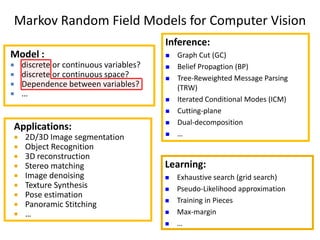
Markov Random Field Models for Computer Vision
                                        Inference:
Model :                                    Graph Cut (GC)
   discrete or continuous variables?      Belief Propagtion (BP)
   discrete or continuous space?          Tree-Reweighted Message Parsing
   Dependence between variables?           (TRW)
   …
                                           Iterated Conditional Modes (ICM)
                                           Cutting-plane
                                           Dual-decomposition
Applications:
   2D/3D Image segmentation               …
   Object Recognition
   3D reconstruction
   Stereo matching                     Learning:
   Image denoising                        Exhaustive search (grid search)
   Texture Synthesis                      Pseudo-Likelihood approximation
   Pose estimation
                                           Training in Pieces
   Panoramic Stitching
   …                                      Max-margin
                                           …
Recap: Image Segmentation


      Input z             Maximum-a-posteriori (MAP)
                          x* = argmax P(x|z) = argmin E(x)
                                  x                x


P(x|z) ~ P(z|x) P(x) Posterior; Likelihood; Prior

P(x|z) ~ exp{-E(x)}                Gibbs distribution

E: {0,1}n → R
E(x) = ∑ θi (xi) + w∑ θij (xi,xj)            Energy
         i          i,j   Є   N4
       Unary term    Pairwise term
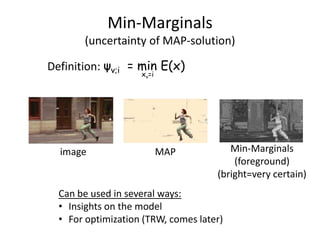
Min-Marginals
       (uncertainty of MAP-solution)

Definition: ψv;i = min E(x)
                    xv=i


  image                    MAP          Min-Marginals
                                         (foreground)
                                     (bright=very certain)
  Can be used in several ways:
  • Insights on the model
  • For optimization (TRW, comes later)
Introducing Factor Graphs
Write probability distributions as Graphical models:

       - Direct graphical model
       - Undirected graphical model (… what Andrew Blake used)
       - Factor graphs

References:
       - Pattern Recognition and Machine Learning *Bishop ‘08, book, chapter 8+
       - several lectures at the Machine Learning Summer School 2009
         (see video lectures)
Factor Graphs
P(x) ~ θ(x1,x2,x4) θ(x3,x4) θ(x2,x3) θ(x4,x5)          “4 factors”

P(x) ~ exp{-E(x)}                                       Gibbs distribution
E(x) = θ(x1,x2,x3) + θ(x2,x4) + θ(x3,x4) + θ(x3,x5)


                              unobserved/latent/hidden variable
     x1           x2
                              variables are in same factor.


     x3           x4


      x5

      Factor graph
Definition “Order”
Definition “Order”:
The arity (number of variables) of
the largest factor                                    x1           x2


      P(X) ~ θ(x1,x2,x3) θ(x2,x4) θ(x3,x4) θ(x3,x5)

                 arity 3             arity 2          x3           x4


                                                      x5

                                                           Factor graph
                                                           with order 3
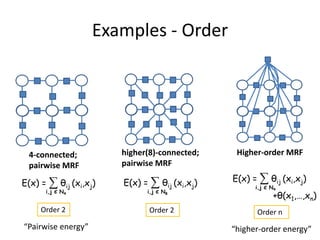
Examples - Order


 4-connected;          higher(8)-connected;    Higher-order MRF
 pairwise MRF          pairwise MRF

E(x) = ∑ θij (xi,xj)   E(x) = ∑ θij (xi,xj)   E(x) = ∑ θij (xi,xj)
                                                    i,j Є N4
      i,j Є N4               i,j Є N8
                                                          +θ(x1,…,xn)
     Order 2                  Order 2               Order n
“Pairwise energy”                             “higher-order energy”
Example: Image segmentation
      P(x|z) ~ exp{-E(x)}
         E(x) = ∑ θi (xi,zi) + ∑ θij (xi,xj)
                    i        i,j   Є   N4


                                       Observed variable

                                       Unobserved (latent) variable
               zi


    xj         xi

Factor graph
Most simple inference technique:
     ICM (iterated conditional mode)
                        Goal: x* = argmin E(x)
        x2                              x
                        E(x) = θ12 (x1,x2)+ θ13 (x1,x3)+
                              θ14 (x1,x4)+ θ15 (x1,x5)+…

x3      x1    x4


        x5
Most simple inference technique:
         ICM (iterated conditional mode)
                  means observed
                                              Goal: x* = argmin E(x)
                x2                                            x
                                              E(x) = θ12 (x1,x2)+ θ13 (x1,x3)+
                                                    θ14 (x1,x4)+ θ15 (x1,x5)+…

    x3          x1          x4


                x5


Simulated Annealing: accept a move even if       ICM                 Global min
energy increases (with certain probability)     Can get stuck in local minima!
Overview
• Introduce Factor graphs notation
• Categorization of models in Computer Vision:

  – 4-connected MRFs

  – Highly-connected MRFs

  – Higher-order MRFs
Stereo matching
                                     d=0

                               d=4


 Image – left(a)     Image – right(b)      Ground truth depth


• Images rectified
• Ignore occlusion for now

Energy:                                         di

    E(d): {0,…,D-1}n → R
    Labels: d (depth/shift)
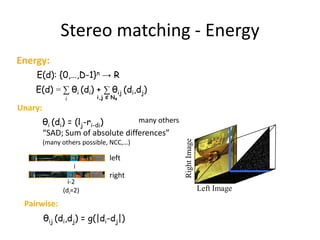
Stereo matching - Energy
Energy:
    E(d): {0,…,D-1}n → R
    E(d) = ∑ θi (di) + ∑ θij (di,dj)
                i          i,j Є N4

Unary:
         θi (di) = (lj-ri-di)      many others
         “SAD; Sum of absolute differences”


                                                 Right Image
         (many others possible, NCC,…)

                                left
                    i
                                right
                 i-2
               (di=2)                                          Left Image
 Pairwise:
         θij (di,dj) = g(|di-dj|)
Stereo matching - prior

                            θij (di,dj) = g(|di-dj|)


                           cost
                                  |di-dj|


No truncation
(global min.)


                                      [Olga Veksler PhD thesis,
                                      Daniel Cremers et al.]
Stereo matching - prior

                                            θij (di,dj) = g(|di-dj|)


                                           cost
                                                  |di-dj|
                                         discontinuity preserving potentials
                                              *Blake&Zisserman’83,’87+


No truncation      with truncation
(global min.)   (NP hard optimization)


                                                      [Olga Veksler PhD thesis,
                                                      Daniel Cremers et al.]
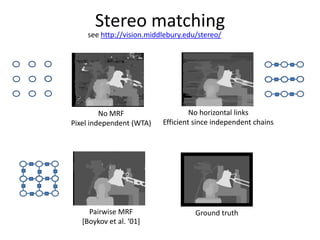
Stereo matching
    see http://vision.middlebury.edu/stereo/


         No MRF                    No horizontal links
Pixel independent (WTA)   Efficient since independent chains


     Pairwise MRF                   Ground truth
   [Boykov et al. ‘01+
Texture synthesis


    Input

                Output

                         Good case:               Bad case:
                b            b                     b
                             a                     a
                                 i   j                  i    j
            a

                    E: {0,1}n → R
O                   E(x) =   ∑ |xi-xj|      [ |ai-bi|+|aj-bj| ]
                         i,j Є N4
    1
                                         [Kwatra et. al. Siggraph ‘03 +
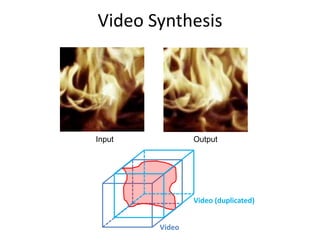
Video Synthesis


Input           Output


                Video (duplicated)


        Video
Panoramic stitching
Panoramic stitching
AutoCollage


http://research.microsoft.com/en-us/um/cambridge/projects/autocollage/   [Rother et. al. Siggraph ‘05 +
Recap: 4-connected MRFs

• A lot of useful vision systems are based on
  4-connected pairwise MRFs.

• Possible Reason (see Inference part):
  a lot of fast and good (globally optimal)
  inference methods exist
Overview
• Introduce Factor graphs notation
• Categorization of models in Computer Vision?

  – 4-connected MRFs

  – Highly-connected MRFs

  – Higher-order MRFs
Why larger connectivity?
We have seen…
• “Knock-on” effect (each pixel influences each other pixel)
• Many good systems

What is missing:
1. Modelling real-world texture (images)
2. Reduce discretization artefacts
3. Encode complex prior knowledge
4. Use non-local parameters
Reason 1: Texture modelling


Training images   Test image     Test image (60% Noise)


  Result MRF      Result MRF         Result MRF
 4-connected      4-connected        9-connected
 (neighbours)                   (7 attractive; 2 repulsive)
Reason1: Texture Modelling
 input         output


                         [Zalesny et al. ‘01+
Reason2: Discretization artefacts

1
                         Length of the paths:

                      Eucl.       4-con.       8-con.
                        5.65       6.28         5.08
                         8         6.28         6.75

                 Larger connectivity can model true Euclidean
                      length (also other metric possible)


                                              *Boykov et al ‘03, ‘05+
Reason2: Discretization artefacts


   4-connected             8-connected           8-connected
    Euclidean               Euclidean              geodesic

                 higher-connectivity can model
                     true Euclidean length       [Boykov et al. ‘03; ‘05+
3D reconstruction


               [Slide credits: Daniel Cremers]
Reason 3: Encode complex prior knowledge:
                      Stereo with occlusion


       E(d): {1,…,D}2n → R
       Each pixel is connected to D pixels in the other image
                                                      d=1 (∞ cost)
                 1                 1

                                                                 d=10 (match)
θlr (dl,dr) =   d                    d
                      match
                                                                     d=20 (0 cost)

                D                    D
                dl              dr           Left view               right view
Stereo with occlusion


Ground truth   Stereo with occlusion    Stereo without occlusion
               [Kolmogrov et al. ‘02+      *Boykov et al. ‘01+
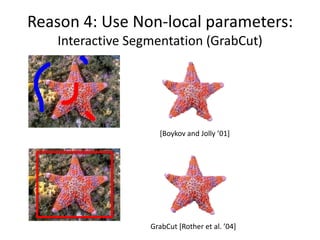
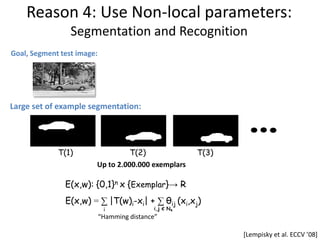
Reason 4: Use Non-local parameters:
   Interactive Segmentation (GrabCut)


                    [Boykov and Jolly ’01+


                  GrabCut *Rother et al. ’04+
A meeting with the Queen
Reason 4: Use Non-local parameters:
         Interactive Segmentation (GrabCut)


                                                    w
 Model jointly segmentation and color model:

 E(x,w): {0,1}n x {GMMs}→ R
 E(x,w) = ∑ θi (xi,w) + ∑ θij (xi,xj)
           i           i,j Є N4


An object is a compact set of colors:
                                  Red
   Red


                                               [Rother et al Siggraph ’04+
Reason 4: Use Non-local parameters:
                 Segmentation and Recognition
Goal, Segment test image:

                 1


Large set of example segmentation:


             T(1)                 T(2)                  T(3)
                        Up to 2.000.000 exemplars

               E(x,w): {0,1}n x {Exemplar}→ R
               E(x,w) = ∑ |T(w)i-xi| + ∑ θij (xi,xj)
                             i               i,j Є N4
                            “Hamming distance”

                                                               [Lempisky et al. ECCV ’08+
Reason 4: Use Non-local parameters:
     Segmentation and Recognition


            UIUC dataset; 98.8% accuracy

                                           [Lempisky et al. ECCV ’08+
Overview
• Introduce Factor graphs notation
• Categorization of models in Computer Vision?

  – 4-connected MRFs

  – Highly-connected MRFs

  – Higher-order MRFs
Why Higher-order Functions?
In general θ(x1,x2,x3) ≠ θ(x1,x2) + θ(x1,x3) + θ(x2,x3)

Reasons for higher-order MRFs:

1. Even better image(texture) models:
   –   Field-of Expert [FoE, Roth et al. ‘05+
   –   Curvature *Woodford et al. ‘08+

2. Use global Priors:
   –   Connectivity *Vicente et al. ‘08, Nowizin et al. ‘09+
   –   Encode better training statistics *Woodford et al. ‘09+
Reason1: Better Texture Modelling


                            Higher Order Structure
                                 not Preserved

Training images


 Test Image       Test Image (60% Noise) Result pairwise MRF    Higher-order MRF
                                             9-connected
                                                               *Rother et al CVPR ‘09+
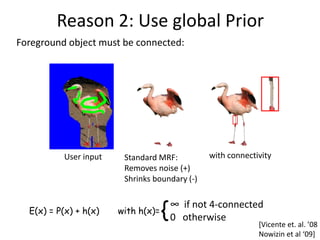
Reason 2: Use global Prior
Foreground object must be connected:


          User input    Standard MRF:          with connectivity
                        Removes noise (+)
                        Shrinks boundary (-)


  E(x) = P(x) + h(x)   with h(x)= {
                                  ∞ if not 4-connected
                                  0 otherwise
                                                            [Vicente et. al. ’08
                                                            Nowizin et al ‘09+
Reason 2: Use global Prior
    What is the prior of a MAP-MRF solution:

   Training image:                                              60% black, 40% white

   MAP:                                  Others less likely :
                        8
       prior(x) = 0.6 = 0.016                              prior(x) = 0.6 5 * 0.4 3 = 0.005
               MRF is a bad prior since input marginal statistic ignored !

               Introduce a global term, which controls global stats:


               Noisy input


Ground truth                              Pairwise MRF –               Global gradient prior
                                      Increase Prior strength
                                                                         [Woodford et. al. ICCV ‘09]
                                                                         (see poster on Friday)
Summary
• Introduce Factor graphs notation
• Categorization of models in Computer Vision?

  – 4-connected MRFs

  – Highly-connected MRFs

  – Higher-order MRFs


  …. all useful models,
     but how do I optimize them?
Course Program
9.30-10.00 Introduction (Andrew Blake)
10.00-11.00 Discrete Models in Computer Vision (Carsten Rother)
15min Coffee break
11.15-12.30 Message Passing: DP, TRW, LP relaxation (Pawan Kumar)
12.30-13.00 Quadratic pseudo-boolean optimization (Pushmeet Kohli)
1 hour Lunch break
14:00-15.00 Transformation and move-making methods (Pushmeet Kohli)
15:00-15.30 Speed and Efficiency (Pushmeet Kohli)
15min Coffee break
15:45-16.15 Comparison of Methods (Carsten Rother)
16:15-17.30 Recent Advances: Dual-decomposition, higher-order, etc.
             (Carsten Rother + Pawan Kumar)

   All online material will be online (after conference):
   http://research.microsoft.com/en-us/um/cambridge/projects/tutorial/
END
unused slides …
Markov Property


                                  xi


• Markov Property: Each variable is only connected to a few others,
                     i.e. many pixels are conditional independent
• This makes inference easier (possible at all)
• But still… every pixel can influence any other pixel (knock-on effect)
Recap: Factor Graphs


• Factor graphs: very good representation since it
                 reflects directly the given energy

• MRF (Markov Property) means many pixels are
                        conditional independent

• Still … all pixels influence each other (knock-on effect)
Interactive Segmentation - Tutorial example


                              Goal


   z = (R,G,B)n                                 x = {0,1}n

    Given Z and unknown (latent) variables x:

    P(x|z) =       P(z|x)     P(x)    / P(z)     ~ P(z|x) P(x)
    Posterior      Likelihood    Prior
    Probability       (data-    (data-
                  dependent) independent)

   Maximium a Posteriori (MAP): x* = argmax P(x|z)
                                                X
Likelihood   P(x|z) ~ P(z|x) P(x)


                              Green
Green


              Red                       Red
Likelihood             P(x|z) ~ P(z|x) P(x)


   Log P(zi|xi=0)                Log P(zi|xi=1)


Maximum likelihood:
x* = argmax P(z|x) =
        X
argmax ∏ P(zi|xi)
   x    xi
Prior   P(x|z) ~ P(z|x) P(x)


                                 xi      xj


P(x) = 1/f ∏ θij (xi,xj)
                   i,j   Є   N

f = ∑     ∏ θij (xi,xj)           “partition function”
    x    i,j   Є   N

θij (xi,xj) = exp{-|xi-xj|}           “ising prior”

    (exp{-1}=0.36; exp{0}=1)
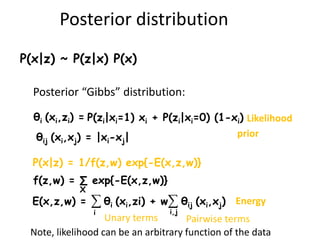
Posterior distribution
P(x|z) ~ P(z|x) P(x)

  Posterior “Gibbs” distribution:

  θi (xi,zi) = P(zi|xi=1) xi + P(zi|xi=0) (1-xi) Likelihood
  θ (x ,x ) = |x -x |                         prior
    ij   i   j           i   j


  P(x|z) = 1/f(z,w) exp{-E(x,z,w)}
  f(z,w) = ∑ exp{-E(x,z,w)}
                 X
  E(x,z,w) =         ∑ θi (xi,zi)   + w∑ θij (xi,xj) Energy
                     i                  i,j
                   Unary terms        Pairwise terms
 Note, likelihood can be an arbitrary function of the data
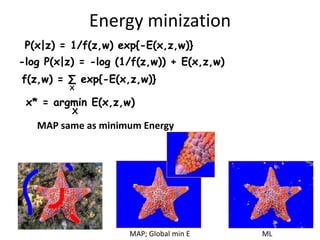
Energy minization
 P(x|z) = 1/f(z,w) exp{-E(x,z,w)}
-log P(x|z) = -log (1/f(z,w)) + E(x,z,w)
f(z,w) = ∑ exp{-E(x,z,w)}
         X

 x* = argmin E(x,z,w)
          X
   MAP same as minimum Energy


                     MAP; Global min E     ML
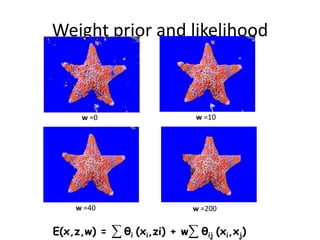
Weight prior and likelihood


     w =0                        w =10


    w =40                       w =200

E(x,z,w) =   ∑ θi (xi,zi)   + w∑ θij (xi,xj)
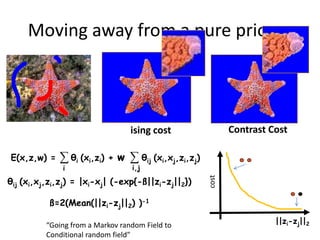
Moving away from a pure prior …


                                  ising cost                   Contrast Cost

E(x,z,w) =   ∑ θi (xi,zi)   + w   ∑ θij (xi,xj,zi,zj)
              i                   i,j

θij (xi,xj,zi,zj) = |xi-xj| (-exp{-ß||zi-zj||2})


                                                        cost
          ß=2(Mean(||zi-zj||2) )-1

          “Going from a Markov random Field to                           ||zi-zj||2
          Conditional random field”
Tree vs Loopy graphs
                             Markov blanket of xi:
                             all variables which are
                             in same factor as xi         [Felzenschwalb, Huttenlocher ‘01+


                xi                                root


- MAP (in general) NP hard                        tree                       chain
  (see inference part)
- Marginals P(xi) also NP hard           • MAP is tractable
                                         • Marginal, e.g. P(foot), tractable
Stereo matching - prior
                                       θij (di,dj) = g(|di-dj|)


                                     cost
 Left image
                                            |di-dj|


                                                 Potts model


(Potts model)   Smooth disparities


                                               [Olga Veksler PhD thesis]
Modelling texture [Zalesny et al ‘01+
                                    “Unary only”


                                         “8 connected
                                         MRF”


input
                                           “13 connected
                                           MRF”
Reason2: Discretization artefacts
θij (xi,xj) = ∆a / (2*dis(xi,xj)) |xi –xj|             √2       ∆a = π/4

1                                                       1

                                               Length of the path
                                             4-con.    8-con.       true euc.
                                               6.28     5.08          5.65
                                               6.28     6.75           8


       Larger connectivity can model true Euclidean length
       (also any Riemannian metric, e.g. geodesic length, can be
       modelled)
                                                                    *Boykov et al ‘03, ‘05+
References Higher-order Functions?
• In general θ(x1,x2,x3) ≠ θ(x1,x2) + θ(x1,x3) + θ(x2,x3)

   Field of Experts Model (2x2; 5x5)
   *Roth, Black CVPR ‘05 +
   [Potetz, CVPR ‘07+

   Minimize Curvature (3x1)
   *Woodford et al. CVPR ‘08 +

   Large Neighbourhood (10x10 -> whole image)
   *Rother, Kolmogorov, Minka & Blake, CVPR ‘06+
   *Vicente, Kolmogorov, Rother, CVPR ‘08+
   [Komodiakis, Paragios, CVPR ‘09+
   *Rother, Kohli, Feng, Jia, CVPR ‘09+
   *Woodford, Rother, Kolmogorov, ICCV ‘09+
   *Vicente, Kolmogorov, Rother, ICCV ‘09+
   *Ishikawa, CVPR ‘09+
   *Ishikawa, ICCV ‘09+
Conditional Random Field (CRF)
E(x) = ∑ θi (xi,zi) + ∑ θij (xi,xj,zi,zj)                      θij
        i              i,j   Є   N4

       with θij (xi,xj,zi,zj) = |xi-xj| exp(-ß||zi-zj||2)

                                                                                ||zi-zj||2


                      zjj

                zii
                z


                      xjj


                xji                       Ising cost                 Contrast Cost

 Factor graph
                      Definition CRF: all factors may depend on the data z
                      No problem for inference (but parameter learning)

Discrete Models in Computer Vision

  • 1.
    Course Program 9.30-10.00 Introduction(Andrew Blake) 10.00-11.00 Discrete Models in Computer Vision (Carsten Rother) 15min Coffee break 11.15-12.30 Message Passing: DP, TRW, LP relaxation (Pawan Kumar) 12.30-13.00 Quadratic pseudo-boolean optimization (Pushmeet Kohli) 1 hour Lunch break 14:00-15.00 Transformation and move-making methods (Pushmeet Kohli) 15:00-15.30 Speed and Efficiency (Pushmeet Kohli) 15min Coffee break 15:45-16.15 Comparison of Methods (Carsten Rother) 16:15-17.30 Recent Advances: Dual-decomposition, higher-order, etc. (Carsten Rother + Pawan Kumar) All online material will be online (after conference): http://research.microsoft.com/en-us/um/cambridge/projects/tutorial/
  • 2.
    Discrete Models inComputer Vision Carsten Rother Microsoft Research Cambridge
  • 3.
    Overview • Introduce Factorgraphs notation • Categorization of models in Computer Vision: – 4-connected MRFs – Highly-connected MRFs – Higher-order MRFs
  • 4.
    Markov Random FieldModels for Computer Vision Inference: Model :  Graph Cut (GC)  discrete or continuous variables?  Belief Propagtion (BP)  discrete or continuous space?  Tree-Reweighted Message Parsing  Dependence between variables? (TRW)  …  Iterated Conditional Modes (ICM)  Cutting-plane  Dual-decomposition Applications:  2D/3D Image segmentation  …  Object Recognition  3D reconstruction  Stereo matching Learning:  Image denoising  Exhaustive search (grid search)  Texture Synthesis  Pseudo-Likelihood approximation  Pose estimation  Training in Pieces  Panoramic Stitching  …  Max-margin  …
  • 5.
    Recap: Image Segmentation Input z Maximum-a-posteriori (MAP) x* = argmax P(x|z) = argmin E(x) x x P(x|z) ~ P(z|x) P(x) Posterior; Likelihood; Prior P(x|z) ~ exp{-E(x)} Gibbs distribution E: {0,1}n → R E(x) = ∑ θi (xi) + w∑ θij (xi,xj) Energy i i,j Є N4 Unary term Pairwise term
  • 6.
    Min-Marginals (uncertainty of MAP-solution) Definition: ψv;i = min E(x) xv=i image MAP Min-Marginals (foreground) (bright=very certain) Can be used in several ways: • Insights on the model • For optimization (TRW, comes later)
  • 7.
    Introducing Factor Graphs Writeprobability distributions as Graphical models: - Direct graphical model - Undirected graphical model (… what Andrew Blake used) - Factor graphs References: - Pattern Recognition and Machine Learning *Bishop ‘08, book, chapter 8+ - several lectures at the Machine Learning Summer School 2009 (see video lectures)
  • 8.
    Factor Graphs P(x) ~θ(x1,x2,x4) θ(x3,x4) θ(x2,x3) θ(x4,x5) “4 factors” P(x) ~ exp{-E(x)} Gibbs distribution E(x) = θ(x1,x2,x3) + θ(x2,x4) + θ(x3,x4) + θ(x3,x5) unobserved/latent/hidden variable x1 x2 variables are in same factor. x3 x4 x5 Factor graph
  • 9.
    Definition “Order” Definition “Order”: Thearity (number of variables) of the largest factor x1 x2 P(X) ~ θ(x1,x2,x3) θ(x2,x4) θ(x3,x4) θ(x3,x5) arity 3 arity 2 x3 x4 x5 Factor graph with order 3
  • 10.
    Examples - Order 4-connected; higher(8)-connected; Higher-order MRF pairwise MRF pairwise MRF E(x) = ∑ θij (xi,xj) E(x) = ∑ θij (xi,xj) E(x) = ∑ θij (xi,xj) i,j Є N4 i,j Є N4 i,j Є N8 +θ(x1,…,xn) Order 2 Order 2 Order n “Pairwise energy” “higher-order energy”
  • 11.
    Example: Image segmentation P(x|z) ~ exp{-E(x)} E(x) = ∑ θi (xi,zi) + ∑ θij (xi,xj) i i,j Є N4 Observed variable Unobserved (latent) variable zi xj xi Factor graph
  • 12.
    Most simple inferencetechnique: ICM (iterated conditional mode) Goal: x* = argmin E(x) x2 x E(x) = θ12 (x1,x2)+ θ13 (x1,x3)+ θ14 (x1,x4)+ θ15 (x1,x5)+… x3 x1 x4 x5
  • 13.
    Most simple inferencetechnique: ICM (iterated conditional mode) means observed Goal: x* = argmin E(x) x2 x E(x) = θ12 (x1,x2)+ θ13 (x1,x3)+ θ14 (x1,x4)+ θ15 (x1,x5)+… x3 x1 x4 x5 Simulated Annealing: accept a move even if ICM Global min energy increases (with certain probability) Can get stuck in local minima!
  • 14.
    Overview • Introduce Factorgraphs notation • Categorization of models in Computer Vision: – 4-connected MRFs – Highly-connected MRFs – Higher-order MRFs
  • 15.
    Stereo matching d=0 d=4 Image – left(a) Image – right(b) Ground truth depth • Images rectified • Ignore occlusion for now Energy: di E(d): {0,…,D-1}n → R Labels: d (depth/shift)
  • 16.
    Stereo matching -Energy Energy: E(d): {0,…,D-1}n → R E(d) = ∑ θi (di) + ∑ θij (di,dj) i i,j Є N4 Unary: θi (di) = (lj-ri-di) many others “SAD; Sum of absolute differences” Right Image (many others possible, NCC,…) left i right i-2 (di=2) Left Image Pairwise: θij (di,dj) = g(|di-dj|)
  • 17.
    Stereo matching -prior θij (di,dj) = g(|di-dj|) cost |di-dj| No truncation (global min.) [Olga Veksler PhD thesis, Daniel Cremers et al.]
  • 18.
    Stereo matching -prior θij (di,dj) = g(|di-dj|) cost |di-dj| discontinuity preserving potentials *Blake&Zisserman’83,’87+ No truncation with truncation (global min.) (NP hard optimization) [Olga Veksler PhD thesis, Daniel Cremers et al.]
  • 19.
    Stereo matching see http://vision.middlebury.edu/stereo/ No MRF No horizontal links Pixel independent (WTA) Efficient since independent chains Pairwise MRF Ground truth [Boykov et al. ‘01+
  • 20.
    Texture synthesis Input Output Good case: Bad case: b b b a a i j i j a E: {0,1}n → R O E(x) = ∑ |xi-xj| [ |ai-bi|+|aj-bj| ] i,j Є N4 1 [Kwatra et. al. Siggraph ‘03 +
  • 21.
    Video Synthesis Input Output Video (duplicated) Video
  • 22.
  • 23.
  • 24.
  • 25.
    Recap: 4-connected MRFs •A lot of useful vision systems are based on 4-connected pairwise MRFs. • Possible Reason (see Inference part): a lot of fast and good (globally optimal) inference methods exist
  • 26.
    Overview • Introduce Factorgraphs notation • Categorization of models in Computer Vision? – 4-connected MRFs – Highly-connected MRFs – Higher-order MRFs
  • 27.
    Why larger connectivity? Wehave seen… • “Knock-on” effect (each pixel influences each other pixel) • Many good systems What is missing: 1. Modelling real-world texture (images) 2. Reduce discretization artefacts 3. Encode complex prior knowledge 4. Use non-local parameters
  • 28.
    Reason 1: Texturemodelling Training images Test image Test image (60% Noise) Result MRF Result MRF Result MRF 4-connected 4-connected 9-connected (neighbours) (7 attractive; 2 repulsive)
  • 29.
    Reason1: Texture Modelling input output [Zalesny et al. ‘01+
  • 30.
    Reason2: Discretization artefacts 1 Length of the paths: Eucl. 4-con. 8-con. 5.65 6.28 5.08 8 6.28 6.75 Larger connectivity can model true Euclidean length (also other metric possible) *Boykov et al ‘03, ‘05+
  • 31.
    Reason2: Discretization artefacts 4-connected 8-connected 8-connected Euclidean Euclidean geodesic higher-connectivity can model true Euclidean length [Boykov et al. ‘03; ‘05+
  • 32.
    3D reconstruction [Slide credits: Daniel Cremers]
  • 33.
    Reason 3: Encodecomplex prior knowledge: Stereo with occlusion E(d): {1,…,D}2n → R Each pixel is connected to D pixels in the other image d=1 (∞ cost) 1 1 d=10 (match) θlr (dl,dr) = d d match d=20 (0 cost) D D dl dr Left view right view
  • 34.
    Stereo with occlusion Groundtruth Stereo with occlusion Stereo without occlusion [Kolmogrov et al. ‘02+ *Boykov et al. ‘01+
  • 35.
    Reason 4: UseNon-local parameters: Interactive Segmentation (GrabCut) [Boykov and Jolly ’01+ GrabCut *Rother et al. ’04+
  • 36.
    A meeting withthe Queen
  • 37.
    Reason 4: UseNon-local parameters: Interactive Segmentation (GrabCut) w Model jointly segmentation and color model: E(x,w): {0,1}n x {GMMs}→ R E(x,w) = ∑ θi (xi,w) + ∑ θij (xi,xj) i i,j Є N4 An object is a compact set of colors: Red Red [Rother et al Siggraph ’04+
  • 38.
    Reason 4: UseNon-local parameters: Segmentation and Recognition Goal, Segment test image: 1 Large set of example segmentation: T(1) T(2) T(3) Up to 2.000.000 exemplars E(x,w): {0,1}n x {Exemplar}→ R E(x,w) = ∑ |T(w)i-xi| + ∑ θij (xi,xj) i i,j Є N4 “Hamming distance” [Lempisky et al. ECCV ’08+
  • 39.
    Reason 4: UseNon-local parameters: Segmentation and Recognition UIUC dataset; 98.8% accuracy [Lempisky et al. ECCV ’08+
  • 40.
    Overview • Introduce Factorgraphs notation • Categorization of models in Computer Vision? – 4-connected MRFs – Highly-connected MRFs – Higher-order MRFs
  • 41.
    Why Higher-order Functions? Ingeneral θ(x1,x2,x3) ≠ θ(x1,x2) + θ(x1,x3) + θ(x2,x3) Reasons for higher-order MRFs: 1. Even better image(texture) models: – Field-of Expert [FoE, Roth et al. ‘05+ – Curvature *Woodford et al. ‘08+ 2. Use global Priors: – Connectivity *Vicente et al. ‘08, Nowizin et al. ‘09+ – Encode better training statistics *Woodford et al. ‘09+
  • 42.
    Reason1: Better TextureModelling Higher Order Structure not Preserved Training images Test Image Test Image (60% Noise) Result pairwise MRF Higher-order MRF 9-connected *Rother et al CVPR ‘09+
  • 43.
    Reason 2: Useglobal Prior Foreground object must be connected: User input Standard MRF: with connectivity Removes noise (+) Shrinks boundary (-) E(x) = P(x) + h(x) with h(x)= { ∞ if not 4-connected 0 otherwise [Vicente et. al. ’08 Nowizin et al ‘09+
  • 44.
    Reason 2: Useglobal Prior What is the prior of a MAP-MRF solution: Training image: 60% black, 40% white MAP: Others less likely : 8 prior(x) = 0.6 = 0.016 prior(x) = 0.6 5 * 0.4 3 = 0.005 MRF is a bad prior since input marginal statistic ignored ! Introduce a global term, which controls global stats: Noisy input Ground truth Pairwise MRF – Global gradient prior Increase Prior strength [Woodford et. al. ICCV ‘09] (see poster on Friday)
  • 45.
    Summary • Introduce Factorgraphs notation • Categorization of models in Computer Vision? – 4-connected MRFs – Highly-connected MRFs – Higher-order MRFs …. all useful models, but how do I optimize them?
  • 46.
    Course Program 9.30-10.00 Introduction(Andrew Blake) 10.00-11.00 Discrete Models in Computer Vision (Carsten Rother) 15min Coffee break 11.15-12.30 Message Passing: DP, TRW, LP relaxation (Pawan Kumar) 12.30-13.00 Quadratic pseudo-boolean optimization (Pushmeet Kohli) 1 hour Lunch break 14:00-15.00 Transformation and move-making methods (Pushmeet Kohli) 15:00-15.30 Speed and Efficiency (Pushmeet Kohli) 15min Coffee break 15:45-16.15 Comparison of Methods (Carsten Rother) 16:15-17.30 Recent Advances: Dual-decomposition, higher-order, etc. (Carsten Rother + Pawan Kumar) All online material will be online (after conference): http://research.microsoft.com/en-us/um/cambridge/projects/tutorial/
  • 47.
  • 48.
  • 49.
    Markov Property xi • Markov Property: Each variable is only connected to a few others, i.e. many pixels are conditional independent • This makes inference easier (possible at all) • But still… every pixel can influence any other pixel (knock-on effect)
  • 50.
    Recap: Factor Graphs •Factor graphs: very good representation since it reflects directly the given energy • MRF (Markov Property) means many pixels are conditional independent • Still … all pixels influence each other (knock-on effect)
  • 51.
    Interactive Segmentation -Tutorial example Goal z = (R,G,B)n x = {0,1}n Given Z and unknown (latent) variables x: P(x|z) = P(z|x) P(x) / P(z) ~ P(z|x) P(x) Posterior Likelihood Prior Probability (data- (data- dependent) independent) Maximium a Posteriori (MAP): x* = argmax P(x|z) X
  • 52.
    Likelihood P(x|z) ~ P(z|x) P(x) Green Green Red Red
  • 53.
    Likelihood P(x|z) ~ P(z|x) P(x) Log P(zi|xi=0) Log P(zi|xi=1) Maximum likelihood: x* = argmax P(z|x) = X argmax ∏ P(zi|xi) x xi
  • 54.
    Prior P(x|z) ~ P(z|x) P(x) xi xj P(x) = 1/f ∏ θij (xi,xj) i,j Є N f = ∑ ∏ θij (xi,xj) “partition function” x i,j Є N θij (xi,xj) = exp{-|xi-xj|} “ising prior” (exp{-1}=0.36; exp{0}=1)
  • 55.
    Posterior distribution P(x|z) ~P(z|x) P(x) Posterior “Gibbs” distribution: θi (xi,zi) = P(zi|xi=1) xi + P(zi|xi=0) (1-xi) Likelihood θ (x ,x ) = |x -x | prior ij i j i j P(x|z) = 1/f(z,w) exp{-E(x,z,w)} f(z,w) = ∑ exp{-E(x,z,w)} X E(x,z,w) = ∑ θi (xi,zi) + w∑ θij (xi,xj) Energy i i,j Unary terms Pairwise terms Note, likelihood can be an arbitrary function of the data
  • 56.
    Energy minization P(x|z)= 1/f(z,w) exp{-E(x,z,w)} -log P(x|z) = -log (1/f(z,w)) + E(x,z,w) f(z,w) = ∑ exp{-E(x,z,w)} X x* = argmin E(x,z,w) X MAP same as minimum Energy MAP; Global min E ML
  • 57.
    Weight prior andlikelihood w =0 w =10 w =40 w =200 E(x,z,w) = ∑ θi (xi,zi) + w∑ θij (xi,xj)
  • 58.
    Moving away froma pure prior … ising cost Contrast Cost E(x,z,w) = ∑ θi (xi,zi) + w ∑ θij (xi,xj,zi,zj) i i,j θij (xi,xj,zi,zj) = |xi-xj| (-exp{-ß||zi-zj||2}) cost ß=2(Mean(||zi-zj||2) )-1 “Going from a Markov random Field to ||zi-zj||2 Conditional random field”
  • 59.
    Tree vs Loopygraphs Markov blanket of xi: all variables which are in same factor as xi [Felzenschwalb, Huttenlocher ‘01+ xi root - MAP (in general) NP hard tree chain (see inference part) - Marginals P(xi) also NP hard • MAP is tractable • Marginal, e.g. P(foot), tractable
  • 60.
    Stereo matching -prior θij (di,dj) = g(|di-dj|) cost Left image |di-dj| Potts model (Potts model) Smooth disparities [Olga Veksler PhD thesis]
  • 61.
    Modelling texture [Zalesnyet al ‘01+ “Unary only” “8 connected MRF” input “13 connected MRF”
  • 62.
    Reason2: Discretization artefacts θij(xi,xj) = ∆a / (2*dis(xi,xj)) |xi –xj| √2 ∆a = π/4 1 1 Length of the path 4-con. 8-con. true euc. 6.28 5.08 5.65 6.28 6.75 8 Larger connectivity can model true Euclidean length (also any Riemannian metric, e.g. geodesic length, can be modelled) *Boykov et al ‘03, ‘05+
  • 63.
    References Higher-order Functions? •In general θ(x1,x2,x3) ≠ θ(x1,x2) + θ(x1,x3) + θ(x2,x3) Field of Experts Model (2x2; 5x5) *Roth, Black CVPR ‘05 + [Potetz, CVPR ‘07+ Minimize Curvature (3x1) *Woodford et al. CVPR ‘08 + Large Neighbourhood (10x10 -> whole image) *Rother, Kolmogorov, Minka & Blake, CVPR ‘06+ *Vicente, Kolmogorov, Rother, CVPR ‘08+ [Komodiakis, Paragios, CVPR ‘09+ *Rother, Kohli, Feng, Jia, CVPR ‘09+ *Woodford, Rother, Kolmogorov, ICCV ‘09+ *Vicente, Kolmogorov, Rother, ICCV ‘09+ *Ishikawa, CVPR ‘09+ *Ishikawa, ICCV ‘09+
  • 64.
    Conditional Random Field(CRF) E(x) = ∑ θi (xi,zi) + ∑ θij (xi,xj,zi,zj) θij i i,j Є N4 with θij (xi,xj,zi,zj) = |xi-xj| exp(-ß||zi-zj||2) ||zi-zj||2 zjj zii z xjj xji Ising cost Contrast Cost Factor graph Definition CRF: all factors may depend on the data z No problem for inference (but parameter learning)