Learning with Large Datasets


           L´on Bottou
            e

        NEC Laboratories America
Why Large-scale Datasets?


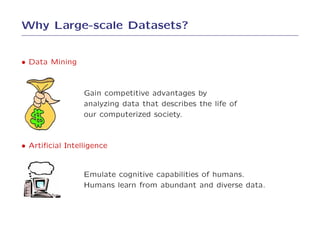
• Data Mining


                 Gain competitive advantages by
                 analyzing data that describes the life of
                 our computerized society.


• Artificial Intelligence


                 Emulate cognitive capabilities of humans.
                 Humans learn from abundant and diverse data.
The Computerized Society Metaphor


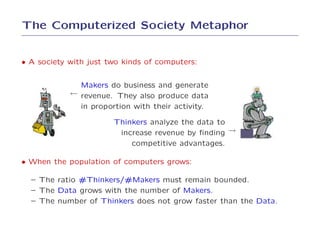
• A society with just two kinds of computers:

              Makers do business and generate
            ← revenue. They also produce data
              in proportion with their activity.

                       Thinkers analyze the data to
                        increase revenue by finding →
                           competitive advantages.

• When the population of computers grows:

  – The ratio #Thinkers/#Makers must remain bounded.
  – The Data grows with the number of Makers.
  – The number of Thinkers does not grow faster than the Data.
Limited Computing Resources


• The computing resources available for learning
  do not grow faster than the volume of data.
      – The cost of data mining cannot exceed the revenues.
      – Intelligent animals learn from streaming data.

• Most machine learning algorithms demand resources
  that grow faster than the volume of data.
      – Matrix operations (n3 time for n2 coefficients).
      – Sparse matrix operations are worse.
Roadmap


  I.   Statistical Eciency versus Computational Cost.

 II.   Stochastic Algorithms.

III.   Learning with a Single Pass over the Examples.
Part I


Statistical Eciency versus
Computational Costs.


This part is based on a joint work with Olivier Bousquet.
Simple Analysis

• Statistical Learning Literature:
“It is good to optimize an objective function than ensures a fast
estimation rate when the number of examples increases.”

• Optimization Literature:
“To efficiently solve large problems, it is preferable to choose
an optimization algorithm with strong asymptotic properties, e.g.
superlinear.”

• Therefore:
“To address large-scale learning problems, use a superlinear algorithm to
optimize an objective function with fast estimation rate.
Problem solved.”

          The purpose of this presentation is. . .
Too Simple an Analysis

• Statistical Learning Literature:
“It is good to optimize an objective function than ensures a fast
estimation rate when the number of examples increases.”

• Optimization Literature:
“To efficiently solve large problems, it is preferable to choose
an optimization algorithm with strong asymptotic properties, e.g.
superlinear.”

• Therefore:                                                       (error)
“To address large-scale learning problems, use a superlinear algorithm to
optimize an objective function with fast estimation rate.
Problem solved.”

        . . . to show that this is completely wrong !
Objectives and Essential Remarks


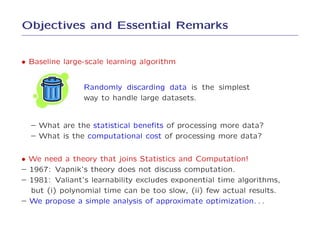
• Baseline large-scale learning algorithm


                Randomly discarding data is the simplest
                way to handle large datasets.


  – What are the statistical benefits of processing more data?
  – What is the computational cost of processing more data?


• We need a theory that joins Statistics and Computation!
– 1967: Vapnik’s theory does not discuss computation.
– 1981: Valiant’s learnability excludes exponential time algorithms,
  but (i) polynomial time can be too slow, (ii) few actual results.
– We propose a simple analysis of approximate optimization. . .
Learning Algorithms: Standard Framework


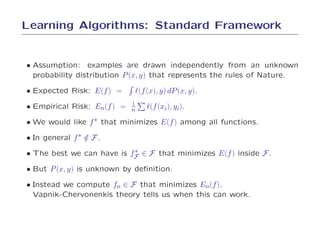
• Assumption: examples are drawn independently from an unknown
  probability distribution P (x, y) that represents the rules of Nature.

• Expected Risk: E(f ) =    ℓ(f (x), y) dP (x, y).
                           1
• Empirical Risk: En(f ) = n    ℓ(f (xi), yi).
• We would like f ∗ that minimizes E(f ) among all functions.
• In general f ∗ ∈ F .
                 /
                           ∗
• The best we can have is fF ∈ F that minimizes E(f ) inside F .
• But P (x, y) is unknown by definition.
• Instead we compute fn ∈ F that minimizes En(f ).
  Vapnik-Chervonenkis theory tells us when this can work.
Learning with Approximate Optimization


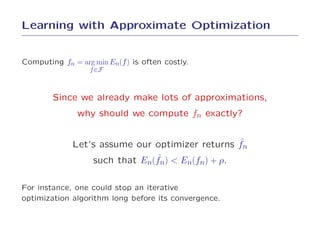
Computing fn = arg min En(f ) is often costly.
                  f ∈F


        Since we already make lots of approximations,
               why should we compute fn exactly?


                                                 ˜
              Let’s assume our optimizer returns fn
                               ˜
                  such that En(fn) < En(fn) + ρ.

For instance, one could stop an iterative
optimization algorithm long before its convergence.
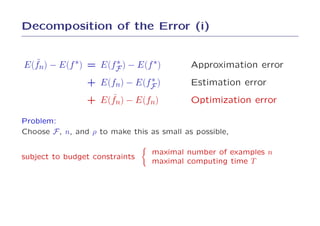
Decomposition of the Error (i)


  ˜
E(fn) − E(f ∗) = E(fF ) − E(f ∗)
                    ∗                       Approximation error
                              ∗
                 + E(fn) − E(fF )           Estimation error
                     ˜
                 + E(fn) − E(fn)            Optimization error

Problem:
Choose F , n, and ρ to make this as small as possible,

                                 maximal number of examples n
subject to budget constraints
                                 maximal computing time T
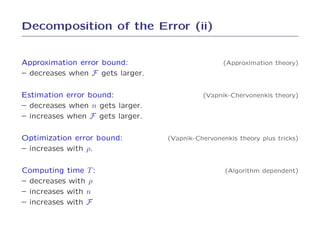
Decomposition of the Error (ii)


Approximation error bound:                        (Approximation theory)
– decreases when F gets larger.

Estimation error bound:                     (Vapnik-Chervonenkis theory)
– decreases when n gets larger.
– increases when F gets larger.

Optimization error bound:         (Vapnik-Chervonenkis theory plus tricks)
– increases with ρ.

Computing time T :                                 (Algorithm dependent)
– decreases with ρ
– increases with n
– increases with F
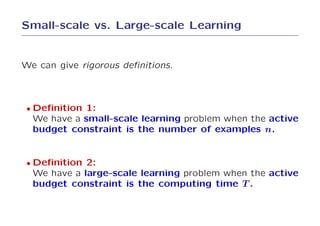
Small-scale vs. Large-scale Learning


We can give rigorous denitions.


 • Definition 1:
  We have a small-scale learning problem when the active
  budget constraint is the number of examples n.


 • Definition 2:
  We have a large-scale learning problem when the active
  budget constraint is the computing time T .
Small-scale Learning

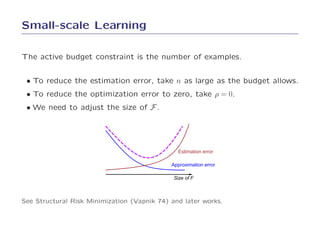
The active budget constraint is the number of examples.


 • To reduce the estimation error, take n as large as the budget allows.
 • To reduce the optimization error to zero, take ρ = 0.
 • We need to adjust the size of F .


                                                Estimation error

                                             Approximation error

                                              Size of F


See Structural Risk Minimization (Vapnik 74) and later works.
Large-scale Learning


The active budget constraint is the computing time.


 • More complicated tradeoffs.
   The computing time depends on the three variables: F , n, and ρ.

 • Example.
   If we choose ρ small, we decrease the optimization error. But we
   must also decrease F and/or n with adverse effects on the estimation
   and approximation errors.

 • The exact tradeoff depends on the optimization algorithm.

 • We can compare optimization algorithms rigorously.
Executive Summary


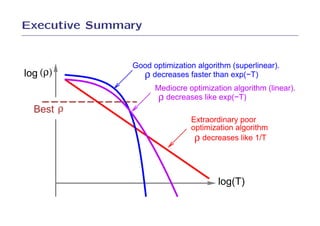
               Good optimization algorithm (superlinear).
log (ρ)          ρ decreases faster than exp(−T)
                     Mediocre optimization algorithm (linear).
                      ρ decreases like exp(−T)
  Best ρ
                               Extraordinary poor
                               optimization algorithm
                                ρ decreases like 1/T


                                       log(T)
Asymptotics: Estimation


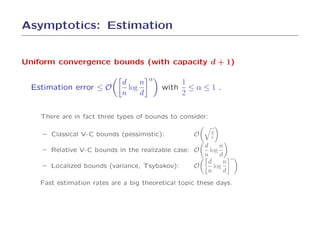
Uniform convergence bounds (with capacity d + 1)

                             d     n Îą        1
  Estimation error ≤ O         log        with ≤ α ≤ 1 .
                             n     d          2

    There are in fact three types of bounds to consider:

                                                           d
    – Classical V-C bounds (pessimistic):           O      n
                                                      d      n
    – Relative V-C bounds in the realizable case: O      log
                                                      n      d
                                                                   Îą
                                                        d      n
    – Localized bounds (variance, Tsybakov):        O      log
                                                       n       d
    Fast estimation rates are a big theoretical topic these days.
Asymptotics: Estimation+Optimization


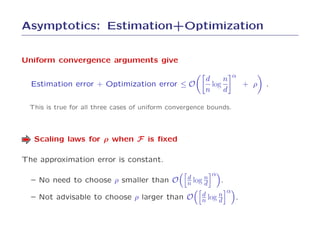
Uniform convergence arguments give

                                                        d     n Îą
  Estimation error + Optimization error ≤ O               log     + ρ       .
                                                        n     d

 This is true for all three cases of uniform convergence bounds.


   Scaling laws for ρ when F is xed

The approximation error is constant.
                                                            Îą
  – No need to choose ρ smaller than O            d     n
                                                  n log d       .
                                                                    Îą
  – Not advisable to choose ρ larger than O            d     n
                                                       n log d          .
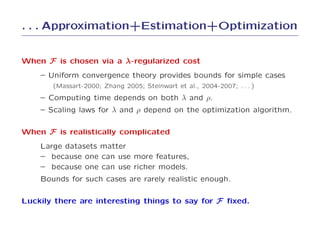
. . . Approximation+Estimation+Optimization


When F is chosen via a Îť-regularized cost
    – Uniform convergence theory provides bounds for simple cases
       (Massart-2000; Zhang 2005; Steinwart et al., 2004-2007; . . . )
    – Computing time depends on both λ and ρ.
    – Scaling laws for λ and ρ depend on the optimization algorithm.

When F is realistically complicated
    Large datasets matter
    – because one can use more features,
    – because one can use richer models.
    Bounds for such cases are rarely realistic enough.

Luckily there are interesting things to say for F xed.
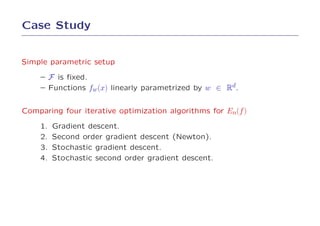
Case Study


Simple parametric setup

    – F is fixed.
    – Functions fw (x) linearly parametrized by w ∈ Rd.


Comparing four iterative optimization algorithms for En(f )

    1.   Gradient descent.
    2.   Second order gradient descent (Newton).
    3.   Stochastic gradient descent.
    4.   Stochastic second order gradient descent.
Quantities of Interest

• Empirical Hessian at the empirical optimum wn.
                            n
        ∂ 2En          1         ∂ 2ℓ(fn(xi), yi)
    H =       (fwn ) =
        ∂w2            n               ∂w2
                           i=1

• Empirical Fisher Information matrix at the empirical optimum wn.
            n
        1         ∂ℓ(fn(xi), yi)      ∂ℓ(fn(xi), yi) ′
    G =
        n              ∂w                  ∂w
            i=1

• Condition number
    We assume that there are Νmin, Νmax and ν such that
     – trace GH −1 ≈ ν .
     – spectrum H ⊂ [λmin, λmax].
    and we dene the condition number κ = Νmax/Νmin.
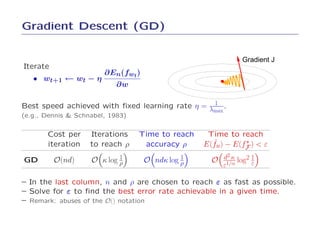
Gradient Descent (GD)

                                                             Gradient J
Iterate
                        ∂En(fwt )
   • wt+1 ← wt − η
                            ∂w

Best speed achieved with xed learning rate Ρ = Ν 1 .
                                                 max
(e.g., Dennis & Schnabel, 1983)


       Cost per     Iterations    Time to reach    Time to reach
       iteration    to reach ρ     accuracy ρ       ˜        ∗
                                                  E(fn) − E(fF ) < ε
                                                       2Îş
GD        O(nd)             1
                    O κ log ρ                 1
                                    O ndκ log ρ     O d1/ι log2 ξ
                                                                1
                                                       Îľ

– In the last column, n and ρ are chosen to reach ε as fast as possible.
– Solve for ε to find the best error rate achievable in a given time.
– Remark: abuses of the O() notation
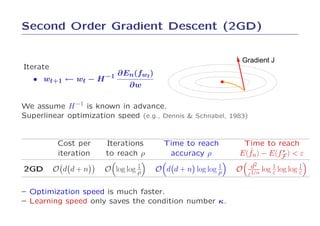
Second Order Gradient Descent (2GD)


                                                               Gradient J
Iterate
                             ∂En(fwt )
   • wt+1 ← wt −      H −1
                               ∂w

We assume H −1 is known in advance.
Superlinear optimization speed (e.g., Dennis & Schnabel, 1983)


          Cost per      Iterations         Time to reach        Time to reach
          iteration     to reach ρ          accuracy ρ           ˜        ∗
                                                               E(fn) − E(fF ) < ε

2GD       O d d+n                1
                       O log log ρ                         1
                                         O d d + n log log ρ   O    d2    log 1 log log ξ
                                                                                        1
                                                                   Îľ1/Îą       Îľ


– Optimization speed is much faster.
– Learning speed only saves the condition number κ.
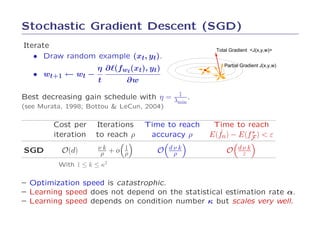
Stochastic Gradient Descent (SGD)
Iterate
                                                    Total Gradient <J(x,y,w)>
   • Draw random example (xt, yt).
                                                       Partial Gradient J(x,y,w)
                 η ∂ℓ(fwt (xt), yt)
   • wt+1 ← wt −
                 t      ∂w

Best decreasing gain schedule with Ρ = Ν 1 .
                                        min
(see Murata, 1998; Bottou & LeCun, 2004)

        Cost per     Iterations    Time to reach    Time to reach
        iteration    to reach ρ     accuracy ρ       ˜        ∗
                                                   E(fn) − E(fF ) < ε

SGD        O(d)       νk       1
                            +o ρ      O dν k            O dν k
                       ρ                 ρ                 ξ
          With 1 ≤ k ≤ κ2

– Optimization speed is catastrophic.
– Learning speed does not depend on the statistical estimation rate α.
– Learning speed depends on condition number κ but scales very well.
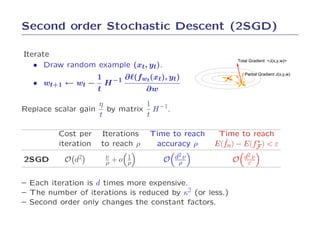
Second order Stochastic Descent (2SGD)

Iterate
                                                         Total Gradient <J(x,y,w)>
   • Draw random example (xt, yt).
                                                             Partial Gradient J(x,y,w)
                1 −1 ∂ℓ(fwt (xt), yt)
   • wt+1 ← wt − H
                 t          ∂w
                   η         1 −1
Replace scalar gain by matrix H .
                   t         t

         Cost per    Iterations    Time to reach    Time to reach
         iteration   to reach ρ     accuracy ρ       ˜        ∗
                                                   E(fn) − E(fF ) < ε

2SGD       O   d2     ν   +o   1      O   d2 ν           O   d2 ν
                      ρ        ρ           ρ                  ξ


– Each iteration is d times more expensive.
– The number of iterations is reduced by κ2 (or less.)
– Second order only changes the constant factors.
Part II


Learning with Stochastic
Gradient Descent.
Benchmarking SGD in Simple Problems

• The theory suggests that SGD is very competitive.
    – Many people associate SGD with trouble.

• SGD historically associated with back-propagation.
    – Multilayer networks are very hard problems (nonlinear, nonconvex)
    – What is difficult, SGD or MLP?


                  • Try PLAIN SGD on simple learning problems.
                     – Support Vector Machines
                     – Conditional Random Fields

Download from http://leon.bottou.org/projects/sgd.
These simple programs are very short.

See also (Shalev-Schwartz et al., 2007; Vishwanathan et al., 2006)
Text Categorization with SVMs

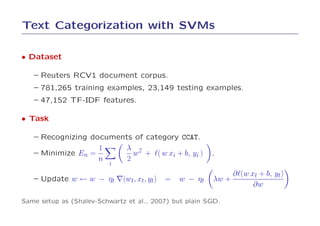
• Dataset

   – Reuters RCV1 document corpus.
   – 781,265 training examples, 23,149 testing examples.
   – 47,152 TF-IDF features.

• Task

   – Recognizing documents of category CCAT.
                   1    Îť 2
   – Minimize En =         w + ℓ( w xi + b, yi )        .
                   n     2
                          i
                                                             ∂ℓ(w xt + b, yt)
   – Update w ← w − ηt ∇(wt, xt, yt)      =   w − ηt    λw +
                                                                   ∂w

Same setup as (Shalev-Schwartz et al., 2007) but plain SGD.
Text Categorization with SVMs

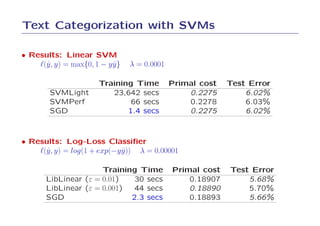
• Results: Linear SVM
    ℓ(ˆ, y) = max{0, 1 − y y }
      y                    ˆ     λ = 0.0001

                       Training Time          Primal cost   Test Error
        SVMLight          23,642 secs             0.2275        6.02%
        SVMPerf                66 secs            0.2278        6.03%
        SGD                   1.4 secs            0.2275        6.02%


• Results: Log-Loss Classifier
    ℓ(ˆ, y) = log(1 + exp(−y y )) λ = 0.00001
      y                      ˆ

                      Training Time           Primal cost   Test Error
       LibLinear (Îľ = 0.01)   30 secs             0.18907       5.68%
       LibLinear (Îľ = 0.001)  44 secs             0.18890       5.70%
       SGD                   2.3 secs             0.18893       5.66%
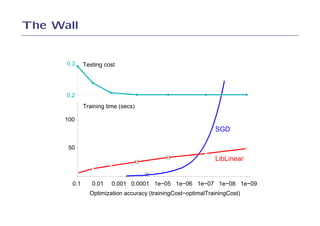
The Wall


      0.3     Testing cost


      0.2
              Training time (secs)

      100
                                                              SGD

       50
                                                              LibLinear


        0.1      0.01    0.001 0.0001 1e−05 1e−06 1e−07 1e−08 1e−09
                Optimization accuracy (trainingCost−optimalTrainingCost)
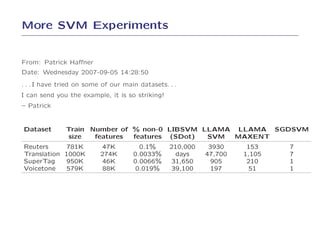
More SVM Experiments


From: Patrick Haffner
Date: Wednesday 2007-09-05 14:28:50
. . . I have tried on some of our main datasets. . .
I can send you the example, it is so striking!
– Patrick


Dataset       Train Number of % non-0 LIBSVM LLAMA LLAMA SGDSVM
               size  features features (SDot) SVM  MAXENT
Reuters      781K          47K         0.1%      210,000    3930     153    7
Translation 1000K         274K       0.0033%       days    47,700   1,105   7
SuperTag     950K          46K       0.0066%     31,650     905      210    1
Voicetone    579K          88K        0.019%      39,100     197      51    1
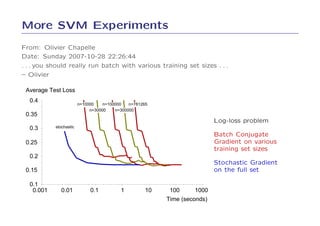
More SVM Experiments
From: Olivier Chapelle
Date: Sunday 2007-10-28 22:26:44
. . . you should really run batch with various training set sizes . . .
– Olivier

 Average Test Loss
  0.4
                        n=10000    n=100000   n=781265
                             n=30000    n=300000
 0.35
                                                                           Log-loss problem
  0.3      stochastic
                                                                           Batch Conjugate
 0.25                                                                      Gradient on various
                                                                           training set sizes
  0.2
                                                                           Stochastic Gradient
 0.15                                                                      on the full set

  0.1
   0.001      0.01           0.1          1          10    100     1000
                                                          Time (seconds)
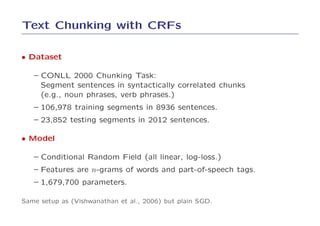
Text Chunking with CRFs

• Dataset

   – CONLL 2000 Chunking Task:
     Segment sentences in syntactically correlated chunks
     (e.g., noun phrases, verb phrases.)
   – 106,978 training segments in 8936 sentences.
   – 23,852 testing segments in 2012 sentences.

• Model

   – Conditional Random Field (all linear, log-loss.)
   – Features are n-grams of words and part-of-speech tags.
   – 1,679,700 parameters.

Same setup as (Vishwanathan et al., 2006) but plain SGD.
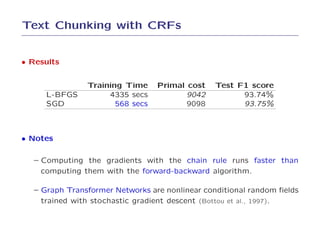
Text Chunking with CRFs


• Results

               Training Time     Primal cost   Test F1 score
     L-BFGS         4335 secs           9042         93.74%
     SGD              568 secs          9098         93.75%


• Notes

  – Computing the gradients with the chain rule runs faster than
    computing them with the forward-backward algorithm.

  – Graph Transformer Networks are nonlinear conditional random fields
    trained with stochastic gradient descent (Bottou et al., 1997).
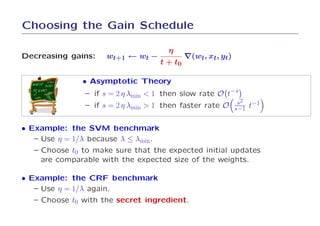
Choosing the Gain Schedule

                                      Ρ
Decreasing gains:    wt+1 ← wt −             ∇(wt, xt, yt)
                                    t + t0

               • Asymptotic Theory
                – if s = 2 η λmin < 1 then slow rate O t−s
                                                          s2
                – if s = 2 η λmin > 1 then faster rate O s−1 t−1


• Example: the SVM benchmark
   – Use η = 1/λ because λ ≤ λmin.
   – Choose t0 to make sure that the expected initial updates
     are comparable with the expected size of the weights.

• Example: the CRF benchmark
   – Use η = 1/λ again.
   – Choose t0 with the secret ingredient.
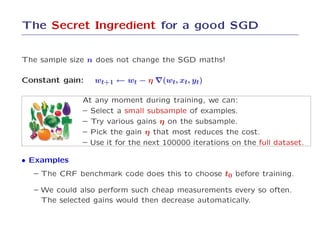
The Secret Ingredient for a good SGD


The sample size n does not change the SGD maths!

Constant gain:   wt+1 ← wt − η ∇(wt, xt, yt)

              At any moment during training, we can:
              – Select a small subsample of examples.
              – Try various gains η on the subsample.
              – Pick the gain η that most reduces the cost.
              – Use it for the next 100000 iterations on the full dataset.

• Examples
  – The CRF benchmark code does this to choose t0 before training.

  – We could also perform such cheap measurements every so often.
    The selected gains would then decrease automatically.
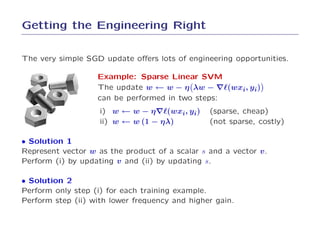
Getting the Engineering Right

The very simple SGD update offers lots of engineering opportunities.

                   Example: Sparse Linear SVM
                   The update w ← w − η λw − ∇ℓ(wxi, yi)
                   can be performed in two steps:
                    i) w ← w − η∇ℓ(wxi, yi)     (sparse, cheap)
                    ii) w ← w (1 − ηλ)          (not sparse, costly)

• Solution 1
Represent vector w as the product of a scalar s and a vector v .
Perform (i) by updating v and (ii) by updating s.

• Solution 2
Perform only step (i) for each training example.
Perform step (ii) with lower frequency and higher gain.
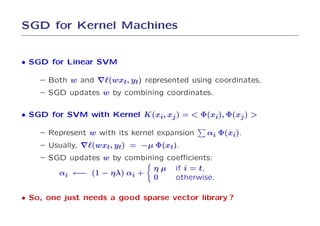
SGD for Kernel Machines


• SGD for Linear SVM

    – Both w and ∇ℓ(wxt, yt) represented using coordinates.
    – SGD updates w by combining coordinates.

• SGD for SVM with Kernel K(xi, xj ) = < Φ(xi), Φ(xj ) >

    – Represent w with its kernel expansion   αi Φ(xi).
    – Usually, ∇ℓ(wxt, yt) = −µ Φ(xt).
    – SGD updates w by combining coefficients:
                               Ρ ¾ if i = t,
        αi ←− (1 − ηλ) αi +
                               0     otherwise.

• So, one just needs a good sparse vector library ?
SGD for Kernel Machines

• Sparsity Problems.
                                   Ρ ¾ if i = t,
          αi ←− (1 − ηλ) αi +
                                   0    otherwise.
     – Each iteration potentially makes one α coefficient non zero.
     – Not all of them should be support vectors.
     – Their α coefficients take a long time to reach zero (Collobert, 2004).

• Dual algorihms related to primal SGD avoid this issue.
    – Greedy algorithms (Vincent et al., 2000; Keerthi et al., 2007)
    – LaSVM and related algorithms (Bordes et al., 2005)
      More on them later. . .

• But they still need to compute the kernel values!
    – Computing kernel values can be slow.
    – Caching kernel values can require lots of memory.
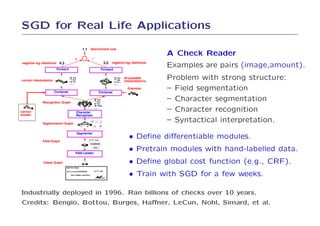
SGD for Real Life Applications

                                          A Check Reader
                                          Examples are pairs (image,amount).
                                          Problem with strong structure:
                                          – Field segmentation
                                          – Character segmentation
                                          – Character recognition
                                          – Syntactical interpretation.

                               • Define differentiable modules.
                               • Pretrain modules with hand-labelled data.
                               • Define global cost function (e.g., CRF).
                               • Train with SGD for a few weeks.

Industrially deployed in 1996. Ran billions of checks over 10 years.
Credits: Bengio, Bottou, Burges, Haffner, LeCun, Nohl, Simard, et al.
Part III


Learning with a Single Pass
over the Examples


This part is based on joint works with
Antoine Bordes, Seyda Ertekin, Yann LeCun, and Jason Weston.
Why learning with a Single Pass?


• Motivation
  – Sometimes there is too much data to store.
  – Sometimes retrieving archived data is too expensive.

• Related Topics
  – Streaming data.
  – Tracking nonstationarities.
  – Novelty detection.

• Outline
  – One-pass learning with second order SGD.
  – One-pass learning with kernel machines.
  – Comparisons
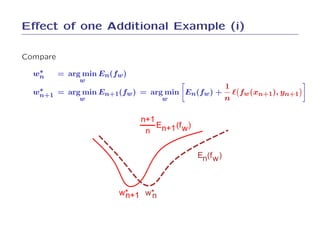
Effect of one Additional Example (i)

Compare
   ∗
  wn      = arg min En(fw )
               w
   ∗                                                  1
  wn+1    = arg min En+1(fw ) = arg min En(fw ) +         ℓ fw (xn+1), yn+1
               w                   w                  n

                              n+1
                                  E (f )
                               n n+1 w

                                           En(f w )


                         w*
                          n+1 w*
                               n
Effect of one Additional Example (ii)


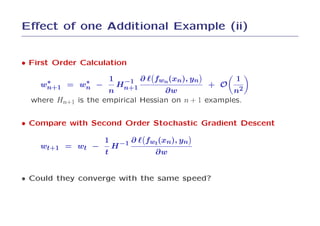
• First Order Calculation

     ∗          ∗           1  −1    ∂ ℓ fwn (xn), yn         1
    wn+1   =   wn   −         Hn+1                      + O
                            n       ∂w                n2
  where Hn+1 is the empirical Hessian on n + 1 examples.


• Compare with Second Order Stochastic Gradient Descent

                        1          ∂ ℓ fwt (xn), yn
    wt+1 = wt −             H −1
                        t                ∂w


• Could they converge with the same speed?
Yes they do!           But what does it mean?

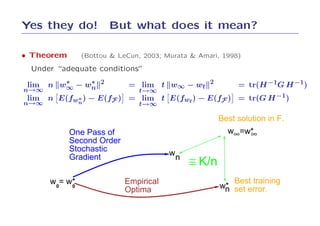
• Theorem       (Bottou & LeCun, 2003; Murata & Amari, 1998)

 Under “adequate conditions”

 lim    ∗      ∗
     n w∞ − wn 2        = lim t w∞ − wt 2        = tr(H −1G H −1)
n→∞                       t→∞
 lim n E(fwn ) − E(fF ) = lim t E(fwt ) − E(fF ) = tr(G H −1)
           ∗
n→∞                            t→∞

                                                        Best solution in F.
            One Pass of                                   w∞=w*
                                                              ∞
            Second Order
            Stochastic
                                        w
            Gradient                        n
                                                ≅ K/n
       w0= w*               Empirical                      Best training
            0
                            Optima                      w* set error.
                                                         n
Optimal Learning in One Pass

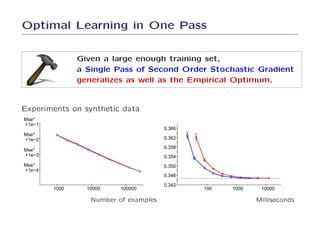
               Given a large enough training set,
               a Single Pass of Second Order Stochastic Gradient
               generalizes as well as the Empirical Optimum.


Experiments on synthetic data
Mse*
+1e−1
                                       0.366
Mse*
+1e−2                                  0.362
                                       0.358
Mse*
+1e−3                                  0.354
Mse*                                   0.350
+1e−4
                                       0.346
                                       0.342
        1000     10000    100000               100   1000    10000

                  Number of examples                        Milliseconds
Unfortunate Practical Issues

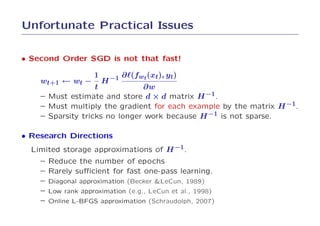
• Second Order SGD is not that fast!

                     1          ∂ℓ(fwt (xt), yt)
    wt+1 ← wt −          H −1
                   t           ∂w
    – Must estimate and store d × d matrix H −1.
    – Must multiply the gradient for each example by the matrix H −1.
    – Sparsity tricks no longer work because H −1 is not sparse.

• Research Directions
  Limited storage approximations of H −1.
    –   Reduce the number of epochs
    –   Rarely sufficient for fast one-pass learning.
    –   Diagonal approximation (Becker &LeCun, 1989)
    –   Low rank approximation (e.g., LeCun et al., 1998)
    –   Online L-BFGS approximation (Schraudolph, 2007)
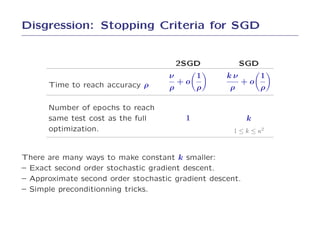
Disgression: Stopping Criteria for SGD


                                         2SGD           SGD
                                    ν         1    kν         1
      Time to reach accuracy ρ           +o             +o
                                     ρ        ρ     ρ         ρ

      Number of epochs to reach
      same test cost as the full          1               k
      optimization.                                  1 ≤ k ≤ κ2


There are many ways to make constant k smaller:
– Exact second order stochastic gradient descent.
– Approximate second order stochastic gradient descent.
– Simple preconditionning tricks.
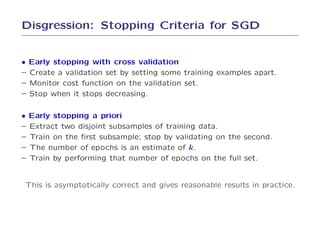
Disgression: Stopping Criteria for SGD


• Early stopping with cross validation
– Create a validation set by setting some training examples apart.
– Monitor cost function on the validation set.
– Stop when it stops decreasing.

• Early stopping a priori
– Extract two disjoint subsamples of training data.
– Train on the first subsample; stop by validating on the second.
– The number of epochs is an estimate of k.
– Train by performing that number of epochs on the full set.


This is asymptotically correct and gives reasonable results in practice.
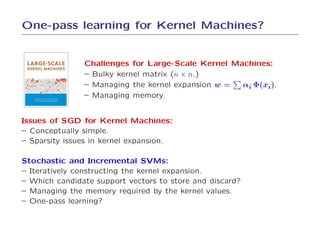
One-pass learning for Kernel Machines?


               Challenges for Large-Scale Kernel Machines:
               – Bulky kernel matrix (n × n.)
               – Managing the kernel expansion w = αi Φ(xi).
               – Managing memory.


Issues of SGD for Kernel Machines:
– Conceptually simple.
– Sparsity issues in kernel expansion.

Stochastic and Incremental SVMs:
– Iteratively constructing the kernel expansion.
– Which candidate support vectors to store and discard?
– Managing the memory required by the kernel values.
– One-pass learning?
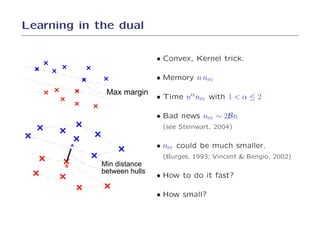
Learning in the dual

                               • Convex, Kernel trick.

                               • Memory n nsv
                Max margin
                               • Time nαnsv with 1 < α ≤ 2

                               • Bad news nsv ∼ 2Bn
                                (see Steinwart, 2004)

           A                   • nsv could be much smaller.
                                (Burges, 1993; Vincent & Bengio, 2002)
       B       Min distance
               between hulls
                               • How to do it fast?

                               • How small?
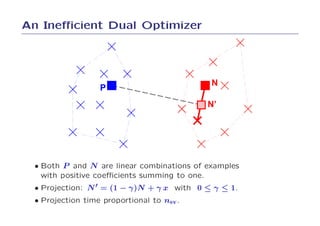
An Inecient Dual Optimizer


                                            N
                  P
                                           N’


 • Both P and N are linear combinations of examples
   with positive coecients summing to one.
 • Projection: N ′ = (1 − γ)N + γ x with 0 ≤ γ ≤ 1.
 • Projection time proportional to nsv .
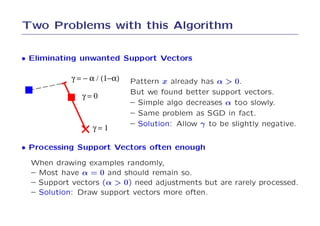
Two Problems with this Algorithm

• Eliminating unwanted Support Vectors

            γ = − α / (1−α)   Pattern x already has α > 0.
                              But we found better support vectors.
               Îł=0
                              – Simple algo decreases α too slowly.
                              – Same problem as SGD in fact.
                              – Solution: Allow γ to be slightly negative.
                  Îł=1

• Processing Support Vectors often enough
  When drawing examples randomly,
  – Most have α = 0 and should remain so.
  – Support vectors (α > 0) need adjustments but are rarely processed.
  – Solution: Draw support vectors more often.
The Huller and its Derivatives


• The Huller

      Repeat
        PROCESS:       Pick a random fresh example and project.
        REPROCESS:     Pick a random support vector and project.

     – Compare with incremental learning and retraining.
     – PROCESS potentially adds support vectors.
     – REPROCESS potentially discard support vectors.

• Derivatives of the Huller
     – LASVM handles soft-margins and is connected to SMO.
     – LARANK handles multiclass problems and structured outputs.

(Bordes et al., 2005, 2006, 2007)
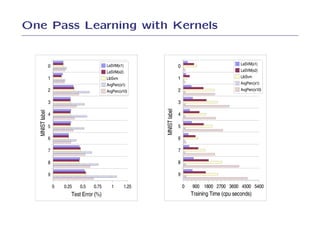
One Pass Learning with Kernels
SGD
                                                                                                                                                                                                                                                                                                               ndk
                                                                                                                                                                                                                                                                                                                d


                                              0
                                      )
                                      (
                                              '
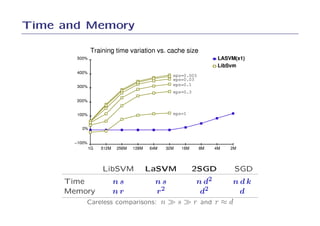
                                                                                                                                                                                                                                                                               comparisons: n ≫ s ≫ r and r ≈ d


                                                                                                                                                                                                                                                              S
                                                  5
                                      &
                                                                                                                                                                                                                                                              F
                                                  4
                                      %
                                                                                                                                                                                      a                                                                   c
                                                      $
                                          $
                                                      3
                                                  2
                                      #
                                      "
                                                  "
                                                                                                                                                                                                                                                              S
                                                                                                                                                                                                                                                                      2SGD


                                                                                                                                                                                                                                                              6
                                      !                   1
                                                                                                                                                                                                                                                                                                     n d2
                                                                                                                                                                                                                                                                                                      d2
                                                                                                                                                                                                                                                              S
                                                                                                                                                                                                                                                                  U
                      ¨
                                                                                  C
                                                                                  A
                                                                                                  C
                  
                  ÂŁ
                                                                                                                  E
                                                                                  A               A
                                                                                                                                              C
                                                                                  B               B                   B                       B
                      
                                                                                                                                                                                                                                                              S
                                                                                                                                                                              E
                                                                                  A               A                   A                       A
                                                                                                                                                                                                                                                                  T
                                                                                                                                                                                                                                                              G
                      ¨
                                                                          @   @           @   @           @   @                       @   @                       @   @
                                                                                  9               9                   9                       9                                   9
                  
                                                                                                                                                                                                                                                                      LaSVM
                                                                                      8               8                       8                   8                                       8
                      
                                                                                                                                                                                                                  `
                                                                                  7               7                   7                       7                                   7
                      ¢
                                                                                                                                                                                                                                                              S
                                                                                                                                                                                                                                                              F


                                                                                                                                                                                                                                                                                          ns
                                                                                                                                                                                                                                                                  D


                                                                                                                                                                                                                                                                                           r2
                  
                                                                              X
                      
                  Š
                                                                                                                                                                                                                                                              S
                                                                                                                                                                                                                                                              6
                  ¤
                                                                                                                                                                                                                                                                  T
                      
                  ÂŁ
                      ÂŚ
                      ¢
                  ÂŁ
                                                                                                                                                                                                                                                              S
                  ÂĄ
                                                                                                                                                                                                                                                                  U
                                                                                                                                                                                                                                                              F
Time and Memory


                      ¢


                                                                                                                                                                                                                                                                      LibSVM
                                                                                                                                                                                                                                                              G
                  Š
                      ¨


                                                                                                                                                                                                                                                                                 ns
                                                                                                                                                                                                                                                                                 nr
                                                                                                                                                                                                                                                              S
                                                                                                                                                                                                                                                                  T
                  §
                                                                                                                                                                                                                                                                  
                  ÂŁ
                                                                                                                                                                                                                                                              F
                      ÂŚ


                                                                                                                                                                                                                                                                                                          Careless
                          ÂĽ
                                                                                                                                                                                                                                                              S
                                                                                                                                                                                                                                  Y
                  ¤
                  ÂŁ
                                                                                                                                                                                                                                                              F
                                                                                                                                                                                                                      P
                                                                                                                                                                                                                                                              G
                  ¤
                                                                                                                                                                                                                                                                  
                  ÂŁ
                      ¢


                                                                                                                                                                                                                                                                                 Memory
                  ÂĄ
                   
                                                                                                                                                                                                                                                                  R
                                                                                                                                                                                                              I
                                                                              W                                                                                                                       V                       H
                                                                                                                                                                                                                                      b
                                                                                                                                                                                                                                                              G


                                                                                                                                                                                                                                                                                 Time


                                                                                                                                                                                              G
                                                                                                                                                                                                                                                  G
                                                                 6                                                               D                       F
                                                                                                                                                                                                                                              Q
Are we there yet?


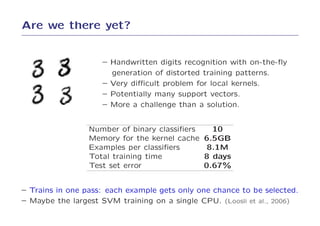
                    – Handwritten digits recognition with on-the-fly
                      generation of distorted training patterns.
                    – Very difficult problem for local kernels.
                    – Potentially many support vectors.
                    – More a challenge than a solution.


                 Number of binary classiers     10
                 Memory for the kernel cache   6.5GB
                 Examples per classiers        8.1M
                 Total training time           8 days
                 Test set error                0.67%


– Trains in one pass: each example gets only one chance to be selected.
– Maybe the largest SVM training on a single CPU. (Loosli et al., 2006)
Are we there yet?


                                                  er


                                                                           er
                                               ay


                                                                        ay
                                               ll


                                                                        ll
                                             na


                                                                      na
                                          io


                                                                   io


                                                                                                n


                                                                                                                n
                                        ut


                                                                 ut


                                                                                              io


                                                                                                               io
                                        ol


                                                                 ol


                                                                                            ct


                                                                                                             ct
                                    nv


                                                             nv


                                                                                           ne


                                                                                                           ne
                                   co


                                                            co


                                                                                       on


                                                                                                        on
                               5


                                                         5


                                                                                      lc


                                                                                                      lc
                              5x


                                                       5x


                                                                                       l


                                                                                                       l
                                                                                    fu


                                                                                                    fu
                                                                                                    10 output units
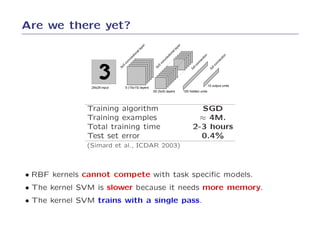
                29x29 input        5 (15x15) layers
                                                       50 (5x5) layers          100 hidden units


               Training algorithm                                                       SGD
               Training examples                                                        ≈ 4M.
               Total training time                                                    2-3 hours
               Test set error                                                           0.4%
               (Simard et al., ICDAR 2003)


• RBF kernels cannot compete with task specific models.
• The kernel SVM is slower because it needs more memory.
• The kernel SVM trains with a single pass.
Conclusion

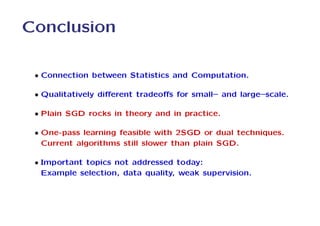
 • Connection between Statistics and Computation.

 • Qualitatively different tradeoffs for small– and large–scale.

 • Plain SGD rocks in theory and in practice.

 • One-pass learning feasible with 2SGD or dual techniques.
   Current algorithms still slower than plain SGD.

 • Important topics not addressed today:
   Example selection, data quality, weak supervision.

NIPS2007: learning using many examples

  • 1.
    Learning with LargeDatasets L´on Bottou e NEC Laboratories America
  • 2.
    Why Large-scale Datasets? •Data Mining Gain competitive advantages by analyzing data that describes the life of our computerized society. • Artificial Intelligence Emulate cognitive capabilities of humans. Humans learn from abundant and diverse data.
  • 3.
    The Computerized SocietyMetaphor • A society with just two kinds of computers: Makers do business and generate ← revenue. They also produce data in proportion with their activity. Thinkers analyze the data to increase revenue by finding → competitive advantages. • When the population of computers grows: – The ratio #Thinkers/#Makers must remain bounded. – The Data grows with the number of Makers. – The number of Thinkers does not grow faster than the Data.
  • 4.
    Limited Computing Resources •The computing resources available for learning do not grow faster than the volume of data. – The cost of data mining cannot exceed the revenues. – Intelligent animals learn from streaming data. • Most machine learning algorithms demand resources that grow faster than the volume of data. – Matrix operations (n3 time for n2 coefficients). – Sparse matrix operations are worse.
  • 5.
    Roadmap I. Statistical Eciency versus Computational Cost. II. Stochastic Algorithms. III. Learning with a Single Pass over the Examples.
  • 6.
    Part I Statistical Eciencyversus Computational Costs. This part is based on a joint work with Olivier Bousquet.
  • 7.
    Simple Analysis • StatisticalLearning Literature: “It is good to optimize an objective function than ensures a fast estimation rate when the number of examples increases.” • Optimization Literature: “To efficiently solve large problems, it is preferable to choose an optimization algorithm with strong asymptotic properties, e.g. superlinear.” • Therefore: “To address large-scale learning problems, use a superlinear algorithm to optimize an objective function with fast estimation rate. Problem solved.” The purpose of this presentation is. . .
  • 8.
    Too Simple anAnalysis • Statistical Learning Literature: “It is good to optimize an objective function than ensures a fast estimation rate when the number of examples increases.” • Optimization Literature: “To efficiently solve large problems, it is preferable to choose an optimization algorithm with strong asymptotic properties, e.g. superlinear.” • Therefore: (error) “To address large-scale learning problems, use a superlinear algorithm to optimize an objective function with fast estimation rate. Problem solved.” . . . to show that this is completely wrong !
  • 9.
    Objectives and EssentialRemarks • Baseline large-scale learning algorithm Randomly discarding data is the simplest way to handle large datasets. – What are the statistical benefits of processing more data? – What is the computational cost of processing more data? • We need a theory that joins Statistics and Computation! – 1967: Vapnik’s theory does not discuss computation. – 1981: Valiant’s learnability excludes exponential time algorithms, but (i) polynomial time can be too slow, (ii) few actual results. – We propose a simple analysis of approximate optimization. . .
  • 10.
    Learning Algorithms: StandardFramework • Assumption: examples are drawn independently from an unknown probability distribution P (x, y) that represents the rules of Nature. • Expected Risk: E(f ) = ℓ(f (x), y) dP (x, y). 1 • Empirical Risk: En(f ) = n ℓ(f (xi), yi). • We would like f ∗ that minimizes E(f ) among all functions. • In general f ∗ ∈ F . / ∗ • The best we can have is fF ∈ F that minimizes E(f ) inside F . • But P (x, y) is unknown by definition. • Instead we compute fn ∈ F that minimizes En(f ). Vapnik-Chervonenkis theory tells us when this can work.
  • 11.
    Learning with ApproximateOptimization Computing fn = arg min En(f ) is often costly. f ∈F Since we already make lots of approximations, why should we compute fn exactly? ˜ Let’s assume our optimizer returns fn ˜ such that En(fn) < En(fn) + ρ. For instance, one could stop an iterative optimization algorithm long before its convergence.
  • 12.
    Decomposition of theError (i) ˜ E(fn) − E(f ∗) = E(fF ) − E(f ∗) ∗ Approximation error ∗ + E(fn) − E(fF ) Estimation error ˜ + E(fn) − E(fn) Optimization error Problem: Choose F , n, and ρ to make this as small as possible, maximal number of examples n subject to budget constraints maximal computing time T
  • 13.
    Decomposition of theError (ii) Approximation error bound: (Approximation theory) – decreases when F gets larger. Estimation error bound: (Vapnik-Chervonenkis theory) – decreases when n gets larger. – increases when F gets larger. Optimization error bound: (Vapnik-Chervonenkis theory plus tricks) – increases with ρ. Computing time T : (Algorithm dependent) – decreases with ρ – increases with n – increases with F
  • 14.
    Small-scale vs. Large-scaleLearning We can give rigorous definitions. • Definition 1: We have a small-scale learning problem when the active budget constraint is the number of examples n. • Definition 2: We have a large-scale learning problem when the active budget constraint is the computing time T .
  • 15.
    Small-scale Learning The activebudget constraint is the number of examples. • To reduce the estimation error, take n as large as the budget allows. • To reduce the optimization error to zero, take ρ = 0. • We need to adjust the size of F . Estimation error Approximation error Size of F See Structural Risk Minimization (Vapnik 74) and later works.
  • 16.
    Large-scale Learning The activebudget constraint is the computing time. • More complicated tradeoffs. The computing time depends on the three variables: F , n, and ρ. • Example. If we choose ρ small, we decrease the optimization error. But we must also decrease F and/or n with adverse effects on the estimation and approximation errors. • The exact tradeoff depends on the optimization algorithm. • We can compare optimization algorithms rigorously.
  • 17.
    Executive Summary Good optimization algorithm (superlinear). log (ρ) ρ decreases faster than exp(−T) Mediocre optimization algorithm (linear). ρ decreases like exp(−T) Best ρ Extraordinary poor optimization algorithm ρ decreases like 1/T log(T)
  • 18.
    Asymptotics: Estimation Uniform convergencebounds (with capacity d + 1) d n α 1 Estimation error ≤ O log with ≤ α ≤ 1 . n d 2 There are in fact three types of bounds to consider: d – Classical V-C bounds (pessimistic): O n d n – Relative V-C bounds in the realizable case: O log n d α d n – Localized bounds (variance, Tsybakov): O log n d Fast estimation rates are a big theoretical topic these days.
  • 19.
    Asymptotics: Estimation+Optimization Uniform convergencearguments give d n α Estimation error + Optimization error ≤ O log + ρ . n d This is true for all three cases of uniform convergence bounds. Scaling laws for ρ when F is fixed The approximation error is constant. α – No need to choose ρ smaller than O d n n log d . α – Not advisable to choose ρ larger than O d n n log d .
  • 20.
    . . .Approximation+Estimation+Optimization When F is chosen via a λ-regularized cost – Uniform convergence theory provides bounds for simple cases (Massart-2000; Zhang 2005; Steinwart et al., 2004-2007; . . . ) – Computing time depends on both λ and ρ. – Scaling laws for λ and ρ depend on the optimization algorithm. When F is realistically complicated Large datasets matter – because one can use more features, – because one can use richer models. Bounds for such cases are rarely realistic enough. Luckily there are interesting things to say for F fixed.
  • 21.
    Case Study Simple parametricsetup – F is fixed. – Functions fw (x) linearly parametrized by w ∈ Rd. Comparing four iterative optimization algorithms for En(f ) 1. Gradient descent. 2. Second order gradient descent (Newton). 3. Stochastic gradient descent. 4. Stochastic second order gradient descent.
  • 22.
    Quantities of Interest •Empirical Hessian at the empirical optimum wn. n ∂ 2En 1 ∂ 2ℓ(fn(xi), yi) H = (fwn ) = ∂w2 n ∂w2 i=1 • Empirical Fisher Information matrix at the empirical optimum wn. n 1 ∂ℓ(fn(xi), yi) ∂ℓ(fn(xi), yi) ′ G = n ∂w ∂w i=1 • Condition number We assume that there are λmin, λmax and ν such that – trace GH −1 ≈ ν . – spectrum H ⊂ [λmin, λmax]. and we define the condition number κ = λmax/λmin.
  • 23.
    Gradient Descent (GD) Gradient J Iterate ∂En(fwt ) • wt+1 ← wt − η ∂w Best speed achieved with fixed learning rate η = λ 1 . max (e.g., Dennis & Schnabel, 1983) Cost per Iterations Time to reach Time to reach iteration to reach ρ accuracy ρ ˜ ∗ E(fn) − E(fF ) < ε 2κ GD O(nd) 1 O κ log ρ 1 O ndκ log ρ O d1/α log2 ε 1 ε – In the last column, n and ρ are chosen to reach ε as fast as possible. – Solve for ε to find the best error rate achievable in a given time. – Remark: abuses of the O() notation
  • 24.
    Second Order GradientDescent (2GD) Gradient J Iterate ∂En(fwt ) • wt+1 ← wt − H −1 ∂w We assume H −1 is known in advance. Superlinear optimization speed (e.g., Dennis & Schnabel, 1983) Cost per Iterations Time to reach Time to reach iteration to reach ρ accuracy ρ ˜ ∗ E(fn) − E(fF ) < ε 2GD O d d+n 1 O log log ρ 1 O d d + n log log ρ O d2 log 1 log log ε 1 ε1/α ε – Optimization speed is much faster. – Learning speed only saves the condition number κ.
  • 25.
    Stochastic Gradient Descent(SGD) Iterate Total Gradient <J(x,y,w)> • Draw random example (xt, yt). Partial Gradient J(x,y,w) η ∂ℓ(fwt (xt), yt) • wt+1 ← wt − t ∂w Best decreasing gain schedule with η = λ 1 . min (see Murata, 1998; Bottou & LeCun, 2004) Cost per Iterations Time to reach Time to reach iteration to reach ρ accuracy ρ ˜ ∗ E(fn) − E(fF ) < ε SGD O(d) νk 1 +o ρ O dν k O dν k ρ ρ ε With 1 ≤ k ≤ κ2 – Optimization speed is catastrophic. – Learning speed does not depend on the statistical estimation rate α. – Learning speed depends on condition number κ but scales very well.
  • 26.
    Second order StochasticDescent (2SGD) Iterate Total Gradient <J(x,y,w)> • Draw random example (xt, yt). Partial Gradient J(x,y,w) 1 −1 ∂ℓ(fwt (xt), yt) • wt+1 ← wt − H t ∂w η 1 −1 Replace scalar gain by matrix H . t t Cost per Iterations Time to reach Time to reach iteration to reach ρ accuracy ρ ˜ ∗ E(fn) − E(fF ) < ε 2SGD O d2 ν +o 1 O d2 ν O d2 ν ρ ρ ρ ε – Each iteration is d times more expensive. – The number of iterations is reduced by κ2 (or less.) – Second order only changes the constant factors.
  • 27.
    Part II Learning withStochastic Gradient Descent.
  • 28.
    Benchmarking SGD inSimple Problems • The theory suggests that SGD is very competitive. – Many people associate SGD with trouble. • SGD historically associated with back-propagation. – Multilayer networks are very hard problems (nonlinear, nonconvex) – What is difficult, SGD or MLP? • Try PLAIN SGD on simple learning problems. – Support Vector Machines – Conditional Random Fields Download from http://leon.bottou.org/projects/sgd. These simple programs are very short. See also (Shalev-Schwartz et al., 2007; Vishwanathan et al., 2006)
  • 29.
    Text Categorization withSVMs • Dataset – Reuters RCV1 document corpus. – 781,265 training examples, 23,149 testing examples. – 47,152 TF-IDF features. • Task – Recognizing documents of category CCAT. 1 λ 2 – Minimize En = w + ℓ( w xi + b, yi ) . n 2 i ∂ℓ(w xt + b, yt) – Update w ← w − ηt ∇(wt, xt, yt) = w − ηt λw + ∂w Same setup as (Shalev-Schwartz et al., 2007) but plain SGD.
  • 30.
    Text Categorization withSVMs • Results: Linear SVM ℓ(ˆ, y) = max{0, 1 − y y } y ˆ λ = 0.0001 Training Time Primal cost Test Error SVMLight 23,642 secs 0.2275 6.02% SVMPerf 66 secs 0.2278 6.03% SGD 1.4 secs 0.2275 6.02% • Results: Log-Loss Classifier ℓ(ˆ, y) = log(1 + exp(−y y )) λ = 0.00001 y ˆ Training Time Primal cost Test Error LibLinear (ε = 0.01) 30 secs 0.18907 5.68% LibLinear (ε = 0.001) 44 secs 0.18890 5.70% SGD 2.3 secs 0.18893 5.66%
  • 31.
    The Wall 0.3 Testing cost 0.2 Training time (secs) 100 SGD 50 LibLinear 0.1 0.01 0.001 0.0001 1e−05 1e−06 1e−07 1e−08 1e−09 Optimization accuracy (trainingCost−optimalTrainingCost)
  • 32.
    More SVM Experiments From:Patrick Haffner Date: Wednesday 2007-09-05 14:28:50 . . . I have tried on some of our main datasets. . . I can send you the example, it is so striking! – Patrick Dataset Train Number of % non-0 LIBSVM LLAMA LLAMA SGDSVM size features features (SDot) SVM MAXENT Reuters 781K 47K 0.1% 210,000 3930 153 7 Translation 1000K 274K 0.0033% days 47,700 1,105 7 SuperTag 950K 46K 0.0066% 31,650 905 210 1 Voicetone 579K 88K 0.019% 39,100 197 51 1
  • 33.
    More SVM Experiments From:Olivier Chapelle Date: Sunday 2007-10-28 22:26:44 . . . you should really run batch with various training set sizes . . . – Olivier Average Test Loss 0.4 n=10000 n=100000 n=781265 n=30000 n=300000 0.35 Log-loss problem 0.3 stochastic Batch Conjugate 0.25 Gradient on various training set sizes 0.2 Stochastic Gradient 0.15 on the full set 0.1 0.001 0.01 0.1 1 10 100 1000 Time (seconds)
  • 34.
    Text Chunking withCRFs • Dataset – CONLL 2000 Chunking Task: Segment sentences in syntactically correlated chunks (e.g., noun phrases, verb phrases.) – 106,978 training segments in 8936 sentences. – 23,852 testing segments in 2012 sentences. • Model – Conditional Random Field (all linear, log-loss.) – Features are n-grams of words and part-of-speech tags. – 1,679,700 parameters. Same setup as (Vishwanathan et al., 2006) but plain SGD.
  • 35.
    Text Chunking withCRFs • Results Training Time Primal cost Test F1 score L-BFGS 4335 secs 9042 93.74% SGD 568 secs 9098 93.75% • Notes – Computing the gradients with the chain rule runs faster than computing them with the forward-backward algorithm. – Graph Transformer Networks are nonlinear conditional random fields trained with stochastic gradient descent (Bottou et al., 1997).
  • 36.
    Choosing the GainSchedule η Decreasing gains: wt+1 ← wt − ∇(wt, xt, yt) t + t0 • Asymptotic Theory – if s = 2 η λmin < 1 then slow rate O t−s s2 – if s = 2 η λmin > 1 then faster rate O s−1 t−1 • Example: the SVM benchmark – Use η = 1/λ because λ ≤ λmin. – Choose t0 to make sure that the expected initial updates are comparable with the expected size of the weights. • Example: the CRF benchmark – Use η = 1/λ again. – Choose t0 with the secret ingredient.
  • 37.
    The Secret Ingredientfor a good SGD The sample size n does not change the SGD maths! Constant gain: wt+1 ← wt − η ∇(wt, xt, yt) At any moment during training, we can: – Select a small subsample of examples. – Try various gains η on the subsample. – Pick the gain η that most reduces the cost. – Use it for the next 100000 iterations on the full dataset. • Examples – The CRF benchmark code does this to choose t0 before training. – We could also perform such cheap measurements every so often. The selected gains would then decrease automatically.
  • 38.
    Getting the EngineeringRight The very simple SGD update offers lots of engineering opportunities. Example: Sparse Linear SVM The update w ← w − η λw − ∇ℓ(wxi, yi) can be performed in two steps: i) w ← w − η∇ℓ(wxi, yi) (sparse, cheap) ii) w ← w (1 − ηλ) (not sparse, costly) • Solution 1 Represent vector w as the product of a scalar s and a vector v . Perform (i) by updating v and (ii) by updating s. • Solution 2 Perform only step (i) for each training example. Perform step (ii) with lower frequency and higher gain.
  • 39.
    SGD for KernelMachines • SGD for Linear SVM – Both w and ∇ℓ(wxt, yt) represented using coordinates. – SGD updates w by combining coordinates. • SGD for SVM with Kernel K(xi, xj ) = < Φ(xi), Φ(xj ) > – Represent w with its kernel expansion αi Φ(xi). – Usually, ∇ℓ(wxt, yt) = −µ Φ(xt). – SGD updates w by combining coefficients: η µ if i = t, αi ←− (1 − ηλ) αi + 0 otherwise. • So, one just needs a good sparse vector library ?
  • 40.
    SGD for KernelMachines • Sparsity Problems. η µ if i = t, αi ←− (1 − ηλ) αi + 0 otherwise. – Each iteration potentially makes one α coefficient non zero. – Not all of them should be support vectors. – Their α coefficients take a long time to reach zero (Collobert, 2004). • Dual algorihms related to primal SGD avoid this issue. – Greedy algorithms (Vincent et al., 2000; Keerthi et al., 2007) – LaSVM and related algorithms (Bordes et al., 2005) More on them later. . . • But they still need to compute the kernel values! – Computing kernel values can be slow. – Caching kernel values can require lots of memory.
  • 41.
    SGD for RealLife Applications A Check Reader Examples are pairs (image,amount). Problem with strong structure: – Field segmentation – Character segmentation – Character recognition – Syntactical interpretation. • Define differentiable modules. • Pretrain modules with hand-labelled data. • Define global cost function (e.g., CRF). • Train with SGD for a few weeks. Industrially deployed in 1996. Ran billions of checks over 10 years. Credits: Bengio, Bottou, Burges, Haffner, LeCun, Nohl, Simard, et al.
  • 42.
    Part III Learning witha Single Pass over the Examples This part is based on joint works with Antoine Bordes, Seyda Ertekin, Yann LeCun, and Jason Weston.
  • 43.
    Why learning witha Single Pass? • Motivation – Sometimes there is too much data to store. – Sometimes retrieving archived data is too expensive. • Related Topics – Streaming data. – Tracking nonstationarities. – Novelty detection. • Outline – One-pass learning with second order SGD. – One-pass learning with kernel machines. – Comparisons
  • 44.
    Effect of oneAdditional Example (i) Compare ∗ wn = arg min En(fw ) w ∗ 1 wn+1 = arg min En+1(fw ) = arg min En(fw ) + ℓ fw (xn+1), yn+1 w w n n+1 E (f ) n n+1 w En(f w ) w* n+1 w* n
  • 45.
    Effect of oneAdditional Example (ii) • First Order Calculation ∗ ∗ 1 −1 ∂ ℓ fwn (xn), yn 1 wn+1 = wn − Hn+1 + O n ∂w n2 where Hn+1 is the empirical Hessian on n + 1 examples. • Compare with Second Order Stochastic Gradient Descent 1 ∂ ℓ fwt (xn), yn wt+1 = wt − H −1 t ∂w • Could they converge with the same speed?
  • 46.
    Yes they do! But what does it mean? • Theorem (Bottou & LeCun, 2003; Murata & Amari, 1998) Under “adequate conditions” lim ∗ ∗ n w∞ − wn 2 = lim t w∞ − wt 2 = tr(H −1G H −1) n→∞ t→∞ lim n E(fwn ) − E(fF ) = lim t E(fwt ) − E(fF ) = tr(G H −1) ∗ n→∞ t→∞ Best solution in F. One Pass of w∞=w* ∞ Second Order Stochastic w Gradient n ≅ K/n w0= w* Empirical Best training 0 Optima w* set error. n
  • 47.
    Optimal Learning inOne Pass Given a large enough training set, a Single Pass of Second Order Stochastic Gradient generalizes as well as the Empirical Optimum. Experiments on synthetic data Mse* +1e−1 0.366 Mse* +1e−2 0.362 0.358 Mse* +1e−3 0.354 Mse* 0.350 +1e−4 0.346 0.342 1000 10000 100000 100 1000 10000 Number of examples Milliseconds
  • 48.
    Unfortunate Practical Issues •Second Order SGD is not that fast! 1 ∂ℓ(fwt (xt), yt) wt+1 ← wt − H −1 t ∂w – Must estimate and store d × d matrix H −1. – Must multiply the gradient for each example by the matrix H −1. – Sparsity tricks no longer work because H −1 is not sparse. • Research Directions Limited storage approximations of H −1. – Reduce the number of epochs – Rarely sufficient for fast one-pass learning. – Diagonal approximation (Becker &LeCun, 1989) – Low rank approximation (e.g., LeCun et al., 1998) – Online L-BFGS approximation (Schraudolph, 2007)
  • 49.
    Disgression: Stopping Criteriafor SGD 2SGD SGD ν 1 kν 1 Time to reach accuracy ρ +o +o ρ ρ ρ ρ Number of epochs to reach same test cost as the full 1 k optimization. 1 ≤ k ≤ κ2 There are many ways to make constant k smaller: – Exact second order stochastic gradient descent. – Approximate second order stochastic gradient descent. – Simple preconditionning tricks.
  • 50.
    Disgression: Stopping Criteriafor SGD • Early stopping with cross validation – Create a validation set by setting some training examples apart. – Monitor cost function on the validation set. – Stop when it stops decreasing. • Early stopping a priori – Extract two disjoint subsamples of training data. – Train on the first subsample; stop by validating on the second. – The number of epochs is an estimate of k. – Train by performing that number of epochs on the full set. This is asymptotically correct and gives reasonable results in practice.
  • 51.
    One-pass learning forKernel Machines? Challenges for Large-Scale Kernel Machines: – Bulky kernel matrix (n × n.) – Managing the kernel expansion w = αi Φ(xi). – Managing memory. Issues of SGD for Kernel Machines: – Conceptually simple. – Sparsity issues in kernel expansion. Stochastic and Incremental SVMs: – Iteratively constructing the kernel expansion. – Which candidate support vectors to store and discard? – Managing the memory required by the kernel values. – One-pass learning?
  • 52.
    Learning in thedual • Convex, Kernel trick. • Memory n nsv Max margin • Time nαnsv with 1 < α ≤ 2 • Bad news nsv ∼ 2Bn (see Steinwart, 2004) A • nsv could be much smaller. (Burges, 1993; Vincent & Bengio, 2002) B Min distance between hulls • How to do it fast? • How small?
  • 53.
    An Inefficient DualOptimizer N P N’ • Both P and N are linear combinations of examples with positive coefficients summing to one. • Projection: N ′ = (1 − γ)N + γ x with 0 ≤ γ ≤ 1. • Projection time proportional to nsv .
  • 54.
    Two Problems withthis Algorithm • Eliminating unwanted Support Vectors γ = − α / (1−α) Pattern x already has α > 0. But we found better support vectors. γ=0 – Simple algo decreases α too slowly. – Same problem as SGD in fact. – Solution: Allow γ to be slightly negative. γ=1 • Processing Support Vectors often enough When drawing examples randomly, – Most have α = 0 and should remain so. – Support vectors (α > 0) need adjustments but are rarely processed. – Solution: Draw support vectors more often.
  • 55.
    The Huller andits Derivatives • The Huller Repeat PROCESS: Pick a random fresh example and project. REPROCESS: Pick a random support vector and project. – Compare with incremental learning and retraining. – PROCESS potentially adds support vectors. – REPROCESS potentially discard support vectors. • Derivatives of the Huller – LASVM handles soft-margins and is connected to SMO. – LARANK handles multiclass problems and structured outputs. (Bordes et al., 2005, 2006, 2007)
  • 56.
    One Pass Learningwith Kernels
  • 57.
    SGD ndk d 0 ) ( ' comparisons: n ≫ s ≫ r and r ≈ d S 5 & F 4 % a c $ $ 3 2 # " " S 2SGD 6 ! 1 n d2 d2 S U ¨ C A C £ E A A C B B B B S E A A A A T G ¨ @ @ @ @ @ @ @ @ @ @ 9 9 9 9 9 LaSVM 8 8 8 8 8 ` 7 7 7 7 7 ¢ S F ns D r2 X © S 6 ¤ T £ ¦ ¢ £ S ¡ U F Time and Memory ¢ LibSVM G © ¨ ns nr S T § £ F ¦ Careless ¥ S Y ¤ £ F P G ¤ £ ¢ Memory ¡   R I W V H b G Time G G 6 D F Q
  • 58.
    Are we thereyet? – Handwritten digits recognition with on-the-fly generation of distorted training patterns. – Very difficult problem for local kernels. – Potentially many support vectors. – More a challenge than a solution. Number of binary classifiers 10 Memory for the kernel cache 6.5GB Examples per classifiers 8.1M Total training time 8 days Test set error 0.67% – Trains in one pass: each example gets only one chance to be selected. – Maybe the largest SVM training on a single CPU. (Loosli et al., 2006)
  • 59.
    Are we thereyet? er er ay ay ll ll na na io io n n ut ut io io ol ol ct ct nv nv ne ne co co on on 5 5 lc lc 5x 5x l l fu fu 10 output units 29x29 input 5 (15x15) layers 50 (5x5) layers 100 hidden units Training algorithm SGD Training examples ≈ 4M. Total training time 2-3 hours Test set error 0.4% (Simard et al., ICDAR 2003) • RBF kernels cannot compete with task specific models. • The kernel SVM is slower because it needs more memory. • The kernel SVM trains with a single pass.
  • 60.
    Conclusion • Connectionbetween Statistics and Computation. • Qualitatively different tradeoffs for small– and large–scale. • Plain SGD rocks in theory and in practice. • One-pass learning feasible with 2SGD or dual techniques. Current algorithms still slower than plain SGD. • Important topics not addressed today: Example selection, data quality, weak supervision.