Modern features: advances,
               applications and software

•  Why now?


•  2005 IJCV paper on “A comparison of affine region detectors”
 – What has happened since?
 – Improvements over the classics?


•  Release of new software suites for feature detection
 – VLFeat
 – Also benchmarks
Modern features: advances,
              applications and software
Programme:

 2.30 – 2.45 Introduction
 2.45 – 3.30 Feature detectors
 3.30 – 4.15 Feature descriptors
 4.15 – 4.30 Break
 4.30 – 5.00 Software
 5.00 – 5.30 Benchmarks
 5.30 – 6.15 Hands-on software session


See webpage for this up to date programme
       https://sites.google.com/site/eccv12features/
Features Detector.
•  Definition: A feature detector (extractor) is an algorithm taking an image
   as input and outputting a set of regions (“local features”).

•  “Local Features” are regions, i.e. in principle arbitrary sets of pixels, not
   necessarily contiguous, which are at least :
   – distinguishable in an image regardless of viewpoint/illumination
   – robust to occlusion must be local
   – Must have a discriminative neighborhood: they are “features”

•    Terminology has not stabilised:
     Local Feature = Interest “Point” = Keypoint =
                  = Feature “Point” = The “Patch”
                  = Distinguished Region = Features
                  = (Transformation) Covariant Region
•    Definition: A descriptor is computed on an image region defined by a
     detector. The descriptor is a representation of the intensity (colour, ….)
     function on the region.
Feature Detectors: Desiderata
•  Invariance (or covariance) to a broad class of geometric and photometric
   transforms
•  Efficiency: close to real-time performance
•  Quantity/Density of features to cover small object/part of scenes
•  Robustness to:
  –  occlusion and clutter (requires locality)
  –  to noise, blur, discretization, compression
•  Distinctiveness: individual features can be matched to a large database of
   objects
•  Stability over time (to support long-temporal-baseline matching)
•  Geometrically accuracy: precise localization
•  Generalization to similar objects
•  Even coverage, complementarity, number of geometric constraints, …
No detector dominates in all aspects, some properties are competing,
e.g. level of invariance x speed

ECCV 2012 Modern features: … Introduction.                                4/30
Feature Descriptor.
•    Definition: A descriptor is computed on an image region defined by a
     detector. The descriptor is a representation of the intensity (colour, ….)
     function on the region.


Desiderata for feature descriptors:
•  Discriminability
•  Robustness to misalignment, illumination, blur, compression, …
•  Efficiency: real-time often required
•  Compactness: small memory footprint. Very significant on mobile large-
   scale applications


Note: The region on which a descriptor is computed is a called a
measurement region. This may be directly the feature detector output or
any other function of it (eg. convex hull, triple area region..)


ECCV 2012 Modern features: … Introduction.                                  5/30
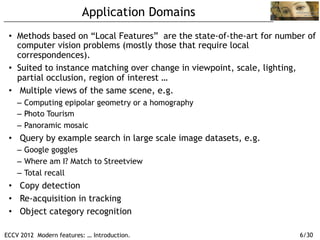
Application Domains
 •  Methods based on “Local Features” are the state-of-the-art for number of
    computer vision problems (mostly those that require local
    correspondences).
 •  Suited to instance matching over change in viewpoint, scale, lighting,
    partial occlusion, region of interest …
 •  Multiple views of the same scene, e.g.
    –  Computing epipolar geometry or a homography
    –  Photo Tourism
    –  Panoramic mosaic
 •  Query by example search in large scale image datasets, e.g.
    –  Google goggles
    –  Where am I? Match to Streetview
    –  Total recall
 •  Copy detection
 •  Re-acquisition in tracking
 •  Object category recognition

ECCV 2012 Modern features: … Introduction.                              6/30
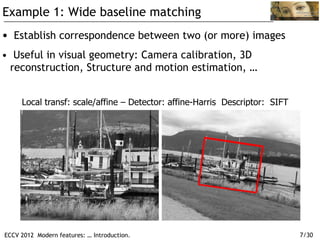
Example 1: Wide baseline matching
•  Establish correspondence between two (or more) images
•  Useful in visual geometry: Camera calibration, 3D
  reconstruction, Structure and motion estimation, …


     Local transf: scale/affine – Detector: affine-Harris Descriptor: SIFT


ECCV 2012 Modern features: … Introduction.                                   7/30
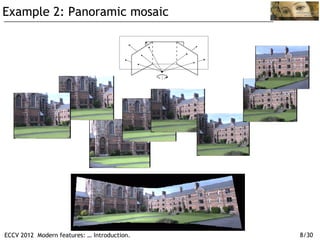
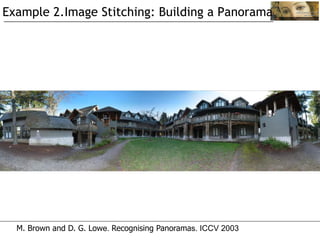
Example 2: Panoramic mosaic


ECCV 2012 Modern features: … Introduction.   8/30
Example 2.Image Stitching: Building a Panorama


  M. Brown and D. G. Lowe. Recognising Panoramas. ICCV 2003
ECCV 2012 Modern features: … Introduction.   M. Brown, D. Lowe, B. Hearn, J. Beis
                                                                              10/30
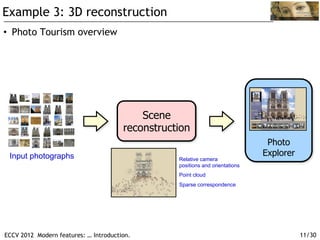
Example 3: 3D reconstruction
•  Photo Tourism overview


                                           Scene
                                       reconstruction
                                                                                Photo
 Input photographs                                                             Explorer
                                                  Relative camera
                                                  positions and orientations
                                                  Point cloud
                                                  Sparse correspondence


ECCV 2012 Modern features: … Introduction.                                                 11/30
                                                                                Slide: N. Snavely
Example 3: 3D reconstruction
57,845 downloaded images, 11,868 registered images. This video: 4,619 images.
The Old City of Dubrovnik                    Building Rome in a Day, Agarwal, Snavely, Simon, Seitz,
                                             Szeliski, ICCV 2009
                                             See also [Havlena, Torrii, Knop pand Pajdla, CVPR 2009].


ECCV 2012 Modern features: … Introduction.                                                       12/30
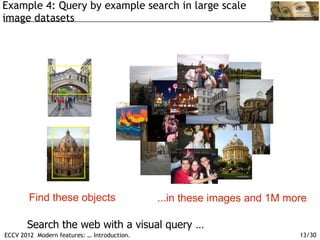
Example 4: Query by example search in large scale
image datasets


        Find these objects                   ...in these images and 1M more

       Search the web with a visual query …
ECCV 2012 Modern features: … Introduction.                               13/30
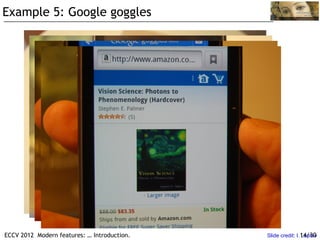
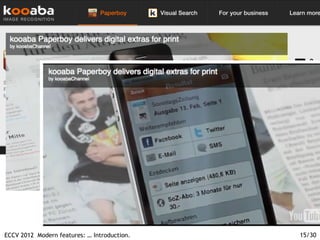
Example 5: Google goggles


ECCV 2012 Modern features: … Introduction.   Slide credit: I. 14/30
                                                              Laptev
ECCV 2012 Modern features: … Introduction.   15/30
Example 6: Where am I?
•  Place recognition - retrieval in a structured (on a map) database


     Query                  Image database                                  Best match

                                                      Image indexing
                                                        with spatial
                                                        verification

 Query
 Expansion
 (Panoramio,
  Flickr, … )


      Confuser
   Suppression
    Only negative
     training data
  (from geotags)


[Knopp, Sivic, features: … Introduction. http://www.di.ens.fr/willow/research/confusers/
 ECCV 2012 Modern Pajdla, ECCV 2010]                                                  16/30
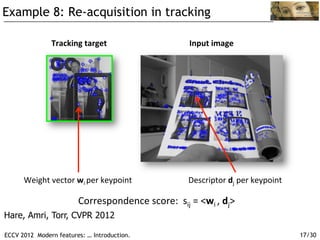
Example 8: Re-acquisition in tracking

                 Tracking	
  target	
                                  Input	
  image	


      Weight	
  vector	
  wi	
  per	
  keypoint	
                      Descriptor	
  dj	
  per	
  keypoint	
  

                            Correspondence	
  score:	
  	
  sij	
  =	
  <wi	
  ,	
  dj>	
  
Hare, Amri, Torr, CVPR 2012

ECCV 2012 Modern features: … Introduction.                                                                       17/30
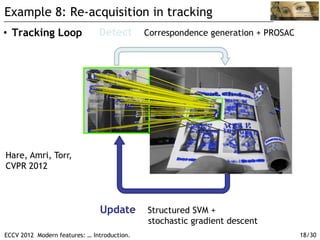
Example 8: Re-acquisition in tracking
•  Tracking Loop               Detect        Correspondence generation + PROSAC


Hare, Amri, Torr,
CVPR 2012


                               Update        Structured SVM +
                                             stochastic gradient descent
ECCV 2012 Modern features: … Introduction.                                        18/30
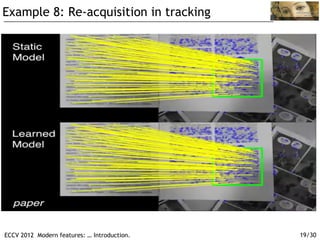
Example 8: Re-acquisition in tracking


ECCV 2012 Modern features: … Introduction.   19/30
Example 8: Re-acquisition in tracking


                              Courtesy of Graz University of Technology
ECCV 2012 Modern features: … Introduction.                                20/30
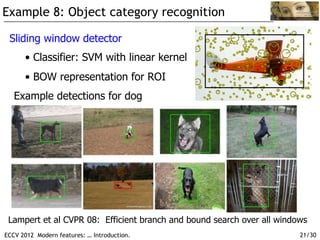
Example 8: Object category recognition

 Sliding window detector
      •  Classifier: SVM with linear kernel
      •  BOW representation for ROI
   Example detections for dog


 Lampert et al CVPR 08: Efficient branch and bound search over all windows
ECCV 2012 Modern features: … Introduction.                              21/30

Modern features-part-0-intro

  • 1.
    Modern features: advances, applications and software •  Why now? •  2005 IJCV paper on “A comparison of affine region detectors” – What has happened since? – Improvements over the classics? •  Release of new software suites for feature detection – VLFeat – Also benchmarks
  • 2.
    Modern features: advances, applications and software Programme: 2.30 – 2.45 Introduction 2.45 – 3.30 Feature detectors 3.30 – 4.15 Feature descriptors 4.15 – 4.30 Break 4.30 – 5.00 Software 5.00 – 5.30 Benchmarks 5.30 – 6.15 Hands-on software session See webpage for this up to date programme https://sites.google.com/site/eccv12features/
  • 3.
    Features Detector. •  Definition:A feature detector (extractor) is an algorithm taking an image as input and outputting a set of regions (“local features”). •  “Local Features” are regions, i.e. in principle arbitrary sets of pixels, not necessarily contiguous, which are at least : – distinguishable in an image regardless of viewpoint/illumination – robust to occlusion must be local – Must have a discriminative neighborhood: they are “features” •  Terminology has not stabilised: Local Feature = Interest “Point” = Keypoint = = Feature “Point” = The “Patch” = Distinguished Region = Features = (Transformation) Covariant Region •  Definition: A descriptor is computed on an image region defined by a detector. The descriptor is a representation of the intensity (colour, ….) function on the region.
  • 4.
    Feature Detectors: Desiderata • Invariance (or covariance) to a broad class of geometric and photometric transforms •  Efficiency: close to real-time performance •  Quantity/Density of features to cover small object/part of scenes •  Robustness to: –  occlusion and clutter (requires locality) –  to noise, blur, discretization, compression •  Distinctiveness: individual features can be matched to a large database of objects •  Stability over time (to support long-temporal-baseline matching) •  Geometrically accuracy: precise localization •  Generalization to similar objects •  Even coverage, complementarity, number of geometric constraints, … No detector dominates in all aspects, some properties are competing, e.g. level of invariance x speed ECCV 2012 Modern features: … Introduction. 4/30
  • 5.
    Feature Descriptor. •  Definition: A descriptor is computed on an image region defined by a detector. The descriptor is a representation of the intensity (colour, ….) function on the region. Desiderata for feature descriptors: •  Discriminability •  Robustness to misalignment, illumination, blur, compression, … •  Efficiency: real-time often required •  Compactness: small memory footprint. Very significant on mobile large- scale applications Note: The region on which a descriptor is computed is a called a measurement region. This may be directly the feature detector output or any other function of it (eg. convex hull, triple area region..) ECCV 2012 Modern features: … Introduction. 5/30
  • 6.
    Application Domains • Methods based on “Local Features” are the state-of-the-art for number of computer vision problems (mostly those that require local correspondences). •  Suited to instance matching over change in viewpoint, scale, lighting, partial occlusion, region of interest … •  Multiple views of the same scene, e.g. –  Computing epipolar geometry or a homography –  Photo Tourism –  Panoramic mosaic •  Query by example search in large scale image datasets, e.g. –  Google goggles –  Where am I? Match to Streetview –  Total recall •  Copy detection •  Re-acquisition in tracking •  Object category recognition ECCV 2012 Modern features: … Introduction. 6/30
  • 7.
    Example 1: Widebaseline matching •  Establish correspondence between two (or more) images •  Useful in visual geometry: Camera calibration, 3D reconstruction, Structure and motion estimation, … Local transf: scale/affine – Detector: affine-Harris Descriptor: SIFT ECCV 2012 Modern features: … Introduction. 7/30
  • 8.
    Example 2: Panoramicmosaic ECCV 2012 Modern features: … Introduction. 8/30
  • 9.
    Example 2.Image Stitching:Building a Panorama M. Brown and D. G. Lowe. Recognising Panoramas. ICCV 2003
  • 10.
    ECCV 2012 Modernfeatures: … Introduction. M. Brown, D. Lowe, B. Hearn, J. Beis 10/30
  • 11.
    Example 3: 3Dreconstruction •  Photo Tourism overview Scene reconstruction Photo Input photographs Explorer Relative camera positions and orientations Point cloud Sparse correspondence ECCV 2012 Modern features: … Introduction. 11/30 Slide: N. Snavely
  • 12.
    Example 3: 3Dreconstruction 57,845 downloaded images, 11,868 registered images. This video: 4,619 images. The Old City of Dubrovnik Building Rome in a Day, Agarwal, Snavely, Simon, Seitz, Szeliski, ICCV 2009 See also [Havlena, Torrii, Knop pand Pajdla, CVPR 2009]. ECCV 2012 Modern features: … Introduction. 12/30
  • 13.
    Example 4: Queryby example search in large scale image datasets Find these objects ...in these images and 1M more Search the web with a visual query … ECCV 2012 Modern features: … Introduction. 13/30
  • 14.
    Example 5: Googlegoggles ECCV 2012 Modern features: … Introduction. Slide credit: I. 14/30 Laptev
  • 15.
    ECCV 2012 Modernfeatures: … Introduction. 15/30
  • 16.
    Example 6: Wheream I? •  Place recognition - retrieval in a structured (on a map) database Query Image database Best match Image indexing with spatial verification Query Expansion (Panoramio, Flickr, … ) Confuser Suppression Only negative training data (from geotags) [Knopp, Sivic, features: … Introduction. http://www.di.ens.fr/willow/research/confusers/ ECCV 2012 Modern Pajdla, ECCV 2010] 16/30
  • 17.
    Example 8: Re-acquisitionin tracking Tracking  target   Input  image   Weight  vector  wi  per  keypoint   Descriptor  dj  per  keypoint   Correspondence  score:    sij  =  <wi  ,  dj>   Hare, Amri, Torr, CVPR 2012 ECCV 2012 Modern features: … Introduction. 17/30
  • 18.
    Example 8: Re-acquisitionin tracking •  Tracking Loop Detect Correspondence generation + PROSAC Hare, Amri, Torr, CVPR 2012 Update Structured SVM + stochastic gradient descent ECCV 2012 Modern features: … Introduction. 18/30
  • 19.
    Example 8: Re-acquisitionin tracking ECCV 2012 Modern features: … Introduction. 19/30
  • 20.
    Example 8: Re-acquisitionin tracking Courtesy of Graz University of Technology ECCV 2012 Modern features: … Introduction. 20/30
  • 21.
    Example 8: Objectcategory recognition Sliding window detector •  Classifier: SVM with linear kernel •  BOW representation for ROI Example detections for dog Lampert et al CVPR 08: Efficient branch and bound search over all windows ECCV 2012 Modern features: … Introduction. 21/30