Download as PDF, PPTX
![Why does deep learning work?
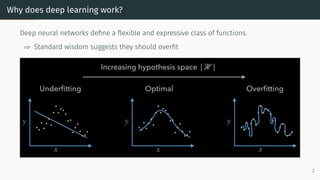
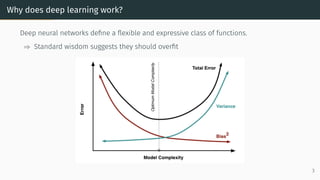
Deep neural networks define a flexible and expressive class of functions.
State-of-the-art models have millions or
billions of parameters
• Meena: 2.6 billion
• Turing NLG: 17 billion
• GPT-3: 175 billion
Source: [Canziani et al., 2016]
1](https://image.slidesharecdn.com/randommatrixlearning3-210710210436/85/Random-Matrix-Theory-and-Machine-Learning-Part-4-2-320.jpg)
![Why does deep learning work?
Deep neural networks define a flexible and expressive class of functions.
State-of-the-art models have millions or
billions of parameters
• Meena: 2.6 billion
• Turing NLG: 17 billion
• GPT-3: 175 billion
Source: [Canziani et al., 2016]
Models that perform well on real data can
easily memorize noise
Source: [Zhang et al., 2021]
1](https://image.slidesharecdn.com/randommatrixlearning3-210710210436/85/Random-Matrix-Theory-and-Machine-Learning-Part-4-3-320.jpg)
![Double descent
However, large neural networks do not obey the classical theory:
Source: [Belkin et al., 2019]
Source: [Advani et al., 2020]
Source: [Nakkiran et al., 2019]
The emerging paradigm of double descent seeks to explain this phenomenon. 4](https://image.slidesharecdn.com/randommatrixlearning3-210710210436/85/Random-Matrix-Theory-and-Machine-Learning-Part-4-6-320.jpg)

![History of double descent: Kernel interpolation
1) Interpolating kernels (trained to zero error) generalize well [Belkin et al., 2018]
⇒ Double descent is not unique to deep neural
networks
5](https://image.slidesharecdn.com/randommatrixlearning3-210710210436/85/Random-Matrix-Theory-and-Machine-Learning-Part-4-8-320.jpg)
![History of double descent: Kernel interpolation
1) Interpolating kernels (trained to zero error) generalize well [Belkin et al., 2018]
⇒ Double descent is not unique to deep neural
networks
2) Kernels can implicitly regularize in high
dimensions [Liang and Rakhlin, 2020]
0.0 0.2 0.4 0.6 0.8 1.0 1.2
lambda
10 1
log(error)
Kernel Regression on MNIST
digits pair [i,j]
[2,5]
[2,9]
[3,6]
[3,8]
[4,7]
Source: [Liang and Rakhlin, 2020]
5](https://image.slidesharecdn.com/randommatrixlearning3-210710210436/85/Random-Matrix-Theory-and-Machine-Learning-Part-4-9-320.jpg)
![History of double descent: Kernel interpolation
1) Interpolating kernels (trained to zero error) generalize well [Belkin et al., 2018]
⇒ Double descent is not unique to deep neural
networks
2) Kernels can implicitly regularize in high
dimensions [Liang and Rakhlin, 2020]
0.0 0.2 0.4 0.6 0.8 1.0 1.2
lambda
10 1
log(error)
Kernel Regression on MNIST
digits pair [i,j]
[2,5]
[2,9]
[3,6]
[3,8]
[4,7]
Source: [Liang and Rakhlin, 2020]
3) Consistency is a high-dimensional phenomenon [Rakhlin and Zhai, 2019]:
The estimation error of the minimum-norm kernel interpolant
arg min
f∈H
∥f∥H s.t. f(xi) = yi , i = 1 . . . n
does not converge to zero as n grows, unless d is proportional to n. 5](https://image.slidesharecdn.com/randommatrixlearning3-210710210436/85/Random-Matrix-Theory-and-Machine-Learning-Part-4-10-320.jpg)
![Models of double descent: High-dimensional linear regression
What is the simplest theoretically tractable model that exhibits double descent?
Linear regression suffices, but requires a mechanism to vary the effective number of
parameters or samples:
• The size of randomly selected subsets of features [Belkin et al., 2020]
• The dimensionality of the low-variance subspace [Bartlett et al., 2020]
• The sparsity of the generative model [Mitra, 2019]
0 20 40 60 80 100
p
0
2
4
6
8
10
Risk
Source: [Belkin et al., 2020] Source: [Mitra, 2019]
6](https://image.slidesharecdn.com/randommatrixlearning3-210710210436/85/Random-Matrix-Theory-and-Machine-Learning-Part-4-12-320.jpg)
![Models of double descent: Random feature models
In random feature regression, the number of random features controls the model
capacity, and can be tuned independently from the data.
Exact asymptotic results in high dimensions exist in many settings, including:
• Unstructured random features [Mei and Montanari, 2019]
• NTK-structured random features [Adlam and Pennington, 2020]
• Random Fourier features [Liao et al., 2020]
100 101 102 103 104 105
n1
10 2
10 1
100
Test
loss
NTK reg. pred.
NTK reg. emp.
NN GD emp.
Source: [Adlam and Pennington, 2020] Source: [Mei and Montanari, 2019]
7](https://image.slidesharecdn.com/randommatrixlearning3-210710210436/85/Random-Matrix-Theory-and-Machine-Learning-Part-4-13-320.jpg)

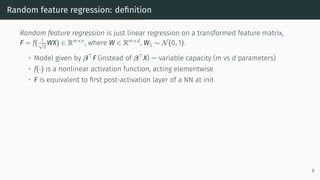
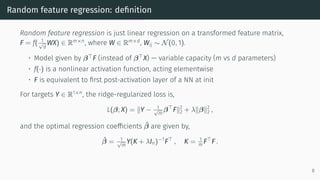
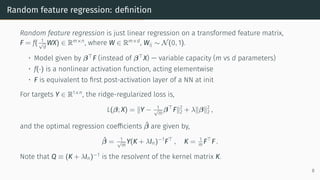
![Aside: Generalized cross validation (GCV)
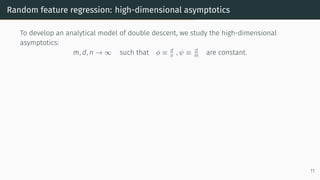
A model’s performance on the training set, or subsets thereof, can be useful for
estimating its performance on the test set.
• Leave-one-out cross validation (LOOCV)
ELOOCV(λ) = 1
n ∥YQ · diag(Q)−1
∥2
2
• Generalized cross validation (GCV)
EGCV(λ) = 1
n ∥YQ∥2
2/( 1
n tr(Q))2
In certain high-dimensional limits, EGCV(λ) = ELOOCV(λ) = Etest(λ):
• Ridge regression [Hastie et al., 2019]
• Kernel ridge regression [Jacot et al., 2020]
• Random feature regression [Adlam and Pennington, 2020]
10](https://image.slidesharecdn.com/randommatrixlearning3-210710210436/85/Random-Matrix-Theory-and-Machine-Learning-Part-4-21-320.jpg)
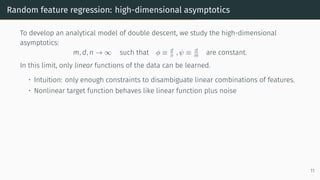
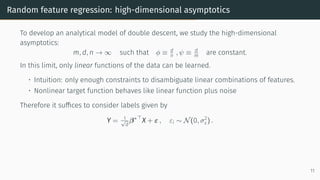
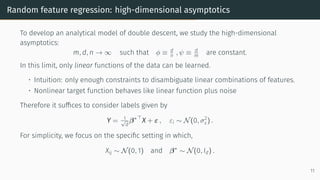
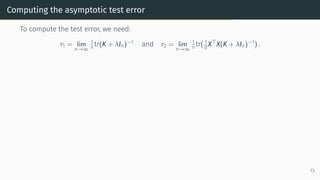
![Random feature regression: test error
In the high-dimensional asymptotic setup from above, the random feature test error can
be written as,
Etest(λ) = EGCV(λ)
= lim
n→∞
1
n ∥YQ∥2
2/( 1
n tr(Q))2
= lim
n→∞
1
n ∥( 1
√
d
β∗⊤
X + ε)Q∥2
2/( 1
n tr(Q))2
= lim
n→∞
1
n tr[(σ2
εIn + 1
d X⊤
X)Q2
]/( 1
n tr(Q))2
≡ −
σ2
ετ′
1(λ) + τ′
2(λ)
τ1(λ)2
,
where we used that ∂
∂λ Q = −Q2
, and we defined
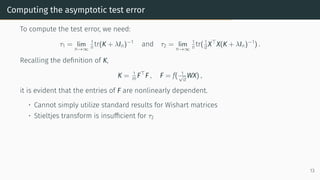
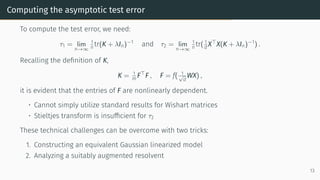
τ1 = lim
n→∞
1
n tr(Q) and τ2 = lim
n→∞
1
n tr( 1
d X⊤
XQ) .
12](https://image.slidesharecdn.com/randommatrixlearning3-210710210436/85/Random-Matrix-Theory-and-Machine-Learning-Part-4-26-320.jpg)
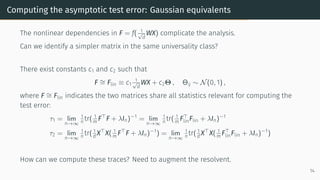
![Computing the asymptotic test error: resolvent method
Recall from Part 2 that the resolvent method identifies consistency relations between
suitably chosen submatrices of the resolvent.
Here we can undertake a similar analysis as in Part 2, but now on an augmented matrix,
H =
[
λIn
1
√
m
F⊤
lin
1
√
m
Flin −Im
]
,
which encodes the resolvent through Q = (K + λIn)−1
= [H−1
]1:n,1:n.
15](https://image.slidesharecdn.com/randommatrixlearning3-210710210436/85/Random-Matrix-Theory-and-Machine-Learning-Part-4-33-320.jpg)
![Computing the asymptotic test error: resolvent method
Recall from Part 2 that the resolvent method identifies consistency relations between
suitably chosen submatrices of the resolvent.
Here we can undertake a similar analysis as in Part 2, but now on an augmented matrix,
H =
[
λIn
1
√
m
F⊤
lin
1
√
m
Flin −Im
]
,
which encodes the resolvent through Q = (K + λIn)−1
= [H−1
]1:n,1:n.
To derive consistency relations, we consider two submatrices: H(1)
(leaving out
row/column 1), and H(n+1)
(leaving out row/column n + 1).
As before, we use the Sherman-Morrison formula to compute [H(1)
]−1
and [H(n+1)
]−1
, and
relate them to Q and rows/columns of Flin.
Straightforward concentration arguments eventually lead to coupled self-consistent
equations for τ1 and τ2 [Adlam et al., 2019].
15](https://image.slidesharecdn.com/randommatrixlearning3-210710210436/85/Random-Matrix-Theory-and-Machine-Learning-Part-4-34-320.jpg)
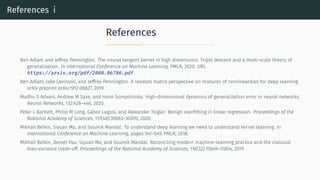
![Computing the asymptotic test error: free probability
An alternative augmentation of the resolvent completely linearizes the dependence on
the random matrices:
M =
λIn
c2
m Θ⊤ c1
√
dm
X⊤
0
c2Θ −Im 0 c1
√
d
W
0 W⊤
−Id 0
X 0 0 −Id
,
where the Schur complement formula now gives,
τ1 = lim
n→∞
1
n tr([M−1
]1,1) , and τ2 = lim
n→∞
1
n tr([M−1
]4,3) .
The asymptotic blockwise traces tr([M−1
]a,b) can themselves be computed using free
probability [Adlam and Pennington, 2020].
16](https://image.slidesharecdn.com/randommatrixlearning3-210710210436/85/Random-Matrix-Theory-and-Machine-Learning-Part-4-35-320.jpg)
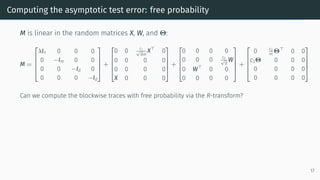
![Computing the asymptotic test error: free probability
M is linear in the random matrices X, W, and Θ:
M =
λIn 0 0 0
0 −Im 0 0
0 0 −Id 0
0 0 0 −Id
+
0 0 c1
√
dm
X⊤
0
0 0 0 0
0 0 0 0
X 0 0 0
+
0 0 0 0
0 0 0 c1
√
d
W
0 W⊤
0 0
0 0 0 0
+
0 c2
m
Θ⊤
0 0
c2Θ 0 0 0
0 0 0 0
0 0 0 0
Can we compute the blockwise traces with free probability via the R-transform?
Not naively: the additive terms are independent, but not free over C.
However, they are free over M4(C), and there exists a suitable operator-valued generalization of the
R-transform that enables the necessary computations [Mingo and Speicher, 2017].
17](https://image.slidesharecdn.com/randommatrixlearning3-210710210436/85/Random-Matrix-Theory-and-Machine-Learning-Part-4-37-320.jpg)
![Asymptotic test error
Theorem
Let η = E[f(g)2
] and ζ = (E[gf(g)])2
for g ∼ N(0, 1). Then, the asymptotic traces τ1(λ)
and τ2(λ) are given by solutions to the polynomial system,
ζτ1τ2 (1 − λτ1) = ϕ/ψ (ζτ1τ2 + ϕ(τ2 − τ1)) = (τ1 − τ2) ϕ ((η − ζ)τ1 + ζτ2) ,
and, Etrain = −λ2
(σ2
ετ′
1 + τ′
2) and Etest = −(σ2
ετ′
1 + τ′
2)/τ2
1 .
MSE
0.01 0.10 1 10 100
0.0
0.5
1.0
1.5
2.0
Random Feature Regression, d = n
m/n
MSE
0.01 0.10 1 10 100
0.0
0.5
1.0
1.5
2.0
Random Feature Regression, d = n/2
m/n
log10(λ)
-5
-4
-3
-2
-1
18](https://image.slidesharecdn.com/randommatrixlearning3-210710210436/85/Random-Matrix-Theory-and-Machine-Learning-Part-4-38-320.jpg)


Deep learning models with millions or billions of parameters should overfit according to classical theory, but they do not. The emerging theory of double descent seeks to explain why larger neural networks can generalize well. Random matrix theory provides a tractable framework to model double descent through random feature models, where the number of random features controls model capacity. In the high-dimensional limit, the test error of random feature regression exhibits a double descent shape that can be computed analytically.


![谷歌留痕技术 [ 𝙩𝙤𝙥 𝟮𝟯𝟯. 𝙘 𝙤𝙢 ]](https://cdn.slidesharecdn.com/ss_thumbnails/top233-260130174328-3833018c-thumbnail.jpg?width=640&height=640&fit=bounds)


